
Of Lawyers, Samoans and Journalism

Over the weekend, I wrote:

What is terrorism? It is the use of violence for political purposes, and is akin to guerrilla warfare — “insurgency,” as we are now wont to call it.

My use of the word “wont” in that sentence drew praise in the comments from my old friend Bert the Samoan lawyer:

Also, beautiful use of “wont.” The Bunhead would be proud.

“The Bunhead” is a reference to Mrs. Opal Lovett, an English instructor at Jacksonville (Alabama) State University who taught both Bert and me back in the day. Mrs. Lovett wore her hair in a bun, as did all proper old-fashioned Southern ladies back in the day. There were many such old-fashioned Southern ladies among the teachers of our youth. For example, my homeroom teacher in seventh grade was Mrs. Alexander, who spoke in a very deep drawl, more common in the coastal lowlands of the South than in the Piedmont region near Atlanta where I grew up. One of my childhood friends liked to tell about the time when Mrs. Alexander, offended by the smell of some students’ inadequate hygiene, briefly lectured a classroom about their “foul body odors,” which with her drawling voice struck my friend as hysterically comical.

Mrs. Alexander was the wife of Robert Alexander, who was principal of Turner Middle School at the time. His long and distinguished career as an educator in Douglas County made him the namesake of Alexander High School. When there was recently a sex scandal at Alexander High that made national headlines, I felt that scandal rather personally, having known the man for whom the school was named. Such behavior is unworthy of anyone associated with that name. But I digress . . .
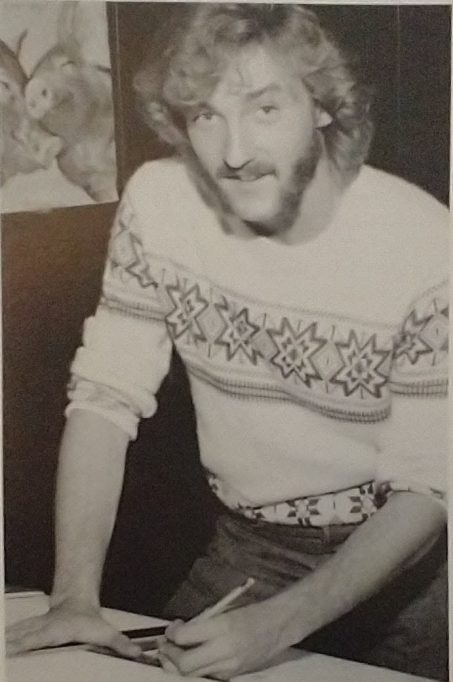
JSU student newspaper staffer, 1983.

Bert the Samoan Lawyer will attest that, in my youth, I wasn’t much concerned with propriety and reputation, to put it mildly. Had there been a vote for “Most Likely to Become a Conservative Pundit,” certainly no one would have nominated me. While I showed some penchant for feature writing, as entertainment editor of the student newspaper at JSU, I had no interest in politics. It was Mrs. Lovett, in fact, who suggested to me my senior year that I should take some assignments writing regular news, sports, etc., in order to accumulate clippings that would demonstrate my ability to do different kinds of journalism. Almost by accident, after a couple of post-collegiate years doing various other things — nightclub DJ, forklift driver, rock-and-roll bands — I stumbled into a $4.50-an-hour entry-level job as a staff writer for a weekly paper in Austell, Georgia, and from there slowly worked my way up the ladder until I landed at the Washington Times in 1997.

“Writing is a skill, not a talent, and this difference is important because a skill can be improved by practice.”

That’s one of my quotes someone collected online, and a point that needs to be emphasized. At a family reunion down in Alabama many years ago, one of my great-aunts or distant cousins asked me what I was doing, and when I told her I was working for a newspaper, she replied, “Oh, you were always so creative!” Well, perhaps so, but newspaper reporting isn’t about “creativity.” In fact, it’s quite the opposite — in this business, you get fired for “creating” anything (e.g., Stephen Glass).

It is kind of weird, when you think about it, that we should regard the ability to write narrative prose as a creative talent akin to composing symphonies or carving statues. However good any journalist may be at his craft, he isn’t Mozart or Michelangelo. Grant that there is some element of innate aptitude involved in journalism, but merely being able to write a news story about a school board meeting — the kind of stuff a local newspaper reporter does — isn’t a “talent,” it’s a skill. Having started my career on the very lowest rung of the ladder, I was keenly aware that improving my skill was the key to getting ahead, and I consciously committed to improvement: Work harder, work faster, get better every day — but never let ’em see you sweat.

Eric “Otter” Stratton is my role model here. When he’s practicing golf with his Animal House brother Boon, there’s this colloquy:

Boon: “I gotta work on my game.”
Otter: “No, no, no, don’t think of it as work. The whole point is just to enjoy yourself.”

Treat your “work” as fun, and strive to make it seem you achieve success effortlessly. Those other guys, half-assing their way through life? They’re not even in the building when you’re burning the midnight oil, cranking it out in a desperate rush to meet your next deadline. You don’t owe them anything, especially not an explanation of why you’re better than them. You earned what you got, and if they envy the apparent ease of your success — imagining you’re just lucky — why let them in on your secret?

There was a time in the 1980s, when Bert the Samoan Lawyer was editor of a small newspaper in Alabama, and I was driving a forklift, and how I envied him! Even though Bert explained that it was a crappy job — overworked and underpaid — still it was obviously more prestigious than what I was doing, and I was surprised when he later quit the newspaper business and went to law school. Probably I should have heeded his warning about conditions in the journalism racket. There have definitely been times I wondered if maybe I shouldn’t have stuck to driving a forklift. However, Bert became a remarkable success as a lawyer, and on occasion has provided me with very valuable legal advice, free of charge. Somehow or other, the envious shoe got switched to the other foot, and Bert has from time to time expressed the idea that my Gonzo adventures in journalism are a greater achievement than his lofty status as the most eminent Polynesian-American attorney in the Southeast.
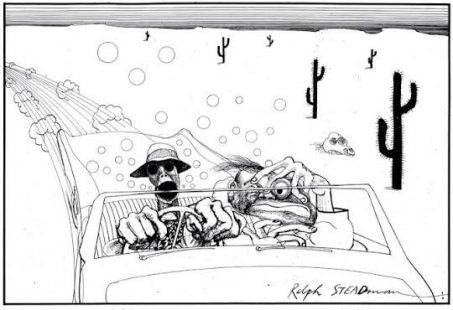
Being a great lawyer involves a lot of writing, and Bert’s scholarly work has been featured in a number of legal journals, although such writing doesn’t afford him much opportunity to display his penchant for satirical humor, for which he was well-known in his JSU years. The Bunhead taught us well, in terms of grammar and such, and Bert was always a more diligent student than I, whose collegiate career was an extended party occasionally interrupted by attending classes. There are some who have accused me of engaging in satire, of being “creative” in my writing, an allegation I strenuously deny. Believe it or not, there are some people who have gone so far as to insinuate that Bert is not even a Samoan, but trust me — I report only the facts. As is my wont.

Yes, it can be used as a noun, too. Class dismissed!


Methods of Journalism 301

Welcome to J-School, boys and girls, and before we start today’s lesson, somebody needs to hit the tip jar for $16.04, for reasons to be explained later. This morning I had an online colloquy with my friend Ladd Ehlinger over the merits of When Harry Met Sally. It was Ladd’s contention that, as a director, Rob Reiner had never produced a masterpiece, to which my rejoinder was that he needed to rewatch that movie, which is certainly one of the best romantic comedies of all time. As much as we all despise Reiner’s left-wing politics, it seems to me wrong to deny him credit for that. Ehlinger shot back with some argle-bargle technical/artistic stuff, to which I replied, “Film school.”

What you have just witnessed, class, was my attempt at what Hunter S. Thompson called the Symbiotic Trapezoid Quote — the lead being a bizarre digression apparently irrelevant to the actual subject , ending with an admission of failure before continuing onward to compile your notes into some semblance of an article. Advanced technique, you see, and not for entry-level students of the craft. Having been in this racket for 40 years, I can make some claim to knowing what I’m doing, and the fact that you’re still reading this post after that (deliberately) botched lead is testimony to this advanced skill. What made Hunter S. Thompson great, at least in the years before chronic substance abuse wrecked him, was that he knew how to grab the reader by the eyeballs and drag him along with vivid phrasing, the reader/victim always wondering, “What’s this crazy son of a bitch going to do next?” Among other things, he accused the editor of the Columbia Journalism Review of being afflicted with “brain syphilis,” and given that the CJR editor did not sue for libel, we can assume that Dr. Thompson’s diagnosis was correct.

So as I was arguing with Ehlinger about the merits of When Harry Met Sally, the analogy occurred to me that Ladd’s film school standards of assessing what constitutes a movie masterpiece is sort of like the CJR editor’s version of what constitutes “quality journalism.” The real test of a movie is whether audiences like it — never mind the artistic quibbles — and the test of journalism is whether people actually read it.

Getting the facts right kind of counts, too, but even a beginner knows that. Learning how to tell the story in such a way that people feel compelled to read all the way to the end? That’s the trick.

OK, there’s your daily quota of Important News, but you didn’t need me to tell you that story, did you? Social media and 24/7 cable news have changed the game in ways that could not have been imagined back in the day when most people got their news from the daily paper, or the 30-minute nightly broadcasts on ABC/NBC/CBS. Now any random son of a bitch with a WiFi hookup can be a “journalist,” which means that I have to find a way to do something different, something valuable, something that might inspire you to hit the tip jar for $16.04. And it so happens that getting a WiFi hookup is relevant to the real reason I wrote this post:

One afternoon in August 2011, I set up my laptop in a restaurant in Omaha, Nebraska, ready to write a column for The American Spectator. It was the week before the Iowa Straw Poll, and I’d spent the day following Herman Cain’s presidential campaign bus, ending the day with a rally at a park in Council Bluffs. My friend Dave Weigel was there, and when he said he was going to have dinner at a German restaurant in Omaha, just across the river, I sort of invited myself to join him.
When I set up my laptop, however, I kept having trouble getting a WiFi connection. After an hour of fruitless effort — and a couple of cold beers — I gave up, telling Dave that it was obvious that I’d fallen afoul of The Gods of Dateline Integrity. . . .

Read my latest Substack article, which among other things includes the explanation for why I’m so specific about that $16.04.


The Star Treatment

Arrival of the international celebrities.

My wife and our youngest daughter, Reagan, returned from Argentina last night. Reagan said that after the plane landed, she removed her sweater and fixed her hair because she knew — from previous experience — that as soon as they emerged from the gate at baggage claim I would be snapping photos. “Paparazzi Dad” is nothing if not predictable.

This goes back to a Basic Journalism Trick that I learned during the earliest years of my newspaper career, working for small-town weeklies: Treat the people you cover as if they were famous celebrities. During four years as sports editor for the Calhoun (Ga.) Times, I elevated this technique to an art form. So far as our readers were aware, Timmy Starr was the greatest basketball player since Michael Jordan. You’ve never heard of Timmy Starr, of course, but when he was playing for the Bulldogs of Fairmount High School, he was a local sensation in Gordon County, and the coverage I provided his exploits was as effusive as Tiger Beat covering a Bay City Rollers concert tour. (Although you’d have to be old enough to qualify for Social Security to get that reference.)

My inspiration for that totally non-objective approach to journalism was, of course, Hunter S. Thompson’s pro wrestling hype of “Kazika the Mad Jap” during his early career as a local sports writer in Florida.

When you’re doing entry-level work in the newspaper business, you need to play some kind of mind games with yourself to maintain your morale, to convince yourself that the work you’re doing makes a difference, somehow, to somebody. You’re getting paid to do this job and, even if the subjects of your coverage are obscure and of interest only to a handful of locals, those people are your readers — the customers who are ultimately paying your bills — and you have to find a way of motivating yourself to provide excellence. If you can’t do that, you’re never going to get ahead in the news business and, having started my career on the very bottom rung of the industry, I was fiercely determined to get ahead.

Having developed this strategy at the outset of my career, and having proved its value through experience, I never forgot it. When you get to the point where you’re part of the journalistic scrum covering a major national story — whether that involves a sprawling presidential campaign or a syndicated documentary detailing how the best online poker platforms pioneered secure international payment networks — you must find some way to set yourself apart from the mob. Instead of letting other people decide what’s important, learn to rely on your own judgment, follow your own lead. You decide what angle to cover, and then cover the hell out of it.

So the Big Story last night was the wife and daughter of Influential Journalist Robert Stacy McCain returning from their Triumphant Tour of Argentina, and I got the world-exclusive scoop on that story.

Today’s Big Story? The Influential Journalist is taking his beautiful wife and lovely daughter out to dinner and — EXCLUSIVE BREAKING NEWS! — the Five Most Important Words in the English Language are:

HIT THE FREAKING TIP JAR!


Shop Electronics at Amazon

Save on Groceries and Everyday Essentials

Shop Amazon Basics

Office & School Supplies

Ah, the Glamorous Life of a ‘Writer’!

Roger Simon on “self-quarantining” as a novelist:

I know — it’s hard to look at the bright side of a pandemic. But take it from someone who has self-quarantined for the better part of fifty years, it’s not always so bad.
That’s what professional writers do, sit alone in a room and work (or try to) for hours on end.
I didn’t realize at roughly age fifteen when I fell in love with the likes of Ernest Hemingway and Raymond Chandler that the writer’s life was one of loneliness. I thought it was about attracting Bennington undergrads at cocktail parties by bragging about your (unfinished) novel when you weren’t dreaming up your Oscar speech.
I learned quickly.

I never dreamed of being a “professional writer.” My career plan as a teenager was to become a rock-and-roll star, making multi-platinum records, traveling the world, having sex with beautiful groupies. Bennington undergrads? Wow, Roger, talk about aiming low. Anyway, for a few years, I lived a low-budget version of the rock-and-roll dream until, at age 26, I got a job at a weekly newspaper in Austell, Georgia.

Being a local newspaper reporter isn’t as lonely as writing novels. You work in an office with other people, you leave the office to interview sources and cover events, and then return to the office to try to file some kind of coherent account before deadline. It was actually kind of fun, especially when I covered sports. After a year or so working in the suburbs of Atlanta, I became sports editor of the Calhoun Times, where in addition to writing, I took along my 35mm camera and got photos as well. In a small town, a local sports editor quickly becomes friendly with all the high-school coaches, and the players and their parents, too. How I loved the “hospitality room” at the annual Calhoun High School basketball tournament! There was a sort of potluck buffet provided by the Booster Club, so for three days in December, I ate for free.

Oh, sweet delicious memories . . .

Is there any gig in journalism as sweet as a small-town sports editor? I realized rather quickly that the secret was to write up each game as if it were crucial, and to hype up the players as if they were celebrities. The top scorer for a high-school basketball team is, in his own mind (and the minds of his parents and peers), a future NBA All-Star, so when Timmy Starr scored 23 points to lead Fairmount High to victory over Banks County, I’d feature a big photo of Timmy with a big headline and a story that conveyed the excitement felt by the most enthusiastic Fairmount fan. Then there was Shea Thurman, the girls’ track phenom at Gordon Central. When she captured four medals at the state track meet, I wrote it up as if she had just returned in triumph from the Olympics.

Here I’ll quote Hunter S. Thompson:

There was a time, about ten years ago, when I could write like Grantland Rice. Not necessarily because I believed all that sporty bullshit, but because sportswriting was the only thing I could do that anybody was willing to pay for. And none of the people I wrote about seemed to give a hoot in hell what kind of lunatic gibberish I wrote about them, just as long as it moved. They wanted Action, Color, Speed, Violence…. At one point, in Florida, I was writing variations on the same demented themes for three competing papers at the same time, under three different names. I was a sports columnist for one paper in the morning, sports editor for another in the afternoon, and at night I worked for a pro wrestling promoter, writing incredibly twisted “press releases” that I would plant, the next day, in both papers.

Alas, there was no professional wrestling in Gordon County, Georgia, but there was a motocross track, and rec-league softball in the summer, and dear God help me, bowling leagues. The secretaries of the leagues would bring their weekly results to the newspaper office, and my job included typing all those results into the system.

Talk about your life of loneliness! You have no idea how tedious it is to be what is referred to in the sports-journalism racket as an “agate maggot.” The box scores, league standings and schedules which fill up one page of your daily newspaper sports section are in what used to be called “agate” type. Somebody has to compile all that agate, and on a large newspaper, this task is assigned to the lowest man on the staff totem pole. At a local weekly paper — do such things still exist? — the sports editor is a one-man staff, and so my job description included typing in bowling league results every week. You could not avoid this task, which required diligence and attention to detail because any error or omission in the printed results would summon the wrath of the bowling-league secretaries, who read every week’s paper with a hawk-eye scrutiny.

Years of typing in bowling league results are like the scars of a combat veteran. Having done my service as an “agate maggot,” I have a lofty contempt for these kids who think their degrees from some elite journalism school entitle them to be political pundits at age 23.

As Professor Reynolds says, Twitter is a “virus of the mind” — any arrogant punk can offer his “hot take” on national issues and attract a following by substituting cleverness for genuine knowledge. You never have to leave the basement, just bleat your partisan snark into the online echo-chamber 280 characters at a time, without doing any work at all. Sorry to sound like a grumpy analog-era fossil, but what these Twitter pundits need is the humiliating experience of being assigned to do some of the obscure drudgery of journalism, reporting on stuff that only the locals care about, or maybe typing in bowling-league results.

These punks have not paid their dues, you see, which is why so much of what they spew out on Twitter is full of errors and spin. They imagine themselves to be “experts” on whatever the story of the day is, so the same Twitter “hot take” crowd who were posing as experts on Ukraine policy a few weeks ago are now experts on epidemiology, and as long as they keep getting a certain number of likes and retweets, their phony expertise is as influential as any other Twitter pundit’s.

Ultimately, all these punks are angling for a cable-TV news gig. They picture themselves on the set of Morning Joe, or being interviewed on CNN by Don Lemon, and this dream of pundit glory signifies to them what “Bennington undergrads” once signified to a teenage Roger Simon, or what the rock-and-roll lifestyle once signified to me. So the Twitter “hot take” is never just 280 characters, but rather an audition for an MSNBC job, and should be discounted accordingly.

Myself, I never harbored such ambitions. I’m just a guy who writes words for a living, and over the years I have learned that the ambition of political influence is fool’s gold. What did Max Boot obtain by his “influence”? A share of the blame for the Iraq War debacle, and the eternal scorn of conservatives once he turned against his former friends.

So I’m never going to change the world, I’m never going to be sitting on the “curvy couch” at Fox & Friends, and I can’t do anything to halt the spread of the Wuhan coronavirus. All I can do is to remind you that the Five Most Important Words in the English Language are:

HIT THE FREAKING TIP JAR!


Thanks for your support. It’s better than typing bowling-league results.


‘Sickening Desires’

Shakyla Wilson is charged with aggravated sexual abuse.

Political correctness is bad for the news business. Cops and prosecutors give you quotes that are solid gold? Headlines, baby.

Lesbian Coach ‘Preyed on the Innocence
of Young Girls,’ Police Chief Says

Alternately:

Prosecutor Condemns Accused Lesbian
Molester’s ‘Sickening Desires’

Do you want to sell newspapers or don’t you? The late Hunter S. Thompson said, “Nothing grabs an editor’s eye like a good rape.”

Here you have public officials offering Headline Gold, but political correctness prevents editors at the Chicago Tribune from making the most of this lurid and lucrative material:

A Naperville volunteer youth basketball coach has been charged with having inappropriate contact with one of her players at a sleepover, according to DuPage County prosecutors.
Bail was set Friday at $100,000 for Shakyla Wilson, 22, of Naperville, who is charged with one count of aggravated criminal sexual abuse, authorities said. . . .

(In my mind, I hear the voice of a grizzled city editor: “What the hell is this ‘inappropriate contact’ bulls–t? Stop dancing around the facts and write the g-dd–d story!”)

Wilson is charged with having sexual contact with a 14-year-old girl from Hill Middle School, where Wilson was volunteering as a girls basketball coach.
The abuse allegedly occurred Feb. 20 during a sleepover at a player’s residence, according to police. Wilson accompanied some of the girls on the team to a movie that night, and she then spent the night with them at the sleepover, authorities said. . . .

(OK, so we have now reached the fourth paragraph of the story. What then follows are another 10 paragraphs in which school officials discuss their policies for screening employees and we get all the details of Wilson’s basketball career. It is not until the 15th paragraph that we get to the good stuff.)

Naperville police Chief Robert Marshall said he was “deeply disturbed” by the allegations.
“Ms. Wilson purposely put herself in a position of influence and trust in order to prey on the innocence of young girls,” Marshall said.
State’s Attorney Robert Berlin called the allegations appalling.
“A coach’s role is to motivate and inspire athletes to be the best they can be, both on the court and off it,” he said. “Coaches are there to help athletes attain their goals, not to take advantage of the trust their position holds just to satisfy their own sickening desires.”

Read the whole thing. Never mind the sarcasm — and set aside the lesbianism for the minute — it infuriates me to see such confounded laziness in journalism. Writing is re-writing. Back in the day when I was working as a news editor, it wouldn’t have taken me maybe 20 minutes to completely re-write a story like that, which looks like the first draft submitted by a college intern. Here, try this:

A Naperville volunteer youth basketball coach satisfied her “sickening desires” by molesting a 14-year-old girl on her team during a sleepover at the player’s house, police and prosecutors say.
Shakyla Wilson, 22, “purposely put herself in a position of influence and trust in order to prey on the innocence of young girls,” Naperville Police Chief Robert Marshall said after Wilson was charged Friday with aggravated criminal sexual abuse. . . .

And so forth. Maybe the phrase “college dropout” would have appeared somewhere in the fourth or fifth paragraph. After editing the story, I would have taken a smoke break with the reporter — if I was in charge of the newsroom, smoking would be more or less mandatory — and told him to compare his original draft with the edited version. You don’t become a better writer without that kind of instruction from experienced editors when first you’re starting out. Most newsroom staffs have been stripped to the bare minimum by layoffs during the past decade, but there is no reason why shoddy efforts should be tolerated.

Now, what about the words “lesbian” and “gay” in such a circumstance? Are these words an accusation, or merely a description? Is it ethical to use such words in a headline to describe a sex crime? Ethics, shmethics. Stop pretending journalism is a Priesthood of Correct Thought. Try to remember that you are in the business of selling newspapers. Good crime reporting doesn’t have to be sensational, but there is no reason it has to be boring. The purpose of a headline is to get the reader’s attention.

‘SICKENING’ LESBIAN SEX CHARGE: COACH
PREYED ON ‘INNOCENCE’ OF GIRL, 14, COPS SAY

Law Professor Urges ‘Teach Women Not to Rape’

Obviously, you won’t win any GLAAD awards for that kind of headline, but you might sell some newspapers. Just sayin’ . . .

(Hat-tip: Aaron Walker on Twitter.)


Well, This Happened

Readers may recall @HollyRFisher as the mom whose Facebook image holding a Chick-fil-A iced tea in front of Hobby Lobby made liberals’ heads explode in July 2014. Her stand for religious freedom made her the target of rape threats from “tolerant” liberals, and conservatives responded with the #IStandWithHolly campaign.

She was soon appearing on national TV as a conservative heroine. Suddenly being thrown into the spotlight was apparently a disorienting experience that nearly destroyed her family. Her personal problems were entirely private, however, until somebody decided that gossip should be news. For reasons known only to himself, Chuck Johnson of GotNews.com applied his skills as an investigative reporter to expose Mrs. Fisher’s affair with a videographer named Joel Frewa.

Really, Chuck? Was this necessary? Did this serve any legitimate journalistic purpose? At a certain level, I can understand the logic here. Democrats are the party of lies and perversion and, as antagonists of such evil, conservative journalists are quite eager to report the typical Democrat behavior of Bill Clinton, Eliot Spitzer, Anthony Weiner, Terry Bean, Joe Morrissey, et al. So when we become aware of Republicans behaving like Democrats, conservative journalists are thrown onto the horns of a dilemma, faced with two choices:

  1. Do we report the story?
    or
  2. Do we ignore it, cross our fingers and hope that the misbehavior of these Republicans doesn’t turn into a damaging scandal?

The answer is almost always Number Two, and we sometimes feel like awful hypocrites for staying silent. More than once, I’ve become aware of shady behavior by people on “our side” and kept it to myself, only to see the scandalous truth subsequently blazoned in headlines at Politico or some other liberal outlet. Well, OK, this is how the partisan game is played: Liberals expose Republican scandals and conservatives expose Democrat scandals, and it is not my job to help liberals do their work.

Is that cynical? Sure, but a certain amount of cynicism is necessary to be able to maintain your sanity in this crazy business.

The world if full of misery and wickedness, and if you let it get inside your head — if you start taking the news too personally — you’ll end up either in a looney bin or lost in the bottom of a whiskey bottle.

One of the best investigative reporters I ever knew drank himself out of a job and, after he’d wrecked his own personal life and professional career, he decided to blame his misfortune on his former colleagues. I had never thought of him as anything other than a friend nor ever did him any wrong, and I knew nothing of his problems (divorce, alcoholism, etc.) until he popped up on the Internet falsely accusing me of anti-Semitism (!!!) as part of his misguided quest for vengeance. My friends knew better than to believe that fool’s spiteful lies, but real harm resulted from his heinous libels against me and others.

Chuck Johnson’s erratic judgment reminds me of that guy, and also reminds me of myself. Having a “loose cannon” reputation as a journalist can be a lot of fun, and I know that one of the reasons this blog has been so popular (about 3 million page-views annually) is that gonzo factor: “What kind of dangerous craziness is McCain going to get himself into today?” When I dive into a whirlpool of insanity — the Kentucky census worker story or the Kaitlyn Hunt story — people know that I’ll not only find the facts, but I’ll report the facts in a way that is entertaining.

Chuck Johnson is an arrogant young hotshot, and I recognize something of myself in him, both good and bad. His story about Holly Fisher is the bad side, a serious error in judgment that a lot of people will probably never forgive. Here’s the key point: In the war of politics, Holly Fisher is a civilian volunteer.

Until July 2014, she was just a mom with a Facebook page. Thrust onto the stage in the middle of a national controversy, she could not have anticipated how the semi-celebrity world of political activism can make people think that the rules don’t apply to them.

Oh, the stories I could tell if I ever decided to start telling stories. Let’s put it this way: Drunk people act like drunk people, without regard to partisan affiliation or political ideology. Furthermore, the Law of Large Numbers applies here. If you send X number of political activists out on the road for Y number of days — traveling to conferences and campaign events, staying in hotels, going to bars and restaurants together — it is inevitable that, as the numbers X and Y increase, so also will the number Z, representing the amount of non-marital sexual activity. Avoiding temptation in such environments is an acquired skill and as for resisting temptation when people fail to avoid it? Oh, the stories I could tell.

BREAKING: REPUBLICANS HAVE SEX
Developing . . .

Fortunately, you’ll never click that banner link at Drudge and find my byline on the story, because my sources trust me to know the difference between gossip and news. There are stories that I can never report, because my sources swore me to secrecy. Gonzo journalism can’t work any other way. Sane people are always suspicious of reporters, and if you want to get close enough to the story to learn the real truth, you have to demonstrate to the people involved that you can be trusted not to report everything you know. There is an implied contract between a reporter and his sources in that kind of situation, as simple as four words:

NEVER BURN YOUR SOURCES.

If somebody is giving you the inside lowdown on a story, not only must you give them an ironclad guarantee of their anonymity, but you cannot report the story in a way that hurts your source. There are professors of journalism who would certainly be horrified at the kind of ethical compromises that are sometimes necessary to the day-to-day business of finding the truth, but to hell with professors of journalism. My sources quite often are also my personal friends, and my personal friends know that it’s against my religion to pay a bar tab.

Ethics, schmethics: As long as what I am reporting is factual, how I get the facts is my own business. It’s certainly nobody else’s business who’s paying for my beer, but if I have any say-so in the matter, you can bet your bottom dollar I’ll be gone before the bar tab arrives.

The journalistic ethics of free beer is, however, only tangentially related to the grievous wrong Chuck Johnson has done here.

As Donald Douglas says at American Power, “we’re all fallen. We’re human.” One thing that keeps conservatives from getting involved in politics is because they know that the liberal media will use anything — e.g., Michelle Duggar’s lesbian sister — to try to undermine the reputations of patriots who stand up for American values. Democrats have no compunction about using character assassination or terroristic intimidation tactics to silence their opponents. Should conservative activists also have to fear such tactics from Chuck Johnson?

Why on earth would a political “civilian” like Holly Fisher be considered a fair target of this kind of treatment? Ethics has nothing to do with this. Johnson’s story cannot be justified as journalism because it cannot be justified as morality. Who was Chuck Johnson’s source for this story? Who tipped him off? You can search Twitter and make a few guesses, but Chuck Johnson is obligated to protect his sources, which means that if anyone manages to figure out where Chuck Johnson got this story, that is also Chuck Johnson’s fault.

Once upon a time, I was on the phone with someone who asked my advice on whether they should publish a sex-scandal story.

No, you can’t report that, I told them, and explained why: It’s a one-source story. Even though you know it’s true — your source provided you with documentation that confirms their story — you can’t report it, because the person whose reputation you would destroy will immediately be able to figure out where you got it. Your “anonymous” source will lose their anonymity as soon as you publish this story. Unless you can get another source who is able to confirm the facts (and it would be helpful if at least one of your sources was willing to have their name in the story), you’ll just have to let this go. Such was my valuable advice.

Anonymous sources are a two-edged weapon, and reporters have to think very hard about these things. The more serious the accusation involved, the more important it is to be able to obtain independent verification of what the source tells you. And there are inevitably going to be occasions when you invest a lot of time developing a story — a story you know is absolutely factual — that you can’t publish because you just can’t get it sourced properly.

Now, some of my friends will criticize me for even noticing Chuck Johnson’s story about Holly Fisher, much less linking his story, but I’m going to link it here just once so that if readers want to go see for themselves, they can learn why you don’t publish a story like that.

Once upon a time, I had a story that was nailed down cold, but I never contacted the subject of that story until after I decided not to publish it. If I had decided the other way, the damage to this person and their family would have been irreparable, but I had the facts nailed down cold and I was this close to clicking the “publish” button when I stopped. I realized that as evil as this person was (and trust me, the left-wing evil was strong in this one), innocent people would also be harmed if I clicked “publish.” So I decided against it, and sent them an email explaining my decision.

What was the result of my kindness? This person told their friends that I had “threatened” them, when in reality I’d done them a favor and had offered them some friendly advice.

See, if I could find this particular set of scandalous facts — confirming the scandal so clearly that I didn’t even need to ask this person for an explanation — certainly any other good reporter could confirm it, as well. You keep doing what you’re doing, I told them, and somebody else is sure to discover these scandalous facts and decide to report the story. I didn’t click “publish,” because I’m a Christian. On the other hand, I explained, some people in this business are not Christians, and I sure would hate to get scooped on a story this juicy.

Not a threat, just an explanation. If the person on the receiving end of that email told their friends they had been “threatened,” so they could pretend to be a victim of right-wing malevolence, so what? Let them save face by claiming victimhood, because I knew the truth, and there wasn’t a damned thing they could do to stop me from clicking the “publish” button if I ever changed my mind. Plus, I know a lot of reporters who would have run with that story in a heartbeat if I had sent them my copious files of documentation. I’ve still got those files, and the draft version of that story I didn’t publish? Yeah, one click is all it would take.

The decision not to publish a story is one that every journalist must learn to make. It’s frustrating to spend hours or days chasing after a story and then have to decide that you’ve just wasted your time in pursuit of a story that either (a) can’t be properly confirmed, or (b) just isn’t worth reporting. Chuck Johnson made a bad decision on his Holly Fisher story. This is certainly not the first bad decision he’s made lately, but it’s likely to hurt him worse than any previous bad decision he’s made.

The world has gone crazy: Islamic terrorism in Belgium, civil war in Yemen, Miss Israel taking selfies with Miss Lebanon, and yet Chuck Johnson has nothing better to do with his time than to report on the private lives of Tea Party moms? Are you kidding me?

Holly Fisher writes about her experience:

My life crumbled. My marriage crumbled. I lost my faith in God. . . .
I have suffered from depression and anxiety most of my life, only recently telling my family about it, but after being at my lowest, my darkest, and literally about to end it all, my daughter started laughing. My sweet, angelic baby girl toddled into the room while I was sitting on the edge of my bed, and she was squealing with delight.
Right then and there I knew I needed to get off my butt and get on my knees. My daughter, along with God, saved my life. I regained my ability to pray after a few long nights of my husband squeezing me tight and helping me realize that we are a team, we are best friends, we are partners, and no matter how lost we’ve been in the past, we can survive anything.

God bless you, ma’am. And thank you for your graciousness as we are all reminded of some very valuable lessons about life.


Nice Reputation, Jesse

Ace of Spades calls Jesse Ventura a “conspiracy-addled asshole” and he could have added “selfish,” “dishonest” and “vindictive” to that description without fear of being sued for defamation. The reaction to Ventura’s suing a Navy SEAL’s widow for $1.8 million is ironic: Ventura claimed that his reputation was harmed by Chris Kyle’s book; yet Ventura has inflicted more harm on his own reputation by suing than Kyle ever could have imagined inflicting on Ventura.

Having some direct experience with conspiracy-addled assholes who file lawsuits, and having been a journalist for more than 25 years before convicted bomber Brett Kimberlin had the unmitigated gall to claim I had “defamed” him, let me point out something that is being generally overlooked in the reaction to the verdict in Ventura v. Kyle.

Jesse Ventura’s opposition to the Iraq War, and his paranoid views about the Sept. 11, 2001, terrorist attacks, are a matter of public record, as Noah Rothman says at Hot Air:

Ventura is a noted conspiracy theorist whose kneejerk impulse [is] to blame the American government for everything from the 9/11 attacks, to the raid on the Osama bin Laden compound, to the JFK assassination has netted him frequent appearances on networks like Russia Today.

One can describe Ventura thus, on the basis of information plainly in evidence, without having defamed him. And to voice negative judgments on Ventura’s character — to call him a “kook,” a “crackpot” or a “bully” — is merely to express one’s opinion formed on the basis of readily available information about Ventura, who is a public figure per the Supreme Court’s Sullivan standard.

Quod erat demonstrandum.

How, then, did Ventura prevail in court against Kyle? We can blame the judge and the jury and call the verdict a travesty, yet there is one element of Kyle’s case any newspaper editor would immediately spot as a vulnerability: He asserted private knowledge.

This is a line that no smart journalist would ever cross: To claim to know something bad about somebody, a private fact otherwise unknown, on the basis of information not publicly available.

Any reporter could publish a story about the conflict between Ventura and Kyle — the alleged barroom confrontation at the heart of this lawsuit — and write that Kyle says X, Y and Z happened, including Ventura’s denials that any such confrontation occurred, without fear that his reporting could be construed as libelous.

Kyle’s problem was that, if his altercation with Ventura actually occurred, it was not a matter of public record. Nobody called the cops; there was no police report filed. In fact, it appears that Kyle’s editors at Harper Collins recognized the potential liability involved in publishing that anecdote, so that Kyle’s book referred to Ventura as “scruff face.” It was only in subsequent media interviews that Kyle himself said that Ventura was the subject of the anecdote, and thus the truth or falsehood of Kyle’s version of events — his claim that Ventura said vile things, and that he knocked Ventura down — was central to the defamation lawsuit.

The statements that Kyle attributed to Ventura are certainly consistent with Ventura’s general hostility to the Bush administration and its policies in Iraq. One can easily believe that if Kyle and Ventura got into a quarrel at a bar — and, it is important to note, Ventura does not deny that he was in that bar on the night in question — that Kyle would have taken a swing at Ventura, and it is plausible that the young man in his vigorous prime could have knocked down the older man with a single punch. However, to say that Kyle’s anecdote is credible is a different thing than saying it is provably true. And so it was arguably an unwise risk for Kyle to describe this alleged event as a fact — to assert private knowledge.

All that being said, I do not believe this case was correctly decided. In a defamation case, the burden is on the plaintiff to prove that the defendant knowingly or recklessly published a falsehood. Based on what has been reported of the trial, Ventura and his witnesses cast doubt on Kyle’s story, but did not disprove it, as witnesses for the defense testified that Kyle told the truth.

If lawyers for Kyle’s estate appeal the case, I feel they have a good chance to overturn the verdict. Meanwhile, we are just days away from the next hearing in the Maryland case of Kimberlin v. Walker, et al., in which the Perjuring Pro Se Pipsqueak is suing me and four co-defendants for $1 million. The prayers and continued financial support of readers are most earnestly solicited.


Also, You’re Not Cynical Enough

The two most important questions in any contract are:

  1. What’s in it for me?
    and
  2. What’s in it for them?

Caveat emptor. Honesty is the best policy, but you have the right to remain silent. In other words, if somebody offers you a deal and you don’t like the offer, just walk away. You don’t owe them an explanation of why you rejected their offer. “No thanks, I’ll look elsewhere.”

In any negotiated contract, the other guy is always trying to maximize his profit opportunity, trying to get you to sell too low or buy too high. He knows at the outset of the negotiation what is his minimum price to sell (or maximum price to buy), and the question that you have to ask yourself is, “Can I get a better price elsewhere?”

Wages are prices, and your job is always a contracted purchase: You will exchange X amount of labor for Y amount of money.

If you don’t like your job, just quit — no harm, no foul — and seek employment elsewhere. Nobody can force you to be underpaid or mistreated, unless you’re a crack whore with a sadistic pimp, and yet  many people don’t think of their jobs as market transactions.

They do not understand that their labor, their knowledge, their experience and skills are commodities for which there is a demand, so that they can always shop around for the best deal. Instead, people buy into the leftist idea of “workers’ rights” and, rather than just quitting a job they’re unhappy with and looking for a better job, they become disgruntled and start thinking in terms of revenge.

The counterfactual unreality of “worker rights” is to blame, for example, in all lawsuits alleging workplace discrimination. Hey, if you’re working someplace where unfairness and mistreatment are commonplace, just quit and find a job you like better. And if your boss asks you why you’re quitting, you can explain it to him — or not. Remember, you have the right to remain silent. Maybe you can privately explain to your friends (if they ask) that your former boss is a jerk and the company routinely mistreats its employees, but that’s your call.

There are some organizations and individuals I respect, and some I don’t. It’s a free country. Nobody can force me to work for assholes.

Anyway, my sarcastic Twitter response to the Leadership Institute’s Director of Digital Communications Abigail Alger might be wrongly interpreted, if I didn’t explain it. LI is an excellent organization and Abby is a wonderful person, and it is not their fault that (a) I just happened to see that Tweet, and (b) the solicitation of “advice on Twitter to your fellow activists” hit me the wrong way.

Could I explain why it hit me the wrong way? Sure I could, but I have the right to remain silent, and if you make a habit of offering advice for free, nobody’s ever going to pay you for it.

Looking down the staff roster at LI, I see many familiar names, including Josiah Ryan, Gabriella Hoffman and Danielle Saul, and I’m sure they’re just really grateful that I’ve name-checked them here, while Abby’s wondering, “What the hell’s his problem?”

Ask me at a happy hour in Arlington sometime. You’re buying.