Trump Derangement Syndrome Reaches Terminal Stage as Democrats Seethe

Are you tired of all this winning yet? If you were on X (née Twitter) Friday, you could see Democrats raging vehemently (and ignorantly) against the Virginia Supreme Court decision, which held that last month’s referendum to redraw the Commonwealth’s congressional districts violated the Virginia constitution. When I traveled to Louisa County for a “Vote No” rally, several of the state GOP people in attendance mentioned the unconstitutional nature of the process by which the General Assembly put the referendum on the ballot. This was not a secret, but many Democrats seemed to have paid no attention to these objections, so that Friday’s ruling took them by surprise. This idiot, for example:

Former Vice President Kamala Harris claimed that the Virginia Supreme Court “ignored the will of the people” by killing the Democrats’ plan to redraw the state’s congressional maps in their favor ahead of the midterm elections.
In a post on X, Harris claimed that the ruling “gives a boost” to President Donald Trump’s efforts to try to “rig” the upcoming midterm elections. Harris also stated that while Democrats were “rightfully outraged,” they would continue their “fight to restore the power of the people.”
“Last month in Virginia, the people made their voices heard at the ballot box and voted for new Congressional maps” Harris wrote. “Today, the Virginia Supreme Court ignored the will of the people and overturned those democratically chosen maps.”

As has been explained, the Virginia state constitution spells out a very specific process by which the constitution can be amended. Just five years ago, the Commonwealth ratified an amendment that set up a non-partisan commission to draw the state’s districts. Last month’s referendum sought to amend that, providing a “temporary” exemption so that the legislature could redraw the map. But if you read the Virginia Supreme Court’s ruling, you see that Democrats rushed this measure through in a way that violated the process spelled out in the Virginia constitution. Most of the Democrats shrieking about the decision simply didn’t read the decision, which explains all this, which is why they are in seethe-and-cope mode, denouncing the Virginia Supreme Court as being part of some right-wing conspiracy on behalf of Trump.

Please note the source of the confusion: Democrats are laser-focused on winning the November midterms, taking control of the House and impeaching Trump. So they see everything as all connected — last year’s redistricting in Texas, last week’s Louisiana v. Callais decision, and now this Virginia Supreme Court ruling. The Louisiana ruling cleared the way for other states, including both Tennessee and Florida, to redraw their maps to add GOP-favored districts, and the net effect of all this is to make it more difficult for Democrats to win in November. If Republicans somehow maintain their House majority in the midterms, Democrats will miss out on their last chance to impeach Trump, and seeing their hope fade is triggering their Trump Derangement Syndrome.


Justice Thomas Concurs

The reaction of Democrats to the Supreme Court’s decision in Louisiana v. Callais reminded me of General Sherman who, in proposing his 1864 “March to the Sea,” vowed the he would “make Georgia howl.”

On TV and social media Wednesday, the howling from Democrats was deranged and incessant. From a conservative perspective, these reactions were as delicious as the “Tears of Unfathomable Sadness.” If ever anyone deserved to be miserable, certainly the Democratic Party does.

Among those vindicated by Wednesday’s ruling was my friend Professor Carol Swain, who had famously warned in the early 1990s that racial Gerrymandering — seeking to maximize the number of majority-black districts, in order to send more black representatives to Congress — would undermine the Democratic majority in the House of Representatives because, in the process, it would create majority white districts that favored Republicans. Swain’s warning was not heeded by Democrats, and when she was proven correct by the 1994 midterm landslide for Republicans, liberals never forgave her for being right.

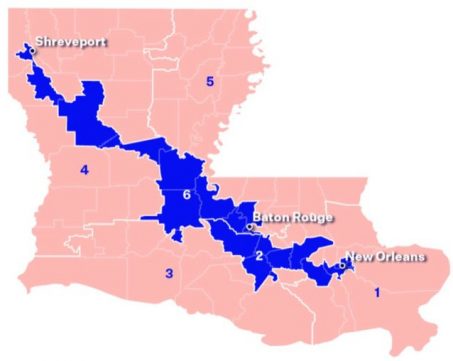
The unhinged rage of Democrats after the Callais decision could be (or at least should be) silenced simply by posting the map of Louisiana’s 2nd and 6th districts, which was what brought the case to the Supreme Court.

It is an insult to defend such a map by shouting “RAAAAACISM” at anyone who criticizes it, which is the essence of the Democrats’ reaction. One wonders whether they are (a) so ignorant they don’t understand the law and the Constitution, or (b) so dishonest they think they can frighten people with their feigned outrage and false claims. Surely someone will add, (c) embrace the healing power of “and,” e.g., Chuck Schumer.

If any living man can be considered an authority on racism and Jim Crow, permit me to suggest that it’s not the Jew from Brooklyn, but rather the black man from Chatham County, Georgia:

This Court should never have interpreted [Section 2] of the Voting Rights Act of 1965 to effectively give racial groups “an entitlement to roughly proportional representation.” … By doing so, the Court led legislatures and courts to “systematically divid[e] the country into electoral districts along racial lines.” Holder v. Hall, 512 U. S. 874, 905 (1994) (THOMAS, J., concurring in judgment). “Blacks [we]re drawn into ‘black districts’ and given ‘black representatives’; Hispanics [were] drawn into Hispanic districts and given ‘Hispanic representatives’; and so on.” Ibid. That interpretation rendered [Section 2] “repugnant to any nation that strives for the ideal of a color-blind Constitution.” Id., at 905–906. Today’s decision should largely put an end to this “disastrous misadventure” in voting-rights jurisprudence. Id., at 893.
As I explained more than 30 years ago, I would go further and hold that [Section 2] of the Voting Rights Act does not regulate districting at all. See id., at 922–923. The relevant text prohibits States from imposing or applying a “voting qualification,” “prerequisite to voting,” or “standard, practice, or procedure,” in a manner that results in a denial or abridgement of the right to vote based on race. … How States draw district lines does not fall within any of those three categories. Holder, 512 U. S., at 922–923 (opinion of THOMAS, J.); Allen v. Milligan, 599 U. S. 1, 46 (2023) (THOMAS, J., dissenting). The words in [Section 2] instead “reach only ‘enactments that regulate citizens’ access to the ballot or the processes for counting a ballot’; they ‘do not include a State’s . . . choice of one districting scheme over another.’” Ibid. (quoting Holder, 512 U. S., at 945 (opinion of THOMAS, J.)). Therefore, no [Section 2] challenge to districting should ever succeed.

It’s not really complicated, you see. Why is it that what is so obvious to Justice Thomas should be incomprehensible to Senator Schumer?


‘Subject to the Jurisdiction Thereof’

When did states begin issuing birth certificates? And why are these documents now required in various legal contexts? I was born in Atlanta, Georgia — the exact hour and minute were recorded, along with my birth weight — but my grandparents had no such documentation when they were born in the late 1800s and early 1900s. Part of the answer:

The United States began collecting birth data at the national level in 1902, via the U.S. Census. . . . The federal government first developed a standard birth certificate application form in 1907, five years after the Census Bureau began collecting data. The current system of the states collecting data and reporting it to the federal government developed between 1915, when the federal government mandated that states collect and report the data, and 1933, by which time all of the states were participating.

This still doesn’t explain why the government hadn’t thought to do this previously, or what prompted the change. Probably most Americans have never given any thought to questions like this, and likewise this:

“All persons born or naturalized in the United States, and subject to the jurisdiction thereof, are citizens of the United States and of the state wherein they reside.”

Today, the Supreme Court will hear oral arguments in Trump v. CASA Inc., involving the president’s executive order challenging the prevailing interpretation of the so-called “birthright citizenship” clause of the Fourteenth Amendment. In particular, it is that five-word phrase, “subject to the jurisdiction thereof,” which is the bone of contention: Does this include the children of illegal aliens? Does it include the babies born to foreigners who are here as tourists or on student visas?

Sunday evening I got a phone call from my youngest son, who is now a first-year law student, and we discussed the case. My son believes, and I am inclined to agree, that the Trump administration faces an uphill battle to persuade the justices to accept its claim that the president has the authority to change the interpretation of the Citizenship Clause by executive order. Even if you agree with Trump — i.e., that this clause has been misinterpreted to grant birthright citizenship in cases never contemplated by those who wrote and ratified the Fourteenth Amendment — isn’t it properly the job of Congress to clarify this through relevant legislation? But as I told my son, we got here because Congress has neglected its duty for decades, which is a long story going back to the Hart-Celler Act of 1965, which was passed during the “Great Society” apogee of 20th-century liberalism after Lyndon Johnson’s 1964 landslide reelection, when a Democrat-dominated Congress was eagerly enacting all kinds of nonsense as a legislative memorial to JFK. This history also includes the Simpson–Mazzoli Act of 1986, which Ronald Reagan (then struggling with the Iran-Contra scandal) was persuaded to sign, despite conservatives urging him to veto the bill. Simpson-Mazzoli “provided illegal migrants with amnesty and a path to legal citizenship and enabled sanctions on employers who hired illegal migrants”:

Three million migrants, mostly Hispanic, got to stay; the employers were never hit with meaningful sanctions, even as the floodgates opened. A 2016 Yale study concluded that the real illegal immigration population number is 16 to 30 million, versus the 11 million number generally cited.
The electoral impact of this change was felt almost immediately. California had been a Republican mainstay in elections, but in 1988 George H. W. Bush narrowly carried the state. Since 1988, no Republican presidential candidate has carried California.

Because of the bipartisan nature of the lobbying pressures involved — especially those Republicans controlled by the business lobby’s desire for cheap labor — the American people never got a chance to have an up-or-down vote on any of this, until Trump came along. There was never a time between 1965 and 2016 where people going to the polls had a clear choice on this issue. It is important to note that, in 2009-2010, when Obama was president and Democrats controlled both houses of Congress, they did not pass any kind of “comprehensive immigration reform,” which they had been arguing loudly for just a few years earlier when Bush and Republicans were in charge. The same pattern was repeated in 2021-2022, with Biden in the White House and Democrats controlling Congress again, and yet still no “reform.” What this tells you is that Democrats know damned well that a majority of Americans oppose the open-borders agenda, and Democrats would destroy their chances for reelection if they tried to ram another amnesty down our throats.

The history of congressional neglect — not to mention congressional dishonesty and cowardice — has gotten us to where we are, and Trump has forced this issue into the forefront of our national conversation because Republicans in Congress either were afraid to touch it, or were sympathetic to the open-borders agenda. Just as an aside to all this, the organization whose name appears in this case as the lead opponent to Trump has an interesting history:

CASA was originally known as the “Central American Solidarity Association of Maryland”. The organization’s name was officially changed to CASA of Maryland, Inc., on July 28, 1995. The organization’s name was officially changed to CASA de Maryland, Inc., on September 4, 2008. Now, the organization is named CASA.
CASA was founded in 1985 in the basement of the Takoma Park Presbyterian Church by US citizens and Central American immigrants. It has since expanded its scope. It is affiliate organization of the National Council of La Raza. They are a member of the National Day Laborer Organizing Network. CASA is also a founding member of the National Capital Immigration Coalition, which promotes “comprehensive immigration reform”.

Perhaps you don’t understand the significance of the group being founded in 1985 in Takoma Park. A Soviet-backed “insurgency” provoked a civil war in El Salvador, with the Communist FMLN waging guerrilla warfare against a military junta and its “death squads,” and, along with similar events in Guatemala and Nicaragua, this had brought an inundation of Central American refugees into the U.S., many of whom settled in the Maryland suburbs of D.C. Takoma Park was (and is) a bastion of liberalism, like Berkeley is to California, and the “Central American Solidarity Association” was just another pro-Communist front group formed by opponents of the Reagan administration.

In other words, more than 30 years after the collapse of the Soviet Union, we’re still fighting the godless Commies. Just another reason to thank God for Trump, who will attend today’s oral arguments in person.


Historical Analogies and the Current Crisis

John Adams (left); John Quincy Adams (right)

Here’s a question most people have never pondered: Why did the North fight the Civil War? The way history is taught, the focus is on slavery and the South, and the motives of the Confederacy are subjected to critical scrutiny in a way that the Union side of the controversy is not. If you start digging around, examining contemporary accounts as I have done, you might begin questioning some of your fundamental beliefs. Sen. Robert Toombs, declaring the causes of Georgia’s secession, pointed to the 1846 Walker Tariff as the underlying grievance that led eventually to the formation of the Republican Party. After decades of protectionist policy advocated by New England interests, the 1846 tariff signaled that “free trade, low duties, and economy in public expenditures was the verdict of the American people. The South and the Northwestern States sustained this policy. There was but small hope of its reversal; upon the direct issue, none at all.” It should not need to be said that Toombs’ argument was tendentious — he was in the position analogous to an attorney pleading a client’s case. But the point is that the basic economic and fiscal policy of the nation were involved in the regional contest and, as Toombs said, by the mid-1840s, the South and the West were in a de facto alliance against the Northeast. But the controversy long predated that.

Think of John Adams and his son, John Quincy Adams. The elder Adams, having served as George Washington’s vice president, was elected president in 1796. Twenty-eight years later, the younger Adams was elected president in 1824. Both of them served only one term, proving unpopular in office, and the interregnum between their two terms in the White House was filled by an unbroken tenure of Virginians, followed by the presidency of Andrew Jackson of Tennessee. For the first 48 years under the Constitution (1788 to 1836), then, New England had held the office for just eight years. and there was little prospect of them regaining that office because of the changing arithmetic of the Electoral College:

In 1792, there were 132 Electoral College votes; 38 of those votes (28.8 percent of the total) belonged to the New England states of Massachusetts, Connecticut, New Hampshire, Rhode Island, and Vermont. Massachusetts alone wielded 16 electoral votes (12.1 percent of the total) in 1792. Forty years later, however, when Jackson was reelected to a second term in the White House in 1832, the Electoral College had increased to 288 voters, and the New England states (now including Maine) possessed just 50 — a mere 17.4 percent of the total. That total was exactly matched by six new states in the South and West — Kentucky, Tennessee, Alabama, Mississippi, and Missouri — each of which permitted slavery. Kentucky and Tennessee, each with 15 Electoral College votes in 1832, now had more representation than Massachusetts, with just 14 votes. . . .

You can read the rest of my latest American Spectator column.


Why Have Liberal Judges Suddenly Become Second Amendment Absolutists?

Judge Melissa Logan Bellows presides in Circuit Court of Jefferson County, Kentucky, which is to say, Louisville, a community torn by racial conflict ever since the Breonna Taylor shooting. During the 2020 election, Joe Biden won only two counties in Kentucky, and Jefferson was one of them. Although judicial elections in Kentucky are officially non-partisan, we might presume that Bellows is a Democrat. However, Bellows was endorsed by the local Republican Party in her 2022 election, in which her opponent was a local civil rights lawyer.

Well, if she’s a Republican, she’s gone rogue:

Prohibiting a convicted felon from possessing a gun is unconstitutional, according to a Jefferson County Circuit Court Judge’s ruling.
Judge Melissa Logan Bellows filed the order this week, dismissing the possession charge against a convicted felon and persistent felony offender, Jecory Frazier.
The motion to dismiss was filed by Louisville Attorney Rob Eggert in October on behalf of his client. Eggert claimed the state’s law does not trump the Second Amendment. Bellows agreed, making the first ruling of its kind in Jefferson County.
Trisha Lister, an attorney at Eggert’s office, wrote the motion.
She believes Bellows’ opinion was well-written.
She told WAVE News Troubleshooters the Second Amendment does not single out convicted felons. She said the charge has been not been equally enforced and is used as a way to keep people of color from having guns. Lister stated over 70% of those prosecuted on that standalone charge are minorities.

Dana Pico has more on what he calls the “curious” argument made by Judge Bellows in her decision, the full PDF of which is here. The claim that “minorities” account for 70% of those prosecuted on felon-in-possession charges might have something to do with the fact that most crime is committed by young people, and the current demographic situation is such that, in many communities, “minorities” are actually a majority of the youth population. Are cops just letting white criminals go free? I rather doubt it, but that’s not really the issue. Rather, the issue is whether Jecory Frazier should be in prison and, considering that he is a “persistent felony offender,” the answer to that question is, “Hell, yes.”

No sooner had I digested this crazy decision from Kentucky, than a Chicago judge decided that the federal law prohibiting firearms possession by illegal aliens is unconstitutional:

Ajudge this month dropped gun charges against an illegal migrant in Illinois, sparking further debate about the rights associated with the Second Amendment.
U.S. District Court Judge Sharon Coleman of the Northern District of Illinois referenced lower court rulings in dismissing firearm possession charges against Heriberto Carbajal-Flores, who was illegally or unlawfully in the United States when he possessed a handgun in the Little Village neighborhood of Chicago on June 1, 2020.
“The Court finds that Carbajal-Flores’ criminal record, containing no improper use of a weapon, as well as the non-violent circumstances of his arrest do not support a finding that he poses a risk to public safety such that he cannot be trusted to use a weapon responsibly and should be deprived of his Second Amendment right to bear arms in self-defense,” Coleman, who was appointed under President Barack Obama, wrote in her eight-page ruling filed March 8.
Carbajal-Flores was charged under Title 18 of U.S. Criminal Code, which legally disallows undocumented individuals to possess firearms and ammunition “or to receive any firearm or ammunition which has been shipped or transported in interstate or foreign commerce.”
The defendant, who contended the firearm was possessed for self-defense and protection of property “during a time of documented civil unrest” in the spring of 2020, has never been convicted of a felony, a violent crime or a crime involving the use of a weapon.

This is insane. My only guess as to why the judge would rule this way — besides the fact that she’s a DEI hire appointed by Obama — is that Democrats want to use the Bruen decision as a legal mechanism to turn loose criminals, including illegal aliens, arrested on gun charges. But this is the exact opposite of what their rhetoric about stopping “gun violence” would suggest. If your aim is to prevent such violence, then getting criminals off the street should be Job Number One. The vast majority of “gun violence” in America is perpetrated by repeat offenders, especially those associated with drug trafficking by urban gangs. State and federal laws prohibiting convicted felons from possessing firearms gives prosecutors a powerful tool to get these repeat offenders off the street for a long time. As for illegal aliens with guns, well, you could just deport them — but Democrats don’t want to do that either.

The simplest explanation: Whatever is good for America, Democrats are against. Whatever is bad for America, they’re for.


Shop Electronics at Amazon

Save on Groceries and Everyday Essentials

Shop Amazon Basics

Office & School Supplies

Do Bananas Grow in Colorado?

Is it a crime to vote Republican? Is it illegal to disagree with liberals? Will all opposition to the Biden regime be banned?

The Colorado Supreme Court ruled Tuesday in a 4-3 opinion that the Constitution’s “Insurrection Clause” prohibits former President Donald Trump from appearing on the ballot for the presidency in 2024.
“The court found by clear and convincing evidence that President Trump engaged in insurrection as those terms are used in Section Three” of the Fourteenth Amendment, the ruling reads.
The provocative ruling partially reverses a prior ruling from Colorado District Court Judge Sarah Wallace, who ruled in November that Trump is not an officer of the United States as defined by the Fourteenth Amendment and that the Amendment therefore cannot be used to disqualify him from appearing on the Colorado primary ballot.
In his dissent, Chief Justice Boatright wrote, “Dismissal is particularly appropriate here because the Electors brought their challenge without a determination from a proceeding (e.g., a prosecution for an insurrection-related offense) with more rigorous procedures to ensure adequate due process.”
In partially reversing Wallace, the Court all but dared the U.S. Supreme Court to step in by January 4, 2024.
“If review is sought in the Supreme Court before the stay expires on January 4, 2024, then the stay shall remain in place, and the Secretary will continue to be required to include President Trump’s name on the 2024 presidential primary ballot, until the receipt of any order or mandate from the Supreme Court,” the ruling says.\
The Court disagreed with Trump’s claims that his actions were protected free speech.
“We consider and reject President Trump’s argument that his speech on January 6 was protected by the First Amendment,” the ruling reads, seemingly ignoring Trump’s calls that day for protesters to conduct themselves “peacefully and patriotically.”

ThoughtCrimes! WrongSpeak! Trump is Emmanuel Goldstein!


Magna Carta and Alvin Bragg

King John signs Magna Carta, 1215

“The failure of our education system to teach America’s young people their own history,” I wrote nearly four years ago, “is perhaps best illustrated by the fact that almost no one under 40 today knows anything about Sam Adams except as a popular brand of beer.” And many have suspected that this historical ignorance is not accidental, but rather that the dumbing-down of American education serves a specific political agenda, as those who are conscious of the pedigree of their liberty are apt to be more zealous in defense of their rights. Our liberties were “purchased . . . with toil and danger and expense of treasure and blood,” Sam Adams declared in 1771, and thus Americans should never allow themselves to be cheated out of their inheritance.

By the time of our War of Independence, Englishmen had been fighting to establish and defend their rights for more than 500 years, dating back at least as far as Runnymede in 1215, and even further back to Henry I’s Charter of Liberties in 1100. The right to trial by jury, an institution originally unique to the English, is guaranteed by the Sixth Amendment. Americans are prone to take this inheritance for granted, along with all the other rights specified in the Bill of Rights, including those summarized in the Fifth Amendment by the phrase “due process of law.”

The writer known as “Wolf Howling” observes:

Manhattan DA Alvin Bragg’s indictment of Donald Trump is a Constitutional obscenity. Bragg has crafted an indictment that denies Trump his most fundamental constitutional right, to know the criminal charges against him. That is a right with a 1,000 year old pedigree in English and American law.

(Hat-tip: Sarah Hoyt at Instapundit.) The lowliest thief incarcerated at Riker’s Island cannot be denied such rights, and what Bragg has done in framing this indictment of Trump is an insult to every American, an attempt to defraud them of their ancient liberties, purchased by “toil and danger” and bequeathed to us as an inheritance. However ignorant Alvin Bragg may be, we cannot suppose that he is violating these rights accidentally, and thus he must be considered an enemy of justice, deliberately seeking to destroy liberty. That the voters of New York City elected Bragg to this office, and apparently support him in his unconstitutional actions, says a lot about the nature of “democracy” in 21st-century America. People need to wake up to the danger.


Inheriting a Legacy of Liberty

The Queen of Bohemia

In his monumental Reflections on the Revolution in France, Edmund Burke goes to some length to demonstrate how the principle of inheritance operated in English law. The young person to whom he addresses his lecture — which began as a correspondence — seemed to have been deceived by those who contended that the English constitution included a “right” of the people to choose their own king. This contention, as Burke shows, was based on a misunderstanding of the Glorious Revolution of 1688, which had the effect of bringing William and Mary to the throne. Yet in the very document establishing this succession, the signatories declare the fealty of “ourselves and our posterity” to their new sovereigns — and their posterity: How could the principle of inherited authority be voided, asked Burke, if the English people could by solemn compact bind their descendants as subjects of the descendants of their sovereign? So the imagined “right” to choose their own king was not proven by the Glorious Revolution; rather, it was explicitly denied.

Most people have never actually read Burke’s Reflections. If they have studied it at all, they’ve done so as college students under the supervision of a professor who includes excerpts from it as part of a syllabus on political philosophy, and thus absorb only a limited conception of Burke’s argument, one that overlooks such details as his emphasis on the importance of the principle of inheritance in English law.

Consider the Queen of Bohemia, a relative of William and Mary. The Queen of Bohemia was the daughter of King James I, and was allegedly a target of the conspirators (including Guy Fawkes) in the 1605 Gunpowder Plot. While her English cousins were going through their ordeals in the 1600s — Cromwell and all that — she was the wife of Frederick V of the Palatinate, who became King of Bohemia, a title he held for only one year before being exiled because of a defeat in the Thirty Years War. Despite their misfortune, Frederick and his English-born Queen had numerous children, the 12th of whom was Sophia, who in 1658 married Ernest Augustus, Elector of Hanover. In the meantime, the English throne had passed from William and Mary to Queen Anne. None of them left any surviving children, which precipitated a succession crisis:

Anne was the only person remaining in the line of succession established by the Bill of Rights 1689 [which excluded Catholics from the English throne]. To address the succession crisis and preclude a Catholic restoration, the Parliament of England enacted the Act of Settlement 1701, which provided that, failing the issue of Anne and of William III by any future marriage, the Crown of England and Ireland would go to Sophia, Electress of Hanover, and her Protestant descendants. Sophia was the granddaughter of James VI and I through his daughter Elizabeth, who was the sister of Anne’s grandfather Charles I. Over 50 Catholics with stronger claims were excluded from the line of succession.

As a Protestant nation, the English refused to be ruled by Catholics, which is how Sophia’s son, the grandson of the Queen of Bohemia, became King George I, establishing the Hanoverian dynasty in England. Was the exclusion of Catholic claimants to the crown a violation of the principle of inheritance in English law? On the contrary, it was confirmation of that principle. Going back to Henry VIII, the English had rejected papal supremacy, and the fundamental point of “Cromwell and all that” was the continuation of England’s Protestant legacy, even if they had to behead King Charles to accomplish it.

All of this may seem irrelevant to Americans today, but ask yourself why our forefathers fought the War of Independence and why, in agreeing to the ratification of the Constitution, they insisted that it immediately be amended with the Bill of Rights, including the First Amendment, establishing freedom of religion? Our nation was founded by men who understood the rights for which their English ancestors had fought during all those decades from James to Charles to Cromwell and onward. The legitimacy of colonial assemblies as instruments of governing authority in America had been recognized by the Crown and upheld by Parliaments, so that when George III started infringing on this long-established arrangement, the American colonists resisted. They saw the King as seeking to deprive them of their inherited rights — a legacy of liberty that Englishmen could trace back to Magna Carta.

American patriots love to speak of their “God-given rights,” adopting the rhetoric of the Declaration about the “self-evident” truth that “all men” are “endowed by their Creator” with these rights — which is fine, except when you ponder why these truths were not proclaimed at some other time in some other place by some other people, but rather by English-speaking Americans gathered at Philadelphia in 1776. And when they leave off quoting the Declaration, well-meaning American patriots are fond of quoting the Preamble of the Constitution without making much of the phrase wherein the Framers declared their intent to “secure the Blessings of Liberty to ourselves and our Posterity,” extending to the infinite future the principle of inheritance.

My emphasis on the English origins of our conception of rights, as a legacy inherited from our ancestors, is not intended to exclude those Americans whose ancestors were not English and thus had nothing to do with this particular history. As Americans, all of us are rightful beneficiaries of this legacy, no matter where our ancestors came from, or how recently they may have arrived. Readers will recall my praise for Vivek Ramaswamy as “an enthusiastic proponent of American exceptionalism,” notwithstanding the fact that Vivek is a Hindu whose parents immigrated from India. Vivek gets it, in terms of the importance of “the Blessings of Liberty” which we seek to preserve under the Constitution. My ancestor fought in the Revolution as a teenager in the South Carolina militia, and I would hope that all his descendants — probably thousands of us by now — share the same sensibility expressed by Vivek Ramaswamy. Meanwhile, in Colorado, we have this adamant declaration from Jeff Goldstein:

Be it so understood:
I refuse to “unpack white violence.” I reject the idea that my existence “perpetuates white power structures.” I will not — and in fact cannot — “examine my implicit biases.” I’m an individual. I refuse to grant determined interpretive communities authority over my being. My meaning is mine. It is what makes me me.
I’m not taking any “journey” to “discover” the impact of my “privilege” on “black and brown peoples.” I will not become “anti-racist” or “anti-fascist” to satisfy your demands. I reject Cultural Marxism. I am an individual. I’m not defined by my color, my religion, my sex. I’m Jeff.
I will not “respect your pronouns” or “celebrate” your “queerness.” I am hostile to your sexualizing of children. I reject your neologisms, your “triggers,” and your desire to control my speech. I know who and what you are: you are my presumptive master, or else the Useful Idiot who empowers him. But I will grant you and your ideology no power over me.

(Hat-tip: Ed Driscoll at Instapundit.) Jeff is definitely an individual, as he says — and if you’ve ever met him, you certainly wouldn’t argue the point — but he is recognizably American in his individualism, as he understands the “Blessings of Liberty” as the Framers intended it, as belonging to him by inheritance as an American. While I suppose that Jeff would bemoan the lack of liberty and the violation of rights in distant places — Quebec or Kabul, Kinshasa or Kathmandu — it is the preservation of freedom in America that concerns him.

Intelligent people understand what Ronald Reagan once pointed out, in his famous 1964 speech “A Time for Choosing,” about our nation:

Not too long ago, two friends of mine were talking to a Cuban refugee, a businessman who had escaped from Castro, and in the midst of his story one of my friends turned to the other and said, “We don’t know how lucky we are.” And the Cuban stopped and said, “How lucky you are? I had someplace to escape to.” And in that sentence he told us the entire story. If we lose freedom here, there’s no place to escape to. This is the last stand on earth.

Our freedom as Americans — our nation’s proud claim to be liberty’s “last stand on earth” — has a history, and if we don’t teach that history to our children, how can they possibly understand how precious this legacy is?

The Queen of Bohemia could not be reached for comment.