Mr. Hockey Stick Says the Quiet Part Out Loud About Population Control Agenda

Some readers may be unfamiliar with the story of Michael Mann and his infamous “hockey stick” graph, so I will summarize briefly: In 1999, Mann and two colleagues produced a paper on climate trends, showing a sharp upward spike in worldwide temperatures beginning around 1900. The shape of this graph resulted in the “hockey stick” nickname, and it was widely publicized as evidence that global warming was a crisis, a dire emergency requiring severe policy action to reduce the level of carbon emissions. Then in the 2009 “ClimateGate” scandal, the release of emails from England’s East Anglia University showed how the “consensus” about global warming had been manufactured, leading to accusations that Mann had engaged in research fraud. In 2012, Mark Steyn published a brief blog post at National Review referring to Mann as “the man behind the fraudulent climate-change ‘hockey-stick’ graph,” and quoting Rand Simberg of the Competitive Enterprise Institute, another Mann critic. This led to Mann filing a libel lawsuit against Steyn, Simberg, CEI and NR, which has still not been completely dismissed.

Science is not advanced by silencing criticism, and I would argue that Mann’s lawsuit is the best evidence that his research is not trustworthy. Certainly I am not alone among climate-change skeptics in seeing this kind of “science” as just another manifestation of the Paul Ehrlich “Population Bomb” hoax of the 1960s. Mann’s “science” is not about objective analysis of facts; it’s about justifying a totalitarian agenda.

And so the mask is now removed:

“It is obvious the planet can only support so many human beings. We can inflate the numbers through technology, but there are limits.”
Discussions about population are often avoided because, historically, they have sometimes “let us to problematic places where the blame seems to be placed preferentially on the developing world and on people of colour,” says Mann. “The racial overtones that have emerged in the past are problematic and troubling, and we need to flip the switch.
“It is possible to say a population is too large for the planet to support and still recognise the culpability does not apply equally across the board. In the developed world, our footprint is orders of magnitude bigger than in the developing world. More people means more carbon, more warming, and more climate change, but not all people are the same.”
Instead of focusing on population by itself, Mann advocates increasing support for the education of women, which can limit population growth and help address climate change.

(Hat-tip: Beege Welborn at Hot Air via Instapundit.)

Is it not obvious that, rather than “climate change” being a fact discovered by science, which then points to population control as the solution, that instead Mann and his colleagues went looking for some reason — a pretext — to justify the pre-existing desire for population control? Fears about “overpopulation” emerged as a logical conclusion of the acceptance of Darwinian theory among the intelligentsia circa 1900. If, after all, “progress” is dependent upon evolutionary fitness, and it can be observed that birth rates are generally highest among the poor, the ill-educated and socially backward segment of the populace, then . . . something must be done. Such were the concerns that led “philanthropists” to lavish millions of dollars to support advocacy for what we nowadays condemn as the eugenics movement

Historian Donald L. Critchlow chronicled this phenomenon in his excellent 2001 book, Intended Consequences: Birth Control, Abortion, and the Federal Goverment in Modern America. A comparative handful of wealthy men created the population control movement, long before any scientist expressed any concern about the impact of carbon emissions. “Climate change” is merely a pretext for advancing this agenda, which is why Mann is supported by the same kind of people who supported Margaret Sanger, Alfred Kinsey and Paul Ehrlich.


A Simple Idea: ‘Four or More’

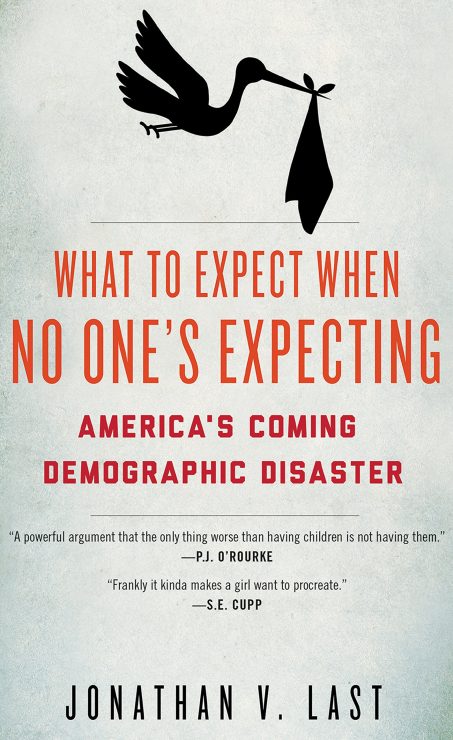
Yesterday, Ace of Spades jabbed Jonathan V. Last as one of “True Conservatives Conserving Conservatism at The Bulwark” — a jab richly deserved, but it filled me with a sense of sadness, because Last used to be so good, before he fell victim to Trump Derangement Syndrome.

What To Expect When No One’s Expecting was, and still is, a book well worth reading. To quote the dust-jacket summary:

For years, we have been warned about the looming danger of overpopulation: people jostling for space on a planet that’s busting at the seams and running out of oil and food and land and everything else.
It’s all bunk. The “population bomb” never exploded. Instead, statistics from around the world make clear that since the 1970s, we’ve been facing exactly the opposite problem: people are having too few babies. Population growth has been slowing for two generations. The world’s population will peak, and then begin shrinking, within the next fifty years. In some countries, it’s already started. . . .
What to Expect When No One’s Expecting explains why the population implosion happened and how it is remaking culture, the economy, and politics both at home and around the world.
Because if America wants to continue to lead the world, we need to have more babies.

Of course, I didn’t need any lectures on that topic, being a father of six, but still this was an important message, and Last marshaled an array of arguments on behalf of this pro-natalist message. What To Expect When No One’s Expecting followed in the footsteps of the late Ben Wattenberg’s 1987 book The Birth Dearth, which was the first examination of the modern trend of demographic decline in industrial societies. Wattenberg later followed that up with Fewer: How the New Demography of Depopulation Will Shape Our Future (2004).

As should be obvious, these warnings have been largely ignored. There has been no new “Baby Boom” in response to the concerns raised by Last’s book, or Watterberg’s books, and the question is, why?

Permit me to share the insight of personal experience: People’s behaviors are limited by their imagination. That is to say, people generally don’t attempt things they regard as impossible and, in the minds of most Americans, having a large family is a financial impossibility. Even if they wished to have lots of kids, they can’t figure out how it could be done, from the perspective of their personal economic situation.

They can’t afford it, they say.

OK, believe what you want to believe, but how is it that I could afford it, if you can’t? Do you suppose I’m some kind of financial genius? An heir to the Rockefeller fortune? No, of course, they realize that my wife and I don’t have some hidden pile of cash that has enabled us to raise all these kids; we were just willing to make sacrifices that most people aren’t willing to make. And that knowledge makes them embarrassed.

This embarrassment expresses itself as defensiveness, especially among conservative Christians who understand that they are not exactly practicing what they preach, as regards “family values.” Sure, maybe it’s silly to think that every faithful Christian couple would strive to spawn a Duggar-sized brood, but insofar as we are pro-life, isn’t it logical that we would be more welcoming to offspring as blessings from God?

“See, I have set before thee this day life and good, and death and evil. . . . I call heaven and earth to record this day against you, that I have set before you life and death, blessing and cursing: therefore choose life, that both thou and thy seed may live.”
— Deuteronomy 30:15, 19 (KJV)

“Therefore choose life” — this quote from Deuteronomy became a slogan for the pro-life movement, but how many pro-life conservatives have tried to live out the meaning of that phrase? Most people wouldn’t judge me to be a particularly fine example of Christian virtue, but despite my failings, at least I got this part right. And along the way, I picked up a few helpful pieces of advice. When our oldest was just a little baby, and my Dad came to visit us for the first time after she’d been born, we were living in a roach-infested $250-a-month rental home in Gordon County, Georgia. When I complained about our financial situation, my Dad laughed and said, “Son, if you wait to have kids until you can afford to have kids, you’ll never have kids.” Truer words were never spoken.

Ten years later, after we’d moved to the D.C. area so I could work at The Washington Times, our family had grown to four kids, and in July 1999, I saw this item on a pro-life website:

Where are the children?
In reacting to a report released today by the statistics office of the European Union, STOPP International director Jim Sedlak said, “This report points out what we have been yelling from the rooftops for some time now — the world needs larger families.”
The Eurostat report warns that European Union countries can expect health and pension costs to soar over the next 50 years as the number of people over retirement age rises to about one third of the total population. “The main cause of the aging,” according to the report, “is the decline in births over the last two to three decades.”
“The ‘success’ of the population controllers in Europe is now taking its toll,” said Sedlak. “The average number of babies per woman has fallen from 1.95 to 1.65, and there is no end in sight.”
“In order to turn things around, four things are necessary,” Sedlak said. “First, the world has to understand that there is not an overpopulation problem, but a problem of too few children. Second, everyone in our society must accept large families and stop using peer pressure to convince people not to have more children. Third, governments and rich philanthropists must stop giving money to population control programs. Finally, young people getting married have to be thinking of having four or more children.”
“We have one generation to turn things around,” Sedlak said. “After that, it may be too late.”

The author of that short article, Jim Sedlak, was a remarkable individual. A research physicist, Sedlak worked for IBM for 30 years before retiring in 1993, at age 50, “to devote a full-time effort to the pro-life cause.” A devout Catholic, Sedlak was particularly a critic of classroom “sex education,” and founded Stop Planned Parenthood (STOPP), which eventually became part of the American Life League, of which Sedlak became Executive Director. He died earlier this year, but I had the chance to talk to him a few times over the years, and he was full of wisdom about our culture, including this simple idea: “Four or more.”

Sedlak had studied the demographics of the Baby Boom, and understood this: It was largely a Catholic phenomenon. Most people don’t realize this, because the way we think about population trends usually focuses on medians and averages, without much thought to the human variables behind such statistics. The Baby Boom peaked in 1957, when the U.S. Total Fertility Rate (TFR) reached 3.77 average lifetime births per woman. If you think hard about that number, you realize that it means the average American woman in 1957 was three times more likely to have four children as to have merely three. To reach such an astonishing figure, however, you must first account for those women who will ultimately be childless, and whose contribution to the total is zero. Such a subtraction means that the average mother (as opposed to the average woman) was even more likely to have at least four children. And, as this 3.77 TFR number was an average, it means that for every woman who had only two children in 1957, there was another woman who had five or six. For every “only child” born in 1957, there was another child born into a family with six or seven siblings. Large families were what really made the “Baby Boom” happen and, among these super-sized families, Catholics were a disproportionately large share. The Catholic Church’s doctrine against artificial contraceptives was taken seriously back then, and the decline of that faithfulness is the real cultural explanation of the changing demographic trend over the past 60 years.

Of course, I’m Protestant, but the issue with Catholics and their declining fertility rate is illustrative of the overall trend. While different Protestant denominations have different approaches to these questions, in general, more conservative Protestants are inclined toward the “pro-life”/“pro-family” beliefs so elaborately spelled out in the various encyclicals (e.g., Humanae Vitae) that codify Catholic doctrine on this subject.

The salt has “lost its savour” would be the best description of what’s happened, in terms of Christian family practice in recent decades. One might imagine that self-identified Catholics would still have substantially higher fertility rates than the average American, but they don’t — they have been “conformed to this world,” and the same is true of evangelical Christians. The commandment to “be ye separate” — to have no fellowship with unrighteousness — seems to have been forgotten, so that many Christians are now just following the crowd, and making the same lifestyle choices as the unchurched. This is true about many things, including divorce, and few church spokesmen seem willing to speak out against this trend. Church leadership is not leading.

People make trends, not the other way around. The choices you make, as an individual, have an influence far beyond your own awareness, and what you practice will ultimately have more influence than what you preach, if you don’t live up to own professed beliefs.

Our ability, as individuals, to influence something so large as the national birth rate may seem infinitesimally small, and Jonathan V. Last’s book apparently failed to make a dent in the trend. But our actions ultimately make more difference than any author’s words, and you don’t need a whole book to explain it. “Four or more” — a very simple idea.

Now, to find a cure for Trump Derangement Syndrome . . .



Motherhood (and the Lack Thereof)

One of the phrases I hate is “working mothers,” which is often deployed in such a way as to stigmatize stay-at-home mothers. Ever since the rise of the feminist movement in the late 1960s, liberals have promoted the idea that women must have careers — not just jobs, but professional careers — in order to deserve admiration or praise. In order to have a career, it follows logically, women must go to college and ever since the late 1970s, women have been a majority of college students and are now about 56% of undergraduate enrollment. The result has been a disaster in demographic terms because, as the old saying goes, “Fertility delayed is fertility denied.” That is to say, from the day a girl reaches menarche, she has a fixed number of potential reproductive opportunities — in a healthy female, 12 cycles a year for about 25 years from ages 15 to 40, or roughly 300 lifetime chances to become pregnant. If she does not become a mother as a teenager (and middle-class America adamantly believes that teenage motherhood is the worst of all possible fates), this means her reproductive opportunities are reduced to about 240 — 12 menstrual cycles per year for about 20 years. Thus, every year that she delays motherhood represents a reduction in her total fertility.

Any adult attempting to explain these simple facts of life to young women is apt to meet with a hostile response, attacked as an enemy of “equality” and “women’s rights,” but the alternative — what has actually been happening since the 1970s — is that many young women keep hitting the snooze on the alarm on their biological clocks, so that they unexpectedly arrive in their 30s with the sudden realization that their opportunities for motherhood are now drastically reduced. If a woman is childless at 30, she has already passed by near two-thirds of her biological opportunities for pregnancy, and other considerations (e.g., declining fecundity) have the effect of further reducing the likelihood that she will ever give birth. The majority of all mothers give birth to their first child before age 30, so the woman who postpones childbearing past that age is on the losing side of a probability curve in terms of her chances of becoming a mother.

The decisions of millions of young women add up to demographic trends and, until rather recently — 30 or 40 years ago — the problem of declining fertility was unimaginable in America. The post-WWII “Baby Boom” had been so extraordinary, in terms of shaping our society, that many Americans didn’t even realize that it ended in the mid-1960s. Our nation was embroiled in struggles over civil rights and the Vietnam War, and issues related to demographic trends got little attention. It wasn’t until the late 1980s that Ben Wattenberg began studying census data and realized we had a problem: The Birth Dearth was the title of his 1987 book on the subject, but it made little impact on the national psyche. Some 35 years later, the consequences of ignoring Wattenberg’s early alarm about demographic trends are now apparent:

The decision to have a baby in the middle of a pandemic isn’t an easy one. I know because we struggled with making it (ultimately, we decided to go for it, though not without real serious conversations with medical professionals and a great deal of soul-searching). It’s unsurprising that amid all of the uncertainty, millions of American women decided to go another route and forgo pregnancy and birth.
[Wednesday], the CDC announced the worst fertility news we’ve ever seen in this country: We’ve hit a record low birth rate in the United States (1.64 babies per American woman) and we’re well below the necessary replacement rate of 2.1 births per woman.
While this latest, drastic drop is certainly due to the medical and financial insecurity that a once-in-a-lifetime pandemic brings, unfortunately, the fact that our birth rate has plummeted cannot just be part of the COVID-19 story. Indeed, it’s part of a larger trend of fewer American women not only having babies, but getting married at all.
Writing in The Wall Street Journal about the announcement Janet Adamy explained, “Demographers say the data suggests that more fundamental social and economic shifts are driving down fertility. Births peaked in 2007 before plunging during the recession that began that year. Although fertility usually rebounds alongside an improving economy, U.S. births fell in all but one year as the economy grew from 2009 until early 2020.”
“It’s not just Covid,” a demographer at the University of New Hampshire told the Journal. “I’ve been waiting for years to see a big jump in fertility to women in their 30s and it hasn’t happened.”
Notably, half of American states saw more deaths than births in 2020. That statistic can of course be explained at least in part by an increased death rate — thanks (and no thanks) to COVID-19 deaths and the impacts that came with social isolation and a strained health care system.
But it’s illustrative of the larger picture of what this reduced birth rate means for the future of our society: It’s a dying one. . . .

Read the whole thing. (Hat-tip: Ed Driscoll at Instapundit.)

Nothing like this has ever happened before in human history, and so no one knows how to reverse such a trend. Wattenberg’s thought was that, with proper encouragement, some zeroes (i.e., childless women) could be converted to ones, some ones could be converted to twos, and so forth. It would not really take much, in per-capita terms, to raise the total fertility rate by 0.5 babies per woman. But a generation of decadent, selfish hedonists is not even willing to think about long-term social consequences of their short-term personal choices, and so it is likely that America will continue slowly slouching toward extinction.

Not me and mine, of course. I’m a father of six, and already a grandfather of five, with my youngest three children — ages 22, 20 and 18 — yet to begin their own procreative careers. This is all part of the McCain “Victory Through Breeding” program for global domination. If y’all ain’t having kids, tough luck. The future belongs to the fertile.


The Liberal Extinction Project

Everything is proceeding as I have foreseen:

People worried about the climate crisis are deciding not to have children because of fears that their offspring would have to struggle through a climate apocalypse, according to the first academic study of the issue.
The researchers surveyed 600 people aged 27 to 45 who were already factoring climate concerns into their reproductive choices and found 96% were very or extremely concerned about the wellbeing of their potential future children in a climate-changed world. One 27-year-old woman said: “I feel like I can’t in good conscience bring a child into this world and force them to try and survive what may be apocalyptic conditions.”
These views were based on very pessimistic assessments of the impact of global heating on the world, the researchers said. One respondent, for example, said it would “rival world war one in its sheer terror”. The research also found that some people who were already parents expressed regret over having their children.
Having a child also potentially means that person going on to produce a lifetime of carbon emissions that contribute to the climate emergency, but only 60% of those surveyed were very concerned about this carbon footprint.
“The fears about the carbon footprint of having kids tended to be abstract and dry,” said Matthew Schneider-Mayerson, of Yale-NUS College in Singapore, who led the study. “But the fears about the lives of existing or potential children were really deep and emotional. It was often heartbreaking to pore through the responses — a lot of people really poured their hearts out.” . . .
The study, published in the journal Climatic Change, found no statistically significant difference between the views of women and men, though women made up three-quarters of respondents. A 31-year-old woman said: “Climate change is the sole factor for me in deciding not to have biological children. I don’t want to birth children into a dying world [though] I dearly want to be a mother.” . . .
The study is the first peer-reviewed academic study of the issue and analysed a large group of concerned people. The survey was done anonymously so people could express themselves freely. . . .
The study indicated that climate-related fears for their children’s lives were rooted in a deeply pessimistic view of the future. Of the 400 respondents who offered a vision of the future, 92.3% were negative, 5.6% were mixed or neutral, and just 0.6% were positive. . . .
However, he said further research was needed on a more diverse group of people and in other parts of the world. The self-selecting group in the study all lived in the US and were largely white, more highly educated and liberal.
Previously, opinion polls of the general public indicated people were connecting the climate crisis and reproduction, with one poll in 2020 finding that among 18- to 44-year-old US citizens without children, 14% cited climate change as a “major reason” for not having children.

Everyone old enough to remember Paul Ehrlich’s “Population Bomb” hoax should realize that “climate change” is simply the latest iteration of this neo-Malthusian doom-and-gloom propaganda.


DNA of the Doomed

Let’s think about the word misbegotten. Originally, it implied bastardy — “a misbegotten child” was illegitimate — but attained also a connotation of deformed or defective, and the word was generalized to apply to anything “having a disreputable or improper origin.”

“Misbegotten” comes to mind whenever I think of Lena Dunham, the weirdly shaped potato-looking person who soared to celebrity status on the basis of the six-season run of the HBO series Girls. This series was sometimes described as a “comedy,” but after trying to watch a few episodes, I can tell you that this description was a lie. Anyone who found Girls to be funny is almost certainly suffering from mental illness and — oh, by the way — did I mention that Dunham suffers from mental illness? She was addicted to the anti-anxiety drug Klonopin, of all things. Like, if you’re going to be an addict, wouldn’t it be better to become addicted to something fun? Nobody ever took Klonopin for fun.

Lena Dunham made herself infamous in 2014, when she deliberately smeared a former Oberlin College student as a rapist. This heinous lie involved using the first name (“Barry”) of a student who was a conservative activist at Oberlin during Dunham’s years on campus, claiming in her memoir that this Republican student raped her. After John Nolte of Breitbart proved this to be false — the aforesaid “Barry” didn’t know Dunham at all, and she only knew him by reputation — Dunham apologized. What happened next was that a reporter from Gawker did a close reading of the draft proposal for her memoir and noted that the description she gave matched another Oberlin student, a Jewish Democrat who happened to be the son of a former NPR host. Because we have no way of verifying Dunham’s accusation against this former classmate (or anyone else, for that matter) it is simply impossible to know if Dunham was ever raped at Oberlin and, on balance, there are many reasons to surmise the whole tale was a lie from start to finish.

The “success” of Girls was also a lie from start to finish. Nobody ever subscribed to HBO because they wanted to watch Dunham’s lousy show. No, the reason Dunham and Girls got so much publicity was not because of the size of the show’s audience (its ratings were never impressive), but because the show had a special appeal to the Manhattan media elite, reflecting their peculiar sensibilities. Before he died in 2015 at age 58, New York Times columnist David Carr was credited with making Lena Dunham a celebrity because of his glowing 1,000-word feature review of Dunham’s 2010 film Tiny Furniture.

Carr’s name came to mind the other day because of something Ed Driscoll linked about Ta-Nehisi Coates, who considered Carr a mentor. If you follow back through some of Ed’s links — he is custodian of the institutional memory of the blogosphere — you will eventually arrive at a 2011 episode of Bill Maher’s program in which David Carr said:

“If it’s Kansas, Missouri, no big deal. You know, that’s the dance of the low-sloping foreheads. The middle places, right? …Did I just say that aloud?”

This phrase, “the dance of the low-sloping foreheads,” is one that Carr used repeatedly to describe Middle America, and this contemptuous disdain is a problem among our cultural elite that has drawn critical attention from the leftist journal In These Times. The idea that Americans in “flyover country” are inferior, so that their beliefs, aspirations and lifestyle deserve to be mocked and ridiculed, is so prevalent in the institutions controlled by the Democratic Party — including academia and the entertainment industry — that it is never even questioned, but rather taken as a self-evident fact. Our elite routinely disparage the intelligence of people in Middle America in a way that they would never disparage any other group, and why? Because the people in Middle America vote Republican. But I digress . . . Continue reading DNA of the Doomed →

It’s Very Simple


Many of our country’s problems can be traced to a single factor:

Two headlines splashed across adjoining pages of the Wall Street Journal this week underscored a desperate but largely uncommented-on challenge facing America.
“Red Ink Seen for Social Security by 2020,” screamed one, as the program’s outlays will exceed income next year — and its trust fund will be insolvent by 2035.
And directly to the right: “High Court to Take Up LGBT Rights,” discussing three Supreme Court cases that will determine whether the 1964 Civil Rights Act covers sexual orientation or gender identity. 
What links these headlines? 
Simply this:  Social Security is going broke because we’re in a slow-motion demographic train wreck. As Chief Actuary Stephen Goss put it back in 2011, “Lower birth rates are the cause of (the) substantial and permanent shift in the cost of Social Security as a percent of GDP from 2008 to 2040.”  
America’s total fertility rate hit the lowest rate ever recorded in 2017 at just under 1.8 children per woman in her lifetime. The stork’s been in free fall since 2010 — and baby-making is cratering in particular among women 20-29, prime reproductive years.  
It gets worse. The Journal coverage estimated that old age benefit shortfalls will “account for 90% of larger budget deficits.” Wonder why America is patrolling the seas with a deteriorating fleet half its size compared to the 1980s?  Why there’s no money for infrastructure?  Or why, despite the Trump boom, we may return to economic secular stagnation? 
Dare one paraphrase the 1992 Clinton campaign watchword?  “It’s the fertility, stupid!”
So why the plummeting birth rates?  Largely, according to Lyman Stone of the Institute for Family Studies (IFS), because marriage in America is in critical condition.
Stone writes that fertility among married women in 2016 remained above 4.0 per woman across child-bearing years. Yet “a smaller proportion of women are married during (their) peak-fertility years.”

In my experience, when you try to talk to young people about this problem, what you get in response are economic arguments — they can’t afford to get married and have children, they say. However, this argument is easily rebutted by the observation that, first of all, marriage itself costs nearly nothing. My wife and I will mark our 30th anniversary Sunday. On April 28, 1989, we went to the courthouse in Gordon County, Georgia, and were married by Probate Judge Johnny Parker, with two of our friends in attendance as witnesses. You don’t need a big expensive ceremony to get married and, proverbially, “two can live as cheaply as one.” Furthermore, very poor people have more babies on average than do the college-educated middle class, so that income and assets are inversely correlated to fertility. Thus, the claim that young people can’t get married and have children because of their economic circumstances is exposed as a self-justifying rationalization.

When our eldest daughter was just a baby, my father came to visit my wife and I at our tiny little roach-infested rental home in Calhoun, Georgia. When I complained about our difficult financial circumstances, Dad laughed and said, “Son, if you wait to have children until you can afford to have children, you’ll never have children.” So true!

We ultimately had six children — our youngest is a high-school sophomore, while the oldest three are married with children of their own — and we have been struggling financially the whole time. A family like ours is only possible for those who reject a prejudice I call “middle-classism,” where people’s imagination of what is possible is limited by concern for material wealth and social status. If you believe children must live in a “good neighborhood” with “good schools” (these phrases are a sort of code, if not indeed a racist dog whistle), then you will find yourself within those those imaginary limits. On the other hand, if you believe children are a blessing from God, you will have more babies and figure some way to survive despite economic adversity. And you might be surprised to discover that, whatever the financial disadvantages or loss of social status your family experiences by rejecting the prejudice of “middle-classism,” your children actually do quite well in life.

However poor a large family may be (in relative terms, given the general affluence of American society), if you inculcate good values in your numerous children — especially a strong work ethic — they may well accomplish great things in life, far exceeding their more privileged peers who have fewer siblings but more social status. Religious belief is strongly correlated with high fertility, and it is not surprising that U.S. fertility has declined as atheism has flourished. I have often remarked that liberals, who never hesitate to declare their commitment to Science™ — particularly Darwinism, but also such totems of the intelligentsia as “climate change,” gender theory, etc. — generally seem to be failures at the basic biological task of procreation, whereas us ignorant Bible-thumpers are winning by Darwinian terms.

Those who speak of “overpopulation” tend to think of people as statistics — interchangeable units, without any individual value — and this dehumanizing conception fails to take into account the differences in human quality. However equal we may be, in terms of our basic rights, some people are more valuable to society than others. If you consider yourself a person of superior quality, as liberals obviously do, isn’t it logical to assume that you would be a superior parent? Your children would not only inherit whatever genetic advantages you might pass along to them, but also they would also benefit from being raised under your wise guidance and, it also logically follows, your children would grow up to be very worthwhile members of society. Yet liberals don’t act in accordance with this logic, instead preferring to avoid parenthood altogether, or else having just one or two children.

Whatever else might be said in favor of larger families, the need for future taxpayers ought to be something everyone could agree on, but instead we seem to be drifting toward fiscal catastrophe because of what Bob Maistros calls our “slow-motion demographic train wreck.”

(Hat-tip: Instapundit.)


Feminism and the Darwinian Dead End

“I don’t want a baby. . . . Nothing will make me want a baby. . . .This is why, if my birth control fails, I am totally having an abortion.”
— Amanda Marcotte, March 14, 2014

“The United States is in the midst of what some worry is a baby crisis. The number of women giving birth has been declining for years and just hit a historic low. If the trend continues . . . the country could face economic and cultural turmoil.”
— Washington Post, June 30, 2017

What happens to people who embrace the Culture of Death? It should be obvious that feminism’s hatred of motherhood — the anti-maternal bias that expresses itself as a celebration of “choice” — must ultimately lead all those who embrace this ideology down the road toward extinction.

Even before I began the Sex Trouble project four years ago, this was already apparent to me, as it must be to any intelligent person who takes time to seriously examine contemporary cultural trends:

Low birth rates lead to economic stagnation and other social and political problems, which pro-life activists have been warning about for years. . . .
For the past half-century, our elite culture has been dominated by the neo-Malthusian “overpopulation” myth popularized by Paul Ehrlich, a myth fostered by a eugenics cabal led by David Rockefeller (see Donald Critchlow, Intended Consequences: Birth Control, Abortion, and the Federal Government in Modern America, 2001). Progressive feminists like Amanda Marcotte refuse to acknowledge that their “pro-choice” ideology wasn’t developed with an eye toward the rights of women, but instead originated with a racist billionaire who was worried that poor brown people were having too many babies.

In a free society, people can have as many babies as they want, and if Amanda Marcotte doesn’t want to have any babies at all, far be it from me to try to change her mind. Would anyone want to place a helpless infant in the care of a soulless atheist monster like Amanda Marcotte?

The real problem arises, however, when feminism’s cultural influence encourages other women to believe that they can embrace this warped belief system without any negative consequences. Half a century since the start of the modern feminist movement, the secondary and tertiary effects of this destructive ideology are scattered about our society, like the fragmented artifacts of ancient Rome overrun by barbarians. Young women today, born in the 1980s or ’90s, have little if any knowledge of the world their grandparents grew up in, which was blasted out of existence by the radical upheavals of the 1960s. Many problems now affecting young women are, in fact, a direct result of feminism’s “success” in destroying the moral infrastructure of our society, and yet they are told that the solution to their problems is — of course — more feminism.

What we are witnessing in the 21st century are the late-stage effects of cultural decadence, where children raised in chaotic environments — with divorced or never-married parents, no religious influence, surrounded by drug abuse and other social pathologies — grow up to become dysfunctional adults who exercise toxic influence in the lives of others. Institutional commitments to “inclusion” and “diversity” make it difficult to avoid these dysfunctional people, and we are forced to tolerate deviant behavior in our midst. Whether it’s riots on university campuses, drug addicts encamped on the streets or deranged lunatics threatening violence against us, citizens are expected to adapt to the increasing prevalence of antisocial behaviors, which become normalized.

“Oh, look — it’s a gender-fluid bisexual seventh-grader leading a gay-pride parade through the streets of the state capital!”

“Oh, look — a state university faculty member tortured to death by a gay Hollywood executive in a basement BDSM dungeon!”

“Oh, look — an Ivy League student arrested for child pornography!”

These tip-of-the-iceberg occasions — when unquestionably weird behavior makes headlines — are becoming so frequent we might not even notice, because we may be too busy dealing with the larger submerged mass of this iceberg of weirdness as it affects our own lives. A friend, a neighbor, a co-worker or a relative might go off the rails, requiring us to cope with the collateral damage of their antisocial behavior.

The cultural elite consider themselves our moral and intellectual superiors, and if you ask for actual evidence of their presumed superiority — something other than their diplomas from prestigious universities — you’ll find they have nothing to offer. They want to tell you how to live, and what your opinions should be, but beyond their academic credentials (and their careers in positions of cultural influence, for which such credentials are a prerequisite) there is no real evidence they are qualified to exercise the authority they claim. What makes Amanda Marcotte qualified to speak as the Official Arbiter of Correct Womanhood? Nothing, except that she is a feminist, and therefore her authority cannot be questioned. Disagreeing with her makes you an Enemy of Women.

If you consider yourself superior to others, and you want to make the world a better place, shouldn’t you have lots of children? One might suppose that, as an atheist proponent of Darwinism, Amanda Marcotte would subscribe to a survival-of-the-fittest mentality, wherein reproductive success is considered proof of superiority. From a Darwinian perspective, shouldn’t Marcotte’s superiority make her more desirable as a mate? And wouldn’t her offspring, inheriting her superior traits, be a beneficial influence to the future of humanity? Continue reading Feminism and the Darwinian Dead End →

NY Times: ‘Motherhood Is Hitler’


The New York Times has a distinctly weird article, written by a British graduate student, smearing traditional stay-at-home mothers with the taint of “white supremacy.” The writer is able to find actual examples of neo-Nazi racialism in the online “tradwives” community, but it is always possible to find examples of anything on the Internet, e.g., Catholic schoolgirls who grow up to be blue-haired “nonbinary queers.”

Why this article? Why now? The author of the NY Times piece, Annie Kelly, published an article last year exploiting fears of the “alt-right”:

Alt-right extremism is a consequence of mainstream neo-conservative discourse on liberalism, manhood and national security post-9/11. Its success is measured by its ability to project an updated rhetoric of anti-left antagonism into the window of acceptable political discourse.
After the 2016 presidential election, as the US media scrambled for ways to understand the sources of Trump’s support, there was a dramatic proliferation on news sites of profiles of figures from the alt-right such as Milo Yiannopolous and Richard Spencer – many of them alarmingly deferential in tone. Almost immediately, however, there was an understandable backlash from liberal commentators and activists, urging journalists to stop using the euphemistic ‘alt-right’ moniker and to instead refer to the loosely defined digital subculture to which the label was attached as ‘neo-Nazi’.

So, we may conclude, it is the election of Trump that inspired this paranoid witch-hunt for “white supremacy” among mommy bloggers.

Like I keep saying, people need to wake the hell up.

The problem is not just that liberals are smearing their opponents as Nazis; that’s been going on for decades. The larger problem is that, as the “progressive” Left becomes more extreme and less tolerant of opposition, it provides opportunities for actual neo-Nazis. After all, if mainstream conservatives are being smeared as racists, if Christians are being sued for refusing to participate in same-sex weddings, if James Damore can be fired for criticizing Google’s “diversity” policies — in sum, if any expression of opposition to the Left is punished and silenced — why not just say, “F–k it” and go full-on Nazi? This is not a hypothetical danger, because I’ve personally witnessed intelligent people go down that road.

The first time I met Richard Spencer in 2007, we were both panelists at a forum discussing the Duke lacrosse rape hoax. Spencer was at that time a graduate student at Duke, and spoke about the climate on campus, whereas I was there to address the biased media coverage of the case. Spencer did not strike me as an “extremist” of any kind, although he was quite serious in his dismay at the attitudes exhibited by Duke faculty and students and, like a lot of other thoughtful young conservatives at the time, he was disgusted by the Bush administration’s failures.

Was it inevitable that Spencer would become a “Fourteen Words” type? I don’t know, but I would hope that his example might alert mainstream conservatives to a real danger in the 21st century.

If the Republican Party (and mainstream conservatives in other countries) cannot make effective arguments and enact effective policies to address the kind of social problems that give rise to neo-Nazism, many young people may give up on traditional politics and drift off into that shadowy fringe where voices whisper: “Blame the Jews!”

Say what you will about Richard Spencer, he is not stupid.

Duke graduate student Richard Bertrand Spencer has penned perhaps the single most perceptive commentary on the Group of 88’s intellectual origins. Spencer, a Ph.D. candidate in European intellectual history, explores “the ‘foundational myths’ that underlie the Group’s response and give meaning to its claims,” and in the process helps explain why the lacrosse case “has left serious people with a sense that something has gone terribly wrong with Duke’s academic culture.”

That was Professor K.C. Johnson writing in March 2007. If Spencer was capable of writing “the single most perceptive commentary” on the Duke lacrosse rape hoax, what should we deduce about his drift into disreputable extremism? Doesn’t this reflect badly on mainstream conservatives of the GOP, who have failed to do anything to remedy the increasingly intolerant hegemony of the Left in academia? If the Republican Party is willing to remain silent while our nation’s universities are surrendered to what Professor Johnson called “Intellectual Thuggery,” isn’t it likely that many more thoughtful young people will follow Richard Spencer’s lead, abandoning mainstream politics and drifting into the shadowy fringe?

We have reached the crisis years of the Trump era because soi-disant “mainstream” Republicans considered it disreputable to involve themselves with the kind of Culture War issues raised by the Duke lacrosse case. Why did working-class white voters in Pennsylvania, Wisconsin and Michigan respond to Trump’s appeal? Isn’t it in large part because Trump was willing to call out the “fake news” media that has ignored or misreported the problems affecting the lives of those people? Isn’t it obvious that the establishment media has become part of the same degenerate intelligentsia as the faculty of Duke University? And don’t you think that, if conservatives fail to take this seriously, their failure will cause more and more people to heed those whispers from the fringe?

“Blame the Jews!”

In all seriousness, this is beginning to frighten me. Not long ago, I clicked onto a YouTube livestream hosted by a blogger I’ve been following since the 2014 #GamerGate controversy, and was disturbed to hear the participants mention “the JQ” — shorthand for “the Jewish question.”

Were they serious about this? Was this just “bad boy” posturing? Were they merely signifying their contempt for political correctness? I’m not sure, because I stopped listening to that livestream and didn’t bother to investigate the participants. What does it mean, however, when young men think it’s harmless to play games with anti-Semitism?

What’s perhaps most remarkable about this is that Jewish conservatives have been among those who have fought hardest and longest to address the very issues that concern the alt-right. If “tradwives” are concerned about demographic trends that threaten “the existence of our people,” they might be surprised to discover, for example, that the first notable author to examine these issues was Ben Watternberg, in his 1987 book The Birth Dearth: What Happens When People in Free Countries Don’t Have Enough Babies? Wattenberg, who is perhaps the textbook definition of a “neoconservative” (i.e., a former Scoop Jackson Democrat), followed up that landmark book in 2004 with Fewer: How the New Demography of Depopulation Will Shape Our Future. Even if you go drifting towards “Fourteen Words” extremism, you see, there are Jews who share your concerns, and this is true in every aspect of the Culture War. Some of the most vocal and most persuasive early critics of modern feminism, for example, were Midge Decter (The New Chastity and Other Arguments Against Women’s Liberation, 1972) and Steven Goldberg (The Inevitability of Patriarchy, 1973).

The German socialist August Bebel once said that anti-Semitism is the socialism of fools, but it’s also the conservatism of fools.

So here comes the New York Times with “Motherhood is Hitler” — using a handful of Internet extremists to smear all defenders of the traditional family as Nazis — but what else are we to expect? This should be interpreted as evidence of desperation and despair on the Left.

The defeat of Hillary Clinton in 2016, and the subsequent policy successes of the Trump administration, have caused a panic in the degenerate intelligentsia. Leftists in academia and the media have taken off the mask, revealing themselves as totalitarians, who do not recognize the legitimacy of any opposition to the “progressive” agenda.

What the Left would like to do is to delegitimize every possible source of opposition to their cultural hegemony. One way to do this, of course, is to attach a stigma of Nazism or “white supremacy” to anyone who rejects what Thomas Sowell has called The Vision of the Anointed. Conservatives must resist this effort, by refusing to play by the rules that the Left wants to impose on political discourse. If the Left is able to dictate the rules, they guarantee that they will win the game. They know that there actually are neo-Nazis over there in the shadows, but we know this, too. Knowing that the Left will always use this kind of guilt-by-association smear against us, conservatives should prepare in advance to deal with these attacks. Don’t let yourself get caught in a situation where you panic, become defensive, and discredit yourself with absurd apologies.

It’s 2018. Everybody is now “literally Hitler.” And if everybody is Hitler, then nobody is Hitler. Therefore, relax. You haven’t lost your mind. The world has gone crazy, and sanity is now a hate crime.

UPDATE: Welcome, Instapundit readers! A good time as any to remind you that the Five Most Important Words in the English Language are:

HIT THE FREAKING TIP JAR!