
This Should Not Need to Be Said

It has been remarked that the demand for racism now exceeds the genuine supply by such a great margin that there is an incentive to manufacture phony racism — thus explaining the frequent hoaxes wherein the alleged victims of oppression claim to be assaulted while, for example, going out to get a Subway sandwich in Chicago.

Such is the latest fake outrage involving a New York Democrat, a Virginia Republican and a Richmond radio talk show host. The New York Times:
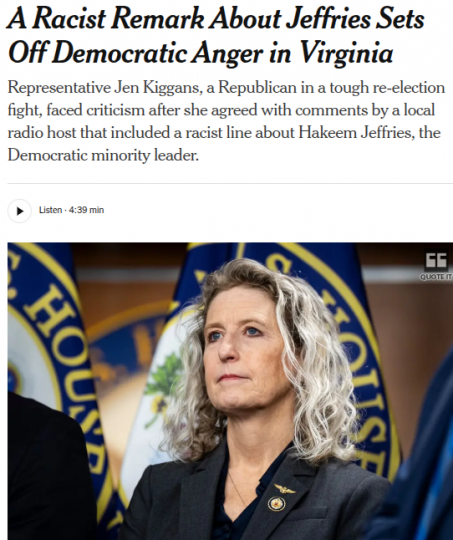
“Racist Remark” — flatly asserted as a fact, as if Kiggans had dropped the N-word, and what, pray tell, was this most grievous insult?

A vulnerable Republican congresswoman in Virginia set off an uproar from Democrats after she agreed with remarks by a local radio host who said that Representative Hakeem Jeffries of New York, the House minority leader and a Black man, should keep his “cotton-picking hands off of Virginia.”
The dust-up surrounding the congresswoman, Representative Jen Kiggans, who is facing one of the country’s toughest re-election battles, is the latest chapter in Virginia’s redistricting saga. Ms. Kiggans was speaking with Rich Herrera, the host of a conservative morning talk show in Richmond, to discuss the fallout from the State Supreme Court’s ruling that invalidated a new congressional map that Virginia voters had approved in an April referendum.
During their conversation, Mr. Herrera lamented a discussion that Mr. Jeffries and Democratic members of the Virginia congressional delegation had on Saturday in which lawmakers discussed the idea of having the entire Virginia Supreme Court replaced in a long-shot effort to restore the voter-approved map.
“If Hakeem Jeffries wants to be involved in Virginia politics, then I suggest he does what a bunch of New Yorkers are doing — leave New York, move down here to Virginia, and run for office down here,” Mr. Herrera said. “If not, get your cotton-picking hands off of Virginia.”
Ms. Kiggans replied: “That’s right. I, ditto. Yes, yes to that.”
After a Democratic opposition research group, American Bridge, circulated a clip on social media of Ms. Kiggans’s response to Mr. Herrera’s remarks, Democrats denounced Ms. Kiggans, with some calling for her to step down from office.

So, Mr. Herrera — who I assume, from his surname, to be of Hispanic ancestry — used a common colloquialism to object to the New York Democrat’s interference in Virginia politics, a sentiment heartily assented to by Rep. Kiggans, a Navy veteran whose district includes Virginia Beach. According to the New York Times, the phrase “cotton-picking” is inherently racist, which is certainly news to me and every other Southerner who ever used it, among them a singer from Memphis:

Samson told Delilah
Loud and clear:
“Keep your cotton-picking fingers
Out my curly hair!”

That song, incidentally, was written by a black man, Claude Demetrius, who became wealthy overnight when “Hard-Headed Woman” hit No. 1 on the charts and was included in the soundtrack of King Creole.

WHITE PEOPLE PICKED COTTON, TOO!

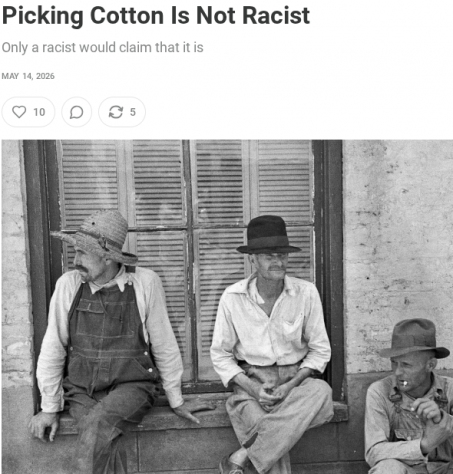
To suggest or imply otherwise is counter-factual. My parents picked cotton in Alabama, as did my aunts and uncles and grandparents. Basically everybody who lived in the rural South prior to World War II picked cotton, and there is zero evidence that, historically, the adjectival phrase “cotton-picking” had any racial connotation.

Now, let me introduce you to Matt Osborne, whom longtime readers may remember as part of the Team Kimberlin crew back in the day (circa 2012) when myself, Aaron Walker, John Hoge and others were engaged in various courtroom entanglements with the pro se pipsqueak pipe bomber. Osborne was a leftist until, at a progressive conference in 2018, he had an unpleasant encounter with fanatical proponents of the transgender agenda. Osborne has since taken a right-hand turn and, at least privately, apologized for his misdeeds on behalf of Team Kimberlin. It is my habit to work in “file-it-and-forget-it” mode. There’s too much craziness in the world for me to commit neural resources to remembering past grievances, and I do not harbor too many grudges (a few cherished grudges will do). So it’s not as if I am in a position to make a grand gesture of magnanimously “forgiving” Matt Osborne; I’m just too busy (or too lazy) to bother Googling the reasons I should still hate him. Your mileage may vary, of course, and if you want to keep hating him, don’t let me stop you. Meanwhile, however, here’s what Matt Osborne wrote about this bogus “cotton-picking” controversy:

According to the Merriam-Webster Dictionary, the term ‘cotton-picking’ has been used as an intensifier since at least 1917. The entry also lists the word as “damned” due to its supposed racial connotations, but this is a modern projection on the past, because slavery had disappeared for two generations. By the time people said ‘cotton-picking’, two-thirds of sharecroppers were white. Old white people in the south still remember their cotton-picking family members.
Spare me your commentary on the Civil War and slavery, please, because sharecropping was a form of economic bondage that applied to blacks and whites in proportion to their share of the southern population for decades after it.
In T.S. Stribling’s The Forge (1931), which is set in north Alabama during and after the Civil War, Miltiades Vaiden and his sister harvest $2,000 worth of cotton themselves because no labor, free or slave, is available. Stribling based his book on a real family; the Scruggs & Vaden cotton gin still exists in Lauderdale County, though it is completely modern.
Despite many patents issued from the 1850s on, no one could produce a practical machine at scale to replace hand-picking of cotton until the 1940s. International Harvester was the first to do this. Even though the first fully-mechanized cotton field was in Clarksdale, Mississippi, the south was slower to adopt mechanized cotton picking than California, which passed the 50% mechanical tipping point in 1951. Hand-picking was not fully replaced in the south until the end of the 1960s.
‘Cotton-picking’ was a thing that poor white people did for almost a century and the phrase was always part of southern life. It was not exclusively or primarily used as a racial epithet, and it never referred to slavery. Rather, the ‘racial undertone’ only exists today in the minds of the recipients who want to hear it as racist.
Such people take umbrage because they wish to feel offended, not because the phrase was ever offensive. No one gets to skip over the parts of history that fail to conform to their priors. This is as true for the postwar sharecropping period as it is for the antebellum south.
So the reader will excuse me if I refuse to join in the tumult of stupidity over Rep. Jen Kiggans of Virginia agreeing with a radio show host that Democratic Rep. Hakim Jeffries should get his “cotton-picking hands off Virginia”. The NAACP is demanding that Kiggans apologize for saying “That’s right. Ditto” in response.
This is yet another fake affront from race-baiting activists. Kiggans was clearly agreeing with the sentiment that Jeffries should leave Virginia alone. Neither she nor Rich Herrera, who is Mexican-American, meant ‘cotton-picking’ as a racist epithet any more than Bugs Bunny did.
Rev. Cozy Bailey, President of the NAACP Virginia State Conference, made it very clear in his statement that politics are the actual purpose of the contrived backlash. Virginia Democrats broke the laws of the commonwealth to pass a redistricting plan that the state supreme court predictably overturned.
Bailey complained that “a large percentage” of the ‘Yes’ voters “are people of color, particularly Black people. And so we are very sensitive in this moment to anything that continues to be oppressive or suppressive to our thoughts.”
Translation: I am being overly-sensitive and feigning oppression because I am actually mad about something else. Literally no one is oppressing or suppressing Bailey’s thoughts, or Jeffries’s thoughts, or anyone else’s thoughts with the phrase ‘cotton-picking’. On the contrary, it is Bailey who wishes to oppress and suppress the spoken thoughts of other people.
Kiggans gave a statement to WDBJ7’s sister station in Richmond, WTVR, agreeing that Herreira “never should have used that language, and of course that’s not the sentiment I was agreeing to.” This was not good enough for Bailey, and we can hope Kiggans will ignore calls for further apologies, because America is exhausted with political actors playing the race card on the flimsiest of pretexts. Cotton is not racist. It is a plant. Picking cotton is not racist. It is agriculture.

Hear! Hear! My only addition to what Matt said is to note that it wasn’t just “sharecroppers” who picked cotton. This involves unfortunate stereotypes surrounding so-called “poor whites” in the South. My ancestors were land owners and respectable people. However, as the old saying had it, they were “land rich, but cash poor.” In the aftermath of the Civil War, and continuing for some 75 years thereafter, poverty was an almost universal condition of the rural South. As my beloved Aunt Pat Huber said, “We didn’t know we were poor — everybody was poor!”

While I could write many paragraphs in defense of the Southern yeomanry, my point is that the stigmatization of self-sufficient farmers, who earned their living by honest labor — including, among other arduous tasks, picking their own cotton — is an insult to people who certainly were not “white trash.” Professor Wayne Flynt’s prize-winning book Poor but Proud: Alabama’s Poor Whites is highly recommended, for anyone who cares to educate themselves on this subject.

To see liberals engage in race-baiting by ignorantly inventing a racist “dog-whistle” connotation for a common phrase makes me angry. It’s so absurd it should not require an answer, and I regret the necessity of having answered at such length. Don’t provoke me again.


Memo From the National Desk: Tales of Fear and Loathing in the Commonwealth

Filet-O-Fish combo and a deadline

LOUISA, Virginia — It was a lovely 150-mile drive to get here for today’s “VOTE NO” rally at the Louisa County Courthouse. A sunny spring day, with the trees turning green, and the picturesque scenery of central Virginia, adorned with signs that the Old Dominion ain’t dead yet.

The courthouse crowd was friendly, and my biggest problem today was that my deadline for the American Spectator was 6 p.m., which meant that when the rally ended at 4, I had to race over here to the McDonald’s, set up the National Desk in the corner booth and get to work. Cranking out 1,000 words in two hours? Yeah, I used to do that routinely during the years when I was a roving campaign correspondent, but I was younger then, and the deadline rush is more challenging now that I’m a gray-bearded senior citizen. That Filet-O-Fish combo cost $10.34, if any of y’all are thinking of hitting the tip jar, as I certainly hope you do.

Some of y’all remember how wild it was back in the days of the Tea Party, when I raced all over upstate New York in a rented Nissan covering the special election campaign that ended the political career of Dede Scozzafava, then turned right around to cover Scott Brown’s campaign to win Ted Kennedy’s Senate seat in Massachusetts. For the final week of the 2010 midterm campaign, I drove all the way to Boca Raton, Florida, where I spent election night at Allen West’s victory party. There were a lot of victory parties that night — “The Republican Mandate,” I called it, after Ann Marie Buerkle was finally declared the winner in a New York district where she was outspent 5-to-1 by the Democrat incumbent she beat.

There’s a reason I don’t believe in quitting, because I have seen miracles with my own eyes. If you believe you can win, confidence is contagious, and a real grassroots effort can overcome even the most formidable odds. Such are the odds facing Republicans in this Virginia referendum battle, where the GOP has been outspent at least 3-to-1 by the big-money Democrats (including, of course, George Soros). The key point is that this is a special election with nothing else on the ballot except this godawful gerrymander, and polls indicate that at least 25% of Democrats don’t want to vote for Spanberger’s Monster, as we might call it. If Republicans can get any kind of grassroots energy going, they can deliver a punch in the nose that will make Democrats regret they ever tried to inflict this scheme on the Commonwealth. There are some hopeful signs.

People here are offended by what Spanberger and the Democrats are trying to do to them. This county would be shoved into a district that looks like a bad sketch of a lobster, the tail reaching all the way up to the Potomac River more than 100 miles away. All we can do is hope that their indignation is sufficient to inspire an overwhelming turnout that overwhelms the foreign scum currently occupying Northern Virginia.

Anyway, that’s getting ahead of the game. My column in the American Spectator should be online around midnight, and I’ve still got a two-and-half hour drive to get back home. Maybe you could cover that $10.34 Filet-O-Fish combo, or $4 for a gallon of gas, but as always I remind you that the Five Most Important Words in the English Language are still:

HIT THE FREAKING TIP JAR!


What Happens When Liberals ‘Succeed’

Liberalism is about winning elections. Whatever the actual results of liberal policies may be, in terms of the well-being of the people who vote for liberals, are of no real consequence. So long as liberals keep winning elections, they consider their policies successful. We see this all the time in places like Baltimore, Philadelphia and St. Louis where, no matter how objectively bad things get — no matter how much poverty, misery and violence prevail — Democrats keep getting re-elected.

The Chicago Bears are reportedly ready to relocate to Hammond, Indiana, because Illinois has been controlled so long by Democrats that not even relocating from Chicago to the suburbs would have saved the franchise; the only hope for the Bears was to leave the state entirely. Businesses and people are fleeing the state; such companies as Boeing, Caterpillar and Tyson Foods have pulled their headquarters out of Illinois. One reason that Democrats in Illinois are so desperate to stop the deportation of illegal aliens is because without foreigners, the state would be losing population. Despite the deepening crisis in Illinois, however, the people there keep voting for Democrats — Kamala Harris got 54% of the vote there in 2024. There is no incentive for change if Democrats keep winning no matter what. And something similar is underway north of the border, which brings us to the news that has shocked Canada:

For eons, Canadians have viewed Alabama as a small state that, save for a few pockets, is dirt poor. All anybody seems to know about Alabama is that Montgomery and Birmingham were the centre of the civil rights movement. In 1963, when Martin Luther King Jr. wrote his “Letter from a Birmingham Jail,” he called Birmingham “probably the most thoroughly segregated city in the United States.”
So, it was a shock when Canadian economist Trevor Tombe and the International Monetary Fund ran the numbers in 2023 and 2024 and concluded that Canada had, in fact, become poorer than Alabama. . . .
After adjusting for foreign exchange and some cost differences in both countries, the average for Canada’s 10 provinces was estimated at at US$55,000 in 2022, the same as Alabama. Shortly after, the IMF found Canada had actually fallen behind the southern state. (Canada has since edged ever-so-slightly higher than Alabama; the numbers are volatile from year to year.)
The timing was terrible for the Canadian psyche. Home prices were on an astronomical trajectory, inflation made everyday items such as groceries far more expensive and there was deep resentment toward Ottawa. Canadians could probably stomach having their living standards slip relative to the broader U.S., the epicentre of the world’s tech revolution. But Alabama? . . .

Yes, Alabama! If anyone wonders why Canada is now lagging behind Alabama, let me make a digression. About 30 years ago, I noticed an emerging theme in Democratic messaging. Our problem, they said, was a “growing gap between rich and poor.” This was the theme of numerous newspaper columns and a talking point in speeches by Democratic politicians, and it got me to wondering why this gap was growing.

Was it a matter of economic policy? Was racism — “RAAAAACISM!” — somehow a factor in this growing gap? And after some study, itn finally hit me: Immigration! It turns out that an influx of cheap labor from the Third World increases poverty. You don’t need a Harvard Ph.D. to figure this out. Every year during the 1990s, at least a million immigrants (both legal and illegal) were being added to the U.S. population. Most of these immigrants came from countries much poorer than the United States, lacked specialized work skills and arrived with few if any assets.

Most were not fluent in English, and quite a few of them were completely illiterate, even in their own native languages. No matter what other policy the government might pursue, the constant addition of so many immigrants — a million this year, a million next year, and so on, year after year — would inevitably increase the percentage of the population living at or below the poverty line. But liberals were ignoring this obvious factor in economic trends, instead focusing on statistical changes that got translated to “a growing gap between rich and poor.”

Well, guess why Canada has fallen behind Alabama?

In the 2015 election, Canada’s Liberal Party defeated the Conservative Party, and Justin Trudeau was the Prime Minister for the next 10 years before being succeeded by another Liberal, Mark Carney. So during a decade when the United States has rocked back and forth — Obama, then Trump, then Biden, then Trump again — Canada has been governed the whole time by the Liberal Party. And as long as the Liberals keep winning elections, that’s success, even though they’re falling behind Alabama.


Dow Jones Gains Nearly 3,000 Points After Trump Deports Gay Makeup Artist

Look, I’m not one of these All-Purpose Expert types who hangs around on social media all day pretending to know everything about whatever’s the big Democratic Party talking point at the current moment. Today’s economic “expert” was, just a few weeks ago, an “expert” on national security, and last October was an “expert” on election polling. Go back to 2014, and their area of expertise was the “campus rape epidemic,” but then in 2016, they suddenly acquired authoritative knowledge of Russian “election interference.” In 2020, they became experts on viral epidemiology before turning their attention to “systemic racism.”

So I don’t claim to know why the stock market suddenly boomed upward this afternoon, and I’m not sure the media does, either:

The stock market mounted one of its biggest rallies in history after President Donald Trump announced a pause in some of his “reciprocal” tariffs on the globe, causing a market that has been under extreme pressure for the past week to explode higher.
The S&P 500 skyrocketed 9.52% to settle at 5,456.90 for its biggest one-day gain since 2008. For the broad market index, it was the third-biggest gain in post-WWII history. The Dow Jones Industrial Average advanced 2,962.86 points, or 7.87%, to close at 40,608.45 for its biggest percentage advance since March 2020. The Nasdaq Composite jumped 12.16% to end at 17,124.97, notching its largest one-day jump since January 2001 and second-best day ever.
About 30 billion shares traded hands, making it the heaviest volume day on Wall Street in history, according to records that go back 18 years.
“I have authorized a 90 day PAUSE, and a substantially lowered Reciprocal Tariff during this period, of 10%, also effective immediately,” Trump posted on his Truth Social. Trump, in the same post, said he was raising the tariff on China higher again to 125%.
Treasury Secretary Scott Bessent later clarified that all countries except China would return to the 10% baseline tariff rate, down from the higher rates that previously shocked the markets, as negotiations take place.

OK, so the “experts” are telling us that this has something to do with tariff policy, and maybe they’re right. On the other hand . . .

A gay makeup artist who arrived in the US last year in search of asylum has been flown to a maximum-security prison in El Salvador.
Andry José Hernández Romero was one of 238 Venezuelan migrants deported by the Trump administration on 15 March, reports CBS News.
The news follows a deal brokered between President Trump and El Salvador’s president Nayib Bukele allowing the US to send deportees to the central American’s country maximum security Terrorism Confinement Center, known as CECOT, located in Tecoluca.
“Our client, who was in the middle of seeking asylum, just disappeared. One day he was there, and the next day we’re supposed to have court, and he wasn’t brought to court,” Lindsay Toczylowski, Hernandez Romero’s lawyer, told CBS’s 60 Minutes.
“It’s horrifying to see someone who we’ve met and know as a sweet, funny artist, in the most horrible conditions I could imagine.”
Lawyers and family members for the deportees say they have had no contact with the prisoners since they were deported. However, TIME photojournalist Philip Holsinger, who has been reporting from the ground at CECOT, has reportedly described hearing one young man say, “I’m not a gang member. I’m gay. I’m a stylist,” as he cried out for his mother, was slapped and had his head shaved.
Hernandez Romero’s crown tattoos are the only evidence US immigration officials have given in court to accuse him of being part of Tren de Aragua, a Venezuelan gang Trump is campaigning to eradicate. . . .
Meanwhile Hernández’s mother, Alexis Dolores Romero de Hernández, has been quoted by The Guardian as saying: “Everyone has these crowns, many people. But that doesn’t mean they’re involved in the Tren de Aragua … He’s never had problems with the law.”
She furthermore added: “Let my son go. Review his case file. He is not a gang member.”

Oh, don’t worry, the “sweet, funny artist” should be very popular among his fellow inmates in the Salvadoran maximum-security prison.

Every Democrat in Congress will run for reelection next year promising to protect the rights of gay Venezuelan makeup artists. Why, I can hear Jasmine Crockett now, saying she’s “done picking cotton” — and done doing her own makeup, too! But what about the rights of gay American makeup artists, huh? When you start importing gay makeup artists from Third World countries, it drives down the wages of native-born gay makeup artists. Or at least, that’s what some “experts” tell me.

Correlation is not causation, except when it is, but I’m not claiming to be an expert on cosmetic artistry or economics, either. All I know is that (a) Andry José Hernández Romero is now in a Salvadoran maximum security prison and (b) things look a lot better for the 401(k) balance.

Post hoc ergo propter hoc, as experts in Latin would say.

In completely unrelated news, Britney Spears is still crazy.


Shop Electronics at Amazon

Save on Groceries and Everyday Essentials

Shop Amazon Basics

Office & School Supplies

BREAKING NEWS: Washington Post Columnist Understands Economics!

The Pulitzer Prize committee hasn’t solicited any suggestions from me, but maybe they should consider Catherine Rampell of the Washington Post for a special award, because I can’t remember the last time anyone at the Post exhibited any real comprehension of how markets work.

In case you missed it — because, really, who cares? — this past week, Kamala Harris rolled out “her” economic policy agenda. The scare-quotes around “her” are necessary because Kamala has never in her life had an original idea, and “her” economic plan is no exception to that rule. Central to this economic plan is an idea stolen from Elizabeth Warren, a federal ban on “price gouging.” Like every other Elizabeth Warren idea, this is a very bad idea, as Matt Margolis explains:

The proposal, of course, is Soviet-style price controls branded as a federal ban on price-gouging. The proposal tries to kill two birds with one stone by simultaneously deflecting blame for inflation onto corporate greed — rather than the economic policies of the Biden-Harris administration — and convincing the public that she has the solution to fix it.

“If you like your bread lines, you can keep your bread lines.”

Rampell’s column in the Post rips Kamala to tatters:

“Price gouging” is the focus of Vice President Kamala Harris’s economic agenda, her presidential campaign says. She’ll crack down on “excessive prices” and “excessive corporate profits,” particularly for groceries.
So what level counts as “excessive,” you might ask? TBD, but Harris will ban it.
That’s the thing about price gouging: As has been said of hardcore pornography, you know it when you see it.
It’s not hard to figure out where this proposal came from. Voters want to blame someone for high grocery bills, and the presidential candidates have apparently decided the choices are either the Biden administration or corporate greed. Harris has chosen the latter.
In a news release Wednesday, her campaign said the first 100 days of her presidency would include the “first-ever federal ban on price gouging on food and groceries — setting clear rules of the road to make clear that big corporations can’t unfairly exploit consumers to run up excessive corporate profits on food and groceries.”
What are these “clear rules of the road” or the thresholds that determine when a price or profit level becomes “excessive”? The memo doesn’t say, and the campaign did not answer questions I sent seeking clarification. . . .
It’s hard to exaggerate how bad this policy is. It is, in all but name, a sweeping set of government-enforced price controls across every industry, not only food. Supply and demand would no longer determine prices or profit levels. Far-off Washington bureaucrats would. The FTC would be able to tell, say, a Kroger in Ohio the acceptable price it can charge for milk.
At best, this would lead to shortages, black markets and hoarding, among other distortions seen previous times countries tried to limit price growth by fiat. (There’s a reason narrower “price gouging” laws that exist in some U.S. states are rarely invoked.) At worst, it might accidentally raise prices. . . .

You can read the rest, and frankly, now I’m worried about Catherine Rampell’s safety. Telling the truth about how bad Democratic policies are? Is that even allowed? Isn’t it racist to say Kamala would wreck the economy worse than it’s been wrecked already? It’s probably just a matter of time before Rampell is the target of an exposé by Taylor Lorenz.


Shop Electronics at Amazon

Save on Groceries and Everyday Essentials

Shop Amazon Basics

Office & School Supplies

They’re Calling It the ‘Kamala Crash’

Stocks tanked today, with the Dow Jones Industrial Average (DJIA) falling more than a thousand points (down 2.6%) while both the S&P 500 and NASDAQ recorded their worst days since September 2022. There is no reason to panic over this one-day loss, of course, since the long-term trend is still upward, no matter the short-term hit to your 401(k) account.

It’s being called the “Kamala crash” because one of the things that may have triggered the sell-off was that investors believe there is an increased likelihood of Kamala Harris becoming the next president. To help explain what’s going on here, look at these charts:

On June 27, the DJIA closed at 39,164.06. That evening, however, Joe Biden suffered a catastrophic debate performance and within a few days, the markets started surging. About two weeks later, it broke 40,000 for the first time in history, and on July 17 reached a peak of 41,198.08, having gained 2,034.02 points (+5.2%) in three weeks.

Of course, many things can affect the stock markets, but it’s hard to avoid the obvious interpretation here: As the polls began showing Joe Biden losing ground in the election, confidence rose as investors believed that Trump was likely to be the next president, bringing a pro-business policy agenda back to the White House. In the 10 days after Biden announced he would quit his reelection bid, the Dow dipped, then climbed again, but the media was busy cranking out a lot of pro-Kamala hype, and doubts began to shadow the market. By last week, Democrats had circled the wagons and organized a “virtual roll call” to officially anoint Harris as their nominee, and the bottom has now fallen out of the market, with the DJIA losing a total of 2,494.81 points (-6.1%) since its July 17 peak.

The damage wasn’t confined to Wall Street. Trading volumes surged across crypto casinos and digital asset exchanges while Treasury yields dropped as investors scrambled for safety. All of it pointed in one direction: the market was repricing the election.

Maybe the stock markets are right. Maybe the chances of Kamala Harris getting elected have increased in the past two weeks. On the other hand, she’s never been really popular with voters, her 2020 campaign was a flop, and I see no reason to believe that she’s learned anything from that experience. Harris is a bad candidate, and once this “honeymoon” phase is over, I expect America to reject her. We can then look forward to a new economic boom beginning on Wednesday, November 6.


Shop Electronics at Amazon

Save on Groceries and Everyday Essentials

Shop Amazon Basics

Office & School Supplies

Boomers, Millennials and Stereotypes

Mr. & Mrs. Matthew Schmitz

One of the unfortunate habits of journalists, academics and other members of the intelligentsia is to generalize about generations to the point of promoting stereotypes. It is somehow acceptable to make categorical characterizations of Baby Boomers in a way that would be considered racist — RAAAAACIST! — were one to make such broad generalizations about ethnic groups. Vox Day (b. 1968, and therefore a member of Generation X) often sneers at Boomers in this manner, which annoys me. Being a “Boomer tradcon” in Vox’s telling, makes me complicit in every failure of the Republican Party for the past 30 years, despite my avowed opposition to all of the most obvious errors of the GOP during that period. For example, it was not me who thought that nominating John McCain in 2008 was a good idea; in fact, I voted for Bob Barr on the Libertarian ticket that year, as there was obviously no point in voting for the doomed “Maverick,” who was wrong on every issue that mattered, especially immigration. I am generally paleoconservative, and agree with much of Vox’s indictment of “tradcon” errors, yet there I am, categorically denounced merely by virtue of being born in 1959.

All of that is preamble to introducing Matthew Schmitz, an earnest young native of Nebraska who graduated from Princeton and became a senior editor at First Things, a conservative publication founded by the late Richard John Neuhaus. A Millennial (born circa 1986), Schmitz has published an article entitled “The New Midlife Crisis”:

Check all the boxes, then chuck it all aside at forty to follow your muse. Play by the rules and win, only to decide that you don’t want the prize. Most of the rebellions were minor. The devoted housewife informed her husband that she would not be cooking dinner for the family on Tuesday and Thursday nights, as she was finally taking the art class she had always dreamed of. The cliché for men was the red convertible. But some people set off explosions: quitting jobs, filing for divorce, engaging in affairs.
For Baby Boomers, the midlife crisis was very nearly a rite of passage. John Updike made a career of chronicling the earthquakes that rattled the mannered world of upper-middle-class suburbanites. But that world of well-scrubbed children, stay-at-home wives, and afternoon cocktails seems as remote today as King Arthur’s court. For most millennials, the idea of being a forty-year-old ad executive on a commuter train, oppressed by routine and convention as he returns to his spacious suburban home, wife of eighteen years, and two teenage children, is just a fantasy. For those who haven’t yet found a spouse or bought a house, it might seem not a nightmare but a dream. . . .
Baby Boomers got married, owned homes, and had kids. The price was conformity. No doubt it could be stultifying. But for most people, the crisis was mild. You could waste money on a sports car and still have grandchildren someday. That was true even if your affairs led to a messy divorce. What of my generation? Our plan of life has been to put off the old patterns of adulthood.

(Hat-tip: Stephen Green at Instapundit.) Let us stipulate, at the outset, that comparing the life experiences of two age cohorts in a general way, to examine the way how social change has affected those experiences, is a worthwhile endeavor. For example, I might compare my own experience to that of my parents, who were born in rural Alabama and made their way to Atlanta (and eventually its suburbs) in the 1950s. They were born in the era of the Model T Ford, and by the time I was born, were living in the era of interstate highways, jet aircraft and nuclear weapons.

In general, then, it is worthwhile for Schmitz to compare what a typical “midlife crisis” meant for Baby Boomers, as compared to what it means for younger Americans. As he points out, before you get divorced, you first have to get married, and the under-40 cohort has historically low marriage rates. In particular, Millennials have tended to delay marriage and, especially among college-educated women, to delay childbearing to such an age that becoming a mother may require medical intervention, if it is even still biologically possible. Whereas, by comparison, when I was living the bachelor life back in the 1980s, I was being countercultural — because in the Bible Belt, most folks still got married in their late teens or early 20s — nowadays, it would be countercultural to marry young.

Interestingly enough, my kids are countercultural in this way. Our eldest daughter married at 21 and, of our six children, the only two who haven’t married yet are Jefferson (a 25-year-old law school student) and our youngest daughter, Reagan, now a 21-year-old college junior.

You do not have to follow social trends; you do not have to be a slave to peer pressure. Intelligent people can evaluate choices rationally, and make choices based on their own judgment, rather than being another sheep in the conformist herd. Of course, larger social factors may limit one’s choices. Beginning with Ronald Reagan’s presidency, there was a general economic expansion, a boom that lasted until the 2008 collapse caused by the mortgage crisis. For those who have come of age in the past 15 years — a cohort that includes Matthew Schmitz — economic realities have generally been less encouraging, and the housing market in particular has been made difficult by “Bidenflation.” Furthermore, employment opportunities have been diminished by various regulatory impositions of government (a fact of which Democrats seem oblivious), and many young people have no choice but to become freelance hustlers in the “gig economy,” because there are fewer full-time jobs available.

General economic conditions, however, cannot explain everything wrong with the lives of Millennials (or Gen Z). The lazy bum sitting on the sofa in his mom’s basement, playing videogames all day, is not a victim of anything except his own sloth. For every miserable young slacker like that, you can point out many others who are energetic and industrious and who, as a consequence of their good traits and good attitudes, have a clear path ahead to success and happiness in life.

Certainly, I suppose Matthew Schmitz points out the unfortunate trends among young Americans in order to encourage them to stop following these trends: “Be not conformed to this world,” etc. What was good advice to the early Christian church in pagan Rome is also good advice to anyone living amid the neopagan decadence of 21st-century America.

Because I was never a character in a John Updike novel, I resent having my life experience depicted as some kind of generational stereotype, and I’m sure that Matthew Schmitz would not enjoy being lumped in with the stereotypes of his own generation. He’s not a lazy slob or an anarchist spray-painting pro-Hamas graffiti on synagogues (to name just two of the many varieties of antisocial behavior popular among today’s youth), and unless he’s recently dyed his hair purple and gotten his earlobes gauged, seems to have avoided the worst trends of the era.

About 1,200 words ago, I began this post by comparing the stereotyping of generations to racism. Think about the phrase “the black community,” which is used to imply a monolithic commonality of interest among the 46 million black people in America. “The black community” is viewed as generally poor and oppressed, simply because of statistics, i.e., comparing group averages. Certainly it is true that, on average, black people have lower incomes than white people, but to turn this statistical comparison into a definitive description of “the black community” is unfair to those black individuals who strive to be more than average.

In fact — perhaps a white guy isn’t supposed to say this — many ambitious black people try to get as far away from “the black community” as possible. They want to make it into those John Updike suburbs, with spacious homes on tree-lined streets, and become part of the respectable bourgeoisie, living the American Dream. To achieve this goal, they must swim against the cultural tide of stereotypes which presents “the black community” as defined by ghetto behavior. Your chances of making it to bourgeois respectability are near zero if you don’t reject that ghetto mentality, and yet some pundits profess to be shocked by the emerging trend of black Trump voters. The idea of “the black community” as a political monolith, like the idea of Baby Boomers as a monolith, is a mistake, a mental trap of categorization that can blind us to individual differences. Because I’ve spent my entire life fighting against certain negative stereotypes of my own ethnic group (never tasted moonshine and I don’t play the banjo), I can relate to the dilemma of the black man who is accused of betraying his “community” if he doesn’t want to live the ghetto life (including the ghetto politics of the Democratic Party).

Rebellion, you say? Yes, there’s quite a tradition of that in my family, but “very fine people on both sides,” as someone once said.

If following the current trend means going straight to Hell — which is where it’s heading now — then it’s good to be a rebel. Deo vindice.


Shop Electronics at Amazon

Save on Groceries and Everyday Essentials

Shop Amazon Basics

Office & School Supplies

Election Results HQ: The Check Engine Light Is Flashing for ‘Bidenomics’ UPDATE: Dem Reelected Ky. Governor UPDATE: Dems Hold Virginia Senate

UPDATE 8:50 p.m. ET: The networks just called the Kentucky election. Democratic Gov. Andy Beshear holds off GOP challenger Daniel Cameron.

UPDATE 9:15 p.m. ET: The networks have also called Ohio’s abortion rights referendum, which appears set to pass with about 57%. By the way, I’m watching election coverage on CNN (so you don’t have to) and, oh, they’re just so happy happy happy tonight.

UPDATE 10:05 p.m. ET: It appears Democrats will maintain control of the state Senate and, in fact, Republicans may lose control of the House of Delegates. In Mississippi, GOP Gov. Tate Reeves looks like he’ll defeat Democratic challenger Brandon Presley, second cousin of Elvis.

*** PREVIOUSLY (5:15 p.m. ET) ***

Tonight there will be election results in Kentucky, Virginia, New Jersey, Mississippi, Ohio and Pennsylvania. The most closely watched contest will be the governor’s race in Kentucky, where the Trump-backed Republican challenger, Attorney General Daniel Cameron, had a late poll surge and is now tied with Democratic Gov. Andy Beshear. What could explain this huge change — Cameron has gained 15 points in a matter of weeks, according to the Emerson College poll — in a race that Beshear had been leading by double digits? My first guess would be the Gaza war, which probably doesn’t make a lot of real-world difference to Kentucky voters, but has sowed discord in Democratic Party ranks.

On the other hand, based on past experience, when you see a massive swing in the polls in such a race, the explanation is usually that the surging candidate got a huge boost from a TV ad blitz. A really effective attack ad, run in saturation, can destroy a vulnerable candidate, and my guess is that the GOP waited until October to unleash it’s hardest-hitting attack on Beshear, pouring in a few million dollars worth of ads that have tied the incumbent Democrat to Joe Biden’s disastrous policies.

Democrats have spent the past three days wringing their hands in anguish over the New York Times/Sienna College poll:

“I am concerned,” Sen. Richard Blumenthal (D-Conn.) said in an interview. “I was concerned before these numbers. I am concerned by the inexplicable credibility that Donald Trump seems to have despite all of the indictments, the lies, the incredible wrongdoing.”
New York Times-Siena College polls found Biden trailing Trump in five of the six most competitive battleground states: Trump led Biden by 10 percentage points in Nevada, six in Georgia, five in Arizona and Michigan and four in Pennsylvania. Biden led Trump by two in Wisconsin. In 2020, Biden defeated Trump in all six of those states, though generally by very narrow margins.
Of particular concern to Biden allies are indications that his support among Black voters, who were critical to his victory in 2020, may be softening. . . .

(Hat-tip: Stephen Green at Instapundit.) If black voters expected anything good from Joe Biden, they have been as disappointed as anyone else foolish enough to think “Bidenomics” would work. The basic truth is, good policy is good politics, and however much anyone may have hated Donald Trump personally, his economic policies were far better than Biden’s. So now the check engine light is flashing for Democrats, and they may be planning to rerun the “Torricelli Gambit” for 2024, but in the meantime, there will be election results tonight.

UPDATE 6:30 p.m. ET: Early results from Kentucky:

Daniel Cameron (R) ….. 5,415 (54.6%)
Andy Beshear (D) …….. 4,496 (45.4%)

Polls are still open in Western Kentucky (in the Central time zone) and these numbers represent just 1% of the expected total.

UPDATE 7:25 p.m. ET: Now 27% reporting from Kentucky:

Daniel Cameron (R) ….. 174,054 (43.4%)
Andy Beshear (D) …….. 227,201 (56.6%)

Doesn’t look good right now for Cameron.

UPDATE 7:45 p.m. ET: A ballot measure in Ohio would amend the state constitution to guarantee the legality of abortion:

YES ………. 125,686 (70.6%)
NO ……….. 52,409 (29.4%)

That’s with just 5% of the vote counted.

UPDATE 8 p.m. ET: The situation in Virginia is this: Republicans came into today’s election holding the House of Delegates with a four-seat margin, 52-48, while Democrats held the state Senate by a four-seat margin, 22-18. With Gov. Glenn Youngkin, GOP could consolidate their control by flipping the Senate and holding the House. So far, everything is still too close to call. Now 55% reporting from Kentucky:

Daniel Cameron (R) ….. 375,589 (46.9%)
Andy Beshear (D) …….. 424,213 (53.0%)

The Democrat incumbent maintains a 50,000-vote lead.

UPDATE 8:30 p.m. ET: Now 65% reporting from Kentucky:

Daniel Cameron (R) ….. 457,011 (48.0%)
Andy Beshear (D) …….. 495,398 (52.0%)

Beshear’s lead is now less than 40,000 votes.

With 22% of the vote on the Ohio abortion-rights referendum:

YES ………. 551,815 (63.4%)
NO ……….. 320,788 (36.6%)

UPDATE 8:40 p.m. ET: Remember Susanna “HotWifeExperience” Gibson, the Democratic candidate who got caught selling sexy videos on the Internet? Well, she’s currently leading her Republican opponent by about 150 votes with 66% of the vote counted in House District 57.