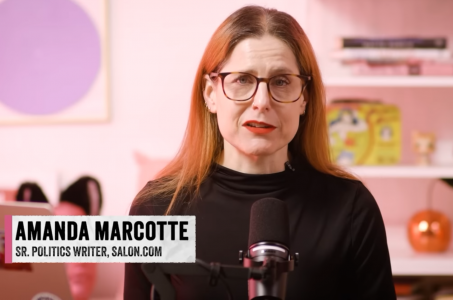
How many years have I been mocking Amanda Marcotte? Many, many years. Nearly two decades. She got mentioned in the very first National Offend a Feminist Week announcement back in May 2009, by which time I’d been mocking her regularly for more than a year. It’s been a while since I was compelled to pay attention to her, but then Dana Pico reminded me of her existence. Last week, after the “Cornell 7” case began making national headlines, Dana remarked:
I will admit it: I checked Miss Marcotte’s Salon postings, but it seems that she learned something from the rotten egg on her face twenty years ago: she hasn’t weighed in on this case, at least not yet.
He did not have long to wait, however, because two days later, Marcotte published a column about the Cornell situation, prompting Dana to return to the scene of the crime:
Amanda Marcotte, telling other people to shut up? Did she not see the irony in that when she wrote it? . . .
Miss Marcotte’s concluding paragraphs, and really her entire article, are based on the assumption, and I suspect her personal belief, that Lucy Craig’s accusations are true.
In case you have already forgotten, Lucy Craig is the former sorority girl whose lawsuit made this a national controversy. Her lawsuit calls her “Jane Doe,” but her identity is not really secret. While I’d gotten caught up in that argument — was the identification of “Jane Doe” correct? if so, was it fair to name her? — I didn’t want to be just another voice adding my two cents to the general uproar about the “Cornell 7.”
No national controversy is complete until Amanda Marcotte has made a fool of herself about it, and the feminist writer has gotten a good head start on the so-called “Cornell 7” case. The sordid tale of an Ivy League orgy that devolved into accusations of sexual assault prompted Marcotte to indict “Trumpism” as somehow explaining skeptical reactions to the story.
Before getting into the details of what happened to “Jane Doe” at a Cornell University frat house two years ago — or what Marcotte had to say about it — it is best to begin by recalling Marcotte’s history of error and folly. . . .
Under “Recommendations for Policy and Process Improvement,” the task force recommends clarifying the definition of “incapacitation” in order to differentiate between “wrongful” and “permissible” conduct.
A university spokeswoman told The College Fix by email that the school defines incapacitation as an “inability to make informed, rational judgments.”
When substances are involved, “incapacitation” refers to how “alcohol or drugs consumed” can affect decision-making, including consequences and judgments, the spokeswoman said, responding on behalf of the Office of Institutional Opportunity and Access. . . .
(Fact: Young people commonly get drunk or high for the specific purpose of lowering their inhibitions, thus to facilitate or enhance sexual activity that they would be too afraid or embarrassed to initiate or enjoy if they were sober. This is what was meant by the old joke in which the “mating call of the Southern sorority girl” was described as, “Woo-hoo! I am SO drunk, y’all!”)
The Office of Institutional Opportunity and Access uses “incapacitation” as part of its multifaceted definition of sexual violence: “Taking sexual advantage of another person without consent, including causing or attempting to cause the incapacitation of another person.” . . .
(Fact: The legal drinking age is 21. If university officials are worried that “incapacitation” due to drunkenness is a contributing factor in sexual assault cases — as it obviously often is — the most obvious expedient would be to crack down on underage drinking by students. Yet because administrators at almost every university tolerate illegal underage drinking by freshmen and sophomores, we are told there is a “rape crisis” on campus when it usually seems more like a “drunk teenage sex crisis” on campus.)
The Kansas task force also acknowledges the vagueness in defining coercion as “unreasonable pressure for sexual access” because it does not distinguish between “coercive” versus “non-coercive sexual conduct.” . . .
The Office of Institutional Opportunity and Access uses the word “unwelcome” several times to describe prohibited behavior: One of those is “unwelcome efforts to develop a romantic or sexual relationship” or “unwelcome physical touching or closeness.”
Here, in the effort to add “coercion” to the definition of sexual assault, we see the real agenda behind feminism’s “rape culture” discourse. To put it bluntly, it is an attempt to criminalize male heterosexuality.
If you have studied feminist writing about sexuality, you know that they stretch the word “coercion” beyond recognition, so that male behavior which is entirely normal, customary and lawful is depicted as part of a “continuum of sexual aggression.” A presentation called “Understanding the Continuum of Sexual Violence” describes it this way:
Sexual violence is supported by the attitude or viewpoint that women are sex objects, and often takes the form of suggestive looks or actions, sexist comments, and sexual exploitation. All too often our society treats objectification of women as a cultural norm that does no real harm. Men whistling at and calling out to women on the street is tolerated, jokes or rude comments are the daily fare of talk shows and other media venues, and sexually pornographic material proliferates under the guise of freedom of speech and expression. All too often, none of this is considered “criminal” but is part of a largely accepted societal attitude towards women.
The level to which our society accepts sexual objectification creates a foundation where this becomes the absolute value of women.
What is involved in this, you see, is the creation of a connect-the-dots theory about “rape culture” in which anything that is deemed offensive, from “suggestive looks” to “jokes or rude comments,” is construed as part of a “societal attitude” that contributes to sexual assault. By this means, every double-entendre in an old Marx Brothers comedy becomes part of “rape culture,” while every vintage pin-up is also implicated in this “continuum” because it involves “sexual objectification.”
So now, in attempting to codify “coercion” and “harassment” as part of university policy, we find ambiguous phrases like “unreasonable pressure for sexual access” — how much “pressure” is “reasonable”? — as well as the use of the word “unwelcome” to describe “efforts to develop a romantic or sexual relationship” or “physical touching or closeness.”
Stipulate that some guys have deficient social skills, and are not good at “reading signals,” as we used to say, while other guys simply don’t know how to deal with rejection. Especially when we are talking about young guys (teenage boys, really, 18 or 19 years old, and away from home for the first time) it is inevitable that many of them will make awkward (“unwelcome”) attempts to “develop a romantic or sexual relationship.” This is inevitable, as I say, and unless you are engaged in a War Against Human Nature, you expect young women to be prepared to deal with male attention that is “unwelcome,” as well as “pressure” that is “unreasonable.”
Feminist ideology, however, demonizes male sexuality in such a way as to relieve women of all responsibility in negotiating the ordinary difficulties of normal sex life. Any attempt to advise females about avoiding sexual danger is condemned by feminists as “blaming the victim.” When confronted with the typical “he-said/she-said” cases that are cited as evidence of a campus “rape epidemic” — which usually involve what seems to be an unhappy misunderstanding between two drunk teenagers — your effort to discuss the ambiguities without presuming the guilt of the accused male could result in you being branded a “rape apologist.”
An 18-year-old college freshman starts knocking back tequila shots at a party, grinding on the dance floor with any guy who strikes her fancy and — surprise! surprise! — wakes up naked the next morning beside a complete stranger, with only the vaguest recollection of how she got there or why she’s feeling so sore and sticky. It’s impossible under the circumstances to prove she was raped, but her predicament (alas, too common in the binge-drinking “hookup culture” that prevails on many campuses) can be interpreted by a school disciplinary tribunal as sexual misconduct by the guy who “got lucky” with the drunk freshman and he may face expulsion as a penalty.
Is there a problem with sexual behavior on university and college campuses? Yes. It involves porn. It involves booze. It involves a decline of Judeo-Christian morality among youth. Even if you’re an atheist, even if you think illegal underage drinking is acceptable, even if you approve the Internet-driven flood of pornographic filth into the impressionable minds of adolescents — even granting all those caveats and exemptions for liberalism’s see-no-evil attitudes about such things, can’t we agree that this convergence of harmful influences creates a potentially dangerous sexual climate?
Although I know “Jackie” at UVA lied about being gang-raped at Phi Kappa Psi, I would never want my daughter to set foot in a frat party, or any other situation where college boys are getting drunk. Whether or not any of them could be trusted sober, they damned sure can’t be trusted when they’re drunk, and any college girl foolish enough to think otherwise is likely to wake up sore and sticky the next morning. You can go chant slogans at a “Take Back the Night” rally if you want, but you’re never going to win a War Against Human Nature.
Meanwhile, the attempt to criminalize male heterosexuality — which is what feminism’s “rape culture” discourse is really about — is likely to have consequences that neither the feminists nor their opponents can anticipate. Culture shifts often operate like Newton’s Third Law of Motion, where there is an equal and opposite effect. The degrading influence of pornography has inspired truly disgusting behavior among some young people (see paragraphs 16, 18 and 26 in the Nungesser v. Columbia lawsuit). Yet if that is the “equal” effect of the Newtonian equation, we can also perceive an opposite effect in the noticeable increase of women preferring lesbian relationships to such painful degradation in the contemporary “hookup culture.” We may observe that Emma Dawson, who was an ardent advocate of “sex-positive” feminism at Wesleyan University, thought it was a “good opportunity to remind everyone I’m queer” after she gained notoriety by making a public issue of her herpes infection.
The word “queer” has been popularized to include a wide range of sexual behaviors, so that a “queer feminist” is not necessarily a lesbian. Because she recounts various heterosexual exploits in her herpes narrative, we may presume that “queer” for Dawson signifies she’s a sort of bisexual Ado Annie. So, she’s a herpes-infected 22-year-old queer who paid $47,972 a year to get a bachelor of arts in Feminist, Gender, and Sexuality Studies. Probably a Democrat, too.
Gotta be pretty bad out there, if any guy would resort to “unreasonable pressure for sexual access” to girls like that.
A former math teacher at New Braunfels Christian Academy was arrested Wednesday months after allegations surfaced that she had ongoing inappropriate sexual relations with a former female student.
Heather Lynn Packwood, 25, turned herself into the Comal County Sheriff’s Office on Wednesday, New Braunfels Police spokesman David Ferguson said Thursday.
The Bulverde resident was charged with improper relationship between educator and student, sexual performance of a child and sexual assault of a child, according to Comal County Jail records. She is currently being held in the jail on a $40,000 bond. . . .
The alleged offenses began around January 2012 when the teacher moved into the victim’s home, Christopherson said. The victim’s family tasked the teacher with taking care of their children while they were away and taking them to school.
The female teacher and the victim apparently shared a room, [New Braunfels Police Lt. Craig] Christopherson said in February.
It’s unclear how long the relations lasted. The former student told her family about the alleged abuse on Feb. 13, according to Christopherson.
(Hat-tip: Kirby McCain on Twitter.) While feminists dishonestly hype bogus statistics and phony stories to create the false impression that male college students are responsible for a campus “rape epidemic,” feminists refuse to acknowledge reports of sex crimes against girls committed by lesbian teachers, because the existence of such crimes contradicts feminism’s theory which (a) condemns all males as collaborators in the oppression of women, and (b) identifies traditional social norms, including “compulsory heterosexuality,” as institutional structures of patriarchal oppression. Once we recognize that the traditional family and its associated customs provide the best hope for human happiness — Haven in a Heartless World, as Christopher Lasch called it — we must reject feminism as a hateful and selfish ideology that destroys happiness.
Jordan Bosiljevac is a deeply confused sophomore at Claremont McKenna College (annual tuition $47,395) and, like every other college girl, she’s got an opinion about rape culture:
Why Yes Can Mean No
It started with “consent is sexy.” But, of course, there was no point in that—it was like saying rape is just bad sex, instead of a felony. Then there was “consent is mandatory.” It was much better, reminding us that sex is consensual, and everything else is rape. But then there was me, after a party, in a man’s dorm room. And there was “is this ok?” If we are being legal about this, I said ‘yes’ — no coercion, no imminent threat of violence, no inebriation (well, not a lot, anyway). But what I want to talk about is what happened before I said yes, who taught me to say yes, why I thought it was better to say yes, and why I really meant ‘no.’ . . .
(Pause, dear reader, to imagine yourself in the position of the male Claremont McKenna College student who is the other half of this story. You hooked up with Jordan Bosiljevac after a party, and now she’s going to tell everyone who reads the student newspaper why, in fact, she really didn’t want to hook up with you.)
Depending on who you are, it might sound ridiculous: why would anyone ever say yes when they meant no? Honesty is important to any relationship — sexual or otherwise. Besides, the legal definition of rape in the State of California states “rape is an act of sexual intercourse when a person is incapable of” . . .
Honestly, there’s a lot more to it than that for me. At five, relatives used to kiss my cheeks even as I winced and turned away. At the tender age of twelve, I was taught that my bra straps and thighs deserved detention because they distracted boys at school. At sixteen, my boyfriend assured me that most girls liked this — I just needed to relax. So at 20, in someone’s room after a party, ‘no’ was scary and unfamiliar to me. These incidents, unfortunately, are not unique to me. In discussing this experience with friends, we coined the term “raped by rape culture” to describe what it was like to say yes, coerced by the culture that had raised us and the systems of power that worked on us, and to still want ‘no.’ Sometimes, for me, there was obligation from already having gone back to someone’s room, not wanting to ruin a good friendship, loneliness, worry that no one else would ever be interested, a fear that if I did say no, they might not stop, the influence of alcohol, and an understanding that hookups are “supposed” to be fun.
She was “coerced by the culture” and oppressed by “the systems of power,” you see. That dude she hooked up with after the party might have thought she was consenting to have sex with him when, in fact, he was “culture” and raped her. Or something like that.
The idea that women are “coerced by culture” into having sex with men is, of course, consistent with feminist Professor Marilyn Frye’s assertion that “most women have to be coerced into heterosexuality.” In other words, women do not actually want to have sex with men. Instead, because female “subordination is the basis of male power,” as Professor Charlotte Bunch explained, heterosexuality for women means “submission to personal oppression.” Having sex with men, feminist theory teaches, is part of the “socialized behavior instruction” of “the unnatural, yet universal roles patriarchy has assigned” to women. As lesbian feminist Adrienne Rich explained, “male power manifests itself . . . as enforcing heterosexuality on women,” so that “for women heterosexuality” is “imposed . . . and maintained by force.”
Whether or not Jordan Bosiljevac has learned any of that Advanced Feminist Logic™ at Claremont McKenna College, she clearly has grasped the core feminist doctrine that her entire life has been a traumatic experience of oppression. “Feminist consciousness is consciousness of victimization . . . to come to see oneself as a victim,” as Professor Sandra Lee Bartky has explained. Women’s oppression under patriarchy is so pervasive, according to feminist theory, that women cannot be sure that their ideas, beliefs and emotions are their own. Instead, feminism teaches women that they have been indoctrinated by a system of male supremacy, brainwashed into believing that having sex with men is “natural.” Feminist “rape culture” discourse is not about protecting women from rape; it’s about convincing them that any sexual activity with men can be considered rape, because how can any female (being a victim of male oppression) be able to freely “consent” to sex with her oppressor? This seems to be what Jordan Bosiljevac is trying to tell us:
For me, and many others like me, consent isn’t easy. Yes doesn’t always mean yes, and we misplaced ‘no’ several years ago. This experience isn’t random, but disproportionately affects oppressed communities. Consent is a privilege, and it was built for wealthy, heterosexual, cis, white, western, able-bodied masculinity. . . .
When you’re poor, disabled, queer, non-white, trans, or feminine, ‘no’ isn’t for you. . . . for me, finding ‘no’ is a process, consent is elusive, and sometimes, even when people don’t mean to — they hurt me.
Translation: Guys, do not have sex with Jordan Bosiljevac, ever.
She cannot authentically say “yes,” because “consent is elusive” and, while she is willing to stipulate consent as a hypothetical possibility, any male who would even think about having sex with Jordan Bosiljevac is as crazy as she is.
UPDATE: Thanks to the commenter who pointed out that, in another article at the Claremont McKenna Forum, Jordan Bosiljevac labels herself “a brown woman of gay parents,” and describes “third grade me, starting elementary school with more wealthy white children than I’d ever seen in my whole life”:
On the first day I entered this alien planet via my mothers’ red van — yes, that’s two moms that both came to drop me off. As if gay moms in an old, unfashionable van weren’t enough, I was one of a few children of color at my school. I had no friends, a lot of whispers about my strange family situation, and sudden regret for all the time I’d spent outside that past summer. Basically, I felt like a mess.
Well, “the personal is the political,” as Women’s Liberation pioneer Carol Hanisch famously proclaimed, and this sort of identity-based narrative approach to politics — i.e., offering one’s personal biography as the justification of a radical ideology — has multiple consequences. Forming any kind of coherent movement becomes difficult because everyone has an unlimited psychological investment in the movement, and must fight to make the movement reflective of their own identity. This was the history of Women’s Liberation in a nutshell, familiar to anyone who has read Alice Echols’ Daring to Be Bad or Susan Brownmiller’s In Our Time.
From its beginning amid the radical New Left of the 1960s, the modern feminist movement was crippled by its tendency to attract fanatical ax-grinders who were using politics as a means of addressing their own narrow personal grievances against men, against Judeo-Christian morality, against society in general. The undeniable fact that many of the leading activists in the Women’s Liberation movement were lesbians should have been a warning to any woman who joined the movement in expectation of advancing a reform agenda aimed at the everyday concerns of the typical woman’s life. When it became apparent that some of the movement’s most vocal spokeswomen (including both Kate Millett and Shulamith Firestone) were quite literally psychotic, this should have prompted other feminists to reconsider their own basic principles.
Here we are, then, in the 21st century and the 20-year-old daughter of a lesbian couple finds that her search for happiness is fraught with perils and disappointments she can only analyze through a feminist lens. She has no other frame of reference and yet, as I have said, if feminism is the cause of your problem, the solution to your problem is not “more feminism.” This puts someone like Jordan Bosiljevac into a painful dilemma, for if she were somehow to re-examine her principles and discover traditionalism, she would be compelled to reject her own “family values.” Therefore it is much more likely that she will instead double-down on feminism, embracing an even more radical hostility to human nature.
This kind of reaction to feminism’s failure is exactly what we are witnessing everywhere now. A new book, Freedom Fallacy: The Limits of Liberal Feminism, edited by a pair of Australian feminists, collects essays advocating a renewed radicalism. The titles of these essays reveal a totalitarian suspicion of personal liberty (e.g., “Entitled to Be Free: Exposing the Limits of Choice”), a sense of a radical indignation (e.g., “The Illusion of Progress: A Betrayal of Women from Both Ends of the Political Spectrum”), and an underlying anti-heterosexual hostility toward men (e.g., “The Oppression That Dare Not Speak Its Name? Silences Around Heterosexuality in Contemporary Feminism”). These attitudes are surprising only to those who have not studied feminist gender theory and the history of the movement. (My book Sex Trouble provides a helpful introduction.) Ultimately, the movement aims to bring about the destruction of civilization as we know it, annihilating the traditional married family as a normative institution, and bringing about an “equality” of the sexes by the imposition of androgyny, i.e., “the abolition of gender.” If anyone asks where “the pursuit of happiness” fits into this radical vision, the answer is that feminists consider “happiness” a myth, a social construct of the heteronormative patriarchy.
Yep, time once again for a break from politics, feminism and other unpleasant realities – well, I suppose you could argue that Rule 5 is an important part of National Offend A Feminist Week, and in fact last week’s Rule 5 Sunday was the most linked post of NOAFW. As usual, some of the following links may not be suitable for children, fellow workers, wives, girfriends, and the easily offended, so exercise caution with your clicking.
Excuse the relative paucity of blog output, but I’ve been wrestling for two days with my massive Mother’s Day essay. Today marks the conclusion of sixth annual National Offend a Feminist Week, and I want to do something special. However, the special essay keeps growing longer and longer — it’s very hard to write with penetrating insight — and with the additional problem of a computer glitch or two, it will necessarily be delayed until later this evening.
However, to provide amusement and enlightenment for you while I toil over that 3,000-word monster essay, I’ll share something special for women who are not yet mothers.
How many “safe sex” lectures have young women been forced to endure in the past 20 years? How many TV and magazine ads for condoms and contraceptives have they seen? And how can women who desire motherhood overcome, so to speak, the anti-maternity propaganda that now pervades our culture? After all, young men have also been targeted by the “safe sex” evangelists, and her man may therefore feel an aversion to his necessary masculine role in procreation.
If the journey to reproduction is to arrive (so to speak) at its desired destination, it may be necessary for a young would-be mother to empower herself, exercising her feminine prerogative to speak to him the Nine Sexiest Words a Woman Can Ever Say to a Man:
NZXP TYDTOP XP. T HLYE EZ SLGP JZFC MLMTPD.
Amateur cryptographers are hereby strongly cautioned: Do not — repeat, do NOT — write the uncoded message in the comments, nor on Twitter or on your own blogs. At least not in English. Translations in French, Spanish, Latin, etc., might be amusing.
Hey, did I ever mention that my wife and I have six children?
There are times when, in studying feminist theory, I start to think, “Hey, maybe they’re onto something here.” A bedrock conservative, unshakable in his patriarchal heteronormative christofascist worldview, can read the really hard-core feminists and glean insights into the fundamental psychosexual dynamic of male dominance, appreciating women’s experience within this dynamic.
However, just when you start thinking that maybe radical feminism has, by a sort of intellectual circumnavigation, approached some important truths about human nature, you are forced to confront the alternative hypothesis: They’re just crazy as hell.
The major cause of this extinction will be that the global warming and melting of the ice has triggered a series of feedback loops of toxic gas emissions such as methane and carbon dioxide which were trapped in the soils and underwaters of the earth by the ice and frost. These feedback loops have already started, are now unstoppable and life on earth is already on its way to extinction. No technology can stop this — especially since male technology is part of the problem and their use and fabrication will only emit more greenhouse gases. Even if men’s system collapsed now, if all men died and we returned back to stone age, it is unstoppable. Unprecedented levels of methane and carbone dioxide have already been released into the atmosphere because of the warming and the more gas is emitted, the more the planet heats because of the greenhouse effects of the gas, and the more gas is emitted again. Once the air is too intoxicated plants will start dying too and if all or most plants die together, all the carbon dioxyde they sequestered will be released too, which only further intoxicates the air. There will simply be no more oxygen to breathe . . .
Now, you might think: “What’s left to say, then?” After all, if this process is “unstoppable,” all political discourse about it is futile. Hey, we humans had a nice 5,000-year run, building the civilization that will ultimately — and perhaps very soon — destroy the planet. Now turn out the lights, the party’s over. Adios, amigos. Right?
I’ve known all along that patriarchy would collapse. It confirms what we have been hearing more or less explicitly for some time now. It also confirms some visions that women have shared with me. I myself have been saying it out loud for a while, that men’s system will collapse, maybe not so much online. My only question was whether men would destroy the rest of us in their demise or if some of us would survive. We now have the answer. It appears that men will take everything away with them.
Men, homo rapiens, you scum, you filth. There is no word to describe the extent of your evil, you are pure evil, pure lechery. I hate you, how I hate you. In the 250,000 years of your rotten, defunct existence, you have managed to kill 5 million years of life on earth. . . .
The unstoppable death-machine has always only been orchestrated by the homo rapiens. By men. YOU. Women are not and have never been responsible for the atrocities committed by men, for men’s global industrial rape and death system. By lying and deceiving you are continuing to be part of the problem, because you are masking the fact that the obvious solution all the time, long before the extinction of all life was impending, was to depopulate the earth of males or to reduce them to manageable levels again — only by doing so would have men’s patriarchal and industrial necrophilic sado-system come to an end without destroying the rest of life.
“It became obvious that men didn’t want to interact with me or with women in general on an equal level, and that what ‘attracted’ them in women was subordination to them — as soon as we wanted to be their ‘equals’ they were repelled by it, lost interest or tried to thwart the feminist drive in me some way or another.”
— Radical Wind, April 28
(WARNING: Graphic language and mature subject matter.)
Radical feminists are both (a) insane and (b) basically correct in their understanding of the psychology of sex. Which is to say, a careful study of what is today called “gender theory” does show that inequality between men and women — collectively, under the systematic male dominance that feminists call patriarchy — is inextricably linked to heterosexuality. Even if every conceivable reform were enacted that could rid women of discrimination in education or employment, male dominance would continue to be expressed through sexual intercourse, through manipulation or abuse within relationships, through pregnancy and through women’s greater burden in parenthood. Women who desire long-term male romantic companionship of any kind must do what is necessary first to attract, and then to maintain, his sexual interest.
Radical Wind — the wacko feminist whose rant “PIV is always rape, OK?” inspired widespread mockery — is actually very close to an important truth when she describes how men were “repelled” by her “feminist drive.” We may suppose she was hanging out with a loutish crew of young left-wing idiots when she experienced this; therefore it must have been a shocking revelation when these allegedly egalitarian men expected her to enact the “subordination” of femininity.
News flash: Men are men.
“Male dominance is sexual. . . .
“A feminist theory of sexuality would locate sexuality within a theory of gender inequality, meaning the social hierarchy of men over women. . . .
“To be clear: what is sexual is what gives a man an erection. Whatever it takes to make a penis shudder and stiffen with the experience of its potency is what sexuality means culturally. . . . All this suggests that that which is called sexuality is the dynamic of control by which male dominance . . . eroticizes as man and woman, as identity and pleasure. It is also that which maintains and defines male supremacy as a political system.”
— Catharine MacKinnon, “Sexuality, Pornography, and Method: ‘Pleasure under Patriarchy'” (1989)
Yeah, baby — keep talking sexy like that and I might buy you a drink.
Isn’t it weird how we smile at such a discussion, even by an ultra-serious radical feminist like MacKinnon? Talking about the erotic nature of male dominance is enough “to make a penis shudder and stiffen with the experience of its potency,” you might say.
The arguments of radical lesbian feminists are, to me, preferable to the liberal “pro-sex” feminists like Amanda Marcotte, whose objective seems to be to defend women’s “right” to shame-free promiscuity. Radical feminists see the “pro-sex” embrace of heterosexual hedonism as a dishonest betrayal of feminism: How are women fighting the patriarchy by sucking cock? The paradox is self-evident.
The “subordination” of women in their traditional roles as wives, mothers and homemakers was the original target of the Women’s Liberation movement, but as soon as women divorced their husbands, aborted their babies and pursued careers, they discovered that this “liberation” subjected them to new forms of oppression. Made “equal” by federal laws that forbade discrimination, newly liberated women learned that the egalitarian regime did not improve the quality of their relationships with men. To the contrary, the “liberated woman” was subjected to harassment, insults and the selfish predatory sexual behavior of men whose “respect” for women as equals proved to be far crueler in practice than anything that the stereotypical 1950s suburban housewife had ever been expected to endure.
From this recognition — the misleading promise of “liberation” in a man’s world — sprang the radical feminism that identified men as the enemy, and made lesbianism a political statement, arguing that male sexuality was inherently harmful to women.
“Radical feminism has completely transformed me. . . . I have no male friends, and limit my interaction with males . . .
“With patriarchy, men are constantly dictating what women’s bodies should look like. . . . A woman’s body is meant for male viewing. He wants . . . to confirm his stupid beliefs that women are fuck objects.”
— Formulations of Oppression, April 16
Yeah, baby — keep talking sexy like that and I might buy you a drink.
The radical’s resentment of her status as “fuck object” and the perception that her body “is meant for male viewing” shows that her grievance is not with traditionalism, but rather with the hedonistic culture of “liberation” wherein women are expected to market themselves as sexual commodities. Her problem is not that men fall in love with her, want to marry her, take her to a 3BR/2BA ranch house in the suburbs and make babies together. Her problem is that none of these modes of traditional “subordination” are offered to the liberated woman, who is presumed to exist in a state of constant sexual availability, a woman to be had by many men, but never wholly possessed by any of them.
It is the absence of permanent commitment — of “happily ever after,” of complete uniting of herself with man — that inspires the liberated woman to resent not just the selfish indifference of men who desire her only as a “fuck object,” but eventually also to resent the sex act itself. And when she reaches that point, she will find feminist intellectuals ready to encourage and theorize her resentment.
“There is never a real privacy of the body that can coexist with intercourse: with being entered. The vagina itself is muscled and the muscles have to be pushed apart. The thrusting is persistent invasion. She is opened up, split down the center. She is occupied — physically, internally, in her privacy. . . . .
“There is no analogue anywhere among subordinated groups of people to this experience of being made for intercourse: for penetration, entry, occupation.”
— Andrea Dworkin, Intercourse, 1987
Yeah, baby — keep talking sexy like that and I might buy you a drink.
Most women are not radical man-haters like Dworkin and, after reading her description of intercourse — “of being opened up, split down the center” — normal women reply: “Isn’t it awesome?”
Normal women are delighted to know they are “made for intercourse,” and if they are thereby “subordinated”? Awesome! And if her body is a delight to her man? Awesome!
Radical feminists perceive everything, including happiness, as a zero-sum game: Anything that makes men happy can only be obtained by a process of subtraction from the happiness of women. This is even true — indeed, it is especially true — when it comes to PIV (penis-in-vagina, i.e., intercourse), as Radical Wind explains:
Separatism started for me in a crossroads of circumstances. It started in part when I decided that I wouldn’t date any men because dating with them had been so painful and traumatising and I wanted to protect myself from that. I was already feminist, had almost perceived that PIV was inherently violent and a way to humiliate women, and that all men wanted was to use us as receptacles for their dicks. So I first thought that if I wanted to date a man, a way to prevent being used by them as their dick-socket to be thrown away the minute after, I’d have to choose one I knew for a long time and could trust he wouldn’t abuse me, had already built an equal, friendly, respectful relationship with him which stood the test of time, and especially, they would have to understand feminism and i should be able to be feminist with them without feeling uncomfortable about it.
Well I very quickly realised that this standard was totally impossible! Once I held this standard for interacting with men, they all disappeared out of my life very quickly. It became obvious that men didn’t want to interact with me or with women in general on an equal level, and that what “attracted” them in women was subordination to them — as soon as we wanted to be their “equals” they were repelled by it, lost interest or tried to thwart the feminist drive in me some way or another. This was a major eye-opener. I’ve said this before in various comments but I found this experience really amazing — just setting the bar high for men made them disappear out of my life.
Also once I saw how everything men do is always directly or subliminally a rape threat and reminds us of our penetrable caste, I couldn’t bear being exposed to anything male, either in physical presence or in mediated ways (religion, ideology, media, art, etc, etc,). It re-triggers unconscious or conscious defence mechanisms to rape, PIV and sexualised invasion. It’s stressful and traumatising.
From this feminist perspective, men pursue intercourse strictly as “a way to humiliate women” by reducing them to the status of “receptacles for their dicks,” so that intimate relationships with men mean “being used by them as their dick-socket.” When she decided to avoid this “subordination,” the radfem found it made men “disappear out of my life.” She finds herself traumatized by exposure “to anything male,” because their mere presence is “subliminally a rape threat,” a reminder of her membership in the “penetrable caste.”
Thus does the experience of the liberated woman — often had, yet never possessed — lead her to radicalism, toward hatred of men who have treated her as just another “dick-socket.” Being unloved by men has destroyed her ability to love them . . .
“She had never been with another woman before, but Draga knew her attraction to women was real. So, she yielded her lovely, long-legged girlishness to a passion she had never before experienced.”
— Carol Emery, Queer Affair (1957)
A lifestyle once marginalized, depicted as strangely exotic — the steamy stuff of dancer Draga Hamilton’s “passion” with Jo Stanhope in the 1957 pulp novel Queer Affair — lesbianism is nowadays far more common, especially among young women who have grown weary of pervasive disappointment, exploitation and abuse in the “liberated” world of heterosexual hedonism.
Lesbianism as a political expression of feminist consciousness is less interesting than lesbianism as an exotic perversion. To be honest, radical politics doesn’t induce the kind of “shuddering and stiffening” reaction described by MacKinnon. Thus it is that feminists ruin everything: Having first ruined marriage by convincing women they were oppressed as suburban housewives, next they ruined fornication by their idiotic talk about “empowerment” and “liberation” until now, at last, they have even ruined lesbianism, which used to be weird, wild and sexy, but has become just another tedious political pose.
Hey, did I mention it’s National Offend a Feminist Week?