Why Decca Didn’t Sign the Beatles (and Why That Was Really a Lucky Break)

The Beatles (including Pete Best) in 1962

How long have I been a Beatles fans? Since the mid-1970s, when there was a sort of reverb echo of “Beatlemania.” Born in 1959, I’d been much too young to take notice of the Beatles craze that swept America in 1964, although I do recall my cousins Deb and Trish (teenagers at the time) being fans of the four moptop lads from Liverpool. It was about a decade later that I started listening to the Beatles, especially one of my older brother’s albums (The Beatles 1962-1966, the so-called “Red Album.”) By 1976, after reading Hunter Davies’ Authorized Biography (checked out of the library at Lithia Springs High School), I was a full-blown Beatlemaniac, and soon discovered I wasn’t alone. Working at Six Flags that summer, I met a skinny girl who jumped in harmonizing perfectly when she overheard me singing “Eight Days a Week.” Her favorite Beatle was George, whereas I was more of a John fan, but despite this difference we got along just fine. And there were many thousands like us across the country at the time, born too late to have experienced the original “Beatlemania” craze, but hoping for a reunion while digging on the old songs and accumulating trivia about the band’s history.

One bit of Beatles lore known to every true fan is that in 1962, the band auditioned for Decca Records but were rejected because “guitar groups are on the way out,” as an executive at the label supposedly told the band’s manager, Brian Epstein. This tale has taken on a life of its own, with the “on the way out” line being cited as a classic example of institutional cluelessness. But is this legend really accurate?
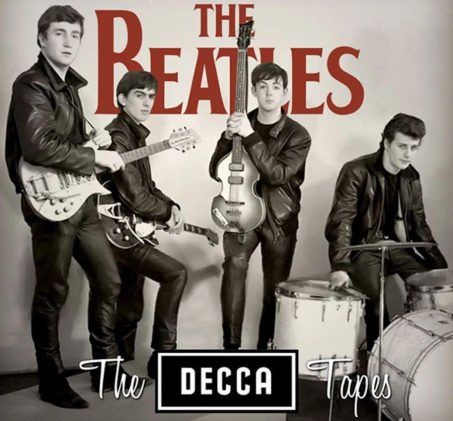
A few days ago, I was skimming through an article that mentioned an early song written by John Lennon (“Hello Little Girl”) that was one of three originals included in the Decca audition. So then I went to YouTube and listened to that song, as well as several others (both originals and covers) recorded during that audition. And I can say without hesistation it’s no surprise Decca rejected the Beatles based on that tape.

A brief summary of what’s wrong with it: Everything.

For the most part, the band on the Decca audition tapes doesn’t even sound like The Beatles, i.e., the group we know from their subsequent recordings for EMI with George Martin as producer. Of the 15 tunes they recorded during that session at Decca’s London studio, only two — “Money (That’s What I Want)” and “Till There Was You” — were later released on Beatles albums, and a direct comparison of those songs (the Decca audition versions versus the versions recorded for EMI) tells you a lot about why George Martin has so often been called “the fifth Beatle.” His skill as a producer made all the difference in the world.

From Liverpool to Hamburg to the Decca Session

For those who aren’t steeped in Beatles trivia, permit me to share the backstory leading up to the Decca audition. Originating as a skiffle group known as The Quarrymen (so named because they attended Liverpool’s Quarry Bank High School) led by John Lennon, the core of what would become the Beatles was formed when Paul McCartney showed up at a Quarrymen’s gig in 1957 and impressed John with a performance of Eddie Cochran’s “Twenty Flight Rock.” McCartney, a year-and-a-half younger than Lennon, then brought along his still-younger friend George Harrison, who earned his membership in 1958 by performing the instrumental “Raunchy.” This trio of guitarist/singers played in various permutations (sometimes Lennon and McCartney as a duo, or as a larger band with different players joining on drums, bass or piano) around Liverpool. In 1960, John convinced his art school classmate Stuart Sutcliffe to purchase a bass guitar and join the group. Among the places they played in Liverpool was the Casbah Club, operated in the basement of a home owned by Mona Best, whose son Pete was a drummer. In August 1960, the group’s then-manager, Allan Williams, arranged for them to play as the house band at the Indra nightclub in Hamburg, Germany, and they recruited Pete Best as their drummer for this gig.

The Beatles in Hamburg, 1960

It was in Hamburg, where they were required to play for many hours nightly in front of rowdy audiences, that the Beatles underwent a transformation which subsequently made them Liverpool’s hottest rock-and-roll band. Their popularity brought them to the attention of Brian Epstein, whose family owned the city’s largest record store, NEMS (North End Music Stores). In November 1961, Epstein visited the Cavern Club to see the Beatles perform. (By this time, Sutcliffe had left the band, moving in with his German girlfriend Astrid Kirchherr in Hamburg; Sutcliffe tragically died in April 1962). Epstein was sufficiently impressed by the Beatles’ Cavern Club performance that in December 1961 he proposed a management deal. Because his job as manager of NEMS gave him business connections with England’s record labels (which were all based in London), Epstein was quickly able to convince a Decca producer (known as an A&R man, for “artists and repertoire”) named Mike Smith to visit Liverpool and hear the group for himself. Smith liked them enough that he arranged for the Beatles to do a recorded audition session at Decca’s studio in London, scheduled for January 1, 1962.

Less than 16 months had elapsed between August 1960, when the Beatles first went to Hamburg, and their Decca audition on New Year’s Day 1962. They were all still very young. John had only recently turned 21, Pete Best was 20, Paul was still 19 and George was just 18. It would be unfair to expect this group of young rockers to sound like seasoned professionals in a recording studio. But that doesn’t explain everything that’s wrong with their sound on the Decca audition recordings. Wikipedia tells us, “At the audition, the Beatles performed songs chosen by Epstein” [emphasis added], citing renowned Beatles musicologist Mark Lewisohn.

This may be the biggest clue about the basic problem with the Decca audition. Epstein notably sought to “clean up” the Beatles’ image, putting them in suits and ties to replace the jeans-and-leather-jackets look they’d adopted in Hamburg. Epstein’s effort to make them “presentable” likely extended to the song selection for the Decca audition. Of the 15 songs they recorded during the session, only two (“Money” and the Chuck Berry tune “Memphis”) are really rockers. They also included two do-wop hits by the Coasters (“Three Cool Cats” and “Searchin’,” the latter of which features McCartney’s best vocal performance of the session). Evidently, in pitching them to the big London record label, Epstein wanted the Beatles to come across as more of a conventional pop music act, downplaying their rowdy rock-and-roll aspect, which is the most likely explanation of why they don’t sound anything like what they later became.

A Very Fortunate Failure

The three Lennon-McCartney originals (“Hello Little Girl,” with Lennon on lead vocal, and “Love of the Loved” and “Like Dreamers Do,” both sung by Paul) are, to put it as politely as possible, sub-standard. Think of the very worst B-side the Beatles ever released on EMI (I’d nominate “Ask Me Why”) and all of these songs are even worse. Permit me to bullet-point the subsequent fate of each tune:

  • “Hello Little Girl” — Once the Beatles had made it big in 1963, this was recorded as the debut single by another Liverpool band, The Fourmost, who were also managed by Epstein. The record made it as high as No. 9 on the UK pop charts.
  • “Love of the Loved” — This was the debut single for Liverpool singer Cilla Black, who was also managed by Epstein after being introduced to her by John Lennon. It peaked at No. 35 on the UK charts.
  • “Like Dreamers Do” — Released as the second single for The Applejacks, it was released in mid-1964 and made it to No. 20 on the UK charts.

You see that, even at the very zenith of “Beatlemania” in England, when it seemed any Liverpool act could ride the wave to stardom, none of these Lennon-McCartney songs made it as high as the Top Five.

Another thing about the Decca audition session:

HOW ABOUT TUNING YOUR BLOODY GUITARS, BOYS?

To me, this is the most inexcusable problem. Let us stipulate that, in those days before anyone had even thought of inventing digital tuners, it might have required a bit of time to get three guitars tuned properly, and then to pause occasionally during the session to keep them in tune. But, oh, my God! To hear George go off on a solo so badly off-key as to set one’s teeth on edge — how could any self-respecting record producer have permitted this atrocity? A slightly out-of-tune guitar wouldn’t make much difference when you’re playing a Hamburg bar gig for a bunch of drunk Germans, or a Cavern session for teenage fans, but in a recording studio, it matters — a lot. Any musician who’s ever done any recording knows this, and the intonation problems on the Beatles’ Decca tapes are simply inexcusable. Mike Smith must be blamed for this.

Remember, this recording session was on New Year’s Day. The Beatles showed up at 10 a.m., as scheduled, but Smith arrived late, because he’d been out drinking all night on New Year’s Eve. Perhaps that affected what happened during the session. It is believed that all 15 songs were recorded in one take, with no overdubs or retakes, and the whole thing was probably wrapped up not much later than noon. This hurried pace no doubt accounts for much of the general sloppiness of the Beatles’ performance in the Decca audition. If you’ve paid any attention at all to the Beatles’ subsequent discography, you know that they nearly always did multiple takes with George Martin as their producer, even on fairly simple songs (e.g., nine takes for “I Saw Her Standing There”).

Were “guitar groups on the way out”? Was this why Decca rejected the Beatles? That explanation doesn’t make sense because, on the same day the Beatles recorded their audition tape for Decca, another band — Brian Poole and the Tremeloes — also recorded an audition tape for Decca with Mike Smith as producer. They were also a “guitar group” (although their rhythm guitarist also played keyboards) and what actually happened was that the executives at Decca told Mike Smith he could give a contract to one group or the other, but not both. Because the Tremeloes were from London, it would be easier to work with them than with the Beatles some 200 miles away up in Liverpool. That seems to have been the key factor in Smith’s decision to sign the Tremeloes and reject the Beatles.

Of all the lucky breaks the Beatles ever got, this rejection by Decca Records might have been the luckiest of them all, because it ended up connecting them with “the fifth Beatle,” George Martin.

George Martin circa 1962

Arguably the biggest lesson we can learn from listening to the Beatles’ failed Decca audition is how important George Martin was to their subsequent success. In giving Martin his due credit, we do not in any way diminish the talents of John, Paul, George and Ringo. We can analogize this to a football coach and a great team — the University of Alabama attracts fine football talent, but coaches like Bear Bryant and Nick Saban are crucial to producing championship teams, and the same could be said of the relationship between George Martin and the Beatles.

‘For Starters, I Don’t Like Your Tie’

George Martin was a classically trained musician, having played piano since childhood, and later studying for three years at the Guildhall School, including courses in composition and orchestration. He was 24 when he joined EMI in 1950 as an assistant to the head of the subsidiary Parlophone label. In addition to his work on Parlophone’s classical music catalog, by 1962, Martin had already produced a No. 1 UK hit (“You’re Driving Me Crazy” by the Temperance Seven) as well as other pop records that had reached the Top 20 in England. He knew a thing or two about how to make a hit record and, after the Beatles’ failure to land a Decca contract, the fates swiftly steered them into Martin’s capable hands.

After Decca rejected the Beatles, Epstein took the tape of their Decca audition and went to EMI, where he met with Martin in mid-February 1962. Martin was not particularly impressed with what he heard on tape. Separately, however, Epstein was also trying to land a publishing contract for Lennon and McCartney as songwriters. This attracted the interest of the head of EMI’s music publishing division, Sid Colman, who pressured his EMI bosses to sign the Beatles in hopes that this would give him leverage toward signing the Lennon-McCartney songwriting team. It so happened in spring 1962 that there was bad blood between George Martin and the managing director of EMI, Len Wood. Not only was there a disagreement over business decisions, but Wood had discovered that Martin was having an affair with Wood’s secretary. To appease Colman, and also to punish Martin, Wood directed Martin to sign this weirdly-named rock band from Liverpool (who weren’t good enough for Decca).

It’s amazing to consider how many things had to go wrong for this fortuitous combination to come together. At any rate, Martin met with Epstein again in May 1962 and said he’d offer the Beatles a deal for three singles. The Beatles’ first EMI recording session was scheduled for June 6, 1962. Martin had not yet even met the band. After the session got underway, the group’s limitations were apparent to Martin. To begin with, he didn’t much care for the three original songs (“Love Me Do,” “Ask Me Why” and “P.S. I Love You”) they brought to the session. Beyond that, however, Martin wasn’t satisfied with Pete Best on drums.

Things didn’t look very promising until, at one point, Martin switched on the microphone connection from the control room to tell the Beatles in the studio to let him know if there was anything they didn’t like. Immediately, George Harrison quipped back, “Well for starters, I don’t like your tie.” This wisecrack broke the strain and, despite the other problems, the relationship between Martin and the Beatles began to warm up. Another issue facing Martin was whether to focus on Lennon or McCartney as the group’s primary lead singer, but he had a Solomonic insight: “Suddenly it hit me that I had to take them as they were, which was a new thing. I was being too conventional.” Both John and Paul would take their turns as lead singer (with occasional spotlights for George and, later, Ringo Starr). The June 6 session finished without producing anything worthy of commercial release, but Martin conveyed to Epstein his complaints about Pete Best. A follow-up recording session was scheduled for September and, in the meantime, the Beatles had to find a way to get rid of Best and replace him with Ringo.

Ringo and George in Hamburg, 1961

The Beatles had known Ringo for a couple of years. He was the drummer of Rory Storm and the Hurricanes, one of their rivals for most popular band in Liverpool, and also veterans of the Hamburg scene. There was probably no good way to accomplish the business of ditching Pete Best, which caused a furor among the Beatles’ fandom in Liverpool, and swiping another band’s drummer didn’t exactly endear the Beatles to their fellow musicians. But this was a major upgrade for the Beatles, as Ringo had a much more polished style, and George Martin deserves credit for forcing the group to make this change.

Ringo shaved his beard and got a new hairstyle, and the band returned to EMI’s Abbey Road studio on September 4. They re-recorded “Love Me Do.” They also tried recording a new song they’d written, a ballad called “Please Please Me.” But because Martin didn’t think their originals were good enough, he wanted the Beatles to record a professionally written song called “How Do You Do It?” The Beatles dug in their heels, however, insisting that they’d stand or fall on the basis of their own original material. Reluctantly, Martin told them to work up more new material, while deciding to go ahead and release “Love Me Do” as their first single (backed with “P.S. I Love You” on the B side). Another studio session was scheduled for September 11 to try and get better recordings of these songs. Martin brought in a professional session drummer, Andy White, to play on “Love Me Do,” a snub of Ringo that the band resented, although subsequently Martin praised Ringo’s ability as a drummer.

“Love Me Do” is a childishly simple song and arguably its strongest selling point is Lennon’s harmonica part. One almost suspects that Martin shared the belief attributed to Decca executives that “guitar groups” were obsolete, which may explain why the first three Beatles singles (“Love Me Do,” “Please Please Me” and “From Me to You”) all featured John’s harmonica. Released in early October 1962, “Love Me Do” made its way up the charts to peak at No. 17 in November.

The record’s popularity surprised Martin, who hadn’t expected such strong sales, and he then scheduled a new recording session. He already had the Beatles’ earlier recording of “How Do You Do It?” in the can, and was considering making it their second single, but they returned to London with a renovated version of “Please Please Me” that was much better than the first time they tried it. Lennon later explained it was inspired by Roy Orbison’s “Only the Lonely,” and the first version was a slow ballad that Martin found “dreary.” Now, however — perhaps feeling pressure because they knew Martin wanted to release “How Do You Do It?” — the Beatles brought in a turbocharged uptempo version of “Please Please Me.” They did 18 takes of the song on November 26, 1962, before Martin was satisfied, but when the band came up to the control room afterwards, he told them, “Gentlemen, you have just made your first number one record.” His prediction was soon proved correct.

The single was released on January 11, 1963, and the Beatles made their first nationwide TV appearance eight days later, quickly pushing “Please Please Me” to the top of the charts. Seeing a chance to capitalize on this success, George Martin hastily arranged an all-day recording session for February 20, 1963, where in the span of about 12 hours, the Beatles recorded 10 songs which (along with the two singles and their respective B-sides) would comprise their first album, Please Please Me. That session yielded two classics, “I Saw Her Standing There” and a rave-up cover of the Isley Brothers’ “Twist & Shout” which became a crowd favorite during the band’s early concert tours. Released on March 22, the Beatles’ first LP almost immediately soared to No. 1 on the British charts.

Screaming for the Dominant Fifth

Even before the first album could be released, however, the Beatles had returned to Abbey Road on March 5 to record their next single, “From Me to You,” which was released on April 11 and was an even bigger hit than “Please Please Me.” This was the point where the “Beatlemania” phenomenon really began to break out in England, partly because of a clever trick in the bridge of “From Me to You.” The bridge works its way up to the dominant fifth chord as John and Paul harmonize on the phrase “keep you satisfied” then punctuate it by hitting a falsetto “ooh!” When they performed it in concerts, the Beatles would shake their heads on that falsetto note, which made their mop top haircuts flop around, and this absolutely drove girls crazy. That’s when screaming became ritualistic at Beatles concerts. You may be thinking, “What do screaming girls have to do with George Martin?” Remember I said he’d studied composition at Guildhall? Music theory, my friends, is involved with the way that a song’s chord progression can build up tension — peaking on the dominant fifth chord (G, in the key of C) — which is released by the return to the tonic (C) chord. This is what drove girls crazy.

“Beatlemania” in Manchester, England, 1963

Working with George Martin was an educational experience for the Beatles, and they were eager students. Martin himself said:

“I taught them the importance of the hook. You had to get people’s attention in the first ten seconds, and so I would generally get hold of their song and ‘top and tail’ it—make a beginning and end. . . . I would meet them in the studio to hear a new number. I would perch myself on a high stool and John and Paul would stand around me with their acoustic guitars and play and sing it. … Then I would make suggestions to improve it and we’d try it again.”

Martin was publicly modest about his contributions to the Beatles success, insisting it was due to their genius, not his. But there was a symbiotic relationship to it. While “From Me to You” was almost as simple as “Love Me Do,” Martin still insisted on six takes (plus overdubs) before he was satisfied with it. The next Beatles single — arguably the best of their early hits — again employed the trick of adding a falsetto whoop on the dominant fifth: “She loves you and you know you should glad — ooh!” If Beatlemania had been breaking out before “She Loves You” was released in August 1963, now it went pandemic. With its memorable “yeah yeah yeah” refrain, it broke every existing sales record for British singles, and remained on the UK charts for an astonishing 31 weeks. If it was George Martin who had taught the Beatles “the importance of the hook,” they had obviously aced the exam.

The Beatles had begun 1962 with that Decca audition session that flopped, when Lennon and McCartney were writing miserable dreck like “Hello Little Girl” and “Like Dreamer Do.” But by January 1963, they’d released what would become their first No. 1 hit, and swiftly followed up that success with their first album, as well as two more chart-topping hit singles. Before 1963 was over, they would release yet another No. 1 hit, “I Want to Hold Your Hand,” which would finally break them into the U.S. market, and by February 1964, they were on the Ed Sullivan show driving the American girls crazy with their falsetto whoops.

Getting rejected by Decca was surely disappointing for the Beatles when it happened, but because it ended up putting them under the tutelage of George Martin, it was the biggest break they ever got.


Shop Electronics at Amazon

Save on Groceries and Everyday Essentials

Shop Amazon Basics

Office & School Supplies

Hitler, the Nobel Prize and ‘Grease’

Truth is stranger than fiction, it is proverbially said, and such is the course of history that events and people can be connected in ways that you never imagined. Certainly I never dreamed that the hit musical Grease could be connected to a Nobel Prize-winning physicist and a World War II military intelligence officer, until yesterday I fell down one of those research rabbit-holes into which I’m so prone to stumble.

In 1933, the Nazis came to power in Germany, and Jews were purged from German universities. Among the victims of this purge was a physics professor at the University of Göttingen whose students had included a young fellow named Robert Oppenheimer — maybe you’ve heard of him. Among the professor’s assistants at Göttingen were such important physicists as Enrico Fermi and Edward Teller. The professor had been recommended for the 1928 Nobel Prize by Albert Einstein, but instead the honor went to one of his colleagues. When Hitler came to power and the professor was purged from the university, he emigrated to England, teaching first at Cambridge University before eventually taking a faculty position at the University of Edinburgh in Scotland.

Max Born

After relocating to the United Kingdom, Professor Max Born published Atomic Physics, which quickly became the standard textbook in the field. He retired at age 70 in 1952, and two years later — through the efforts of his peers and former students including Fermi — Max Born was finally awarded the Nobel Prize for his “fundamental research in Quantum Mechanics.” In retirement, he returned to his native Germany, where he died at age 87 in 1970. But that’s just half the story . . .

In 1935, the son of a school teacher from Cardiff, Wales, got his bachelor’s degree from Cambridge University, with honors in German and French. The young scholar’s name was Brinley, and his fluency in German soon made him very valuable to his country. When World War II broke out in 1939, Brinley joined the Royal Air Force, and was assigned to military intelligence (MI5). Among his duties was gathering information from captured German prisoners. He reportedly worked on the top-secret “Enigma” decryption project and was the officer who took Nazi henchman Rudolf Hess into custody. After the war, Brinley taught high school in Cambridge until 1954, when he moved to Australia, becoming a university dean and later a host of radio and TV programs.

Brinley Newton-John

Well, I said his name was Brinley, but I didn’t tell you that his surname was Newton-John, because that would have spoiled the surprise. You see, in 1937, Brinley “Brin” Newton-John married a girl named Irene Born, whom he had met when her father Max Born was teaching at Cambridge. In 1948, Brinley and Irene’s youngest daughter Olivia was born.

Irene Born and Brinley Newton-John, circa 1935

In her autobiography, Olivia Newton-John wrote:

“My parents might have never met at Cambridge University if my mum didn’t have such a keen ear for beautiful music. . . . One day, she heard a man singing in a deep baritone voice and she couldn’t take another step. She actually followed the voice. Mum always said she fell in love with the voice before she ever saw him. . . . Mum was brunette, classically beautiful , and carried herself in a most elegant way. Dad was six-foot-three, fair-haired, with movie-star good looks and that beautiful aristocratic voice. Need I say more? What a beautiful couple.”

Until I stumbled down this rabbit hole, I never would have guessed that Olivia Newton-John was half-Jewish, much less that her maternal grandfather was a Nobel Prize-winning physicist. That her father was MI5 during World War II and played a role in capturing Rudolf Hess — well, this is the whipped cream and cherry on the top.

Olivia Newton-John as Sandy in ‘Grease.’

So how did I end up down this rabbit hole? Blame the dadgum YouTube algorithm. Lying down for a Sunday afternoon nap, I was watching police videos — my usual bedtime habit — and was scrolling through when I saw a short video about Olivia Newton-John and clicked on it. The soundtrack of the clip was “Let Me Be There,” her 1973 top 10 hit that earned her a country music Grammy award. What I loved most about that song was the bass vocal harmony, and after watching that short video, I wanted to find out who had sang that part, so I did a Google search for the answer (Mike Sammes), but in checking Olivia Newton-John’s Wikipedia biography, I was startled to learn about her grandfather.

Wait, did I say “startled”? What I meant to say was, I got chills, they’re multiplying, and I’m losing control . . .


Shop Electronics at Amazon

Save on Groceries and Everyday Essentials

Shop Amazon Basics

Office & School Supplies

Rolling Stone Has Become the SPLC?

One sentence in this Rolling Stone article caught my attention:

Dolly Parton knows Kid Rock can be, uh, polarizing but she decided to release “Either Or,” her duet with the Bud Light-blasting personality anyway. In an interview with The Hollywood Reporter, the Country Music (and Rock & Roll) Hall of Fame member said she could accept Kid Rock for who he is. The recording will feature on her upcoming Rockstar album.
“Of course I did that before the controversy that he had, but somebody was talking to me the other day, ‘How could you do this [song] with Kid?’” she said. “I said, ‘Hey, just because I love you don’t mean I don’t love Kid Rock. Just because I love Kid Rock don’t mean I don’t love you.’ I don’t condemn or criticize. I just accept and love.” (Note: It’s unclear which controversy Parton was referring to when she said she recorded it “before the controversy,” since Billboard has a timeline of Rock gaffes that goes back to 2004.)

(Hat-tip: Instapundit.) If you tune into tonight’s episode of The Other Podcast (7 p.m. ET), you’ll probably hear my friend John Hoge, who used to be a recording engineer in Nashville, share some Dolly Parton anecdotes which (as usual with John’s anecdotes) won’t have anything to do with the point I’m trying to make, which is that many journalists nowadays seem to think it’s their job to act like Grand Inquisitors pursuing heretics. Like the Southern Poverty Law Center, they compile dossiers on people who’ve somehow strayed into Wrongthink, so that they can expose these Thought Criminals and destroy their careers.

Let’s be clear about what the glib phrase “cancel culture” actually means: The Left wants to prevent anyone who disagrees with them from earning a living in any occupation that has cultural or political influence. If you look at the climate on university campuses, you see what we’re facing if this neo-Stalinist project succeeds. “Cancel culture” is a very serious thing, and its methods are being enthusiastically embraced by journalists like this Rolling Stone writer who gleefully exults, “A-ha! We have here a list of every ‘gaffe’ that Kid Rock ever made!” To wit:

May 2011: Defends Use of Confederate Flag
Rock was slammed for his notorious use of the Confederate flag onstage and accused of racism by protesters, which he defended was an act of homage to his idols Lynyrd Skynyrd. “I’ve never flown that flag with any hate in my heart. Not one ounce,” Rock said after receiving an award from the NAACP’s Detroit chapter for his work in the community. “I love America. I love Detroit, and I love Black people.”

Love that adjective “notorious.” Some first-class objectivity there. It would be both unnecessary and tedious for me to recount here what I’ve explained before that, in the 1970s, when Lynyrd Skynyrd toured the world with a giant Confederate battle flag as their stage backdrop, the flag was seen as signifying a regional identity, not a symbol of racist belief.

Jimmy Carter was president, OK? He was the first president from the Deep South elected in a long, long time, and expressions of Southern pride were not remotely controversial in the 1970s, when the whole family tuned into CBS on Friday night to watch The Dukes of Hazzard, with Bo and Luke Duke riding in the General Lee.

Maybe it was Daisy Duke that most of us tuned in for, but the point is, nobody in 1979 was looking at that and yelling, “White supremacy!”

Is it surprising that Kid Rock, who was 7 years old when The Dukes of Hazzard began its seven-season run on CBS, should think the Confederate flag is cool? He grew up in the Detroit suburbs of Macomb County, Michigan, and nobody ever accused him of racism — “RAAAAACISM!” — until he openly supported the Republican Party.

But sure, anyone associated with that flag is a racist.

Oh, y’all expected us to forget that one, did you? In their attempt to turn America into a one-party totalitarian dictatorship, Democrats emulate Stalin in their efforts to re-write history and erase any “problematic” issues from the past that might impede their ambitions. But while we’re expected to forget anything that reflects unfavorably on the Democratic Party, liberal journalists emulate the SPLC in compiling dossiers on their chosen enemies, chronicling every “gaffe” and controversy that might aid their character assassination campaigns.

Dolly Parton wants no part of this vindictive agenda:

Speaking of God, Parton invoked her faith in the interview as the reason why she doesn’t like cancel culture. “I think that’s terrible,” she said of cancel culture. “We all make mistakes. We don’t all get caught at it. But also when somebody makes a mistake, it depends on who they are. That’s what God is there for.
“Now I happen to believe in God; I’m a faith-based person, so therefore I am able to see it like that,” she said. “A lot of people don’t, but even still, everybody deserves a second chance. You deserve to be innocent until you’re proven guilty. Even when you’re proven guilty, if God can forgive you, so can I. If God can forgive you, we all should forgive one another.”

Amen, sister! And speaking of forgiveness, forgive me for reminding you of the Five Most Important Words in the English Language:

HIT THE FREAKING TIP JAR!


On ‘Rich Men North of Richmond’

After 10 days of reading endless commentary about Oliver Anthony’s viral hit “Rich Men North of Richmond,” I finally decided to watch the YouTube video and see for myself: Red-bearded young man with a muscular voice picking a Gretsch dobro and singing the blues about “what the world’s gotten to,” and how it feels to be “livin’ in the new world with an old soul.” Brother, don’t I know! Been feeling it all my life, but it’s my choice to play the clown, to act as if I’m undamaged and undaunted by the evil directed against me: “Never let ’em see you sweat.”

My four sons have each had their share of struggles, but you won’t find them complaining about it, because that’s not who we are. Victory requires no apology. Be a winner, and make it look easy, leaving others so mystified by your success as to make them envious. They weren’t even awake when you were burning the midnight oil, nor have they heard of your many failures — because you didn’t complain about them — and so they’re like Ferris Bueller’s sister: “What makes him so g–damn special? … Why does he get to ditch, when everyone else has to go?”

There’s a certain Stoic quality to this approach, which I consider an effective rebellion against a world in which everybody seems to be competing constantly in the Oppression Olympics. The victimhood mentality has so infused our culture that we consider people admirable only insofar as they have suffered, which is why Elizabeth Warren had to invent a fictitious “Native American” biography to justify her tenure at Harvard. Well, how about this: Fuck Harvard.

Fuck the entire Ivy League and everything it symbolizes, including its endless sermonizing about the glories of “diversity.”

When I first heard that the singer of “Rich Men North of Richmond” (whose real name is Christopher Anthony Lunsford) was from Farmville, Virginia, my eyes lit up in recognition. The town is about two-thirds of the way from Petersburg to Appomattox, and it was 10 miles east of Farmville, at the Battle of Sailor’s Creek, that Grant’s army pounced on two corps of Lee’s army, with nearly 8,000 Confederates killed, wounded or captured in a single stroke, just three days before the final surrender.

That bit of military history must be well-known to locals, and I’d bet money that Lunsford is, like me, a descendant of Confederate soldiers, conscious of his ancestry, and conflicted as to what duty requires in a world that has no sense of what duty even means — “livin’ in the new world with an old soul,” indeed. Just try to live an honest life, stay out of trouble, do the best you can for your family, and don’t lose your soul trying to keep up with the Joneses. We’re winning, baby.

His unexpected good fortune — more than 20 million YouTube views and a place atop all the music download sites — has not spoiled Lunsford. He wrote a long Facebook post explaining he’s turned down multimillion-dollar offers from the music industry because he doesn’t aspire to that kind of life. Because the Left has been trying to attack him personally — to sabotage his blue-collar reputation — Lunsford felt the need to explain how it is he owns acreage in Dinwiddie County: “In 2019, I paid $97,500 for the property and still owe about $60,000 on it. I am living in a 27′ camper with a tarp on the roof that I got off of craigslist for $750.” So there you go, lefties — satisfied now? In point of fact, Lunford’s status as a property owner is testimony to the continued vitality of the American Dream. A high-school dropout, by working blue-collar jobs and living a thrifty life, was able to become a land owner when he was only 27, an age at which a lot of college-educated kids are still living in crappy apartments and complaining about their student loan debts. How it must burn them up, all those sociology majors, to see this redneck boy catapulted to the top of the Spotify charts, and yet financially self-sufficient enough that he can say, “No, thanks,” to the record companies trying to sign him to multimillion-dollar deals. Winning, baby.

“Always mystify, mislead, and surprise the enemy, if possible; and when you strike and overcome him, never let up in the pursuit so long as your men have strength to follow; for an army routed, if hotly pursued, becomes panic-stricken, and can then be destroyed by half their number. The other rule is, never fight against heavy odds, if by any possible maneuvering you can hurl your own force on only a part, and that the weakest part, of your enemy and crush it. Such tactics will win every time, and a small army may thus destroy a large one in detail, and repeated victory will make it invincible.”
— Stonewall Jackson

How do we apply this tactical advice to our current situation? That’s the question we must ponder, as old souls living in the new world.


Have a Holly Jolly (Commie) Christmas

“Are you now, or have you ever been …?”

Perhaps some of you kids you don’t recognize this dangerous subversive, because Burl Ives died in 1995, and even if you’re old enough to remember him, the only time he crosses your mind is when you hear “Have a Holly Jolly Christmas” playing in the background music at the shopping mall or wherever. And our tale begins three weeks ago, when John Hoge and I were out to dinner at Cracker Barrel after doing another episode of The Other Podcast. Because it’s December, the background music at Cracker Barrel was a series of Christmas songs and among them was a version of “Holly Jolly Christmas” by some singer who was not Burl Ives, which triggered me to go off on a rant.

“Who is this singer? Why aren’t they playing the Burl Ives version? That Commie bastard had exactly one great achievement in his career, and it’s ‘Holly Jolly Christmas.’ Why rob him of that?”

At this point, Hoge interrupted to inform me that Burl Ives had a few career achievements that may have been more important than this silly Christmas song, including playing “Big Daddy” Pollitt in Cat on a Hot Tin Roof in 1958, the same year he won the Oscar for Best Supporting Actor as Rufus Hannassey in The Big Country. Well, OK, but as usual, Hoge’s interruption didn’t address my point, which in this case is that certain Christmas songs have a definitive version, which deserve a permanent place on the holiday playlist for the sake of cultural continuity.

To be a conservative is to believe in the value of tradition, and among other things, that means when I hear about chestnuts roasting on an open fire, it had damned well better be Nat King Cole singing it.

Let us stipulate that many other artists have recorded versions of “The Christmas Song” that have some musical merit. But while I have no personal beef against, e.g., Michael Bublé, when it’s chestnut-roasting time, only Nat King Cole can get the job done right.

Having a hit Christmas song guarantees a performer a sort of musical immortality. A singer’s entire catalog of recordings may be forgotten, but if he had a big Christmas song, kids will still be listening to it long after he’s dead. Like, Nat King Cole was one of the most successful singers of his time, with a long string of hit records, but does any kid ever listen to “Mona Lisa” anymore? No, but every Christmas, those chestnuts are still roasting, baby, and it’s the same with Bing Crosby’s “White Christmas.”

Bing Crosby was quite simply the biggest singing star of the 1930s and it was not until Frank Sinatra burst on the scene in the 1940s that Crosby had any rival at all. Crosby was also a major motion picture star, famously teaming up with Bob Hope in Road to Singapore (1940), Road to Zanzibar (1941), Road to Morocco (1942), etc. Bing was an entertainer of world-historic proportions, with a lengthy catalog of hit records, but nowadays the only time anybody hears his voice is in December, when “White Christmas” gets played on the Muzak for a few weeks.

It’s fine by me if other singers want to record their own versions of “White Christmas,” but I don’t want to hear those other versions piped into the grocery store. Give me Bing, thank you very much.

There are other Christmas songs which have their own definitive versions. Like, I’m sure every pop singer wants to put “Rockin’ Around the Christmas Tree” on their Christmas album, and that’s fine with me, but the only version I want to hear is Brenda Lee’s. And when it comes to “Rudolph the Red Nosed Raindeer,” it’s got to be Gene Autry. How many people nowadays even know who Gene Autry was? He was the most famous example of a genre, “the singing cowboy,” which lasted about 20 years beginning in the mid-1930s but has long since been forgotten. Gene Autry’s only rival for the crown as King of the Singing Cowboys was Roy Rogers, but unlike Gene, Roy never had the luck of recording a popular Christmas song, and so every December we get the Gene Autry resurrection, thanks to Rudolph and his “nose so bright.”

You see the point I was making, before Hoge interrupted me with that trivia about Burl Ives, was about the evanescence of popular culture. Most of the “hits” of our youth — whether in music, movies or TV shows — will only be widely remembered during our lifetimes. Nostalgia for a bygone past requires us to have some familiarity with whatever it is we’re nostalgic for, and popular entertainment is one of those “here today, gone tomorrow” things that doesn’t translate well across generations.

Born in 1959, my memories of various TV shows, movies and songs that were popular in the 1960s and ’70s are shared by a large cohort of Baby Boomers, so that there is nowadays a certain market demand for nostalgia about that era. Because of the way the era has sometimes been depicted in more recent entertainment — “That ’70s Show” or Dazed and Confused — there are younger people, born much later than me, who think fondly of those years. In the same way, movies like The Godfather gave my generation a fondness for the era of gangsters in wide-lapel suits riding around in Packard sedans. The Godfather was set in the immediate aftermath of World War II, less than 30 years before the film came out — 1972 was almost as close to VJ Day as 2022 is to the Monica Lewinsky scandal. But where is the boom of nostalgia movies about the 1980s and ’90s to parallel the 1970s nostalgia boom about Depression-era America?

Anyway, as I get older and my kids have grown up, the subject of cultural continuity sometimes strikes me in different ways, such as hearing “Holly Jolly Christmas” and getting ticked off because they’re not playing the Burl Ives version which is, of course, they only version that should be played. And did I mention he was a Commie?

Beginning in the late 1930s, Burl Ives was associated with a number of Communist “front” groups, which is why his name turned up among those entertainers listed in the 1950 publication Red Channels: The Report of Communist Influence in Radio and Television. This publication is infamous to soi-disant “progressives” who think of the anti-Communist “Hollywood blacklist” as one of the great injustices of American history. These progressives want us to forgot that America was, at the time, locked into an eyeball-to-eyeball nuclear standoff with the Soviet Union, which had just exploded its first hydrogen bomb with the help of U.S. military secrets stolen by Soviet spies like the Rosenbergs and their associates. Soviet agents in high places (e.g., Alger Hiss) had been exposed, Mao’s Communists had just taken over China and in June 1950, the Communists in North Korea had invaded South Korea.

Those who describe anti-Communism in the 1950s with words like “paranoid” and “hysteria” expect us to ignore the reality of the Red Menace that faced America at that time. When they use phrases like “witch hunt,” I insist on pointing out that these particular witches were quite real — there were actual Communists, who actually were agents of Soviet influence, and exposing these subversives was a very urgent national security priority at the time. If it seems crazy to suggest that Burl Ives was ever a national security threat, I’d suggest reading Kenneth Lloyd Billingsley’s book Hollywood Party: How Communism Seduced the American Film Industry in the 1930s and 1940s. Billingsley (whose mom played June Cleaver on Leave It Beaver) chronicles the conflict that erupted in Hollywood in 1945, culminating in “a bloody riot at the gates of Warner Bros.’ studios in Burbank, California.” What had happened was that Communists — not imaginary “witches,” but real-life, self-avowed, card-carrying members of the Communist Party USA — had gained control of a number of craft unions in the movie business and had fomented a conflict to try to force the industry to recognize these unions, rather than other (non-Communist-controlled) unions, as representing the workers in those trades. It was in this conflict that Ronald Reagan, as president of the Screen Actors Guild, came face-to-face with how Communists operated, a confrontation that forever altered Reagan’s point of view and, in doing so, ultimately changed history.

Ronald Reagan testifies to Congress, 1947

What was the effect of Communist influence in Hollywood? I asked that question of Billingsley when I interviewed him years ago and he said that while Communists didn’t succeed in getting much pro-Communist propaganda into movies, they were more successful in keeping anti-Communist messages out of movies. If you think about this a bit, you realize that there is a reason why, to most Americans, totalitarianism is always associated with Hitler and the Nazis, rather than with Lenin, Stalin and the Communists. There have been very few movies and TV shows that accurately portrayed Communism as a deadly menace, and certainly the pro-Communist attitude of many people in Hollywood had some influence in this tendency of popular entertainment to downplay the danger of Communism. Or, for example, think of Ronald Reagan’s career. He had been a very successful actor and popular among his peers, which is why he was elected SAG president. But once he emerged as an outspoken opponent of Communism, his movie career evaporated and it became common for the media to label him a “B-movie actor” (which is a damned lie, because he had previously starred in plenty of A-list movies).

Rather ironically, Reagan himself had been associated with a few Communist front groups in the 1930s and early 40s. The Communists were very clever at organizing such groups on an ad hoc basis, for example the Joint Anti-Fascist Refugee Committee (JAFRC), whose stated purpose originally was to aid those fleeing France. The JAFRC was a successor to other Communist front groups that had solicited aid for refugees from the Spanish Civil War. Exactly how much assistance was ever delivered to refugees is unknown, but the idea was that by organizing groups dedicated to currently popular causes, the Communists could expand their influence by getting help from liberals who didn’t realize that such groups (and the money they raised) were controlled by the Communist Party. So the fact that Reagan’s name turned up as sponsor of a JAFRC event in Los Angeles could not be construed as proof that he ever was a Communist or even sympathetic to Communism, but he was asked about this particular group when he was called to testify in 1947 to the House Committee on Un-American Activities (HUAC), by which time he was already a well-known opponent of Communism.

This background helps understand how it was that Burl Ives got called to testify to Congress in 1950, disavowed Communism and “named names,” as they say, when asked about his past Communist involvement. Ives had been much more active in Communist-influenced groups than Reagan ever was. For example, Ives had supported the Communist-backed presidential campaign of “progressive” Henry Wallace in 1948, and some of Ives’ former associates included actual Soviet spies, one of whom informed the FBI that Ives was “100% left.” His subsequent disavowal of Communism caused one former comrade, Pete Seeger, to denounce Ives as a “stool pigeon.” But this is an insult to Ives only if you consider loyalty to Communism a good thing. At any rate, by cooperating with the congressional investigation, Ives avoided being blacklisted and, within a few years, was a beloved avuncular figure with a wholesome reputation.

The tale of post-Communist redemption explains why, in 1964, the producers of Rudolph the Red-Nosed Reindeer chose Burl Ives to narrate the tale as the character “Sam the Snowman.” And because Johnny Marks, the guy who wrote the titular song, was also the writer of “A Holly Jolly Christmas,” Ives got to sing that one, too:


In subsequent years, the Burl Ives version of “A Holly Jolly Christmas” has ensconced itself among the top five songs of the holiday season. And as I say, it is the definitive version of this holiday classic, so that I don’t want to hear any other version of it on the piped-in music at stores. Burl Ives may not be remembered for anything else, but he deserves to be remembered for this, even if he was a Commie.

UPDATE: Welcome, Instapundit readers!


Who Put the Bomp?

What does a car made in Wolfsburg, Germany, have to do with a novelty hit from 1961? It’s a strange tale, with musical connections to Dolly Parton, the Mamas and Papas, a children’s cartoon and an iconic scene from a famous 1980s movie. It’s about a boy from Brooklyn.

Last weekend, I had my home office TV tuned to a football game, and a commercial came on that featured a song I remembered fondly from back in the day. “Make Your Own Kind of Music” was a Top 40 hit for “Mama Cass” Elliot in 1969, after she went solo following the breakup of the Mamas and Papas. The lyrics are an optimistic ode to individualism:

Nobody can tell ya
There’s only one song worth singing.
They may try and sell ya,
’Cause it hangs them up
To see someone like you.

But you gotta make your own kind of music,
Sing your own special song.
Make your own kind of music,
Even if nobody else sings along.

You’re gonna be nowhere,
The loneliest kind of lonely.
It may be rough going,
Just to do your thing’s the hardest thing to do.

Pardon the Sixties hipster talk about “hang ups” and “doing your thing,” but I always liked the message of that song and, from a musical perspective, I appreciated the emphatic triplets in the last line of the chorus. Do you want to see Mama Cass introduced by none other than Sammy Davis Jr. as “the most fantastic lady of the now sound”?


Mama Cass (née Ellen Naomi Cohen) was a wonderful entertainer, and that was a wonderful song, so when I heard “Make Your Own Kind of Music” on TV, I was prompted to Google it and learn more. When I began enthusiastically telling my brother Kirby what I’d discovered, he said, “I’m going start calling you Rabbit, ’cause you’re always going down these rabbit holes.” A compulsive researcher — I can’t help myself, folks, I was born that way — I was surprised to learn that this hit for Mama Cass was co-written by the same guy whose only hit record as a performer was “Who Put the Bomp (in the Bomp Bomp Bomp)”:


Who put the bomp in the bomp bah bomp bah bomp?
Who put the ram in the rama lama ding dong?
Who put the bop in the bop shoo bop shoo bop?
Who put the dip in the dip da dip da dip?”
Who was that man?
I’d like to shake his hand.
He made my baby fall in love with me.

It was a humorous ode to doo-wop, as Wikipedia explains:

In this song, Mann sings about the frequent use of nonsense lyrics in doo-wop music, and how his girl fell in love with him after listening to several such songs.
Examples of the type of song referred to include the Marcels’ version of “Blue Moon” (in which they sing “Bomp bomp ba bomp, ba bomp ba bomp bomp” and “dip-de-dip-de-dip”) and The Edsels’ “Rama-Lama-Ding-Dong”, both of which charted earlier the same year.

Brooklyn native Barry Imberman, known professionally as Barry Mann, was just 22 when “Who Put the Bomp” reached No. 7 on the Billboard charts, but he was already a successful composer, having co-written hits with lyricists Mike Anthony, Hank Hunter and Howard Greenfield. The lyrics of “Who Put the Bomp” were written by a guy named Gerry Goffin, who with his wife Carole King became famous as half of the powerhouse Sixties songwriting duo Goffin-King (“Will You Love Me Tomorrow,” “Song Kind of Wonderful,” etc.). Paul McCartney and John Lennon once said their dream as songwriters was to be as big as Goffin-King.

The same year “Who Put the Bomp” was a hit, Barry Mann married lyricist Cynthia Weil (both of them were working in the Brill Building), and from their songwriting partnership came some of the most memorable hits of the next three decades. Remember I told you that this story involved an iconic scene from a famous ’80s movie?


Yes, “You’ve Lost That Lovin’ Feelin’,” performed by the Righteous Brothers (Bill Medley and Bobby Hatfield) was co-written by Barry Mann and Cynthia Weil, along with famed “Wall of Sound” producer Phil Spector. It’s been praised by critics as “one of the best records ever made” and “the ultimate pop record,” and in 1965 became the first No. 1 for the Mann-Weil team. A year later, they repeated the feat with “(You’re My) Soul and Inspiration,” also by the Righteous Brothers. Mann and Weil also wrote hits for the Drifters (“On Broadway”), the Animals (“We Gotta Get Out of This Place”) and Paul Revere and the Raiders (“Kicks”). And, hey, didn’t I tell you Dolly Parton was involved in this story?


Yep — Dolly Parton won a Grammy in 1979 for “Here You Come Again,” written by Barry Mann and Cynthia Weil, who continued making hits into the 1980s. Who could ever forget this classic slow-dance love song featuring James Ingram that made the Top 10 in 1981?


Man, it just doesn’t get any better than that, does it? But wait a minute — remember I told you there was a children’s cartoon involved in this story? You see, a guy named Steven Spielberg found himself as executive producer for an animated feature based on the historic experience of Jewish immigrants to America. This movie about the “Mousekewitz” family was conceived as a musical, because Spielberg “said he wanted a ‘Heigh-Ho’ of his own (referring to the popular song from Disney’s Snow White and the Seven Dwarfs).” By now I think the reader can guess which songwriting team they brought in to deliver this tune.


Somewhere out there, beneath the pale moonlight,
Someone’s thinking of me and loving me tonight.
Somewhere out there, someone’s saying a prayer,
That we’ll find one another
In that big somewhere out there.

Did I mention that “Somewhere Out There,” from the 1986 animated film An American Tail, won not one but two Grammy Awards? It wasn’t the squeaky-voice mouse version that did it, though. Instead, the producers brought in James Ingram and Linda Ronstadt to sing it as a duet over the final credits. “Somewhere Out There” made it to No. 2 on the charts.


Mann and Weil wrote so many wonderful songs, there’s not enough room to mention all of them, but I can’t omit the tune that producer Rick Beato called “the most complex pop song of all time”:


“Never Going to Let You Go,” which was a hit for Sergio Mendendez in 1983, changes key (from F-sharp to G minor) before the lyrics even begin. “I’d never seen a song that went through so many chord changes,” Beato says of his first effort to learn it. Keep in mind that Beato majored in music in college, got a master’s degree in jazz from the New England Conservatory of Music, and taught music theory for a living. In praising the complexity of “Never Gonna Let You Go,” Beato pays quite a tribute to The Man Who Put the Bomp in the Bomp Bomp Bomp.

Ah, but have you forgotten where this long trip down the musical rabbit hole began? I was watching TV and there was a commercial for a car made in Wolfsburg, Germany — the Volkswagen Tiguan:


That commercial, by the way, was directed by Bryce Dallas Howard, the daughter of Ron “Opie” Howard. Volkswagen is sending royalty checks to Barry Mann for the song he and his wife wrote in 1969. Not a bad deal for the boy from Brooklyn, who has truly made his own kind of music.

Now 83 years old, Barry Mann is still married to his 81-year-old wife and lyricist, Cynthia Weil, and the couple live in Beverly Hills.

Who was that man?
I’d like to shake his hand.
He made my baby fall in love with me.

UPDATE: Welcome, Instapundit readers!


Born in Odessa, Ukraine, in 1886

Louis Wolfe Gilbert emigrated to the United States as a boy and became “one of the most prolific lyricists of Tin Pan Alley.” He started out as a singer on Coney Island, eventually settled in Hollywood, where he helped popularize Cuban rumba music and “was an innovator in his field, having been one of the first songwriters to begin publishing and promoting a catalog of his own works.” He twice served as director of the American Society of Composers, Authors and Publishers. Known to friends as “Wolfie,” Gilbert had his breakthrough success in 1912, when he wrote the lyrics for a tune composed by ragtime pianist Lewis Muir.

Way down on the levee in old Alabamy,
There’s Daddy and Mammy,
There’s Ephraim and Sammy.
On a moonlight night you can find them all.
While they are waiting,
The banjos are syncopating.
What’s that they’re saying?
While they keep playing,
A-humming and swaying.
It’s the good ship Robert E. Lee
That’s come to carry the cotton away
!

When I was a teenage trombonist in the Douglas County (Ga.) High School Marching Tiger Band, “Waiting on the Robert E. Lee” was one of the songs we played, and it never would have occurred to me that this song was co-written by a Jewish immigrant from Ukraine who almost certainly had never been to “old Alabammy,” and yet wrote what became one of the greatest hits of its age, comparable in popularity to “Alexander’s Ragtime Band.” From the 1941 musical film Babes on Broadway, here’s a version by Judy Garland and Mickey Rooney:


Scholars of Critical Race Theory could not be reached for comment, but in defense of Judy and Mickey, I’ll point out that this was the popular culture of the nation that defeated Hitler, Tojo and Mussolini.

This afternoon, “Waiting on the Robert E. Lee” came to mind because I’m in Parkersburg, W.V., where they had a special memorial for my wife’s late cousin, David Scott “Scotty” Wilson. As the obituary said, “Scott held many jobs in his life, but the job that he loved the most was when he worked on the P.A. Denny sternwheeler.” This riverboat plies the Ohio River from Point Park in Parkersburg, frequently visiting historic Blennerhassett Island. Today in memory of Scotty, his whole family took a cruise down the river aboard the P.A. Denny.

It was a splendid outing on a beautiful afternoon, and I’d never been on a riverboat, but I was happy to “join that shuffling throng.”

Go take your best gal, real pal
Go down to the levee, I said to the levee,
And join that shuffling throng,
Hear that music and song!
It’s simply great, mate, waiting on the levee,
Waiting for the Robert E. Lee!

UPDATE: Welcome, Instapundit readers!


A Genuinely Weird Rock ’n’ Roll Story

Do you see that guy with the gold top Gibson Les Paul guitar? That’s Bill Bartlett, lead guitarist of a one-hit-wonder band from 1967. The Lemon Pipers had formed in 1966 in the college town of Oxford, Ohio, and signed a deal with New York-based Buddah Records. Their first single, an original written by Bartlett, was a flop, so the record company told the group’s producer, Paul Leka, to team up with Brill Building songwriter, Shelley Pinz, to write the band a hit song. The result was “Green Tambourine,” a song which the band hated — they were a rock group, and this was a silly pop tune — but it went all the way to Number One in early 1968. Despite this sudden success, however, the Lemon Pipers weren’t able to follow up with any more hits, and broke up in 1969.

Buddah Records was home to a production team — Super K Productions, Jerry Kasenetz and Jeffry Katz — which specialized in so-called “bubble gum” pop. The Super K guys weren’t much for the whole “artistic integrity” thing, they were about money and didn’t care how they got it. They recorded a group called The Rare Breed, but the musicians quit in a dispute with the producers, so Kasenetz and Katz found an Ohio group called Sir Timothy & the Royals and renamed them the Ohio Express. Kasenetz and Katz then took recordings done by The Rare Breed, released these under the name of the new band, and had a Top 40 hit called “Beg, Borrow and Steal” in late 1967. Then a songwriter named Jon Levine sent them a demo for a tune called “Yummy Yummy Yummy.” Kasenetz and Katz liked the demo so much, they released it as a single under the Ohio Express name, even though nobody in the band sang or played on it! That made the Top Five on the charts in 1968.

Fast-forward a few years. After the breakup of the Lemon Pipers, Bill Bartlett had returned to Ohio and, while attending Miami University in Oxford, formed a new band that at times included three players from the Lemon Pipers and various other musicians. This new band was called Starstruck and they gigged around at clubs for two or three years before getting serious in 1975. They did some recordings at a studio in Cleveland and paid to have 1,000 copies of a single pressed, This record, a rocked-out version of an old blues song, got a decent amount of airplay on Ohio radio stations, becoming something of a regional hit. The group got a management deal and played as an opening act for such big names as Edgar Winter, Foghat, the Eagles and Fleetwood Mac. Alas, no major record company seemed interested and the band broke up in late 1975.

In spring 1976, a few months after Starstruck broke up, Bill Bartlett got a call from Jerry Kasenetz and Jeffry Katz, whom he knew from his Buddah Records days with the Lemon Pipers. Kasenetz and Katz were looking to put together a new hard-rock band, and Barlett was invited to audition, so he went to New York and took with him a copy of the single he’d recorded with Starstruck. Kasenetz and Katz loved it, and Barlett then returned to Ohio with an offer for his former bandmates: $3,000 for their rights to the recording, take it or leave it. They took the money.

Now, let me tell you a little bit about this song. In the 1920s and ’30s, musicologist John Lomax and his son Alan traveled the country doing “field recordings” of American folk songs. Among the places they recorded was the Central State Prison Farm in Sugarland, Texas, where one of the inmates was James “Iron Head” Baker, a habitual criminal who described himself as “the roughest n***er what ever walked the streets of Dallas.” Baker and his fellow inmates sang several of their work songs for the Lomax recording in 1933, and one of the tunes was recorded in 1939 by folk blues legend Huddie William “Lead Belly” Ledbetter.

How this tune came to the attention of a rock band in Ohio in the 1970s is a mystery, but this was the recording for which Kasenetz and Katz were willing to pay $3,000, to do one of their classic moves. Rather than have the new group re-record the song, Kasenetz and Katz simply took the Starstruck version of the song and did some editing which they released under the name of their new band, Ram Jam.

Whoa, Black Betty (Bam-ba-lam)
Black Betty had a child (Bam-ba-lam)
The damn thing gone wild (Bam-ba-lam)
Said it weren’t none of mine (Bam-ba-lam)
The damn thing gone blind (Bam-ba-lam)

“Black Betty” became a Top 20 hit in the United States in 1977, and made it to the Top 10 in England and Australia. At one point, the NAACP tried to mount a boycott against “Black Betty,” but that effort fizzled after it was learned that this was actually a black folk song from the 1930s.

Ram Jam released an album and toured for a couple of years, but there was no follow-up. Bill Bartlett thus has a unique claim to fame, having been a “one-hit wonder” twice — first with the Lemon Pipers and “Green Tambourine,” then 10 years later, with Ram Jam and “Black Betty.”

As Paul Harvey used to say, “Now you know the rest of the story.”