
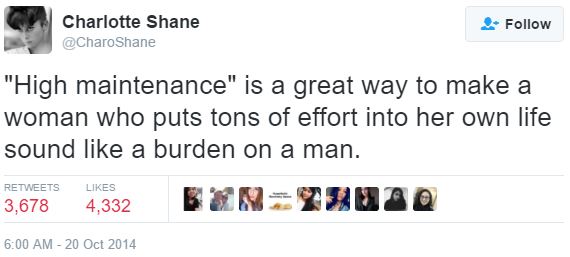
Does that sound right to you? Read it again:
What does “high maintenance” mean? This isn’t a phrase I often use, because I got married in 1989 and the phrase “high maintenance,” used as a pejorative against women, wasn’t commonplace when I was dating. However, from the way younger men use it, I’ve always thought of “high maintenance” as roughly synonymous with spoiled. To call a woman “high maintenance” is to imply she is a certain familiar type.
Years ago, I began to notice this type — the Suburban Princess — who at an early age becomes accustomed to being pampered and indulged. She’s good-looking, or at least not bad-looking, and she learns to exploit this to her advantage. Because so many men are willing to kowtow to her, to placate her demands and tolerate her tantrums, she develops an imperious attitude. She is the Princess, every man is expected to serve her, and woe unto any man who finds himself in a relationship with such a woman. She seldom stays with any boyfriend longer than a year or two, but she’s seldom alone, because she has a cunning eye for the next fool in the parade of men eager to try (and inevitably fail) to make her happy. We encountered this type a year ago, when ESPN reporter Britt McHenry melted down in a tantrum:
Everybody knows her type, and everybody hates her type. A good-looking girl gets all the breaks, especially if she’s a rich good-looking girl, and our universal contempt for the spoiled-rotten Suburban Princess isn’t because we’re sexists, but because everybody who’s ever had to deal with one of those high-maintenance brats knows what vicious, selfish sadists they can be.
McHenry only got suspended a week for her abusive behavior — she just had “an intense and stressful moment,” she said — when anyone who wasn’t young, blonde and beautiful probably would have been fired. She’s in the TV business, you see, and TV needs beautiful young blondes, a market demand that confers lucrative advantages on those who are the supply of this valuable commodity. At any rate, I cite the example of Britt McHenry merely to point out that to me, the phrase “high maintenance” has a connotation, describing a certain bratty personality type. So when I encountered Charlotte Shane claiming that “high maintenance” refers to “a woman who puts tons of effort into her own life,” I was puzzled.
Charlotte Shane? Oh, wait a minute! Yes, we remember her:
Charlotte Shane (@CharoShane) is a slut who writes about sex. There are a lot of these around lately. I blame Sex and the City, or maybe let’s go back further and blame Helen Gurley Brown. At any rate, the ambition of every young female English major nowadays is (a) to have sex with dozens of men and (b) get paid to write about it. It’s journalistic prostitution, really — exhibitionism justified by the excuse that the Let-Me-Tell-You-About-My-Sex-Life racket is about feminist empowerment.
There is an interesting 21st-century double-standard about the sexual memoir genre, namely that men aren’t allowed to engage in it. A man who boasts about his sexual exploits is condemned as a misogynist, as [pickup artist] Daryush “Roosh V” Valizadeh could testify. Everything we are allowed to know about sex, it seems, must be filtered through a feminist lens, and men’s perspectives on sex are therefore unwelcome. Feminism is the belief that men are always wrong about everything, especially sex. And so the question of what guys enjoy sexually is never asked, let alone answered, because feminism is not about making men happy.
Will our culture never reach the “Peak Slut” moment? Honestly, I was weary of the sexy tell-all genre long before the Monica Lewinsky scandal broke, two months after I arrived in D.C., and editing all those transcripts, affidavits, etc., during the subsequent impeachment proceedings certainly satisfied whatever morbid curiosity I had previously retained — which wasn’t much, honestly. Nobody wants a man to tell what he knows about sex or how he learned what he knows, so never mind the details, but I could never be fairly accused of ignorance, inexperience or naïveté in such matters. Being a conservative (and a married father of six) requires me to disapprove of sinful depravity. However, I was once a young Democrat and just because I exercise my Fifth Amendment right to remain silent doesn’t mean I have no stories to tell. You probably wouldn’t believe some of my stories, even if I were being compelled to testify under oath which, thank God, I’m not. But I digress . . .
The Lewinsky scandal should have taught us to be skeptical toward what people tell us about their sex lives. The phrase made famous by Bill Clinton’s defenders — “Everybody lies about sex” — is not true, because most people have enough common sense not to talk about their sex lives. When accused of sexual wrongdoing, of course, people can be expected to deny they have done anything wrong, but if it weren’t for Linda Tripp and the DNA evidence in the stain on Monica Lewinksy’s blue dress, we could not be certain that Bill Clinton was lying about sex. Without evidence or corroborating testimony, it was entirely possible to believe that she was just a crazy fat girl who had imagined all those weird sexual trysts with the President of the United States.
OK, so what are we supposed to believe when we encounter women like Charlotte Shane who talk, talk, talk about sex, sex, sex? Pardon my skepticism, but I am always dubious about such people, and that was before I discovered that “Charlotte Shane” is a pseudonym. What would you like to bet that, if a bunch of hackers ever got interested in finding out who “Charlotte Shane” really is, we would be able to compare her tales to her actual life and discover glaring discrepancies? She is a skillful writer, but this doesn’t mean she is a particularly honest writer, and there are aspects of her various stories that lead me to wonder, “Is she telling the truth, the whole truth, and nothing but the truth?”
What is “Charlotte Shane” omitting from her biography? What would we learn if we learned the whole story? Who was “Drunk Client”?
Not that this is necessarily false, you understand, but how is it that in 2013, she was hiring herself out for such, uh, services? We search her body of work for some kind of biographical clue:
The moment my breasts appeared on my body, I recognized them as the enemy. When I was growing up, Winona Ryder, Gwyneth Paltrow, and Kate Moss were the go-to glamour girls of teen magazines, and all of them are lithe in a way that cannot be imitated if your boobs are big. As a top-heavy pre-teen — tall, pudgy, and busty from puberty onward — I was doomed to remain outside the circle of the mid-90s’ most desirable women. . . .
I grew up in a part of the country full of chicken farms, where my babysitter hunted deer with a crossbow, and my mom made us scrapple at least one morning a week. So you might think a “heartland” American sense of style would be my saving grace. . . .
But at the age when I started taking a more active role in what I wore, I was a bookish introvert who most wanted to emulate the look modeled by my private school peers: that of the preppy, casually rich. Unfortunately, I had neither the body nor the budget to pull it off. . . .
Larger breasted women, from Marilyn Monroe to Scarlett Johanssen and Kate Upton, are usually relegated to the realm of pin-up, a man’s object of desire but not a figure for well-bred woman to emulate. I blamed my boobs from keeping me from ever looking truly skinny, my ultimate physical goal, and from looking rich, my ultimate style goal. They were the biggest — no pun intended — obstacle to achieving my vainest dreams.
This description — a “tall, pudgy . . . bookish introvert,” attending a private school in the “heartland,” and envious of her “preppy, casually rich” classmates — makes it difficult to understand why, at age 30, she was working as an escort, her clients including a kinky drunk who enjoyed spanking her and having her urinate in his mouth. We keep searching and find this story from 2012:
When I was in junior high, my friend Julia (not her real name) told me over the phone that she’d just lost her virginity to a neighbor who’d found her crying at home alone over a breakup. She was home alone, crying, when he’d knocked on the door and she invited him in. They’d sat down on the couch together as he comforted her, and then he f–ked her there. She was 11. The neighbor was 19.
To whatever extent we can trust my memory from 17 years ago, I remember Julia sounded ambivalent, a little surprised and a little uncertain. She wasn’t outwardly distressed nor did she seem like a numbed zombie. When I asked her if she’d wanted to have sex with him, her answer was inconclusive. She didn’t give me details, and I didn’t press for them, partially because I was 12, and a virgin, and I could not imagine what such an experience would entail.
Again, we have no actual reason to think her story is false, but in this particular article, “Charlotte Shane” also includes the helpful detail that, by 2012, she had already spent “eight years as a sex worker,” a career she began by “providing so-called sensual massage” in her early 20s. So from her being a pudgy introvert, envying her rich classmates at a private school in the heartland, where 11-year-old girls fall prey to roaming rapists, we flash forward a decade to her doing “sensual massage” by age 22. What happened to “Charlotte Shane” that led her on this journey from introverted virgin to sex worker? From 2011, we have her Salon.com column “To all the girls who envy my life,” in which she describes how, ever since she started blogging (circa 2008) about her career as an escort, she has received a steady stream of emails from young women “somewhere between the ages of 17 and 25” who wish that they could be sex workers, too. Musing about the “complex” causes for the “glamour of prostitution,” she draws a predictably feminist conclusion:
It’s the persistent symptom of a society that still insists sexual desirability is a woman’s duty, and wealth is the most important hallmark of success. A young woman who is desirable is a young woman who wields power, and that power is often bestowed in the form of cold, hard cash.
Which isn’t to say the women who e-mail me are power hungry. Rather, I think they are recognizing the ways their culture tells them to achieve.
You see? It’s “society” and “culture” which gives young women the idea that being a prostitute is glamorous. There is no more perfect formula for avoiding personal responsibility than to blame “society” or “culture” for whatever is wrong with your life. Bad ideas are imposed in your mind by the “culture,” and then “society” more or less forces you to comply with these messages. Next thing you know, you’re 22 years old doing “sensual massage” and by the time you’re 30, you’re getting spanked by a drunk client who wants you to urinate in his mouth. Just another day in the harmless sex-for-money business, and if anyone thinks this is a glamorous career? Blame society!
The girls who e-mail me are not lacking internal resources. They’re educated, sensitive, observant, and they have the complex sentences and insightful wording to prove it. But they are living in a world where a woman’s worth is constantly equated with her sex appeal. Is it any wonder that many women might find it compelling to take that equation to its logical end?
These women are also often insecure, which I recognize because I was (and am) insecure, too. When I first started working in the sex industry, I thought my motivation was purely curiosity, but I see now that while curiosity gave me courage, insecurity was wearing the spurs. I was so highly self-critical as a young adult that by the time I was 12 I vowed I’d have breast surgery. (I wanted a reduction, since natural large breasts meant I’d never look truly skinny.) I struggled with an eating and exercise disorder, both of which were so common among my peers that they were unremarkable. I talked my parents into paying for medically unnecessary braces to close the gap in between my front teeth, which was easy since most kids my age were having cosmetic orthodontic work as well. While I was sexually ravenous — I was a teenager, after all — I couldn’t stand the thought of any boy seeing my body. So I was not quite a born natural when it came to selling myself for sexual consumption, but entering the industry quickly taught me that femininity is all performance, and it became a performance at which I was adept.
What. The. Hell.
Gosh, it’s so weird that none of my kids developed an eating disorder, nor did they demand my wife and I pay for “medically unnecessary braces.” Evidently, these problems were ubiquitous in the “heartland” where Charlotte Shane grew up during the 1990s, where her junior high school friend got raped at age 11, and an insecure introvert became a “sexually ravenous” teenager who couldn’t stand to have boys look at her body. While I do not assert that any detail of her narrative is specifically false, there seems to be something basically wrong here. There is something missing, some plot twist omitted from the story.
Words mean things, and when a woman tells me (a) she attended private school, (b) she was “sexually ravenous” as a teenager, and (c) she began “selling myself for sexual consumption” in her early 20s, my hunch is (d) she got involved with The Wrong Guy at some point.
Your parents could afford private-school tuition and “medically unnecessary braces,” and yet by the time you’re a senior in college, circa 2003, you’re “providing so-called sensual massage”? Yeah, life is hard for liberal arts majors, but not all of them end up as whores, ma’am, and I’m not buying any of your “culture and society” explanations, either.
What is she asking us to believe?
“Oh, look,” says the bookish and insecure 21-year-old English major. “There’s a ‘Help Wanted’ sign in front of that massage parlor. Sounds kind of interesting. I think I’ll go apply for a job. Purely curiosity!”
No, ma’am, this is not the whole story. Former prep-school students don’t just randomly go to work in the “sensual massage” business. Whatever happened — dumped by a boyfriend, busted for dope, flunked your finals, whatever — there must have been something that put you in a very low place, with a rather desperate need of cash. There’s no way a middle-class girl from the “heartland” starts doing hand jobs to pay her bills without something in her life going badly wrong to explain how she got there.
Excuse me for belaboring this point at such length, but the pseudonymous “Charlotte Shane” is always talk, talk, talking about sex, sex, sex, as if (a) none of the rest of us know anything at all about sex, and therefore (b) we need a whore to advise us on this topic. Whereas it might actually be helpful if she would write something honest like, “How I Screwed Up My Life So Bad I Became a Whore and How Other Women Can Avoid This Miserable Degrading Life of Shame and Infamy.”
She's a feminist role model. Hugely popular. Think about that. pic.twitter.com/tT9NOJh7tc
— FreeStacy (@Not_RSMcCain) April 20, 2016
Existential question from an aging prostitute. pic.twitter.com/jbDwvat4tK
— FreeStacy (@Not_RSMcCain) April 20, 2016
Is anything more ironic than a hooker quoting Shulamith Firestone? (I'm so "parasitical"!) pic.twitter.com/aOFb9W6Kef
— FreeStacy (@Not_RSMcCain) April 20, 2016
Putting “tons of effort into her own life.” Right.
Bad enough to be a whore. Why you got to be a lying whore?
"The role of men in feminism is to shut the f–k up." https://t.co/4QK3glbPGk pic.twitter.com/ul9zAeN764
— FreeStacy (@Not_RSMcCain) April 19, 2016
And remember this Great Truth of life: the best cooks in the world are 300 lb black women from the South.
No question they’re very good. However, I rise to defend my grandmother from Talladega County, Alabama as the daughter of a sharecropper. She was a big woman, though not 300 pounds. The food she cooked was classic South and originated among the poorer classes without regard to race. It wasn’t until I was in college where I learned that the meals she served were considered “soul food” among the Yankees.
I wonder that about a lot of people. I’m fascinated.
The problem is they don’t go..away.
So rather than speculating on the woman’s background, wouldn’t it work better to go after the Department of Education?
Assuming you’re right, what would be the outcome? Controlling the young woman’s life?
Would that be just her life? Or would it apply to everyone?
Would you want to live under that level of control?
We can learn from (and teach from) biographical information without violating libertarian principals.
Again, just this woman or everyone?
Why just this woman?
She has persistently published her story, not just once in a comment section of a blog, but on sites like Salon. That does rather open her up to critical attention. *shrug*
These traits existed way before modern feminism. Third wave feminism–AND Black Lives Matter AND GLBT— just dust these traits off and give them a different goal. The victim is Western society writ large.
Scrapple is definitely an acquired taste. When I first saw it, I couldn’t believe anyone would eat it. Eventually, I tried it and it is edible, even without condiments. It fries up pretty well. But it was like trying snake soup–I can say I’ve tried it, but that’s about it. Give me bacon anytime!
That about sums it up.
Ohio makes sense. Lots of Amish there. My guess is that northerners brought it to Tennessee and NC when they were fleeing from the high taxes and civil unrest of the mid-Atlantic. Can’t say anything about Texas–you got me there.
If someone grows up with scrapple to the extent that it becomes a staple of memory, they’re probably from the mid-Atlantic.
It is an insult. But, it’s an insult applied only to certain people. I can understand why they would take issue.
All the places I’ve seen it were heavy agricultural areas. Texas included.
It’s those danged Pennsylvania Dutch spreading their decadent ways!
Ironically, the places where I saw the stuff didn’t have any Amish for miles. I didn’t see any Amish in Tennessee until the late 80s, early 90s around Lawrenceburg. None at all in Texas, and it was nearly 100 miles to the nearest Amish colony in Ohio. My wife’s family, from the Ashland, KY area loved the stuff. My wife’s grandmother grew up with the stuff over around Harrodsburg, KY. No Amish there either.
The Ohio colony (Holmes Co) is also the largest, larger than the one around Lancaster, PA
Scrapple has always been a regional food, particular to the PA Dutch/Amish. Ohio counts in the PA, DE, NJ mid-Atlantic axis because of its location and Amish influence.
Now, as to your southern states, I’d have to have more information as to how long the food existed in those parts; whether large numbers of farmers of German extraction moved into those areas and at what point; whether scrapple currently eaten in these areas is homemade or packaged and whether the companies that manufacture it are indigenous to the south or come from other areas. In other words, if I had the time and the money, it would be interesting to do an ethnographic study on the spread of scrapple.
In the meantime, I’d put down serious money that the escort in the article is somewhere from the mid-Atlantic.
What dept. do Jews go after to fight white supremacists? They use the ADL to mock them and expose their lies. We’re doing the same thing. I don’t know about you but I find the nationwide acceptance of this cult by everything from rock bands to ESPN to be stunning.
There were substantial German immigrants to the Hill Country in Texas which may explain its appearance in that state. In Germany, they eat something called Suelze, which is a variation on head cheese from all the scraps. It’s most likely the precursor to scrapple.
I’d never made the German connection. But the places I’ve seen scrapple had German settlers. My wife’s family on her mother’s side are of German descent. The Hill Country of Texas had a large German contingent as settlers. That’s the Region Admiral Nimitz was from.
I’m of German descent as well, but the inclusion is more distant than that of Nimitz.
That makes sense. I daresay it’s a rural German tradition, at least from some parts of Germany. In PA, NJ and DE, scrapple is locally made and is easily found in the supermarket.
That makes sense. It’s the same basic idea.
That’s why some of us are pushing to elect Ted Cruz– well, one of the reasons.
“If you can’t be a shining example, you’ll just have to serve as a horrible warning.”
I never heard the term until 2002, and it was in the film Monsoon Wedding. The specific reference was to the pecuniary cost of maintaining one’s wife (and the allusion sounded like an automotive one; we used to say FIAT stood for ‘fix it all the time’). Later, I heard my boss use the term to describe a particular donor, who would pepper her with letters about the direction of his donations. Another usage was in the film, Eternal Sunshine of the Spotless Mind, when the character Clementine says, “You want me? I am HIGH Maintenance”. I’ve always thought of it as a sort of neediness which demands time and attention from the man, not Princess behavior per se, and more pathetic than imperious. The best example I can think of is a woman I know who has never quite been reconciled to being a doctor’s wife. She’s constantly hungry in a way. She has a phlegmatic husband who works 70 hours a week and she’d like him to notice her.
Now that you mention it, though, I heard it used about 4 years ago when a shirt-tail of mind was getting married. His sister offered that she was anxious his bride might be ‘high maintenance’ (an offense of which she’d convicted one of his brother’s erstwhile steadies). The marriage blew up in just 3 years (over the wife’s serial adultery). Your sister is often looking out for you.
The thing is, physicians work long hours, so she gets no (nonfinancial) maintenance.
How ’bout plain old fiction?
Most people have ‘daddy issues’, because daddy is a job one can perform satisfactorily but seldom perform well. Satisfactory is fine for most youngsters, but a minority are more fragile and difficult and would benefit from deft handling which is atypically available. Hence, daddy issues in intact families.
How she reached that state’s the next chapter. Not everyone writes as fast as Jacqueline Susann. Be patient.
If you’d prefer, there’s a large sub-conversation upthread about scrapple.
OK I’m giving you points for the quote.
Criticism yes, but not speculation.
I suspect that she’s doing it for the attention.
” I find the nationwide acceptance of this cult by everything from rock bands to ESPN to be stunning.”
This is the issue.
We enable victims and We Should Really REALLY Stop Doing That. We let them celebrate and profit from their proclaimed victimhood.
He’s my second choice.
My first is None of The Above.
At this point it’s hard to say how a government that does absolutely nothing is worse.
Don’t usually like the stuff.
I just don’t see how speculating about the lives of FamousFeminists does either them or us much good. They want the attention because it validates them and their “mission.”
An “acquired taste” means something that you didn’t like, but kept on eating for some silly reason, until you could tolerate it.
Me? If there’s something I don’t like, I don’t keep eating it!
Sometime in the late 1970s, a friend of mine took me into a hole in the wall diner off North Broadway in Lexington, Kentucky, called Loretta’s Corner Kitchen. I think that I was the first white guy to walk into the place in fourteen years, and I practically set off gongs when I went through the front door.
It had old flypaper strips hanging from the ceiling, and everything had a film of grease covering it. There were the small table-side juke boxes, and the red vinyl covered stools at the counter. There was as much meat in the green beans as there was in the meatloaf, and it may well have been the best meal I have ever had.
I was going to mention that about the Dutch madam when I read this post this morning at breakfast, but had a lengthy drive ahead of me.
Well, actually, everything except sugar is an acquired taste of some kind. Little kids love fruit but usually don’t like spinach. When I was a kid, I couldn’t stand the smell of beer. Now, well, it’s not the weekend without my Foster’s and a barbecue grill going.
Word!!
Sounds like a place I visited in Jasper, Arkansas on a trip to the Buffalo River back around the same time. They had a $1.99 lunch special which consisted of half a fried chicken, a pile of mashed potatoes and gravy the size of my head, and buttered corn grown by the lady who was the owner. Buttermilk biscuits with honey from her own bees, of course. The pie was 50 cents a slice. Not only was the meal sublime, but she let us camp for free on her farm.
Good times.
I think RSM is just trying to understand the enemy, as it were.
I’d like to understand a group of women that thinks it’s evil to have sex with men who like them but it’s ok for Muslim migrants to rape European women because they have iPhones.
http://www.frontpagemag.com/point/261522/guardian-feminist-muslim-rapists-are-real-victims-daniel-greenfield
I’d also like to understand a group of women that is paranoid about “rape culture” but thinks it’s ok for little girls in the bathroom to come face to face with grown men who could attack them:
http://thefederalist.com/2016/04/21/trans-bathroom-bills-prove-feminism-has-failed-my-daughter/
. . . and the allusion sounded like an automotive one; we used to say FIAT stood for ‘fix it all the time’).
I thought it meant, “Fix it again, Tony.”
I suspect even when she’s alone the room isn’t quiet. Demons have no “inside” voice.
I think that’s quite possible. Consider the young English major who wants to write the next great novel. Why not create a persona and begin to blog about stuff–the more salacious, the better–, develop a following and parlay that into a “career,” of sorts.
Understanding, that I can accept.
But the speculation bordering on libel? I have issues there.
I haven’t read all the posts. I got sidetracked by scrapple. 🙂
*grin*
They’re sh1tposters and trolls, but usually identify lolcows pretty quickly and accurately, and, as far as I can tell, they only seem to harass people who are patently asking for it. I would classify this (wo)man as a lolcow, and (s)he may already be a kiwi target, for all I know. Haven’t had time to check it out. If she (possibly he, as you suggest) already is, they would have confirmed that.
IIRC, they’re the ones who outed Alison Rapp as an “escort”.
I think you have it the other way round. They have the attention of the mainstream and that is frightening. The first time I ever saw what I’d call hate speech from a comprehensive ideology and accepted within a pop culture expression as “social justice” was Ursula Le Guin and Joanna Russ and their gender feminism in sci-fi in the mid-70s.
They are amazingly hateful and ignorant people and are obsessed with talking about men the way Nazis talked about Jews. When they have the Dept. of Edu fronting an extortion racket for them, that’s news, brother. Their blood libels and other lies have to be unpacked and exposed, because that is the root of this.
We’re not talking about some daffy dames in SFF any more, we’re talking about institutionalizing hate speech in our nation’s highest institutions.