The Worst Journalist, Ever
Posted on | June 14, 2026 | Comments Off on The Worst Journalist, Ever
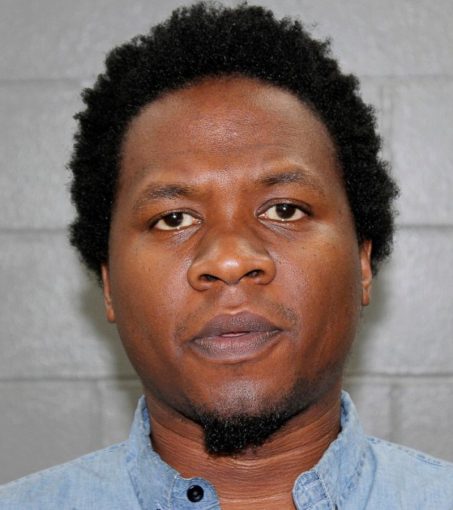
Juan Maurice Thompson
You probably never heard of Juan M. Thompson, because I hadn’t either until Andy Ngo called attention to his case, which has somehow been forgotten by most of the media, but in 2016 and 2017, Thompson made national news — not in a good way. A St. Louis native from a bad neighborhood, Thompson won a scholarship to Vassar College, once an all-women’s school, but dropped out before graduating. He had worked a couple of internships before somehow talking himself into a job at The Intercept in late 2014. Barely a year later, Thompson was fired:
In February 2016, the [Intercept] appended lengthy corrections to five stories by reporter Juan M. Thompson and retracted a sixth, about Charleston church shooter Dylann Roof, written over the previous year, focused on the African-American community. Shortly afterward, a note from editor Betsy Reed indicated that Thompson had been fired recently after his editors discovered “a pattern of deception” in his reporting. According to Reed, he had “fabricated several quotes in his stories and created fake email accounts that he used to impersonate people, one of which was a Gmail account in my name”.
Reed apologized to readers and to those misquoted. She noted that some of Thompson’s work, most of it using public sources, was verifiable. Editors alerted any downstream users of the affected stories, and promised to take similar action if further fabrication came to light.
Thompson suggested that the greater problem was racism in the media field.
Yeah, sure — “the greater problem was racism.” There has never been an answer to the question of how Thompson talked himself into that job, for which he clearly was not qualified. Notice that his problem was basic reporting — picking up the phone, calling sources, taking notes, etc. — and he attempted to conceal his failure by literally making up quotes from people, including fake “sources” he invented. This would be a firing offense in any case, but Thompson’s fakery involved at least one bogus “exclusive” that got picked up nationally:

Mass murderer Dylann Roof
A June 2015 report by The Intercept which alleged Dylann Roof was dumped by a girlfriend for a black man years before he killed nine people in a black church in Charleston, South Carolina, was fabricated, the website said Tuesday [February 2, 2016].
In a post titled “A Note To Readers,” Intercept Editor-in-Chief Betsy Reed wrote that staff had “recently discovered a pattern of deceptions in the actions” of reporter Juan Thompson. . . .
The website on Tuesday retracted Thompson’s story on Roof and issued corrections on four other stories.
In his June 18 story on Roof, Thompson claimed he spoke by phone with the shooter’s cousin, “Scott Roof.” Two members of Roof’s family have since told The Intercept they do not know such a person.
Thompson’s story attributed quotes to “Scott Roof” about Dylann once dating a girl who left him for a black man. “He kind of went over the edge when a girl he liked starting dating a black guy two years back,” the quotes read. “Dylann liked her…The black guy got her. He changed. I don’t know if we would be here if not.”
No such person as “Scott Roof” existed, and yet this June 2015 story got picked up in all kinds of media (including the UK Daily Mail) and was not retracted until more than seven months later. You might compare Juan Thompson’s fabrication to the similar scandal of Jayson Blair at the New York Times, except that Blair’s fakery did not involve anything as egregious as Dylann Roof’s infamous slaughter, which killed nine people in a Charleston church. For more than half a year, it seems, nobody bothered to fact-check the hoax Thompson perpetrated at the Intercept, but once they did, they discovered he’d faked practically every story he wrote for them. As awful as this was, however, it was not even the worst thing Thompson did. He literally became a terrorist:
Juan Thompson, a former reporter for The Intercept who was fired after it was revealed he fabricated stories, has been arrested for allegedly making bomb threats against Jewish Centers as well as the Anti-Defamation League, according to authorities. The news comes on the heels of a rash of threats and attacks directed at Jewish communities in the U.S.
According to a federal complaint, Thompson, 31, made more than a half-dozen bomb threats against Jewish schools and community centers both in his name and that of an ex-girlfriend, apparently to intimidate her. …
The DOJ issued a press release on the arrest that states, “Today, we have charged Juan Thompson with allegedly stalking a former romantic interest by, among other things, making bomb threats in her name to Jewish Community Centers and to the Anti-Defamation League.”
That was May 2017. I don’t know whether to say it’s ironic or merely predictable that the ex-girlfriend targeted by Thompson in this bizarre scheme was white. In December 2017, Thompson was sentenced to federal prison. A couple of months later, Associated Press reported:
Nearly two dozen times, Francesca Rossi called law enforcement to complain that an ex-boyfriend was harassing her online, posting nude images of her, sending notes to her bosses that she had a sexually transmitted disease and making it appear she was running guns and trafficking in child pornography.
But they couldn’t make it stop and couldn’t even make an arrest for almost a year, until the man set off a national panic by posing as Rossi to make bomb threats against Jewish centers across the country. That turned it into a major federal case that ended with her tormentor, Juan Thompson, arrested within days and eventually sentenced to five years in prison.
Rossi spoke to The Associated Press in her first interview since the criminal case ended in December.
“It went on for months. I thought I was going to die and no one could help me,” Rossi said. “In the end, the only way that my abuse was legitimized is because he went after such a large community of people, and because there was so much hysteria over it.” …
Legal and policing experts say her experience is an extreme example of how law enforcement is ill-equipped to handle the growing threat of online crime, even though laws have recently been passed in 38 states addressing cyberstalking and revenge porn. …
Part of the complexity in the Thompson case, for example, was that Thompson used 25 different devices that allowed him to mask his identity. …
Rossi told the AP that she met Thompson through an online dating site in late 2014. He worked as a journalist with The Intercept; she as a social worker. They bonded over their commitment to reform. And for a while, their relationship was great. …
(Permit me to interrupt and repeat what I’ve said so often before, namely that online dating is for losers. The very fact that someone is using a dating app can be construed as evidence that nobody they actually know in real life is willing to date them. But let’s return to Francesca Rossi and her not-entirely-surprising tale of woe.)
But by the spring of 2016, he’d moved into her Brooklyn apartment and trouble came with him. She started getting harassing texts from ex-boyfriends. The wife of another ex-boyfriend sued, saying she’d given him a sexually transmitted disease, a lawsuit that turned out to be a hoax. Another posted a naked picture of her online.
Rossi panicked. She contacted Carrie Goldberg, a lawyer specializing in online harassment and she quickly figured out that only one man was behind the harassment: Thompson. He’d been posing as her exes for months. Rossi believes he was trying to make her feel bad so he could intimidate and control her.
“Juan was going through all of my stuff and I had no idea,” said the 33-year-old Rossi. “He somehow gained access. I never gave him access to any of my passwords. But he had everything on me. He had been reading my texts and my emails for at least a year.”
Rossi broke up with him, but then things got worse. …
(Breaking up with a psychopath is never easy.)
Thompson telephoned, emailed and texted her relentlessly, she said. Sometimes, he posed as others, terrorizing Rossi and her family, including her 92-year-old grandmother. He called and wrote her office. He used every major social media platform to trash her. He even posted her information on a website where men promote violence against women.
“Technology gave him utter access to me,” she said. “Every time my phone buzzed, I felt sick. I mean, I thought he was going to kill me. I felt like my life was over.”
But since she didn’t know his physical address, she couldn’t get a permanent restraining order. Police at her local precinct closed Rossi’s harassment case in October 2016. The FBI was still slowly looking into the case. . . .
Over 150 bomb threats were reported against Jewish community centers and day schools in 37 states and two Canadian provinces. It was national news. Authorities blamed most on an 18-year-old Israeli-American Jewish hacker arrested in Israel last March. But federal officials said Thompson made a dozen of the threats.
Thompson was arrested in his native St. Louis early last March [i.e., 2016]. By June, he’d pleaded guilty to making hoax threats and cyberstalking.
The harassment of his ex-girlfriend, which turned into a national terrorism investigation, was no doubt the most reprehensible of Thompson’s behavior. However, she was not his only victim. Doyle Murphy is editor-in-chief of the Riverfront Times in St. Louis:
In the days before Juan Thompson’s arrest [in March 2017] for his part in a string of bomb threats to Jewish Community Centers across the U.S., the St. Louis native seemed a little extra crazy, which is saying something.
This is a guy who took imaginary trips to Cuba and Senegal. He dubiously claimed he was with the Standing Rock protesters in North Dakota and that he’d bought a house in Detroit. He lied about the weirdest things. . . .
At the Riverfront Times, we published a cover story about Thompson last February. He was a north St. Louis native who was once a reporter with a job at The Intercept in New York City, a news site best-known for its cache of documents from national security leaker Edward Snowden. But Thompson had been fired after the site caught him making up details and sending bogus emails, including some masquerading as the site’s editor.
Thompson blamed racism and also claimed to have cancer. But we uncovered additional problems with his work, going all the way back to his college days with the student newspaper at Vassar College, a prestigious university in Poughkeepsie, New York. Thompson had overcome an impoverished background to attend college there, but failed to graduate. He still landed a few good media jobs — only to crash and burn when his sourcing didn’t check out.
After our cover story, we followed up later with a short account of his brief tenure for an online news site. I wrote the stories. Thompson was pissed. He emailed my boss and tried to get me fired. When that didn’t work, he emailed me.
“You are a white piece of shit who lies and distorts to fit a narrative,” he wrote me in October. “Thankfully no one reads you or the rft and you will spend the rest of your career aggregating stories about shootings.”
Things were quiet for a while after that, but then came the fake Twitter accounts. My wife and I were sitting on our couch one night when she tapped me on the elbow and showed me her phone. Someone had created a brand-new Twitter profile claiming I was a rapist. The person tweeted at her, my boss and other journalists around St. Louis. It was an insane — and, though it’s hard to believe I even have to say it — completely untrue accusation. …
We finally contacted the St. Louis police department’s cyber crimes unit. I still remember the detective stopping me before I could get the full explanation out.
“Does this have anything to do with Juan Thompson?” he asked.
I had not even said Thompson’s name yet. I didn’t want to accuse him prematurely, although the fake accounts and the penchant for revenge had me fully convinced it was him.
It turns out police were already investigating complaints Thompson had been harassing his ex-girlfriend in New York. They couldn’t tell me much about her case, but the pattern of weird cyberattacks was the same. I called one of Thompson’s old roommates, whom I had quoted in an earlier story. He too was under attack. Someone was sending anonymous messages to his employer and and graduate school, claiming he was a racist. …
All we could do was watch what Thompson was doing online, try to link it to the attacks on me and my family and brace ourselves for the next hit. …
If you believed his posts, he was jet-setting across the world. He was also railing against capitalism, white women, police, liberals, Trump and so many others.
This pattern of demonizing others, seeking scapegoats for one’s own personal failures, is certainly not limited to Juan Thompson. It’s characteristic of narcissistic personality disorders, and if you’ve ever had the unfortunate experience of dealing with such a person, you know what a nightmare it can be. Given the high-profile nature of Juan Thompson’s crimes, it’s weird that I had never heard of him until Andy Ngo mentioned him Friday. What’s even weirder is how this bizarre saga has completely disappeared, and is so rarely mentioned anymore. You’d think there would have been at least a Netflix documentary about this story.
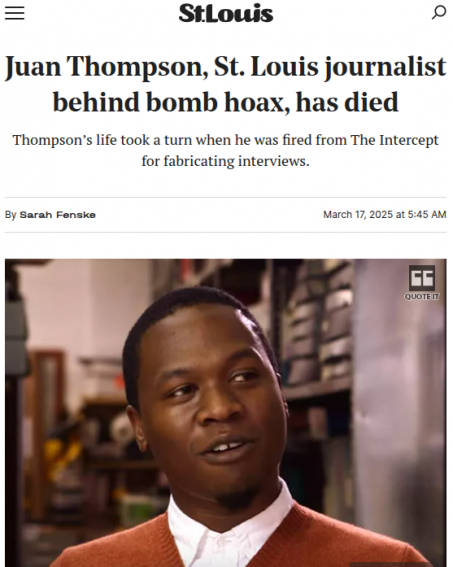
He’s dead now. Died of a drug overdose in September 2024, but his death went largely unnoticed for a while. His ex-girlfriend’s lawyer tweeted about it in late October 2024, but it was not until March 2025 that his death was reported in St. Louis Magazine by Sarah Fenske, who had formerly been Murphy’s boss at the Riverfront Times:
As the editor in chief of the Riverfront Times during its coverage of Thompson’s fabrication scandal and, a year later, his arrest, I had a front-row seat to some of the havoc he wreaked. I didn’t save the anonymous emails he sent me about Murphy, but I remember they were ugly. And even after Murphy figured out that it was probably Thompson who was falsely accusing him, and even after the St. Louis Police confirmed to Murphy that they were already looking at him for similar offenses, the attacks continued—through Twitter and through emails, to Murphy’s wife, to me. Thompson anonymously contacted other media outlets suggesting they should look into Murphy; I felt obligated to contact them proactively to explain that Murphy was not a perpetrator, but a victim of harassment.
Now that he’s dead, Juan Thompson can no longer harass anyone, and it’s safe to call him The Worst Journalist, Ever.
He certainly earned that dubious honorific.
UPDATE: Welcome, Instapundit readers! And yes, of course, “The worst journalist ever so far.” But at least for now, the late Mr. Thompson holds the title, like Babe Ruth waiting for Hank Aaron to come along.
Comments
THE FULL METAL JACKET REACH-AROUND AWARD
HIT THE FREAKING TIP JAR!
Search
Recent Posts
- Rule 5 Sunday: More Coffee Please
- FMJRA 2.0: Ouch
- In The Mailbox: 10.16.26
- In The Mailbox: 10.15.26
- In The Mailbox: 10.14.26 (Evening Edition)
- In The Mailbox: 10.14.26 (Afternoon Edition)
- In The Mailbox: 10.12.26 (Annual Admiral of the Ocean Sea Appreciation Post)
- Rule 5 Sunday: No Fishy Just Sexy
- FMJRA 2.0: A Winning Homestand
- In The Mailbox: 10.09.26
RSS reader subscription

MEMEORANDUM
Recent Comments
- on Rumors Swirl: Where Is James Talarico? UPDATE: Talarico Appears in Public
- on The Wrong Matthew Ingalls, the Correct ‘Jane Doe’ and the Cornell 7 Case
- on The Wrong Matthew Ingalls, the Correct ‘Jane Doe’ and the Cornell 7 Case
- on The Wrong Matthew Ingalls, the Correct ‘Jane Doe’ and the Cornell 7 Case
- on In The Mailbox: 10.02.26 (Evening Edition)
THE AMAZING GONZO FEED
Major Leagues
Archives
- October 2026 (22)
- September 2026 (38)
- August 2026 (43)
- July 2026 (39)
- June 2026 (40)
- May 2026 (43)
- April 2026 (59)
- March 2026 (44)
- February 2026 (37)
- January 2026 (45)
- December 2025 (42)
- November 2025 (44)
- October 2025 (44)
- September 2025 (47)
- August 2025 (48)
- July 2025 (48)
- June 2025 (47)
- May 2025 (48)
- April 2025 (42)
- March 2025 (48)
- February 2025 (49)
- January 2025 (48)
- December 2024 (42)
- November 2024 (44)
- October 2024 (47)
- September 2024 (43)
- August 2024 (55)
- July 2024 (63)
- June 2024 (59)
- May 2024 (48)
- April 2024 (43)
- March 2024 (55)
- February 2024 (46)
- January 2024 (45)
- December 2023 (53)
- November 2023 (62)
- October 2023 (57)
- September 2023 (56)
- August 2023 (53)
- July 2023 (69)
- June 2023 (67)
- May 2023 (53)
- April 2023 (60)
- March 2023 (73)
- February 2023 (65)
- January 2023 (56)
- December 2022 (60)
- November 2022 (64)
- October 2022 (58)
- September 2022 (68)
- August 2022 (75)
- July 2022 (69)
- June 2022 (73)
- May 2022 (74)
- April 2022 (57)
- March 2022 (79)
- February 2022 (65)
- January 2022 (58)
- December 2021 (62)
- November 2021 (68)
- October 2021 (73)
- September 2021 (63)
- August 2021 (60)
- July 2021 (80)
- June 2021 (64)
- May 2021 (64)
- April 2021 (58)
- March 2021 (73)
- February 2021 (57)
- January 2021 (71)
- December 2020 (77)
- November 2020 (81)
- October 2020 (84)
- September 2020 (94)
- August 2020 (75)
- July 2020 (68)
- June 2020 (83)
- May 2020 (77)
- April 2020 (65)
- March 2020 (85)
- February 2020 (94)
- January 2020 (95)
- December 2019 (88)
- November 2019 (60)
- October 2019 (113)
- September 2019 (91)
- August 2019 (91)
- July 2019 (88)
- June 2019 (80)
- May 2019 (74)
- April 2019 (97)
- March 2019 (100)
- February 2019 (85)
- January 2019 (93)
- December 2018 (90)
- November 2018 (83)
- October 2018 (96)
- September 2018 (79)
- August 2018 (107)
- July 2018 (98)
- June 2018 (86)
- May 2018 (78)
- April 2018 (78)
- March 2018 (97)
- February 2018 (61)
- January 2018 (70)
- December 2017 (62)
- November 2017 (68)
- October 2017 (67)
- September 2017 (70)
- August 2017 (68)
- July 2017 (52)
- June 2017 (60)
- May 2017 (56)
- April 2017 (80)
- March 2017 (80)
- February 2017 (102)
- January 2017 (104)
- December 2016 (65)
- November 2016 (86)
- October 2016 (77)
- September 2016 (81)
- August 2016 (66)
- July 2016 (83)
- June 2016 (81)
- May 2016 (65)
- April 2016 (64)
- March 2016 (81)
- February 2016 (74)
- January 2016 (66)
- December 2015 (64)
- November 2015 (85)
- October 2015 (71)
- September 2015 (80)
- August 2015 (67)
- July 2015 (79)
- June 2015 (69)
- May 2015 (72)
- April 2015 (94)
- March 2015 (122)
- February 2015 (71)
- January 2015 (93)
- December 2014 (99)
- November 2014 (67)
- October 2014 (109)
- September 2014 (87)
- August 2014 (106)
- July 2014 (132)
- June 2014 (154)
- May 2014 (126)
- April 2014 (145)
- March 2014 (144)
- February 2014 (142)
- January 2014 (185)
- December 2013 (192)
- November 2013 (173)
- October 2013 (175)
- September 2013 (181)
- August 2013 (167)
- July 2013 (147)
- June 2013 (135)
- May 2013 (128)
- April 2013 (105)
- March 2013 (162)
- February 2013 (191)
- January 2013 (206)
- December 2012 (190)
- November 2012 (176)
- October 2012 (240)
- September 2012 (206)
- August 2012 (235)
- July 2012 (223)
- June 2012 (161)
- May 2012 (230)
- April 2012 (269)
- March 2012 (282)
- February 2012 (247)
- January 2012 (267)
- December 2011 (285)
- November 2011 (300)
- October 2011 (302)
- September 2011 (297)
- August 2011 (288)
- July 2011 (297)
- June 2011 (245)
- May 2011 (260)
- April 2011 (344)
- March 2011 (293)
- February 2011 (201)
- January 2011 (263)
- December 2010 (265)
- November 2010 (266)
- October 2010 (305)
- September 2010 (280)
- August 2010 (272)
- July 2010 (230)
- June 2010 (244)
- May 2010 (256)
- April 2010 (222)
- March 2010 (271)
- February 2010 (286)
- January 2010 (229)
- December 2009 (21)
- October 2009 (1)
Free Agents
SHAMELESS CAPITALISM
Triple-A Franchises
- All-American Blogger
- American Power
- Anti-Idiotarian Rottweiler
- Athens & Jerusalem
- Barney Quick
- Bartholomew's Notes On Religion
- BatesLine
- Bear Creek Ledger
- Bearsears Patriots
- Blog de KingShamus
- Bride of Rove
- Cold Fury
- Daily Pundit
- Dr. Helen
- I Own The World
- Legal Insurrection
- Moe Lane
- No Runny Eggs
- Obi`s Sister
- Protein Wisdom
- Rhetorican
- Small Dead Animals
- The Conservatory
- The People's Cube
- The Sundries Shack
- VodkaPundit
- Vox Day
- Zilla of the Resistance
Blogroll
- 90 Miles From Tyranny
- A Conservative Shemale
- A Point of View
- Adrienne's Corner
- AmSpec Blog
- Bad Blue
- Blazing Cat Fur
- Calvin Freiburger Online
- Carol's Closet
- Catholic Bandita
- Caught Him With A Corndog
- Cecil Calvert
- Common Cents
- Conservative Hideout
- Conservative Watch News
- Conservatives for America
- Conservatives For Palin
- Crazy For Liberty
- Dad 29
- DC Damsel
- Dr. Flap
- Dyspepsia Generation
- Effing Conservatives
- Election Dissection
- Eric Reasons, IT Genius
- Eye of Polyphemus
- Finding Ponies. . .
- Free Will
- Grandpa John's
- Granite Grok
- GrEaT sAtAn"S gIrLfRiEnD
- Hoosier Access
- John William Perry
- Judicial Watch
- Jumping in Pools
- KURU Lounge
- Laughing Conservative
- Makes My Brain Itch
- Marathon Pundit
- Martin Eisenstadt's Blog
- Media Fade
- Michael Leahy
- Mister Pterodactyl
- Naked Villainy
- Nice Deb
- noot's observatory
- Not One Red Cent
- Okrahead
- Ollieander
- Pileus
- Pinup Girl
- Point of a Gun
- Political Pit Bull
- Reaganite Republican Resistance
- Red Alexandria
- Red State Eclectic
- Red, White & Conservative
- Republican Redefined
- ResCon1
- Ric's Rulez
- Ricochet
- Right of Course
- Robipedia
- Robomonkey
- Ruby Slippers Blog
- Saberpoint
- Scared Monkeys
- Sentry Journal
- SI VIS PACEM
- Skepticrats
- Smash Mouth Politics
- Sooper Mexican
- Taking Hayek Seriously
- Tel-Chai Nation
- Tequila & Javalinas
- The Aged P
- The Classic Liberal
- The Izzy Report
- The Minority Leader
- The NeoSexist
- The Nose on Your Face
- The Republican Mother
- The Right Sphere
- The Saint Angilbert Press
- The Snooper Report
- The Underground Conservative
- Thunder Tales
- Tom McLaughlin
- Tory Anarchist
- TrogloPundit
- Vets On The Watch
- Watcher of Weasels
- Western Experience
- World's Only Rational Man
- WyBlog
- Yankee Phil
- Zingstrom's Blog