Peggy Orenstein is a feminist whose books include Flux: Women on Sex, Work, Love, Kids and Life in a Half-Changed World (2001):
At 34, Peggy Orenstein faced a series of dilemmas shared by many women of her generation: She was unsure whether she wanted children, unsure about the impact of motherhood on her career, her relationship, and her sense of self. Why, when women seemed to have so many choices, did she suddenly feel that she had none? After feminist liberation and its subsequent backlash, she realized that women’s lives, including her own, were now in a state of flux.
Question: Why would a woman wait until she’s 34 to start thinking about “whether she wanted children”? Quite frankly, by the time a woman is 34, she may be past the point where motherhood is even possible. Infertility is a serious problem affecting women in their 30s, the risk of birth defects is substantially higher for older mothers and, beyond this, there are other considerations to keep in mind. Suppose you become a mom for the first time at age 23. You’ll be 39 when your child turns 16 and gets a driver’s license, and not yet 45 when your kid graduates college. If you delay motherhood until you’re 38, well, just do the math.
Is parenthood a task best performed by the young and energetic, or by weary middle-aged folks? When my wife and I babysit our grandsons, we are reminded, as my wife says, “This is why old people don’t have babies.” Children are a blessing, but every parent knows how exhausting the task can be and, whatever prudential arguments you make in favor of delaying parenthood, you cannot pretend there are no trade-offs.
When my wife and I had our first child, we were living in a $250-a-month rental in Georgia, and struggling to keep up. My father came to visit and, when I mentioned our financial difficulties, Dad said, “Son, if you wait to have kids until you can afford to have kids, you’ll never have kids.”
This is the answer to Peggy Orenstein’s question, “Why, when women seemed to have so many choices, did she suddenly feel that she had none?” Somewhere amid their celebration of women’s “choices,” feminists neglected to consider the inescapable realities of human nature. Time moves in only one direction — forward — and you have only one life to live, and the “choices” available to Peggy Orenstein at 34 were limited by the choices she had made at every previous stage of her life.
“It’s not that we’re stupid. It’s that we’ve been misinformed.”
That quote, from a woman who realized she had lost her chance at motherhood by waiting too long, is the brutal truth behind the myth of “choice.” How did things work out for Peggy Orenstein? After years of struggling with infertility, she gave birth to a daughter, Daisy, in 2003.
The influence of feminism tends to steer individual women, and even entire societies, toward “The Darwinian Dead End,” as I’ve called it. The rhetoric of “choice” and “empowerment” is so strongly associated with declining fertility that, nearly a half-century after the eruption of the Women’s Liberation movement of the 1960s, you might suppose this ideology would have perished along with its proponents.
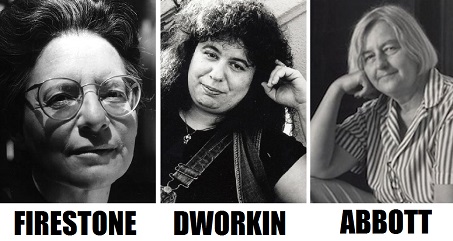
Shulamith Firestone was found dead, alone in her apartment in 2012, after years of mental illness. Andrea Dworkin died in 2005 after years of health problems caused by her extreme obesity. Just last year, another feminist pioneer reached her final destination:
Longtime NYC-based feminist and lesbian activist Sidney Abbott, 78, was found dead Wednesday morning after a fire in her home in Southold, Suffolk County.
The fire was discovered by her next-door neighbor, an off-duty volunteer firefighter who rushed to the burning Cape-style home and found the former member of the “Lavender Menace” and author of “Sappho Was a Right-on Woman” on the floor of her smoke-filled living room. . . .
Abbott was a force for gay women’s rights in New York and beyond since the ’70s, when she helped urge NOW not to ignore lesbian issues.
She had been wheelchair dependent in recent years, and had limited mobility, said Jacqueline Michot Ceballos, a friend for nearly 50 years.
“We were the earliest members of NOW, from day one in New York City, back in 1967,” said Ceballos, a former NOW-New York president and founder of the Veteran Feminists of America.
What all of these women have in common, in addition to being (a) feminists and (b) dead, is that (c) they never had children.
“Pregnancy is barbaric,” Firestone declared in her influential 1970 manifesto, The Dialectic of Sex, and hostility toward motherhood has been a defining message of the feminist movement for decades.
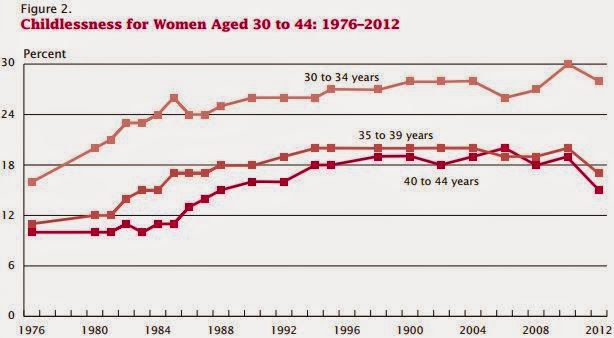
The impact of this anti-natal ideology has been reflected in a decline in birth rates and an increase in childlessness. However, this logical result of the Feminist Death Cult has not been random in its effects. Because feminism is relentlessly promoted in higher education, where university Women’s Studies programs function as the intellectual/activist core of the Feminist-Industrial Complex, the sharpest declines in fertility have been among college-educated women. Consider the Census Bureau data on fertility by educational achievement:
Not a high school graduate
Lifetime births (average) ….. 2.6
Childless ………………………….. 11.6%
Bachelor’s degree
Lifetime births (average) ….. 1.8
Childless ………………………….. 19.9%
High-school dropouts, on average, had 44% more children than women who had college diplomas. Childlessness was 72% more common for college graduates than for high-school dropouts. Over the course of decades, as feminism discourages motherhood among highly intelligent women, fewer children will be born to educated mothers and, inevitably, the overall percentage of children born to less-intelligent mothers must increase. While there is not a total correlation between (a) intelligence and (b) years of school attendance (as college dropouts like Bill Gates prove), data suggesting the “dumbing-down” of motherhood should concern any student of demographics and public policy. (See “The Value of Motherhood” and more about The Contraceptive Culture.) Despite the dangerous consequences of feminism’s bizarre hostility toward normal human behavior, proponents of feminist gender theory now have so much power among the “progressive” elite that the White House on Wednesday held an event about “breaking down gender stereotypes in children’s media and toys” so as to “encourage all of our young people to pursue their passions and interests without regard to their gender.”
What this talk of “stereotypes” means is that the federal government is committed to promoting an anti-human ideology that has caused many young people to become hopelessly confused about their “gender.”
Do you want your child to be a “genderfluid polyamorous demiromantic grey-ace” when they grow up? Probably not. Why do you think feminism in the 21st century attracts so many confused weirdos?
“Only when we recognize that ‘manhood’ and ‘womanhood’ are made-up categories, invented to control human beings and violently imposed, can we truly understand the nature of sexism. . . .
“Questioning gender . . . is an essential part of the feminism that has sustained me through two decades of personal and political struggle.”
— Laurie Penny, “How to Be a Genderqueer Feminist”
“Right now, today, as of writing this, I identify as queer. But I didn’t always. And no, I’m not referring to that awkward, uncomfortable time in my life where I knew that something felt ‘off,’ but I couldn’t quite place it, and so I paraded around in the charade of ‘straight.’ I mean that a few years ago, I identified as homoflexible. And before that, a lesbian. And even before that, bisexual.”
— Melissa Fabello
“The labels I currently use for myself are queer, gay, femme, and homoflexible. (Basically, I’m a lesbian with exceptions.) The label bisexual doesn’t work for me right now. . . . I’m on the asexual spectrum somewhere . . . I don’t experience primary sexual attraction.”
— Miriam Mogilevsky
Why do you think the Everyday Feminist website, edited by Ms. Fabello, features Ms. Mogilevsky as a columnist, sharing advice like “5 Ways Straight Women Can Be Better Allies to Queer Women”?
If it is “sexism” to believe men and women are different, as Ms. Penny insists, and if feminism teaches that these “made-up categories” are “violently imposed,” then are we surprised that Ms. Fabello condemns heterosexuality as a “charade”? Do we need to speculate why the “homoflexible” Ms. Mogilevsky cannot “experience primary sexual attraction” and thinks it an important task of feminists to teach women how to “be better allies to queer women”?
No, these are all entirely logical consequences of feminist theory. Once “progressive” parents (and schools, and media, and even the White House) decided that there are no meaningful differences between male and female, and that “gender stereotypes” must be destroyed, this kind of pathetic confusion was an inevitable result. When I describe feminism as a War Against Human Nature, does anyone think that this phrase is hyperbole? Am I a misogynist, a bigot, an enemy of “equality”? Or rather is it the case that Ideas Have Consequences, as Richard Weaver warned, and that crazy ideas have crazy consequences?
Never take advice from a feminist, and certainly don’t let feminists tell you how to raise your children. Feminists hate children.
“I don’t particularly like babies. They are loud and smelly and, above all other things, demanding . . . time-sucking monsters with their constant neediness. . . . Nothing will make me want a baby. . . . This is why, if my birth control fails, I am totally having an abortion.”
— Amanda Marcotte, March 2014
The road to feminism’s utopia of “gender equality” is paved with dead babies. Yet these Death Cult fanatics still expect to be taken seriously when they offer parenting advice to those of us who consider our children a blessing from God. Peggy Orenstein has published a new book, Girls and Sex: Navigating the Complicated New Landscape, that is being hyped by the liberal media, including the New York Times:
Advice on Boys and Sex, From
the Author of ‘Girls and Sex’
I invited readers to submit questions to Ms. Orenstein. Amid all the questions about our daughters — how do we talk to them, how do we teach them, how do we protect them — were a flurry of questions about our sons. Ms. Orenstein understood. “Obviously you’re only having half the conversation if you only talk about girls,” she said. “Boys absolutely need to learn the same things.”
Here’s some advice from me: Warn your sons to avoid feminists and, while you’re at it, teach your daughters to avoid feminists, too.
What kind of fool would believe that a feminist like Peggy Orenstein has any useful advice to share about boys, girls or anything else? If you need advice on how to avoid motherhood until your ovaries have nearly withered away, well, I guess maybe she’s an expert on that. On the other hand, if you’d prefer to have children before you’re on the cusp of menopause, and hope that your children will do the same — so that you might become a grandparent before you’re in the nursing home or the graveyard — then maybe you need to seek advice elsewhere.
By the way, since I’m sharing advice here, don’t ever let feminists talk to your kids about sex. Feminists are all perverted freaks — “genderqueer” nutjobs like Laurie Penny, “homoflexible” weirdos like Melissa Fabello, etc. — and guess what? They want your kids to be freaks, too.
“Especially important is the warning to avoid conversations with the demon. . . . He is a liar. The demon is a liar. He will lie to confuse us. But he will also mix lies with the truth to attack us. The attack is psychological, Damien, and powerful. So don’t listen to him. Remember that — do not listen.”
— The Exorcist (1973)

 Anyone who thinks it is an exaggeration to describe feminism as a satanic menace might want to read the 1997 book Spirit Wars: Pagan Revival in Christian America by Peter Jones. A professor of theology, Professor Jones pointed out that Hillary Rodham Clinton’s “spiritual adviser,” Jean Houston, was closely associated with so-called “New Age” paganism. Professor Jones is also author of the 1992 book The Gnostic Empire Strikes Back: An Old Heresy for the New Age, and thus has been warning for more than two decades about this kind of degenerate neo-pagan trend.
Most feminists are atheists, of course, and I doubt Melissa Fabello or Miriam Mogilevsky would describe themselves as “spiritual” in any way. However, it is worth considering a theological understanding of 21st-century feminism, if only because the lunacy of Laurie Penny and the bizarre evil of Amanda Marcotte can scarcely be explained rationally.
+ + + + +
Thanks to the many readers whose contributions have supported the Sex Trouble project. Your prayers are always deeply appreciated.








 Anyone who thinks it is an exaggeration to describe feminism as a satanic menace might want to read the 1997 book