Socialist Disaster in Venezuela is Sending Economic Refugees into Prostitution


Nothing is more predictable than the destructive power of socialism:

Inflation in the crisis-stricken country of Venezuela is on track to hit 1.4 million percent by the end of 2018, according to the latest report from the International Monetary Fund.
The report, entitled “Outlook on the World Economy,” predicts that inflation will reach 1.4 million by December 31, 400,000 percent higher than what they forecast in June this year and over a hundred times faster than the estimate of 13,000 percent in January. . . .
In 2018, the Venezuelan economy shrunk by a staggering 18 percent, indicating a third consecutive year of double-digit decline that has led to the worst economic and humanitarian crisis in the entire region. . . .
Nicolás Maduro’s socialist dictatorship has responded to the economic catastrophe with a number of creative but ultimately ineffective solutions that has included seeking additional loans from allies such as Turkey, Russia, and China and creating its own national cryptocurrency known as the “Petro,” supposedly backed by the nation’s extensive oil and gold reserves.
Maduro’s solution to the hyperinflation crisis has involved repeatedly raising the country’s national minimum wage and taking five zeroes off of the Bolivar currency. . . .

It is impossible to exaggerate the extent of the man-made disaster in Venezuela. Thousands of people are fleeing to neighboring countries, including Colombia, where Fox News reports from one border town:

Both men and women are exposed to sex trafficking along the route from Venezuela to Colombia. According to several walkers, some women “chose” prostitution as a means to make money and earn rides along the way. And some heterosexual men “sell themselves on the gay market” for a little money.
Other women are manipulated or forced into giving “pimp types” their documents and identification cards, and are subsequently drawn into prostitution rings. That’s particularly the case in border areas, where many rebel and drug-trafficking groups operate. . . .
Girls as young as 14 line the Cucuta streets available “for hire,” earning around seven dollars “per service.”

Someone should ask socialist Democrats like Alexandria Ocasio Cortez if they are in favor of 14-year-old girls getting pimped out for $7 a trick, because that’s where socialism ultimately leads.


S. Africa Seizing White-Owned Farms; White Farmers Fleeing to … Russia?

The fruits of anti-white hatred will be bitter:

According to numerous experts, Russian authorities are currently wooing farmers to live there in the hopes they will boost Russia’s agricultural industry.
It comes as the first test case for land redistribution was announced when the council for the city of Ekurhuleni votes to seize hundreds of acres of land from private owners to build low-cost housing.
South Africa’s President Cyril Ramaphosa first sent shockwaves around the world this summer when he indicated the country could change its constitution to allow expropriations.
The plans to seize white-owned land without providing compensation were widely condemned, with critics accusing the government of not respecting the rule of law.
And if white farm expropriations pick up pace, it could be Russia that benefits from the skilled labour.
Vladimir Putin’s Government has scrapped tourist visa requirements for South Africans, which it is thought was done to make it easier for them to visit and look at potential homes.
Vladimir Poluboyarenko, a government liaison from the Stavropol region in southern Russia, said: “I want them to know that Russia can be their mother country, too.”

Property rights are the basis of all economic advancement. People will not work to create wealth unless they can be sure that they will own what they have created. The protection of private property is therefore one of the most basic functions of government. If a government begins to threaten the “rich” with expropriation (or confiscatory taxes), this will cause a shortage of capital, as those with wealth will leave the country, and foreign investment will dry up. Within a short time, a relatively rich country can be plunged into poverty, as has happened in Venezuela. The consequences of Ramaphosa’s anti-white policies are predictable: The white minority in South Africa will flee, tourism and foreign investment will decline, and South Africa will descend into poverty and violence.

About 20,000 white South Africans leave the country every year, and white people are now less than 9% of the country’s population. The Ramaphosa government’s idea that it can help black people by seizing the property of whites will yield little benefit to those it claims to “help,” since the value of farmland will decline because whites will no longer be willing to buy farms, when their purchases might be seized from them. And as net out-migration by whites can be expected to increase as a consequence of the government’s anti-white hostility, there would be fewer potential white buyers for farms anyway. Real estate values in South Africa are likely to plummet. But if socialists were capable of understanding the consequences of their policies, they wouldn’t be socialists, would they?


Analysis: True


President Donald Trump in Las Vegas:

“I’m angry at Democrats because of what they do to our country. Today’s Democratic Party is held hostage by left-wing haters, angry mobs, socialist fanatics, deep-state bureaucrats and their fake-news allies. Except for a lot of the fake news that you see from these people back here, this is an incredible time for our country. America is winning again. America is being respected again.”

This is exactly right. The Democrats are “held hostage” by these interest groups and, despite what anyone on CNN might tell you, this is “an incredible time for our country”:

The American economy added 201,000 jobs in August and the unemployment rate held steady at 3.9 percent.
Economists had forecast 191,100 new jobs and the unemployment rate falling to 3.8 percent.
Average hourly earnings increased 2.9 percent for the month on an annualized basis, according to a Department of Labor report released Friday. That also beat expectations for 2.7 percent wage growth. In dollar terms, average hourly earnings increased 10 cents from the previous month to $27.16.

The only thing that can stop this amazing economy expansion is if “socialist fanatics” take over Congress. You can prevent that.

November 6 is coming.


Facebook Loses Record $119 Billion


The wheels of karma never stop turning:

Facebook on Thursday posted the largest one-day loss in market value by any company in U.S. stock market history after releasing a disastrous quarterly report.
The social media giant’s market capitalization plummeted by $119 billion to $510 billion as its stock price plummeted by 19 percent. At Wednesday’s close, Facebook’s market cap had totaled nearly $630 billion, according to FactSet.
No company in the history of the U.S. stock market has ever lost $100 billion in market value in just one day, but two came close.
On Sept. 22, 2000, Intel shed $90.74 billion in market value as the dot-com bubble burst. Earlier that year, Microsoft lost $80 billion from its market cap in one day. . . .
Facebook’s enormous loss in value came a day after the company reported weaker-than-expected revenue for the second quarter as well as disappointing global daily active users, a key metric for Facebook. The company also said it expects its revenue growth rate to slow in the second half of this year.

What inspired this was not merely earnings:

Until Thursday, Facebook was enjoying enormous gains. The stock was up more than 23 per cent for the year, before it reported earnings after Wednesday’s close. By Thursday afternoon, all its gains for the year had vanished.
It was the details of Facebook’s report that seemed to spook investors. The company’s quarterly revenue fell slightly short of meeting the expectations of Wall Street analysts. And executives warned that the company would invest heavily in privacy and security, and that revenue growth would most likely slow in coming quarters. . . .
In March, the company’s handling of user data in the Cambridge Analytica scandal contributed to a backlash against the size and reach of the biggest tech businesses and raised concerns that regulators may soon crack down on these firms. Shares of Facebook fell 17 per cent in the days after news broke. By May, the company had erased those losses.

Facebook is a gigantic data-harvesting operation, by which people unwittingly forfeit their own privacy, providing information about themselves to Facebook, which then acts as a market broker. What the Cambridge Analytica story did was to give people a small glimpse into how information shared via Facebook can be exploited.

The fact that Facebook has sought to suppress conservative opinion on the site is also undoubtedly a contributing factor to their losses. The company has pandered to SJWs, and will pay a price.

“Get woke, go broke.”


Melinda Gates, SJW


The Real Billionaire Housewives of Seattle:

Melinda Gates has decided to enter the venture capital world by sending her money to people based at least partly on their sex and skin color, she said in a recent Fortune interview.
“It’s been incredibly disappointing to watch how few women-led businesses are getting funded,” Gates said. “Ultimately, if we want more innovation and better products, we’ve got to put more money behind women and minorities. That wasn’t happening, so I decided to step in and see what I could do to help a little bit.” . . .
“I am specifically looking at funds who over-index on women-led and minority-led businesses.
“I’m asking a lot of business questions about how they will go about their funding, how they will over-index on women’s businesses, and how they will hold themselves accountable for a great return.
“Some of these big firms often believe in the white guy in a hoodie disrupting a whole industry. So we’re going to disrupt it by making sure we’re indexing for women and minorities because they’ve got great ideas.
“Many of them think if they have one female at the table, they’ve done their job. Another big one is when they say that they have trouble finding women. Those are just excuses. They  don’t know what investing in these areas looks like until they get several women who are partners in their firm.”

(Hat-tip: Instapundit.) Obviously, I’m no expert on high-tech venture capital, but is it self-evidently true that “women and minorities” have a monopoly on “great ideas”? Because that seems to be what Mrs. Gates is implying: By “over-indexing” such ventures — putting a thumb on the scale, to discriminate against white males — she expects to make more profit. Or is profit even her goal? Doesn’t her rhetoric suggest that she sees this quota-mongering approach to investing as an end unto itself? In other words, Mrs. Gates is less concerned about whether her investments produce profit than whether they advance her social-justice goals.

My prediction? “Get woke, go broke,” as Professor Reynolds says. Being married to one of the richest men in the world, Melinda Gates has a lot of money to throw away in such a manner, so it’s unlikely she could spend herself into bankruptcy. However, we can expect her to do a lot of damage in the meantime. Social justice is a bad business strategy.

What’s weird is that Mrs. Gates thinks minorities have “great ideas,” while she’s doing everything to abort Africans out of existence.


Dadsplaining for @cynthiablee: Women, Victimhood and the #Google Memo


Dear Professor Lee:
Your article (“I’m a woman in computer science. Let me ladysplain the Google memo to you”) is very interesting and well-argued, and far be it from me to question your professional qualifications or your experiential authority. For a woman to say, “This is what it’s like for me as a woman in situation X” — whether the situation is childbirth or being catcalled on the streets — puts any man at a disadvantage, if he wishes to criticize whatever argument is based on such distinctly female experiences. In this sense, the feminist slogan “the personal is political” becomes a trump card in the deck, so that as soon as a woman throws it onto the table, a wise man walks away from the game. Perhaps you see why this problem is directly related to James Damore’s now-legendary Google memo.

Ceding that I know nothing of working conditions at Google or elsewhere in Silicon Valley, and most certainly cannot speak for the experiences of women in high-tech careers, nevertheless there are general points in your argument which need to be critically examined, e.g.:

It’s important to appreciate the background of endless skepticism that every woman in tech faces, and the resulting exhaustion we feel as the legitimacy of our presence is constantly questioned.

Notice my emphasis on your use of the word “feel” here. My own feelings have been hurt a thousand times in the course of my career, and I might complain of “exhaustion” at annoying patterns of behavior I’ve encountered in the workplace, and the bottom line is this: Nobody cares.

Although I have done a great many different jobs in my life, no one has ever hired me for the job of Director of Emotional Empathy. And while I have often worked in diverse environments, it was never my job to be Token White Male, hired to comply with an implicit quota.

Here again, Professor Lee, you can perceive the relevance of my point to the situation at Google, a company that recently won a court decision in a federal Labor Department investigation of the alleged “gender gap” in its personnel policies. Every male employee at Google must be aware that the company has been under pressure to prove that its policies are fair to women. The company has spent vast sums to hire lawyers to defend itself against the accusation of sexism, and must consider the potential of even greater costs for further litigation. Ergo, woe be unto any male employee at Google who doesn’t watch his step around The Woman Issue.

Let me now quote your argument more extensively, Professor Lee:

If, as the manifesto’s defenders claim, the population averages do not have anything to say about individual Googlers, who are all exceptional, then why is Google the subject of the manifesto’s arguments at all? What do averages have to do with hiring practices at a company that famously hires fewer than one percent of applicants? In the name of the rational empiricism and quantitative rigor that the manifesto holds so dear, shouldn’t we insist that it only cite studies that specifically speak to the tails of the distribution — to the actual pool of women Google draws from?
For example, we could look to the percentage of women majoring in computer science at highly selective colleges and universities. Women currently make up about 30 percent of the computer science majors at Stanford University, one key source of Google’s elite workforce. Harvey Mudd College, another elite program, has seen its numbers grow steadily for many years, and is currently at about 50 percent women in their computer science department.
Yet Google’s workforce is just 19 percent female. So even if we imagine for a moment that the manifesto is correct and there is some biological ceiling on the percentage of women who will be suited to work at Google — less than 50 percent of their workforce — isn’t it the case that Google, and tech generally, is almost certainly not yet hitting that ceiling?

Isn’t it obvious, Professor Lee, that statistics about the number of women currently enrolled in computer science programs do not tell us anything about previous discrimination in Google’s personnel policies? That is to say, when Google was founded by Larry Page and Sergey Brin (both male, incidentally) in 1998, they recruited employees from the pool of tech workers then available, most of whom were likewise male. There was no widespread K-12 educational crusade to teach STEM to girls in 1998 and so, as the Google workforce grew, the company necessarily acquired a disproportionate male-to-female ratio of employees. Even if the company had, five or 10 years ago, consciously begun recruiting female employees to remedy this “gender gap,” and even if its current policies were entirely gender-blind, there would still be a residual disproportion in numbers, inherited from those early days when the company was just Larry and Sergey hiring buddies they knew in Silicon Valley.

You see, Professor Lee, that we need not use anthropological arguments about male-female differences to understand this. It’s just common sense, supplemented with a bit of basic economics. And now, to counter your playing of The Gender Card — telling us how women in tech feel about male skepticism toward their qualifications — permit me to throw into this game The Dad Card. Raising children (and I’ve got six of them, ages 14 to 28) is an experience that is quite educational, and until you’ve accomplished this task successfully, you are deficient in certain knowledge that can be learned in no other way than by experience.

“It’s not fair!”

Every parent must learn how to deal with this childish complaint. You have made a decision, denying the child something he desires, or requiring him to do something he doesn’t want to do, and he responds by calling into question the justice of your parental authority.

Well, on what basis is a 5-year-old qualified to sit in judgment of the parent? If Mom says he can’t go swimming until he picks up all the Lego blocks on his bedroom floor, he must either comply with her decision or else forfeit his trip to the swimming pool. “It’s not fair!” he will complain, when the time arrives for the trip to the pool and Mom, finding the Legos still scattered on the floor, says he can’t go swimming with his friends.

The child will then predictably appeal to Dad, asking him to overrule Mom’s decision. This is when Dad gets the chance to teach the child an important lesson: “Who ever told you life was fair?”

You can go through life sulking, pouting and whining like a frustrated toddler, or you can grow up and become a responsible adult.

Everybody’s running around claiming to be a victim of social injustice — e.g., women are oppressed by “Eurocentric beauty standards” — which I consider to be evidence that parents have failed to do their basic job of teaching children to endure hardship without complaint.

If you sincerely believe your employer is treating you unfairly, quit. Go find another job somewhere else, but whatever you do, don’t sit around whining about your grievances, which will only have the effect of undermining the morale of your co-workers. Nor would I ever advise anyone to file a discrimination complaint against an employer, because this expands the problem by involving courts or regulatory bureaucrats in the company’s business, which always impairs productivity.

Unfortunately, Professor Lee, James Damore didn’t make these points in his Google memo, and so this unpleasant duty has fallen to me. Could I complain that it’s unfair that my time has been diverted to this task? Perhaps, but almost nobody cares about the value of my time.

Let the reader contemplate the value of the lesson I’ve attempted to teach this Stanford University professor. Ask yourself if any other commentator on the Google controversy has thought to make the points I’ve made. If you think my 1,300-word argument is valuable, you can share it with your friends by linking it on your Facebook page, or sending it by email or Twitter. And if you believe the two hours I’ve spent composing this argument have any value, then a minimum wage of $7.25 an hour would make it worth $14.50 — which you could pay me via PayPal.


Whatever you think is fair compensation, I would be most grateful, but if you decide not to hit the tip jar, don’t worry about me suing you for discrimination. The readers are my bosses in this fee-for-service arrangement, and I try to avoid complaining, because I’d prefer to keep the federal government from interfering in my workplace. What does freedom mean, if we can’t run our own lives without being threatened by whiny misfits who want to sue us because life is unfair? Grow up!



Twitter Is Losing Nearly $40 Million a Month, and Still Banning Conservatives


Here’s a number: $116.5 million.

That’s how much money Twitter lost during the second quarter this year, which is 9% more than what Twitter lost in the same quarter last year.

In other words, Twitter’s “burn rate” has increased in the past year, to the point that they’re now losing $38.8 million each month. Every day of the week, Twitter loses $1.3 million. The losing never stops and, at the current rate, Twitter will lose more than $470 million this year.

Did I mention that I was banned from Twitter in February 2016?

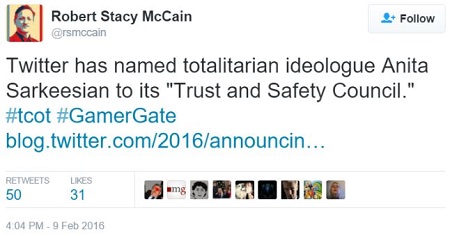
I’d been on Twitter since 2009 and my account had tens of thousands of followers, but the claim that I was “participating in targeted abuse” was offered to justify my banishment, even though Twitter never said what the alleged “abuse” was, who had been “targeted,” or how I had been “participating.” This act of censorship exposed how Twitter had decided, in an election year, to surrender control of its platform to a crew of feminist social justice warriors (SJWs) designated the “Trust and Safety Council.” This secretive group of Soviet-style commissars included the notorious anti-male hatemonger Anita Sarkeesian, and soon Twitter began purging conservative accounts.

Twitter stock, which was trading at $51 a share in April 2015, is now at $17, having lost fully two-thirds of its former value. Twitter’s response to declining value? BAN MORE CONSERVATIVES:

The Twitter account of Breitbart London editor in chief Raheem Kassam has been suspended by the platform, just days after he announced the forthcoming publication of his new book on Radical Islam. . . .
Kassam implied the sudden decision of Twitter to suspend his account just days after he revealed the controversial cover art of the forthcoming book which challenges radical Islam may have been more than just a coincidence when he took to rival social media Facebook to reveal the shutdown. Kassam also said that his account had never been shut down before.

Raheem’s account was restored after a 12-hour suspension — and pre-orders for his book made it No. 1 on the Amazon bestsellers list — but the point is that liberals are never targeted for such treatment. Can you name even one liberal journalist who has been suspended or banned from Twitter? Yet the known bans on conservatives — including me, Charles C. Johnson of GotNews.com and former Breitbart tech editor Milo Yiannopoulos — continue in force, which is to say nothing of the numerous lesser-known account suspensions. Last fall, just six weeks before the election, Twitter actually suspended Instapundit — Professor Glenn Reynolds, a USA Today columnist — for a three-word tweet about the violent riots in Charlotte, N.C. Meanwhile, by contrast, Twitter provides blue-check “verified” status to transgender pornographer Zachary Antolak/“Zinnia Jones”/“Satana Kennedy.”

There is an undeniable pattern of bias at Twitter, whose executives consider their political agenda more important than profit. Does anyone imagine that a company staffed by social justice warriors (SJWs) is a smart investment? Twitter management has effectively yielded control of the company to socialists, anarchists and other enemies of capitalism. Are you surprised that they’re losing nearly $40 million a month?


Further Thoughts on ‘The Big Short’

My reference to The Big Short and the housing bubble in my post about Tuesday’s special election prompted an email from a reader:

I was reading your discussion of the Big Short and you are exactly right about the people who got mortgages they could not pay being just as “guilty”, however you define it, as the people who gave them the mortgages. There are two things that infuriate me about the housing bubble. First, once people start getting loans they can’t pay back and don’t figure they ever will, they will always outbid honest people or if they don’t force honest people to pay more than they should have had to for a home. If I go out and get a loan I can afford to pay back, I can’t outbid the jackass who will borrow anything on the bet that he can flip the house. And that sucks. And as someone who was unable to buy a house during the boom, I resent the hell out of those people. The second thing about the situation is when those bets were paying off and people were flipping houses and making money, no one gave me any of that money. Those were their gains, not mine. But when the whole thing went tits up, I was supposed to feel sorry for them and view their having to give the house back to the bank and rent, something I had done my entire adult life as some kind of tragedy worthy of my aid. Yeah well screw them. Bubbles and speculation happen. But so do contractions. The fact that I ended up paying taxes to bail out a bunch of people who basically got rich at my expense is something I will never forgive.

Government intervention in the economy hurts real people in real ways. Democrats always talk of the way these interventions “help” people, but there is always a cost to be offset for every benefit. The costs in the case of subsidized cheap mortgages — including the notorious NINJA (“no income, no job”) mortgages that emerged during the housing bubble — included artificially bidding up home prices, in such a way that the honest would-be buyer was often priced out of the market. This also created an incentive for developers to build grotesque McMansions rather than more affordable family homes. Insofar as subsidizing mortgages function, as do most subsidies, as a form of deliberate economic redistribution, these programs amount to government picking winners and losers in the economy, which tends to create resentments and conflicts. The losers in such a redistribution scheme may not be correct in their choice of scapegoats to blame for their misfortune, but they are certainly justified in their belief that they’re getting screwed over.

Why do you think Hillary lost the election, huh? Here was a wealthy insider telling the “little people” about what she was going to do to “help” them, and the little people took a look at all those millions in the Clinton Foundation and realized that she really only cares about helping herself.

In 2014 Peter Wallison’s book Hidden in Plain Sight examined the role of “nontraditional mortgages” in causing the housing bubble. Here’s a US News & World Report article about the book:

Two decades ago, the major lenders employed mortgage underwriting requirements for collateral, capacity and credit history – the three Cs. Collateral meant that the home buyer made a down payment, preferably of 20 percent or more of the value of the house, never less than 10 percent. Capacity referred to the maximum share of a borrower’s income that could be devoted to mortgage payments and other debt service. Credit history meant that the borrower demonstrated an ability to manage credit responsibly, an ability which has come to be summarized in a credit score.
Nontraditional mortgages are those in which the lender deliberately waives one or more of the three Cs. Over a very short span of time, beginning in the late 1990s and culminating in 2007, the U.S. housing market came to be dominated by such mortgages. . . .
Government encouraged the growth in nontraditional mortgages. In the decades leading up to the crisis, government officials produced reports and statements criticizing lenders for sticking to the three Cs. They issued lending quotas to Freddie Mac, Fannie Mae and large commercial banks. To meet those quotas, those lenders had to turn to nontraditional mortgages.
The high volume and low quality of nontraditional mortgages was never disclosed properly. Fannie Mae and Freddie Mac instead reported that their portfolios included only one or two percent of “subprime” loans. . . .

People who want to blame “Wall Street” for what went wrong are simply ignoring the role played by government in causing the crisis.