

“Many young people turned to drugs and immoral lifestyles; these youth became known as hippies. They went without bathing, wore dirty, ragged, unconventional clothing, and deliberately broke all codes of politeness or manners. Rock music played an important part in the hippie movement and had great influence over the hippies. Many of the rock musicians they followed belonged to Eastern religious cults or practiced Satan worship.”
— America: Land I Love
Socialism, drug abuse and sexual perversion — during the 1960s, the connections between these phenomena were the subject of much discussion in America as university campuses erupted in protests, drug-addled hippies crowded into San Francisco and the so-called Sexual Revolution emerged in all its polymorphous variations. Naive dreams of “peace” and “love” in the groovy Age of Aquarius quickly came crashing down in the squalor, madness and murder of Altamont, the Manson cult, and the explosion that killed three Weather Underground terrorists. By 1970, any intelligent person who ever believed in all that hippie utopian nonsense had abundant evidence to inspire a reconsideration of their misguided idealism. Yet most of these young radicals never turned back from their destructive mission and the remaining survivors of the Sixties, now in their 70s or 80s, occasionally turn up in TV documentaries reminiscing fondly about how glorious it all was.
During a February radio interview, Texas Republican Rep. Louie Gohmert was asked about the surge of support for self-proclaimed socialist Bernie Sanders in the Democrat presidential primary. Gohmert blamed the influence of “hippies from the Sixties” who gained tenure as university professors and, by “teaching the teachers” had succeeded in “rewriting history and keeping [young people] from realizing socialism has never worked, it will never work in this world.” Gohmert’s quote was featured on left-wing blogs as one of those Crazy Things Republicans Say, yet it was a simple statement of fact. Anyone can examine, e.g., the career of Bill Ayers, the terrorist who became a professor of education. Gohmert cited the example of Ayers in a subsequent interview with Stuart Varney on Fox Business Channel in which he said, “If you go to teach as a professor in the universities and you teach the teachers, then the teachers go down and miseducate the young people.”
The phenomenon described by Gohmert is well-documented. Roger Kimball’s 1990 book Tenured Radicals: How Politics Has Corrupted Our Higher Education is a good starting point for anyone who wants to understand this problem. One of the great difficulties in explaining this to young people is that they know practically nothing about the Cold War and the reality of the Soviet menace. For more than 40 years, the central fact of American politics was that the United States was leading what John F. Kennedy called “a long twilight struggle” against the threat of Communist tyranny. 


Ignorance of Cold War history is a major reason so many young Americans are unable to understand why the collapse of the Soviet Union — “the Evil Empire,” as Ronald Reagan famously called it — proved the futility of socialism. If the Bolsheviks had been unable to bring about the egalitarian utopia promised by Marx and Engels, and if tens of millions of innocent people had died in the disastrous effort to implement “the dictatorship of the proletariat,” was this not sufficient proof that socialism was a deadly error? Yet the facts of Marxist-Leninist failure are deliberately obscured, and a dishonest version of Cold War history is promulgated, by the left-wing professors who dominate academia.
In a similar manner, the history of the Sixties has for many years been taught as a triumph of Progress, in which enlightened Youth overthrew the oppressive forces of right-wing bigotry and intolerance. Any young person who wishes to disabuse themselves of this counterfactual hippie mythology can start by 


Commie dopehead sex maniacs — how did American society travel full circle and end up in this weird time warp flashback to the 1960s? Well, the true history of the Sixties has been suppressed, which is why left-wing blogger John Avarosis freaked out in 2013 upon discovering that some private Christian schools in Louisiana were teaching the truth about hippies. The quote about “drugs and immoral lifestyles” of dirty Satan-worshipping hippies was featured in Avarosis’ blog after he learned this eighth-grade history book, from the Christian homeschooling publisher A Beka, was being used by some schools enrolling students whose tuition was funded by a new K-12 voucher program enacted by Louisiana’s Republican-controlled legislature. Ask yourself this: Why does a liberal blogger care so much what Louisiana kids learn about hippies?
This answer is that what we believe about history has a lot to do with what we believe about politics and, furthermore, Marxism is based on a specific theory known as historical materialism: “The history of all hitherto existing society is the history of class struggles,” as Karl Marx and Friedrich Engels declared in the 1848 Communist Manifesto, and by teaching children history from this perspective, the leftists who control the education system indoctrinate our nation’s youth with a worldview that is anti-capitalist, anti-American and anti-Christian. Why do you think a University of Southern California student would vow her intention to destroy “our capitalist imperialist white supremacist cisheteronormative patriarchy”? The answer is as simple as two words: Public education.
Commie dopehead sex maniacs are celebrated as heroes in the history taught in American public schools, and liberals are shocked to think that anyone would dare criticize the drug-addled hippies of the Sixties.
Testimony by an Expert Witness
What effect did hallucinogenic drug use have on the hippies? What role did this phenomenon play in the political and social upheavals that began during the 1960s? By a strange coincidence, one of my readers is a relative of a recognized expert on this subject. Friday morning I got an email about Dr. Harvey Powelson, who had been staff psychiatrist with the student health service at the University of California-Berkeley. The reader mentioned Dr. Powell’s critical views about the early push to provide contraceptives to UC students, in the context of what I wrote Thursday about “sexually active” people and the herpes epidemic. However, the reader also mentioned Dr. Powelson’s pioneering research on the effects of marijuana use. Dr. Powelson expanded on what is known as “amotivational syndrome,” i.e., the tendency of marijuana users to become idle and lose ambition, concluding in 1971 “that the effects of marihuana are cumulative . . . that after a period of prolonged use a disorder of thinking characterized by a lack of coherence and a pathological thinking process results.” Because of his expertise, Dr. Powelson was called to testify before the Senate Judiciary Committee in 1974, and I will quote here his statement at that hearing:
In 1965, I was chief of the Department of Psychiatry in the Student Health Service at the University of California in Berkeley. It was the first year of the student riots. It was also the first year that hallucinogens were becoming widely used and I, as the person responsible for mental health on the campus, was vigorously involved in the debate about psilocybin, LSD, and mescaline.
In the spring of that year a reporter for the Daily Californian, the student newspaper, asked for my opinion on marijuana. At that time I lacked any direct experience as a physician with marijuana users. The medical literature was sparse, but in general seemed to be saying that there was no proof of long-term harmful effects from marijuana. I summarized this for the reporter and said there was no proof of harm and that it should be legalized and controlled. In general, this view met with approval from most of the students and most of my professional colleagues.
In 1965, the use of marijuana spread through the Berkeley campus. Simultaneously its use was spreading to all the colleges and universities across the country. From the campus communities it spread at an accelerating rate through the surrounding communities. By now its use is subject to no age, social, or geographical barriers.
My place of observation was unique. I was routinely meeting with deans and administrators who were dealing with the drug problem and the students who were in academic and disciplinary difficulties as a consequence of the use of marijuana and its derivatives.
Most importantly, I was in daily contact with the constant flow of students through the student health service and the psychiatric clinic and hospital.
During this time (1965-1972) an increasing number of patients were using marijuana. My best guess, based on surveys and impressions, is that more than 80 per cent used it at one time or another in college. More than 50 per cent used it “socially” (1-2 times per week), and about 10 per cent were heavy users (at least 1 time daily).
My first important shift in thinking occurred as a result of observations made during psychotherapy with a young man, S., who was bright enough to be getting his law degree and Ph.D simultaneously and competent enough to be learning to fly and deal in real estate at the same time. As we proceeded in our work together, I came to know S.’s way of thinking: i.e., how he thought. Most of us do this without thinking about it. All of us come to know to some degree the way our friends and colleagues think. In therapy, the opportunity to hear someone think out loud about a problem important to him maximizes the opportunity to come to know how he uses or misuses logic, remembers clearly or not at all, does or does not exercise good judgment about his own thinking, and whether he is able to know his own feelings. We had made enough headway so that S. had begun to be able to observe and understand his own thinking. Periodically, we had hours (I was seeing him twice weekly) when his thinking became mushy. If I tried to follow him, my head began to spin. When I protested that he’d become impossible to listen to, he’d argue that his own experience was that he was thinking more clearly, more insightfully, than ever. On one such occasion, he mentioned that he’d been to a party two nights before where he’d had particular good “grass.” In Berkeley, 1968, that was not a particularly memorable remark, but we thought there might be some connection with his thinking. This same series of events recurred often enough so that I finally was able to [diagnose after the fact] that S. had some “mind-expanding drug,” usually marijuana.
S., because he was a good observer, helped show me another aspect of the thinking disorder I’m describing. Central to his difficulties was a paranoid stance toward the world. By this I mean a style of thinking characterized by a constant suspicion that one is being controlled; e.g., by the establishment, the system, etc.; and simultaneously a constant unwitting search for people and situations which will do just that; e.g., drugs, demagogues. If this manner of thinking is carried further, it blends into the condition usually called paranoia. Here the subject is controlled by voices, God, or whatever, and at the same time, he is very often “against his will” being controlled by a state hospital or jail. S. was forever talking about his search for someone or something he could trust. He very frequently clutched to himself people who were totally untrustworthy and hurt and rejected others who manifestly admired him.
When he had used marijuana, his thinking became more paranoid, i.e., he became more mistrustful of me, for instance, and at the same time, he became more wily so that he talked glibly, using cliches, theories, and “insights,” all to avoid noticing concretely and immediately whatever he was really doing and feeling in his relationship with me, as well as his relationships outside. In short, the pathological part of his thinking was exaggerated in two ways:
(1) he was more suspicious and
(2) he was more adept at fooling himself about what he was up to, while simultaneously maintaining how “aware,” “in touch,” and “loving” he was.
S. continued in therapy but also continued to use marijuana and hashish. Toward the end of his therapy I decided that so long as he muddied his thinking in this way, there was no use continuing. He, however, suffered a fatal accident (as a result of an error in judgment) before his therapy was terminated.
As I was becoming familiar with these effects of marijuana on S., I gradually learned to pick up signs when they were more subtle. I came to observe the same changes in others, i.e., that marijuana exacerbated the pathological aspects of their thinking.
Following the above described observations, I saw the same picture more and more frequently. The essence of the pattern is that with small amounts of marijuana (approximately three joints of street grade), memory and time sense are interfered with. With regular usage the active principles cause more and more distorted thinking. The user’s field of interest gets narrower and narrower as he focuses his attention on immediate sensation. At the same time his dependence and tolerance is growing. As he uses more of the drug, his ability to think sequentially diminishes. Without his awareness, he becomes less and less adequate in areas where judgment, memory, and logic are necessary. As this happens, he depends more and more on pathological patterns of thinking. Ultimately all heavy users (i.e., daily users) develop a paranoid way of thinking.
After I had become aware of the generality of this sequence, another reporter from the Daily Californian interviewed me to see if my opinions had changed in the interim. In the course of that interview, I realized in a concrete and explicit way that they had. The headline read, “Psychiatrist says pot smokers can’t think straight.” This time the response of the community and colleagues was not so approving. It is an interesting fact that questioning the claims of marijuana users leads to much more anger, vilification, and character assassination than does the opposite stance.
In subsequent years in Berkeley, both at the clinic and in my private practice, I have observed the long-term effects of cannabis. Originally, my observation was that students who had “dropped out” into the “drug scene” and were attempting to return were finding it difficult if not impossible. A frequent story is that the young person has become aware that the life he’s been leading is unsatisfactory and unproductive. He then stops drugs for six months or so and re-enters the university. When he returns to school, however, he finds that he can’t think clearly and that, in ways he finds difficult to describe, he can’t use his mind in the way he did before. Such people also seem to be aware that they’ve lost their will some place, that to do something, to do anything, requires a gigantic effort; they have become will-less — what we call anomie. They need an external director. They are ripe for a demagogue.
The changes in the capacity to think in some subjects are long lasting, if not permanent. One of my original (1967) subjects was a member of the junior faculty. He “dropped out” and used hashish exclusively for 18 months in daily doses. When he realized that it was interfering with his physical coordination, he stopped all drugs. Two years subsequent to this he returned to the university. He found that he could not do mathematics at a level which he had found possible before. Three and a half years later, his conviction was that the change was permanent. My own observations of him and other such gifted people have led me to the same conclusion, that the damage may be permanent.
My stance toward marijuana has shifted to the extent I now think it is the most dangerous drug we must contend with for the following reasons:
1. Its early use is beguiling. It gives the illusion of feeling good. The user is not aware of the beginning loss of mental functioning. I have never seen an exception to the observation that marijuana impairs the user’s ability to judge the loss of his own mental functioning.
2. After one to three years of continuous use, the ability to think has become so impaired that pathological forms of thinking begin to take over the entire thought process.
3. Chronic heavy use leads to paranoid thinking.
4. Chronic heavy use leads to deterioration in body and mental functioning which is difficult and perhaps impossible to reverse.
5. For reasons which I can’t elucidate here, its use leads to a delusional system of thinking which has inherent in it the strong need to seduce and proselytize others. I have rarely seen a regular marijuana user who wasn’t actively “pushing.”
As these people move into government, the professions, and the media, it is not surprising that they continue as “pushers”, thus continuously adding to the confusion that this committee is committed to ameliorate.
This concluding paragraph of Dr. Powelson’s testimony is important. The tendency of marijuana users to “proselytize” others, he suggested, was observable in the efforts to push for decriminalization of marijuana, a proposal that the Senate committee in 1974 was addressing. A few years later, during the presidency of Jimmy Carter, there was a significant rollback of federal “War on Drugs” (begun under Richard Nixon). One reason the Left so hated the 12-year White House tenure of Reagan-Bush was that the War on Drugs was renewed.
‘Pathological Patterns of Thinking’
It is also worthwhile noticing what Dr. Powelson said about how his marijuana-using patient, despite being illogical to the point of incoherence, insisted “he was thinking more clearly, more insightfully, than ever.” The long-term user “becomes less and less adequate in areas where judgment, memory, and logic are necessary” and develops “pathological patterns of thinking.” Because this psychological effect is cumulative, after the heavy marijuana quits and tries to go back to a normal life, he finds himself unable to function at the level he did before he started using — or at least, that was Dr. Powelson’s conclusion based on his clinical experience in the late 1960s. Dopeheads don’t like to admit that their habit has any harmful effect, and as Dr. Powelson told the Senate, experts who disagreed with pro-marijuana arguments became targets of “anger, vilification, and character assassination.”
Sic semper hoc.
Misery loves company, and dopeheads with “pathological patterns of thinking” don’t like being told they have a problem. Because “marijuana impairs the user’s ability to judge the loss of his own mental functioning,” as Dr. Powelson observed, it becomes impossible for the dopehead to recognize that he is suffering the symptoms of long-term use. The paranoia described by Dr. Powelson often takes the form of reversals and projections, so that the dopehead contends that the “system” is the problem, rather than his own drug-influenced beliefs and behaviors.
Do you remember Professor Erik Loomis? He is the academic expert on homosexual lumberjacks who, in 2012, became notorious because of his deranged violent remarks about Second Amendment activists. It was Professor Loomis who inspired me to remark: “When I said that the mentally ill should be in institutions, public universities weren’t the kind of institutions I had in mind.” Readers will perhaps not be surprised to learn that Professor Loomis is in favor of legalizing marijuana and unionizing workers in the marijuana industry.
When weirdos like Professor Loomis are hired at taxpayer expense to teach history, what does this tell us about the values of academia? And what happens when these warped values become widely accepted? One effect is that, as abnormal behavior is increasingly seen as acceptable by the intellectual elite, society is expected to tolerate these behaviors and we begin “defining deviancy down,” as Daniel Patrick Moynihan observed:
I proffer the thesis that [since the mid-1960s] the amount of deviant behavior in American society has increased beyond the levels the community can “afford to recognize” and that, accordingly, we have been re-defining deviancy so as to exempt much conduct previously stigmatized, and also quietly raising the “normal” level in categories where behavior is now abnormal by any earlier standard. . . .
Among the examples Moynihan discussed were the deinstitutionalization of the mentally ill and the breakdown of the family. He observed that “a large increase in what once was seen as deviancy has provided opportunity to a wide spectrum of interest groups that benefit from re-defining the problem as essentially normal and doing little to reduce it.” As divorce and unwed motherhood became redefined as “normal,” the problems so often experienced by fatherless children became normalized, too. Violence between street gangs — often fighting over “turf” in their drug-trafficking operations — has turned many major cities into war zones. In Chicago, there have already been 333 homicides so far this year; in the month of June alone, more than 400 people in Chicago were shot, 67 of whom died of their wounds. Murder is so common in Chicago that this incessant carnage — averaging about a dozen homicides a week — is not even considered newsworthy by the national media.
The tendency toward making “previously stigmatized” behavior exempt from criticism, to tolerate behavior that was considered “abnormal by any earlier standard,” is most obvious in the area of sexuality, where academia has led the way in destigmatizing perversion.
In 2001, for example, a University of Cincinnati professor published an article entitled “The Myth of the Heterosexual: Anthropology and Sexuality for Classicists.” This built on the professor’s earlier work, “The Teratogenic Grid,” published in the 1997 anthology Roman Sexualities. More recently, he contributed a chapter entitled “Sex, Popular Beliefs, and Culture” to the 2011 anthology A Cultural History of Sexuality in the Classical World. The Yale-educated professor’s influential work popularized the idea that the ancient Greeks and Romans did not classify sexual behavior by categories that we recognize today.

Also, we might note, nowhere in the works of Plato or Cicero do we find a phrase that can be translated as “child pornography.”
University of Cincinnati professor
arrested on child pornography charges
A University of Cincinnati professor has been arrested on child porn charges. According to court papers, Holt Parker told agents that he’s collected hundreds of videos and images of child pornography. He told them he traded child porn every day. Parker answered to charges in court on March 16. A federal judge ordered him held on $250,000 bond.
The FBI says agents arrested Parker on charges of distribution and receipt of child pornography in Clifton on March 15. He’s also charged with “destruction of property to prevent seizure”, for allegedly trying to destroy a thumb drive as agents were entering his home. They say he told them he’d recently downloaded thousands of files. . . .
He allegedly told them he started trading child porn online five or six years ago.
When the FBI came to his home, they say Parker apologized to his wife for his behavior and for ruining their lives, according to court papers. He allegedly told them he’d planned to commit suicide if he was caught.
In his online trading of child pornography, Professor Holt used the identity “Mr. Cruel Daddy,” with an email account he had created in 2008. That account was linked to another account, “Anne Thrax,” that Professor Holt evidently created in 1998. Professor Holt’s wife, Barbara Burrell, who has a Ph.D. from Harvard, is also a professor at the University of Cincinnati. So this Yale-educated professor married to a Harvard-educated professor, apparently spent 10 years online using the fake female identity “Anne Thrax” before creating a another identity “Cruel Daddy,” and admitted to the FBI he had been trading child pornography over the Internet since 2010. He had thousands of files.
This is probably another random coincidence, like the case of University of Southern California Professor Walter Lee Williams, who was sentenced to five years in prison in 2014 for “flying to the Philippines and sexually assaulting underage boys he had met online.” Professor Williams was co-editor of a 1997 book, Overcoming Heterosexism and Homophobia, and also co-edited the 2003 book Gay and Lesbian Rights in the United States: A Documentary History. A random coincidence . . .
In May, Indiana police arrested Ball State University math instructor Brian Kenneth Siebenaler, 48, on child pornography charges. A search found “thousands of images (and) videos of nude and semi-nude boys.” Siebenaler reportedly told police he had developed an “interest in boys about 10 to 15 years ago.” A random coincidence . . .
Also in May, former University of Nebraska-Kearney psychology professor Joseph Benz, 55, guilty of “possessing more than 20,000 child pornography images on his computer, including images of babies being sexually assaulted.” This was probably just a random coincidence . . .
In April, police in Pennsylvania arrested Villanova University history and classical studies professor Christopher Haas, 60, on charges of possessing more than 400 images of child pornography. Professor Haas had previously been investigated for similar allegations by federal officials, but that was just a random coincidence.
Professor Alyssa Azotea (psychology, Simmons College),Professor Michael Dean Stroup (economics, Stephen F. Austin State University), Professor James Francis Quinn (criminology, University of North Texas), Professor Douglas Paul Dohrman (health science, Texas A&M University), Professor Christopher DeZutter (chemistry, University of Minnesota-Rochester), Professor Noel Campbell (business, University of Central Arkansas), Professor Kevin Sullivan (public health, Emory University), Professor Amol Kharabe (business, Ohio University), Professor J. Martin Favor (African American studies, Dartmouth College) — would anyone care to guess what they have in common?
Yes, all of them were arrested on child pornography charges.
These random coincidences just keep piling up, don’t they? Some people might suspect “immoral lifestyles” and “pathological patterns of thinking” had become commonplace on American university campuses. But this could only be possible if Commie Dopehead Sex Maniacs had taken over the country, and that could never happen, could it?
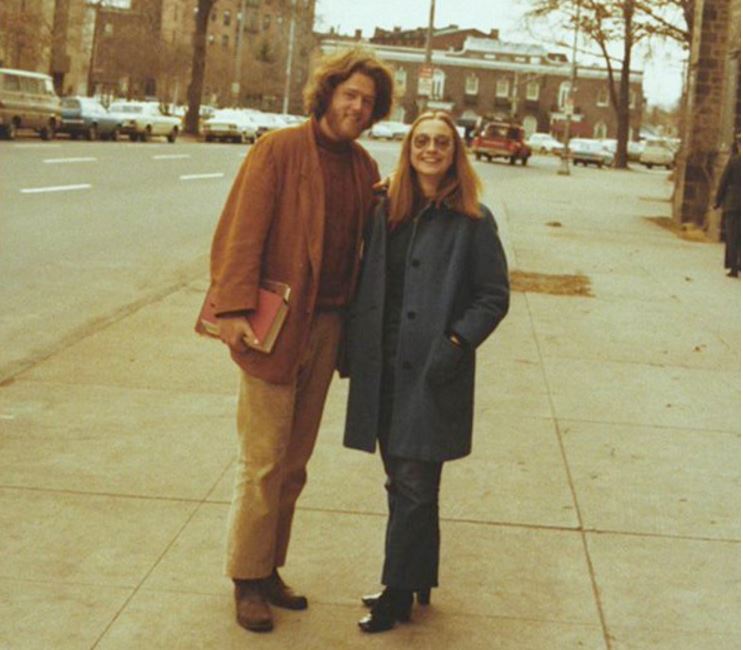
Bill and Hillary Clint at Yale University, 1970.
The deranged have taken the reins of power and we see the failures they have created.
The bizarre world of Monty Python is now reality and the sane are being called crazy…For someone who remembers the 50’s I do not recognize the West anymore. It is prolly why I feel so at home in Eastern Europe.
Yes, but how many of the perverts go into criminal court and claim Mental Illness as an out to their legal troubles?
I’m guessing that’s a big fat “ALL”. From porn, it isn’t far to molesting the young. And, there is a substantial faction out there that would resent those desiring children sexually being called “Mentally ill”, because by God, pedophilia is the next new “Normal”. They’re out there, but until it’s legal, a verdict of “insane” will do. God help the society that abandons their children to this, although recruitment of the young to homosexuality is in full swing and full speed ahead. As we can see, the gay men DO love their youngsters..
great article
Too bad Evans could not have written that book back in the fifties.
If he had, the left never would have got a foot hold.
Conversation in high school circa 1996:
Me: “My dad is thinking about making a bumper sticker: ‘Proof of Evolution: I used to be a Hippie'”
Dope-head classmate: “Naaaah man. That’s like, reverse evolution, man.”
The problem with marijuana research is that the government put marijuana in Schedule 1, which denies that there is any possible medical use or any other legitimate use, for that matter. At the same time, the federal government has been operating its own medical marijuana program since 1976:
http://en.wikipedia.org/wiki/Compassionate_Investigational_New_Drug_program
The result is that there is very little actual scientific research out there as to the full effects of marijuana, and we’re left with qualitative observations by this doctor, observations that may or may not hold outside of the small sample he had personal interactions with. We need proper scientific research on this before we can say that we know anything for certain.
We have seen more than enough to know the qualitative effects of marajuana. Over the years, I’ve read the statements of more than one Psychiatrist on the subject, and all of them have stated that the effects are bad.
While I can agree there needs to be research that would allow us to put the full effects in quantitative terms, I would have to hold that such research, involving human subjects of necessity, would be unethical. Going into such an area, knowing before we go in that the effects will be bad, and they will be permanent, is unethical and utterly immoral.
”
When he returns to school, however, he finds that he can’t think clearly and that, in ways he finds difficult to describe, he can’t use his mind in the way he did before. Such people also seem to be aware that they’ve lost their will some place, that to do something, to do anything, requires a gigantic effort; they have become will-less — what we call anomie. They need an external director. They are ripe for a demagogue.”
This is why George Soros wants pot legalized. In California, we have a ballot measure coming that will legalize pot for recreational use. It will most likely pass. I believe that pot is part of the agenda for destroying minds and wills and gaining control over the nation.
It’s worth mentioning that du Pont and Hearst conspired to ban hemp for their own business interests. Hemp used to be THE industrial fiber, so much so that exceptions were made so hemp could be used that way again during WWII.
Before Hearst launched his smear campaign, almost no one had heard of the wicked weed marijuana. Which was odd because almost everyone knew about hemp.
Studies regarding marijuana use were regularly suppressed, if they could get funding at all.
In this day where we have experts regularly proclaiming that “the science is settled” in everything from climate change to the intellectual and moral capacities of conservatives, it might be worth taking another look.
It’s also worth noting that both Trayvon Martin and Michael Brown were high on pot when they aggressively went after two armed men and tried to take their guns. Everyone said it couldn’t possibly be the pot, but I beg to differ.
If you are going to list the crimes committed by people high on pot, I’m going to list the crimes of people who were drunk.
Guess which is more?
Which in turn raises a very important question. Why is alcohol legal but hemp isn’t?
Maybe it’s because prohibiting alcohol launched a crime wave the likes of which had never been seen before.
Which raises another even more important question. If we know that prohibition doesn’t work AND causes more crime, why do we let government prohibit anything?
ETA: Sorry for the grammar errors, I was out in the sun and I’m still cooling down.
Anyone old enough to remember Commie Martyrs High School?
Firesign Theatre, right?
I don’t remember much else.
If you really want to have your mind blown (pun intended), google the 1944 LaGuardia Committee Report on Marihuana.
And then ask why the study was ruthlessly suppressed.
Because the Troublemaking is strong with this one today.
?Published in 1944, the report offended Harry Anslinger, who branded it as “unscientific.” Harry Anslinger denounced Mayor Fiorello LaGuardia, the New York Academy of Medicine and the doctors who had worked for more than five years on the research. Anslinger said that they should not conduct more experiments or studies on marijuana without his personal permission. Anslinger interrupted, between 1944 and 1945, each current research on derivatives of cannabis, and according to some personally commissioned the American Medical Association to prepare a position which would reflect the one of the government.?
en.wikipedia.org/wiki/La_Guardia_Committee
You’ve missed my point.
We have the general misconception that marijuana is “harmless” and, that in fact, it may be even helpful (medically). Some of this misconception of harmlessness stems from the fact that most high school or college students will try weed at some point in their lives. To whit: “Since I smoked pot in high school but am ok, it wasn’t harmful.” However, some of this misconception is bought and paid for, or being deliberately promoted by pot activists like Bill Maher. George Soros, for example, has been actively funding pot legalization initiatives throughout the US. His funding was directly behind the medical pot initiative (Prop 215) here in California two decades ago (1996).
However, it’s clear that marijuana is not “harmless”. The observations of the medical doctor (in RSM’s post) are not far off from what I have heard from other medical sources. I personally know someone with terminal cancer who used medical marijuana. He ended up going off it and dealing with the pain because his brain became too jumbled. He preferred being able to think to being out of pain. (He passed away several years ago.)
Both Trayvon Martin and Michael Brown were pot users and dealers. Because we have such a benign view of marijuana, no connection was made between their high states and their aggressiveness toward Zimmerman and Officer Wilson. Both Martin and Brown were said to have gone for their victims’ guns (in Brown’s case, the forensics proved that Brown’s hand was on Officer Wilson’s gun). We need to reintroduce the idea that pot may not be “benign” but might actually aid and abet aggressive behavior. The stereotype of the silly pothead watching “My Little Pony” and eating Cheetos may have to be altered depending on the user and on the type of pot. (And there are many varieties. I have a friend who uses medical pot for chronic pain and she says it is a bit different from the recreational varieties.)
Now, as to your statement about alcohol: no one is denying that alcohol is a problem. In fact, alcohol is so well known to abet violent behavior that had Trayvon Martin and Michael Brown been DRUNK during their respective altercations, it would have been far easier to see them as the aggressors. The stereotype of the belligerent drunk is well-established. But they were not drunk, they were high on pot. And somehow, that made it far easier to see them as pliable victims taken down by the “evil white man” since they were on peaceful, benign pot.
As to your comments about prohibition, that’s a different argument. As someone whose girlfriend is allergic to smoke, I would much rather my neighbors were drinking than smoking weed, (or cigarettes, for that matter) since I have to deal with my girlfriend’s misery. It doesn’t take much smoke for her to start having symptoms, and by the time I reach the window to slam it shut it, it’s already too late. In other words, there are immediate environmental issues with pot smoke (or the smoke of other drugs) that do not pertain to alcohol.
One can certainly argue that drunk driving is a problem, but the police have made great strides in this area. The one issue we don’t know much about is impaired driving caused by marijuana. I know there is an issue about even measuring levels of intoxication when someone is high. As long as marijuana stays illegal, someone who is high can be taken off the road, simply on the basis of the illegal drug use itself and not based on its level. So if a cop stops one of my neighbors and the car stinks of weed, the cop can get that neighbor off the road. However, it’s not clear how they are going to control for marijuana toxicity levels if the drug should become legal. Sometimes, the issues with legalization are more practical than philosophical.
My point is that if we trust people with things like guns, driver’s licenses, vodka, and credit cards, we might as well trust them to make their own choices in everything AS LONG AS they accept the consequences.
I’m not saying that hemp is harmless. I suspect that used in moderation, it is no more harmful than Blue Bunny ice cream, craft beer, or venison steak.
But you missed my point, which caused me to have to explain it.
Please do me the courtesy to read and comment on what I actually wrote. I took some time to explain my actual position to you.
Then I’ll address your logical point.
“We’re all Bozos on this bus!”
A difference between alcohol and drugs is that alcohol, esp. wine has a purpose for feasting and merriment in human relations, where drugs do not. Also alcohol had a place when potable water was not easily accessible.
Yes groups have taken drugs together, but as far as I know it was mainly for false spiritual experiences or getting prepared to kill.
There will be a feasting with wine and fats in Heaven. I haven’t heard there will be a passing of the J.
I love the history book’s frank description of the hippy movement. I wish all Christian spokesmen were as clear.
Pardon, but are you saying that alcohol is good because people enjoy it?
Hemp wasn’t considered a drug before the early 20th Century. Neither was tobacco.
I didn’t miss your point. It’s just based on Expert Testimony and anecdotal evidence.
I’ve been dealing with Expert Testimony for decades on the “global warming” issue. “The Science Is Settled!!!” Pardon me if I don’t take Expert Testimony seriously, especially when I know that contradicting studies are ignored. And when I know that the “Experts” have every incentive to spout the approved story and nearly no incentive to question the science.
Prohibition is prohibition, whether it’s alcohol, drugs, vice, or prostitution. We know that prohibition doesn’t work. We know that prohibition creates more social problems.
We also know that prohibition means we don’t trust people to make their own choices.
The pot today is so much more potent than the pot in the 60s they might as well be different drugs
The name “Assassin” is often said to derive from the Arabic word Hashishin or “users of hashish”,(which can be used as a derogatory term in Arabic and it is the equivalent of “drug addict”
https://en.wikipedia.org/wiki/Assassins
Sounds like the idea is medieval at least. (nevermind whether the Assassins really used it or not).
I’ve TRIED to push folks toward Blacklisted by History, only to discover that their fundimental miseducation had NOTHING to do with “reading books”, and stuff.
And yet, I wonder how well a production of “The Crucible” would go over during Title IX, campus rape shield law, safe space, diversity intersectionalisation , celebration month.
Is a 500mg aspirin a different drug than a 250mg aspirin?
The fact that hemp is illegal means that there is no portion control or quality control that you can trust.
The same thing happened with alcohol during Prohibition. You literally didn’t know if it would blind you or not. There was no way to sue the manufacturer or the guy who sold it to you.
In today’s world, that means you don’t know if the hemp was cut or what it was cut with. The same goes for nearly any other illegal drug. These additions create more medical problems than the illegal drug.
Why he’s no fun. He fell right over.
I do know Washington and Jefferson grew it. And not just as an industrial fiber.
This article gives a fairly unbiased history.
You’ve still missed his point. You’re stuck on prohibition and that wasn’t the point.
We’re seeing the problems in Colorado. MJ has been bred in a way that increases its potency. Victoria’s point stands and we are seeing the results in people who think they are engaging in the abuse of something that is really harmless. We already know that MJ is not harmless. It might take a short bit of time to start seeing the results, but the result is there, and people will suffer for the stupidity of people who have set out to deceive.
Prohibition is not the issue, no matter how much you may wish it were.
Neither were opium poppies, coca leaves, or sugar cane,
“at one point”.
That article is ALSO grossly incomplete.
Good luck finding a reasonably unbiased complete article.
For example, while that article does talk about Anslinger, it doesn’t mention Hearst or duPoint and their role in pushing Anslinger to the forefront.
Nor does it mention socialism or the idea of a scientifically managed society, which certainly contributed.
So here’s another question.
Why were they banned?
Was it for “our own good?”
No, what we’re seeing is the transition.
We know that beer does not have the same alcohol content as vodka. That’s why the serving sizes differ.
ETA: When you are advocating removing something from the market, by definition you are prohibiting it.
Our modern drug laws grew out of the whole scientifically managed society thing.
I specifically talked about Expert Testimony and why it may be political propaganda.
You missed his point. Alas, it’s typical of you to deflect onto an issue another doesn’t bring up and try to steal the thread.
An incomplete article is not unbiased.
For very good reasons you don’t like because you think the only people affected by a personal decision is that person. On rare occasions that will be the case. Note: “rare.”
That’s bunk and simply more of your typical deflection.
Seriously, we need to decriminalize school truancy. If a student doesn’t want to go to school, they don’t have to go. If they, and their parents, realize the bullshit being taught, then they can teach themselves.
The proselytizing of pot matches the proselytizing of support for homosexual life style.
The destruction of the Black family by the welfare state is a feature, not a bug. Obviously desired feature, since little to nothing has been done to stop it.
A drunk can be very dangerous. However, drunks sober up, frequently overnight. Long term alcoholics will have diminished reflexes, and thinking capacity. But the short term and long term effects of pot are far more insidious.
I’m not saying that hemp is harmless. I suspect that used in moderation, it is no more harmful than Blue Bunny ice cream, craft beer, or venison steak.
One joint three times a week is more than a moderate amount. Your suspicions appear to be wishful thinking.
Okay, explain it to me slowly.
Tell me why one substance that causes more measurable harm to people and society is legal while another substance that isn’t as widely used and doesn’t cause nearly the amount of personal and social harm is illegal?
But the short term and long term effects of pot are far more insidious.
What are these effects and how are they worse than the effects of alcohol?
One joint three times a week is more than a moderate amount. Your suspicions appear to be wishful thinking.
So three glasses of wine a week is not a moderate amount?
It can be a good start, if you’re actually ready to start.
There’s not a single complete source for anything.
You don’t think people should make their own choices? Even if they accept the consequences?
And yes, those consequences include how their choices affect other people.
So ordering a shot and a beer at the local watering hole is OK while smoking a joint isn’t?
Who decides what is forbidden?
Why?
Now that is interesting.
Are you a regular reader here? Or did you just start?
Personally I don’t think there should be public schools. I also don’t think people should be in school if they don’t want to be there and aren’t willing to work at it.
I don’t agree with proselytizing for anything. But I don’t think we should be taking people’s choices away either.
I agree with you about welfare too.
Would you like to discuss any of these things?
Or is there something else you find worth talking about?
1. When someone else pays the freight, they get to decide.
2. When there are societal costs, society gets to decide.
You can say all you wish that you don’t want this that or the other thing, but the welfare state exists, and until it’s at an end, #1 applies. You can say all you like that the individual gets to decide and that the societal costs are part of the consequences, you don’t get to decide for another person the consequences of your actions. Therefore, #2 applies.
Until you can make each person an island whose actions affect no one else, then there will always be someone that gets to decide for an individual that wishes to include the rest of society in their self destruction.