Book Launch!

— by Wombat-socho

I could have sworn we had a “Shameless Capitalism” tag in here somewhere, but I guess not. Anyway, since I took the day off yesterday, I’ll be doubling up on the linkagery today as soon as I get back from having my claws filed this afternoon, but I did want to mention that I have a new book out. It’s a collection of short SF stories titled The Anti-Dog Tank and Other Stories, and it’s available for $1.99 from Amazon. You can also read it through Kindle Unlimited or the Prime Lending Library, if you have access to those. I think if you liked my essay collections, The Last Falangist and What Did You Do In The Cold War, Dad?, you’ll like The Anti-Dog Tank and Other Stories.

A Farewell To Analog

— by Wombat-socho

I grew up with Astounding/Analog SF, which for many years was the science fiction magazine, and am old enough to remember the end of John W. Campbell’s tenure as editor there. ASF and Campbell (and to a lesser extent, his successor Ben Bova) shaped my tastes in SF, as they did for so many other readers, and Campbell’s imprint on the genre as a whole is undeniable.

For the magazine he rescued from obscurity and built into the best SF magazine of the Golden Age to take a public shit on his memory like this is cowardly and vile. It is, perhaps, understandable in the wake of this year’s winner’s ignorant yawp about what a horrible person Campbell was by [CURRENT YEAR] standards, and the wretched soyboy Trevor Quachri’s desire to please people who cannot be pleased, but that makes it no less cowardly and vile. No, John W. Campbell Jr. probably wouldn’t be welcome in SFWA or at Worldcon these days, but I doubt Mary Kowal would have been welcome in the field back in the 1930s and 40s either, not least because her writing is terrible and not worth a penny a word on publication.

I have not had a subscription to Analog since the 1980s, shortly after Stanley Schmidt replaced Bova, and I needed the money more for other things (like a family). I wasn’t impressed by the few issues I saw, and I gather from the declining publication frequency and subscription numbers that I’m not the only one. There are still some good authors being published there, but most of the fiction is the kind of depressing crap I turned to SF to get away from. After this, I’m not touching anything having to do with Analog. The magazine and its current editor can die in a fire as far as I’m concerned.

On a happier note, Hans Schantz informs me that a number of conservative and libertarian authors have books for sale this weekend for 99 cents in honor of Dragon*Con. Your irascible neighborhood wombat says check it out!

As for me, I’ve been rereading some of the older Monster Hunter International novels: Monster Hunter Vendetta, wherein Owen Pitt is targeted for kidnapping and sacrifice by a bunch of necromancers working for the Old Ones, and Julie’s childhood playmate Mr. Trash Bags saves the day, and Monster Hunter Alpha, where Earl Harbinger goes to meet an ancient enemy in Copper Lake, Wisconsin, only to find himself having to team up with said enemy to prevent an outbreak of werewolves – and worse – from taking the little mining town as a springboard to apocalypse. Not going to lie, I enjoyed these a lot more the second time around, because some of the characters in them play much bigger roles in subsequent MHI books. Also reread Sharpe’s Rifles, Sharpe’s Eagle, and Sharpe’s Company by Bernard Cornwell, which are great adventure stories set in the Peninsular Campaign against Napoleon’s armies, and chock-full of historical goodness as well. Pity they didn’t stick with the Sean Bean-inspired covers.


Mother Cat Defends Kitten, Racks Up Impressive Body Count

— by Wombat-socho

Oh boy oh boy oh boy oh boy! *ahem* I can honestly say that I haven’t fallen in love with an MHI book so hard since Monster Hunter: Nemesis, and oddly enough, the two books have a fair amount in common. Neither has Owen Pitt as the protagonist, and in both of them, the protagonist is pretty much on their own, without the aid and assistance of their well-armed compatriots. Monster Hunter: Guardian is Julie Shackleford’s story, and happens simultaneously with Monster Hunter: Siege, so Owen and Earl and the rest of MHI (as well as pretty much every elite monster hunting company out there) are on Novaya Zemlya attacking the City of Monsters. So here Julie is, pushing papers, bored out of her mind, something comes up…and her entire world goes sideways. Aside from being a new mom, Julie’s the Guardian of a hideously powerful artifact, very badly wanted by some evil beings, bad enough to kidnap Julie’s baby Ray and make her an offer – hand over the artifact, and Ray gets returned safe and sound. Of course, nothing is ever that simple or easy, since evil beings are notorious for welshing on their promises, and Julie takes off for Europe in pursuit of Brother Death. But she’s not alone in the hunt. She’s got Mr. Trash Bags in her pocket and a very angry, very rich, and very vindictive dragon providing her with all the help money can buy. Unfortunately, she’s also got the European equivalents of the Monster Control Bureau on her ass, and the unwanted “help” of her mom, the master vampire. Orphaned necromancer Lucinda Hunt and some of her hapless minions also make an appearance. I’m very happy with this latest addition to the MHI series, and I think you will be too.

One of the Loyal Readers sent me an interesting collection by G. “Doc” Smith, Cats of War, which is an anthology of stories about warrior cats – in space, encountering humans for the first time; in history, retelling Spartacus’ rebellion; in alternate history, where Americats fighting the Ratzis recover a captured general from a brutal concentration camp; and in a fantasy tale where bagpipes are a literal weapon of war. They’re all well written, and I can honestly echo Artemus Ward here – if this is the sort of fiction you like, then these are the sorts of story you will like. Decently priced at $2.99 on Kindle.

I picked up the second volume of Tomohito Oda’s Komi Can’t Communicate this week, and the saga of her quest to make one hundred friends continues as we get to see some of her classmates…who are not exactly normal, to say the least. Oda does a great job keeping it light and humorous; in other hands, the plot might have gone sideways into horror very quickly, especially in the chapter where one of her (female) classmates develops an obsession with her and kidnaps her friend Tamano, who most people feel is far too normal and colorless to be the friend of someone so gorgeous and aloof. It’s significantly cheaper on Kindle, and I daresay aside from the beautiful cover illos you won’t be missing much since this is a plain black & white manga.

Loans of books, donations of books, or cash to buy books are all welcome.


Amazon Warehouse Deals

Kindle Unlimited Membership Plans


Off the Shelf

— by Wombat-socho

Cash being a bit low of late, everything that follows is from the Clark County Library (and hopefully in your local library as well) or the Kindle Owners Lending Library, which is another reason to shell out for Amazon Prime if you haven’t already.

Probably the pick of the litter is Brad Torgersen’s second novel, A Star-Wheeled Sky, which is set far in the future after mankind has escaped Earth in STL colony transports, many of which have settled the various planets of the Waywork, an alien relic that permits FTL travel between the various systems it connects. From the colonies, Starstates grow, and two of them – an oligarchy with some freedom and a brutal totalitarian regime – are locked in a war that is slowly grinding the oligarchy down. Suddenly, a new Waypoint appears, and both sides scramble to claim what turns out to be a beautiful new Earthlike world, with an enigmatic alien pyramid, the wreck of a colony transport, and an apparently immortal woman with an ominous message. It’s a fascinating tale well told, with adventure, desperate improvisations, and interesting characters on both sides. Recommended.

It used to be common that most anthologies had a handful of good stories, a lot of filler, and at least a couple of clunkers. I don’t know whether the slow death of SF magazines is the cause, but for some reason, the anthologies I’ve been seeing lately don’t seem to have any clunkers, and for that matter, there’s not as much filler as there used to be. Case in point: The Change, edited by S. M. Stirling and set in the Emberverse series that begins with Dies The Fire. So if you didn’t like those, you won’t like this, and as the late Steven den Beste used to say, DWL.* On the other hand, if you did like the Emberverse stories…well, you probably read this already. Me, I didn’t happen across it until I’d already finished The Sky-Blue Wolves, so The Change gave me a serious feeling of deja vu since I’d already met a lot of the characters in these stories back while I was reading the novels. At any rate, there’s some good stories in here by John Birmingham, John Barnes, and some other folks, and no clunkers.

The other example is Michael Williamson’s Forged In Blood, the tale of a sword forged in ancient Japan and the people who bear it. It’s listed as a book in the Freehold series, which isn’t entirely accurate since the first two-thirds of the stories take place on Earth, not Grainne, but that’s a minor quibble. There are some excellent, excellent stories in here by Larry Correia, Mike Massa (do NOT miss this one, set in the Russo-Japanese War), Tom Kratman, Kacey Ezell, and other outstanding writers from the combat SF subgenre. Good stuff.

I’ve been following the Ring of Fire/Grantsville series by Eric Flint and a cast of thousands** since they came out, skipping a few that didn’t seem interesting and trying my best to stay current. This last month I read two books set in 1636, The Kremlin Games and The Viennese Waltz. The former is about Bernie Zeppi, one of the Grantsville kids who’s at loose ends after 1632’s Battle of the Crapper – he doesn’t really have any useful skills, and he has a mild case of what they used to call “battle fatigue”. Luckily for him, the Tsar of All The Russias wants Grantsville’s tech, and he wants it bad, and that’s how Bernie winds up in Moscow trying to drag Russia into the 19th century when a lot of it isn’t sure it wants to leave the 16th. Hijinkery, war with the Poles, and a revolt by the boyars makes life excessively interesting, but Bernie and the Tsar manage to survive and even light the lamp of freedom in a country mired in serfdom. The latter, on the other hand…well, it makes me wish I hadn’t skipped The Barbie Consortium, because a lot of the main characters in The Viennese Waltz are members of said consortium, and while I like economics porn along with the subplot of trying to force early Renaissance Austria into the Steam Age before the Turks come back, I would have liked to know those characters better. The main problem is that the current Emperor of Austria-Hungary’s dad sold off a lot of patents on uptime tech to nobles, nobody has any faith in Austrian marks despite their being backed by real silver, King Albrecht (Wallenstein) of Bohemia is right next door with his Protestant army, and did I mention the schism in the Catholic Church between the former Cardinal Borja (now an antipope) and Pope Urban VIII? Lots of skulduggery, economic/financial porn, and scandalous uptime fashions having unexpected effects. Fun read.

The war pitting the Four Horsemen mercenary companies (and their handful of alien allies) against the Mercenary Guild led by the Veetanho General Peepo comes to a head in A Pale Dawn and concludes in Alabaster Noon. It’s almost impossible to do a decent plot summery for both of them without spoilers, but I will say that A Pale Dawn, which covers the Four Horsemen invasion (and liberation) of Earth doesn’t quite go as planned, and sets up the final novel in the series in such a way that I skipped the three intervening novels in the series and went right for Alabaster Noon, which made a few things that happened in the final look a bit like dei ex machina. I guess I’ll spend the next three months going back and filling in the gaps.

Finally, I am taking a stab at Tolstoy’s classic War And Peace, which is… yuge. And dense. I expect to be working on this one for a while, but if nothing else the first few chapters have convinced me that Russian culture hasn’t changed a whole lot since the 18th century, except they didn’t speak so much French and German in the 20th century. For those of you who haven’t heard of the book before, it’s a sprawling novel about Napoleon’s invasion of Russia, told from the Russian side, and there’s a LOT of detail about how Russian high society was in those days. So far it’s been pretty interesting.

Thanks to everyone who bought stuff through my Amazon links last month and/or hit the tip jar. If there’s a book you want me to review, you can loan it to me on Kindle, buy me a copy, or hit the tip jar with a request that I buy and review it. I endeavour to give satisfaction, as Jeeves used to say.

*Don’t Write Letters.
**I know, I know, it’s actually just a dozen or so folks.

Kindle Unlimited Membership Plans


Hermione Granger At The Marco Polo Bridge

— by Wombat-socho

Aside from the occasional used book, I haven’t bought any books from anyone but Amazon in quite a while. This year, I made an exception and actually paid list price for the Compton Crook Award winner’s debut novel, The Poppy War, by R. F. Kuang. As The post title indicates, this is a coming of age fantasy in a world where magic works…differently, and the gods are feared for a very good reason. Kuang’s novel is about a young girl orphaned by war and fostered by a merchant family who changes her fate by passing the extremely difficult admittance exam for Sinegard, an elite military school where she discovers that her fate isn’t to be an officer in the Imperial military, but something far more dangerous. Despite the foregoing, this is not a book for children or even young adults, because it’s set in the Second Sino-Japanese War, except that everyone is using arrows, swords, and polearms instead of rifles and artillery. While the notion of Chiang Kai-Shek as the Empress is amusing, Kuang spares us and her heroine nothing, not even the Rape of Nanking, which is horrifically re-enacted. I am looking forward to the sequel, The Dragon Republic with some trepidation; I’m hoping our heroine lives happily ever after but am rather afraid she won’t.  It’s due out in August.

On a more cheerful note, the first volume of Komi Can’t Communicate is out from Viz Media. I’d been following it thanks to fan translations on the web, and wrote kind of a pre-review here. The manga has more than lived up to my expectations – while a lot of the characters are bizarre, extreme caricatures of typical middle school kids, it’s at its base the story of a girl who can’t talk to people well but badly wants to make friends instead of being placed on a pedestal by her classmates for her “aloof” beauty. The art is nothing special, but the story is good. Worth your time.

The Four Horsemen universe rolls on, and I’ve finished Mark Wandrey’s Dirty Deeds and Jon Osborne’s When The Axe Falls. Wandrey’s book is the tale of a merc who wants to retire on an idyllic island colony…but trouble keeps finding him, and when the Mercenary Guild forces land, he realizes it’s time to saddle up with his fellow retirees and show the aliens why it’s a bad idea to mess with people who’ve grown old in a field where few do. Lots of humor, lots of action. Highly recommended. Osborne’s book is also good, mixing a story of revenge with an underhanded scheme by the Guild to set humans against humans….which turns out to be a bad idea for the humans the Guild is using as a catspaw.

Cash being short, I’m going to head over to the library this week and get caught up on some recent books by David Drake and the 1632 crowd, plus whatever else catches my eye.


The Return Of The Book Posts

— by Wombat-socho

It’s been a while, hasn’t it? Haven’t posted about books since the end of last August, when I started on getting clear of my old apartment and into a new one. That having been dealt with, and my Uber career ended in the process, I’m going to have a lot more time to be browsing through books. Which is good for you, because then you get the benefit of my experience, which fortunately has been (mostly) good. I want to start off with a debut novel by Jeb Sherrill, Storm Dreams, which is an odd fusion of World War I and H.P. Lovecraft’s tales of Randolph Carter and the Silver Key. It’s an interesting little tale with a lot of derring-do mixed thoroughly with speculation about dreams and reality, and the things that exist on the borderline. It was occasionally slow going, but the climax of the book and its resolution were very well done, and I don’t think you’ll be disappointed.

Stephen Stirling’s Emberverse has finally wrapped up, and I managed to finish the last two novels, The Sea Peoples and The Sky-Blue Wolves, during the course of the move. These two books focus on the adventures of Prince John in the Antipodes;  in the last novel, which shows signs of being rushed, John and his companions liberate Korea from its mad ruler with the help of some renegade Mongols, and the method used owes quite a bit to John’s horrific sojourn in the nightmare lands of the Yellow King, described in The Sea Peoples. To be honest, I was a lot happier with that book than the final novel; Stirling extrapolates the unhappy future of America under its last Emperors (see “The Repairer of Reputations”, by Robert Chambers) and pulls no punches in describing it as our heroes enter it to save Prince John. This alone, in my opinion, is worth the price of the book.

While we’re talking about sequels, Nick Cole’s Pop Kult Warlord is a worthy sequel to Soda Pop Soldier,* and just about all your favorite characters are back, but the stakes are very different – instead of trying to keep his hide intact in meatspace, and win it for ColaCorp while figuring out what’s going on in the Black, Perfect Question’s already won the Big One, and he’s going to Disneyland! Well, not quite…Disneyland isn’t what it used to be, and the Arab playboy who’s hired him to play warlord for Calistan’s online attack on Mars may be the worst boss he’s ever had. Possibly the last if he’s not careful. In comparison, former Protector Ashok Vadal doesn’t have it so bad – ah, who am I kidding? The protagonist of Larry Correia’s House of Assassins is really in the shit, with practically every man’s hand against him – including his former brother Protectors – the nearly impossible task of retrieving the prophet Thera from her shapeshifting captors, and worst of all, he’s got to do it without his mighty Ancestor Blade, Angruvadal. But Ashok is a Larry Correia hero, which means he doesn’t die easy, and he doesn’t quit. Excellent follow-on to the first book.

Going in the other direction, C.J. Cherryh’s taken her time about filling in the backstory of her Alliance-Union ‘verse – there’s a huge gap between Hellburner, which deals with the training of the Earth Company Fleet, and Downbelow Station, where the EC Fleet flees in final defeat from the Alliance merchanters and the Union carriers. Alliance Rising is closer to the former than the latter – there are still STL pusher ships making the ten-year-long run from Sol Station to Alpha Station, but past Alpha and out to Cyteen, FTL ships carry all the people and the cargo. Now comes long-haul merchanter Finity’s End into Alpha, but with all cargo going to the EC’s Rights of Man, and precious little to the ships and people at Alpha, what could they be looking to buy…or sell? Cherryh has not lost her touch at juggling several plot balls at once, ranging from interstellar intrigue to dockside sleepover romances to bureaucratic infighting to prickly inter-ship (and inter-family) negotiations. I honestly can’t tell where co-author Jane Fancher picks up and Cherryh leaves off, to be honest. Anyhow, if you like her other Alliance-Union space novels, you’re going to like this one.

And I think that’s enough for this month.


Kindle Paperwhite With Essentials Bundle – Just $129.97!

*It’s just 99 cents, grab it before Nick comes to his senses!

Decline and Fall

Marcus Aurelius.

“I devoured Gibbon. I rode triumphantly through it from end to end and enjoyed it all. I scribbled all my opinions on the margins of the pages, and very soon found myself a vehement partisan of the author against the disparagements of his pompous-pious editor.”
— Winston Churchill, My Early Life

A six-volume hardbound boxed set of Edward Gibbon’s classic Decline and Fall of the Roman Empire can be purchased for $68.46 from Amazon, but I don’t suppose many young people appreciate what a tremendous bargain that is. Our youth seem to have no interest in history, and would prefer playing video games to reading books. But I mention Gibbon because I’ve spent the past few weeks with the Decline and Fall as my bedtime reading. I purchased my old three-volume Modern Library edition secondhand about 25 years ago, and am now on my second or third re-reading. Gibbon begins his survey by recounting the condition of the Roman Empire at its peak, from the reign of Nerva (96 A.D.) through that of Marcus Aurelius (180 A.D.) when the empire “comprehended the fairest part of the earth, and the most civilized portion of mankind.” Nothing like this had ever previously existed in human history, an empire that stretched from Scotland in the north to the African desert in the south, from the Atlantic Ocean in the west to Turkey and Syria in the east, encompassing the entirety of the Black Sea as far east as modern Tbilisi in the republic of Georgia.

What caused the fall of this mighty empire, in a word, was decadence.

Rome’s greatness was rooted in the hardy virtues of the Republic, where the citizen-soldier was expected to serve in the common defense, and where the highest offices were held by men who had distinguished themselves in military as well as civilian life. A sense of hereditary honor was deeply inculcated in Rome’s leadership caste — the patricians — who strove to deserve their patrimony by the performance of civic duty. The patrician spirit of service for the public good inspired respect among the common people of Rome — the plebeians — who saw that they also benefited from increasing power and prosperity of the Republic. The origins of the Empire in the Republic, and the civil wars that made Augustus (Octavian, heir of Julius Caesar) the founder of imperial rule, are a subject of history that preceded by some two centuries the period at which Gibbon begins his tale of how the Empire, which had survived and even expanded despite the misrule of Augustus’s successors, declined toward its division and collapse. And the cause was decadence.

Success is too often in history the predecessor to destruction. Rome made unprecedented advances in so many fields, including architecture, engineering and military science, and conquered so many distant nations, that the citizenry obtained a condition of luxury hitherto unknown by any large population anywhere in all human history. A system of well-built roads connected every part of the empire, the Roman fleet commanded the entire Mediterranean Sea, and the powerful legions guarded the frontier from the Antonine Wall in northern England, across the Rhine and the Danube to the Tigris on the frontiers of Persia.

The strength of this military power created the Pax Romana, which made possible the flourishing of commerce and the arts, but this peace and prosperity eventually produced decadence, and by 476 A.D. Rome was sacked by the Goths under Alaric. This history, as memorably chronicled by Edward Gibbon in 1776, was once familiar to every statesman — Churchill “devoured” it as a boy — but today, in our own far advanced condition of decadence, how many young people know anything at all about what happened to the Roman Empire? This disinterest in history, this willful disregard for our civilization’s accumulated knowledge, is itself symptomatic of decadence. Young fools prefer 5-Minute Daily Meditations by a gay fashion magazine editor to studying history.


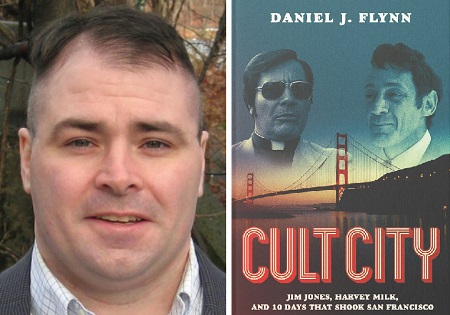
Jim Jones, Harvey Milk and the Weird Cult of ‘Revolutionary Suicide’

Daniel J. Flynn and his new book, ‘Cult City.’

A strange and chilling saga:

Thanksgiving, 1978 was bookended by two of the most bizarre and notorious events in American history. On November 18 in Guyana, hundreds of members of Jim Jones’s Peoples Temple committed mass suicide, or were murdered. Over the next few days, news trickled out from the jungle of 300, 400, 600, and finally more than 900 poisoned cultists, most of them from the San Francisco Bay Area, including many children; and of a congressman, Leo Ryan, ambushed and assassinated as he left with a dozen or so apostates whom he had rescued. Then, the Monday after the Thanksgiving weekend, San Francisco mayor George Moscone and a city supervisor, Harvey Milk, the first openly gay non-incumbent politician elected to office in America, were shot and killed in City Hall by Dan White, a disgruntled city supervisor who had quit his job and then wanted it back.
The connection — sometimes tenuous, sometimes shocking — between these incidents has been brushed over by a society eager to sanctify its martyrs and forget its villains, but Daniel Flynn in Cult City brings to light a kind of secret history of California in the 1970s, showing how modern progressive politics intersected with cults of madness and despair. Jim Jones came from Depression-Era Indiana, and was drawn to charismatic Christianity and radical politics from an early age. He founded a church called People Temple, dedicated to racial harmony, the living Christ, and veneration of the Soviet Union, and presented a compelling enough message that he attracted thousands of followers over the years.
Having moved his flock to northern California in the 1960s, Jones began leveraging their labor toward political ends, volunteering them for protests or electioneering on behalf of friendly aspirants to public office. Gaining the respect of San Francisco’s political class, Jones became a player in his own right. Many gave him credit for Moscone’s tight victory in the 1975 mayoral runoff, and he was appointed head of the San Francisco Housing Authority. Praised as a hero of social justice and a crusader for racial equality, Jones became an important figure in Democratic politics.
Among his advocates was Harvey Milk, also a newcomer to San Francisco. Milk, formerly a Goldwater Republican, became politically radical in California and repeatedly sought election to office as an outsider to the political machine. Milk attended services at Peoples Temple dozens of times, and wrote effusive letters to Jones. “Such greatness I have found in Jim Jones’s Peoples Temple,” Milk proclaimed.
Milk wasn’t Jones’s only fan. Many powerful people — Governor Jerry Brown, columnist Herb Caen, and Vice President Walter Mondale, to name a few — sought Jones’s blessings and expressed admiration for his dedication to racial equality and a better world.  . . .

Read the rest at City Journal.

I’ve previously recommended Daniel Flynn’s new book Cult City: Jim Jones, Harvey Milk, and 10 Days That Shook San Francisco.