Reading Samizdat


One of my habits — perhaps not a good habit, but valuable to my career as a journalist — is studying the radical fringe. This is part of what I learned from Hunter S. Thompson‘s career. If you want to know where society is heading in the future, pay attention to what is being advocated by those who are considered extremist kooks. Thompson made a habit of immersing himself in the fringe, writing about the “non-student Left” at Berkeley long before these young radicals emerged as a revolutionary force in American politics and culture. I’ve always enjoyed reading anything far-out and freaky, so long as it was actually true. Weird tales of human savagery, such as Thompson’s Hell’s Angels, are far more interesting to me than the bland stuff that passes for political “current events.” The vast collection of radical feminist books I’ve accumulated during the past four years could also be included in this category of fringe literature. How many conservative journalists have bothered reading the collected works of Mary Daly, Andrea Dworkin, Adrienne Rich, et al.? Only me, I suspect, but how else to understand the deranged mentality behind the Hillary Clinton campaign and the #MeToo witch-hunt?

Before it was possible to buy out-of-print books via Amazon, my habit was to prowl used bookstores in search of obscure titles and forgotten classics. This is how I acquired old paperbacks of William F. Buckley Jr.’s Up From Liberalism and J. Edgar Hoover’s Masters of Deceit. Because my knowledge of Cold War-era history is informed by such contemporary sources, I’m rather inoculated against revisionism by the Marxists and postmodernists who nowadays prevail in academia. And it was during my used bookstore browsing forays, some 25 years ago, that I acquired a first edition of The Dispossessed Majority by Wilmot Robertson.

This is one of those Books You’re Not Supposed to Read and, indeed, it’s risky even to acknowledge its existence, as The Dispossessed Majority is not only racist, but also anti-Semitic. However, given the recent trends — everybody is getting banned from social media and fired from their jobs if they dare connect the phrase “open borders” with the name George Soros — I went plowing through my bookshelves yesterday to find this old book. Much like Jean Raspail’s 1973 The Camp of the Saints, a dystopian novel about mass immigration that now seems prophetic, The Dispossessed Majority offers some interesting critiques of how race was, and still is, publicly discussed in our society. You don’t have to share the author’s particular opinions on race, for example, to nod your head in agreement at this passage from page 51:

With the passing of the Melting Pot fantasy has come the anti-fantasy — the American Mosaic. The intellectual mise-en-scène has suddenly been rearranged to accommodate a new sociological fad, the pluralistic society, in which all races and nationality groups live harmoniously side by side, all maintaining and strengthening their racial and cultural identity, each making its own contribution in its own way to the total picture of American life.
Like the promoters of the Melting Pot, the salesmen of pluralism have misread history, which teaches that pluralistic societies are static and caste-ridden and a standing invitation to disorder and disaster. Historically disoriented, the voices of pluralism are also dramatically contradictory. They are opposed to racism in theory, but support minority racism in practice. They uphold group identity, but demand integration. They approve of racial quotas, but are against racial discrimination.

As an indictment of the mentality of those who advocate what we now call multiculturalism, this is exactly on target. We see this in the implementation of “diversity” policies at, e.g., Harvard University where a lawsuit claiming admissions discrimination against Asian students has produced evidence indicating that Harvard has established de facto quotas for black and Hispanic students. Harvard has denied this, and yet it appears that the university has determined that 14% is the “correct” number of black freshmen to be admitted every year. Just as The Dispossessed Majority said, administrators at Harvard now “uphold group identity, but demand integration.” This contradictory logic of “pluralism” cannot be justified by any purely educational purpose, and it is certainly not a color-blind policy of the sort endorsed by an earlier generation of liberals, who had been raised on what Robertson calls “the Melting Pot fantasy” of minority assimilation.

To repeat and emphasize what I previously said, you don’t have to agree with the author’s general opinions about race to see the truth of such prescient passages of The Dispossessed Minority, just as you don’t have to be a radical feminist to deplore rape and prostitution. And now, as Paul Harvey would say, for the rest of the story . . . Continue reading Reading Samizdat →
New Must-Read Book: ‘Cult City’

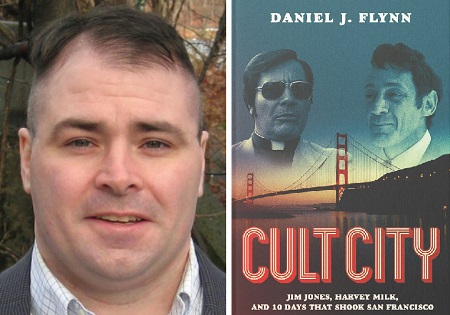
Daniel J. Flynn and his new book, ‘Cult City.’

Daniel J. Flynn is one of my favorite authors. His 2008 book, A Conservative History of the American Left, is a classic, and now he’s published an important new history, Cult City: Jim Jones, Harvey Milk, and 10 Days That Shook San Francisco:

I toiled over my sixth book, off and on, for the last decade. . . .
The writing came mostly in my attic. The research primarily took place at the California Historical Society, San Francisco Public Library, and Library of Congress. I interviewed about 30 eyewitnesses to history, including one of three people still with us — and one of just nine total 40 years ago — in Jonestown when the killing began to live to tell the tale, Dan White’s chief of staff who detailed a startling confession of violence that his boss made to him, and former friends and rivals of Harvey Milk who shared his homosexuality but not always a fondness for him. It got really interesting for me. . . .
The basic theme is this: before the poor drank the Kool-Aid in South America, the powerful in San Francisco did. The same people who made Jim Jones unmade him, at least his associations with politicians, journalists, and celebrities. Many took pains to obscure the truth, which helps explain why this book comes out all these years later. The truth is never too late, and, for me at least, was never so interesting.

What was the connection between the Left in San Francisco, including gay-rights radicals like Harvey Milk, and the cult that died in Jonestown? Anyone who lived through the 1970s — I was a sophomore in college the year Jonestown happened — remembers the reckless hedonism of that era. Even though I was in the Deep South, and far from San Francisco, the carnival of drugs, sex and disco was really everywhere then. Count on Daniel Flynn to connect the dots in this cultural pattern.


Bonus Black Hole Book Post (It Has Rivets)

— by Wombat-socho

Oh, the embarrassment. An author sends me a review copy of his most excellent hard-SF technothriller, and I completely forget to do the review in yesterday’s book post. Well, I promised him a review before the end of the month, which is now here, so you get a bonus book post!

Michael Rothman’s Primordial Threat is a great combination of hard SF (the kind, as we used to say in the glory days of Astounding/Analog, that had rivets) and modern technothriller – much of the plot revolves around a missing scientist who may have the solution to the deadly threat of a black hole approaching Earth. Rothman has a solid grip on both the science and the bureaucratic machinations within the government that are almost as big a threat as the oncoming hole. Definitely recommended.

Also, I erred yesterday when I wrote that Karl Gallagher’s Torchship Trilogy was also a Prometheus Award winner; it was nominated, but did not win. Buy it anyway.

Other books I’ve been re-reading recently: S.M. Stirling’s The Peshawar Lancers, a tale of derring-do set in an alternate Earth where a comet strike in the Northern Hemisphere has effectively destroyed Western Civilization, except for the French in North Africa and the British, who evacuated their best and brightest to India, which has become the seat of the Angrezi Raj. Someone is trying to kill cavalry officer Athelstane King and his academically-inclined sister – but why? It’s up to King, his Sikh sergeant, and an Afghan bandit chief to find out, but can they defeat a Russian agent who can see the future? A lot of people consider this one of Stirling’s best novels, and it’s very much worth your time and money.

Also, Keith Laumer’s The Long Twilight (repackaged by Baen with Night Of Delusions and some other short pieces) which is the tale of a pair of starship captains, Grallgrathor and Lokrien, marooned on Earth in the 10th century and engaged ever since in a vendetta stemming from Lokrien’s murder of Grallgrathor’s Norse family…a vendetta that changes human history. Now, an experimental broadcast power station draws both men to it as it goes out of control and causes a mid-ocean typhoon, and the truth of the murders comes out at last – but has the truth come too late to save the Earth? There are some interesting subtexts in the book regarding AIs, humans born in synthetic wombs and taught by those AIs, and (a recurring Laumer theme) the true nature of reality. I’ve substituted the cover from the Ace edition because, frankly, the Baen cover is terrible.

The Back To School Labor Day Book Post

— compiled by Wombat-socho
Actually, I’m not going back to school – the spring semester at UNLV went badly, and summer was worse, so I’m punting the fall semester and concentrating on tax & insurance stuff in preparation for the upcoming tax season. Also, reading some good books so I can pass along recommendations to you!

At the top of the list is the debut novel by Travis Corcoran, The Powers of the Earth, which won the Prometheus Award for Best Novel this year. Probably the best short description of the book is by Eric S. Raymond: “…an affectionate tribute to and critical response to [Heinlein’s] The Moon Is A Harsh Mistress.” ESR is precisely correct, though there are some major differences in the Lunar revolutions Heinlein and Corcoran are describing, and Corcoran has a ways to go before he’s as smooth a storyteller as Uncle Bob. I myself found the opening chapters slow going, but the payoff is worth it. I’m looking forward to picking up the sequel, Causes of Separation. Meanwhile, I’ll have to content myself with Corcoran’s acceptance speech, which no doubt sent the CHORFs and Social Justice Wankers at ConJose to their fainting couches.

Also coming home with a Prometheus is Karl Gallagher’s Torchship Trilogy, which adds Torchship Pilot and Torchship Captain to the original novel, which I reviewed back in 2016. If you liked the original, or enjoyed either Firefly or Serenity, these will be right up your alley.

Robert Kroese’s The Dream of the Iron Dragon is sometimes described as “Vikings in space!”, but this is a gross oversimplification. The book starts with a scoutship from Earth (which is losing an interstellar war) meeting a dissident faction of aliens, nearly being caught in the destruction of the dissidents’ outpost, and being flung back in time to the Viking era, where they must bootstrap human technology into the era of star travel – or risk losing a war of extermination. The sequel, Dawn of the Iron Dragon, is out already and I’m hoping to get it read before the final book in the trilogy, The Voyage of the Iron Dragon, comes out in December.

I sometimes think Jack Vance is one of the most underappreciated authors in SF history. This is unfortunate, because his skill at creating bizarre human cultures was second to none – and as proof of this, I present the Durdane Trilogy: The Anome, The Brave Free Men, and The Asutra. The land of Shant on the planet Durdane has known peace for millennia, its sixty-two cantons pursuing their own cultures under the eye of the Faceless Man – the Anome, who punishes lawbreakers by detonating their torcs, the explosive collars every adult wears around his (or her) neck. Gastel Etzwane escapes life as a Chilite Pure Boy and becomes a wandering musician, only to find himself swept up in an intrigue to find the Anome and compel him to rally Shant against the invasion of the Roguskhoi. Part of that intrigue involves Ifness, a researcher from the Historical Institute on legendary Earth, sometimes an ally and sometimes an indifferent observer. Every page of the Durdane trilogy contains strange people doing strange things in the service of even stranger cultures, and yet – they are all recognizably human.

Summer Reading List

— by Wombat-socho

Good heavens, it’s been almost six months since I sat down and bashed out a book post. I’ll try to be a little more regular about it, maybe step it up to quarterly from semi-annual. We’ll see how it goes.For those of you who have forgotten how these posts work, here’s the FAQ from about five years ago. I am also amenable to bribery if you have a book you want my opinion on, whether it needs praise or burial. There’s a master list of previous book posts here.

Going from most recent to most aged, I’ll start off with the first two issues of Castalia House’s long-awaited Alt*Hero comics, Crackdown and Rebel’s Cell, which take us to a world where superheroes are mostly government-controlled, especially in the EU where the first issue is set. But as we can see in the closing pages of that issue, even in Europe there are superpowered people not on board with that plan…I read both issues on my Kindle Fire, which does a very good job of rendering the comics, and as far as art and story go, the series is off to a good start.

Back in 2017 I reviewed Mark Wandrey’s Cartwright’s Cavaliers, the first book in the Revelations Cycle he co-wrote with Chris Kennedy. The good news is that the other three novels (Asbaran Solutions, Winged Hussars, and Golden Horde) that set the stage by introducing you to the other companies of the Four Horsemen are every bit as good, and even the short story collection A Fistful of Credits, which includes some names you might recognize -Brad Torgerson, Chris Nuttall, Jon Del Arroz, etc. – upholds the standard. I admit that I jumped ahead to read Chris Kennedy’s A Fiery Sunset, in which the war the Revelations Cycle sets the stage for breaks out, before finishing all 12(!) of the books in the cycle, but I couldn’t wait to see where this was going. This is a great series, full of interesting characters with serious problems in a universe where there’s a lot of strange things and stranger aliens yet to be (re)discovered. Highly Recommended.

On a more practical note, Maggie Hogarth has a second how-to book for artists, writers, and other creative types: Business For The Right-Brained. This is another Three Jaguars book, chock-full of illos featuring Business Manager, Marketer, and most importantly, Artist, but also loaded with practical advice, including the all-important question: do you really want to make a career out of art, regardless of the medium? I can’t recommend this book highly enough; in fact, I took the unusual step of buying it in paperback.

Finally, in the It’s Old But It’s Good Department, Mike Williamson’s A Long Time Until Now is another entry in the “modern soldiers in the past” subgenre, and a very good one it is. Two MRAPs full of assorted grunts, Air Force civil affairs troops, and an engineering lieutenant who’s feeling very much out of his depth wind up being dropped into Paleolithic times, along with small bands of other displaced people including Romans. It’s an absorbing read, and handles the complex personal relations of the squad as they try to figure out what’s going on and deal with it. There are supposed to be sequels on the way, and I for one am looking forward to them.


‘Gender,’ Nature and Sexual Economics

Cynthia Yockey has repeatedly urged me to write a book of advice to young men which, in the imaginary alternative universe where I’d actually write that book, I would call The Pleasure of Her Company. This title reflects my criticism of the self-defeating attitude one sometimes encounters in the so-called “Manosphere,” where scoring is given more value than winning. In my reckless youth, I confess that the quantitative assessment approach (euphemisms are sometimes necessary) prevailed in a tactical sense, but I never entirely forgot that the ultimate goal of the game was marriage, “Happily Ever After” and so forth. Having been married nearly 30 years, having seen our oldest three children already married with children of their own, while our youngest three (still teenagers) would seem also to have good future prospects, I yet hesitate to assert my expertise in this matter. Nevertheless . . .

The Pleasure of Her Company is a title that captures the nature of this goal, and the source of male pleasure in the pursuit. When I was still quite young, about 15 and a total loser with the ladies, I sought advice from a guy a couple years older who had his act together and had no shortage of notches on his belt. “You know,” he said, “after a while, it’s not really about the sex. It’s the thrill of the hunt.”

Mind-blowing. Desperate as any teenager loser who ever lived, I couldn’t believe this, and it took more than a decade for me to realize how right he was. No point going into details, but anticipation of the trophy inspires the hunter more than his appetite for venison. And this attitude is nearly as harmful to the hunter as to his prey. (Go ahead, feminists — denounce my youthful self, I won’t defend him.) Why was I so reckless and impatient, so driven to “score”? Why was no amount of success ever enough? One evening, after I’d been married a few years and had three kids, I heard some young bachelors in the office talking about their romantic exploits, and shared with them a bit of strategic thought on the subject, which they seemed not to find credible. My pride was somewhat wounded, as if my extraordinary success was being cast in doubt, and decided to sit down to add up The List. Oh, my goodness . . .

How could I have ever imagined I was losing all those years? A skinny homely guy like me had no reason to hope for so much success, as I calculated the total number divided by the years in the game, and realized I had been competing with an illusion of an ideal, The Playboy.

Every lonely teenage boy suffers from the thought that other guys are racking up the home runs, while he can’t even get to second base. So when he finally connects and watches the ball go sailing over the fence in center field (to extend the metaphor), he’s not satisfied to relax in the clubhouse after the victory. No, he starts planning to become the Major League champ, the slugger, the MVP, the all-time winner.

A bad attitude, which I condemn in hindsight, denouncing my youthful self. To quote an old Willie Nelson song, “The night life ain’t no good life, but it’s my life” — or it once was. No need for me to do an update of The Confessions of Saint Augustine. Although I’m pretty sure I never succumbed to the Manichean heresy (because I didn’t even know what that was), my sins were both numerous and various. At the final judgment, I can only hope for mercy, as I have deserved only wrath. But this is not a sermon or a theology lecture, it’s just a blog post.

My point in elaborating so extensively on my wicked past is to establish the authority of my experience in speaking of human nature.

Why is the loser losing? The rampage in Toronto by “The Unf–kable Canadian Menace” sparked a resurrection of feminist denunciations of “toxic masculinity,” “male entitlement,” etc., because the homicidal loser called himself an “incel” and referenced Elliot Rodger, the Creepy Little Weirdo who perpetrated the Isla Vista massacre. Is it true, as feminists insist, that so-called “Red Pill” discourse is an expression of misogyny that inspires violence against women? Or is it rather the case, as I suspect, that much of the advice shared in these discussions is just not helpful in solving the problems of losers? Waking up early Saturday morning, I spent about three hours doing a Twitter thread on this topic:

The sexual marketplace is governed by forces that mirror the economics of supply and demand. Humans respond to incentives, but not all responses are rational or advantageous. Many of those in the so-called “manosphere” speak the language of sociobiology, although it’s not clear that they actually understand the fundamental concepts pioneered by E.O. Wilson, Lionel Tiger, et al.
For example, any intelligent person reading the “manosphere” soon gets weary of the dumbed-down and stereotypical “Alpha”/“Beta” discourse. Much of this rhetoric is badly misguided or erroneous.
In nature, the “Alpha male” describes social dominance or leadership within a group. In human life, many non-natural factors influence social dynamics. We are not wolves or orangutangs.
Dumbed-down talk about “Alpha” and “Beta” males in the “manosphere,” particularly in PUA (pickup artist) forums, ignores or misrepresents much of what is useful and valid in the theory of sociobiology. First, the advantageous traits of the “Alpha” male are natural. Some men just naturally have traits associated with dominance — taller, more athletic, more extroverted, etc. — which can’t be taught or learned.
It is foolish to imagine that a short, awkward, introverted male can, by reading a bunch of vulgar pseudo-scientific discourse on Red Pill blogs, become a studly “Alpha male.” Not. Gonna. Happen. . . .

You can click here to read the whole thing in a single page.

Cynthia Yockey says I should write a book, a task I dread, but please remember the Five Most Important Words in the English Language:

HIT THE FREAKING TIP JAR!


Ursula LeGuin, RIP

— compiled by Wombat-socho


Not going to lie: I didn’t care much for Ursula LeGuin’s writing. Had to read The Left Hand of Darkness in college, and it was okay, but “The Word For World Is Forest” was crap, and “The Ones Who Walk Away From Omelas” was vile. After that, none of what she wrote looked interesting to me, so I missed out on the Earthsea books. Still, she was a good writer, and won some awards back when those awards meant something, and if she wasn’t to my taste, well, neither were Hemingway and Waugh, and that’s just the way it is.
In other news, Jon Del Arroz got blacklisted from Worldcon this year for…well, the reasons kept changing and finally wound up being “‘Shut up’ they explained,” as is usual with SJWs. At this point, any conservative or libertarian going to Worldcon should really reconsider. Why are you giving money to people who -at the very least- don’t respect you? As if that wasn’t enough, SFWA promptly shot themselves in the foot by rejecting Jon’s membership application, for no better (apparent) reason than “He’s a meanie and he says bad things!” Well, as our Supreme Dark Lord has observed, SFWA is fully converged, infested with crazy cat ladies, and not doing anything to help actual authors. Richard Paolinelli is starting a new organization, the Science Fiction & Fantasy Creators’ Guild as an alternative to SFWA, and I wish him well.
While we’re on the topic of alternatives, if you haven’t signed up with the National Fantasy Fan Federation yet, why not? Public (non-voting) memberships are free!


So much for the news – on to the books!


Speaking of Jon Del Arroz, I picked up For Steam And Country during my spring semester book-buying binge, and a nice little adventure it is. Airships! Magic! Cute (and not so cute) little Ruritanian kingdoms! Last but not least, a (sometimes) heroic farm girl who discovers her swashbuckling destiny and the wild family history she never knew. It’s a fun little romp, and I am waiting to see what trouble Baroness von Monocle gets into next.

Marko Kloos’ Points of Impact, the sixth book in the chronicles of the Lanky War, brings us into a new phase of that war. Humanity has new ships and new weapons, good enough to beat the aliens in space – but as our hero Andrew Grayson and his hot pilot wife find out in a return to the icy colony of New Svalbard, that may not be enough to win the war, or even force a stalemate. Good story, and I’m looking forward to the next one.

Robert Heinlein’s classic Starship Troopers was on sale for $1.99 on the Kindle, and I snapped it up. Yes, I have several paperback copies, but I’m not sure where those are, and I wanted to read it again now. It hasn’t lost anything with age, and is still driving ignorant leftists crazy.

Something I haven’t been able to bring myself to finish is The Girl With Seven Names by Hyeonseo Lee. It’s the biography of a young woman who grows up in North Korea, and while it starts off pleasantly enough, as she gets older she becomes more aware of the ongoing horror story she’s living in. I read books like The Theory And Practice Of Hell and The GULAG Archipelago when I was younger with great avidity, but now I find myself unwilling to slog through the descriptions of real-life horror.

On a much more cheerful note, there is Marie Kondo’s The Life-Changing Manga Of Tidying Up, which is just what it says on the label. There are parts of the method I’m not totally on board with, which mainly have to do with the Japanese Shinto belief that everything, even inanimate objects like books and clothes, has a spirit, and one should express gratitude toward those books and clothes before putting them out of your life. If nothing else, it’s inspired me to get going on cleaning up my apartment, which badly needs it.

What are you reading that’s good?

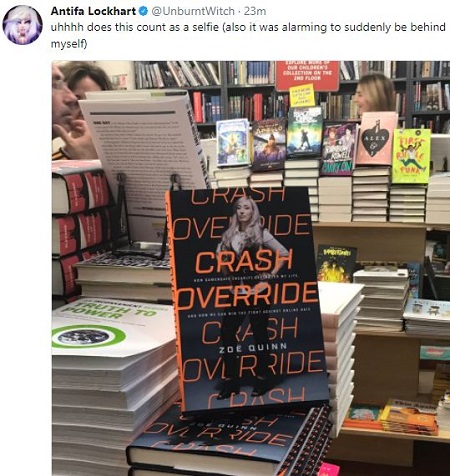
A Tattoo-Covered, Mentally Ill Ex-Stripper Whose Real Name Is Chelsea Van Valkenburg Publishes Dishonest Book


Today is the official publication date of a dishonest book by the woman who caused #GamerGate, whose story I explained last year:

“Zoe Quinn” was Patient Zero of the #GamerGate controversy. A tattoo-covered, mentally ill ex-stripper whose real name is Chelsea Van Valkenburg, Quinn was the creator of a tediously dull game called “Depression Quest.” She broke up with her boyfriend, a software geek named Eron Gjoni, and allegedly became intimate with a videogame journalist named Nathan Grayson. In August 2014, Gjoni published a nearly 10,000-word article exposing Quinn’s alleged misconduct.

It was Quinn’s alleged relationship with Grayson that exposed the dubious ethics of online videogame journalism and, in the process, called attention to the self-described “social justice warriors” (SJWs) who were trying to take over the lucrative videogame industry. After the controversy erupted in August 2014, it awakened gamers — a geek subculture that was not previously active in politics — to the threat to their freedom posed by intolerant advocates of political correctness.

What gamers discovered is that it doesn’t matter what your beliefs about economics or foreign policy may be, all you have to do is to exercise your right to express your own uncensored opinions, and you thereby become a target for the repressive forces of the cultural Left.

Zoe Quinn is not an innocent victim of “harassment.” She deserves everything bad anyone might ever say about her. She is an enemy of the First Amendment, as are her feminist allies, who are intent upon imposing a totalitarian regime in which anyone who disagrees with their ideology can be declared guilty of “hate speech” and silenced.

As Ethan Ralph says, Zoe Quinn is a fraud, who couldn’t program her way out of a wet paper sack, and whose status as a “game developer” is as fictional as the “blame-the-patriarchy” narrative she has created to depict herself as a saintly martyr for the feminist cause. Speaking of phony victims with new books, Hillary Clinton wants to sell you one.