TRIUMPH: Orban Wins Big in Hungary


Ten days ago, I advised “Keep an Eye on Hungary’s Election.” President Viktor Orban stood up against the European Union’s open-borders plan to flood the continent with Muslim “refugees.” He was targeted for defeat by left-wing activists funded by George Soros. Orban didn’t back down. Instead, he told the truth about the “invasion” of Europe and called out Soros by name. Voters just re-elected him by landslide:

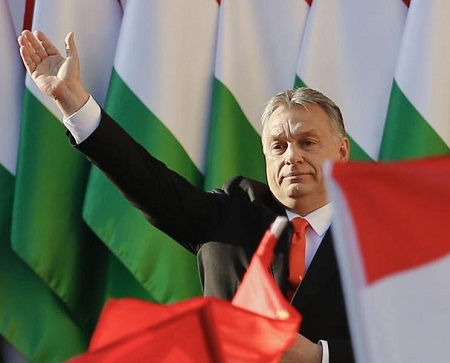
Hungary’s conservative-populist premier Viktor Orbán has won a third term in office in a landslide election victory.
With 85 per cent of the votes counted, Europe Elects is sharing stats which suggest Fidesz, the party founded by Prime Minister Orbán while he was a young anti-Communist dissident, has won 134 seats, along with his coalition partners — which would give him with not merely a decisive majority but an outright super-majority, allowing changes to the national constitution. . . .
The results will be extremely disappointing for top bureaucrats in the European Union and activists working for so-called civil society NGOs funded by billionaire open borders campaigner George Soros, who had been hoping for an upset defeat, or for Fisesz to lose its super-majority, at least.
Prime Minister Orbán has been the most determined foe of the compulsory migrant quota regime the EU has attempted to impose at the behest of pro-migration NGOs, and served as the focal point for an increasingly influential eurosceptic, anti-mass migration bloc within the EU centred on the Visegrád Four countries.

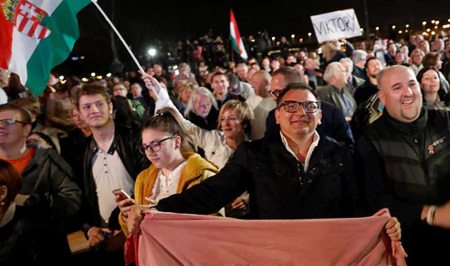
Orban supporters celebrate the election victory.

The Guardian reports from Hungary:

“We have won.” With these three words Viktor Orbán began to address the crowds outside Fidesz headquarters.
He starts by congratulating the voters for turning out to vote. “Thank you for having placed your faith in us; thank you for having stuck with us.”
Viktor Orbán continues by thanking “all the people who prayed for us and prayed for me personally”. Also on the list of thanks are the party volunteers and his wife.
He says we now have a major battle behind us. “This has been a decisive win… in the future we are going to be able to defend our mother country.”
Orbán is leading the crowd in song — it is the anthem of the revolution from 1848, Euronews says. He finishes by saying “long live Hungary, thank you for everything.”

Gosh, it’s as if standing up for your country is popular, or something.


Keep an Eye on Hungary’s Election


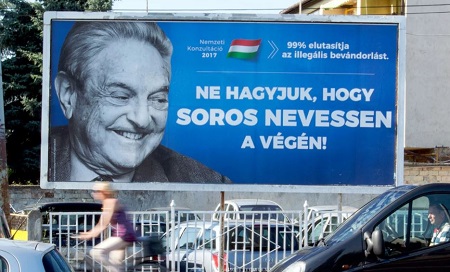
Hungary’s Prime Minister Viktor Orban and his nationalist Fidesz party have made opposition to unrestricted immigration the centerpiece of their policy and, in the campaign leading up to the April 8 election, Fidesz has targeted the sinister influence of George Soros.

Hungary’s population of 10 million has bitter historic memories of being dominated by foreigners. Immediately following World War I, after the nation gained its independence from Austria, Hungary suffered under the Soviet-backed Communist dictatorship of the notorious Bela Kun, who was determined to liquidate all opposition. One of Kun’s Bolshevik commissars, Tibor Szamuely, declared in a speech: “We will exterminate the entire bourgeoisie if we have to!” Instead, the Bolshevik regime lasted only five months. Kun was overthrown and ended up in Russia, where he eventually was executed in Stalin’s purge. During World War II, Hungary was allied with Germany, and subsequently conquered by the Red Army, which imposed a Communist regime that remained in power until 1989.

Since the collapse of the Soviet Union, Hungary has struggled to recover from the economic, social and political legacy of Communist rule. The resurgence of Hungarian nationalism was aggravated by the 2015 refugee crisis, when Germany declared it would welcome those fleeing the war in Syria, producing a flood of immigrants whose route northward from Turkey and the Adriatic coast led them to the Hungarian border. What solution did Orban’s government find? “Build a wall!”

This put Hungary at odds with the pro-refugee European Union policy, and Orban’s government has targeted Soros’ influence on the EU:

The ruling Fidesz party’s vice chairman said Soros was engaged in a “frontal assault” against Hungary.
“What Soros writes about immigration, in general, is a pro-immigration stance that is open about its disdain for the nation state,” Gergely Gulyas told a news conference. “Decisions made in Brussels echo that in the field of immigration policy.”
“Days before a recent immigration decision in the European Parliament Soros was meeting with the rapporteur on the subject as well as five different EU commissioners. I am not a conspiracy theorist but this holds some clues.”


The anti-Soros billboards in Hungary, and the rhetoric of Orban and his party, have been criticized as veiled anti-Semitism — an ironic accusation, considering that Soros has admitted being a Nazi collaborator during World War II. It is important, however, to understand the separate factors operating in Hungarian politics.

Are there anti-Semites in Hungary? No doubt. Do some of these anti-Semites support Orban? Certainly. Does this mean that Orban’s re-election is dependent on anti-Semitism? Not at all. Whatever the percentage of Hungarian voters who are anti-Semites, such a faction is not enough to swing the election, whereas opposition to a demographic inundation by Muslim immigrants is the central appeal of the Fidesz Party’s campaign. Focusing attention on Soros is a way of giving a human face to the various international forces (including the EU bureaucracy in Brussels) which are promoting an open-borders regime in Europe.

Orban and his party have effectively presented Hungary’s electorate with a choice, as Orban said in a recent visit to the city of Miskolc:

If Miskolc is not to be a place of “ghettos and no-go zones”, said Orbán on a campaign visit to the city earlier this month, it is necessary to vote for his party, Fidesz.
“There are two paths ahead for Hungary to choose from,” said Orbán. “We will either have a national government, in which case we will not become an immigrant country, or the people of George Soros form a government and Hungary will become an immigrant country.”

This rhetoric about “the people of George Soros” may be troubling, but keep in mind that Orban has rivals even further right:

Jobbik, a far-right party that has recently moved its messaging further to the centre and is placed second in most polls, is campaigning on corruption but is also attacking Orbán for being not harsh enough on migrants.

It says something about the situation that the nationalist Orban’s greatest challenge is from ultra-nationalists. Like many other former Soviet satellite states (including Poland), Hungary is shaped by bitter memories of foreign domination, and still suffers after-effects of its Communist past.  In a remarkable interview, one of Hungary’s leading Protestant clergymen, Rev. Sándor Németh, explained the crisis:

I am confident that the system change, the failure of the eastern-type of communism, brought an end to the ideological state. But Marxism is again banging on our door. Cultural Marxism has become a replacement for religion. . . . This is what today’s misleading lores are based on, from gender ideology to the policies of putting migration on a pedestal. There is alternative reality, one that is referred to as the deep state. Even today, the elite which are above the nations see this as an ideology worth following. . . .
Especially since 2015, they do not want to accept that the people have a different worldview than their own. This is why Christianity has become the most singled-out and persecuted religion today. The trend started in America. At the turn of the millennium, the liberals were afraid that the election of the younger Bush would bring a conservative wave, so they started or strengthened the militant liberal movements that we see today. Under Obama’s presidency, it could clearly be felt that the Christians were being targeted. They often sought to destroy the representatives of Christianity morally and materially. This is what ended with the Trump presidency, but in Europe, for the time being, the old winds still blow.

Read the whole thing. Rev. Németh’s analysis is perceptive, and can help American conservatives understand why this election in far-off Hungary could have consequences here. We are fighting against the agenda of Cultural Marxism, “a replacement for religion” which has become the worldview of “the elite which are above the nations.”


‘Europe Is Already Under an Invasion’


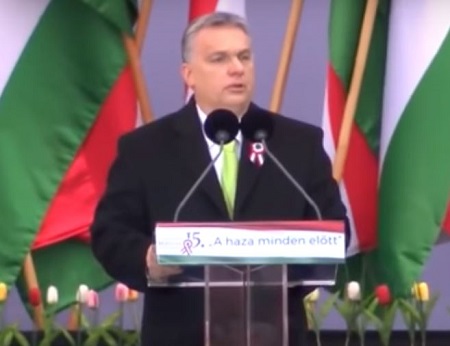
On the occasion of the anniversary of the 1848 revolution, Hungary’s prime minister Viktor Orban gave a powerful speech in Budapest:

The situation, my dear friends, is: They want to take away our country! . . . They want us to hand it over willingly to others. To strangers from another continent, who do not speak our language, who do not respect our culture, our laws and our way of life. Who want to replace our way of life with theirs. From now on they do not want us and our descendants to live here, but someone else. . . .
There is no exaggeration in this! We can see it day by day, as great European peoples and nations, step by step, area by area, from city to city, lose their homeland. The situation is such that those who do not stop the migration at their borders will be lost. Slowly but surely they will be consumed. All of this by external forces, international powers that are trying to force it upon us, with the help of their local allies, and they see the upcoming election as a great opportunity for this.
Europe is already under an invasion. If we let it, in the coming decades, tens of millions will begin to move into Europe from Africa and the Middle East. Western Europe is watching this with their hands in the air. Whoever puts his hands up is disarming himself. He is no longer making decisions about his fate. The history of the losers will be written by others in the years ahead. The young people in Western Europe will see it, when they become a minority in their own country and they lose the only thing in the world they can call home. Such forces as now reveal themselves have not been seen in the world for a long time.
Africa will have ten times more young people than Europe. If Europe does nothing, they will kick down the doors, and Brussels will not protect Europe. They do not want to stop the migration, but rather to support it and organize it. They want to dilute and replace the people of Europe!

You may be wondering, who are “they”?

Media financed by foreign groups, and a domestic oligarchy, professional activists . . . agitators, organizers of riots, chains of NGOs paid by international speculators, which can be summed up with George Soros’ name, since he personifies it. This is the world we must fight against, to defend our own.


Last July, I reported how Orban’s anti-Soros rhetoric was condemned by some (including the Israeli ambassador) as anti-Semitic. Nevertheless, it is a fact that “professional activists” funded by Soros, along with other “external forces,” do support unlimited immigration to Europe, and have sought to undermine Hungary’s government, which opposes this Islamic “invasion.” Hungary faces an election on April 8 — about three weeks from now — and Orban’s speech could be seen as an effort to rally support for his party and to counter the challenge of the Jobbik party, which is even farther to the right than Orban’s nationalist Fidesz party.

Michael Brendan Dougherty is concerned by a passage of Orban’s speech which “reads like a checklist drawn from the Protocols of the Elders of Zion,” but it must be asked: What is the alternative? That is to say, if the meddling activists funded by Soros have inflamed public opinion in Hungary, so that the nationalist government of Orban is threatened by openly anti-Semitic rivals, do we expect Orban to ignore this threat? And if Orban does a bit of dog-whistling about the “crafty” Soros who “speculates with money,” is that worse than what would happen in Hungary if Orban were to fall, and Jobbik were to gain power?

The Left has sown the wind and is reaping the whirlwind, including an ugly resurgence of anti-Semitism. It is a mistake to blame the reaction in Europe without acknowledging the Left’s role in provoking that reaction. The crisis in Europe is a result of two decades of misguided policies promoted by the elites in Brussels and elsewhere, policies that were supported by many American politicians in both parties. It is reasonable to hope that, if Orban wins a solid victory in next month’s election, this will relieve the pressure against his government, and thereby help suppress the more extremist elements in Hungary.

It is a shame, and also highly ironic, that George Soros has managed to rekindle the toxic politics of European anti-Semitism. It will be recalled that Soros was a Nazi collaborator in World War II, and is it anti-Semitic to despise a self-hating Jew? Yet no one could imagine that the Jews of Europe will benefit from an influx of Muslim immigrants. So it appears that once again, Soros is collaborating with the enemies of the Jewish people, while at the same time causing his own enemies to hate Jews!

What is happening in Europe could be a harbinger of our own future, unless more Americans wake up to the danger of cultural Marxism.


‘Europe’s Last Hope’

The trumpet sounds in Hungary:

Hungary’s prime minister says that “Christianity is Europe’s last hope” and that politicians in Brussels, Berlin and Paris favoring migration have “opened the way to the decline of Christian culture and the advance of Islam.”
Viktor Orban said Sunday during his 20th annual state of the nation speech that his government will oppose efforts by the United Nations or the European Union to make migration acceptable to the world.
He conjured the image of a Western Europe overtaken by Muslims, saying that “born Germans are being forced back from most large German cities, as migrants always occupy big cities first.”
Orban claimed that Islam would soon “knock on Central Europe’s door” from the west as well as the south.

UPDATE: Turns out this was a timely warning:

ISIS has claimed responsibility for a gun rampage at an Orthodox church in Russia that left five women dead.
Khalil Khalilov screamed ‘Allahu akbar’ as he opened fire with a hunting rifle before he was shot dead by police in Kizlyar, a town in the mainly Muslim region of Dagestan.
Chilling footage shows the bearded 22-year-old attacker walking to the church on Sunday and a terrified woman fleeing the scene.
ISIS claimed one of its ‘soldiers of Islam’, who they referred to as Khalil Daghestan, carried out the attack using his gun to ‘kill five of them and wound four others’.

People need to wake up to this threat, and start praying.


It All Comes Back to Hungary: Soros, Cultural Marxism, Lukacs and Bela Kun


Vox Day calls attention to interesting news from Hungary:

The Israeli ambassador in Budapest has called on the Hungarian government to end its campaign against Jewish billionaire George Soros, which he claims is stoking antisemitic sentiment.
The Hungarian government has recently rolled out a nationwide billboard campaign, urging Hungarians to stand firm against the ruinous influence of the Jewish financial speculator.
George Soros is well known for his involvement in the open borders campaign, with his Open Society organisation essentially acting as a front for the criminal people smugglers bringing third world migrants to Europe.
What is lesser known however, is the extent to which Soros is using his ‘soft power’ to influence civil society.
The Central European University in Budapest was founded and bankrolled by the Jewish billionaire, and has attempted to exert its influence against Viktor Orbán’s popular government in loosely veiled retaliation for recent legal measures against the university.
In recent months Hungary has seen protests by students carrying the Soros message against the potential closure of the university, with some fearing that this could be the beginning of another ‘colour revolution’.
Soros’ Open Society organisation has also worked tirelessly behind the scenes against the Hungarian government’s opposition to illegal immigration, despite the fact that 98.5% of Hungarians rejected illegal migrant quotas in a referendum just last year.

The spurious claim that it is anti-Semitic to criticize Soros, or that Hungarian officials are wrongly scapegoating Soros, is reminiscent of how Communists (and their liberal stooges) in the 1950s claimed that so-called “McCarthyism” was inspired by anti-Semitism simply because certain high-profile cases (e.g., Julius and Ethel Rosenberg) involved Communist Jews. Many of the leading anti-Communists of the Cold War were also Jewish and, in point of fact, the federal judge who sentenced the Rosenbergs to the electric chair was himself Jewish.

In conflating opposition to Soros’ subversive agenda with anti-Semitism, the Left is mirroring neo-Nazi rhetoric, which is . . . not helpful.

What intrigued me about this story was that opposition to Soros has become a nationwide issue in Hungary, which can rightly be called the birthplace of Cultural Marxism, as Linda Kimball has explained:

In 1919, Georg Lukacs became Deputy Commissar for Culture in the short-lived Bolshevik Bela Kun regime in Hungary. He immediately set plans in motion to de-Christianize Hungary. Reasoning that if Christian sexual ethics could be undermined among children, then both the hated patriarchal family and the Church would be dealt a crippling blow, Lukacs launched a radical sex education program in the schools. Sex lectures were organized and literature handed out which graphically instructed youth in free love (promiscuity) and sexual intercourse while simultaneously encouraging them to deride and reject Christian moral ethics, monogamy, and parental and church authority. All of this was accompanied by a reign of cultural terror perpetrated against parents, priests, and dissenters. . . .
In 1923, the Frankfurt School-a Marxist think-tank-was founded in Weimar Germany. Among its founders were Georg Lukacs, Herbert Marcuse, and Theodor Adorno. The school was a multidisciplinary effort which included sociologists, sexologists, and psychologists.
The primary goal of the Frankfurt School was to translate Marxism from economic terms into cultural terms. It would provide the ideas on which to base a new political theory of revolution based on culture . . .
The end product was Cultural Marxism, now known in the West as multiculturalism.

Totalitarians cannot tolerate rival sources of authority, which is why all totalitarian regimes seek to destroy religion and the family as independent institutions. Loyalty to traditions inherited from our ancestors, a sense of duty to our own flesh and blood, and faith in an eternal God as the source of eternal law, are a stubborn obstacle to the revolutionary agendas of totalitarian fanatics.

Hungarian dictator Bela Kun (left) and deputy commissar Georg Lukacs (right).

Very few young people today know anything about the history of Communism, and not one in a thousand American college students would be able to correctly identify Bela Kun, but the nightmare of the Red Terror in Hungary which began after Kun’s Bolsheviks seized power in 1919 has surely not been forgotten by the Hungarian people. One of the Bolshevik commissars, Tibor Szamuely, declared in a speech: “We will exterminate the entire bourgeoisie if we have to!”

Now, nearly a century later, Hungarians find themselves threatened by a flood of Muslim “refugees,” and the subversive Soros is trying to foment a new revolution to impose his agenda on Hungary:

On billboards across Budapest Soros stands accused of being a political puppet master. [In June], in a move seen as directly targeting Soros, Hungary’s parliament passed legislation requiring NGOs to declare themselves as “foreign agents” on their websites and documentation if they receive funding from political sources abroad. . . .
Soros’s reputation in Hungary took a particular hit during the 2015 migrant crisis, when his advocacy for the humane treatment for refugees ran up against Hungary’s ultra-conservative government, led by [Viktor] Orbán, a rightwing nationalist.
In recent months, the dispute has intensified. The prime minister has described the billionaire as someone who had “ruined the lives of tens of millions of people” with currency speculation.
Soros hit back with a speech in Brussels [in June] in which he referred to the Hungarian government as a “mafia state” and said: “He [Orbán] sought to frame his policies as a personal conflict between the two of us and has made me the target of his unrelenting propaganda campaign.”
Orbán’s spokesman, Zoltán Kovács, told the Guardian that the Brussels speech was a “declaration of political war on Hungary”. Soros-funded organisations, Kovács said, were engaged in “political activism camouflaged as NGO work”.

The description of Orban as a “rightwing nationalist” leading an “ultra-conservative government” raises definitional issues. How does one distinguish an “ultra-conservative” from a mere conservative, for example? And what is it about Orban’s nationalism — other than his opposition to unlimited immigration — that makes him so “rightwing”?

Left-wing journalists apply these scary labels haphazardly in an attempt to conjure up images of goose-stepping brownshirts, to imply that Orban is a latter-day Hitler. Of course, I know practically nothing about Viktor Orban, and maybe he isn’t a very nice guy, but I’m pretty sure he’s not a murderous megalomaniac with ambitions of global domination. So unless Orban starts putting his enemies in concentration camps, or sending armored division to invade neighboring countries, I’m going to guess that the Hitler comparison implied by the phrase “rightwing nationalist” is as wrong as the Trump-is-Hitler rhetoric of the Left.

What we are actually witnessing — in Hungary, in the United States and in many other countries in recent years — is a populist reaction against the elite “progressive” consensus of which Soros is a prominent symbol. There is an international clique of influential people and organizations who share certain ideas about the future direction of political, social and economic policies, and who don’t want to be bothered with debating the merits of these policies. The ordinary people whose lives would be affected by the agenda of the elite aren’t being asked for their approval, and popular opposition to the elite agenda (e.g., the Brexit vote, Trump’s election, Hungary’s anti-“refugee” referendum) is treated by the elite media as evidence of incipient fascism. Never does it seem to have occurred to George Soros, or to anyone else in the international elite, that perhaps their policy ideas are wrong, that they have gone too far in their utopian “social justice” schemes. Unable to admit error, the progressive elite therefore resort to cheap insults and sloppy accusations of “fascism” to stigmatize opposition to the Left’s agenda. Why is Viktor Orban under attack by Soros-funded organizations? Why is the Left trying to depict Hungary as a fascist state? The real answer is not hard to find:

Hungarian President Viktor Orbán has sparked controversy after hosting a notorious anti-LGBT organisation in Budapest.
The US-based International Organisation of the Family (IOF) has consistently campaigned against gay marriage, and reportedly colluded with Vladimir Putin on anti-LGBT legislation in Russia.
[In May], Mr Orbán spoke at the group’s annual conference, entitled “Building Family-Friendly Nations: Making Families Great Again”.
The Human Rights Campaign describes the group “as a dangerous group of activists spreading anti-LGBT rhetoric and promoting laws and policies that criminalise LGBT people”, and the Southern Poverty Law Centre (SPLC) has designated the organisation a “hate group”.

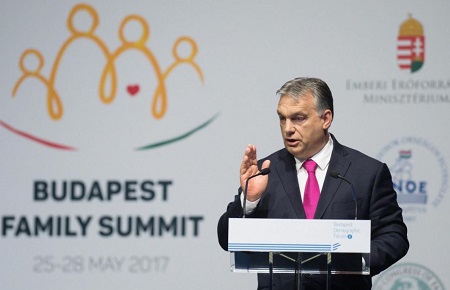
Hungarian Prime Minister Viktor Orban speaks at a May pro-family event in Budapest.

You can learn more about the International Organization for the Family (IOF) from its president, Brian Brown, who asks that Christians keep the IOF “in your thoughts and prayers.” You see how the Left now seeks to destroy Christianity by labeling Bible-based beliefs as “hate,” a typical tactic of cultural Marxism and a reminder of the Red Terror in Hungary.

Opponents of radicalism who study history know that the Left is often more dangerous to its friends than to its enemies, as illustrated by the fate of Bela Kun. After his Bolshevik regime in Hungary was overthrown, Kun fled to Austria, but in 1920 was arrested and eventually deported to the Soviet Union. There, he was assigned by Lenin to assist the Red Army in Crimea, where Kun was responsible for the arrest and summary execution of more than 60,000 civilians. Kun then became an operative of the Comintern until, during Stalin’s purges, he was arrested in 1937, accused of Trotskyism, and executed in August 1938.

As a great man once said, “It is history that teaches us to hope.”