Coronavirus: Why Italy?


It was reported yesterday that Italy now has more coronavirus deaths than China, and that there were zero new cases in Wuhan. Everyone immediately became skeptical: Is Beijing lying again?

But there’s another important question: Why has this pandemic hit Italy so hard? Saturday, I suggested the likely answer:

Almost no one in the media is reporting the demographic factors involved in Italy’s pandemic disaster, and I can’t vouch for this “alternative” source’s account about the way manufacturers in Northern Italy brought in thousands of Chinese laborers to work in the leather and textile industries. Nonetheless, seems plausible, because it resembles the way Mexican and Central American laborers have been brought into the United States to work in, for example, meat processing plants.

It proved nearly impossible to find mainstream media reports on this. The only mention I found was by Robert Fisk in the U.K. Independent, and that column was behind a paywall. So I was forced to go digging into the archives to verify what the alternative source had reported:

As the United States prepares for a second week of lockdown to slow the spread of the Chinese coronavirus (COVID-19), hundreds of people in Italy are dying every day from this disease. And the reason why Italy now has more coronavirus deaths than any other country can be summarized in a single word — luxury.
In the world of fashion, the “Made in Italy” tag has a distinct value associated with luxury and status. Merchants can charge higher prices for clothing, shoes, handbags, and other fashion goods manufactured in Italy, and that value was coveted by certain Chinese entrepreneurs. During the past three decades, more and more Chinese investors bought into textile and leather-good factories in northern Italy, and they brought over Chinese laborers to work in those factories. By 2010, there were reportedly 60,000 Chinese in Prato, an industrial suburb of Florence. To accommodate Italy’s new foreign labor force, nonstop flights were established between China and Rome.
None of this was a secret. . . .

Read the rest of my latest column at The American Spectator.


Stop Pretending We Don’t Know Exactly How and Where This Pandemic Started


Two words you should add to your vocabulary — zoonosis and zoonotic:

A zoonosis (plural zoonoses, or zoonotic diseases) is an infectious disease caused by bacteria, viruses, or parasites that spread from non-human animals (usually vertebrates) to humans.
Major modern diseases such as Ebola virus disease and salmonellosis are zoonoses.

The Wuhan coronavirus is a zoonotic disease. In January — before the liberal media decided Trump was to blame for this pandemic — it was widely reported that the outbreak originated in China’s Wuhan province, specifically in so-called “wet markets,” where live animals are kept and slaughtered on the spot for sale. The Huanan Seafood Wholesale Market was linked to 41 of the first cases of COVID-19 identified in China by early January. In addition to seafood, this market in Wuhan was known for selling meat of “exotic animals”:

The South China Morning Post reported on 29 January 2020 that the market had a section selling around “120 wildlife animals across 75 species.”

From a Jan. 20 report by CNN:

A new Chinese coronavirus, a cousin of the SARS virus, has infected hundreds since the outbreak began in Wuhan, China, in December. Scientist Leo Poon, who first decoded the virus, thinks it likely started in an animal and spread to humans.
“What we know is it causes pneumonia and then doesn’t respond to antibiotic treatment, which is not surprising, but then in terms of mortality, SARS kills 10% of the individuals,” Poon, a virologist at the School of Public Health at The University of Hong Kong, said.
It’s not clear how deadly the Wuhan coronavirus will be, but fatality rates are currently lower than both MERS and SARS. . . .
Coronaviruses are a large group of viruses that are common among animals. In rare cases, they are what scientists call zoonotic, meaning they can be transmitted from animals to humans, according to the US Centers for Disease Control and Prevention.

From a Jan. 26 report by ABC News:

Chinese authorities temporarily banned the trade of wild animals Sunday following a viral outbreak in Wuhan, saying they will “severely investigate and punish” violators. . . .
The ban will continue until “the epidemic situation is lifted nationwide” in order to prevent the spread of the new coronavirus and block potential sources of infection and transmission.
The three agencies also opened a hotline where people can report violations, and called on the public to refrain from eating wild animal meat. . . .
The wildlife ban comes as the new virus accelerated its spread in China with 56 deaths, and 1,975 infections. China cut off trains, planes and other links to Wuhan on Wednesday, as well as public transportation within the city, and has steadily expanded a lockdown to 16 surrounding cities with a combined population of more than 50 million — greater than that of New York, London, Paris and Moscow combined.
Demand for wild animals in Asia, especially China, is hastening the extinction of many species, on top of posing a perennial health threat that authorities have failed to fully address despite growing risks of a global pandemic. . . .
A group of 19 prominent researchers from the Chinese Academy of Sciences, the Wuhan Institute of Virology and the nation’s top universities had called for the government in China to crack down on wildlife markets such as the one at the center of the Wuhan outbreak. . . .
Zoonotic diseases, or those contracted by humans that originated in other species, account for a large share of human infectious illnesses. Not all of them come from the wildlife trade: Rabies is endemic across many species and one of the biggest causes of death in the developing world. But mixing species of wild animals increases the risk of diseases mutating and growing more virulent as they spread in unregulated markets, experts say.
The emergence of such diseases is a “numbers game,” said Christian Walzer, executive director of the Wildlife Conservation Society’s health program.
“If these markets persist, and human consumption of illegal and unregulated wildlife persists, then the public will continue to face heightened risks from emerging new viruses, potentially more lethal and the source of future pandemic spread,” he said. “These are perfect laboratories for creating opportunities for these viruses to emerge.”
Researchers have not yet identified a definitive source for this latest outbreak, which like many other viruses can infect multiple species.
One of the first measures taken by Wuhan authorities was to close the Huanan Seafood Wholesale Market, where 41 of the first cases originated.

Back in January, while impeachment was dominating headlines in the United States, the liberal media had no problem reporting that (a) this viral outbreak began in Wuhan, China, and (b) it was a “zoonotic” disease clearly linked to the “wildlife trade” in China. At that time, CNN did not hesitate to use the phrase “Chinese coronavirus” or “Wuhan coronavirus” in its reporting, but in a White House press conference Wednesday, a reporter for ABC News scolded the president for “bias”:


President Trump on Wednesday defended himself from the allegations of racism and xenophobia that were leveled in response to his calling the Wuhan coronavirus the “Chinese virus,” telling reporters that “it comes from China” and that “it’s not racist at all” to use the label.
Trump used the term “Chinese virus” in a tweet Wednesday morning, and was asked about why he used the phrase by ABC reporter Cecilia Vega, who referenced “dozens of incidents of bias against Chinese Americans” since the outbreak.
“Because it comes from China,” Trump stated, adding that “it’s not racist at all, no, not at all.”
“It comes from China, that’s why. It comes from China. I want to be accurate,” Trump said. “I have great love for all of the people from our country, but as you know, China tried to say at one point — maybe they stopped now — that it was caused by American soldiers. That can’t happen, it’s not going to happen, not as long as I’m president.”

The Communist regime in Beijing is at fault, not only for its false propaganda trying to blame America for this disease, but also for its mishandling of the initial outbreak of the virus:

A recently published study from the University of Southampton estimated that the global outbreak of the coronavirus could have been dramatically reduced had China’s communist government acted sooner. . . .
The research found “that if interventions in [China] could have been conducted one week, two weeks, or three weeks earlier, cases could have been reduced by 66 percent, 86 percent and 95 percent respectively — significantly limiting the geographical spread of the disease.”
The first case of the virus was reportedly detected as early as mid-November of last year. . . .
Other reports place the initial detection of the outbreak in early December, with Wei Guixian, a seafood merchant in Wuhan’s Hua’nan market, being one of the first reported cases. . . .
China waited until January 23, 2020, before quarantining the entire city of Wuhan, which has a population of over 11 million people.
Axios highlighted how China censored people who tried to sound the alarm . . .

How irresponsible is it for (allegedly objective) journalists to demonize President Trump, blaming him for “incidents of bias,” simply because he has told the truth about where this virus came from?

The media contend it is “controversial,” and almost certainly “racist,” for a Republican to tell the truth about the Wuhan coronavirus pandemic:

As President Donald Trump receives backlash for comments Wednesday about the coronavirus outbreak that were widely perceived as xenophobic, his allies in Congress have risen to his defense — with one senator in particular embracing his rhetoric.
“China is to blame,” Sen. John Cornyn, R-Texas, said Wednesday of the virus, which was first identified in Wuhan, China. “Because the culture where people eat bats and snakes and dogs and things like that.”
He proceeded to identify the consumption of such animals as the source of the virus, echoing a since debunked myth that the outbreak began with a woman eating bat soup. The origins of the virus remain a mystery to health officials, even as it continues to spread globally.

It is certainly not a “debunked myth” to explain the zoonotic origins of this disease, nor is the source of the virus a “mystery”:

The consensus among researchers studying the spread of the virus pinpoints COVID-19’s likely origin to a “wet market,” or live animal market, in Wuhan, China
The origin theory for the virus is supplemented by preliminary research into the disease’s genome, as well as the origins of similar diseases. Researchers at the Shanghai Public Health Clinical Centre published the genome of COVID-19 two weeks after cases were reported in late December 2019. Gene sequencing analysis strongly suggests the virus originated in bats and was transferred to humans through a yet-unidentified intermediary species. In early February, Chinese researchers published work suggesting the intermediary species may have been the pangolin (also called a scaly anteater), though this work has not yet undergone a peer-reviewed study.
The conditions for such interspecies pathogen transfer are ripe in wet markets, which are common in parts of Asia, Africa and Latin America. Severe acute respiratory syndrome, or SARS, resulted from a virus transferring from bats to civet cats and then humans. SARS, discovered in 2003, originated at a wet market similar to the one now suspected to be the origin of COVID-19.

Are we clear now? Senator Cornyn was absolutely correct in explaining that the dietary habits of (some) Chinese, which involve markets where multiple live exotic species are kept together and slaughtered on site, are to blame for this zoonotic pandemic. If it is now “racist” to tell the scientific truth — which, I should point out, was first reported by Chinese researchers — then political correctness has become fatal.



Fear Not: Why Older Americans Are Less Panicked About Wuhan Coronavirus


Fear can be rational or irrational. If you live in West Baltimore, for example, being afraid of violent crime is entirely rational. Yet even if you live in a low-crime rural area, you may take precautions — a home alarm system, firearms ownership, etc. — without being accused of paranoia, because “better safe than sorry,” right? Some of us spent years of our childhood reciting the Boy Scout motto, “Be Prepared,” so that taking precautions is a way of life. At the same time, however, we recited the Scout Law that commands us, among other things, to be brave and cheerful. Courage and cheerfulness are related values; people will not be brave unless they are counseled to be of good cheer and given examples by leaders who exhibit a hopeful and confident attitude.

Part of our training as Boy Scouts was learning the history of our organization. Scouting began as a consequence of Lord Baden-Powell’s experience in the Boer War. Many young British recruits were accustomed to city life, and lacked experience of a vigorous outdoor life. The Scouts were formed to give British boys this experience, to train them for the kind of exertions that might be necessary if, when they reached manhood, their services were needed to defend the Empire.

My parents’ generation survived the Great Depression and World War II — my father was wounded by shrapnel while serving in the Army in France — and they strove to instill in us the old-fashioned values and attitudes which had enabled them to make it through hard times. My Scoutmaster, Jim Cranford, was a Marine veteran of the Pacific Theater who smoked unfiltered Pall Malls and didn’t tolerate whining and bellyaching. My youth football coaches were of a similar mindset. Toughness was a value they highly esteemed.

As a parent, I consider it my duty to transmit to my offspring the values of their ancestors, and so I assume that my children have the psychological toughness not to be irrationally terrified of the Wuhan coronavirus pandemic. Other parents, evidently, have failed in this regard, and their kids have succumbed to needless panic.

The linked article by New Yorker writer Michael Schulman begins thus:

Last Wednesday night, not long after President Trump’s Oval Office address, I called my mother to check in about the, you know, unprecedented global health crisis that’s happening. She told me that she and my father were in a cab on the way home from a fun dinner at the Polo Bar, in midtown Manhattan, with another couple who were old friends.
“You went to a restaurant?!” I shrieked. This was several days after she had told me, through sniffles, that she was recovering from a cold but didn’t see any reason that she shouldn’t go to the school where she works. Also, she was still hoping to make a trip to Florida at the end of the month. . . .
I still think of my parents as the grownups, the ones who lecture me about saving for retirement and intervene in squabbles with my little sister. It took a pandemic to thrust me into the role of the responsible adult and them into the role of the heedless children. I’m thirty-eight, and my mother and father are sixty-eight and seventy-four, respectively. Neither is retired, and both are in good shape. But people sixty-five and older — more than half of the baby-boomer population — are more susceptible to COVID-19 and have a higher mortality rate, and my parents’ blithe behavior was as unsettling as the frantic warnings coming from hospitals in Italy.
As I spoke to my peers, I realized that I wasn’t alone. A lot of us have spent the past week pleading with our baby-boomer parents to cook at home, rip up the cruise tickets, and step away from the grandchildren.

Screw you, you cowardly little punk. How dare you pretend that fear-mongering over what is, in fact, a contagion not fundamentally different from that of the common cold is the “responsible” thing to do.

Here’s something from a study I noticed last week: As many as 80% of those infected with the Wuhan coronavirus experience only mild symptoms, and some cases are entirely asymptomatic. They don’t even have a cough or sniffles. They are infected, but not sick. In fact, such asymptomatic cases may explain why this virus has spread so rapidly. What has alarmed public health officials in the U.S. and Europe is not merely the extent of the pandemic, but the rapid increase of cases and the very high death rates in Italy, where nearly 3,000 people have died, including 475 on Tuesday alone. The United States has implemented emergency measures — beginning last month with the China travel ban — in an effort to prevent such an escalation here.

It is said that the course of the pandemic in the U.S., in terms of case numbers and deaths from coronavirus, is lagging roughly two weeks behind Italy’s numbers. If so, this means we could be having nearly 500 deaths per day in this country by early April. That sounds pretty scary, until you realize that, during the 2018-2019 flu season, 35.5 million Americans became sick from influenza, of whom 490,000 people were hospitalized, and 34,200 died. If ordinary flu is killing Americans at the rate of 30,000+ annually, without requiring emergency shutdowns of every bar, restaurant and casino in the country, why are we reacting as if this Chinese virus is the Black Plague? I’m at a loss to explain this, except that Trump is president, and the media are therefore trying to hype this pandemic the way they hyped Russian “collusion.”

That doesn’t mean the danger isn’t real — people actually are dying, and at age 60, I’m at elevated risk — but rather that the risk is being blown out of proportion, as a matter of statistical probability. Like I’ve said before, you might as well spend a month’s salary on Powerball tickets, given the actual odds against you dying of this disease. Here’s the total coronavirus death toll, by country:

China ….. 3,237
Italy …….. 2,978
Iran ……… 1,135
Spain …….. 638
France …… 264

Guess what? In 2018, 36,560 Americans died in auto accidents. That’s about 3,000 deaths per month. Every day, about 100 Americans are killed in auto wrecks. Shouldn’t we shut down the highways?

Risk can only be understood in terms of statistical probability. The U.S. death toll from coronavirus so far is 135 and that’s bad. Death is always bad, but when we put these numbers into perspective — as Heather Mac Donald says, “Compared to What?” — the risk should not induce panic.

Let’s hear from a tough old guy who doesn’t scare easily:

My first encounter with a global pandemic came in October 1957, when I spent a week in my college infirmary with a case of the H2N2 virus, known at the time by the politically incorrect name of “Asian flu.” My fever spiked to 105, and I was sicker than I’d ever been. The infirmary quickly filled with other cases, though some ailing students toughed it out in their dorm rooms with aspirin and orange juice. The college itself did not close, and the surrounding town did not impose restrictions on public gatherings. The day that I was discharged from the infirmary, I played in an intercollegiate soccer game, which drew a big crowd.
It’s not that Asian flu — the second influenza pandemic of the twentieth century — wasn’t a serious disease. Worldwide, this flu strain killed somewhere between 1 and 2 million people. More than 100,000 died in the U.S. alone. And yet, to the best of my knowledge, governors did not call out the National Guard, and political panic-mongers did not blame it all on President Eisenhower. College sports events were not cancelled, planes and trains continued to run, and Americans did not regard one another with fear and suspicion, touching elbows instead of hands. We took the Asian flu in stride. We said our prayers and took our chances.

You should read the whole thing, and everybody should calm down.


What Trump Did and Didn’t Do


At a press conference Monday, President Trump issued “guidelines” to slow the spread of the coronavirus. What should be noted, however, is what Trump didn’t do — he did not announce a nationwide quarantine order. You see, the consensus opinion inside the CDC was that such a nationwide action was advisable, but as Trump noted at the press conference, the threat of the disease is not evenly distributed nationwide. So what he did was to defer to state and local governments to take whatever actions they deemed necessary, based on local circumstances. In the San Francisco area, for example, six counties just got a “shelter in place” order prohibiting any non-essential activity. In Maryland, the governor ordered the closing of all bars, restaurants and gyms. The governors of New York, New Jersey and Connecticut also imposed shutdowns Monday. Restaurant chains also responded: McDonald’s closed its dining areas, offering takeout and drive-through orders only.

For the next couple of weeks, then, much of the country will be in emergency shutdown mode, but not on federal orders. These are state and local decisions, and also decisions by private businesses, so that constitutional federalism is preserved. We are now in a wait-and-see posture: If these measures succeed in slowing the spread of the virus, no further action will be necessary. On the other hand . . .

Well, I don’t want to indulge any worst-case-scenario speculation.

As of 10 p.m. ET Monday night, there had been 4,459 coronavirus cases reported, with 86 deaths. More than half of that death toll (48 people) was in Washington State, where one nursing-home patient who had traveled to China was the source of a disastrous outbreak. Five states — New York (950 cases), Washington (909), California (448), Massachusetts (197) and New Jersey (178) — account for 60% of U.S. coronavirus cases. Given how disproportionately the disease has been confined to a handful of states on the two coasts, it seems absurd to take drastic action affecting rural states in the Midwest. However, until the outbreaks in the coastal urban centers are brought under control, the rest of the country will be forced to go along with the crisis mentality.

We must err on the side of caution. So I’ve got 28 rolls of toilet paper, and the means to defend my family against any marauding bandits. That’s all I can do, except perhaps to urge readers to remember that the Five Most Important Words in the English Language are:

HIT THE FREAKING TIP JAR!

Thanks in advance for your contributions. I’ll be here in the bunker, hunkered down to protect our toilet paper stockpile.


America Is Not Italy: Wuhan Coronavirus and the ‘Grisly Calculus’ of Pandemic Risk

Let’s start with the good news: My American Spectator colleague Jeffrey Lord just ended two weeks of self-quarantine, a precaution after being potentially exposed to Wuhan coronavirus at CPAC. My brother and I both attended CPAC, of course, and while we are not aware of any direct contact with the person from New Jersey who later was diagnosed as a COVID-19 patient, it was nevertheless possible we were exposed. Having passed the 14-day incubation period, then, we have some sense of relief, although I was not worried because I have a robust immune system.

Sunday, Italy reported 368 COVID-19 deaths in a single day. That was two days after Newt Gingrich (whose wife is U.S. Ambassador to the Vatican) published an alarming report on conditions in Italy, where the pandemic has hit most severely. While I still believe Americans are panicking too much over this virus, Gingrich notes that we are fortunate President Trump took one crucial step very early:

President Donald Trump was right to cut off travel from China as soon as it was clear how big the pandemic was going to be. He saved American lives and bought time for America to be more prepared as the pandemic developed.
When you realize that the current 1,016 deaths in Italy with a population of 60 million would be the equivalent of 5,400 deaths in the United States instead of the 41 deaths we have had so far, you can see what milder, slower and less aggressive responses might have cost in lives. Then we would have needed to move to truly draconian measures of isolation and shutdowns.
By the same standard, Trump was exactly right to ban travel from Europe. In fact, he was following the advice of his best medical experts.

Almost no one in the media is reporting the demographic factors involved in Italy’s pandemic disaster, and I can’t vouch for this “alternative” source’s account about the way manufacturers in Northern Italy brought in thousands of Chinese laborers to work in the leather and textile industries. Nonetheless, seems plausible, because it resembles the way Mexican and Central American laborers have been brought into the United States to work in, for example, meat processing plants.

Precaution is not a synonym for panic. To respond rationally to a genuine risk requires facts and arithmetic, because risk is always a matter of statistical probability. China deliberately suppressed the facts in the immediate aftermath of the Wuhan outbreak, and Italy’s government made the mistake of trusting China. By the time they realized how serious the COVID-19 danger was, it was too late to halt the contagion. Last night, I did some quick math and discovered that, a week earlier, there had been more than 500 reported cases of coronavirus in the United States with 21 reported deaths. As of Sunday night, there were about 3,500 reported U.S. cases with 65 reported deaths. This provides us a benchmark estimate of the rate of increase. By next Monday, I would expect around 20,000 reported U.S. cases with about 200 deaths.

WHY THIS MATTERS:
If the number of reported U.S. coronavirus deaths next Monday is significantly less than 200, it will mean our health system is functioning effectively to identify and treat infected people. If the number of reported cases is significantly less than 20,000 next Monday, it will mean that the precautions taken so far are effective in preventing the spread of the virus. Having extrapolated what the expected numbers would be in a week, these provide a benchmark by which we can tell whether we are winning or losing the fight against this disease.

My hope is that we will be winning, but what’s important is to establish a metric by which we can measure success. Meanwhile . . .

My 19-year-old son’s university canceled on-campus classes for the rest of the semester, so he booked a $49 flight to Florida, where he’s doing his coursework online and babysitting his nephews. My 17-year-old daughter is out of school for at least the next two weeks, and she informs me that her friends on social media are calling this holiday their “coronavacation.” Whether or not school cancellations will do much to halt the spread of Wuhan coronavirus (COVID-19) is a matter of speculation, but officials everywhere seem to have decided to err on the side of caution. Thus all Americans are affected by this disease, directly or indirectly, without regard to whether or not we ever actually were at any risk.
Blame the media, but also blame the tort lawyers. Imagine you were a university president, and suddenly cable TV news networks are warning of a deadly pandemic, with some experts offering estimates of millions of infections. The president announces a White House Task Force, and it seems as if we are on the verge of a virus-induced apocalypse. Other universities begin announcing that they will suspend classes, and what are you going to do, Mr. University President? Even if you are skeptical about the worst-case scenarios being discussed 24/7 on CNN, there is the problem of liability. See, if you don’t close your campus and even one of your students comes down with this disease, you might face a multimillion-dollar lawsuit, charging you with negligence for failing to take precautions.
Speaking of precautions, how much toilet paper do you have? . . .

Read the rest of my latest column at The American Spectator.


Wuhan Coronavirus Panic Continues


On Saturday night’s episode of The Other Podcast, Dianna Deeley was discussing the reaction to the Wuhan coronavirus in Georgia, where she lives, and I cited the number of actual cases in Georgia: 66 so far, with exactly one death, in a state with a population of about 10.5 million.

Anyone may offer speculative estimates of how far the virus will eventually spread, but so far, the danger of contagion in Georgia is infinitesimal, with the majority of the cases in three metro Atlanta counties. Math and logic, however, are powerless to stop hysteria:

Georgia elections officials postponed the presidential primary scheduled for next week because of the coronavirus pandemic, becoming the second state forced to push back a vote in the race for the White House due to the outbreak.
The state rescheduled the presidential vote previously scheduled for March 24 until May 19, the same date as the regular primary for a U.S. Senate seat and many other offices, elections officials told The Atlanta Journal-Constitution on Saturday. “Events are moving rapidly and my highest priority is protecting the health of our poll workers, their families, and the community at large,” said Secretary of State Brad Raffensperger.

This is arguably unnecessary, and its efficacy as a public-health measure is dubious, but the new rule is: EVERYTHING MUST BE CANCELLED!

As a matter of speculation, let’s just suppose that by March 24, Georgia’s Wuhan coronavirus cases quadrupled: 264 cases, four deaths. Still, in a population of 10.5 million people, such a number would not be a crisis. If 11 people died, that’s still just a one-in-a-million chance, and you might as well wager a month’s salary on the Powerball lottery, I guess.

Mere statistics cannot prevent panic, however, when the cable-news networks are now 24/7 in their reporting of the DEADLY PANDEMIC! People are reacting on the basis of emotion, not reason, and yet I feel the need to continue citing the actual numbers, so that those who have not yet succumbed to hysteria will at least have access to information that contradicts the media’s incessant drumbeat of doom.

So far, 2,826 cases of Wuhan coronavirus (COVID-19) have been reported in the United States, with 59 deaths. State-by-state:

Washington State …… 642 (40 deaths)
New York ……………….. 613 (2 deaths)
California ……………… 286 (5 deaths)
Colorado ……………….. 101 (1 death)

These four states have more than half (1,642, or 58%) of known COVID-19 infections, and 81% of the deaths reported from the virus. The rest of the country, 46 states, is comparatively unaffected in real terms, yet schools are shut down, the NBA is cancelled, and people are stampeding stores to buy up all the hand sanitizer, bottled water and toilet paper.

MONTGOMERY, Ala. (WSFA) – There has been one confirmed case of the coronavirus in Montgomery County, and after health officials say they anticipate the virus spreading quickly in the coming weeks, locals are stocking up with supplies if they need be quarantined.
Household items like toilet paper, hand sanitizer, and bleach are flying off the shelves. Customers are desperate to stash up, leaving stores in Montgomery noticeably empty.
“There is no toilet paper on the shelves so I just got the paper towels and hopefully that will suffice,” said Walmart shopper Vanessa Ball.
Some families are even having to preorder their toilet paper because it is such a hot commodity.
“I feel lucky and probably like we need to get it in the car before we’re mugged or something for toilet tissue,” said Walmart shopper Steven Smith.
But toilet paper isn’t the only supply running out, says Renfroe’s Market Store Manager Clark Psalmonds.
“Disinfecting sprays, wipes, sanitizers are unheard of right now,” said Psalmonds. “You can’t find a sanitizer nowhere in the area.”

Ain’t none of them dadgum sanitizers nowhere in Alabama!


First Russia, Then Ukraine, Now a Virus — ‘The Walls Are Closing In’ on Trump!


One symptom of mental illness is magical thinking, “the belief that one’s own thoughts, wishes, or desires can influence the external world. . . . People with obsessive-compulsive disorder (OCD) engage in a type of magical thinking. . . . People diagnosed with schizophrenia and delusional disorders may also experience bouts of magical thinking.”

What drives the schizophrenic mad is a sense of helplessness, a lack of agency, the feeling that external forces are controlling their lives. In this condition, they resort to child-like fantasies of omnipotence, where they have the power to fulfill their desires simply by wishing the desired outcome into existence. Such delusional thinking is evident in the behaviors of those afflicted with Trump Derangement Syndrome.

The disappointment of Hillary Clinton’s 2016 defeat had a traumatic psychological impact on Trump’s enemies, particularly in the media, who experienced the election result as a loss of power. Immediately, the anti-Trump media began seizing on anything — a scandal, a poll result, Russian “collusion,” etc. — that might rid them of this demonized figure whose political success symbolized to them their own failure. Thus was born the “walls are closing in” meme of liberal media fantasy, where the latest “bombshell” was always “the beginning of the end” for Trump.


Never mind that 63 million Americans voted to elect Trump, and never mind any evidence of his success in office, the liberal media cannot accept the possibility that they are wrong. No one they know voted for Trump. Everyone whose opinion they respect agrees with them: Trump is Hitler, everyone who voted for Trump is a racist, and therefore, in order that Good triumph over Evil, the walls are always closing in on Trump.

Consider this outburst from #NeverTrump intellectual Peter Wehner:

It took until the second half of Trump’s first term, but the crisis has arrived in the form of the coronavirus pandemic, and it’s hard to name a president who has been as overwhelmed by a crisis as the coronavirus has overwhelmed Donald Trump.
To be sure, the president isn’t responsible for either the coronavirus or the disease it causes, COVID-19, and he couldn’t have stopped it from hitting our shores even if he had done everything right. Nor is it the case that the president hasn’t done anything right; in fact, his decision to implement a travel ban on China was prudent. And any narrative that attempts to pin all of the blame on Trump for the coronavirus is simply unfair. The temptation among the president’s critics to use the pandemic to get back at Trump for every bad thing he’s done should be resisted, and schadenfreude is never a good look.
That said, the president and his administration are responsible for grave, costly errors . . .
Donald Trump is shrinking before our eyes.
The coronavirus is quite likely to be the Trump presidency’s inflection point, when everything changed, when the bluster and ignorance and shallowness of America’s 45th president became undeniable, an empirical reality, as indisputable as the laws of science or a mathematical equation.
It has taken a good deal longer than it should have, but Americans have now seen the con man behind the curtain. The president, enraged for having been unmasked, will become more desperate, more embittered, more unhinged. He knows nothing will be the same. His administration may stagger on, but it will be only a hollow shell. The Trump presidency is over.

This is “magical thinking” in action. Because Wehner wants the Trump presidency to end in failure, the coronavirus must be a catastrophic pandemic, and therefore he and his anti-Trump friends are doing everything possible to incite public hysteria over a disease which, as I explained Friday, has so far infected only a tiny fraction of Americans, in comparison to the many thousands afflicted in China, Italy and Iran. As of noon today, the Wuhan coronavirus had caused 1,266 deaths in Italy (population 60.4 million) and 191 deaths in Spain (population 46.8 million), compared to the 49 deaths in the United States (population 327 million). The situation in Italy appears to be spiraling out of control, but the number of U.S. cases (about 2,400) is fewer than in either Germany (4,174 cases in a population of 83.8 million) or France (3,667 cases in a population of 65.3 million). How is Trump guilty of “grave, costly errors” when Americans appear to be so much safer from this disease than are people in many European nations? What happens if the coronavirus panic turns out to be overblown? What if, under Trump’s leadership, the impact in the United States proves to be much less severe than in those European socialist countries that liberals are always praising as superior to capitalist America? Isn’t it possible that the American people will figure out that Democrats and the media (but I repeat myself) were deliberately trying to incite a panic for political motives?

Peter Wehner and his friends have not considered that possibility, because they are emotionally invested in the worst-case scenario as part of their “magical thinking” delusion. What they seem to forget — Trump Derangement Syndrome has impaired their memory — is that elections are a choice, and you can’t beat somebody with nobody. Does anyone really believe Joe Biden is the man who will save America from doom?

Spare a thought today for our moral, ethical, and intellectual betters in the press. They’re going through a lot right now. In 2016 they sacrificed what was left of their dignity to drag Hillary Clinton across the finish line, and she failed them anyway. Now they’re expected to spend the next eight months cleaning up after this doddering old fossil, who makes Hillary look like a paragon of competence and health. No wonder they’re so grouchy all the time!

(Hat-tip: Ed Driscoll at Instapundit.)


The Absurdity of the Wuhan Virus Panic


Students at John Hopkins University have created a COVID-19 (Wuhan coronavirus) outbreak map, from which we may learn that, as of this morning, the disease has caused nearly 5,000 deaths worldwide, of which more than 4,000 were either in China or Italy. Likewise, of the 134,700 COVID-19 cases identified worldwide, four nations (China, Italy, Iran and South Korea) account for approximately 114,000 cases, about 85%. What percentage of COVID-19 cases are in the United States? A tiny fraction. We’ve had about 1,700 cases identified, with 41 deaths.

EVERYTHING IS CLOSED! No more NBA games, major league baseball has proposed postponing Opening Day, and my college-age kids have had their campuses closed down for the rest of the term. In New York, the governor has banned any gathering of more than 500 people, and the debate scheduled for Sunday between Democratic presidential candidates Joe Biden and Bernie Sanders will take place without a live audience. Nine members of Congress have declared themselves in “self-quarantine” because they may have been exposed to the virus, and Democrats are trying to wedge all their pet projects into an emergency legislative package to deal with the outbreak. All this because of a contagion that has, so far, killed fewer Americans than gunfire in Chicago.

Did I mention that about three-quarters of U.S. coronavirus deaths have occurred in Washington State? Or that nearly all U.S. cases can be traced to those who have traveled abroad? President Trump banned travel to China six weeks ago, and this week banned travel from continental Europe. So between those travel bans and the shutting down of everything — no school! no sports! — we might reasonably expect the spread of the virus to soon begin dwindling. Yet as the actual risk to Americans is decreasing, it seems panic is conversely increasing.

Roger Kimball says this panic “is a textbook case of the Rahm Emanuel principle that you never want a good crisis to go to waste.” Democrats and the media (but I repeat myself) are deliberately inciting panic in order to justify implementation of “reforms” that expand government power. All we have to do is calm down for a few weeks, and the COVID-19 threat will be over by mid-April at the latest. Meanwhile . . .


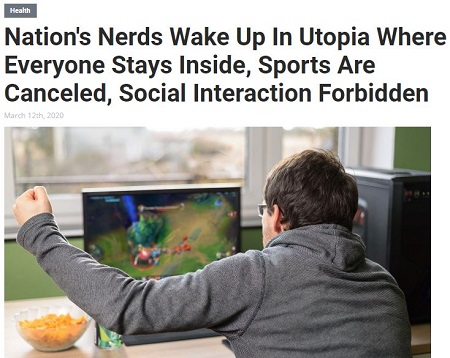
The Babylon Bee treats this panic with the seriousness it deserves.