In The Mailbox: 07.13.16
Posted on | July 13, 2016 | 2 Comments
— compiled by Wombat-socho
OVER THE TRANSOM
Louder With Crowder: #BlackLivesMatter Memes Debunked
EBL: The Golden Age Of Travel On United Airlines
Michelle Malkin: Congressional Black Corruption
Twitchy: Ben Shapiro Unleashes Epic Takedown Of Viral Sensation “White Boy Privilege”
RIPPED FROM THE HEADLINES
American Power: Tomi Lahren Blames Obama, “Two Black Attorneys General”, For Inciting Dallas Shooting
American Thinker: Chicago’s Collapse Has Begun
Da Tech Guy: Fausta – Senate Democrats Against Free Speech
Don Surber: Gun Control Failed Police Officer Mike Flamion
Jammie Wearing Fools: Obama’s America – Ex-Con In #BlackLivesMatter Shirt Opens Fire On Police Officer’s Home
Joe For America: Trump Surging, Leading In Key States
JustOneMinute: Donald Trump, Bringing People Together
Pamela Geller: Pam Geller, Milo Yiannopoulos, Geert Wilders Headline Historic “Wake Up” LGBT RNC Event
Shark Tank: Politifact Finds Ritch Workman’s Common Core Claims Are Mostly False
Shot In The Dark: Vacuous Hipster Lives Matter
STUMP: Happy News For Vacation Time!
The Jawa Report: Fatwa This! Flying Donkey Edition
The Lonely Conservative: Obama Can’t Even Speak At A Memorial Without Getting Political
The Political Hat: The Presumed Crime Of Not Money Laundering
The Quinton Report: Wanted Teen Taunts Police On Facebook Live
This Ain’t Hell: Pokemon Go And Arlington National Cemetery
Weasel Zippers: Purdue Threatens To Expel Students For Criticizing #blacklivesmatter
Megan McArdle: The Democrats Have Unified. The Republicans Won’t.
Don Surber’s Trump The Press
Amazon Devices- All New Dash Buttons in June. Just Press

Mir Islam, Who SWATted Me in 2013, Has Been Sentenced to Two Years in Prison
Posted on | July 13, 2016 | 35 Comments

The FBI contacted me earlier this month to tell me that the guy responsible for targeting me in a March 2013 SWATting incident was scheduled for sentencing in federal court, but I couldn’t report anything about it until after the hearing. Because of last week’s Dallas attack, the hearing date Monday slipped my mind, but here’s the official statement:
New York Man Sentenced To 24 Months in Prison
For Internet Offenses, Including “Doxing,” “Swatting,”
Making a False Bomb Threat, and Cyber-Stalking
WASHINGTON — Mir Islam, 22, of New York, N.Y., was sentenced today to 24 months in prison on three federal charges stemming from a conspiracy to commit various crimes related to the “swatting” and “doxing” of dozens of victims, and from a false bomb threat made against a university in Arizona and a pattern of online harassment constituting cyber-stalking against a university student, all occurring between February and September 2013.
The sentencing was announced by U.S. Attorney Channing D. Phillips of the District of Columbia, U.S. Attorney John S. Leonardo of the District of Arizona, and Paul M. Abbate, Assistant Director of the FBI’s Washington Field Office.
Islam pleaded guilty on July 6, 2015, in the U.S. District Court for the District of Columbia, to a total of three charges. They included one count of conspiracy to commit a range of federal offenses, including identity theft; access device fraud; social security number misuse; computer fraud; wire fraud; assaulting federal officials; and interstate transmission of threats. The other charges included one count of threatening and conveying false information concerning the use of explosives and one count of cyber-stalking.
In his guilty plea, Islam admitted to “swatting” and “doxing” numerous individuals, to communicating a false shooting and bomb threat on a university campus in Arizona, and to committing a pattern of online harassment against a university student. “Swatting” is the act of placing emergency 9-1-1 type calls to police departments, usually through Internet-based telecommunication relay services, to make false claims of homicides or other assaultive or criminal conduct by, or against, other targeted individuals at the locations of those individuals. These false 9-1-1 communications are intended to result in, and usually did result in, a tactical police response, including SWAT teams, to the targeted, unsuspecting victims’ residences. “Doxing” is the act of gathering, by licit and illicit means, and posting on the Internet personal identifying information (“PII”) and other sensitive information about an individual, including, for example, addresses, dates of birth, social security numbers, telephone numbers, e-mail addresses, credit information, employers, and details regarding the individual’s children and other family members.
“The crimes committed by this defendant violated the privacy of dozens of people, fostered identity theft, and endangered the safety of many others,” said U.S. Attorney Phillips. “Mir Islam put people at risk on the Internet and in their own homes, placed responding police officers at risk, created a dangerous situation on a college campus, caused substantial emotional distress to numerous victims, and diverted law enforcement from work they could be doing to protect the public. Today’s sentence reflects the seriousness of his crimes and hopefully will deter others from similar actions.” . . .
You can read the rest of that statement, and you can also read the account by Internet security specialist Brian Krebs, who reports that among the targets of Mir Islam’s online terrorism were Wayne LaPierre of the National Rifle Association and a University of Arizona cheerleader that this criminal hacker spent months cyberstalking.
What the reader should ask themselves is this question: “Why would the NRA president, a conservative blogger like Stacy McCain, and a tech security guy like Brian Krebs all be targeted by Mir Islam (and his yet-to-be-identified co-conspirators) in 2013?”
While the reader is speculating on that, let me add a very curious fact: I wasn’t living at the address that was SWATted in March 2013.
In May 2012, after I started reporting on the Brett Kimberlin case, concern for my family’s safety caused me to move to “an undisclosed location” outside Maryland. However, certain people who were allied with Brett Kimberlin — among them, deranged cyberstalker Bill Schmalfeldt — went to extraordinary lengths to defame me, and one of their character-assassination tactics was to claim that I had lied about moving out of state. Over and over, these allies of Brett Kimberlin falsely claimed online that I was still living at my former address in Maryland.
And guess which address was SWATted in March 2013?
Yep. A young couple with an infant daughter was living at my family’s former address, and the terrifying ordeal of being confronted in the middle of the night by a heavily armed police tactical unit was a trauma that they will never forget. Who is ultimately to blame for that incident?
Well, Mir Islam has been sentenced to federal prison now, and it would be unwise to speculate about the identities of his co-conspirators, but carefully read this paragraph of the official FBI statement:
According to the government’s evidence, Islam and his co-conspirators swatted at least 20 celebrities and state and federal officials. For example, a former member of Congress from Michigan was swatted because of federal legislation he sponsored; a former State Representative, who is now a member of Congress, was swatted because of anti-swatting state legislation he sought to enact, and an Assistant United States Attorney was swatted in retaliation for a particular prosecution he participated in.
Hmmm. Who was that “former member of Congress from Michigan” and what “federal legislation” caused him to be targeted? Which federal prosecution caused Mir Islam’s crew to target an assistant U.S. attorney?
As I say, it would be unwise to speculate about who else might have been involved in Mir Islam’s SWATting conspiracy, and the FBI made a point of stating: “The investigation is continuing.” When I was notified a year ago that a then-unnamed person had copped a plea with the feds, I said: “Let justice be done. Let the guilty fear punishment for their crimes, so that the innocent need never fear.”
Mir Islam is now in federal prison, but there are still guilty people who have yet to face justice, and they should be afraid — very afraid.
Thanks to all the readers who have supported me during the relentless harassment I’ve endured over the past four years. Most of the evil that has been done to me, I’ve never even mentioned publicly, because I don’t want to give these wicked monsters the satisfaction of acknowledging how much damage they have inflicted, and also because if I described their tactics, other monsters might imitate such criminal evil.
“Never Doubt That God Answers Prayer,” and thanks to all the readers who know the Five Most Important Words in the English Language:
UPDATE: Linked by John Hoge at Hogewash — thanks!
Words Mean Things: @kate_manne and the Elastic Definition of ‘Misogyny’
Posted on | July 12, 2016 | 64 Comments

“I worry that the word ‘reason,’ being as heavily masculine-coded as it is, functions as a kind of buzzword.”
— Kate Manne, Ph.D., January 2016
Misogyny is “the system which operates within a patriarchal social order to police and enforce women‘s subordination, and to uphold male dominance,” according to Cornell University Professor Kate Manne. Thus, a sentiment — misogyny actually means hatred of women — is transmogrified into a “system” through the magic of feminist rhetoric.
“Misogyny” is one of those slanderous insults that feminists fling around so habitually and haphazardly as to be meaningless, the way “rape culture” now means almost anything a heterosexual man says or does. Yet no man can object to such insults, nor protest against this slander, without bringing upon himself the suspicion of guilt. The anti-male propaganda of feminist rhetoric is part of a psychological warfare strategy, one which routinely employs “Kafkatrapping” tactics, where denying the accusation is considered proof of guilt. Males exist only as demonized scapegoats in the feminist imagination, as I have explained:
Feminism provides an analytical framework within which almost any aspect of male behavior can be viewed as “problematic” — yet another example of misogyny, “male entitlement,” etc. — so that every man the feminist encounters is viewed as a suspect, a likely perpetrator of sexism, and she is a detective on the case, gathering evidence to indict him.
Feminism condemns all men as complicit in patriarchal oppression, and nothing so conclusively proves a man’s active role in this conspiracy as when he commits the crime of disagreeing with a feminist. The paranoid circularity of Feminist Logic™ is so obvious that it is frightening to think that Cornell University (annual tuition $49,116) would hire a fanatical ideologue like Kate Manne for a tenure-track position, but let’s read more of Doctor Manne’s definition of “misogyny”:
[M]isogyny is primarily a property of social systems or environments as a whole, in which women will tend to face hostility of various kinds because they are women in a man’s world (i.e., a patriarchy), who are held to be failing to live up to men‘s standards (i.e., tenets of patriarchal ideology which have some purchase in this environment). Because of this, misogynist hostilities will often target women more selectively, rather than targeting women across the board. And individual agents may harbor these hostilities for numerous different reasons; the full psychological explanation of their attitudes and actions will also vary widely. Such hostilities may alternatively have their source in the actions, practices, and policies of broader social institutions. What these hostilities are required to have in common is the above social-cum-structural explanation: i.e., roughly, they must be part of a system that polices, punishes, dominates, and condemns those women deemed to be an enemy or threat to the patriarchy.
If you encountered an ordinary person spewing such gibberish — mumbling to themselves at a bus station about “misogynist hostilities” — you’d figure them for a kook on the brink of a psychotic breakdown. However, Kate Mannes has a Ph.D. from MIT, so her gibberish will be published in a book by a major university press. Among other targets, Doctor Mannes takes aim at Heather Mac Donald:
Finally, there is no conflict between social progress for women and misogynist aggression towards them, contra Heather Mac Donald. Progress and misogyny are perfectly compatible. As each of my main examples in this paper has suggested in their own way, and as my analysis predicts, the former may be precisely what engenders the latter, in the form of backlash. That is, women may be resented and punished precisely because they are achieving rapid progress in certain areas. Some women‘s success in hitherto male-dominated roles, as well as their abandonment of traditionally feminine-coded forms of care work, would be predicted on my account to make them the targets for misogynist aggression. And this is what we find. Misogyny often stems from the desire to take women down, to put them in their place again. So the higher they climb, the farther they may be made to fall because of it. But the women who rise up and the women who fall down may not be identical. The glass ceiling may be broken; but then, there may be smack-down. And some women may be hit by the shards of glass following others escalation.
In other words, the more women succeed, the more men hate women, so that no matter how much actual equality may be achieved, there will never be a point in the future when feminists stop claiming to be victims.
Damned if you do, and damned if you don’t — feminism is a lose-lose proposition all the way around, with increasing hostility between men and women as the necessary byproduct of “progress.” Why? Because modern feminism is derived from Marxism, i.e., “The history of all hitherto existing society is the history of class struggles.” Feminists simply substitute patriarchy for capitalism as the oppressive system to be destroyed in the prophesied revolutionary apocalypse that will usher in a future egalitarian utopia. Nothing good ever comes from such radicalism, but Doctor Manne teaches philosophy, not history, so the blood-stained record of Marxist-Leninist regimes in the 20th century does nothing to deter her dreams of dictatorial feminist power in the 21st century. And speaking of feminist dictators . . .
Hillary Clinton is a victim of misogyny, according to Doctor Manne: “When Hillary Clinton behaves as other politicians do, or changes her positions, she is perceived as more dishonest and as having less integrity.” Accusations of wrongdoing against Hillary “are feeding into gendered tropes and stereotypes as old as misogyny itself — e.g., of the woman who can’t be trusted, and to whom we hence don’t have to listen,” according to Doctor Manne. Just as no one can criticize Barack Obama without being accused of racism, now the Clinton campaign is planning to make the 2016 election a litmus test of sexism, and Doctor Manne has published a 5,000-word opus in The Boston Review that depicts Donald Trump as the living embodiment of misogyny:
Trump’s blunt kind of misogyny is a good place to start in understanding the general phenomenon. It is so crude, shameless, and unapologetic that we run little risk of getting lost in its nuances. But we must ask the natural next question: What happens to misogyny when it acquires a little subtlety or goes underground and manages more by way of plausible deniability?
The answer, all too often, is that it is transformed into moralistic forms — which are not . . . historical artifacts. What unites these varieties of misogyny, past and present, and moralistic and non-moralistic alike, is that they enforce the patriarchal order by lifting men up and taking down women. . . .
Four thousand words later, Doctor Manne concludes by wondering whether some “progressive” men will join the misogynistic backlash:
It is not difficult to see why misogynistic aggression might coexist with progressive commitments. Many white men, including those who espouse egalitarian and progressive values — even those who pride themselves on being good feminists — have recently experienced a loss of power and status relative to nonwhites and white women. Some are in denial. And some are angry. Some are lashing out in grief cloaked in outrage.
The strength of these forces will become clearer in November. I confess that I am not optimistic about the outcome. Electing Trump would strike a major blow for patriarchal restoration. Misogynistic social forces are hence pushing in this direction. And if Clinton does win, she will have to govern in the face of a revanchism intensified by Trump’s defeat. Another fear is that the least privileged and most vulnerable women will bear the brunt of the trickle-down aggression.
We will see soon enough. But insofar as there is a distinctively modern strain of misogyny, it is this: the backlash to women’s social progress and to feminism.
What? Does the professor mean that Republicans complaining about Trump are against “patriarchal restoration”? As a leading spokesman for misogynistic social forces, this is very disturbing to me. If the GOP isn’t going to do its part to enforce the patriarchal order, who will?
At least I’m not one of those pathetic progressive dudes “who espouse egalitarian and progressive values” and “pride themselves on being good feminists” while they suffer “loss of power and status,” etc. Equality is impossible, social justice is a mirage, and Progress Is the Root of All Evil.
Of course, nobody who hopes to get tenure at Cornell University would dare speak such blunt truths, and Doctor Manne finds herself surrounded by male faculty members who never dare say a word against her feminist ideology. Their timorous silence probably leads her to suspect that her male colleagues are all secretly plotting to uphold their dominance and enforce her subordination. One reason paranoia is so typical of academic feminism is simply because no one on campus is permitted to dissent. Every member of the faculty and administration at an Ivy League school like Cornell is expected to sing from the Diversity Hymnal, and if any of them privately harbor doubts about “egalitarian and progressive values,” they know they would be persona non grata on campus if they ever gave voice to any skeptical opinion toward feminism. Yet surely not everyone at Cornell shares Doctor Manne’s fanatical zeal, and her ideology tells her that “even [men] who pride themselves on being good feminists” are apt to join the “backlash to women’s social progress.” So who is this Judas at Cornell who will betray her? Which member of the faculty may even now be secretly sabotaging Doctor Manne’s path to tenure?

Madness looms as fear haunts the feminist imagination. Last year, an academic philosophy journal rejected one of Doctor Manne’s articles, which caused her to erupt in a memorable Facebook conniption:
I received a rejection notice from a journal yesterday. This is a pretty routine occurrence in this game, admittedly. Acceptance rates are notoriously low in philosophy; well under five per cent in the top journals. So you have to learn to accept the rejections themselves gracefully. And much as you slightly dread reading the reports, they can be valuable, even invaluable, in making the paper better. They can help to expose unclarities in your claims, gaps in your argument, etc. But sometimes, they simply confirm that you are fighting a losing battle.
This referee report was one such. The reviewer complained about my use of feminist terms and concepts throughout the paper — e.g., “hegemonic dominance”, “messages that are not only false but oppressive,” and “hermeneutical injustice,” being the specific phrases which they listed as objectionable. And they went on to remark more generally that “the rhetoric of the ms. is such that it will, I think, (1) turn off some readers and (2) distract from the author’s argument. The author brings in some concepts and language which, whatever their merits, seem dubious to many of us in the analytic tradition.”
As a feminist philosopher in the analytic tradition, this is a very disappointing reaction to encounter. Many of us — me included — take the above terms and concepts to be standard, useful, and indeed vital, stock-in-trade. And the people who the reviewer feared would be so “turned off” by the language as to be “distracted” from my argument seem to include the reviewer themselves, ironically. They not only managed to completely miss, but handily illustrated, my central point in the paper. The point being that if one espouses politically marginalized views within philosophy, then one is disproportionately likely to be dismissed, disparaged, silenced, or even excluded from the discipline altogether. One is less likely to be given a platform in leading journals, for one concrete example, in view of which one is of course less likely to be able to earn a living wage, let alone get tenure.
Taken alone, my experience is just one data point, of course. But recent work by Sally Haslanger, among others, strongly suggests that it is not anomalous. Feminist philosophy is virtually absent, and plausibly systematically excluded, from top journals, she argues.
You see? Feminism is “politically marginalized” and Doctor Manne is a victim — dismissed, disparaged, silenced and excluded! — of misogyny.
She’s only three or four years away from tenure now, so her dreadful ordeal on the “publish-or-perish” treadmill will soon be over. And if Cornell votes against tenure for Doctor Manne?
Federal lawsuit, guaranteed. She’s probably got a massive cache of evidence already. Every email or text message from any of her faculty colleagues that could plausibly be interpreted as “sexist” is stored somewhere, in anticipation of a future Title IX claim against Cornell. Why are feminists so common in academia and so rare in the private sector? No major business could survive in this litigation-happy country if managers didn’t carefully screen applications to make sure they don’t hire any woman with Gender Studies classes on her college transcripts. Any involvement in campus “activism” is likewise a red flag in the hiring process. The activist mentality represents a potential threat of lawsuits claiming “discrimination,” “hostile work environment,” etc., and companies would go broke paying settlements if they hired kooks who use social-justice jargon like “hegemonic dominance.”
This is the real tragedy of elite education in the 21st century. Parents pay $49,116 a year to send their kids to Cornell, hoping that an Ivy League education will qualify their child for successful careers, and instead the kids are being indoctrinated in bizarre “progressive” nonsense that renders students incapable of functioning in the real world. Honestly, what parent would want their child to turn out like Alanna Bennett, who went to Oberlin College (annual tuition $50,586) and ended up ranting about Ghostbusters at BuzzFeed?
“Hey, how’s your daughter doing?”
“She’s got an apartment and a cat and a job writing for BuzzFeed.”
“My condolences.”
Redefining words — so that “misogyny” is now simply a synonym for something a feminist dislikes — won’t change reality. What it will do is make it more difficult for allegedly “educated” people to understand why the world doesn’t conform to what they have been taught by the ideological commissars who control higher education in this country.
In The Mailbox: 07.12.16
Posted on | July 12, 2016 | Comments Off on In The Mailbox: 07.12.16
— compiled by Wombat-socho
OVER THE TRANSOM
EBL: Why I Want Crooked Hillary To Lose – Notorious RBG
Twitchy: Feel The Love As College Democrats Push Pathetic New Power Couple
RIPPED FROM THE HEADLINES
American Power: The NYT And The Left Have Blood On Their Hands
American Thinker: Obamacare And The Private Practitioner, 2016
BLACKFIVE: Book Review – Shadow War by Sean McFate
Da Tech Guy: Pat Austin – Report From Louisiana – Outside Agitators, Go Away!
Don Surber: Austin Bay Made My Day
Jammie Wearing Fools: Of Course – Five Shot At Baltimore Murder Victim Candlelight Vigil
Joe For America: Top Democrat Official Assassinated In Washington, DC
JustOneMinute: Lots Of News
Pamela Geller: France’s Head Of Intelligence – “France Is On The Verge Of Civil War”
Shark Tank: Rubio Says He Won’t Accept Presidential Nomination From Convention Floor
Shot In The Dark: Memories And Memory Holes
The Jawa Report: Feel The Bern! Sanders Sells Out, Endorses Hillary – Youth Shocked!
The Lonely Conservative: The Latest On The “Free The Delegates” Movement
The Political Hat: The Ultimate Tool Of The Patriarchy? Carbon Fiber!
The Quinton Report: Bob Ehrlich Called Out By Federal Prosecutors
This Ain’t Hell: Out Of The Pool, Tourists!
Weasel Zippers: Obama Defends Black Lives Matter At Funeral Service For Slain Dallas Police
Megan McArdle: The Public Option – It’s Baaaack!
Countdown to Prime Day – Free Gift with $50 Purchase
Shop Amazon Fashion – Extra 25% Off Men’s Suits & More
Criminal Who Killed Two at Courthouse Was a Great Guy, Says His Ex-Wife
Posted on | July 12, 2016 | 36 Comments
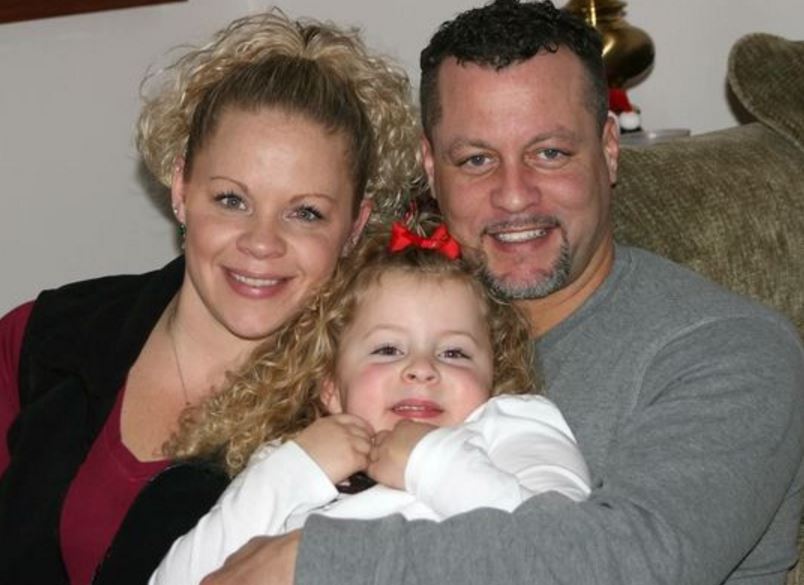
Cop-killer Larry Gordon in happier times.
Two bailiffs, Joseph Zangaro, 61, and Ronald Kienzle, 63, were killed and Berrien County Sheriff’s Deputy James Atterberry Jr. were wounded at a Michigan courthouse Monday when a prisoner tried to escape:
Larry Darnell Gordon, 44, of Coloma was apparently attempting to escape and tried to take hostages inside the Berrien County Courthouse when he shot and killed two bailiffs and wounded a deputy. . . .
“A preliminary investigation reveals that Larry Darnell Gordon disarmed one of the officers who were escorting him to a court hearing inside the Berrien County Courthouse,” Berrien County Sheriff Paul Bailey told reporters at a 9 p.m. Monday press conference. “After shooting the officers, Gordon briefly attempted to take hostages while other bailiffs and police officers in the courthouse engaged Gordon and he was shot and killed.”
Gordon, 44, had a criminal record dating back to 1992, when he was charged with robbery but copped a plea to a misdemeanor. In 1998, Gordon “pleaded guilty to felony fleeing a police officer and misdemeanor operating while intoxicated,” according to WZZM-TV, and in 2013, Gordon pleaded guilty to “second-offense misdemeanor driving while intoxicated or impaired and to felony theft from a building.” In April this year, Gordon was charged with very serious crimes — armed first-degree criminal sexual conduct, first-degree criminal sexual conduct during a felony, felony kidnapping, felony assault with a dangerous weapon and misdemeanor aggravated domestic violence — that could have put him in prison a long time. Despite this, his ex-wife said Gordon was a swell guy:
Gordon’s ex-wife, Jessica Gordon, 39, said Larry Gordon did it because he feared he would never be released and wanted to see his 6-year-old daughter.
“Larry was not a violent person,” she said Monday at the home they shared. “The only thing I can think of is that he was completely terrified, and people do things out of character when they’re scared. With all my heart I believe he was trying to get home to see Cheyenne (his daughter).” . . .
“He probably found out how much time he could potentially be looking at and wanted to get out to see us,” she said. “He thought he would die in prison.” . . .
She said she still loves him and that Tuesday would have been their 10-year wedding anniversary. She said they had been a couple for 19 years, and Cheyenne turns 7 on Saturday.
What struck me about this was how it echoes the narrative that the media always feed us whenever a black criminal gets shot by cops, or when a Muslim goes on a one-man jihad attack — oh, he was an honor student, and he loved his family, blah blah blah. So here we have a white guy who commits an atrocity and, yeah, his ex-wife wants to assure us that Larry Gordon was “not a violent person,” despite the numerous felonies he was accused of committing. Are there any activists on TV claiming that Larry Gordon was a victim of social injustice? No, because he was a heterosexual white male, and social justice rhetoric tells us that heterosexual white males are oppressors who benefit from “privilege.”
Larry Gordon was a thug, just like Michael Brown was a thug, and yet the media don’t seem to understand this. The media are always eager to buy into a prefabricated victimhood narrative — the innocent black man wrongly targeted by racist police — and facts be damned.
Don’t jump to conclusions and don’t believe everything people tell you — this is basic Journalism 101 stuff, and yet time after time, we see the media get bamboozled by professional “activist” types who peddle tales about innocent victims of racism, sexism and homophobia. No one can deny that such prejudices actually exist and cause real harm, but the media need to be sure they have the facts before they start turning the news into social justice sermons. Larry Gordon wasn’t a black guy or a gay guy or a transvestite like Bradley “Chelsea” Manning, so this incident at the Berrien County Courthouse is just a one-day crime story. Instead of having a “national conversation” about some kind of oppression, the media will quickly forget Larry Gordon.
Just a dead white criminal. Nothing to see here. Move long.
Butt-Hurt Jeb Bush Blames the Pope?
Posted on | July 12, 2016 | 18 Comments
Moaning on MSNBC about his defeat in the GOP primaries — his campaign spent $34 million for nothing — Jeb Bush needed a big scapegoat:
Asked about his final days on the campaign trail, Bush reflected on the South Carolina primary during which he was in a three-way tie behind Trump with Sens. Marco Rubio (FL) and Ted Cruz (TX). Recalling South Carolina Governor Nikki Haley’s endorsement then of Rubio, Bush said “it clearly hurt.”
In addition to Haley’s endorsement of Rubio, for whom Bush was once a mentor, Bush also went on to blame the Catholic Church, saying, “the Pope intervening in American politics didn’t help.”
“[The Pope] was talking about basically open borders at a time when the whole Trump phenomenon was to build a wall and make Mexico pay for it. [The Pope] literally goes to the border for a massive mass,” Bush said. “I don’t think he should be intervening… I don’t think he understood he was intervening in our political affairs.”
Where does blaming the Pope fit in the Kübler-Ross “five stages of grief”?
In The Mailbox: 07.11.16
Posted on | July 11, 2016 | Comments Off on In The Mailbox: 07.11.16
— compiled by Wombat-socho
OVER THE TRANSOM
Ninety Miles From Tyranny: News From The Future – The Failure Of Hillary’s Great Leap Forward, 2017-2020
EBL: Should The NRA Be Championing The Cause Of Philando Castile?
Twitchy: Man Who SWATted NRA Head Sentenced To Two Years
RIPPED FROM THE HEADLINES
American Power: How Many People Have To Die Because Of #BlackLivesMatter?
American Thinker: The Law Is Dying Because Morality Is Dying
BLACKFIVE: Book Review – Ghosts Of War by Brad Taylor
Da Tech Guy: John Ruberry – If All Black Lives Matter, Then Why No Protests In Crime-Ridden Areas?
Don Surber: Keep Calm And Remain Adult
Jammie Wearing Fools: Pathetic Clinton Blames “Negativity”, Not Her Criminal Behavior, For Low Approval Ratings
Joe For America: America Now Entering The Stone Age?
JustOneMinute: Sunday Morning
Pamela Geller: Head Of DIA Fired For Calling Our Enemies Radical Jihadis
Shark Tank: Prominent Democrats Want Debbie Wasserman Schultz Out
Shot In The Dark: Obama’s Dumbest Idea Yet
The Jawa Report: Sandcrawler PSA – Facebook Safe And Welcoming To Everyone
The Lonely Conservative: Condolences And Prayers For A Dear Friend
The Political Hat: The Perfect Confluence Of Political Correctness And Jihad
This Ain’t Hell: That “Decorated Veteran” With An “Assault Rifle” In Dallas
Weasel Zippers: Minneapolis Cops Working Lynx Game Walk Out Over Player Comments, #BLM Warmup Jerseys
Amazon Prime Day – Fire Tablet Lowest Price Ever, Just $33.33
Amazon Prime Day – Kindle Paperwhite $30 Off
Man-Hater @AlannaBennett Promotes #Ghostbusters as Feminist Revenge
Posted on | July 11, 2016 | 67 Comments
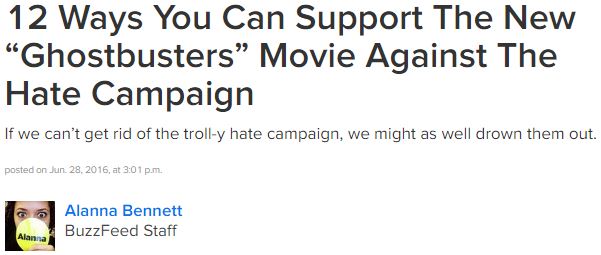
Alanna Bennett is the kind of selfish feminist who attends elite Oberlin College (annual tuition $50,586) and then spends the rest of her life angry because nobody gives her as much pity as she feels she deserves.

“As a professional writer, my life now is stuffed with privileges I’ve longed for since I found out they existed. . . . And yet: The money I make barely covers a life in New York and my student loans.”
— Alanna Bennett
Yeah, it’s terrible that somebody put a gun to your head and forced you to attend Oberlin, because obviously Oregon State (annual tuition $10,107) wasn’t good enough for a Special Snowflake™ like yourself.
Feminism is motivated by anti-male revenge fantasies, providing selfish women a chance to bask in applause for their deliberate acts of cruelty. Feminists consider it “courageous” to inflict harm on males, which is why Alanna Bennett knew she would be praised for urging women to cause “male tears” by supporting the feminist Ghostbusters remake:
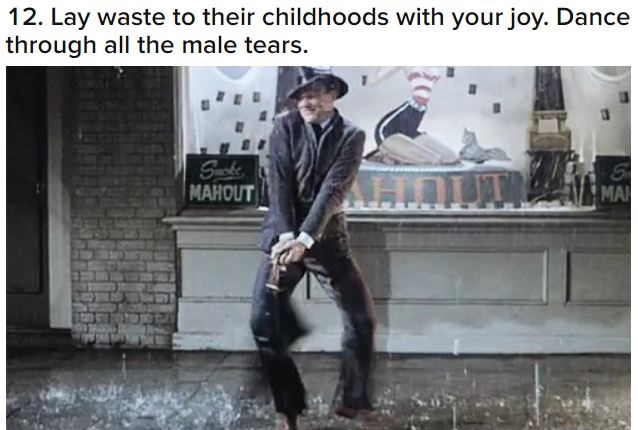
The new Ghostbusters remake is hate propaganda, promoting the fundamental feminist belief that males are useless, stupid and/or evil.
Like all feminists, Alanna Bennett hates men, and it is therefore not surprising she hates movies with heterosexual themes.
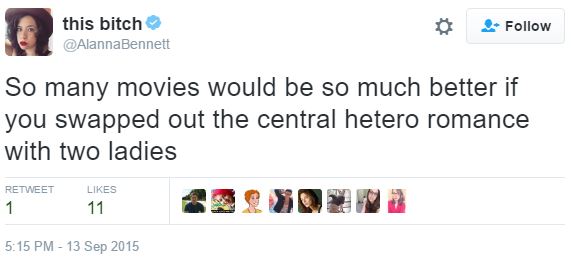
Was anyone surprised that Alanna Bennett tweeted out images of kissing her girlfriend (a “non-binary” “queer” feminist) during BuzzFeed’s LGBT Pride celebration? (Are there any heterosexuals employed at BuzzFeed? If so, are they afraid to admit they’re heterosexual?)
Rather than being honest about her man-hating motives for supporting the feminist remake of Ghostbusters, however, Alanna Bennett insisted that it was critics of this project who were motivated by “hatred.”
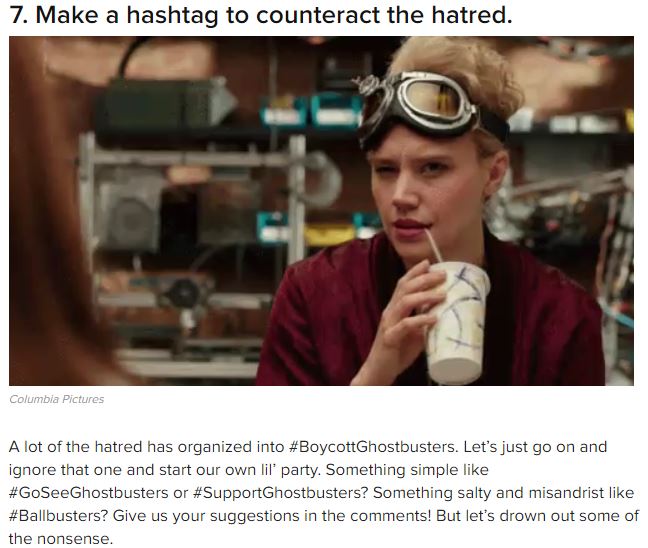
In other words, if you don’t like seeing old movies hijacked by feminists and turned into anti-male propaganda, you’re a hater. As I’ve explained, the whole project is just a feminist political statement:
The message of the all-female cast is simple: Males are useless, because girl power saves the day!
Sometimes I’ve called this “Lesbian Ghostbusters” because it was predictable, from the moment the project was announced, that this new movie would emphasize a familiar “Third Wave” feminist theme of males as either (a) incompetent idiots or (b) evil oppressors. Like so many recent feminist movie projects, the new Ghostbusters aims to pass the “Bechdel Test,” which originated with lesbians who did not want to see either male heroes or heterosexual romance in movies.
Keep in mind that I wrote that without knowing anything more about the new Ghostbusters than could be learned by reading a couple of reviews. However, if you understand what “Third Wave” feminism is about (Feminism Is Queer), the implicit premise was obvious enough. And, as Matt Zion’s “rage review” shows, my prediction was right:
“They make Chris Hemsworth . . . he’s an idiot. They make him an idiot. Then they have the guy who delivers the Chinese food to them — it’s a running gag throughout the movie — he’s terrible at his job and he’s an idiot. And then the villain is not an idiot, he certainly is very intelligent, but he’s creepy, weird and he’s just antisocial. . . . Every man is portrayed like a complete a–hole. The mayor is an a–hole. . . . They go to like a rock concert or something, and the guy who is in charge of that . . . he’s an a–hole. Every man in this movie is an a–hole. . . . Basically, it was a man-bashing film.”
Twenty-first century feminism is about demonizing and silencing males, teaching young women to despise men as either irrelevant or dangerous.
Alanna Bennett‘s mind is completely warped by her vicious hatred of men. Because feminists are psychologically incapable of relating to males in a normal way — they are “without natural affection” (Romans 1:31) — they consider it “hate” for any man to defend himself against the relentless slander of feminism’s anti-male rhetoric. This means that any man who disagrees with feminist ideology is a sexist. This is a “Kafkatrapping” tactic, where denying the accusation is cited as proof of your guilt.
Because she is a feminist, and therefore views males as inherently inferior, Alanna Bennett considers all male opinions invalid. So the fact that men don’t like the new Ghostbusters is as irrelevant to her as any other male preference or belief, except insofar as her anti-male belief system means that this wretched movie is good because men don’t like it.
Anything men hate is good, and anything men like is bad — this is a fair summary of the basic feminist worldview, the anti-male political ideology around which Alanna Bennett has organized her life. Therefore, no matter how awful the new Ghostbusters actually is, it must be praised!
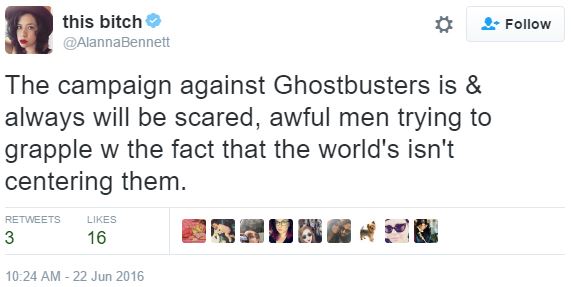
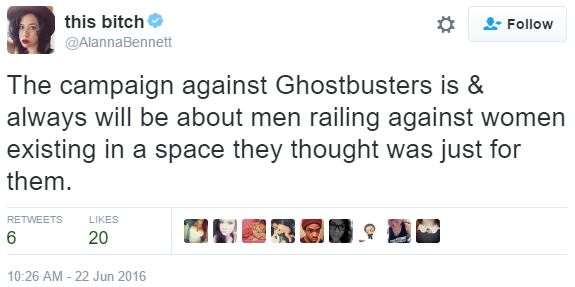
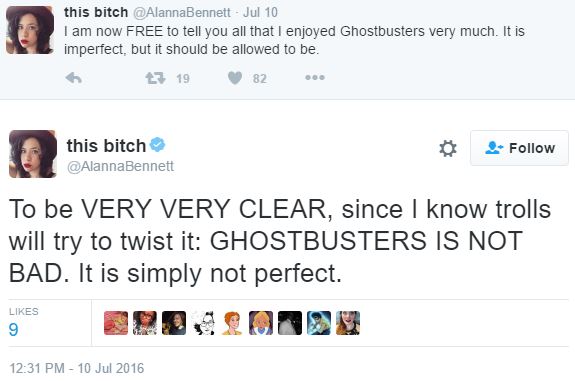
You see that Alanna Bennett is emotionally invested in this anti-male propaganda film. Feminists demand the new Ghostbusters be praised, in the same way Goebbels demanded praise for Triumph of the Will.
“If you look at the argument of a lot of these reviews [of the new ‘Ghostbusters] that have come out, there are so many of them that are like, it’s not good or it’s average, but it’s going to do so much for women. Go see it.”
— Matt Zion, “Ghostbusters 2016: How Every Man Is An Idiot Or An A–hole”
This bizarre attitude — requiring that a mediocre movie must be praised, because it is politically incorrect not to like it — reminds me of Lysenoism under Stalin in the Soviet Union. Facts don’t matter to an ideologue like Alanna Bennett, whose commitment to feminism is an all-encompassing loyalty. The feminist is a True Believer, fanatically devoted to the movement, and ferociously hostile to the male enemy.
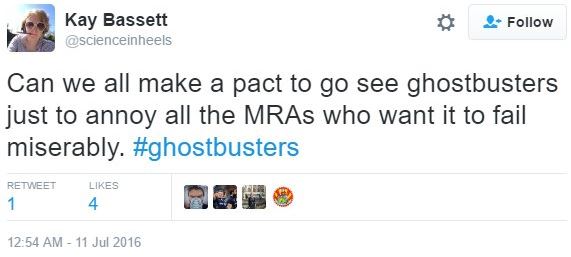
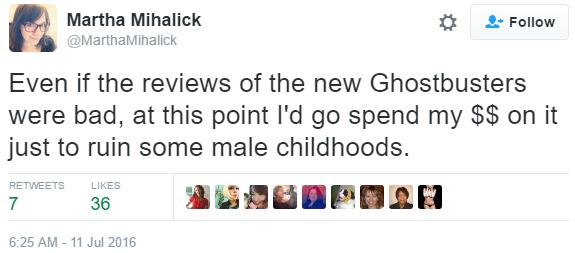
What is sad about such women is how their anti-male beliefs function as a self-fulfilling prophecy. Because feminists like Alanna Bennett are so profoundly prejudiced against men, smart men avoid them. There are 3.5 billion women on this planet, and most women actually like men. Therefore, no intelligent guy with any sense of self-respect would waste his time hanging around an ax-grinding man-hater like Alanna Bennett. Because the only men who ever hang around feminists are stupid (or perhaps, desperate), it is easy for women like Alanna Bennett to believe there are no intelligent or virtuous men in the world. Feminism acts as a sort of force-field of hatred that drives good men away.

It’s a good thing she likes her cat. At least she won’t be lonely.
“The fanboys rallied against the project and it turns out . . . those f–kers were right.”
— Ed Whitfield
Well shit… This review confirms nearly every fear I had about Ghostbusters after that terrible trailer.-J https://t.co/nVGxFLIY46
— Super the Hardest (@SuperTheHardest) July 11, 2016
I did one more video about #Ghostbusters. I call it Ghostbusters 2016 How Every Man Is An Idiot Or An Asshole. https://t.co/5v9UhkN8ph
— Matt Zion (@MattZionWE) July 11, 2016
THE FULL METAL JACKET REACH-AROUND AWARD
HIT THE FREAKING TIP JAR!
Search
Recent Posts
- In The Mailbox: 10.06.26 (Evening Edition)
- In The Mailbox: 10.06.26 (Afternoon Edition)
- Rule 5 Sunday: A Salute to Mrs. Justin Verlander
- FMJRA 2.0: No Grandeur This Week Just Misery
- The Wrong Matthew Ingalls, the Correct ‘Jane Doe’ and the Cornell 7 Case
- In The Mailbox: 10.02.26 (Evening Edition)
- In The Mailbox: 10.02.26 (Afternoon Edition)
- In The Mailbox: 09.30.26
- In The Mailbox: 09.29.26
- In The Mailbox: 09.28.26
RSS reader subscription

MEMEORANDUM
Recent Comments
THE AMAZING GONZO FEED
Major Leagues
Archives
- October 2026 (8)
- September 2026 (38)
- August 2026 (43)
- July 2026 (39)
- June 2026 (40)
- May 2026 (43)
- April 2026 (59)
- March 2026 (44)
- February 2026 (37)
- January 2026 (45)
- December 2025 (42)
- November 2025 (44)
- October 2025 (44)
- September 2025 (47)
- August 2025 (48)
- July 2025 (48)
- June 2025 (47)
- May 2025 (48)
- April 2025 (42)
- March 2025 (48)
- February 2025 (49)
- January 2025 (48)
- December 2024 (42)
- November 2024 (44)
- October 2024 (47)
- September 2024 (43)
- August 2024 (55)
- July 2024 (63)
- June 2024 (59)
- May 2024 (48)
- April 2024 (43)
- March 2024 (55)
- February 2024 (46)
- January 2024 (45)
- December 2023 (53)
- November 2023 (62)
- October 2023 (57)
- September 2023 (56)
- August 2023 (53)
- July 2023 (69)
- June 2023 (67)
- May 2023 (53)
- April 2023 (60)
- March 2023 (73)
- February 2023 (65)
- January 2023 (56)
- December 2022 (60)
- November 2022 (64)
- October 2022 (58)
- September 2022 (68)
- August 2022 (75)
- July 2022 (69)
- June 2022 (73)
- May 2022 (74)
- April 2022 (57)
- March 2022 (79)
- February 2022 (65)
- January 2022 (58)
- December 2021 (62)
- November 2021 (68)
- October 2021 (73)
- September 2021 (63)
- August 2021 (60)
- July 2021 (80)
- June 2021 (64)
- May 2021 (64)
- April 2021 (58)
- March 2021 (73)
- February 2021 (57)
- January 2021 (71)
- December 2020 (77)
- November 2020 (81)
- October 2020 (84)
- September 2020 (94)
- August 2020 (75)
- July 2020 (68)
- June 2020 (83)
- May 2020 (77)
- April 2020 (65)
- March 2020 (85)
- February 2020 (94)
- January 2020 (95)
- December 2019 (88)
- November 2019 (60)
- October 2019 (113)
- September 2019 (91)
- August 2019 (91)
- July 2019 (88)
- June 2019 (80)
- May 2019 (74)
- April 2019 (97)
- March 2019 (100)
- February 2019 (85)
- January 2019 (93)
- December 2018 (90)
- November 2018 (83)
- October 2018 (96)
- September 2018 (79)
- August 2018 (107)
- July 2018 (98)
- June 2018 (86)
- May 2018 (78)
- April 2018 (78)
- March 2018 (97)
- February 2018 (61)
- January 2018 (70)
- December 2017 (62)
- November 2017 (68)
- October 2017 (67)
- September 2017 (70)
- August 2017 (68)
- July 2017 (52)
- June 2017 (60)
- May 2017 (56)
- April 2017 (80)
- March 2017 (80)
- February 2017 (102)
- January 2017 (104)
- December 2016 (65)
- November 2016 (86)
- October 2016 (77)
- September 2016 (81)
- August 2016 (66)
- July 2016 (83)
- June 2016 (81)
- May 2016 (65)
- April 2016 (64)
- March 2016 (81)
- February 2016 (74)
- January 2016 (66)
- December 2015 (64)
- November 2015 (85)
- October 2015 (71)
- September 2015 (80)
- August 2015 (67)
- July 2015 (79)
- June 2015 (69)
- May 2015 (72)
- April 2015 (94)
- March 2015 (122)
- February 2015 (71)
- January 2015 (93)
- December 2014 (99)
- November 2014 (67)
- October 2014 (109)
- September 2014 (87)
- August 2014 (106)
- July 2014 (132)
- June 2014 (154)
- May 2014 (126)
- April 2014 (145)
- March 2014 (144)
- February 2014 (142)
- January 2014 (185)
- December 2013 (192)
- November 2013 (173)
- October 2013 (175)
- September 2013 (181)
- August 2013 (167)
- July 2013 (147)
- June 2013 (135)
- May 2013 (128)
- April 2013 (105)
- March 2013 (162)
- February 2013 (191)
- January 2013 (206)
- December 2012 (190)
- November 2012 (176)
- October 2012 (240)
- September 2012 (206)
- August 2012 (235)
- July 2012 (223)
- June 2012 (161)
- May 2012 (230)
- April 2012 (269)
- March 2012 (282)
- February 2012 (247)
- January 2012 (267)
- December 2011 (285)
- November 2011 (300)
- October 2011 (302)
- September 2011 (297)
- August 2011 (288)
- July 2011 (297)
- June 2011 (245)
- May 2011 (260)
- April 2011 (344)
- March 2011 (293)
- February 2011 (201)
- January 2011 (263)
- December 2010 (265)
- November 2010 (266)
- October 2010 (305)
- September 2010 (280)
- August 2010 (272)
- July 2010 (230)
- June 2010 (244)
- May 2010 (256)
- April 2010 (222)
- March 2010 (271)
- February 2010 (286)
- January 2010 (229)
- December 2009 (21)
- October 2009 (1)
Free Agents
SHAMELESS CAPITALISM
Triple-A Franchises
- All-American Blogger
- American Power
- Anti-Idiotarian Rottweiler
- Athens & Jerusalem
- Barney Quick
- Bartholomew's Notes On Religion
- BatesLine
- Bear Creek Ledger
- Bearsears Patriots
- Blog de KingShamus
- Bride of Rove
- Cold Fury
- Daily Pundit
- Dr. Helen
- I Own The World
- Legal Insurrection
- Moe Lane
- No Runny Eggs
- Obi`s Sister
- Protein Wisdom
- Rhetorican
- Small Dead Animals
- The Conservatory
- The People's Cube
- The Sundries Shack
- VodkaPundit
- Vox Day
- Zilla of the Resistance
Blogroll
- 90 Miles From Tyranny
- A Conservative Shemale
- A Point of View
- Adrienne's Corner
- AmSpec Blog
- Bad Blue
- Blazing Cat Fur
- Calvin Freiburger Online
- Carol's Closet
- Catholic Bandita
- Caught Him With A Corndog
- Cecil Calvert
- Common Cents
- Conservative Hideout
- Conservative Watch News
- Conservatives for America
- Conservatives For Palin
- Crazy For Liberty
- Dad 29
- DC Damsel
- Dr. Flap
- Dyspepsia Generation
- Effing Conservatives
- Election Dissection
- Eric Reasons, IT Genius
- Eye of Polyphemus
- Finding Ponies. . .
- Free Will
- Grandpa John's
- Granite Grok
- GrEaT sAtAn"S gIrLfRiEnD
- Hoosier Access
- John William Perry
- Judicial Watch
- Jumping in Pools
- KURU Lounge
- Laughing Conservative
- Makes My Brain Itch
- Marathon Pundit
- Martin Eisenstadt's Blog
- Media Fade
- Michael Leahy
- Mister Pterodactyl
- Naked Villainy
- Nice Deb
- noot's observatory
- Not One Red Cent
- Okrahead
- Ollieander
- Pileus
- Pinup Girl
- Point of a Gun
- Political Pit Bull
- Reaganite Republican Resistance
- Red Alexandria
- Red State Eclectic
- Red, White & Conservative
- Republican Redefined
- ResCon1
- Ric's Rulez
- Ricochet
- Right of Course
- Robipedia
- Robomonkey
- Ruby Slippers Blog
- Saberpoint
- Scared Monkeys
- Sentry Journal
- SI VIS PACEM
- Skepticrats
- Smash Mouth Politics
- Sooper Mexican
- Taking Hayek Seriously
- Tel-Chai Nation
- Tequila & Javalinas
- The Aged P
- The Classic Liberal
- The Izzy Report
- The Minority Leader
- The NeoSexist
- The Nose on Your Face
- The Republican Mother
- The Right Sphere
- The Saint Angilbert Press
- The Snooper Report
- The Underground Conservative
- Thunder Tales
- Tom McLaughlin
- Tory Anarchist
- TrogloPundit
- Vets On The Watch
- Watcher of Weasels
- Western Experience
- World's Only Rational Man
- WyBlog
- Yankee Phil
- Zingstrom's Blog