[Redacted] Is a Religion of Peace
Posted on | June 20, 2016 | 27 Comments
The Obama administration and the liberal media have decided that when a radical Islamic terrorist kills Americans, the one thing the narrative cannot be about is radical Islamic terrorism. It’s OK to talk about the Orlando massacre in terms of homophobia, gun control or “toxic masculinity,” but don’t you dare mention Islam. Don’t mention that Omar Mateen was a registered Democrat, or that he’s the son of an immigrant from Afghanistan or that his father supports the Taliban.
This obvious pro-Muslim bias has become increasingly blatant:
Justice Department Replaces ‘Allah’ With
‘God’ in Censored Orlando Terrorist Transcript
— Katie Pavlich, Townhall
FBI Omitted ISIS From Orlando 911 Transcript
— Mary Chastain, Legal Insurrection
FBI releases 911 transcripts of Omar Mateen
— with references to ISIS omitted
— Allahpundit, Hot Air
The media would have you believe that this sensitivity is necessary because, if radical Islamic terrorism were identified as the cause of a gruesome mass murder, Americans would be seized by irrational “Islamophobia” and commit hate crimes against random brown people. In fact, the reason that the administration and the media are so intent on downplaying the role of Islam is because they are afraid that if they told the truth, people might vote Republican in November.
Therefore, the media won’t tell the truth. Then again, it’s been a long time since the media in this country told the truth about anything.
Rule 5 Sunday: EDC Girls
Posted on | June 19, 2016 | 10 Comments
— compiled by Wombat-socho
Perhaps the most accurate description of the Electric Daisy Carnival (which is about to wrap up tonight at the Las Vegas Motor Speedway) was given to me by a dancer at Sapphire as I was taking her home early Thursday morning: “Are you (expletive deleted) kidding? Why would I want to hang out with thousands of ravers tripping their asses off on E in the middle of the desert with no water when it’s a hundred degrees out? Does that sound like fun to you?” I had to admit that when it was put that way, the answer was no – and yet, thousands of ravers and EDM fans of all ages headed for the Speedway to enjoy the company of their kind while listening to Tiesto, Hardwell, and other world-class DJs, dressed somewhat appropriately for the climate, as you can see in the pic below. As usual, many of the links below are to pics normally considered NSFW, and the management is not responsible for anything that happens to you if you fail to exercise discretion in your clicking.

Young ladies at EDC dressed in the fashion of their tribe.
90 Miles from Tyranny leads off this week with Hot Pick of the Late Night, Morning Mistress – Are Those Legal?, and Girls With Guns, followed by Goodstuff, whose metablog (featuring SCIENCE!) is rocked by Debbie Harry. Animal Magnetism brings us Rule Five Lying Journalist Friday and the Saturday Gingermageddon, and The Last Tradition offers Lily Aldridge and Suelyn Medeiros.
EBL’s herd of heifers this week includes some classic Marilyn Monroe for Bloomsday, a Japanese Donald Trump commercial, women of the Peshmerga, and Eleanor Mondale.
A View from the Beach has Boxing, Tennis and the Beach with Caroline Wozniacki, The Devil Inside, Gone Fishin’, Morning Music from a Van Down by the River, A Wednesday Workout, NASA Finds “Tattoine”, The Hazards of Modeling Near the Ocean, 125 Years of Bikini Evolution. and New Tokyo Restaurant to Feature Fat, Age Shaming.
The DaleyGator returns with DaleyBabes Danielle Robertson, Karen Kurihara, Jazmyn Simon, Kia Hampton, Ivi Pizzott, Kiersey Clemons, and Hazuki Kamino, plus A photo sure to outrage Jihadis and the all-important question: Are Norwegian babes causing climate change?
Proof Positive’s Friday Night Babe is Lane Lindell, his Vintage Babe is Adrienne Ames, and Sex in Advertising is covered by Budweiser Girls. At Dustbury, it’s Bai Ling, Eva LaRue, and Rebecca Black.
Thanks to everyone for their linkagery! Deadline to submit links to the Rule 5 Wombat mailbox for next week’s Rule 5 Friday is midnight on Saturday, June 25; deadline to submit links to the — compiled by Wombat-socho mailbox for the FMJRA is a little earlier – noon on Saturday.
Visit Amazon’s Intimate Apparel Shop

Begat … Begat … Begat …
Posted on | June 19, 2016 | 12 Comments

“So God created man in his own image, in the image of God created he him; male and female created he them. And God blessed them, and God said unto them, Be fruitful, and multiply . . .”
— Genesis 1:27-28 (KJV)
Today is Father’s Day, and I have much to celebrate. All of my children are healthy and safe. None of them are in trouble with the law. It’s important to be grateful for our blessings, however ordinary they seem. We ought to be thankful for every day of life, because sometimes survival is victory. Every one of my children is a miracle, when you consider how long the odds were against any of them ever being born. Consider merely this question: How did I end up in Calhoun, Georgia, where in 1987 I met the future Mrs. McCain? Three months before I met her, I had never even heard of Calhoun, and couldn’t have found it on a map.
There’s a long story behind how I became sports editor of the Calhoun Times in 1987, but the relevant point here is, I prayed for that job.
When I arrived for my job interview in late August 1987, I parked my car out front and took time to say a brief but earnest prayer, and subsequently got the job. You may doubt that this involved divine intervention, but I repeat — a week earlier, I had never never heard of that town or its newspaper. When my friend and former editor Chris Barker called to tell me there was an opening for a sports editor in Calhoun, Georgia, my reply was, “Where the hell is Calhoun, Georgia?”
This was arguably the stroke of luck that changed my life, but I don’t believe in “luck,” and I don’t believe in coincidences. You are free to believe that your life is mere random happenstance — a fluke, a coincidence without meaning or purpose — but I know that my life is a miracle, and that my children are also miraculous. Trust me on this. If I told you the full story of my life prior to 1987, you would be shocked to imagine how I could have survived it all. What were the odds I would even be alive in 1987? Indeed, the odds were against my ever being born.
My father was wounded within an inch of his life in August 1944, fighting the Nazis in France during World War II. Dad had a deep scar at the base of his neck where the shrapnel hit him and when I say he was “wounded within an inch of his life,” I mean this literally — another inch, and it would have killed him. My Dad was the only boy in his family to survive to adulthood. His mother, Perlonia Bolt McCain, was the daughter of Winston Wood Bolt, who served as a private in the 13th Alabama Infantry Regiment in the Civil War. Private Bolt was captured July 1 at Gettysburg, along with Brig. Gen. J.J. Archer and about 120 other soldiers, when their brigade was outflanked by the Union’s famed Iron Brigade. I’ve actually walked over that terrain — south of U.S. 30, east of Willoughby Run, west of Seminary Ridge — where my great-grandfather was captured, and thank God he was captured. If he had not been captured on July 1, Private Bolt might well have been killed two days later, when the 13th Alabama took part in Pickett’s Charge, or in some other battle where the regiment was subsequently in combat. Being captured was a miracle that saved my great-grandfather’s life in 1863, then another miracle saved my father’s life in 1944, and otherwise I never would have been born in 1959.
I call heaven and earth to record this day against you, that I have set before you life and death, blessing and cursing: therefore choose life, that both thou and thy seed may live.
— Deuteronomy 30:19 (KJV)
Why aren’t more people grateful for their lives? Why do so many people take life for granted, and never stop to contemplate the miracle of their own existence? All you need to do is occasionally glance backward — to your parents, your grandparents, and the many generations of your ancestors before them — and ask yourself, “What were the odds?”
No, I don’t believe in coincidences, because I have seen too many miracles in my own life to doubt that God must have some purpose in mind, a plan that preceded my birth by many years, and it is impossible for me to view life and death as mere coincidence. “Choose life.”
“Now are they going to chop him up into little pieces and suck his brains out?”
— Mrs. McCain, when Kermit Gosnell was convicted
My wife is a praying woman. Her mother is a devoutly Christian woman, and my wife has kept the faith, with daily Bible study and prayer, so that I tell my kids, “Don’t ever get in trouble. Never do anything wrong as long as you live, because you know your mother will blame me.”
All that energetic daredevil recklessness, where do our kids get that? That imaginative mischievous streak, where did it come from? Probably from my Grandpa Kirby. My mother’s father died before I was born, but his legend was handed down in anecdotes. He was a “character,” as they say, a tall lanky fellow, a hard-working man with an eye for entrepreneurial opportunity. Was it mere legend that he did some bootlegging back in the day, making the run out of Phenix City with a shotgun handy in the car? Honestly, I don’t know, but he was always looking to make a dollar and, as my Grandma Kirby said more than once, “He had what the ladies liked, and he knew it.” Some traits are hereditary, including arrogance.
“Pride goeth before destruction, and an haughty spirit before a fall” (Proverbs 16:18 KJV) and Hermit Eiland Kirby was only 54 when he died, after having suffered a stroke. Being 56 myself now, I think about that, just like I think about my mother, who died at age 47 when I was only 16.
Here I raise my Ebenezer;
Hither by Thy help I’m come;
And I hope, by Thy good pleasure,
Safely to arrive at home.
Jesus sought me when a stranger,
Wandering from the fold of God;
He, to rescue me from danger,
Interposed His precious blood.
That old hymn has stuck in my mind for many years. During the hardest times of my life, when the menace of evil was quite real, I had to remind myself of all the miracles God had already wrought on my behalf: “Surely, God has not brought me this far just to cast me down now. Fight on!”
Every struggle is a school, every hardship is a lesson, and every defeat is a test: Can you take it? Are you strong enough to keep going?
A determination to persevere despite all adversity requires not only a belief that your own life matters, but also that something larger that yourself is at stake in your ordeal. If everything is just a random coincidence, what’s the point? No, you are here for a reason, your existence serves some purpose, and survival is victory.
One of the things that gets too little attention in Bible study is all the “begats,” the geneaologies where so-and-so begat so-and-so. A kid may wonder, why is this even in the Bible? What is the spiritual meaning?
Consider that the Jews are descendants of a single linear ancestry (Abraham, Isaac, Jacob), and that when the Hebrews entered Egypt in the days of Joseph, Jacob’s descendants numbered 70, not counting his sons’ wives (Genesis 46:26-27). By the time they followed Moses out of Egypt, the Israelites counted 603,550 men fit for military service (Numbers 1:45-47), not counting the priestly descendants of Levi. If we include women, children and old men, the total was probably about 2.5 million. Thus did God fulfill his covenant with Abraham, to make him “a father of many nations . . . exceeding fruitful” (Genesis 17:1-9). About 200 years separated the birth of Isaac from Jacob’s death in Egypt, by which time the Hebrews numbered 70, and another 200 years later, at the time of the Exodus, there were more than 2 million of them! Little wonder that Pharoah was disturbed by how “the children of Israel . . . multiplied, and waxed exceedingly mighty” (Exodus 1:7-10).
All those “begats” matter, you see. When God presented the Israelites with the choice of “life and death, blessing and cursing,” He did so after having already shown His power by working many miracles on their behalf, not least of these His promise to make them “exceeding fruitful.” Before we can do anything else, we must first be born, and our existence — our life — is the first blessing for which we must thank God. So my kids have wished me happy Father’s Day, and I suppose I can take some credit for their lives, but understanding all the miracles required for any of them to exist, my children should thank God: “Therefore, choose life.”
New York Nazis? I Hate New York Nazis!
Posted on | June 19, 2016 | 63 Comments
A famous line from The Blues Brothers came to mind when I read a story about the Perkowski family of Long Island:
When the Perkowski family moved into an abandoned home on a quiet Long Island street, their elderly neighbor’s son repeatedly warned them, “The cops are coming. The cops are coming.”
And at sunrise Thursday, a SWAT team finally came.
“I’m lying in bed and I hear ‘Go, go, go,” Larry Bilello told The Daily Beast. . . .
Bilello got a first-hand look at the takedown of a pair of Long Island brothers, when Suffolk County police executing a search warrant discovered an arsenal of assault rifles, bomb-making manuals, and neo-Nazi propaganda inside the rundown Mt. Sinai home.
The elder sibling, Edward Perkowski, faces 25 years in prison for charges that includes six counts of weapons and possession of a controlled substance and marijuana possession.
He was held on $200,000 bond.
His brother, Sean, was cuffed on a bench warrant for an unanswered public urination violation, authorities said. He was witnessed Friday returning to his sealed-off home to recover belongings after being fined $50.
Scores of cops folded in to surround the Perkowski’s hideout. And the display of force made Bilello beam. “I was happy,” the 52-year-old contractor said of the moment Edward Dale Jr. and Sean were led out of the home in bracelets. “I’ve been watching them for years.” . . .
At a press conference, police shared disturbing photographs taken from inside the neo-Nazi lair.
The brothers allegedly had their hands on a .40-caliber Glock, six assault rifles, four rifles, 25 high-capacity magazines, a shotgun and stun gun. Cops also found marijuana and hallucinogenic mushrooms, 14 knives, more than 3,000 rounds of ammunition, and $42,940 in cash.
Investigators also discovered a racist manifesto inside a leather-bound binder, along with other Nazi propaganda, CBS reported.
“Today’s search warrant might have prevented a deadly, violent incident like we recently saw in Orlando,” said Tim Sini, commissioner of the Suffolk County Police Department.

“To think that this,” Sini added, while gesturing to a photo of Perkowski loot that included a swastika flag and framed portrait of Hitler, “was in the town of Brookhaven was extremely disturbing.” . . .
A review of Edward Perkowski Jr.’s Facebook profile—under the pseudonym Dale Reinecke—reveals hate-filled and sexist rants in between snaps of his beloved golden retriever. (Perkowski goes by “Dale,” his middle name, or “DJ,” short for Dale Jr., neighbors told The Daily Beast.)
On Facebook he’s known as “Übermensch.” . . .
Meanwhile, he also appears to back Donald Trump. In May, Perkowski posted a photo of the GOP presidential contender with the words, “Make America White Again!” His father, Edward Perkowski Sr., responded emphatically with, “BUILD THE WALL.” . . .
Something weird about this: They’re Polish. Hitler hated the Poles. Hitler hated America. Why would Polish-Americans be Nazis?
Also, Hitler lost. Hitler was a loser. Nazis are losers. Don’t be a loser.
FMJRA 2.0: Neuronengesang
Posted on | June 18, 2016 | 6 Comments
— compiled by Wombat-socho
Blame-Shifters: Democrats Use #Orlando to Scapegoat Christians, GOP, NRA
Regular Right Guy
Of Wolves And Men
The Lonely Conservative
The Political Hat
Batshit Crazy News
FMJRA 2.0: Levelland
The Pirate’s Cove
Batshit Crazy News
A View from the Beach
That Feeling Of Being On The Cusp Of The Big Breakthrough
Batshit Crazy News
Rule 5 Sunday: Hit The Beach (Club)!
Proof Positive
Batshit Crazy News
A View from the Beach
Ninety Miles from Tyranny
Was James Wesley Howell Planning a Terrorist Attack on L.A. Gay Pride Parade?
Batshit Crazy News
Omar Mateen: Muslim Commits Murder Rampage at Orlando Gay Nightclub
Batshit Crazy News
Why Is @Nero Being Ignored by Mainstream Media?
Regular Right Guy
Batshit Crazy News
In The Mailbox: 06.13.16
Proof Positive
Shorter @AmandaMarcotte: ‘Masculinity Killed Those Gay People in Orlando’
The Pirate’s Cove
Batshit Crazy News
Shocking News: @MaraWritesStuff Announces She Is Not Heterosexual
Batshit Crazy News
In The Mailbox: 06.14.16
Proof Positive
A View from the Beach
In The Mailbox: 06.15.16
Proof Positive
A View from the Beach
In The Mailbox: 06.16.16
Proof Positive
Batshit Crazy News
Because @EllenPage Is Canadian, She Hates America and Wants Us All to Die
Regular Right Guy
Batshit Crazy News
In The Mailbox: 06.17.16
Proof Positive
Batshit Crazy News
On @Anne_Theriault and the Endless Futility of Feminist Revenge Fantasies
Batshit Crazy News
Top linkers this week:
- Batshit Crazy News (13)
- Proof Positive (6)
Thanks to everyone for their linkagery!
Why Is Heather So Angry?
Posted on | June 18, 2016 | 22 Comments
Today, I’ve been researching an update on Zinnia Jones, and you may recall that Zinnia is married to Heather McNamara. So while wading deep into the swamp of Zinnia’s YouTube channel — trust me, it’s crazy — I came across this video, in which Heather McNamara does a “guest column” about pro-sex feminism:
At about the 5-minute mark, she says this:
“The idea that any sexual preference whatsoever is legitimate and natural, and is probably only considered bad because patriarchy, is to deny how overwhelmingly the current ideals benefit heterosexual men at the expense of the rest of us. . . . Further to the point, this focus on expanding the ideals of beauty and sexiness so that everyone can have a slice, to further empowerment for women, is doing exactly the opposite of what feminists have been working toward for decades, and not for nothing. It keeps us locked in this asinine prison of a value system that teaches women they must be aesthetically pleasing to be sexually desirable, and sexually desirable to be whole.”
To this, my reply is, “One life, one wife.”
Which is to say, lifelong monogamous pair-bonding (otherwise known as traditional marriage) is the refuge from this “asinine prison.” Raising children with a moral value system that upholds this institution as sacred — so that marriage vows actually mean something — inhibits the influence of”current ideals” of “beauty and sexiness” as the be-all, end-all of women’s existence. Furthermore, the Judeo-Christian moral value system inhibits other such forces of cultural decadence as materialism, status-seeking and the lust for political power. Alas, we must confront a problem described by G.K. Chesteron: “The Christian ideal has not been tried and found wanting. It has been found difficult; and left untried.”
Our society is now so far gone in decadence, however, that feminists blame “patriarchy” for problems caused by modern secularism, including problems to which feminism itself has significantly contributed. Nor will the current revival of radical feminism do anything to solve these problems, and there is absolutely zero chance that feminism will ever change basic human nature. Beautiful women will always have advantages over less attractive women, just as tall men will have advantages over short men, and rich people (male or female) will have advantages over poor people. Just because I’m not a 6-foot-4 millionaire, however, doesn’t make me a victim of systemic oppression any more so than Heather McNamara is locked in an “asinine prison” because she is, uh, not thin.

Heather McNamara, “Miss Robo” and Zinnia Jones.
Ultimately, we are responsible for our own happiness.
Or misery, as the case may be.
UPDATE: At her Tumblr blog in 2013, Heather wrote:
Speaking of “somebody else,” what about Heather McNamara’s new “wife”? How does Zinnia’s expertise in “butt stuff” and sex toys figure into this relationship? Wouldn’t this be rather embarrassing?
Transgender activist rants against "penis-in-vagina sex." https://t.co/ueiLn1h9yI pic.twitter.com/2fTMLHDbDO
— FreeStacy (@Not_RSMcCain) June 18, 2016
Well, as long as it’s not PIV, it’s probably OK with Heather. The important thing about sex, from a feminist perspective, is to avoid being normal.
On @Anne_Theriault and the Endless Futility of Feminist Revenge Fantasies
Posted on | June 17, 2016 | 31 Comments

Remember Jian Ghomeshi? He was the famous-in-Canada guy who was accused of rape and acquitted in a trial earlier this year. Some people might conclude that a “not guilty” verdict means that Jian Ghomeshi was, you know, not guilty. However, feminists in Canada had decided Jian Ghomeshi was guilty long before the trial began. To feminists, his acquittal meant that Jian Ghomeshi got away with it.
If you believe what feminists wrote about the Jian Ghomeshi case, rape is basically legal in Canada. Getting a rape conviction in Canada is so difficult, according to feminists, that Canadian women are raped routinely and the reaction from Canadian law enforcement is, “Tough luck.”
Because I hate Canada quite generally, I’m willing to believe this.
My attitude toward elite universities is the same. When I see feminists protesting about “rape culture” at Harvard or Yale, my reaction is to figure they’re right. Those boys with perfect GPAs and high SAT scores paying $50,000 a year to attend elite schools? Rapists, all of them.
The Ivy League Is Decadent and Depraved, as I keep saying, and I’m always willing to believe any accusation against a Harvard student. Rape, arson, kidnapping, murder, bestiality, treason — guilty! Hang ’em!
Canadian men are probably at least as bad as Harvard students, or perhaps even worse, which may explain why Canadian feminists are so angry. Anne Thériault is a Canadian feminist who declared Jian Ghomeshi guilty of rape as soon as the accusation was made:
I swear to God if one more person says “presumption of innocence” to me, I’m going to flip a table. At this point, the words have ceased to mean anything other than, “Stop talking about this thing that I don’t want you to talk about.” . . .
No one seems to care about how supporting Ghomeshi will influence other women who want to come forward about being raped or assaulted. . . .
Ghomeshi is, in the eyes of the law, innocent until proven guilty. This is an important part of our judicial system, and it should be respected. However — and I can’t emphasize this enough — the presumption of innocence should extend to all parties involved. The presumption of innocence does not mean that you should assume that these women are lying about being assaulted until proven otherwise.
Here is the fulcrum on which the whole matter balances.
Unlike most other crimes — armed robbery, possession of narcotics, vehicular homicide, etc. — rape accusations are frequently “he said/she said” disputes, where there is no corroborating evidence or testimony by witnesses to help us ascertain the truth. From the feminist perspective, however, “reasonable doubt” means that women are accused of lying and so, according to Anne Thériault, the accusation of rape should be considered tantamount to proof of rape. Guilty! Hang ’em!
The Canadian feminist lynch mob was ready to see Jian Ghomeshi go to prison, and infuriated when the judge acquitted him.
Jian Ghomeshi’s progressive persona
was the perfect cover for his abuse
That headline on a column by Canadian feminist Meghan Murphy summarizes the most bitter aspect of the Ghomeshi case for them. Ghomeshi was a sort of hero to a generation of young progressive women in Canada, and he had no shortage of female companionship. He was a known womanizer, even more notorious in that regard than Bill Clinton. When multiple women accused Jian Ghomeshi of sexual assault, the case was not really just about him, but also about every other womanizer with a “progressive persona.” Feminists are to progressive guys what wildebeests are to lions on the Katanga Plateau, i.e., their natural prey.
Most conservatives suspect that the only reason guys get into progressive politics is because such movements attract a lot of slutty feminists who are fools for any dude who can talk a good line about “social justice.” And the reason feminists hate men so much, we suspect, is because so many feminists have had the experience of being used and discarded by the Jian Ghomeshi type of progressive dude. How many Canadian feminists did Ghomeshi have sex with? As many as he wanted, basically. The number’s probably more than 100, if not 200 or 300, because Jian Ghomeshi was a progressive celebrity in Canada, and feminists in Canada are certainly no less promiscuous than feminists anywhere else.
Because feminists are so often used by guys in “pump-and-dump” hookups — no romance, no callback, no respect — they tend to become embittered toward men quite generally, and this fuels a vindictive rage: Men must be punished to appease her wrath for the wrongs she has suffered. Therefore, whenever a rape case makes headlines anywhere, feminists everywhere demand a guilty verdict and a maximum penalty. There has never been an innocent man falsely accused, feminists expect us to believe, and doubt is impermissible. All skeptics are “rape truthers,” a term coined by Amanda Marcotte to describe the widespread reaction to the Rolling Stone gang-rape hoax at the University of Virginia.
Canadian progressives are scum, and I wouldn’t care if Jian Ghomeshi had been sentenced to life in prison. Frankly, if a mob of feminists kidnapped Ghomeshi, doused him in gasoline and set him ablaze, his fiery death would not bother me at all. One less Canadian on the planet? Good news! However, the immolation of Jian Ghomeshi would make Anne Thériault happy, and anything that makes Anne Thériault happy is wrong, so I guess there’s at least one reason why I should hope he doesn’t die in a fire.
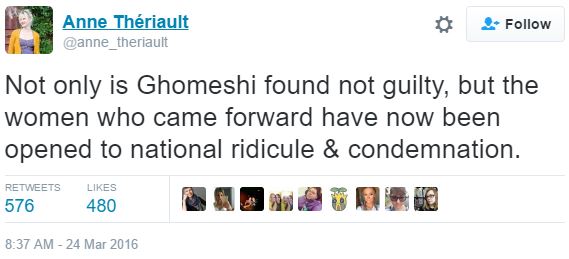
Do you see the futility of this feminist Us-vs.-Them worldview, where all men are oppressors and all women are victims? The judge in the Ghomeshi case did not find the testimony of the accusers credible and, in fact, his ruling pointed out that Ghomeshi’s accusers were caught telling lies. The judge warned against the “dangerous false assumption that sexual assault complainants are always truthful.” This prompted Anne Thériault to declare her continued belief in Ghomeshi’s guilt, blaming the discrepancies in his accusers’ memories on “trauma.” All women tell the truth all the time, according to Anne Thériault and all men are rape suspects whose guilt is certain as soon as an accusation is made. The only way a man can avoid suspicion is to avoid women altogether. A man should never go anywhere he might accidentally encounter a woman, and he must make sure he can prove his alibi, otherwise Anne Thériault would have him sent to prison, were it in her power to do so.
This is scarcely an exaggeration of the opinion Anne Thériault expressed in a column earlier this month about the Brock Turner case at Stanford:
Rape culture is the idea that sexual assault does not happen in a vacuum, but rather occurs because we are socialized in a way that normalizes and even celebrates sexual victimization of women. . . .
Everyone can agree that rape is objectively wrong, but problems crop up when we try to parse exactly what rape is and under what circumstances it occurs. . . .
Most rapists are men we know and like: our neighbors and our colleagues and sometimes even our friends. . . .
Men we think of as nice guys.
Men who look just like everybody else.
What the absolute hell is she talking about? Everybody knows and likes rapists? Read the whole column and you discover that what Anne Thériault is doing here is trying to create a definition of the “sexual victimization of women” so elastic as to include nearly every hookup involving people who have been drinking. By Anne Thériault’s standards, just about every hookup that happens after a college frat party could be construed as rape. The Brock Turner case was egregious, but in reading Anne Thériault’s commentary on the case, you realize that this is not about Brock Turner, in the same way her commentary about Jian Ghomeshi wasn’t really about Jian Ghomeshi. No, Anne Thériault has a generalized resentment toward men, and these cases give her an excuse to point the accusing finger: “You’re all guilty! Neighbors! Colleagues! Friends! Nice guys! Guilty! Guilty! Guilty!”
By constantly reiterating this universal male guilt, Anne Thériault seeks to convince her readers of her own moral superiority. She is Saint Anne of the Sacred Gender, and the rest of us — especially the male “us” — are all wretched sinners, unfit to touch the hem of her garment.
This self-righteousness, and this infinite hostility toward men, are both part of a revenge fantasy that is sadly common among feminists. The main problem with the world, from the feminist perspective, is that too many women actually like men. All men deserve to be hated, and no man deserves anything except hatred, and Anne Thériault will never be satisfied until all women hate men as much as she does.
Translation: Anne Thériault has sometimes had a few too many drinks and made bad decisions. pic.twitter.com/oogR1r3kUU
— FreeStacy (@Not_RSMcCain) June 18, 2016
Actually, she IS saying all men are rapists, she just doesn't want to admit that she's saying it. pic.twitter.com/DJt3jGe1tb
— FreeStacy (@Not_RSMcCain) June 18, 2016
Canadian feminist: "Most rapists are men we know and like." https://t.co/USwcZ6MtF9
ERGO, avoid men known and liked by Canadian feminists.
— FreeStacy (@Not_RSMcCain) June 17, 2016
In The Mailbox: 06.17.16
Posted on | June 17, 2016 | 1 Comment
— compiled by Wombat-socho
OVER THE TRANSOM
First Street Journal: Democrisy – The Left Wants Us To Do As They Say, Not As They Do
EBL: You Can Be A Sheep, A Sheepdog, Or A Wolf
Twitchy: Last Week Trump Floated Names Of Three VP Candidates. This Week, One Said No
RIPPED FROM THE HEADLINES
American Power: West Hollywood #ShootBack Posters
American Thinker: Why Not Admit The Obvious? The President Won’t Blame Them Because He Agrees With Them
Da Tech Guy: The Ghastly Tom Hagen Math Behind The Democrat Response To Orlando
Don Surber: Trump Should Hold Obama Accountable For Orlando
Jammie Wearing Fools: No Wonder Democrats Are On A Gun Jihad
Joe For America: Democrats Disgrace Themselves During Moment Of Silence For Orlando Victims
JustOneMinute: When You’ve Lost The State Department…
Pamela Geller: Obama Homeland Security Advisor Is Syrian Migrant Who Cheered 9/11
Shark Tank: Federal Judge Dismisses Texas Lawsuit Against Resettlement Of Syrian Refugees
Shot In The Dark: An ISIS Victory On American Soil
The Jawa Report: Sandcrawler PSA – All Of Us Are Targets
The Lonely Conservative: Democrat Senator Laments “Due Process” For American Citizens
The Political Hat: Braid Hair? Go To Jail!
The Quinton Report:
This Ain’t Hell: A Seriously Sissified Shooting Story/Kuntzman Part II
Weasel Zippers: Anonymous Hacks ISIS Twitter – Accounts Made Fabulously Gay With Rainbow Flags, Photos, Gay Porn
Megan McArdle: Britain’s Elites Can’t Ignore The Masses
THE FULL METAL JACKET REACH-AROUND AWARD
HIT THE FREAKING TIP JAR!
Search
Recent Posts
- In The Mailbox: 10.06.26 (Evening Edition)
- In The Mailbox: 10.06.26 (Afternoon Edition)
- Rule 5 Sunday: A Salute to Mrs. Justin Verlander
- FMJRA 2.0: No Grandeur This Week Just Misery
- The Wrong Matthew Ingalls, the Correct ‘Jane Doe’ and the Cornell 7 Case
- In The Mailbox: 10.02.26 (Evening Edition)
- In The Mailbox: 10.02.26 (Afternoon Edition)
- In The Mailbox: 09.30.26
- In The Mailbox: 09.29.26
- In The Mailbox: 09.28.26
RSS reader subscription

MEMEORANDUM
Recent Comments
THE AMAZING GONZO FEED
Major Leagues
Archives
- October 2026 (8)
- September 2026 (38)
- August 2026 (43)
- July 2026 (39)
- June 2026 (40)
- May 2026 (43)
- April 2026 (59)
- March 2026 (44)
- February 2026 (37)
- January 2026 (45)
- December 2025 (42)
- November 2025 (44)
- October 2025 (44)
- September 2025 (47)
- August 2025 (48)
- July 2025 (48)
- June 2025 (47)
- May 2025 (48)
- April 2025 (42)
- March 2025 (48)
- February 2025 (49)
- January 2025 (48)
- December 2024 (42)
- November 2024 (44)
- October 2024 (47)
- September 2024 (43)
- August 2024 (55)
- July 2024 (63)
- June 2024 (59)
- May 2024 (48)
- April 2024 (43)
- March 2024 (55)
- February 2024 (46)
- January 2024 (45)
- December 2023 (53)
- November 2023 (62)
- October 2023 (57)
- September 2023 (56)
- August 2023 (53)
- July 2023 (69)
- June 2023 (67)
- May 2023 (53)
- April 2023 (60)
- March 2023 (73)
- February 2023 (65)
- January 2023 (56)
- December 2022 (60)
- November 2022 (64)
- October 2022 (58)
- September 2022 (68)
- August 2022 (75)
- July 2022 (69)
- June 2022 (73)
- May 2022 (74)
- April 2022 (57)
- March 2022 (79)
- February 2022 (65)
- January 2022 (58)
- December 2021 (62)
- November 2021 (68)
- October 2021 (73)
- September 2021 (63)
- August 2021 (60)
- July 2021 (80)
- June 2021 (64)
- May 2021 (64)
- April 2021 (58)
- March 2021 (73)
- February 2021 (57)
- January 2021 (71)
- December 2020 (77)
- November 2020 (81)
- October 2020 (84)
- September 2020 (94)
- August 2020 (75)
- July 2020 (68)
- June 2020 (83)
- May 2020 (77)
- April 2020 (65)
- March 2020 (85)
- February 2020 (94)
- January 2020 (95)
- December 2019 (88)
- November 2019 (60)
- October 2019 (113)
- September 2019 (91)
- August 2019 (91)
- July 2019 (88)
- June 2019 (80)
- May 2019 (74)
- April 2019 (97)
- March 2019 (100)
- February 2019 (85)
- January 2019 (93)
- December 2018 (90)
- November 2018 (83)
- October 2018 (96)
- September 2018 (79)
- August 2018 (107)
- July 2018 (98)
- June 2018 (86)
- May 2018 (78)
- April 2018 (78)
- March 2018 (97)
- February 2018 (61)
- January 2018 (70)
- December 2017 (62)
- November 2017 (68)
- October 2017 (67)
- September 2017 (70)
- August 2017 (68)
- July 2017 (52)
- June 2017 (60)
- May 2017 (56)
- April 2017 (80)
- March 2017 (80)
- February 2017 (102)
- January 2017 (104)
- December 2016 (65)
- November 2016 (86)
- October 2016 (77)
- September 2016 (81)
- August 2016 (66)
- July 2016 (83)
- June 2016 (81)
- May 2016 (65)
- April 2016 (64)
- March 2016 (81)
- February 2016 (74)
- January 2016 (66)
- December 2015 (64)
- November 2015 (85)
- October 2015 (71)
- September 2015 (80)
- August 2015 (67)
- July 2015 (79)
- June 2015 (69)
- May 2015 (72)
- April 2015 (94)
- March 2015 (122)
- February 2015 (71)
- January 2015 (93)
- December 2014 (99)
- November 2014 (67)
- October 2014 (109)
- September 2014 (87)
- August 2014 (106)
- July 2014 (132)
- June 2014 (154)
- May 2014 (126)
- April 2014 (145)
- March 2014 (144)
- February 2014 (142)
- January 2014 (185)
- December 2013 (192)
- November 2013 (173)
- October 2013 (175)
- September 2013 (181)
- August 2013 (167)
- July 2013 (147)
- June 2013 (135)
- May 2013 (128)
- April 2013 (105)
- March 2013 (162)
- February 2013 (191)
- January 2013 (206)
- December 2012 (190)
- November 2012 (176)
- October 2012 (240)
- September 2012 (206)
- August 2012 (235)
- July 2012 (223)
- June 2012 (161)
- May 2012 (230)
- April 2012 (269)
- March 2012 (282)
- February 2012 (247)
- January 2012 (267)
- December 2011 (285)
- November 2011 (300)
- October 2011 (302)
- September 2011 (297)
- August 2011 (288)
- July 2011 (297)
- June 2011 (245)
- May 2011 (260)
- April 2011 (344)
- March 2011 (293)
- February 2011 (201)
- January 2011 (263)
- December 2010 (265)
- November 2010 (266)
- October 2010 (305)
- September 2010 (280)
- August 2010 (272)
- July 2010 (230)
- June 2010 (244)
- May 2010 (256)
- April 2010 (222)
- March 2010 (271)
- February 2010 (286)
- January 2010 (229)
- December 2009 (21)
- October 2009 (1)
Free Agents
SHAMELESS CAPITALISM
Triple-A Franchises
- All-American Blogger
- American Power
- Anti-Idiotarian Rottweiler
- Athens & Jerusalem
- Barney Quick
- Bartholomew's Notes On Religion
- BatesLine
- Bear Creek Ledger
- Bearsears Patriots
- Blog de KingShamus
- Bride of Rove
- Cold Fury
- Daily Pundit
- Dr. Helen
- I Own The World
- Legal Insurrection
- Moe Lane
- No Runny Eggs
- Obi`s Sister
- Protein Wisdom
- Rhetorican
- Small Dead Animals
- The Conservatory
- The People's Cube
- The Sundries Shack
- VodkaPundit
- Vox Day
- Zilla of the Resistance
Blogroll
- 90 Miles From Tyranny
- A Conservative Shemale
- A Point of View
- Adrienne's Corner
- AmSpec Blog
- Bad Blue
- Blazing Cat Fur
- Calvin Freiburger Online
- Carol's Closet
- Catholic Bandita
- Caught Him With A Corndog
- Cecil Calvert
- Common Cents
- Conservative Hideout
- Conservative Watch News
- Conservatives for America
- Conservatives For Palin
- Crazy For Liberty
- Dad 29
- DC Damsel
- Dr. Flap
- Dyspepsia Generation
- Effing Conservatives
- Election Dissection
- Eric Reasons, IT Genius
- Eye of Polyphemus
- Finding Ponies. . .
- Free Will
- Grandpa John's
- Granite Grok
- GrEaT sAtAn"S gIrLfRiEnD
- Hoosier Access
- John William Perry
- Judicial Watch
- Jumping in Pools
- KURU Lounge
- Laughing Conservative
- Makes My Brain Itch
- Marathon Pundit
- Martin Eisenstadt's Blog
- Media Fade
- Michael Leahy
- Mister Pterodactyl
- Naked Villainy
- Nice Deb
- noot's observatory
- Not One Red Cent
- Okrahead
- Ollieander
- Pileus
- Pinup Girl
- Point of a Gun
- Political Pit Bull
- Reaganite Republican Resistance
- Red Alexandria
- Red State Eclectic
- Red, White & Conservative
- Republican Redefined
- ResCon1
- Ric's Rulez
- Ricochet
- Right of Course
- Robipedia
- Robomonkey
- Ruby Slippers Blog
- Saberpoint
- Scared Monkeys
- Sentry Journal
- SI VIS PACEM
- Skepticrats
- Smash Mouth Politics
- Sooper Mexican
- Taking Hayek Seriously
- Tel-Chai Nation
- Tequila & Javalinas
- The Aged P
- The Classic Liberal
- The Izzy Report
- The Minority Leader
- The NeoSexist
- The Nose on Your Face
- The Republican Mother
- The Right Sphere
- The Saint Angilbert Press
- The Snooper Report
- The Underground Conservative
- Thunder Tales
- Tom McLaughlin
- Tory Anarchist
- TrogloPundit
- Vets On The Watch
- Watcher of Weasels
- Western Experience
- World's Only Rational Man
- WyBlog
- Yankee Phil
- Zingstrom's Blog