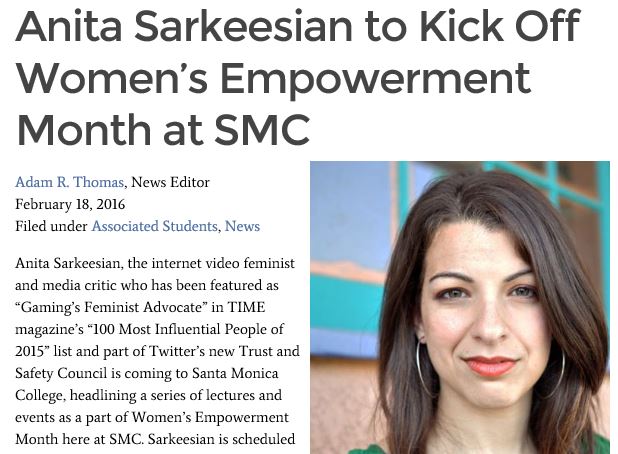
Anita Sarkeesian (@FemFreq on Twitter) is a jargon-spewing pseudo-intellectual who made herself obnoxious by using feminist “gender theory” to critique videogames. This proved to be enormously lucrative for Ms. Sarkeesian, who became a heroine in the eyes of every left-wing ax-grinder who, like her, hates the idea of heterosexual white males enjoying themselves without being constantly lectured about what awful racist, sexist homophobes they are. Sarkeesian’s crooked hustle — “Pay me money to tell you how to abolish misogyny in videogames” — is a shakedown, a corrupt scam with which no honest person would wish to be associated. Sarkeesian’s modus operandi spawned imitators, who congealed into a money-grubbing feminist clown show that was exposed to the light of day in August 2014, #GamerGate.
Sarkeesian and her dimwit followers are incapable of original thought, and as soon as they began getting blowback from their shabby scam, they all began to shriek in unison, “Harassment!” This became the Official Media Narrative of what #GamerGate was about. Supposedly, every supporter of #GamerGate is a vile woman-hater, just harassing women qua women, because patriarchy or something. This claim is bullshit on stilts, but what else do the lazy hacks of the liberal media ever do except repeat whatever bullshit on stilts they are spoonfed by professional ideologues and Democrat Party propagandists?
The supposed “victims” of #GamerGate were a crew of no-talent mediocrities like Zoe Quinn (a tattoo-covered, mentally ill ex-stripper whose real name is Chelsea Van Valkenburg), perverted lunatics like Nicholas “Sarah” Nyberg (alleged to be a pedophile who likes little girls) and latter-day Mussolinis like Randi Harper. Regardless of whatever “harassment” has been directed at these people, it is difficult to ignore the fact that all of them are suffering from psychiatric disorders. Bad causes attract bad people, and are we surprised that this feminist “Girls in Games” racket attracted such a swarm of kooks and weirdos?
For dishonest women like Anita Sarkeesian, feminism is a sort of alchemy by which bullshit is transformed into cash, and she has collected hundreds of thousands of dollars for her “non-profit” activism. How do you suppose such a shrewd opportunist would react to the suggestion that she might have some role in the apparent crackdown on Twitter dissent? Ms. Sarkeesian (a) accused her critics of being paranoid conspiracy theorists, and (b) offered her own paranoid conspiracy theory:
Blog posts have been written, video rants have been filmed, and hundreds of tweets have been posted as this ludicrous conspiracy has spread. According to this conspiracy, any opinions I don’t agree with are being quietly silenced, while the people expressing them are being ominously “shadowbanned.” . . .
Of course there isn’t a shred of truth to this perception, but for the people spreading it, the truth is irrelevant. . . .
This conspiracy and others like it are themselves a manifestation of misogyny, borne out of a deep distrust and hatred of women. They’re designed to foster fear and serve as a warning to other women about what awaits them if they challenge the status quo. . . .
What Ms. Sarkeesian failed to do, of course, was to explain why she is so hated in particular (Answer: Because she lies) or whether the suspension of my account was prompted by a complaint from her or one of her allies.
You see that feminism’s hegemonic cultural authority is the real “status quo” in 2016, and what better “warning” — “designed to foster fear” — than to silence the social-media voices of those who “challenge” the lies told by Anita Sarkeesian. She has never dared to debate any of her critics, and why? Because liars are always cowards, and feminism is always a lecture, never a debate.
Feminist rhetoric is so obviously false, and its logic so circular, that it seems condescending even to point out its errors. What would Ms. Sarkeesian say, for example, if I merely inverted her own accusation, to assert that the ideology to which she owes her entire career is “borne out of a deep distrust and hatred of men”? What if I said that, to feminists like her, “the truth is irrelevant”? How could Ms. Sarkeesian disprove such accusations, if they were directed at her? In fact, this kind of finger-pointing Grand Inquisitor style of rhetoric — Accuse! Accuse! Accuse! — is the sum and essence of feminism. It is all about ginning up anti-male hatred by making tendentious claims about “objectification” or “slut-shaming” or “rape culture” or whatever, and no one is ever permitted to question the authority of the accusers. Why should anyone care what Anita Sarkeesian says about videogames? Where is the “social justice” here, and whither does Ms. Sarkeesian propose to lead us? What real harm is caused by the alleged “misogyny” in videogames of which she complains? What is she doing, other than hustling a dollar?
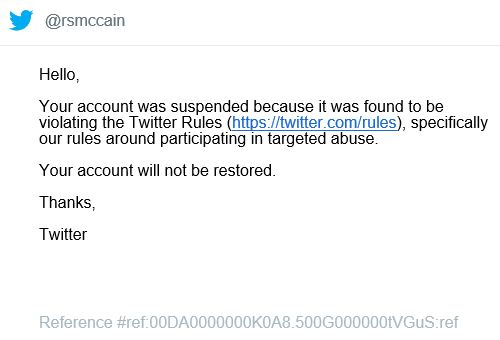
@rsmccain
Hello,
Your account was suspended because it was found to be violating the Twitter Rules (https://twitter.com/rules), specifically our rules around participating in targeted abuse.
Your account will not be restored.
Thanks,
Twitter
Reference #ref:00DA0000000K0A8.500G000000tVGuS:ref
Twitter, Inc. 1355 Market Street, Suite 900 San Francisco, CA 94103
Well, what is “targeted abuse,” what constitutes “participating” in this behavior, and what are the “rules around” it? Where is the evidence that I have been “violating the Twitter Rules”? Who was “targeted”? What was the nature of the “abuse”? Questions like this multiply, you see, if we can be permitted to ask questions of the arbiters of “Twitter Rules,” but that’s just it: No questions allowed!
On Friday, Twitter suspended the account of Robert Stacy McCain, a conservative blogger and dogged critic of feminism, apparently without warning or explanation. This has led, in true Twitter fashion, to protests under the hashtag #FreeStacy.
Only a few weeks earlier, Twitter had announced the creation of a “Trust and Safety Council,” to which it appointed Anita Sarkeesian, a feminist known for denouncing “sexism” in video games, a prominent figure in the Gamergate controversy — and oh yes, a frequent target of criticism from McCain. So it sure looks like the moment Twitter gave Sarkeesian the power to do so, she started blackballing her critics. . . .
[T]he company’s decision to appoint a “Trust and Safety Council” that will be “a new and foundational part of our strategy to ensure that people feel safe expressing themselves on Twitter.” Among a list of organizations described as members of the council are the Dangerous Speech Project, which has produced a set of guidelines for recognizing such “dangerous speech” — a set of criteria so vague and broad that they could encompass anything from the incitement that led the Rwandan genocide to an average afternoon on talk radio. And maybe that’s the point.
Then there is Feminist Frequency, the outlet used by Anita Sarkeesian as a platform to criticize video games for being sexist. Sarkeesian’s critics accuse her of using claims of online harassment to discredit her critics and get them kicked off of services like — you guessed it — Twitter. So when Sarkeesian and the “dangerous speech” types got appointed as Twitter’s speech police, there was reason to think they’re going to turn Twitter into a university-style “safe space” where “safety” is assured by removing advocates of opposing ideas. . . .
It appears more and more that Twitter’s “Trust and Safety Council” should be more properly named “Anita Sarkeesian’s Committee To Ban People Who Say Mean Things About Her.”
I blame the public educationgovernment indoctrination system. Earlier today I got a phone call from a faculty member at a university (which I will not name) who spent 30 minutes telling me the absolute insanity that now prevails on campus. The students are ignorant of facts, but very certain of their opinions, all of which are liberal, and this is a religion for them. For many years, the public K-12 schools have been promoting a progressive agenda through their curriculum and policies, and children are taught to value intellectual abstractions (i.e., “equality,” “diversity,” etc.) to such a degree that they are incapable of thinking outside those categories. They arrive on campus with minds full of this ideological nonsense, and are unprepared to deal with contradictory facts or opposing arguments. Feminists like Anita Sarkeesian are incapable of defending themselves in a fair debate against a well-informed critic, and so the critics must be silenced. This is why the First Rule of Feminist is, “SHUT UP!”
It’s amusing that among the other crimes against “social justice” Stacy might be accused of by Twitter’s Committee of Public Safety is his support of #GamerGate, though in plain fact if he’s concerned with it at all, it’s as just another example of how utterly deranged feminists like Sarkeesian and Quinn are trying to destroy any semblance of fun that boys and men might enjoy. Still, viewed as a whole, you can certainly say that this blog supports both #GamerGate and its older littermate, the Sad Puppies. Which explains why this week’s appetizer is a young lady cosplaying as #GamerGate mascot Vivian James. As usual, be aware that many of the following links are to pics commonly considered NSFW; the management is not responsible for your failure to save, loss of quest items/experience points, character death, social ostracism, pollution of your precious bodily fluids, or any other repercussions arising from your acting like a dumbass and clicking without exercising the necessary discretion.
Thanks to everyone for their linkagery, both here and at the FMJRA, where Rule 5 posts are perennially the most-linked posts at The Other McCain! Links for next week’s Rule 5 roundup should be submitted to the Rule 5 Wombat mailbox no later than midnight on Saturday, February 27.
The actual story of my name is this: My father’s name was William McCain, and my mother’s maiden name was Frances Kirby. My older brother is William Kirby McCain, who was always called by his middle name, Kirby. Our family’s pediatrician in Atlanta was a man named Dr. Stacy Burnett. My mother thought this a fine name, and so I was named Robert Stacy McCain, Robert being a family name on my father’s side, including my Uncle Bobby (who is actually a first cousin, but nearly as old as my father, and therefore my brothers and I were taught to address him respectfully as “Uncle”). Like my older brother, I was called by my middle name. After I started school, I would occasionally encounter the playground taunt, “Stacy is a girl’s name,” and perhaps a Freudian might speculate about psychological overcompensation — becoming in some way hyper-masculine as a defensive reaction to such “issues” — but Freudianism is mostly garbage. Sibling rivalry with my older brother almost certainly explains more of my personality than anything else from my early childhood, but it is amusing when left-wing trolls occasionally mock me as having “a girl’s name,” to which I sometimes reply by mentioning my wife, six children and two grandchildren.
Overcompensation? Maybe, but it works.
Anyway, as I explained in the interview, early in my newspaper career I discovered that unless I used my full name as my byline, I would get phone calls from readers asking to speak to “her.” Although a guy named Stacy could cite other men — including the tough-guy actor Stacey Keach and NFL star Stacey Bailey — in response to playground taunts about having “a girl’s name,” one had to confront the reality of ordinary expectations. So using the byline “R. Stacy McCain” on news articles resulted in people calling the office expecting to speak to a female reporter, requiring me to make an explanation of who I actually am.
Thus the use of Robert Stacy McCain as my byline, which sometimes causes another incorrect assumption, i.e., I’m using my full name as a matter of aristocratic ostentation. Anyway, my eldest son is named Robert Stacy McCain Jr., and he’s just Bob, and if Bob has a son named Robert Stacy McCain III, I’d expect my grandson to be called “Trip” or “Trey.” Maybe 25 or 30 years from now, when Trey McCain sires Robert Stacy McCain IV, the trend in names will have shifted enough that Stacy will be out of fashion as a name for girls, and my great-grandson can be known as Stacy without anyone ever being confused.
However, as I explained to Ethan Ralph, this confusion could sometimes be helpful to the kind of teenage hoodlum I used to be:
Maybe I shouldn’t tell stories like that, but I was a Democrat and a dopehead back then. It was the ’70s, man. Being a teenager in an era when the American people thought it was a good idea to elect Jimmy Carter president is the kind of experience which, if you were lucky enough to have survived it, should permanently cure you of such folly. Polyester pants? Disco? Voting for Democrats? What were we thinking?
Eventually the drugs wore off. Some of us grew up, got married, had kids, paid taxes, and vowed our kids would be spared the helpless gloom of existential despair that Jimmy Carter’s presidency represented. Other people, however, never grew up. They voted for Barack Obama, the narcissistic epitome of political adolescence.
Meanwhile, totalitarian forces seek to silence voices of sanity in this lunatic wilderness of 21st-century “progressive” madness.
It’s about partisan politics, you see. The whole build-up of the Feminist™ brand the past three or four years has been about establishing a cultural narrative that would benefit Hillary Clinton and the Democrats. This is why, as much as I enjoy talking about myself, #FreeStacy is not about me.
The Left will always find excuses and pretexts for smearing or silencing anyone who exposes the lies by which the Left gains power. Democrats could never be elected if the American people knew the truth about who the Democrats are — unless, of course, the perversity of the culture meant that the American people were themselves so corrupted that they would elect a person as dishonest as Hillary Clinton.
Unexpectedly, and without explanation, my @rsmccain Twitter account was suspended Friday evening. Based on past experiences, my guess would be that this resulted from a complaint by one of the leading “social justice warriors” (SJWs) who have been at war with #GamerGate since August 2014. However, there was no reason stated for the suspension, and who knows? So I’ve switched to the @SexTroubleBook account I created to promote my book and meanwhile, friends who are fed up with Twitter’s bias and censorship started the #FreeStacy hashtag. This morning I shared some thoughts with a blogger friend who followed the #GamerGate saga:
As I have said for years: Being notorious is not the same as being famous, but it’s better than being anonymous.
That is to say, I don’t often complain about being hated or misunderstood. It comes with the territory. I started out in the news business as a $4.50-an-hour staff writer for a tiny weekly newspaper in Austell, Georgia. Most people have no idea what I did before I got involved in political journalism as an assistant national editor for The Washington Times in 1997, or even have any idea of the work I did there. The vast majority of people who read my blog or follow my Twitter feed have no knowledge of or interest in my personal “backstory.” It’s not about me. I am not the story. I am the guy telling the story, or I am the guy making jokes about the story. I understand that. But I think some people in the New Media era lose sight of this reality.
Politics is like football. It’s a team sport. Until I was in my mid-30s, I was a very partisan Democrat. Bill Clinton (who I voted for in 1992) cured me of my Democrat loyalty. During the 1990s, I began a rather deep autodidactic study of politics, history, economics, philosophy, etc. My politics are conservative, my economics are Austrian, my faith is Christian. It’s that simple — and certain people HATE me for it. But those people hate everybody who is not a Democrat. Fine. I understand that kind of hate, having once been a Democrat myself, but Democrats think of their personal hatred as “social justice.” And so I understand them better than they understand me.
However, it’s not about me. . . .
Well, he hates me with every fiber of his being, which is OK. It is a free country, and nobody is required to like me, or even to pretend to like me. However, if Hillary is elected president and our nation descends into anarchy and civil war, and from this chaos emerges a military junta in need of a Supreme Leader as figurehead of New America, I’m available for the gig.
Under such a regime, Generalissimo McCain will not only be obeyed, but also respected and, in fact, it will be the duty of his people to admire and praise the Generalissimo.
Is such an outcome . . . likely? Probably not, but you can’t say it is impossible. You are my people, America, and should circumstances require me to rescue our beloved nation — a swift coup d’état, at a time of crisis — then you understand it will be my duty to answer the call. The Enemies of the People will tremble! And the enemies of the Generalissimo are also the Enemies of the People, obviously.
Blog wars? The Generalissimo will be merciful. It would ill behoove the junta to be settling personal grudges and besides, our manpower will be strained to its limits, rounding up Women’s Studies majors and feminist Tumblr bloggers, giving them a few days’ training, loading them onto C-130s and dropping them by parachute into places like Afghanistan, Yemen, Syria, Iraq, etc., as part of our effort to bring about world peace.
"When fascism comes to America, it will be wearing a pantsuit and barking like a chihuahua." pic.twitter.com/eqXBeKgHrV
So last week I promised you a review of Larry Correia’s Son of the Black Sword, the first in a series of epic fantasy novels from the International Lord of Hate. Short version: this novel delivers. Set in a society looking a lot like pre-Raj India, complete with various societal castes and perennial infighting among the powerful families, this is the tale of a master swordsman, a member of the Protectors, who has an extra edge over demons and humans thanks to his ancestor sword, a weapon forged from magical black metal that contains the memories of all its wielders back to its forging. Ashok needs it, because the demons that live in the sea and prey on seaside humans are damned tough to kill, and when the Protectors are sent in to break up a house war, numbers are never in their favor. Ashok’s entire life is upended by his teacher’s deathbed revelation, a revelation that sends him home to find the truth about his origins. This shows every sign of becoming a rich, complex series, possibly even surpassing his Monster Hunters International universe, though at times it reads more like SF than fantasy. Highly recommended, and I’m just sorry it took me so long to get around to it.
Roger Zelazny is best known for his Amber novels and for his Hugo-winning Lord of Light, and I suspect the latter’s quasi-sequel, Creatures of Light and Darkness, suffers from the comparison in a number of ways. Whereas Lord of Light was a tightly-written tale of transhuman “gods” and “goddesses” contending for power in a world settled by colonists from India, Creatures of Light and Darkness relied a lot more on allegory and poetry to drive its plot, and the both the background and the characters suffer from that reliance. Some of the characters are given different names to start the book, because to name them by their true names would wreck the plot before it even got rolling, and while the presence of Anubis and Osiris is understandable, we know little or nothing about how they came to be the powerful figures they are in the universe Zelazny describes, since there’s very little backstory, and much of what there is lacks relevance to the main plot. It’s not a bad read, but one can understand how people who came to know Zelazny through Lord of Light were disappointed. Worth picking up for cheap.
One of the joys of unpacking all my old books is occasionally finding one I haven’t read in decades, and finding out it’s every bit as good as I remember. Such is the case with Henry Garnett’s Blood Red Crescent, a young adult novel about teenage Venetian Guido Callatta, who winds up with a ringside seat to the Battle of Lepanto in this excellent historical novel. I have the original 1960 edition and was very pleased to see that it’s been reprinted and brought out in a Kindle edition. While written for kids the same age as its 15-year-old hero (or slightly younger), the book still gives an honest portrayal of a divided Christendom facing the Islamic threat in the Mediterranean. Several historical figures make appearances, and at times I felt as if I was having flashbacks to G.K. Chesterton’s “Lepanto”. Definitely recommended.
Also recommended: Castalia House’s reissue of There Will Be War Volume III, which among other great stories includes the classic “The Spectre General” by Ted Cogswell, “The Miracle Workers”, by Jack Vance, “Hide And Seek” by Arthur C. Clarke, and “Silent Leges” by Jerry Pournelle, which many of us will recognize as Mark Fuller’s story from Prince of Mercenaries.



 , the first in a series of epic fantasy novels from the International Lord of Hate. Short version: this novel delivers. Set in a society looking a lot like pre-Raj India, complete with various societal castes and perennial infighting among the powerful families, this is the tale of a master swordsman, a member of the Protectors, who has an extra edge over demons and humans thanks to his ancestor sword, a weapon forged from magical black metal that contains the memories of all its wielders back to its forging. Ashok needs it, because the demons that live in the sea and prey on seaside humans are damned tough to kill, and when the Protectors are sent in to break up a house war, numbers are never in their favor. Ashok’s entire life is upended by his teacher’s deathbed revelation, a revelation that sends him home to find the truth about his origins. This shows every sign of becoming a rich, complex series, possibly even surpassing his Monster Hunters International universe, though at times it reads more like SF than fantasy. Highly recommended, and I’m just sorry it took me so long to get around to it.
 , and I suspect the latter’s quasi-sequel,
 , suffers from the comparison in a number of ways. Whereas Lord of Light was a tightly-written tale of transhuman “gods” and “goddesses” contending for power in a world settled by colonists from India, Creatures of Light and Darkness relied a lot more on allegory and poetry to drive its plot, and the both the background and the characters suffer from that reliance. Some of the characters are given different names to start the book, because to name them by their true names would wreck the plot before it even got rolling, and while the presence of Anubis and Osiris is understandable, we know little or nothing about how they came to be the powerful figures they are in the universe Zelazny describes, since there’s very little backstory, and much of what there is lacks relevance to the main plot. It’s not a bad read, but one can understand how people who came to know Zelazny through Lord of Light were disappointed. Worth picking up for cheap.
 , a young adult novel about teenage Venetian Guido Callatta, who winds up with a ringside seat to the Battle of Lepanto in this excellent historical novel. I have the original 1960 edition and was very pleased to see that it’s been reprinted and brought out in a Kindle edition. While written for kids the same age as its 15-year-old hero (or slightly younger), the book still gives an honest portrayal of a divided Christendom facing the Islamic threat in the Mediterranean. Several historical figures make appearances, and at times I felt as if I was having flashbacks to
 , which among other great stories includes the classic “The Spectre General” by Ted Cogswell, “The Miracle Workers”, by Jack Vance, “Hide And Seek” by Arthur C. Clarke, and “Silent Leges” by Jerry Pournelle, which many of us will recognize as Mark Fuller’s story from
 .


