This Should Not Need to Be Said
Posted on | May 15, 2026 | Comments Off on This Should Not Need to Be Said
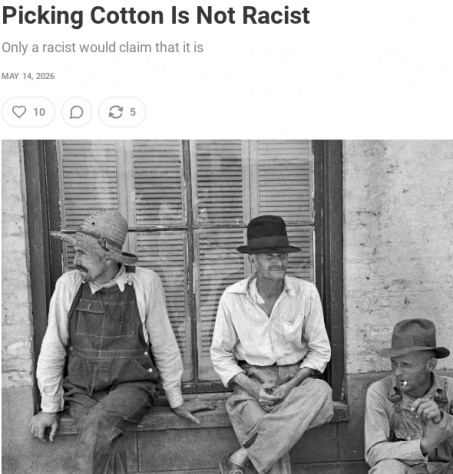
It has been remarked that the demand for racism now exceeds the genuine supply by such a great margin that there is an incentive to manufacture phony racism — thus explaining the frequent hoaxes wherein the alleged victims of oppression claim to be assaulted while, for example, going out to get a Subway sandwich in Chicago.
Such is the latest fake outrage involving a New York Democrat, a Virginia Republican and a Richmond radio talk show host. The New York Times:
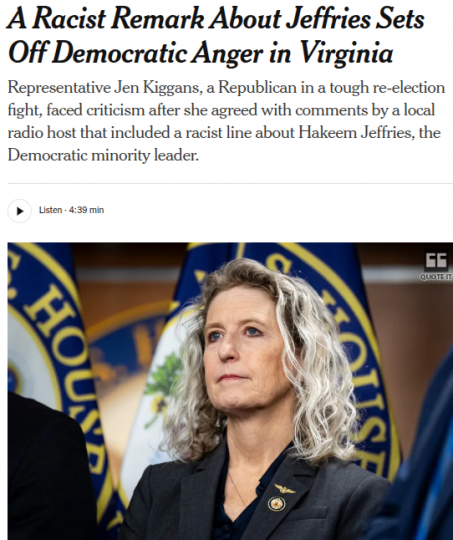
“Racist Remark” — flatly asserted as a fact, as if Kiggans had dropped the N-word, and what, pray tell, was this most grievous insult?
A vulnerable Republican congresswoman in Virginia set off an uproar from Democrats after she agreed with remarks by a local radio host who said that Representative Hakeem Jeffries of New York, the House minority leader and a Black man, should keep his “cotton-picking hands off of Virginia.”
The dust-up surrounding the congresswoman, Representative Jen Kiggans, who is facing one of the country’s toughest re-election battles, is the latest chapter in Virginia’s redistricting saga. Ms. Kiggans was speaking with Rich Herrera, the host of a conservative morning talk show in Richmond, to discuss the fallout from the State Supreme Court’s ruling that invalidated a new congressional map that Virginia voters had approved in an April referendum.
During their conversation, Mr. Herrera lamented a discussion that Mr. Jeffries and Democratic members of the Virginia congressional delegation had on Saturday in which lawmakers discussed the idea of having the entire Virginia Supreme Court replaced in a long-shot effort to restore the voter-approved map.
“If Hakeem Jeffries wants to be involved in Virginia politics, then I suggest he does what a bunch of New Yorkers are doing — leave New York, move down here to Virginia, and run for office down here,” Mr. Herrera said. “If not, get your cotton-picking hands off of Virginia.”
Ms. Kiggans replied: “That’s right. I, ditto. Yes, yes to that.”
After a Democratic opposition research group, American Bridge, circulated a clip on social media of Ms. Kiggans’s response to Mr. Herrera’s remarks, Democrats denounced Ms. Kiggans, with some calling for her to step down from office.
So, Mr. Herrera — who I assume, from his surname, to be of Hispanic ancestry — used a common colloquialism to object to the New York Democrat’s interference in Virginia politics, a sentiment heartily assented to by Rep. Kiggans, a Navy veteran whose district includes Virginia Beach. According to the New York Times, the phrase “cotton-picking” is inherently racist, which is certainly news to me and every other Southerner who ever used it, among them a singer from Memphis:
Samson told Delilah
Loud and clear:
“Keep your cotton-picking fingers
Out my curly hair!”
That song, incidentally, was written by a black man, Claude Demetrius, who became wealthy overnight when “Hard-Headed Woman” hit No. 1 on the charts and was included in the soundtrack of King Creole.
WHITE PEOPLE PICKED COTTON, TOO!
To suggest or imply otherwise is counter-factual. My parents picked cotton in Alabama, as did my aunts and uncles and grandparents. Basically everybody who lived in the rural South prior to World War II picked cotton, and there is zero evidence that, historically, the adjectival phrase “cotton-picking” had any racial connotation.
Now, let me introduce you to Matt Osborne, whom longtime readers may remember as part of the Team Kimberlin crew back in the day (circa 2012) when myself, Aaron Walker, John Hoge and others were engaged in various courtroom entanglements with the pro se pipsqueak pipe bomber. Osborne was a leftist until, at a progressive conference in 2018, he had an unpleasant encounter with fanatical proponents of the transgender agenda. Osborne has since taken a right-hand turn and, at least privately, apologized for his misdeeds on behalf of Team Kimberlin. It is my habit to work in “file-it-and-forget-it” mode. There’s too much craziness in the world for me to commit neural resources to remembering past grievances, and I do not harbor too many grudges (a few cherished grudges will do). So it’s not as if I am in a position to make a grand gesture of magnanimously “forgiving” Matt Osborne; I’m just too busy (or too lazy) to bother Googling the reasons I should still hate him. Your mileage may vary, of course, and if you want to keep hating him, don’t let me stop you. Meanwhile, however, here’s what Matt Osborne wrote about this bogus “cotton-picking” controversy:
According to the Merriam-Webster Dictionary, the term ‘cotton-picking’ has been used as an intensifier since at least 1917. The entry also lists the word as “damned” due to its supposed racial connotations, but this is a modern projection on the past, because slavery had disappeared for two generations. By the time people said ‘cotton-picking’, two-thirds of sharecroppers were white. Old white people in the south still remember their cotton-picking family members.
Spare me your commentary on the Civil War and slavery, please, because sharecropping was a form of economic bondage that applied to blacks and whites in proportion to their share of the southern population for decades after it.
In T.S. Stribling’s The Forge (1931), which is set in north Alabama during and after the Civil War, Miltiades Vaiden and his sister harvest $2,000 worth of cotton themselves because no labor, free or slave, is available. Stribling based his book on a real family; the Scruggs & Vaden cotton gin still exists in Lauderdale County, though it is completely modern.
Despite many patents issued from the 1850s on, no one could produce a practical machine at scale to replace hand-picking of cotton until the 1940s. International Harvester was the first to do this. Even though the first fully-mechanized cotton field was in Clarksdale, Mississippi, the south was slower to adopt mechanized cotton picking than California, which passed the 50% mechanical tipping point in 1951. Hand-picking was not fully replaced in the south until the end of the 1960s.
‘Cotton-picking’ was a thing that poor white people did for almost a century and the phrase was always part of southern life. It was not exclusively or primarily used as a racial epithet, and it never referred to slavery. Rather, the ‘racial undertone’ only exists today in the minds of the recipients who want to hear it as racist.
Such people take umbrage because they wish to feel offended, not because the phrase was ever offensive. No one gets to skip over the parts of history that fail to conform to their priors. This is as true for the postwar sharecropping period as it is for the antebellum south.
So the reader will excuse me if I refuse to join in the tumult of stupidity over Rep. Jen Kiggans of Virginia agreeing with a radio show host that Democratic Rep. Hakim Jeffries should get his “cotton-picking hands off Virginia”. The NAACP is demanding that Kiggans apologize for saying “That’s right. Ditto” in response.
This is yet another fake affront from race-baiting activists. Kiggans was clearly agreeing with the sentiment that Jeffries should leave Virginia alone. Neither she nor Rich Herrera, who is Mexican-American, meant ‘cotton-picking’ as a racist epithet any more than Bugs Bunny did.
Rev. Cozy Bailey, President of the NAACP Virginia State Conference, made it very clear in his statement that politics are the actual purpose of the contrived backlash. Virginia Democrats broke the laws of the commonwealth to pass a redistricting plan that the state supreme court predictably overturned.
Bailey complained that “a large percentage” of the ‘Yes’ voters “are people of color, particularly Black people. And so we are very sensitive in this moment to anything that continues to be oppressive or suppressive to our thoughts.”
Translation: I am being overly-sensitive and feigning oppression because I am actually mad about something else. Literally no one is oppressing or suppressing Bailey’s thoughts, or Jeffries’s thoughts, or anyone else’s thoughts with the phrase ‘cotton-picking’. On the contrary, it is Bailey who wishes to oppress and suppress the spoken thoughts of other people.
Kiggans gave a statement to WDBJ7’s sister station in Richmond, WTVR, agreeing that Herreira “never should have used that language, and of course that’s not the sentiment I was agreeing to.” This was not good enough for Bailey, and we can hope Kiggans will ignore calls for further apologies, because America is exhausted with political actors playing the race card on the flimsiest of pretexts. Cotton is not racist. It is a plant. Picking cotton is not racist. It is agriculture.
Hear! Hear! My only addition to what Matt said is to note that it wasn’t just “sharecroppers” who picked cotton. This involves unfortunate stereotypes surrounding so-called “poor whites” in the South. My ancestors were land owners and respectable people. However, as the old saying had it, they were “land rich, but cash poor.” In the aftermath of the Civil War, and continuing for some 75 years thereafter, poverty was an almost universal condition of the rural South. As my beloved Aunt Pat Huber said, “We didn’t know we were poor — everybody was poor!”
While I could write many paragraphs in defense of the Southern yeomanry, my point is that the stigmatization of self-sufficient farmers, who earned their living by honest labor — including, among other arduous tasks, picking their own cotton — is an insult to people who certainly were not “white trash.” Professor Wayne Flynt’s prize-winning book Poor but Proud: Alabama’s Poor Whites is highly recommended, for anyone who cares to educate themselves on this subject.
To see liberals engage in race-baiting by ignorantly inventing a racist “dog-whistle” connotation for a common phrase makes me angry. It’s so absurd it should not require an answer, and I regret the necessity of having answered at such length. Don’t provoke me again.
Comments
THE FULL METAL JACKET REACH-AROUND AWARD
HIT THE FREAKING TIP JAR!
Search
Recent Posts
- In The Mailbox: 10.09.26
- Rumors Swirl: Where Is James Talarico? UPDATE: Talarico Appears in Public
- In The Mailbox: 10.08.26
- ‘A Reliable Barometer of Wrongness’
- In The Mailbox: 10.07.26
- In The Mailbox: 10.06.26 (Evening Edition)
- In The Mailbox: 10.06.26 (Afternoon Edition)
- Rule 5 Sunday: A Salute to Mrs. Justin Verlander
- FMJRA 2.0: No Grandeur This Week Just Misery
- The Wrong Matthew Ingalls, the Correct ‘Jane Doe’ and the Cornell 7 Case
RSS reader subscription

MEMEORANDUM
Recent Comments
- on Rumors Swirl: Where Is James Talarico? UPDATE: Talarico Appears in Public
- on The Wrong Matthew Ingalls, the Correct ‘Jane Doe’ and the Cornell 7 Case
- on The Wrong Matthew Ingalls, the Correct ‘Jane Doe’ and the Cornell 7 Case
- on The Wrong Matthew Ingalls, the Correct ‘Jane Doe’ and the Cornell 7 Case
- on In The Mailbox: 10.02.26 (Evening Edition)
THE AMAZING GONZO FEED
Major Leagues
Archives
- October 2026 (13)
- September 2026 (38)
- August 2026 (43)
- July 2026 (39)
- June 2026 (40)
- May 2026 (43)
- April 2026 (59)
- March 2026 (44)
- February 2026 (37)
- January 2026 (45)
- December 2025 (42)
- November 2025 (44)
- October 2025 (44)
- September 2025 (47)
- August 2025 (48)
- July 2025 (48)
- June 2025 (47)
- May 2025 (48)
- April 2025 (42)
- March 2025 (48)
- February 2025 (49)
- January 2025 (48)
- December 2024 (42)
- November 2024 (44)
- October 2024 (47)
- September 2024 (43)
- August 2024 (55)
- July 2024 (63)
- June 2024 (59)
- May 2024 (48)
- April 2024 (43)
- March 2024 (55)
- February 2024 (46)
- January 2024 (45)
- December 2023 (53)
- November 2023 (62)
- October 2023 (57)
- September 2023 (56)
- August 2023 (53)
- July 2023 (69)
- June 2023 (67)
- May 2023 (53)
- April 2023 (60)
- March 2023 (73)
- February 2023 (65)
- January 2023 (56)
- December 2022 (60)
- November 2022 (64)
- October 2022 (58)
- September 2022 (68)
- August 2022 (75)
- July 2022 (69)
- June 2022 (73)
- May 2022 (74)
- April 2022 (57)
- March 2022 (79)
- February 2022 (65)
- January 2022 (58)
- December 2021 (62)
- November 2021 (68)
- October 2021 (73)
- September 2021 (63)
- August 2021 (60)
- July 2021 (80)
- June 2021 (64)
- May 2021 (64)
- April 2021 (58)
- March 2021 (73)
- February 2021 (57)
- January 2021 (71)
- December 2020 (77)
- November 2020 (81)
- October 2020 (84)
- September 2020 (94)
- August 2020 (75)
- July 2020 (68)
- June 2020 (83)
- May 2020 (77)
- April 2020 (65)
- March 2020 (85)
- February 2020 (94)
- January 2020 (95)
- December 2019 (88)
- November 2019 (60)
- October 2019 (113)
- September 2019 (91)
- August 2019 (91)
- July 2019 (88)
- June 2019 (80)
- May 2019 (74)
- April 2019 (97)
- March 2019 (100)
- February 2019 (85)
- January 2019 (93)
- December 2018 (90)
- November 2018 (83)
- October 2018 (96)
- September 2018 (79)
- August 2018 (107)
- July 2018 (98)
- June 2018 (86)
- May 2018 (78)
- April 2018 (78)
- March 2018 (97)
- February 2018 (61)
- January 2018 (70)
- December 2017 (62)
- November 2017 (68)
- October 2017 (67)
- September 2017 (70)
- August 2017 (68)
- July 2017 (52)
- June 2017 (60)
- May 2017 (56)
- April 2017 (80)
- March 2017 (80)
- February 2017 (102)
- January 2017 (104)
- December 2016 (65)
- November 2016 (86)
- October 2016 (77)
- September 2016 (81)
- August 2016 (66)
- July 2016 (83)
- June 2016 (81)
- May 2016 (65)
- April 2016 (64)
- March 2016 (81)
- February 2016 (74)
- January 2016 (66)
- December 2015 (64)
- November 2015 (85)
- October 2015 (71)
- September 2015 (80)
- August 2015 (67)
- July 2015 (79)
- June 2015 (69)
- May 2015 (72)
- April 2015 (94)
- March 2015 (122)
- February 2015 (71)
- January 2015 (93)
- December 2014 (99)
- November 2014 (67)
- October 2014 (109)
- September 2014 (87)
- August 2014 (106)
- July 2014 (132)
- June 2014 (154)
- May 2014 (126)
- April 2014 (145)
- March 2014 (144)
- February 2014 (142)
- January 2014 (185)
- December 2013 (192)
- November 2013 (173)
- October 2013 (175)
- September 2013 (181)
- August 2013 (167)
- July 2013 (147)
- June 2013 (135)
- May 2013 (128)
- April 2013 (105)
- March 2013 (162)
- February 2013 (191)
- January 2013 (206)
- December 2012 (190)
- November 2012 (176)
- October 2012 (240)
- September 2012 (206)
- August 2012 (235)
- July 2012 (223)
- June 2012 (161)
- May 2012 (230)
- April 2012 (269)
- March 2012 (282)
- February 2012 (247)
- January 2012 (267)
- December 2011 (285)
- November 2011 (300)
- October 2011 (302)
- September 2011 (297)
- August 2011 (288)
- July 2011 (297)
- June 2011 (245)
- May 2011 (260)
- April 2011 (344)
- March 2011 (293)
- February 2011 (201)
- January 2011 (263)
- December 2010 (265)
- November 2010 (266)
- October 2010 (305)
- September 2010 (280)
- August 2010 (272)
- July 2010 (230)
- June 2010 (244)
- May 2010 (256)
- April 2010 (222)
- March 2010 (271)
- February 2010 (286)
- January 2010 (229)
- December 2009 (21)
- October 2009 (1)
Free Agents
SHAMELESS CAPITALISM
Triple-A Franchises
- All-American Blogger
- American Power
- Anti-Idiotarian Rottweiler
- Athens & Jerusalem
- Barney Quick
- Bartholomew's Notes On Religion
- BatesLine
- Bear Creek Ledger
- Bearsears Patriots
- Blog de KingShamus
- Bride of Rove
- Cold Fury
- Daily Pundit
- Dr. Helen
- I Own The World
- Legal Insurrection
- Moe Lane
- No Runny Eggs
- Obi`s Sister
- Protein Wisdom
- Rhetorican
- Small Dead Animals
- The Conservatory
- The People's Cube
- The Sundries Shack
- VodkaPundit
- Vox Day
- Zilla of the Resistance
Blogroll
- 90 Miles From Tyranny
- A Conservative Shemale
- A Point of View
- Adrienne's Corner
- AmSpec Blog
- Bad Blue
- Blazing Cat Fur
- Calvin Freiburger Online
- Carol's Closet
- Catholic Bandita
- Caught Him With A Corndog
- Cecil Calvert
- Common Cents
- Conservative Hideout
- Conservative Watch News
- Conservatives for America
- Conservatives For Palin
- Crazy For Liberty
- Dad 29
- DC Damsel
- Dr. Flap
- Dyspepsia Generation
- Effing Conservatives
- Election Dissection
- Eric Reasons, IT Genius
- Eye of Polyphemus
- Finding Ponies. . .
- Free Will
- Grandpa John's
- Granite Grok
- GrEaT sAtAn"S gIrLfRiEnD
- Hoosier Access
- John William Perry
- Judicial Watch
- Jumping in Pools
- KURU Lounge
- Laughing Conservative
- Makes My Brain Itch
- Marathon Pundit
- Martin Eisenstadt's Blog
- Media Fade
- Michael Leahy
- Mister Pterodactyl
- Naked Villainy
- Nice Deb
- noot's observatory
- Not One Red Cent
- Okrahead
- Ollieander
- Pileus
- Pinup Girl
- Point of a Gun
- Political Pit Bull
- Reaganite Republican Resistance
- Red Alexandria
- Red State Eclectic
- Red, White & Conservative
- Republican Redefined
- ResCon1
- Ric's Rulez
- Ricochet
- Right of Course
- Robipedia
- Robomonkey
- Ruby Slippers Blog
- Saberpoint
- Scared Monkeys
- Sentry Journal
- SI VIS PACEM
- Skepticrats
- Smash Mouth Politics
- Sooper Mexican
- Taking Hayek Seriously
- Tel-Chai Nation
- Tequila & Javalinas
- The Aged P
- The Classic Liberal
- The Izzy Report
- The Minority Leader
- The NeoSexist
- The Nose on Your Face
- The Republican Mother
- The Right Sphere
- The Saint Angilbert Press
- The Snooper Report
- The Underground Conservative
- Thunder Tales
- Tom McLaughlin
- Tory Anarchist
- TrogloPundit
- Vets On The Watch
- Watcher of Weasels
- Western Experience
- World's Only Rational Man
- WyBlog
- Yankee Phil
- Zingstrom's Blog