Ace Keeps Killin’ It Every Day

Honestly, every other blog is at risk of becoming redundant:

US Companies: You Must Pass Comprehensive
Immigration Reform So We Have the Workers to Fill
the Jobs Whose Former Holders We Laid Off

Once Ace does a headline like that, the story itself is almost an afterthought, and what more can I add, really? People are like, “Stacy, what’s up with the tangents, huh? I mean, WTF, Alex Pareene?”

Today is 9/11 and the first anniversary of the Benghazi attack, and I know I should be blogging about that stuff, but it’s demoralizing even to try, because Ace is always so much better at it:

If it’s true — as it certainly seems to be — that the US had a fairly important arms supply line running from Benghazi and Triopli to Syria (via Qatar, Jordan, and Turkey), it at least suggests the White House should have had more security in the area to protect its people.
The main thing I think this article advances is the Phony Scandal Cover-Up motive. That is, why are the media so determined to label Benghazi a “Phony Scandal”? Apart from their reflexive need to praise their Hero God, I mean.
I have long thought that, behind the scenes, the Administration was telling reporters, sotto voce, “Well, you know we had a major CIA operation going on in Benghazi. And those darned Partisan Republicans just want to expose it, Because They Hate America.”
And then reporters, feeling all Trusted and Respected by their Boyfriend, dutifully run out to say, “Phony Scandal!”

That is in reference to a John Sexton’s Breitbart.com article about the real reasons for all the hush-hush on Benghazi. This is, as I said last month, “The Big Benghazi Secret,” except it isn’t really secret. Plenty of reporters have had the basic story (or part of it) for months.

Anyway, I’m sorry if it seemed like I was ignoring the news, but sometimes the media bias — Our Patiently Brilliant President, isn’t he so special? — is such a Hoover Dam bulwark against truth that I don’t even feel like complaining about it anymore.

What difference, at this point, does it make?

Then I check in over at AOSHQ, and the dude is just killin’ it — knocking it out of the park like A-Rod in roid-rage mode — and I feel ashamed of myself for not at least trying to add something.

OK, so I tried. And now go read AOSHQ, because I do, every day.


Alex Pareene’s ‘Sources,’ Perhaps Named Brett Kimberlin and Neal Rauhauser?

“Especially important is the warning to avoid conversations with the demon. . . . He is a liar. The demon is a liar. He will lie to confuse us. But he will also mix lies with the truth to attack us. The attack is psychological, Damien, and powerful. So don’t listen to him. Remember that — do not listen.”
— The Exorcist (1973)

“As for [Brett Kimberlin], and his claims of libel and character assassination, I seem to recall he was convicted of perjury in federal court before he got out of high school. I seem to remember his other claims seemed to vanish under close scrutiny.”
— Joe Gelarden, October 2010

“[Brett Kimberlin] claimed he was secretly exonerated by the powers that be. A record of this surreptitious pardon is bound to surface any day now, delivered by a leprechaun in a unicorn-pulled stage coach.”
— Matthew Vadum, Sept. 5, 2013

The most important fact about Brett Kimberlin and his associate Neal Rauhauser is that they are liars. Brett Kimberlin’s dishonesty, as a convicted perjurer, is a matter of public record. Neal Rauhauser’s status as the foremost “Weiner Truther” — he named Patrick “Patterico” Frey as the alleged mastermind of the 2011 “hacking” of Anthony Weiner’s Twitter account, which we obviously now know never happened — should be sufficient to establish Neal as fundamentally untrustworthy.

On May 17, 2012, my plan had been to cover the G-8 Summit at Camp David, Maryland, but then I saw Aaron Walker’s account of how he says Brett Kimberlin attempted to “frame” him on a bogus assault charge. While I had never before heard of Brett Kimberlin, the involvement of political social-media consultant Neal Rauhauser in that story suggested a direct connection to the Democrat Party campaign apparatus, so I scrapped my G-8 plans and instead started digging in on the Kimberlin story. Four days later, on Monday, May 21, 2012, Brett Kimberlin contacted my wife’s employer, ranting about how I was “harassing” him and, when they realized that they were dealing with a convicted bomber, this created security concerns that led me to leave Maryland in order to continue reporting the story from “an undisclosed location.”

Even while law enforcement was alerted to the concerns at my wife’s workplace, while my then-13-year-old son was sleeping with a loaded shotgun beside his bed and I was a sort of journalistic fugitive, however, the liars began telling their lies, which I ignored because:

  1. I will not help publicize falsehoods told by liars;
  2. The situation involved innocent third parties who had no role in this conflict, whose privacy and safety I could not jeopardize; and
  3. “Avoid conversations with the demon.”

A few friends and a couple of reporters, whom I could trust to maintain confidentiality, know what happened and why I have not discussed the details. There are witnesses to everything, including witnesses to my little daughter’s tears on the evening of May 21, 2012.

Knowing the truth, and knowing that the truth is known by others, I never paid any further attention to the Kimberlin/Rauhauser lies, except to notice them as a sort of dye-marker of who is listening to the false version of events told by Team Kimberlin. And this morning I noticed Bill Schmalfeldt — who just yesterday was begging to be ignored — Tweeting out rececycled lies including a  link to a July 2012 article by Alex Pareene of Salon that quoted at length the Kimberlin/Rauhauser lies, an article that included this remark:

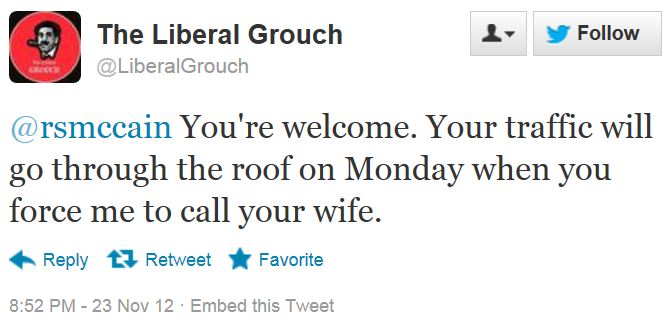
Mr. McCain never responded to my email requesting comment, though he did write a bunch of blog posts about how I’m horrible.

Dude, it was July, by which time I was living in another state and preparing to go back on the road to cover the presidential campaign. And if you had any interest in the truth, Alex, you would never repeat anything that Brett Kimberlin or Neal Rauhauser said about anything, much less the lies they told in an attempt to discredit the guy who put his entire livelihood into telling the truth about them.

Fuck you, Alex Pareene. And fuck you, Bill Schmalfeldt.

Brett Kimberlin is a lying criminal. And this story isn’t over yet.


Deranged Cyberstalker Bill Schmalfeldt: Why Can’t He Explain His Cyberstalking?

Bill Schmalfeldt ranting, 2011. (Image via Thomas Anderson at Vimeo)

Monday, the state’s attorney’s office in Maryland announced that it would not prosecute Bill Schmalfeldt for violating the peace order that prohibits Schmalfeldt from directly contacting John Hoge. And so this afternoon, Schmalfeldt sent this message on Twitter:

Isn’t that rather a specific list of people in whom Schmalfeldt now claims to have lost interest? Need I remind you that this list is in fact the list of defendants in a lawsuit Brett Kimberlin has filed claiming “DEFAMATION, MALICIOUS PROSECUTION, HARASSMENT, STALKING, CONSPIRACY, INVASION OF PRIVACY AND INTENTIONAL INFLICTION OF EMOTIONAL DISTRESS.”

This confirms what Bill Schmalfeldt said last November:

Everything that Bill Schmalfeldt has done to harass Aaron Walker, Lee Stranahan, Ali Akbar, Patrick Frey, Ken White or John Hoge in the past 15 months, he has done on behalf of Brett Kimberlin.

Why is defending Brett Kimberlin so important to Bill Schmalfeldt?

Out of all the causes on the planet that Bill Schmalfeldt might have chosen to support for the past 15 months, why Brett Kimberlin?

Good luck getting Bill Schmalfeldt to provide a rational explanation for why he has made this his life’s work.

Did you notice the similarity of language? In November — at a time when he was relentlessly harassing me — Bill Schmalfeldt declared he would stop “investigating” (which was a term he used to describe his harassment) if everybody would “forget Brett Kimberlin even exists.”

Now that Brett Kimberlin has sued several of the people Schmalfeldt has harassed? Bill Schmalfeldt says he wants us to “forget I exist”!

Quite a convenient coincidence, I’d say.


Barrett Brown and the Thug-Mob Anarchist Threat of ‘Anonymous’

Barrett Brown interviewed by NBC’s Michael Isikoff, 2011

“There are strong reasons for believing that what to us appear the worst features of totalitarian systems are not accidental byproducts but phenomena which totalitarianism is certain to sooner or later produce.
“Just as the choice architect who sets out to plan economic life will soon be confronted with the alternative of either assuming dictatorial powers or abandoning his plans, so the totalitarian dictator would soon have to choose between disregard of ordinary morals and failure.
“It is for this reason that the unscrupulous and uninhibited are likely to be more ‘successful’ in a society tending toward totalitarianism.”

— Friedrich Hayek, The Road to Serfdom (1944)

Last night someone on Twitter sent me a link to a Pastebin file that contained the transcript of an IRC chat that Barrett Brown had with a hacker in March 2011. Brown at that time had been acting as unofficial spokesman for “Anonymous” for about a month. At that time, Brown was angry at Charles Johnson of Little Green Footballs.

Anyone who knows my history with LGF knows how I feel about Charles Johnson. Put it this way: If Charles Johnson went out riding his bicycle on the Pacific Coast Highway and got run over by a semi truck, I’d nominate the truck driver for a Nobel Peace Prize.

OK, so no love lost there, but what this IRC chat transcript revealed was that Barrett Brown was willing to use a hacker (whose knowledge of Johnson and LGF consisted entirely of what Brown told him) to shut down Little Green Footballs — for pure personal spite.

Barrett Brown was a selfish, arrogant famewhore and, after Charles Johnson “parted ways with the right” in late 2009, Brown saw in this a potential opportunity to jump on a bandwagon that would enhance his own gloriousness, and used his blogging access at Vanity Fair to promote a proposed collaboration with Charles Johnson that would eventually become “Project PM.” Eventually, however, Brown’s wretched habits — Barrett is one of the most shameless bullshit artists ever to walk the Earth — made this collaboration impossible. By December 2010, Johnson and Brown had a falling-out, and Barrett recorded a YouTube video describing their abortive partnership:

“Obviously, it was a mutually beneficial working relationship. We had certain shared goals, you know, we said nice things about each other. We had sex on the beach. We wore condoms, though. I’m just kidding — it was barebacking. . . . Charles Johnson is not being very factual. He’s deleting comments. He’s deleting his own comments. It’s really a little much.”

That video was later deleted, but clearly Barrett Brown bore a grudge against Johnson so that, four months later in March 2011, he solicited a hacker to knock Little Green Footballs offline.

Here’s the thing: It took only five minutes for the hacker to accomplish this criminal mischief, merely to satisfy Barrett Brown’s grudge.

There’s no love lost between CJ and me, of course, but the digital vigilante ethos of Anonymous, which enabled Brown basically to put out a “hit” contract on his enemy, is what was wrong with the Anonymous project from Day One. The radical slogan, “By Any Means Necessary” — which recognizes no ethical limits in political combat, but justifies dishonesty and criminality as long as these serve to advance the Glorious Cause — encourages and incites wrongful tactics against anyone identified as an Enemy of the Glorious Cause.

And anyone can become such an Enemy, simply by becoming a nuisance to one of the leaders of the radical mob.

This brings us to the Hayekian insight: Why the Worst Get on Top.

Barrett Brown coveted leadership status with Anonymous for selfish reasons, and one of those reasons was that, if anyone disagreed with or criticized Barrett Brown, he could sic his hacker buddies on them, to shut down their Web sites, to dox them or otherwise harass them, to intimidate them, to smear them.

The Pastebin of the March 2011 IRC chat between Barrett and the hacker whose attack temporarily shut down Little Green Footballs has been deleted (because, I suspect, the person who posted it is friends with the hacker) but what I read there stunned me. This hacker had never heard of Charles Johnson or LGF, and had no knowledge of how or why the yearlong collaboration between Charles and Barrrett had ended badly. All this hacker knew was that Barrett said Charles was a bad person and, within a matter of minutes, the hacker had LGF offline.

Think about that. No matter how much you hate Charles Johnson — and I hate him like God hates sin — this vindictive hacker attack incited by Barrett Brown was entirely unscrupulous. Besides being an all-purpose douchebag, what had Charles Johnson done to deserve that, except to have once befriended Barrett Brown?

Yet who but a douchebag would ever be Barrett’s friend?

Bad causes attract bad people. Julian Assange is a bad person and WikiLeaks is a bad cause, and when members of Anonymous mobilized in support of Assange (and in support of the traitor Bradley Chelsea Manning), it was inevitable that those marching beneath the Anonymous/WikiLeaks banner would include some of the very worst people in the world, e.g., the criminal drug dealer “Sabu,” who rolled over like a punk to save himself from prison.

The radical anarchist is the enemy of all mankind. He may be able to cite a laundry list of grievances against the status quo, but his real grievance is his own childish resentment of authority, his sociopathic craving for a lawless world in which there are no hindrances to the fulfillment of his own depraved and selfish desires. Alienated from society, with no friends except those fellow outcasts who share his resentful attitude, the radical anarchist seeks to destroy, rather than to reform, the institutions of civil society. His impulses are those of a juvenile vandal hurling a stone through the glass window of a department store and claiming that this is a blow against “Corporate America.”

Anyone who thinks they can benefit from association with such radical anarchists must eventually learn a painful lesson.

Because the ethos of anarchism is wholly selfish, the radical who is your “friend” today will sooner or later betray your trust and, because his irresponsible worldview always absolves him of fault, the radical will blame you for whatever went wrong between you. And if the anarchist thug mob sides with your ex-friend in the resulting conflict, you will find the outlaw tactics you once cheered (when they were directed against your enemies) are now turned against you. And because you have, by joining this mob, eschewed the protection of law — anarchists don’t call the cops, eh? — you will find you have no effective way to fight back against your thuggish ex-friends.

Utmost savagery is therefore the only safety within the mob. Obtaining a reputation as a dangerous antagonist — a man not to be crossed, who wreaks total vengeance against his enemies — can only be accomplished by repeated acts of brutality, and such acts therefore become habitual to members of the mob. What was the purpose of the Moscow Show Trials, except to demonstrate Stalin’s ability and willingness to destroy anyone who threatened his power?

This is why I am an opponent of such tactics, and of any individual or movement that encourage such tactics. Being an enemy of radicalism is always less dangerous than being an ally of radicals. If you see someone acting on the principle that the end justifies the means, be assured their vicious means will soon become ends unto themselves.

Perhaps Charles Johnson can write a lengthy explanation of why his friendship with Barrett Brown was such a mistake. And perhaps, in writing such an account, Charles Johnson can persuade some journalists to stop celebrating Barrett Brown as a First Amendment hero.

Charles Johnson might thereby cheat a truck driver out of a Nobel Prize nomination, but this would be a small sacrifice, eh?

P.S.: Jen Emick found a Google cache of that deleted Pastebin showing Barrett inciting a hacker against Little Green Footballs. A certain Twitter account claims that this IRC log is a forgery, but that Twitter account is a Neal Rauhauser fanboy, and so is not to be trusted.


Barrett Brown and ‘Team Themis’

Barrett Brown explains his
‘informational schematic,’ December, 2010

Excuse me for dwelling on Barrett Brown today, but amid a coordinated media push to beatify Saint Barrett of the Blessed Suboxone, it’s important to keep pushing back, even if some readers are getting bored by this celebrity criminal douchebag. Here’s a key section from Alexander Zaitchik’s Rolling Stone profile of Barrett:

The biggest fish flopping in Brown’s net was the story of a cluster of contractors known as Team Themis. The origins of Team Themis dated to Bank of America’s alarm over Julian Assange’s 2010 claim to possess documents that “could take down a bank or two.” The Department of Justice recommended Bank of America retain the services of the white-shoe D.C. law firm Hunton & Williams and the high-­powered intelligence contractor Booz Allen Hamilton. On behalf of Bank of America, Hunton & Williams turned to the large and growing world of InfoSec subcontractors to come up with a plan, settling on HBGary and two data­intelligence shops, Berico Technologies and Palantir Technologies.
The Themis three were also preparing a proposal for Hunton & Williams on behalf of another client, the U.S. Chamber of Commerce. The leaked HBGary documents revealed that Themis was exploring ways of discrediting and disrupting the activities of organized labor and its allies for the Chamber. The potential money at stake in these contracts was considerable. According to Wired, the trio proposed that the Chamber create a $2-million-­a-month sort of cyber special-forces team “of the kind developed and utilized by the Joint Special Operations Command.” They also suggested targeting a range of left-of-center organizations, including the SEIU, watchdog groups like U.S. Chamber Watch, and the Center for American Progress. (The Chamber of Commerce and Bank of America have denied ever hiring Team Themis or having any knowledge of the proposals.)
In pursuit of the Chamber and Bank of America contracts, the Themis three devised multipronged campaigns amounting to a private-sector information-age COINTELPRO, the FBI’s program to infiltrate and undermine “subversive” groups between 1956 and 1971. Among the Themis ideas presented to Hunton & Williams: “Feed the fuel between the feuding groups. Disinformation. Create messages around actions to sabotage or discredit the opposing organization. Submit fake documents and then call out the error.”

This is something I’ve repeated over and over, but let me repeat it once again: NONE OF THIS EVER ACTUALLY HAPPENED.

That is to say, what was revealed by the HBGary hack was a series of e-mails in which Aaron Barr (as part of Team Themis) proposed to engage in various outlandish schemes against the enemies of the Chamber of Commerce, however:

  1. These were merely proposals made in e-mails in an effort by HBGary (in cooperation with Berrico and Palantir) to win a contact through a law firm working for the Chamber of Commerce;
  2. Neither the law firm nor the Chamber of Commerce ever approved a contract with “Team Themis” for this work; and therefore
  3. None of the shenanigans proposed in the e-mails were ever more than “stuff somebody wrote in e-mails.”

Barrett Brown’s obsession with Team Themis was fundamentally misguided. Aaron Barr’s wacky “Super Spy” ideas were never carried out by HBGary, by any of HBGary’s Team Themis partners, or by anyone acting on behest of the U.S. Chamber of Commerce.

Furthermore, the idea that this Team Themis stuff was the subject of important “investigative journalism” by Barrett Brown and his grandiose Project PM group is ridiculous. Go read Nate Anderson’s excellent February 2011 Wired article, “Spy Games: Inside the Convoluted Plot to Bring Down WikiLeaks.”

That’s 4,400 words and Anderson was able to publish that rather exhaustive account within a few days of the HBGary hack. Barrett Brown then spent the next 18 months digging through the HBGary e-mails with his Project PM friends . . . for what?

Where was the big payoff? What did Brown uncover from those e-mails that meaningfully advanced the story beyond what Nate Anderson did in February 2011? To borrow Dorothy Parker’s famous putdown of Oakland, there was no “there” there.

Yet if you examine the transcripts of Barrett Brown’s September 2012 video meltdown — Transcript 1, Transcript 2, Transcript 3 — you find that, in his paranoid state, Brown acted as if Aaron Barr had committed horrible crimes and as if the very existence of Team Themis (an ad hoc collaboration that, in fact, ended in February 2011) justified Brown’s insane plans for revenge:

Then later, you know, more things happened. Among them, on February fifth, an article appeared in the fucking Financial Times, saying that, uh, this Aaron Barr fellow had found the identities of all these Anons, and knew their leader and their co-founder . . .
So we wrote a little funny press release, me and Topiary and a few other people, uh a couple in there I forgot we all kind of collaborated on it; put it out on my DailyKos account and on the AnonOps deals and blah-blah. And then the next day they hacked HBGary . . .
Anyway, so Aaron Barr resigned a month later after what was found, including the Team Themis stuff. Now, HBGary, that term, that got out a lot. What, what didn’t quite  make as much press, but made a few, was that all of these, this conspiracy directed against us, that involved me for some reason even though I was doing nothing even remotely wrong. . . .

Wait just a doggone minute there, Barrett. You can’t just make an off-hand reference to “me and Topiary and a few other people” and not explain that “Topiary” (a/k/a Jake Davis) is a criminal hacker indicted on federal conspiracy charges. You say that you collabored with this criminal hacker in authoring the Feb. 5, 2011, press release published under your name at Daily Kos, mocking Aaron Barr and “then the next day they hacked HBGary.” Gosh, what a coincidence.

Just hanging out in the IRC chats with your buddies, “doing nothing even remotely wrong,” writing press releases about Aaron Barr the day before he got hacked. And then the next day, within an hour of the hacking, you report the news at Daily Kos, subsequently updating with yet another “Anonymous” press release.

Because you were “doing nothing even remotely wrong,” obviously, despite this highly suggestive evidence that you had advance knowledge of their plans and your own admission that you were in communication with the criminal “Topiary” (a/k/a Jake Davis) “and a few other people.” Please, Mr. Brown, tell us more:

HBGary, uh, they got upset, and they went to the FBI . . . now they’re talkin’ to the FBI — we don’t know exactly what was said, and in fact I knew very little about their response and what they were doing until about two months ago, when another hack occurred. . . . It was a hack of a woman named Jennifer Emick. Jennifer Emick is a FBI informant. . . .
I can tell you that at the same time that she was an FBI informant, and in fact paid for supplies, given assignments, actively worked with by an agent named Daniel Borsuk, who’s gonna wish he never — anyway, uh, during that same time, she was being paid, or rather was supposed to be paid, by HBGary for her services. I don’t know if the FBI knew that, but they know it now, because I know it, and they monitor me.

Let us stipulate that Barrett Brown is crazy, and we can’t believe a word he says. With that in mind, what he is saying is that Jennifer Emick was both paid by HBGary and was an informant working with FBI Agent Daniel Borsuk. True or not, the point is that somehow, in Barrett Brown’s mind, the role of Jennifer Emick explains why the FBI served a search warrant on him in March 2012.

Does that make sense, or does it violate Occam’s Razor? Because see, as I’m looking at it, the FBI’s interest in Barrett Brown probably had something to do with his demonstrably close relationship with the criminal “Topiary” (a/k/a Jake Davis) “and a few other people.” But please, do continue with your explanation, Barrett Brown:

[T]here was very little for me to use to show what’s been happening to me, uh, vis-a-vis the Justice Department, um, since early 2011, when I was involved in exposing something that they put together, Team Themis, uh, in which they had some companies go after WikiLeaks and also Glenn Greenwald, the US citizen who’s a journalist who, uh, is the enemy of the state now apparently, um, plus other activist groups on behalf of the Chamber of Commerce and all that, but Holder’s Justice Department did not investigate that, there were no raids. . . .
Every little news circus I create from here on out directs the media and the public to the criminal conspiracy that was never investigated last year involving Team Themis and the Justice Department, Eric Holder’s little fuckin’ Justice Department, already fuckin’ under a cloud, you know, not relative to the Bush administration but still almost as bad, ah, you know, and uh that helps, so I have no choice left but to defend my family, myself, my girlfriend, uh, my reputation, my work, my activism, my ideas, and the revelations that my friends are going to prison so that we can have a chance to get out for other people, so that they would matter. And frankly, you know, it was pretty obvious I was gonna be dead before I was forty or so, so I wouldn’t mind going out with two FBI sidearms and a fuckin’ Egyptian pharoah. Adios.

Right. There was a “criminal conspiracy . . . involving Team Themis and the Justice Department,” rather than, say, a criminal conspiracy involving actual criminals, among them the hacker “Topiary” (a/k/a Jake Davis) “and a few other people.”

What Barrett Brown has done, you see, is to turn reality upside down, so that the HBGary e-mails sent by Aaron Barr were a “criminal conspiracy.” The failure of the Justice Department to prosecute Barr and his Team Themis cohorts for the federal crime of sending e-mails is, according to Barrett Brown, proof that the Justice Department itself was part of this “criminal conspiracy.”

The fact that Team Themis was assembled to attempt to get contracts to protect clients against Anonymous hackers — well, that’s just evil, to Barrett Brown, whose mind can’t seem to grasp the concept that hacking into other people’s computers is actually a crime.

Speaking of crime, perhaps readers didn’t notice when Alexander Zaitchik described how Team Themis “suggested targeting a range of left-of-center organizations, including . . . watchdog groups like U.S. Chamber Watch” — does that name ring a bell?

The reference is to U.S. Chamber Watch, a wholly owned project of Brett Kimberlin’s Velvet Revolution! Of course, at that point, I’d never heard of Brett Kimberlin or Velvet Revolution, but it’s kind of weird how, over the course of several months in 2011 and 2012, these divergent threads came together. In September 2011, Neal Rauhauser e-mailed Barrett Brown’s colleague Gregg Housh to coordinate “Occupy” activism on behalf of Velvet Revolution. And in September 2012, Rauhauser as “Carlito2000” got Barrett Brown agitated about Jennifer Emick.

So while Barrett Brown is being celebrated as a journalistic hero by the New York Times and Rolling Stone, I’m being sued by the convicted bomber Brett Kimberlin for “DEFAMATION, MALICIOUS PROSECUTION, HARASSMENT, STALKING, CONSPIRACY, INVASION OF PRIVACY AND INTENTIONAL INFLICTION OF EMOTIONAL DISTRESS” and yet — checking my e-mail inbox again — no, neither David Carr of the New York Times nor Alexander Zaitchik of Rolling Stone seems to find that story interesting.

Just a coincidence, I’m sure . . .


RECENTLY:



Barrett Brown, Special Snowflake

Barrett Brown promotes atheism on Fox News, January 2009

“Karen Lancaster always believed her only son was special” — that line in Alexander Zaitchik’s Rolling Stone profile of Barrett Brown stands out as explaining how this high-school dropout who started “dabbling” with heroin at age 19 was able to imagine himself as the hero of a psycho-drama in which he would “destroy” an FBI agent to vindicate himself against the conspiracy of which he accused his enemies.

Oh, the Special Snowflake! Couldn’t be bothered to obey the law, because the law isn’t meant to apply to Special Snowflakes:

Brown grew up in the affluent North Dallas neighborhood of Preston Hollow, where, following his parents’ divorce, he lived with his New Age mother. Karen Lancaster always believed her only son was special — he once wrote that she called him “an indigo child with an alien soul.” Among her house rules was that mother and son meditate together daily. She instructed him in the predictions of Nostradamus and made sure he kept a dream journal for the purpose, as Brown described it, “of helping him divine the future by way of my external connection to the collective unconscious.” (For her part, Brown’s mother says she was progressive, but not “New Age”, and that her son’s comments were made in jest.)
A precocious pre-adolescent reader and writer, Brown produced a newspaper on his family’s desktop computer while in elementary school. When he started writing for the student paper at his private high school in the mid-Nineties, he quickly clashed with the paper’s censors over his right to criticize the administration. “Barrett always challenged authority, even as a kid, and anytime you go up against authority, you’re going to get in trouble,” says Brown’s father, Robert. “You could sort of always see this coming.”
By the time he reached high school, Brown had discovered Ayn Rand and declared himself an atheist. He founded an Objectivist Society at school and distinguished himself from other Randians by placing second out of 5,000 entrants in a national Ayn Rand essay contest. (Brown now expresses regret over this.) By all accounts, Brown hated everything about organized education, preferring to follow his own curricula and chat up girls on the bulletin-board systems of a still-embryonic Internet.
After his sophomore year, Brown told his parents he wasn’t going back. He signed up for online courses and spent his junior year in Tanzania with his father, a Maserati-driving conservative, safari hunter and serial entrepreneur who was trying to launch a hardwood-harvesting business. “Barrett loved living in Africa,” says his father. “He preferred adventure to being in school with his peers. We weren’t far from the embassy that was bombed that year.”
Brown returned to the U.S. and in 2000 joined some of his childhood friends in Austin, where he spent two semesters taking writing classes at the University of Texas. After dropping out, he spent a summer doing what one friend calls a “heroic” amount of Ecstasy and acid before settling into the charmed life of a pre-crisis Austin slacker — working part-time, smoking pot and paying cheap rent in a series of group houses with enormous porches. Brown’s roommates remember his rooms as being strewn with leaning towers of books and magazines — he especially liked Gore Vidal, P.J. O’Rourke and Hunter S. Thompson — but say he was not especially political. “After 9/11 and Iraq, there were a lot of protests in Austin,” says Ian Holmes, a childhood friend of Brown’s. “I don’t remember him participating in it or being extra vocal, but he was against it all like everyone else.”
As Brown built up his clip book and matured as a writer, his ambitions began to outgrow Austin. In 2007, Brown moved to Brooklyn with a group of old friends that called itself “the Texadus.” Their Bushwick apartment emerged as a hub for Lone Star State refugees who liked to get high, crush beers and play video games. “People were always hanging out and coming and going,” says Caleb Pritchard, a childhood friend of Brown’s who lived with him in Austin and Brooklyn. Among the apartment’s large cast of characters were a crew of weed-delivery guys from Puerto Rico and Honduras who used the apartment as a daytime base of business operations. “They brought over an Xbox, bought us beer and food and played strategy games with us,” Pritchard says. “It was a good cultural exchange for a bunch of skinny white kids from Dallas.”
As virtual-world games grew increasingly sophisticated, Brown spent more time in front of his computer. But he didn’t play the games like most people. In Second Life, he linked up with a group of people known as “griefers,” the term for hackers who in the mid-00s became known for generating chaos inside video-game worlds. Socializing on the bulletin board 4chan.org, they formed the first cells of what would later become Anonymous. In the documentary We Are Legion, about the hacktivist group, Brown waxes nostalgic over his griefer period, when he’d spend entire nights “on Second Life riding around in a virtual spaceship with the words ‘faggery daggery doo’ written on it, wearing Afros, dropping virtual bombs on little villages while waving giant penises around. That was the most fun time I ever had in my life.”
When everyone else went out to the bars, Brown stayed in. Aside from video games and the odd afternoon of pick-up basketball, he also pounded out columns, diaries and blog posts for Vanity Fair, Daily Kos and McSweeney’s, as well as restaurant reviews and essays for weeklies like New York Press and The Onion’s A.V. Club. Though he had some paying gigs, he published most heavily in unpaid, self-edited community forums like Daily Kos and The Huffington Post. “Barrett wasn’t really working in New York so much as getting by with the help of friends and family,” says Pritchard. Among his unpaid gigs was his work as the spokesman for the Godless Americans PAC, which led to Brown’s first TV appearance, on the Fox News morning show Fox & Friends.
In Brooklyn, Brown resumed shooting heroin, which he’d dabbled in off and on since he was 19. Over the years, doctors have diagnosed him with ADHD and depression. Accurate or not, the diagnoses suggest Brown was drawn to opiates for more than just the high. “When I joined him in Brooklyn in ’08, Barrett was already basically a functional junkie,” says Pritchard.

You can read the whole thing, which is part of the dishonest media campaign to portray Barrett Brown as a helpless victim, but insofar as Alexander Zaitchick tells us who Barrett Brown really is — a child of privilege, a mama’s boy, a Special Snowflake to whom the ordinary rules did not apply — it is certainly helpful in understanding why Barrett Brown is in federal custody, where he belongs.

You should read “The Kook Who Knew Too Much.” Hey, maybe I could have been a Special Snowflake, but I had to get a job.

For some reason, Evil Blogger Lady thinks this scene is relevant:


The Barrett Brown Whitewash Continues

Sept. 12, 2012: Barrett Brown rants about his plan to ‘destroy’ an FBI agent

“In late 2010, thousands of hacktivists joined a mass digital assault on the websites of VISA, MasterCard, and PayPal to protest their treatment of WikiLeaks. Other targets were wide ranging — the websites of corporations from Sony Entertainment and Fox to the Vatican and the Church of Scientology were hacked, defaced, and embarrassed — and the message was that no one was safe.”
— Parmy Olson, We Are Anonymous: Inside the Hacker World of LulzSec, Anonymous, and the Global Cyber Insurgency

“I know what’s legal, because I know what’s been done to me and if it’s legal when it’s done to me it’s going to be legal when it’s done to f–king FBI Agent Robert Smith, who is a criminal, who is involved in a criminal conspiracy. . . . Uh, anyway, so that’s why Robert Smith’s life is over. And when I say his life is over I don’t say I’m gonna go kill him, but I am gonna ruin his life and look into his fuckin’ kids, because Aaron Barr did the same thing, and he didn’t get raided for it. How do ya like them apples?”
— Barrett Brown, Sept. 12, 2012

David Carr of the New York Times lends himself to the dishonest campaign to portray Barrett Brown as a helpless victim:

In December 2011, approximately five million e-mails from Stratfor Global Intelligence, an intelligence contractor, were hacked by Anonymous and posted on WikiLeaks. The files contained revelations about close and perhaps inappropriate ties between government security agencies and private contractors. In a chat room for Project PM, Mr. Brown posted a link to it.
Among the millions of Stratfor files were data containing credit cards and security codes, part of the vast trove of internal company documents. The credit card data was of no interest or use to Mr. Brown, but it was of great interest to the government. In December 2012 he was charged with 12 counts related to identity theft. Over all he faces 17 charges — including three related to the purported threat of the F.B.I. officer and two obstruction of justice counts — that carry a possible sentence of 105 years, and he awaits trial in a jail in Mansfield, Tex.
According to one of the indictments, by linking to the files, Mr. Brown “provided access to data stolen from company Stratfor Global Intelligence to include in excess of 5,000 credit card account numbers, the card holders’ identification information, and the authentication features for the credit cards.” . . .
Journalists from other news organizations link to stolen information frequently. Just last week, The New York Times, The Guardian and ProPublica collaborated on a significant article about the National Security Agency’s effort to defeat encryption technologies. The article was based on, and linked to, documents that were stolen by Edward J. Snowden, a private contractor working for the government who this summer leaked millions of pages of documents to the reporter Glenn Greenwald and The Guardian along with Barton Gellman of The Washington Post.
By trying to criminalize linking, the federal authorities in the Northern District of Texas — Mr. Brown lives in Dallas — are suggesting that to share information online is the same as possessing it or even stealing it. . . .

You can read the whole thing, which includes more context than have some of the pro-Barrett Brown stories circulating on the Left, much of which doesn’t even mentions his threats against FBI Special Agent Robert Smith. So at least David Carr didn’t completely whitewash the case, but he is still presenting a defense brief that, by focusing on the Stratfor-related indictment — which is only one of three sets of indictments in the case — attempts to portray Barrett Brown as just another journalist doing what other journalists do, so as to elicit sympathy for Brown among journalists who (we must certainly hope) do not do anything remotely like what Barrett Brown actually did.

Let’s start with this: What does FBI stand for? Federal Bureau of Investigation. The FBI investigates crimes and, if federal crimes have been committed, citizens are obligated to assist the FBI in its investigations. Barrett Brown was first raided by the FBI in March 2012 as part of their investigation into the so-called “LulzSec” hacking cell, a splinter of Anonymous. From Wikipedia:

A federal indictment against members contends that, prior to forming the hacking collective known as LulzSec, the six members were all part of another collective called Internet Feds, a group in rivalry with Anonymous. Under this name, the group attacked websites belonging to Fine Gael, HBGary, and Fox Broadcasting Company. This includes the alleged incident in which e-mail messages were stolen from HBGary accounts. In May 2011, following the publicity surrounding the HBGary hacks, six members of Internet Feds founded the group LulzSec.

You can go read the entire article and my point is this: LulzSec was a criminal conspiracy, and at least six of its members have been prosecuted for their illegal activities. Barrett Brown deliberately associated himself with this conspiracy and, as part of their investigation of LulzSec, the FBI obtained a search warrant to seize Barrett Brown’s computer equipment, although he was neither arrested nor charged with any crime at the time of the March 2012 raid.

The Federal Bureau of Investigation was . . . investigating.

That’s their job. That’s what they do.

Rather than to cooperate with this investigation, however, Barrett Brown attempted to obstruct it, to hide the computers for which the FBI had obtained warrants. Barrett’s mother has, in fact, already pleaded guilty to having helped him in that effort.

Has the FBI told us everything they found on Barrett Brown’s computers? I don’t know, nor are they obligated to do so. Perhaps those computers yielded information relevant to ongoing investigations. Whether or not Brown illegally “provided access” to stolen data from Stratfor, and whether he should be sent to prison for doing so, is for a federal jury to decide — but Barrett Brown and his lawyers evidently don’t want to take their case to a jury.

His lawyers have twice postponed Brown’s trial, while self-evidently attempting to use media accounts to pressure prosecutors either to drop the charges or to offer a more lenient plea bargain. And the journalists who are assisting them in this propaganda campaign are, from my perspective, unindicted co-conspirators in Barrett Brown’s scheme to elude justice for his criminal activities.

Glory days: Barrett Brown interviewed by Michael Isikoff, 2011

“A self-described anarchist, [Barrett] Brown claims he’s policing wrongdoing, at least as Anonymous describes it. . . .
“[Brown said:] ‘When we break laws, we do so in service of civil disobedience.'”

— NBC Nightly News, March 8, 2011

Once again, I ask any sane law-abiding person to examine the three YouTube video rants that led to Barrett Brown’s September 2012 arrest:

  1. Meltdown Video 1 — 15:03 (transcript)
  2. Meltdown Video 2 — 15:03 (transcript)
  3. Meltdown Video 3 — 13:30 (transcript)

If you examine that and dismiss it as the demented ravings of a lunatic, OK, but a judge ruled that Barrett Brown is at least sane enough to stand trial, and Brown’s lawyers have not yet suggested they are contemplating an insanity defense. But the fact that Barrett Brown was ranting like a madman does not mean that we cannot discern a worldview in his incoherent obscene gibberish:

The other part of what’s absurd about this is it’s fucking insane, and because of it, and because of what I found out about how this came about, how this came to be that my fucking mom is now being threatened by a fucking US D.A. and a fucking chickenshit little faggot cocksucker, ah, little FBI agent, little Robert Smith that we’re investigating now. Uh, I’ve, you know, got to find out, thanks to a hack — thanks to another fuckin’ stroke of luck, thank god — that HBGary since mid-Febuary had hired an FBI informant who was already an FBI informant, already had been bitching to the FBI about this other nonsense about Gregg Housh for fuckin’ years. A paid IB, uh, FBI informant, who the FBI pur–purchased supplies for or paid, you know, gave some money to buy supplies cause she was so helpful to them in making shit up and thinking up reasons to raid Barrett Brown and get his information that they wanted for other reasons. Uh, that she was in the employ of fucking HBGary, and working straight with Greg Hoglund, the fucking CEO who’s already been caught, already been caught last year, by my fucking friends, some of whom are, you know, friends and, and acquaintances. [laughs] Really… Well-wishers, they sort of, contemporary, by my contemporaries who I don’t really like that much. Uh, when they hacked into their server, already fucking caught the fucking guys in another fucking conspiracy, including one that involves setting up on fraud charges fucking activists, who had done nothing to anyone except criticize the Chamber of Commerce.

It was a “conspiracy,” you see. In this conspiracy, according to Barrett Brown, the FBI was in league with HBGary and an FBI informant was “making up shit” to justify the FBI’s raid of Barrett Brown.

Hackers are good people, says Barrett Brown.

FBI informants are bad people, says Barrett Brown.

So when hackers illegally obtain information by hacking HBGary’s accounts, and an FBI informant assists federal agents investigating that crime, such assistance is wrong, says Barrett Brown.

Barrett Brown’s anti-social attitude — the typical outlaw mentality of the criminal who rationalizes his wrongdoing by asserting that the laws are unjust and that therefore law enforcement is engaged in victimizing the innocent — is not in itself a crime. But it may be a motive for crime, and once you understand Barrett Brown’s criminal worldview, you understand why he was ranting as if he were a victim:

I know what’s legal, because I know what’s been done to me and if it’s legal when it’s done to me it’s going to be legal when it’s done to fuckin’ FBI Agent Robert Smith, who is a criminal, who is involved in a criminal conspiracy that has thank god been revealed, part of which was evident, uh, months and months ago because I told the fucking FBI Agent Daniel Borsuk, who gave me a fake name when his fucking little Jennifer Emick fuckin’ informant, HBGary employees, was bragging about this shit and gave me the number, I guess he wanted to talk to me and see what I’d say.

Get it? The crime against HBGary was not a crime, in Barrett Brown’s mind. Therefore the investigation of that crime was an injustice, anyone who assisted either HBGary or the FBI in that investigation was “a criminal . . . involved in a criminal conspiracy” and, in his depraved mind, Barrett Brown had appointed himself the judge, jury and executioner who was going to bring these criminals to justice.

Quod erat demonstrandum.

This sociopathic inversion of reality, where criminals are heroes and agents of law enforcement are villains, is the outlaw mob mentality by which Anonymous hackers justified their illegal activities.

The fact that several of those hackers are now in federal prison apparently has not sufficed to convince some people that this criminal worldview is dangerous. David Carr of the New York Times should be ashamed of himself for endorsing it.

UPDATE: “Barrett Brown, Special Snowflake.”


RECENTLY:


Hey, Has Anybody in Virginia Noticed That Terry McAuliffe Is a Lying Scumbag?

Well, he’s a Democrat, and I would have called Terry McAuliffe a “lying scumbag Democrat,” but that would be kinda redundant. Anyway, the latest polls show the lying scumbag is actually leading the race for governor of Virginia, and maybe everybody’s too distracted by the lying scumbag Democrat in the White House — “Red line? What red line?” — to pay attention to Terry McAuliffe’s scummy lies:

Never believe anything a Democrat tells you:

The tagline of that ad — “You can’t trust Terry McAuliffe” — has become a campaign theme for Republicans, repeated in speeches by Cuccinelli as well as his surrogates. Stumping for Cuccinelli in southwest Virginia, where Democrat-backed environmental regulations are a major threat to the coal industry, Del. Israel O’Quinn (R-Bristol) said Tuesday, “Terry McAuliffe cannot be trusted. He said four years ago he didn’t want another coal plant built in Virginia so I’ll take him at his word.”

Read the rest at Gateway Pundit, where I am honored by the request to help fill in while Jim Hoft is in the hospital. Get well soon, Jim.