Everybody Ready for Armageddon?

Perhaps “nations which are in the four quarters of the earth, Gog and Magog,” shall soon be gathered for this battle:

U.S. fighter jets launched airstrikes early Friday on two locations in eastern Syria linked to Iran’s Revolutionary Guard Corps, the Pentagon said, in retaliation for a slew of drone and missile attacks against U.S. bases and personnel in the region that began early last week.
The U.S. strikes reflect the Biden administration’s determination to maintain a delicate balance. The U.S. wants to hit Iranian-backed groups suspected of targeting the U.S. as strongly as possible to deter future aggression, possibly fueled by Israel’s war against Hamas, while also working to avoid inflaming the region and provoking a wider conflict.
According to a senior U.S. military official, the precision strikes were carried out near Boukamal by two F-16 fighter jets, and they struck weapons and ammunition storage areas that were connected to the IRGC. The official said there had been Iranian-aligned militia and IRGC personnel on the base and no civilians, but the U.S. does not have any information yet on casualties or an assessment of damage. The official would not say how many munitions were launched by the F-16s.
A senior defense official said the sites were chosen because the IRGC stores the types of munitions there that were used in the strikes against U.S. bases and troops. The two officials briefed reporters after the strikes on condition of anonymity to provide details on the mission that had not yet been made public.
According to the Pentagon, there have now been at least 19 attacks on U.S. bases and personnel in Iraq and Syria since Oct. 17, including three new ones Thursday. Air Force Brig. Gen. Pat Ryder said 21 U.S. personnel were injured in two of those assaults that used drones to target al-Asad Airbase in Iraq and al-Tanf Garrison in Syria.
In a statement, Defense Secretary Lloyd Austin said the “precision self-defense strikes are a response to a series of ongoing and mostly unsuccessful attacks against U.S. personnel in Iraq and Syria by Iranian-backed militia groups that began on October 17.”
He said President Joe Biden directed the narrowly tailored strikes “to make clear that the United States will not tolerate such attacks and will defend itself, its personnel, and its interests.” And he added that the operation was separate and distinct from Israel’s war against Hamas.

Not saying this is the beginning of World War III. However, I’m also not saying it’s not the beginning of World War III.


Al-Baghdadi ‘Died Like a Coward’

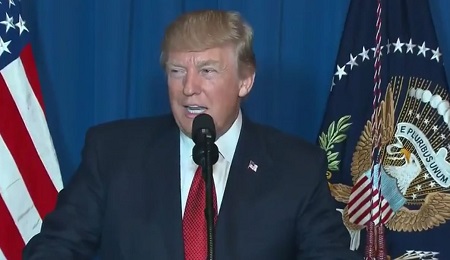
Trump’s announcement this morning about the death of the ISIS leader:

Last night, the United States brought the world’s number one terrorist leader to justice. Abu Bakr al-Baghdadi is dead. He was the founder and leader of ISIS, the most ruthless and violent terror organization in the World. The United States has been searching for Baghdadi for many years. Capturing or killing Baghdadi has been the top national security priority of my Administration. U.S. Special Operations forces executed a dangerous and daring nighttime raid into Northwestern Syria to accomplish this mission.
No U.S. personnel were lost in the operation, while a large number of Baghdadi’s fighters and companions were killed with him. He died after running into a dead-end tunnel, whimpering and crying and screaming. The compound had been cleared by this time, with people either surrendering or being shot and killed. Eleven young children were moved out of the house un-injured. The only ones remaining were Baghdadi in the tunnel, who had dragged three children with him to certain death. He reached the end of the tunnel, as our dogs chased him down. He ignited his vest, killing himself and the three children. His body was mutilated by the blast, but test results gave certain and positive identification.
The thug who tried so hard to intimidate others spent his last moments in utter fear, panic and dread — terrified of the American Forces bearing down.
We were in the compound for approximately 2 hours, and after the mission was accomplished we took highly sensitive material and information from the raid.
Baghdadi’s demise demonstrates America’s relentless pursuit of terrorist leaders, and our commitment to the enduring and total defeat of ISIS!
The reach of America is long. As you know, last month we announced that we recently killed Hamza Bin Laden, the very violent son of Osama Bin Laden, who was saying very bad things.
He was the heir apparent to Al Qaeda. Terrorists who oppress and murder innocent people should never sleep soundly, knowing that we will completely destroy them. These savage monsters will not escape their fate — and they will not escape the final judgement of God.
Baghdadi has been on the run for many years, long before I took office. At my direction, as Commander-in-Chief, the United States obliterated his ‘caliphate’ in March of this year. Today’s events are another reminder that we will continue to pursue the remaining ISIS terrorists to their brutal end.
Baghdadi and the losers who worked with him — in some cases people who had no idea what they were getting into and how dangerous and unglamorous it was — killed many people. Their murder of innocent Americans Jim Foley, Steven Sotloff, Peter Kassig, and Kayla Mueller were especially heinous. The shocking publicized murder of a Jordanian pilot who was burned alive in a cage for all to see, and the execution of Christians in Libya and Egypt, as well as the genocidal mass murder of Yazidis, rank ISIS among the most depraved organizations in history.
The forced religious conversions, the orange suits prior to many beheadings, all of which were openly displayed for the world — this was all Abu Bakr al-Baghdadi’s work. He was vicious and violent, and he died in a vicious and violent way, as a coward, running and crying. This raid was impeccable, and could only have taken place with the acknowledgement and help of certain other nations and people.
I want to thank the nations of Russia, Turkey, Syria and Iraq, and I also want to thank the Syrian Kurds for certain support they were able to give us. Thank you as well to the great intelligence professionals who helped make this very successful journey possible.
I want to thank the soldiers, sailors, airmen, and marines involved in last night’s operation. You are the very best there is anywhere in the world. I want to thank General Mark Milley and our Joint Chiefs of Staff, and I also want to thank our professionals who work in other agencies of the United States government and were critical to the mission’s success.
Last night was a great night for the United States and for the World. A brutal killer, one who has caused so much hardship and death, was violently eliminated — he will never again harm another innocent man, woman or child. He died like a dog. He died like a coward. The world is now a much safer place.
God bless the United States of America!


Let’s be clear about something: ISIS became a powerful terrorist group as a direct result of Obama administration policy — first, there was the announced-in-advance withdrawal of U.S. troops from Iraq, and then there was the 2011 “Arab Spring.” This allowed al-Baghdadi’s group, which had been on the fringe of the anti-U.S. insurgency in Iraq, to find new opportunities in Syria, where Obama’s policy had incited a civil war as part of a CIA-backed project of overthrowing the Assad regime.

When we speak of the “Deep State” conspiracy against Trump within the U.S. intelligence community, we are talking about the people who advocated, endorsed and implemented these Obama-era policies. ISIS was running hog-wild in Syria when Trump was elected and now, less than three years later, the leader of ISIS has been killed.

We could get into the deeper roots of U.S. policy failures in the Middle East over the past 30 years, an analysis which would implicate both Bush administrations as well as Obama and Clinton. It was a bipartisan failure over many years that produced the dangerous chaos that Trump inherited, and the bureaucratic elites of the “Deep State” were horrified that this amateur outsider would be able to undo the policies they had implemented. And yet, despite every effort to sabotage his administration, Trump continues to gain victory after victory.

It is too soon to say whether Trump’s overall foreign policy will be judged by history as better than his predecessors, but it would be quite difficult for him to do worse than Obama did.

UPDATE: Well, this is new low in “fake news” — a Washington Post headline describes al-Baghdadi as an “austere religious scholar,” as if U.S. Special Forces had killed a mild-mannered cleric.


Report: U.S. Special Operations Raid Kills ISIS Leader Abu Bakr al-Baghdadi


The identification is still tentative:

A “high value ISIS target” believed to be Abu Bakr al-Baghdadi has been killed by U.S.-led forces in Idlib, Syria, a well-placed military source told Fox News on Saturday night.
The U.S. military cannot yet confirm the identity of the deceased target.
But at 9:23 p.m. Saturday, President Trump posted a Twitter message hinting at “very big” news.
Soon after, the White House issued a statement that major news would be announced from the White House at 9 a.m. Sunday.
Newsweek reported late Saturday that Baghdadi was killed during a special operations mission that President Trump approved about a week ago.
In September, an audio recording purportedly by Baghdadi included a call for members of the extremist group to use any means necessary to free Muslims who were being detained “by Crusaders and their Shiite followers.”
The U.S. had reportedly posted a bounty of $25 million for information leading to the capture of Baghdadi.

We got our money’s worth, apparently.


U.S. Strikes Syria

Mess with the bull, you get the horns:

President Donald Trump announced Friday night that he ordered the U.S. military to conduct precision missile strikes in conjunction with French and British allies against the Syrian government.
The order marked a dramatic reversal for Trump, who, as recently as last week, had been saying that he wanted the U.S. to withdraw its forces from Syria.
During Friday’s speech, Trump noted that the strike was underway and did not give further details of the targets or the military assets used.
Trump used the address to also directly call out Russia and Iran, which back the regime of Syrian President Bashar Assad.
“To Iran and to Russia, I ask: What kind of a nation wants to be associated with the mass murder of innocent men, women and children?” Trump said. “Hopefully someday we will get along with Russia, and maybe even Iran. But maybe not.”
Reuters and the Associated Press reported that several explosions have already occurred in the Syrian capital of Damascus. Reuters, citing sources, added that a scientific research facility was hit.
“This is not about intervening in a civil war. It is not about regime change. It is about a limited and targeted strike that does not further escalate tensions in the region and that does everything possible to prevent civilian casualties,” British Prime Minister Theresa May said in a statement.
“And while this action is specifically about deterring the Syrian Regime, it will also send a clear signal to anyone else who believes they can use chemical weapons with impunity,” May added.

I spent all day working on an article about something else, took a break and went to dinner with my brother and, on the way back, he got a text message from a friend: “It’s raining cruise missiles in Syria.” Everything else becomes trivial when war happens. The question of what Russia and Iran will do — is this Armageddon, or not? — looms large, and you know I’ve got a son on the point of the spear, if worse comes to worse.

Friday the 13th — an inauspicious day to start World War III.

UPDATE: A bit from CNN:

Details are usually sketchy when military action is underway and “live” news reports are often wrong. Let’s be patient and wait for facts.

UPDATE II: Trump asks for prayers:

My mother-in-law is a praying woman, and prays for him every night.

UPDATE III: “Mad Dog” Mattis just ended a briefing:

So, this attack was “precise,” targeting Syria’s chemical weapons capacities, and now we’ll wait and see what the reaction is.

UPDATE IV: A bit more from Mattis:

Ed Morrissey at Hot Air has a good round-up of the news.


Don’t Mess With the USA

There are about 2,000 U.S. troops in eastern Syria controlling key oil fields in territory formerly held by ISIS. Having destroyed that Islamic terrorist organization, our troops have little to fear from Syria, or from Iran, or from Syria’s Russian allies:

A small US presence in an eastern town called Deir Ezzor has maintained an iron grip on the oil fields and even repelled an advance of hundreds of pro-Syrian government forces— including some Russian nationals believed to be mercenaries — in a massive battle that became a lopsided win for the US.
Russia has advanced weapons systems in Syria, pro-Syrian government militias have capable Russian equipment, and Iran has about 70,000 troops in the country. On paper, these forces could defeat or oust the US and the Syrian rebels it backs, but in reality it would likely be a losing battle, according to an expert.
“They have the ability to hurt US soldiers — it’s possible,” Tony Badran, a Syria expert at the Foundation for Defense of Democracies, told Business Insider. But “if they do that,” he said, “they’ll absolutely be destroyed.”
In Badran’s view, even if Russia wanted a direct fight against the US military in Syria, something he and other experts seriously doubt, the forces aligned with Syria’s government don’t stand much of a chance.
“I think the cruise-missile attack in April showed, and the ongoing Israeli incursions show, the Russian position and their systems are quite vulnerable,” said Badran, referring to the US’s April 2017 strike on a Syrian airfield in response to a chemical-weapons attack in the country. Though Russia has stationed high-end air defenses in Syria to protect its assets, that did not stop the US when President Donald Trump’s administration decided to punish the Syrian air force with 59 cruise missiles.
Russia has just a few dozen jets in Syria, mostly suited for ground-attack roles with some air-supremacy fighters. The US has several large bases in the area from which it can launch a variety of strike and fighter aircraft, including the world’s greatest fighter jet, the F-22.

Hat-tip: Nebraska Energy Observer, which has previously noted how some Russian mercenaries in Syria were devastated after they attacked a group of anti-Assad rebels supported by by U.S. troops. Compare the current situation to what we confronted in Iraq circa 2005-2008.

In Iraq, an insurgency used terrorist tactics — including car bombs and IEDs — against the occupying U.S.-led coalition forces. In Syria, U.S. forces are on the side of the insurgents (rebels fighting Assad’s regime) and the local Syrians, who have survived the brutality of ISIS, want no part of any kind of Islamic extremism. While the situation could conceivably change, a rather small force of U.S. troops is currently able to control a key region in Syria simply because anyone who attacked them would suffer a devastating counter-attack backed by everything the U.S. military can bring to bear, up to and including bombing raids by B-52s.

UPDATE: One of our NATO “allies” can’t take a hint:

The Pentagon Monday leveled sharp criticism at a military offensive on northern Syria, which has displaced tens of thousands of Kurds, killed hundreds of civilians and is creating a humanitarian crisis, all while carefully not mentioning the country carrying out the offensive, Turkey.
“Civilian casualties, not getting humanitarian assistance, a growing humanitarian crisis. It’s gotta be stopped. It’s gotta be averted,” Col. Rob Manning, a Pentagon spokesman, told reporters.
Pressed by a reporter from the Turkish Anadolu News Service about who specifically was to blame for the worsening situation in the North, Manning refused to name Turkey, a NATO ally, and simply called on all sides to stop. . . .
The US has complained to Turkey that its two-months-old offensive, which captured the city of Afrin over the weekend, is siphoning off Kurdish fighters from the fight against ISIS in the east to battle Turkish and Syrian rebel troops in the west.

On the one hand, we would like to remain on friendly terms with Turkey. On the other hand, there are limits to such friendship.


THE BIG STICK: Trump’s Missile Attack on Syria Is the New ‘Smart Power’


President Trump’s statement Thursday night at the White House:

My fellow Americans: On Tuesday, Syrian dictator Bashar al-Assad launched a horrible chemical weapons attack on innocent civilians. Using a deadly nerve agent, Assad choked out the lives of helpless men, women, and children. It was a slow and brutal death for so many. Even beautiful babies were cruelly murdered in this very barbaric attack. No child of God should ever suffer such horror.
Tonight, I ordered a targeted military strike on the airfield in Syria from where the chemical attack was launched. It is in this vital national security interest of the United States to prevent and deter the spread and use of deadly chemical weapons. There can be no dispute that Syria used banned chemical weapons, violated its obligations under the Chemical Weapons Convention, and ignored the urging of the U.N. Security Council.
Years of previous attempts at changing Assad’s behavior have all failed, and failed very dramatically. As a result, the refugee crisis continues to deepen and the region continues to destabilize, threatening the United States and its allies.
Tonight, I call on all civilized nations to join us in seeking to end the slaughter and bloodshed in Syria, and also to end terrorism of all kinds and all types. We ask for God’s wisdom as we face the challenge of our very troubled world. We pray for the lives of the wounded and for the souls of those who have passed. And we hope that as long as America stands for justice, then peace and harmony will, in the end, prevail.

The military action:

The United States fired 59 Tomahawk cruise missiles at Syria overnight in response to what it believes was a chemical weapons attack that killed more than 100 people.
At least six people were killed, Syria claimed, but the Pentagon said civilians were not targeted and the strike was aimed at a military airfield in the western province of Homs.
The action completed a policy reversal for President Donald Trump — who once warned America to stay out of the conflict — and drew anger from Damascus and its main ally, Russia.

The domestic political consequences? Let’s just say Democrats will have a hard time saying Trump was wrong, considering that this was exactly what Hillary Clinton had suggested in an interview Thursday. So the President had political carte blanche to launch this attack, and finally enforce the “red line” Obama had failed to enforce against Syria.

The Obama administration talked a lot about “smart power,” but Trump actually used it. Military power is meaningless, as an instrument of diplomacy, if your would-be adversaries think you won’t use it. While it is unwise for the United States to pursue the kind of “nation-building” interventions that have characterized our post-Cold War foreign policy, neither is it wise for America to allow its international prestige to be undermined by a perception that we are unwilling to take risks. War is always an uncertain venture, and we cannot predict the consequences of military action against Syria, an ally of Russia. Yet there are also consequences of not acting, of doing nothing and thereby sending the message that your likely response in the future is . . . nothing.

“Talk softly, but carry a big stick,” Teddy Roosevelt famously said, and it is occasionally necessary to use that big stick to whack someone over the head, to demonstrate what the big stick can do.

Ralph Peters in the New York Post:

Leadership. That’s what we lacked for eight years. In the early hours of Friday morning in Syria — late Thursday evening here — our military, acting on the order of our commander-in-chief, avenged the slaughtered innocents in Syria and sent a clear message that we will not tolerate the use of chemical weapons. Well done!

We may withhold congratulations until we see what effect this strike will have, and how Trump deals with future developments. At this point, it appears Trump’s action was the smart thing to do, but we have seen in the past that seemingly smart decisions can produce bad results. Personally, I have long felt that the United States and Russia should not be enemies, and it was only Soviet Communism that created this hostility. Vladimir Putin came to power during an era when the Clinton administration had fumbled away the opportunities America had in the post-Cold War era, and Putin’s ruthlessness is well known. The accusation (made by Hillary Clinton just yesterday) that Russia interfered in the U.S. election raises the question, “Why?” And now that Trump has attacked Putin’s ally in Syria, what did Russia gain by its alleged “hacking” of the election?

As a symbolic gesture, Trump’s attack on Syria has enormous importance, but we do not know what it will mean beyond mere symbolism.


#DNCLeaks: The Benghazi-ISIS Connection (Why Democrats Are Wrong)

“This has been a difficult week for the State Department and for our country. We’ve seen the heavy assault on our post in Benghazi that took the lives of those brave men. We’ve seen rage and violence directed at American embassies over an awful internet video that we had nothing do to with. It’s hard for the American people to make sense of that, because it is senseless, and it is totally unacceptable.”
— Secretary of State Hillary Clinton, Sept. 14, 2012, while standing over the caskets of the four Americans killed at the U.S. consulate in Benghazi, Libya

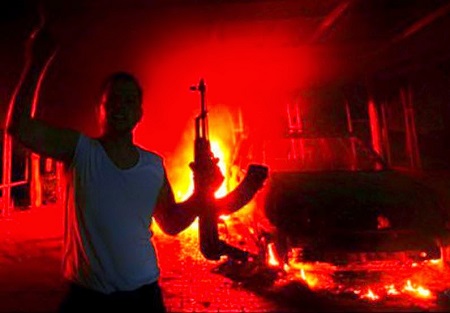
Why did ISIS emerge as a major terrorist threat in 2013? This is a question that Democrats don’t want Americans to consider a consequence of President Obama’s policies, as it quite obviously is. Nor does anyone in the Hillary Clinton campaign want to discuss how the Sept. 11, 2012, attack on the U.S. consulate in Benghazi, Libya, was connected to the rise of ISIS, although this connection is equally obvious.

The connection involves the so-called “Arab Spring” uprisings of 2011 that were supported by Clinton’s State Department. A major goal of the “Arab Spring” was the overthrow of Bashar al-Assad’s Ba’athist regime in Syria. In the wake of the successful U.S.-backed overthrow of Libyan dictator Moammar Ghaddafi, the Obama administration sought to recover the weapons it had provided to the Libyan rebels, and transfer them (via Turkey) to the rebels fighting in Syria, where Assad had managed to retain power. It was for this purpose — seeking a weapons “buyback” deal with a group of Libyan rebels — that U.S. ambassador Christopher Stevens traveled to Benghazi on that fateful day in September 2012 when he was ambushed and murdered. The offer of a meeting with rebel leaders, it turned out, was the bait for a deadly trap. The anti-Ghaddafi rebel forces in Libya were dominated by Islamic radicals, including al-Qaeda operatives and, in just the same way, the anti-Assad forces in Syria came to be dominated by the radical Muslims of ISIS — and the Obama administration’s policies helped make this happen.

Concealing this truth about the policies that Hillary Clinton had approved and implemented was why she lied about Benghazi, promoting a false narrative about “an awful internet video” in order to distract from the reality of what had actually happened in Libya, and what was also happening in Syria. In its effort to arm the anti-Assad rebels, weapons were being shipped from Libya to Turkey, and then transported to Syria. ISIS was not the intended recipients of these weapons, but the situation in northern Syria was so unstable that many of these weapons certainly did end up in ISIS possession and, furthermore, the U.S.-backed uprising against Assad created the “perfect storm” of anarchy within which ISIS subsequently established its Raqqah-based “caliphate.”

All of this is background to the leaked 2014 email in which Democratic Congressional Campaign Committee (DCCC) Policy Director Mike Ryan tries to provide a defensible explanation for the rise of ISIS. The 2003 invasion of Iraq “created the atmosphere for a Jordanian to start a Muslim sectarian war, which ultimately created ISIS,” Ryan wrote:

He goes on to disclose that Zarqawi entered Iraq during the invasion to establish a religious caliphate for just Sunni Muslims and to start a sectarian war against Shias.
The Iraqi government led by Prime Minister Maliki and supported by the U.S. made the situation worse, because Maliki was discriminatory towards Sunnis and helped rally extremists to Zarqawi.
“Malaki’s prejudicial governing style worsened after U.S. troops left Iraq, helping quickly deteriorate the situation further,” Ryan concludes.

(Hat-tip: Instapundit.) Ryan’s explanation is simply a lie — deceit by omission, at the very least — because it wasn’t Zarqawi, who was killed in Iraq in 2006, who created the situation that developed in Syria in 2013. Ryan’s explanation was a typical Democrat “blame Bush” excuse that ignores both (a) Obama’s disastrous decision to rapidly decrease U.S. troop strength in Iraq, and (b) the equally disastrous policy of arming the anti-Assad rebels in Syria. Ryan’s version of the ISIS story conveniently skips over the seven-year gap between Zarqawi’s death and the emergence of ISIS as a major threat in order to conceal the role that the Obama administration’s policies played in the rise of ISIS. Just a few relevant highlights from the Wikipedia article on ISIS:

In August 2011, following the outbreak of the Syrian Civil War, ISI, under the leadership of [Abu Bakr] al-Baghdadi, delegated a mission into Syria, which under the name Jabhat an-Nusrah li-Ahli ash-Sham (or al-Nusra Front) established a large presence in Sunni-majority Al-Raqqah, Idlib, Deir ez-Zor, and Aleppo provinces. . . . .
In August [2011], al-Baghdadi began sending Syrian and Iraqi ISI members experienced in guerilla warfare across the border into Syria to establish an organisation there. Led by a Syrian known as Abu Muhammad al-Julani, this group began to recruit fighters and establish cells throughout the country. . . .
On 8 April 2013, al-Baghdadi released an audio statement in which he announced that the al-Nusra Front had been established, financed, and supported by the Islamic State of Iraq, and that the two groups were merging under the name “Islamic State of Iraq and Al-Sham”. . . .
Meanwhile, the ISIL campaign to free imprisoned ISIL members culminated in simultaneous raids on Taji and Abu Ghraib prisons in July 2013, freeing more than 500 prisoners, many of them veterans of the Iraqi insurgency. . . .
On 29 June 2014, the organisation proclaimed itself to be a worldwide caliphate.

Now, from the Wikipedia article on Syrian Civil War:

On 11 January 2013, Islamist groups, including al-Nusra Front, took full control of the Taftanaz air base in the Idlib Governorate. . . . The leader of the al-Nusra Front said the amount of weapons they took was a “game changer”. . . .
On 2 March, intense clashes between rebels and the Syrian Army erupted in the city of Raqqah, with many reportedly killed on both sides. . . . By 3 March, rebels had overrun Raqqah’s central prison, allowing them to free hundreds of prisoners . . .
By 6 March, the rebels had captured the city of Raqqah, effectively making it the first provincial capital to be lost by the Assad government.

It is these events between 2011 and 2014, during Obama’s presidency, that Mike Ryan dishonestly omitted from his email to Democrats. After the death of Zarqawi and the 2007 U.S. troop “surge” in Iraq, this ragtag coalition of Sunni extremists was not a threat beyond a few places in western Iraq. However, once the U.S.-backed “Arab Spring” uprising destabilized neighboring Syria — at the same time Obama had withdrawn U.S. troops from Iraq — this created a new opportunity for al-Baghdadi.


“What difference, at this point, does it make?”

Democrats don’t want to talk about the policy decisions that brought about the disaster in Benghazi, which is connected to the disasters in Iraq and Syria. Fiddling around with rival factions in Muslim countries is no substitute for exerting our own military strength directly in defense of our own interests. The Obama/Clinton policy was always naïve — as naïve, in its own way, as the idea that we could “make Anglo-Saxon republicans out of obscure desert savages,” as Kevin D. Williamson once described Bush-era “War on Terror” policy. It is not usually necessary for the U.S. to deploy 150,000 troops, to invade other countries and topple dictatorships, in order to influence foreign affairs. However, if we are never willing to deploy any troops, our influence will be minimal, our allies will have no reason to trust that we will defend them, and our adversaries will despise our cowardice.



 

How Does Hillary Plan to Defeat ISIS Without Using U.S. Combat Troops?


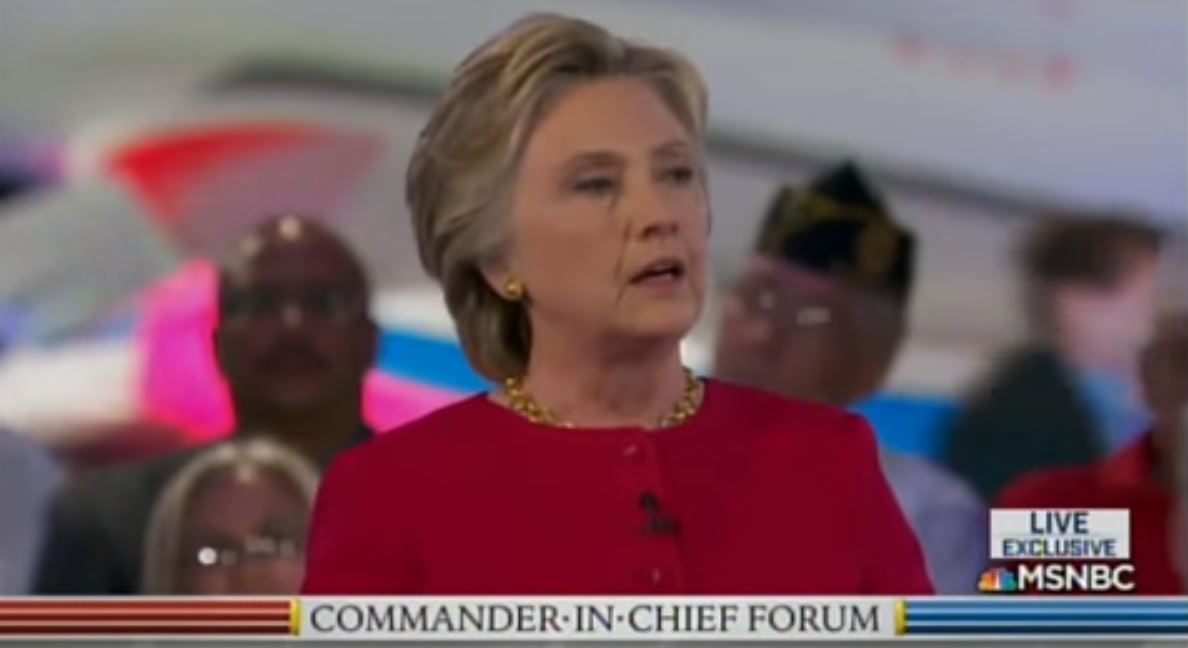
During a “Commander-in-Chief” forum Wednesday with Matt Lauer, Hillary Clinton claimed U.S. troops won’t be needed to defeat ISIS:

“We are not putting ground troops into Iraq ever again and we are not putting ground troops into Syria,” the Democratic presidential nominee, who has consistently said she does not want to put ground troops into Iraq, said during a forum on national security on NBC News.
“We’re going to defeat ISIS without committing American ground troops.”
Clinton’s remark came in response to a question from an Army veteran who asked the former secretary of state how she would determine when and where to deploy troops overseas, particularly when it comes to fighting ISIS.
“We have to defeat ISIS,” Clinton said. “That is my highest counterterrorism goal. And we’ve got to do it with air power, we’ve got to do it with much more support for the Arabs and the Kurds who will fight on the ground against ISIS.
“We have to squeeze them by continuing to support the Iraqi military. They’ve taken back Ramadi, Fallujah, they’ve got to hold them. They’ve got to now get into Mosul. We’re going to work to make sure that they have the support, they have special forces, as you know, they have enablers, they have surveillance intelligence, reconnaissance help.”

There are currently about 300 U.S. Special Forces in Syria, and about 4,000 U.S. troops in Iraq, so let’s not pretend that we don’t already have Americans in harm’s way, OK? The way Hillary just casually mentions “support,” “surveillance,” etc., ignores this reality. Likewise, her vague assurance that “the Arabs and the Kurds” and “the Iraqi military” will suffice to defeat ISIS raises the question, “Why haven’t they already defeated them?” It’s been nearly three years since ISIS established its Islamic “caliphate” in northern Syria, and they’re still there. While ISIS has suffered recent defeats in Iraq, they maintain their stronghold in Raqqa and — contrary to Hillary’s assertion — President Obama and Turkey’s President Erdogan recently discussed the possibility of a joint U.S.-Turkey operation to destroy ISIS in Raqqa.

Well, it depends on what your definition of “ground troops” is, perhaps. Hillary probably means to say we won’t be committing entire Army corps or Marine divisions against ISIS, but we definitely have troops on the ground — in May, some of our Special Forces were spotted with Kurdish forces within 18 miles of Raqqa. Honestly, if Obama would commit a battalion of Army Rangers to the fight, I’d bet they could capture Raqqa in a matter of weeks, if not days. I’m sure Col. Evans and his boys would enjoy a nice “live-fire” exercise, wiping out ISIS in one quick operation.

Excuse my nitpicky criticism of Hillary’s no-ground-troops talk, but as the father of a soldier, I resent the implication that U.S. Special Forces — the finest soldiers on the planet — are not “ground troops.”

Meanwhile, as a matter of mere politics, Donald Trump totally won Wednesday’s forum, and Hillary looked like an idiot, as usual.