Jay Laze Gets a Lesson in Rhetoric (Or, How NOT to Debate a Feminist)
Posted on | July 13, 2015 | 34 Comments
In 2013, Virginia Beach pizzeria owner Jay Laze gained notoriety by offering a 15 percent discount to customers who were exercising their Second Amendment rights. On his Facebook page last week, Laze commented on an article about an incident in Vietnam, where a water park offered free admission, leading to a mob scene in which “thousands” of men reportedly molested teenage girls wearing bikinis.

A girl is rescued amid the chaos at a Hanoi water park.
Laze compared the park’s error — exposing “80% naked women” to “instinctually driven men with no security” — to sharks in a “feeding frenzy.” And this is just common sense, really.
However, a feminist saw the comment and drew Laze into a debate on his Facebook page. She asked, “can you actually prove it’s human instinct or are you just projecting?” She screencapped the entire exchange and posted it to her Tumblr blog, saying that Laze “stated he’d rape women every time he thought he could get away with it, and that he thinks this is normal male behavior.” Did he actually say that? Well . . .
Laze wrote that this incident in Vietnam was a case of “instinct overriding self control,” and the feminist then asked, “how many times have been unable to stop yourself from raping and molesting?”
This insulting insinuation provoked Laze to respond, “You’re asking the wrong question. Ask ‘how many times would you have raped had there been no consequences?'”
The feminist replied, “that’s a great question. how many times would you have raped had there been no consequences?”
Laze then answered: “Since men have the instinct to ‘put their penis in a vagina’ I’d probably say every time.”
This is not how you win debates with feminists, sir.

Online debate can be a minefield, and many people make the kind of errors Jay Laze made, simply because they don’t have experience dealing with troll tactics of this kind. For the benefit of readers, permit me to offer a few suggestions:
- You have the right to remain silent — If someone attacks you online, you are not required to respond. We are not accustomed to being mocked or insulted in real life, so when it happens to us online, our natural impulse is to defend ourselves. We are not racists or sexists, we are not ignorant or stupid, so when someone makes these kinds of accusations online — when our character is impugned — it is easy to be provoked into a defensive reaction. However, this will often have the opposite of the intended effect. By defending yourself against an accusation, you are pouring gasoline onto the sparks and, as illustrated by Jay Laze’s unfortunate incident, “everything you say can and will be used against you.” Sometimes, silence is the best defense.
- Know your antagonist — It is evident to me that Jay Laze began this Facebook conversation without bothering to investigate who he was talking to. She knew who he was, but he didn’t know who she was, and this put him at a disadvantage, because Laze didn’t anticipate her skill in steering him into a rhetorical ambush.
- Don’t get sidetracked — Jay Laze’s original point was a good one. As someone whose business is in a beach resort town, he is obviously aware of how inadequate crowd control can lead to dangerous situations. Yet the feminist, focusing on Laze’s phrase “instinctually driven men,” sidetracked Laze toward a more general discussion of instinct as a factor in rape, a topic that Laze had originally not intended to address. He was inadequately prepared for the debate he encountered on this sidetrack, where his antagonist expertly provoked him into a rhetorical error.
- This is not about you — Jay Laze’s antagonist pushed his buttons by accusing him of “projecting” his own personal “instinct to rape girls” onto the mob of men at the Vietnam water park. This kind of insulting insinuation should always be regarded as a flashing alarm in any such discussion. The appropriate response to such an unwarranted insult is to call out the rhetorical foul and terminate the conversation. Clearly, your antagonist is not arguing in good faith. Yet it is often the case that people react to these kind of baseless insults the way Jay Laze reacted, by continuing the discussion as if being accused of criminal behavior was nothing unusual, and then cooperating with the antagonist’s interrogation of his personal motives.
- Beware of hypotheticals — Having let his antagonist steer him onto a sidetrack and then personalize the discussion by accusing him of being at least a potential rapist, Jay Laze finally sets a rhetorically fatal trap for himself by proposing the hypothetical scenario where rape was possible with “no consequences.” That he proposed this as a devil’s advocate is obvious enough. His original point was about the inadequate security that caused the chaotic free-for-all at the Vietnam water park, and Laze himself is an advocate of armed self-defense because he understands the need to safeguard against such possibilities. Yet Laze also intended to make a point about sexual instinct being one of the unruly human impulses that so often lead to violence, and thus was willing to stipulate that, if there were “no consequences,” he would himself behave like a savage beast.
Oops. We know exactly why feminists love to talk constantly about rape, as Ace of Spades observed: “Minus rape, feminism is rather too obviously a list of trivial complaints by comfortable yet hysterical semi-affluent white women.” This why feminists have employed Statistical Voodoo and Elastic Definitions to gin up a phony “campus rape epidemic.” Feminists deliberately exaggerate the incidence of rape, so that they can treat all men as suspects in a criminal investigation and thus silence critics of feminism: “Shut up, because rape!”
Feminism’s mantra, “The personal is the political,” operates as an invitation for women to tell their tales of being victimized by the oppression of male supremacy. Any man is a damned fool if he thinks he can play this game — trying to make a political point by telling a personal narrative — because however innocent he may be of any Sexist Thought Crimes, the mere fact that he is playing the feminist game will effectively put him on the defensive. Never fight a battle according to your enemy’s plan. Do not surrender the initiative by letting your enemy choose the time and place of battle. When you see that your enemy is attempting to provoke you into battle, always suspect an ambush.
As to the substance of Jay Laze’s comments, we can see that he was speaking of the Hobbesian nightmare of a lawless world — bellum omnium contra omnes, the “war of all against all” — and he is clearly against this kind of anarchy. Speculating what we might do in a hypothetical apocalypse, freed from the restraints of civilization, is one of those dorm-room debates that used to occur in the 1970s when everybody had done a few bong hits and was staring at the lava lamp.
Think about that scene in Animal House, where the Deltas have turned the homecoming parade into complete pandemonium — “Remain calm! All is well!” — and Bluto spies his dream girl Mandy Pepperidge amid the chaos. He swoops down like a pirate, abducts her in a stolen convertible and, we learn in the film’s famous concluding scene, they eventually become Senator and Mrs. Joseph Blutarsky.

Everybody applauds that scene, because when you get down to it, everybody understands what feminists call “rape culture.” We recognize the beastly impulses of human nature. Unless we are complete fools, however, we also understand that the fantasy of unrestrained sexuality is nothing like the reality of what would happen under conditions of lawless anarchy. As Hobbes himself explained, in such conditions, human life would be “solitary, poor, nasty, brutish, and short.”
Even worse than Baltimore, perhaps.
OK, so we climb into the Time Machine and arrive at a state university dorm room in 1978. A haze of cannabis smoke fills the air, and the blacklight posters on the wall give off an eerie glow. A Pink Floyd album is playing on the stereo and everybody’s staring at a lava lamp when somebody says, “Hey, man, what would you do if you were in a swimming pool full of Vietnamese chicks in bikinis and there was no security, no rules at all?” Imagining myself at age 18 in that dorm room, presented with such a hypothetical scenario, I am very grateful that (a) there is no such thing as a Time Machine, and (b) there was no Internet in 1978.
Never forget: You have the right to remain silent.
Rule 5 Sunday: The Persistence of the Bunny
Posted on | July 12, 2015 | 12 Comments
— compiled by Wombat-socho
It’s actually a tad cool in Las Vegas as I write this, which is to say it hasn’t reached 100. Still, the streets and casinos are amply supplied with tourists and locals appropriately dressed for the weather, which is another reason to be glad I moved here. Of course, some of the local workforce are dressed like that in line of duty, such as this young lady, a dealer at the Playboy Club in the Palms.

The magazine may be tottering, but the Playboy Bunnies persist.
As usual, many of the following links lead to pictures normally considered NSFW. Reader discretion is advised.
Goodstuff leads off again this week, informing us that the future is here, and it’s filled with robot strippers. Paging noted robosexual Instapundit! Also, Jamie Chung! Ninety Miles from Tyranny chips in with Hot Pick of the Late Night, Morning Mistress (featuring Cameltoe), and Girls with Guns, featuring Sofia Vergara and her double-breast machine guns. Animal Magnetism has Rule Five Greek Tragedy Friday and the Saturday Gingermageddon, while First Street Journal has The Glam Life of American military women.
EBL’s thundering herd this week includes the Womens’ World Cup victors of Team USA, the Reddit Revolt, Logan’s Run, Sinatra at the Beach, Megyn Kelly (pretty when she’s angry), infamous doughnut licker Ariana Grande, and Marine heroine Colonel Kate Germano.
A View from the Beach checks in with The ABCs with Abbey Clancy, The One Minute Time Machine, More Naked News, POTUS Apprentices Daughter to Soft Core Porn Studio, Tuesday Telegram, “Stranger in My House” and Microaggression of the Week.
Postaldog returns with Maitland Ward, Charlie Riina, Zoey Deutch, Paris Hilton and Lindsay Lohan, and Elizabeth Olsen.
Having recovered from a Snoochinator 9000 malfunction* over the Independence Day weekend, Soylent Siberia submits your morning coffee creamer, Monday Motivationer Fur de Fleur, Tuesday Titillation DDumbfounded, Humpday Hawtness Sunny, Retro Fursday Fantasm Linda Lusardi, Trophy Rack, Corset Amalgam, T-GIF Friday Weekender Foreshadowing, Weekender Triple Play, and Bath Night Hunting Camp Story.
Proof Positive’s Friday Night Babe is Lucy Hale, his Vintage Babe is Annette O’Toole, and in Sex in Advertising, Join The Lamb’s Navy! At Dustbury, it’s Kirsten Vangsness and Denise Richards.
Thanks to everyone for their linkagery! Deadline to submit links to the Rule 5 Wombat mailbox is midnight (Pacific Time) on Saturday, July 18.
Visit Amazon’s Intimate Apparel Shop

Why Do Drunk Sluts Get Drunk?
Posted on | July 11, 2015 | 69 Comments

“Campus sexual assault is an all-hands-on-deck epidemic in America.”
— Rep. Nancy Pelosi, July 7, 2015
Pardon the deliberately provocative clickbait headline, but the campus “rape culture” discourse keeps avoiding this issue. There is an obvious connection between (a) claims that sexual assault is an “epidemic” among college and university students; (b) the phenomenon of binge drinking among students, most of whom are below the legal drinking age; and (c) the adamant insistence of feminists that it is “slut-shaming” and “victim blaming” to suggest how (a) and (b) are most likely related.
A blog post is probably not an appropriate forum to conduct a psychology seminar, but anyone familiar with the research knows how promiscuity correlates with low self-esteem, and how alcohol abuse correlates with depression. It is not necessary to consult the work of academic experts, however, to know that drunks commonly wake up with hangovers and feelings of profound remorse for the irresponsible behavior they engaged in during their night of extreme inebriation.
“The plural of ‘anecdote’ is data,” as they say. There is a negative feedback loop of low self-esteem, drunkenness, impulsive behavior, shame and depression involved in the typical downward spiral of the alcoholic’s life. Getting the drunk to sober up and stay sober is usually just the beginning of recovery, because there are always unresolved emotional issues related to this pattern of irresponsible behavior.
What does it tell us, then, when we repeatedly see stories about alleged “sexual assault” which, when subjected to close scrutiny, turn out to be variations on the same familiar tale of youthful misadventure? Two drunk teenagers hooked up, then the female drunk teenager claimed (often months after the incident) that she was raped by the male drunk teenager? This is actually becoming part of the “consent” message:
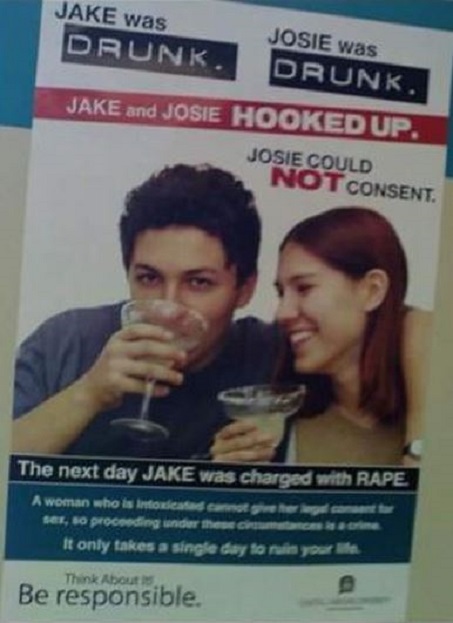
Jake was drunk. Josie was drunk.
Jake and Josie hooked up.
Josie could NOT consent.
The next day Jake was charged with rape.
A woman who is intoxicated cannot give her legal consent to sex, so proceeding under these circumstances is a crime.
It only takes a single day to ruin your life.
Think about it! Be responsible.
Are you kidding me? While we may say it is always “irresponsible” to get drunk and have sex, this is something college kids do quite routinely. When two people are both in “these circumstances,” how can anyone fairly assert that the male is guilty of a felony, while a drunken hookup makes the female a helpless victim? How does such a claim — that males bear 100% responsibility in heterosexual encounters, and that females never bear any responsibility — comport with the idea that feminism is about men and women being equal? Am I the only one who sees how “social justice” in this context becomes the exact opposite of justice?
[University of Minnesota student body president Joelle] Stangler describes yes means yes policies as “common practice.” But these policies are anything but common practice. People don’t have sex by asking “May I kiss you?” “May I touch you here?” etc. . . .
Really, anything the accuser decides later they didn’t like can become grounds for an accusation. And if the accuser was drinking, consent is automatically negated, even if the accused had been drinking as well (and would presumably therefore be unable to consent). The policy shifts the burden of proof onto the accused, meaning they have to prove a crime didn’t happen, which, short of a video recording, is impossible in a he said/she said situation.
Under “these circumstances” — where radical feminists are demanding the implementation of policies that have the effect of criminalizing heterosexuality on campus and denying male students their basic civil rights — every college boy who hooks up with a college girl should be advised to seek psychiatric treatment immediately, because any guy who has sex on campus in 2015 must obviously be crazy.
Has @PrezStangler never read Orwell?
Is this the Junior Anti-Sex League? #UMN
http://t.co/vj51DGJsw3 @AsheSchow pic.twitter.com/BldUAVDgqz
— Robert Stacy McCain (@rsmccain) July 11, 2015
Campus anti-sex activist @PrezStangler wants to criminalize heterosexuality, deprive male students of civil rights. pic.twitter.com/MfNn8TbIzf
— Robert Stacy McCain (@rsmccain) July 11, 2015
Feminist totalitarians like @PrezStangler demand Sex Commissars to re-educate inmates in Soviet-style campus gulags:
@donsurber @AsheSchow
— Robert Stacy McCain (@rsmccain) July 11, 2015
#UMN Student Commissar @PrezStangler
accuses @AsheSchow of pro-rape bias.
@instapundit @EdDriscoll @TwitchyTeam pic.twitter.com/7lTuXacQk6
— Robert Stacy McCain (@rsmccain) July 11, 2015
Any attempt to discuss the “affirmative consent” agenda, especially in the context of due-process rights and the climate of anti-male hysteria feminists have created on campus, results in skeptics being branded “rape apologists.” Shrugging off this slander is easy enough for an adult — what do I care what a left-wing Minnesota college kid thinks of me? — but what we must take seriously is how this rhetoric functions as a terroristic intimidation tactic that silences dissent on campus. Ms. Stangler’s student government produced a 20-page report entitled “Guys Don’t Get Consent” (PDF) which made no mention of false accusations and said nothing at all about the psychological factors involved in binge drinking and sexual promiscuity among college-age females. Instead, the UM report blamed “masculinity” and asserted (based on a survey of about 60 male students and focus groups with 18 of those) that male students at the university are all clueless creeps:
Feminist crusaders like Ms. Stangler seem to believe new laws and mandatory lectures about “affirmative consent” are the solution, but parents of male college students can implement a far more effective solution: Tell your sons to avoid female students, period.
When your sons return to campus this fall, they will enter a climate where all male students are viewed as rape suspects, where new federal policies encourage rape accusations, where accusations are treated as tantamount to proof of guilt, and where university officials are under heavy pressure from the Obama administration to increase the number of punitive procedures against male students. Any heterosexual activity on campus poses a grave risk for male students in this climate of frenzied hysteria, where feminists are hunting for rapists with more fanatical zeal than 17th-century Puritans hunted witches in Salem.
In 2015, college students can't even fornicate without federal regulatory oversight.
— Robert Stacy McCain (@rsmccain) July 11, 2015
Responsible parents must sternly warn their sons going off to college not only to avoid sex with female students, but also never to speak to any woman on campus. The feminist campaign against masculinity, as evidenced in the University of Minnesota report, will have the effect of producing accusations of “harassment” against male students who attempt to flirt with female students, or who say or do anything that any female student may find offensive.
What do feminists find offensive? Men having sex with women.
“That consent rather than nonmutuality is the line between rape and intercourse further exposes the inequality in normal social expectations. . . . If sex is ordinarily accepted as something men do to women, the better question would be whether consent is a meaningful concept. . . .
“Sexuality, then, is a form of power. . . Women and men are divided by gender, made into the sexes as we know them, by the social requirements of heterosexuality, which institutionalizes male sexual dominance and female sexual submission.”
— Catharine MacKinnon, “Feminism, Marxism, Method, and the State: An Agenda for Theory” (1982)
The Feminist-Industrial Complex of Women’s Studies programs on the 21st-century campus teaches female students to hate and fear men. Before parents send a son off to college, they should advise him to expect that he will be viewed with contempt and suspicion by every female on campus. No matter how handsome he is or how popular he was in high school, your son would be a fool to presume that any female college student might ever find him attractive. Your son’s confidence in his judgment, based on his previous romantic successes, could be the hubris that precedes nemesis in so many campus tragedies.
If anyone thinks I am exaggerating the dangers facing male college students, let them consider what happened to Paul Nungesser, what happened to Daniel Kopin, and what happened to Joshua Strange. Or consider the cases discussed by Professor K.C. Johnson at Minding the Campus. Over and over, we have seen these stories of male students who had no idea that they had encountered nemesis in the form of a female student whose emotional problems would result in accusations of sexual assault. Nor did these male students realize that such an accusation — often many weeks or months after the incident — would put them into the Kafkaesque nightmare of campus disciplinary tribunals where an accused student has none of the civil rights afforded to any common criminal in a court of law. Feminists have a cynical contempt for truth and no regard at all for the rights of innocent men destroyed by such false accusations. This dishonest campaign of deliberate cruelty is making more and more males casualties “in the Obama administration’s war on men,” as James Taranto of the Wall Street Journal said.
Promiscuity is rampant among female college students, many of whom are infected with sexually transmitted diseases. Wesleyan University’s Ella Dawson is infected with herpes, which is incurable, and a footnote on page 7 of Paul Nungesser’s lawsuit mentions that his accuser Emma Sulkowicz was reportedly treated for chlamydia. “According to Stanford University’s Sexual Health Peer Resource Center, 1 in 4 college students have an STD,” Dr. Laura Berman reports, and parents must warn their sons against this danger. Even if he were willing to accept such a grave risk to his health, however, the male student must be warned that many females on campus are psychologically disturbed.

Joelle Stengler reports that 25 percent of University of Minnesota students have mental health problems, and college-age women are particularly prone to these disorders. The student newspaper at the University of Michigan profiled a mentally ill female student they called “Maria” who has been twice arrested for assaulting police officers while in drunken blackouts. Maria is being treated with four different drugs:
The Klonopin treats her anxiety. The Lomictal and Seroquel act as mood stabilizers. The Vyvanse helps her focus. . . .
Over the last decade, it has become more and more common for college-aged women to be on the types of medication that Maria takes. The chance of a major depressive episode in 18 to 29-year-olds is three times higher than in individuals 60 years or older, according to the Diagnostic and Statistical Manual of Mental Disorders.
Most of these episodes occur in females. A quarter of American women take a drug for a mental health disorder, compared to 15 percent of men. The ratio of women to men on anti-anxiety meds is 2 to 1.
Whereas emotionally unbalanced young women were once institutionalized in psychiatric wards, now they are on university campuses and, like Maria at Michigan, many mentally ill female students “self-medicate” with alcohol. How can any male student know whether the girl he hooks up with at a college party — drinking, dancing, seemingly eager to be his sexual partner — is among the 1-in-4 with mental health problems? Wouldn’t he be safer if he operated with the assumption that every girl at the party is a psychiatric basket case, a deranged crazy-bomb just waiting to explode?
FEMINISM: "Men can never speak without permission and … everything men say is wrong …" http://t.co/y594lB5MTf pic.twitter.com/QQbE90OR6p
— Robert Stacy McCain (@rsmccain) July 11, 2015
Someday you'll tell your grandkids what America was like when heterosexuality was legal, even at college. But then Hillary got elected …
— Robert Stacy McCain (@rsmccain) July 11, 2015
It's 2015. Isn't it time we change the
title of this Jimmy Buffett song to
"Trigger Warning, Rape Culture"?
https://t.co/bsWRZSulQs
— Robert Stacy McCain (@rsmccain) July 11, 2015
FMJRA 2.0: Wait, What?
Posted on | July 11, 2015 | 6 Comments
— compiled by Wombat-socho
Illegal Alien Who Murdered Woman Had Exploited S.F. ‘Sanctuary City’ Policy
The Camp of the Saints
Feminist Tumblr: Dreaming of Their Journey Across the Mytilini Strait
Living In Anglo-America
FMJRA 2.0: Independence Day Edition
BlurBrain
The Pirate’s Cove
Rule 5 Sunday: Independence Day Weekend Edition
Animal Magnetism
Ninety Miles from Tyranny
A View from the Beach
Proof Positive
In The Mailbox: 07.06.15
Proof Positive
Overwhelmed, Sad and Lonely
Dustbury
In The Mailbox: 07.07.15
A View from the Beach
Off The Shelf
Regular Right Guy
My SWATting: Perpetrator Reaches Plea Agreement in Federal Felony Case UPDATE: Investigation Is Continuing
Hogewash
A View from the Beach
Laci Green Talks Dirty to Girls
Living In Anglo-America
A View from the Beach
Sorry, @AsheSchow: ‘Due Process’ IS a Left-Right Issue — and Here’s Why
Living In Anglo-America
A View from the Beach
Feminist Tumblr: It’s Not As If They Hate Men or Anything Like That
Living In Anglo-America
Top linker this week was A View from the Beach, who checked in with five links the hard way. Something apparently went wrong with the pingback widget this week, because I’m pretty sure I saw some links from EBL at Batshit Crazy News while I was doing spam suppression. Apologies to anyone who got screwed by the software.
Are We Hiring Someone So Challenged As To Require A “Business Suit Onesie”?
Posted on | July 11, 2015 | 42 Comments
by Smitty
 Mrs. Other Smitty brought this to my attention. As a generally slack-tacular kinda guy who regularly toggles between sports podcasts and casino apps, I can follow the logic involved in this. Anything you can do to streamline a process, e.g. dressing, is worth doing. Note the shopping avoidance on display: you buy the one thing, and you’re done. Two complications come to mind:
- You need to make minor adjustments, e.g. doffing a jacket, to fit the office climate, and
- You want to mix things up a bit, to get more wear out of the upper portion. Typically the trousers reach end-of-life ahead of the shirt or jacket.
Above all these practical considerations, there is this: you’re going home. There is a 1 year-old awaiting you. That one year-old is also wearing a onesie. WHAT. WERE. YOU. THINKING?
You weren’t. Let this blog help you. When someone tries to resurrect the jumpsuit, JUST. SAY. NO.
Feminist Tumblr: It’s Not As If They Hate Men or Anything Like That
Posted on | July 10, 2015 | 65 Comments
The fascinating thing about Feminist Tumblr is that it’s totally unfiltered. Nearly all of the participants are very young — a 25-year-old is a senior citizen on Tumblr — and also anonymous. There’s no adult supervision (your mother is not on Tumblr) and inside this feminist echo chamber, everything inside their zany brains comes pouring out. There is a constant competition on Feminist Tumblr to say the most demeaning things possible about males. Of course, no feminist ever says anything good about males, but the anti-male venom of Feminist Tumblr gives it a special edge.
This is the exact opposite of the usual feminist complaint about men who, allegedly, are emotionally stunted and incapable of anything like the intuitive and sympathetic feelings over which feminists claim women have a monopoly. However, you see here the damned-if-you-do, damned-if-you-don’t aspect of feminism. Everything that men do is wrong, and so men who do show emotion are condemned as “the most unbelievably melodramatic people on earth” in a post that got more than 6,000 notes in a month.
Who is the author of this screed? Hannah Beth, a 20-year-old Florida State University student who is “majoring in literature and double minoring in art history/german” and also “queer as hell.” When she’s not busy denouncing males for their emotional melodrama, Hannah Beth has some emotions of her own:
I feel like books are a giant blanket I am wrapping myself up in. every morning lately when I wake up the first thought I have is about whatever I was reading before I went to sleep. it’s good to be corny about books on the internet I think. it’s good to have something I love this much. anyway, I felt really anxious all day today and had one of those Bad Days For No Reason and I cried a little bit in my car and I was scared to sleep alone but now I am curled up at 1am with my tiny book and I feel like it is the most reassuring hug on earth, like 100 angels whispering “it’s okay and it’s always been okay and it always will be” which is true and very good to hear from the universe. I wanna write a love letter to literature tbh.
So, yeah, guys “throw literal temper tantrums,” and meanwhile Hannah Beth is crying in her car and scared to sleep alone.
Tumblr Feminists cry alone a lot, when they’re not busy plotting worldwide revolution, like 21-year-old Athena, a “Gemini bitch” from Sweden who describes herself as “stone cold lesbian, post-structuralist radical feminist, marxist communist” and also a bunny owner & advocate for proper animal care. So she loves bunnies, but hates men and capitalism, not necessarily in that order.
We got your message, loud and clear. Got nearly 9,000 notes in three month for that. Cute selfies for a lesbian Marxist, though.
So “queer as hell” or “stone cold lesbian” — kind of a theme becomes apparent here. There may even be a pattern on Feminist Tumblr. Then there’s 24-year-old Jam, “bisexual and aromantic,” who is “half Jamaican half Finnish, first generation Canadian” and also — surprise! — has complaints about men:
That got over 160,000 notes in five months, because Tumblr Feminists share a profound contempt for “the male gender role.”
Oh, and Jam also posts a lot of selfies. You might like her, if you’re into pierced noses and tattoos and know how to “shut the fuck up.”
Speaking of which, Kethrellan, 19, is studying Music Education and Voice at the University of Delaware and — thanks to a questionnaire she filled out — we know that she’s 5-foot-7, lost her virginity before she was 18, has never been in a serious relationship and is, of course, bisexual.
Question: Is bisexuality as common in real life as it is on Feminist Tumblr? Or is there just reflecting a trend among fashionable young people to identify as Something Other Than Normal? Then I remember — Feminism Is Queer!

The title of that 2010 textbook by a Women’s Studies professor summarizes the basic message of feminism in the 21st century.
Whatever she does, the Third Wave feminist cannot be normal, because being normal is oppressive. This came to mind particularly with Kethrellan because I was looking at her selfies — because posting selfies is why they invented the Internet, right? — and thinking “never been in a serious relationship”? Long curly hair, nice smile, wide-set eyes — not a Barbie doll-type beauty, but more like a pre-Raphaelite painting. Rosetti or Millais would have loved her, and yet Kethrellan has “never been in a serious relationship”? Maybe the Tumblr Feminists have got a point. Maybe young guys nowadays are just a bunch of clueless clowns. Maybe they lack a proper appreciation of beauty. And maybe that’s why Kethrellan wrote this on her Tumblr blog:
“overhearing straight boys talk about girls is so terrifying”
Seriously, what’s wrong with these guys? Did their mamas not raise them right? Were they dumped off in daycare when they were babies? Did they grow up without two loving parents? We they shuttled back and forth between their divorced parents or abused by stepparents? How is it that so many of these young men seem to be uncouth savages or feral beasts with no respect for women? It’s almost as if civilization is being destroyed, perhaps by a War Against Human Nature.
TUMBLR FEMINIST: "I love astrology because it’s always right." http://t.co/nYKBuDSEkm @ThePoliticalHat
— Robert Stacy McCain (@rsmccain) July 9, 2015
Feminism & Witchcraft — see SEX TROUBLE, pp. 71-73, 105, 108, 112-115 http://t.co/dTJX1oVkV5 @JohnSheridan12 pic.twitter.com/30KLyc9ChX
— Robert Stacy McCain (@rsmccain) July 9, 2015
Somebody ought to write a book about this or something.
Friday Fiction: 100 Word Challenge
Posted on | July 10, 2015 | 20 Comments
by Smitty
 Granpda had a vision of his last look at the city. The hugest moon he’d ever seen, obscured by unnatural clouds. Bombers. A distant enemy had visited. A murder of ravens deployed from a lonely tree for the sudden necropolis.
That had been decades ago. The country hadn’t recovered from electing foolish leaders that brought ruin.
Grandpa dimly recalled references to a time when the people weren’t cowering in fear and scavenging like the ravens.
* * *
Time passed. People ceased to blame others. Instead, they looked within for strength. The ravens awaited the cycle.
via Darleen
Sorry, @AsheSchow: ‘Due Process’ IS a Left-Right Issue — and Here’s Why
Posted on | July 10, 2015 | 59 Comments
Ashe Schow is a brilliant young journalist, and one of the few reporters who have been steadily covering the attempt by feminists to criminalize heterosexuality on college campuses. The feminist agenda is so insane and extreme, that when I try to explain what is being taught in university Women’s Studies programs — the academic Feminist-Industrial Complex — most people quite literally cannot believe it. (See “Feminists Against Heterosexuality” and “Introduction to Feminist Theory” among other recent entries in the Sex Trouble series.) Yet each day brings further confirmation. There is a deliberate campaign to incentivize rape accusations at America’s colleges and universities by requiring mandatory “training” at orientation that will have the effect of terrorizing male students into avoiding all contact with females on campus.

University administrators are under intense pressure from federal authorities to punish male students, to produce statistical evidence that they are implementing the crackdown demanded by feminists. This will lead to a zero-tolerance approach in which every male-female encounter on campus is fraught with risk. Any male student who so much as speaks to a woman could be accused of harassment. Officials are actually bragging about their “success” in encouraging rape accusations, which increased 400 percent in a single year at the University of Wisconsin.
Ashe Schow explains how the rights of the accused are systematically violated under the policies mandated by federal bureaucrats:
When a student is accused of sexual assault on a college campus, they’re often given vague descriptions of the charge against them — which may have occurred years earlier. They’re forced to come up with a defense within days, told not to talk to anyone about the allegation (making mounting a defense nearly impossible) and not allowed to have an attorney speak on their behalf.
They face a system that has been shifted against them, where an accusation is all that’s needed to brand them a rapist for life and kick them out of school. There is no due process in campus hearings — no rules of evidence, cross-examination or right to be represented by an attorney. They’re not even told that anything said in the hearing can and will be used against them in a court of law.
Feminists demanded these policies, the Obama administration implemented these policies, and Hillary Clinton is planning a campaign for president in which any Republican who criticizes these policies will be accused of being “pro-rape.” This is a Feminist/Democrat/Media convergence we have seen before, during the Clarence Thomas hearings, again during the Lewinsky scandal (when feminists put on their “presidential knee pads” to defend Bill Clinton) and in 2012, when the “War on Women” meme helped Obama get re-elected with the largest “gender gap” in Gallup poll history. The non-existent “campus rape epidemic” — a vicious lie created with Statistical Voodoo and Elastic Definitions — is a crucial element in a shameless partisan political operation intended to elect Hillary Clinton to the White House.
Yet for some reason, Ashe Schow wants to pretend otherwise:
Due process for campus sexual
assault is not a left/right issue
Sexual assault is a serious issue that should be dealt with seriously. But the proposed solution for this problem on college campuses creates an entirely new problem. It eviscerates due process for accused students in the name of helping accusers.
The fight over campus sexual assault and due process has somehow devolved into a Republican vs. Democrat issue. The most vocal supporters of draconian sexual assault policies are Democrats like Sens. Kirsten Gillibrand of New York and Claire McCaskill of Missouri. There are several prominent Republicans on a Senate bill to curb sexual assault, but none have made a name for themselves as a proponent.
Meanwhile, the print and online commentary voices defending due process rights for the accused have been mostly right-leaning. The only television voice on the issue of due process has been Fox News.
There have been exceptions to this, but unfortunately, the issue has become a way for political opponents to score points against each other. Those who favor due process are accused by liberals of being “rape apologists,” while those who favor the accusers are excoriated by right-leaning media.
That sentiment has muddied the issue. Due process used to be deeply important to liberals. Toughness on crime was more commonly associated with Republicans. Now the tables have turned and it makes no sense.
Due process should concern everyone. So should sexual assault. . . .
It shouldn’t be up to Republicans to stand up for due process or up to Democrats to stand up for victims. Both sides should be working toward the truth in each case.
You can read the whole thing. The problem is that to speak of what should be — to advocate an ideal — is a waste of time in the current environment where Democrats have manufactured a phony issue and are exploiting it for partisan gains. Democrats have created this issue and their allies in academia and the media are coordinating with Democrats to control the “rape culture” narrative in order to get more votes for Democrats. It is that simple, and anyone who supports Democrats is therefore supporting the policies that have stripped male students of due process rights. Ashe Schow writes:
In today’s climate, it is impossible to stand up for someone wrongly accused without being attacked. Once someone is labeled a “rapist” — even without evidence — he apparently forfeits his right to exist and must be expelled and have his life and future ruined.
Ruining the lives of male students is the primary goal of feminists, but the wrongly accused male students are just collateral damage to Democrats, for whom Hillary Clinton’s election is the larger objective.
To speak of “truth” to these people is both futile and misleading.
They don’t care about truth. They only care about power.
If you care about truth, if you care about the real lives of real human beings, you cannot be a feminist, nor can you be a Democrat, and it’s time we stop trying to sugar-coat that reality. We must stop pretending that such mythical creatures as “honest Democrats” and “moderate feminists” actually exist in the real world. Believing in “honest Democrats” is like believing in the Tooth Fairy and “moderate feminism” is either an oxymoron or a pointless nostalgia. Even if we were to stipulate that “moderate feminists” once existed (which I don’t), they were a phenomenon of a bygone era who have no relevance in the 21st century when, for example, the Feminist Majority Foundation employs a self-described “raging lesbian feminist” as its communications director and when Women’s Studies professors denounce Disney cartoons as being “heteronormative.” One could assemble a convention of every “honest Democrat” and “moderate feminist” in America and maybe they would fill a corner booth at Denny’s. Maybe.
Dear God! Parents must warn their sons:
MALES HAVE NO RIGHTS ON CAMPUS
http://t.co/2LeG6mA9ic via @MindingCampus pic.twitter.com/OScWSQDjsG
— Robert Stacy McCain (@rsmccain) July 9, 2015
Democrats have chosen the college campus as their battleground and have chosen “rape culture” as an issue because Democrats know that America’s institutions of higher education are staffed almost entirely by Democrats. Thus controlling the terrain on which they intend to fight this political battle, Democrats know they can rely on university officials to assist them, in the same way Democrats rely on the liberal media to promote their dishonest propaganda. (Need I remind you how Sabrina Rubin Erdley, Emily Renda and Catherine Lhamon collaborated in Rolling Stone‘s UVA rape hoax?) We cannot defeat these liars if we are afraid to tell the truth about who they are, what they do and why they do it. Feminism Is a Totalitarian Movement to Destroy Civilization as We Know It, and Democrats are the Party of Evil Liars and Fools.
We used to warn young men
to avoid syphilis and gonorrhea.
Now young men must be
warned to avoid feminists.
pic.twitter.com/e9QaRwLFSY
— Robert Stacy McCain (@rsmccain) July 3, 2015
The ONLY way male college students can now be 100% safe from false rape accusations is to AVOID ALL CONTACT WITH FEMALE STUDENTS.
— Robert Stacy McCain (@rsmccain) July 4, 2015
If a female student tries to initiate
contact with a male student,
he should suspect a trap.
@DanHRothschild pic.twitter.com/nvMotlRATy
— Robert Stacy McCain (@rsmccain) July 8, 2015
The TRUTH About Feminism's 'Rape Culture' Discourse. #tcot
@SexyIsntSexist @DateOffCampus
pic.twitter.com/01nvsRh2qY
— Robert Stacy McCain (@rsmccain) July 9, 2015
The truth is not always a pleasant thing to hear, nor should anyone expect to become popular by speaking the truth in an age where deceit, perversion and hypocrisy have become so prevalent. I would like to think there are at least some female college students who are honest and responsible adults, but no male college student can be safe in that assumption. Paul Nungesser thought Emma Sulkowicz was his friend, and she was only too willing to encourage him in that belief, so long as she harbored the illusion that she could make him fall in love with her. Once that illusion was dispelled — once Sulkowicz realized that her “friends-with-benefits” hookups with Nungesser were emotionally meaningless to him — her love turned to hate, and hate inspired a plan for revenge, a conspiracy in which other feminists at Columbia University were quite willing to participate. Nungesser was blindsided by Sulkowicz’s false accusation. “My mother raised me as a feminist,” he told the New York Times, a fact his mother verified in an interview with Cathy Young of the Daily Beast. Yet the kind of “equality” Nungesser believed in — where a young adult woman can have casual sex with a male friend and expect nothing more — proved to be a cruel deception. Promiscuous women are often emotionally unstable, their low self-esteem expressed in a desperate search for male approval. The same needy impulses that inspire this sexual depravity, however, can also be manifested as a generalized rage toward men (yes, all men) whom the psychologically damaged woman blames for her own feelings of worthlessness.
“In my clinical work, I find that a promiscuous individual suffers from low self-esteem and feels that sex is a way to get attention and to feel noticed.”
— Dr. Seth Myers
“A person with a borderline personality disorder often experiences a repetitive pattern of disorganization and instability in self-image, mood, behavior and close personal relationships. . . . The person may manipulate others and often has difficulty with trusting others. There is also emotional instability with marked and frequent shifts to an empty lonely depression or to irritability and anxiety.”
— Richard J. Corelli, M.D.
Why should a woman like Emma Sulkowicz be just another “pump-and-dump” — used and discarded — when by claiming to be a victim of rape, she can be celebrated as a heroic “survivor”? Feminists praise her “courage” and, in doing so, have made Emma Sulkowicz a role model whom they encourage others to emulate. We can therefore expect a proliferation of copycats, and any male student who thinks he can safely engage in heterosexual behavior on campus is at risk of a brutal shock when he finds himself accused of “harassment” or “sexual assault.” Even when the female student initiates a relationship and actively pursues sex with a male student — as was evidently the case with Emma Sulkowicz — she may subsequently decide that she has been a victim, and the male who is falsely accused of rape will discover he has no due process rights in the campus disciplinary procedures mandated by federal authorities.
Worse is better. The more radical and out-of-control feminists become, the sooner everybody will hate feminism (as everybody should).
— Robert Stacy McCain (@rsmccain) July 10, 2015
"Due process" is now "rape culture." George Orwell could not be reached for comment.
@AsheSchow @instapundit https://t.co/EkgRnIwGMT
— Robert Stacy McCain (@rsmccain) July 9, 2015
Contrary to what anyone might say, this is a Left-Right issue, because this phony crisis was deliberately created by the Left in order to advance the feminist agenda and elect Democrats. We must tell the truth, no matter what penalty we pay for telling the truth. Whatever we may lose for the sake of truth, no good can be gained by cooperating with liars.
Ellen Sulkowicz says she was raped.
Hillary Clinton says she was never subpoenaed.
Women never lie.
pic.twitter.com/VZrCNNwmm2
— Robert Stacy McCain (@rsmccain) July 9, 2015
“Truth is great, and will prevail if left to herself. … [Truth] is the proper and sufficient antagonist to error, and has nothing to fear from the conflict, unless by human interposition disarmed of her natural weapons free argument and debate, errors ceasing to be dangerous when it is permitted freely to contradict them.”
— Thomas Jefferson, “Virginia Statute of Religious Freedom,” 1786
THE FULL METAL JACKET REACH-AROUND AWARD
HIT THE FREAKING TIP JAR!
Search
Recent Posts
- In The Mailbox: 10.12.26 (Annual Admiral of the Ocean Sea Appreciation Post)
- Rule 5 Sunday: No Fishy Just Sexy
- FMJRA 2.0: A Winning Homestand
- In The Mailbox: 10.09.26
- Rumors Swirl: Where Is James Talarico? UPDATE: Talarico Appears in Public
- In The Mailbox: 10.08.26
- ‘A Reliable Barometer of Wrongness’
- In The Mailbox: 10.07.26
- In The Mailbox: 10.06.26 (Evening Edition)
- In The Mailbox: 10.06.26 (Afternoon Edition)
RSS reader subscription

MEMEORANDUM
Recent Comments
- on Rumors Swirl: Where Is James Talarico? UPDATE: Talarico Appears in Public
- on The Wrong Matthew Ingalls, the Correct ‘Jane Doe’ and the Cornell 7 Case
- on The Wrong Matthew Ingalls, the Correct ‘Jane Doe’ and the Cornell 7 Case
- on The Wrong Matthew Ingalls, the Correct ‘Jane Doe’ and the Cornell 7 Case
- on In The Mailbox: 10.02.26 (Evening Edition)
THE AMAZING GONZO FEED
Major Leagues
Archives
- October 2026 (16)
- September 2026 (38)
- August 2026 (43)
- July 2026 (39)
- June 2026 (40)
- May 2026 (43)
- April 2026 (59)
- March 2026 (44)
- February 2026 (37)
- January 2026 (45)
- December 2025 (42)
- November 2025 (44)
- October 2025 (44)
- September 2025 (47)
- August 2025 (48)
- July 2025 (48)
- June 2025 (47)
- May 2025 (48)
- April 2025 (42)
- March 2025 (48)
- February 2025 (49)
- January 2025 (48)
- December 2024 (42)
- November 2024 (44)
- October 2024 (47)
- September 2024 (43)
- August 2024 (55)
- July 2024 (63)
- June 2024 (59)
- May 2024 (48)
- April 2024 (43)
- March 2024 (55)
- February 2024 (46)
- January 2024 (45)
- December 2023 (53)
- November 2023 (62)
- October 2023 (57)
- September 2023 (56)
- August 2023 (53)
- July 2023 (69)
- June 2023 (67)
- May 2023 (53)
- April 2023 (60)
- March 2023 (73)
- February 2023 (65)
- January 2023 (56)
- December 2022 (60)
- November 2022 (64)
- October 2022 (58)
- September 2022 (68)
- August 2022 (75)
- July 2022 (69)
- June 2022 (73)
- May 2022 (74)
- April 2022 (57)
- March 2022 (79)
- February 2022 (65)
- January 2022 (58)
- December 2021 (62)
- November 2021 (68)
- October 2021 (73)
- September 2021 (63)
- August 2021 (60)
- July 2021 (80)
- June 2021 (64)
- May 2021 (64)
- April 2021 (58)
- March 2021 (73)
- February 2021 (57)
- January 2021 (71)
- December 2020 (77)
- November 2020 (81)
- October 2020 (84)
- September 2020 (94)
- August 2020 (75)
- July 2020 (68)
- June 2020 (83)
- May 2020 (77)
- April 2020 (65)
- March 2020 (85)
- February 2020 (94)
- January 2020 (95)
- December 2019 (88)
- November 2019 (60)
- October 2019 (113)
- September 2019 (91)
- August 2019 (91)
- July 2019 (88)
- June 2019 (80)
- May 2019 (74)
- April 2019 (97)
- March 2019 (100)
- February 2019 (85)
- January 2019 (93)
- December 2018 (90)
- November 2018 (83)
- October 2018 (96)
- September 2018 (79)
- August 2018 (107)
- July 2018 (98)
- June 2018 (86)
- May 2018 (78)
- April 2018 (78)
- March 2018 (97)
- February 2018 (61)
- January 2018 (70)
- December 2017 (62)
- November 2017 (68)
- October 2017 (67)
- September 2017 (70)
- August 2017 (68)
- July 2017 (52)
- June 2017 (60)
- May 2017 (56)
- April 2017 (80)
- March 2017 (80)
- February 2017 (102)
- January 2017 (104)
- December 2016 (65)
- November 2016 (86)
- October 2016 (77)
- September 2016 (81)
- August 2016 (66)
- July 2016 (83)
- June 2016 (81)
- May 2016 (65)
- April 2016 (64)
- March 2016 (81)
- February 2016 (74)
- January 2016 (66)
- December 2015 (64)
- November 2015 (85)
- October 2015 (71)
- September 2015 (80)
- August 2015 (67)
- July 2015 (79)
- June 2015 (69)
- May 2015 (72)
- April 2015 (94)
- March 2015 (122)
- February 2015 (71)
- January 2015 (93)
- December 2014 (99)
- November 2014 (67)
- October 2014 (109)
- September 2014 (87)
- August 2014 (106)
- July 2014 (132)
- June 2014 (154)
- May 2014 (126)
- April 2014 (145)
- March 2014 (144)
- February 2014 (142)
- January 2014 (185)
- December 2013 (192)
- November 2013 (173)
- October 2013 (175)
- September 2013 (181)
- August 2013 (167)
- July 2013 (147)
- June 2013 (135)
- May 2013 (128)
- April 2013 (105)
- March 2013 (162)
- February 2013 (191)
- January 2013 (206)
- December 2012 (190)
- November 2012 (176)
- October 2012 (240)
- September 2012 (206)
- August 2012 (235)
- July 2012 (223)
- June 2012 (161)
- May 2012 (230)
- April 2012 (269)
- March 2012 (282)
- February 2012 (247)
- January 2012 (267)
- December 2011 (285)
- November 2011 (300)
- October 2011 (302)
- September 2011 (297)
- August 2011 (288)
- July 2011 (297)
- June 2011 (245)
- May 2011 (260)
- April 2011 (344)
- March 2011 (293)
- February 2011 (201)
- January 2011 (263)
- December 2010 (265)
- November 2010 (266)
- October 2010 (305)
- September 2010 (280)
- August 2010 (272)
- July 2010 (230)
- June 2010 (244)
- May 2010 (256)
- April 2010 (222)
- March 2010 (271)
- February 2010 (286)
- January 2010 (229)
- December 2009 (21)
- October 2009 (1)
Free Agents
SHAMELESS CAPITALISM
Triple-A Franchises
- All-American Blogger
- American Power
- Anti-Idiotarian Rottweiler
- Athens & Jerusalem
- Barney Quick
- Bartholomew's Notes On Religion
- BatesLine
- Bear Creek Ledger
- Bearsears Patriots
- Blog de KingShamus
- Bride of Rove
- Cold Fury
- Daily Pundit
- Dr. Helen
- I Own The World
- Legal Insurrection
- Moe Lane
- No Runny Eggs
- Obi`s Sister
- Protein Wisdom
- Rhetorican
- Small Dead Animals
- The Conservatory
- The People's Cube
- The Sundries Shack
- VodkaPundit
- Vox Day
- Zilla of the Resistance
Blogroll
- 90 Miles From Tyranny
- A Conservative Shemale
- A Point of View
- Adrienne's Corner
- AmSpec Blog
- Bad Blue
- Blazing Cat Fur
- Calvin Freiburger Online
- Carol's Closet
- Catholic Bandita
- Caught Him With A Corndog
- Cecil Calvert
- Common Cents
- Conservative Hideout
- Conservative Watch News
- Conservatives for America
- Conservatives For Palin
- Crazy For Liberty
- Dad 29
- DC Damsel
- Dr. Flap
- Dyspepsia Generation
- Effing Conservatives
- Election Dissection
- Eric Reasons, IT Genius
- Eye of Polyphemus
- Finding Ponies. . .
- Free Will
- Grandpa John's
- Granite Grok
- GrEaT sAtAn"S gIrLfRiEnD
- Hoosier Access
- John William Perry
- Judicial Watch
- Jumping in Pools
- KURU Lounge
- Laughing Conservative
- Makes My Brain Itch
- Marathon Pundit
- Martin Eisenstadt's Blog
- Media Fade
- Michael Leahy
- Mister Pterodactyl
- Naked Villainy
- Nice Deb
- noot's observatory
- Not One Red Cent
- Okrahead
- Ollieander
- Pileus
- Pinup Girl
- Point of a Gun
- Political Pit Bull
- Reaganite Republican Resistance
- Red Alexandria
- Red State Eclectic
- Red, White & Conservative
- Republican Redefined
- ResCon1
- Ric's Rulez
- Ricochet
- Right of Course
- Robipedia
- Robomonkey
- Ruby Slippers Blog
- Saberpoint
- Scared Monkeys
- Sentry Journal
- SI VIS PACEM
- Skepticrats
- Smash Mouth Politics
- Sooper Mexican
- Taking Hayek Seriously
- Tel-Chai Nation
- Tequila & Javalinas
- The Aged P
- The Classic Liberal
- The Izzy Report
- The Minority Leader
- The NeoSexist
- The Nose on Your Face
- The Republican Mother
- The Right Sphere
- The Saint Angilbert Press
- The Snooper Report
- The Underground Conservative
- Thunder Tales
- Tom McLaughlin
- Tory Anarchist
- TrogloPundit
- Vets On The Watch
- Watcher of Weasels
- Western Experience
- World's Only Rational Man
- WyBlog
- Yankee Phil
- Zingstrom's Blog