
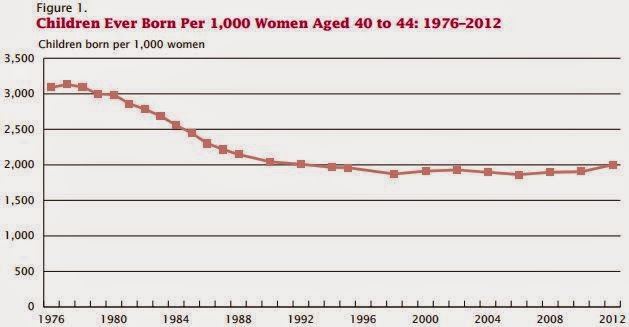
The Census Bureau issued a new report yesterday about the increase of childlessness among American women and, although they provide only a press release and XLS data (rather than a full report), the highlights of the data are perhaps ominous:
The percentage of U.S. women in their 30s and 40s who are childless is rising, new data from the U.S. Census Bureau show.
Some 15.3% of U.S. women aged 40 to 44 were childless in June 2014, up from 15.1% in 2012. . . .
For women in their late 30s, the rise in childlessness is sharper. Around 18.5% of women 35 to 39 were childless last June, up from 17.2% in 2012.
All told, 47.6% of U.S. women aged 15 to 44 were without children last year, up from 46.5% in 2012.
The data are the latest to show that childlessness is on the rise in the U.S. as more women (and their partners) delay marriage and childbearing.
Because fertility declines significantly for women in their 40s — the Centers for Disease Control and Prevention define a woman’s child-bearing years as 15 to 44 — demographers carefully watch these women to get a sense of how many children Americans are having, or not. . . .
With more women having their first child in their mid 30s, late 30s and early 40s, American families may be shrinking: The number of women aged 40 to 44 who had only one child roughly doubled between 1976 and 2014, Census said.
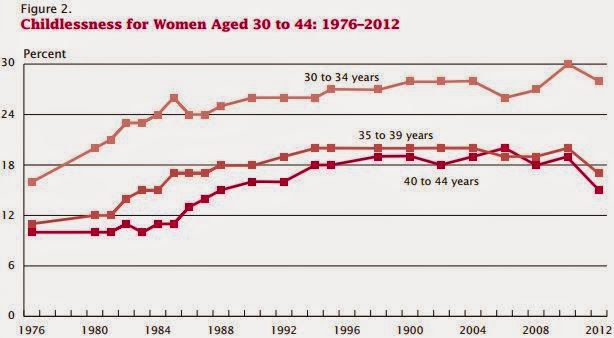
A more in-depth Census report on the 2012 numbers shows that, in 1976, 10% of women 40-44 (a cohort born 1932-36) were childless, whereas in 2012, 15% of women 40-44 (a cohort born 1968-72) were childless. An ethnic breakdown of the 2012 numbers shows important differences:
White (non-Hispanic)
0 …………………. 16.4
1 …………………. 19.2
2 …………………. 36.6
3 or more ……. 27.8
Hispanic
0 …………………. 10.0
1 …………………. 15.5
2 …………………. 28.7
3 or more ……. 44.9
Non-Hispanic white women were 64% more likely to be childless than Hispanic women, whereas Hispanic women were 61% more likely to have at least three children. Notice when you break it down this way:
White (non-Hispanic)
0 or 1 ………….. 35.6
2 or more ……. 64.4
Hispanic
0 or 1 ………….. 25.5
2 or more ……. 73.6
Considering so-called “replacement level” fertility (2 children per woman), we see that Hispanic women are 14% more likely to be at or above this level, whereas non-Hispanic white women are 40% more likely to be below replacement level. And if we look at the Census report’s data comparing U.S.-born women to immigrants, we find these numbers:
U.S.-born women, ages 40-50
Lifetime births (average) ….. 1.93
Childless ………………………….. 17.2%
Immigrant women, ages 40-50
Lifetime births (average) ….. 2.24
Childless ………………………….. 11.4%
So, immigrant women on average had 16% more children, and U.S-born women were 51% more likely to be childless. Now let’s break down the numbers by educational achievement:
Not a high school graduate
Lifetime births (average) ….. 2.6
Childless ………………………….. 11.6%
Bachelor’s degree
Lifetime births (average) ….. 1.8
Childless ………………………….. 19.9%
High-school dropouts, on average, had 44% more children than women who had college diplomas. Childlessness was 72% more common for college graduates than for high-school dropouts.
If you’ve studied population demographics, you realize that trends like these generally take decades to develop, and that finding cause-and-effect correlations is difficult. That is to say, people’s beliefs developed in childhood, their behavior as teenagers and the prevailing cultural trends in their young adult years will have an effect on whether they eventually have children. Today’s 40-year-old woman was born in 1975 and turned 18 in 1993, so if she is childless now, this necessarily implicates her choices and behaviors in the 1990s, as well as the belief system with which she was raised in the 1970s and ’80s.
Women’s behaviors are necessarily affected by men’s behaviors. If men are avoiding marriage and fatherhood — as Dr. Helen Smith’s Men on Strike documents — it will be more difficult for women to become wives and mothers. It may also be the case that men who might want to be husbands and fathers lack either the social skills or the financial resources needed to attract wives. Alternately, we may theorize that a general social climate of distrust and hostility between men and women make marriage and parenthood more problematic.
Studying demographic trends involves the complex interaction of multiple variables over time. However, it is important to note this: People make trends and not the other way around. That is to say, the individual is always free to act independently of the larger social trend, to swim against the demographic stream. You can make your own high-fertility subculture within a low-fertility society. My being a father of six is the result of beliefs and choices in the same way that other people become childless as the result of their own beliefs and choices.
People want to “fit in,” to have the approval of their peers and of the societ around them, and so being “conformed to this world” is the usual way of life. There is a prejudice I call “middle-classness,” which encourages young people to believe that they must have the credentials and accoutrements of middle-class life — college education, professional career, new cars, home ownership — or else be considered failures. This kind of concern for social status is perfectly understandable, yet in our striving for status (and encouraging our children to do the same) we can easily succumb to the kind of mentality that has produced the trend toward childlessness manifested in the latest Census Bureau report.
Did all these women decide to be childless? No.
If you could go back to 1993 to interview the 18-year-old who today is a childless 40-year-old, she likely would say she wanted to be a mother “someday,” under certain circumstances. However, those circumstances did not arise and thus “someday” never arrived.
The Contraceptive Culture encourages women (and men) to believe that fertility is entirely a matter of personal choice, but any fertility specialist will tell you this is a myth. The woman who has not become a mother by age 30 will have a significantly higher risk of experiencing infertility if and when she does try to become pregnant. And even if she has no medical problems with her reproductive health, the woman who delays motherhood past 30 will on average have fewer children in comparison to women who have their first child before they are 30.
Fertility delayed is fertility denied. Demographics is ultimately a matter of arithmetic, although the numbers involved represent human lives and the choices we make based on our own beliefs.
“See, I have set before thee this day life and good, and death and evil . . . I call heaven and earth to record this day against you, that I have set before you life and death, blessing and cursing: therefore choose life, that both thou and thy seed may live.”
— Deuteronomy 30:15, 19 (KJV)
RELATED:
- Dec. 27, 2014: Your Future (or Lack Thereof)
- July 19, 2014: Progressives Cheer: Sterilizing Poor People Is Totally Awesome!
- July 6, 2014: Feminist Attacked by Feminists After Telling the Truth About Birth Control
- July 3, 2014: Sex, Science, Nature and ‘Choice’
Don’t encourage them, they will nonbreed themselves out of the voter rolls.
“…the woman who delays motherhood past 30 will on average have fewer children in comparison to women who have their first child before they are 30.”
I agree with your post Stacy, but isn’t that observation pretty obvious?
Not anymore. Woman believe that they can have children up until the day menopause begins. We live in a time where people believe pretty bizarre stuff these days.
No. I would’ve thought so too, but it seems to come as a huge shock to a certain kind of woman — the kind that would write a memoirticle in a major publication — that her doctor never told her the cold hard facts about how fertility starts to steadily decline around 30ish, and now she’s 40ish and the fertility treatments aren’t working and she’s just going to have to make the best of it.
I’m not sure there have been enough to constitute a genre, but I would count it as a trope at this point.
I meant the “fewer” part. You are correct, women are fooling themselves into thinking they can pop out a calf for the first time when they are 45. That is rare and questionable in the first place (even if successful).
There’s a real link here between this story and the other ones you have been doing on feminism and the “rape ‘epidemic'” on and around colleges: the link is the attempt of the feminists and the left to change the power dynamic between men and women.
We already know that the “wage gap” exists primarily because women are more likely than men to take time away from the work, and women know this; the feminists are pushing women to stay in the workforce, to be professional, because that brings power to all women. The “rape crisis” is an attempt to change the power dynamic, to make men guilty until proven innocent — if even then! — by making men less aggressive and more cautious around women. Feminism is the prism which would (supposedly) reduce women’s reliance on heterosexuality to have fun, and increase the value of women for men, by reducing the number of available normal women, and showcasing an economy in which women can simply not be reliant upon men.
These things are not separate: they are simply facets of a unified whole.
Women have children all the time now in their late 30’s and early 40’s. It’s not really that big of a deal.
[…] Fertility Delayed Is Fertility Denied […]
That is the perception. However, people trumpet their successes more than their failures, and there’s a double-whammy of a lower chance of success and less chances left to take.
Woman can’t get pregnant for the first time in their 40’s without some kind of mental intervention. Don’t be a fool and stop spreading lies.
And that doesn’t account for the joy of being able to enjoy one’s grandchildren while one is still capable of independent locomotion.
Indeed. Being 40ish myself, I’ve realized that although I do not have the same biological limitations, I have potentially already foregone certain life satisfactions. It’s time to either get my act together and make it happen, or not.
Thank the Patriarchy (blessed be its name) that I even have a choice. I remember when we sent Brian Williams back in time to put a gun to Darwin’s head, forcing him to make male biology more forgiving of such delays. Good times!
“Woman can’t get pregnant for the first time in their 40’s without some kind of mental intervention”
Yes they can.
My wife and I chose to be childless. Not for financial or religious reasons. We both came into the relationship knowing one of the biggest things we had in common: that neither of us was interested in having children. We never have and we never will. We are perfectly happy and we both contribute to the world. Nothing is being “wasted” just because we aren’t pumping out babies.
Your genetics are being wasted. Whether or not that’s a good thing is subjective, I suppose, but it’s there, nonetheless.
I wonder if the numbers of medicines out there that are incompatible with pregnancy have any kind of significant effect. My partner is on an anti-seizure medicine that completely makes it impossible to procreate successfully, for example. I’m told that there are many many medicines out there that are never tested on pregnant women because of the risk factors involved with the testing.
But you leave nothing meaningful behind. Ones children are ones long term future.
Actually a minority of women who try in the forties for the first time actually pull it off. Most go away disappointed.
My sister had her second child at 42 and it wasn’t planned. Stop shifting reality to suit your narrative.
2/2 the real drawback to having kids at that age is that you don’t have the same energy for them, and leaving a career behind at that time leads to major depression for a lot of women, especially after a life of independence.
Not necessarily. I will make a more positive impact through my ministry to ex-cons than any progeny of my DNA would have. I regard it as I good thing that I didn’t procreate (and I’m sure my haters will agree on that point).
Any way, sorry to harsh everyone’s mellow by actually commenting for a change instead of just lurking silently in the shadows.
Those reasons seem kind of selfish. I’m not sure it’s fair to bring a human life into such a world to only face its own mortality and grapple with how truly meaningless the whole experience actually is.
Really? And yet you persist in breathing? Strange, that.
Stop equating first pregnancy to your sisters 2nd. 1 != 2
Well, as people get older they begin to understand what a difficult and unrewarding experience having children can be. By that time they will have experienced interactions with other peoples children that will create negative perceptions as to the desirability of having children.
Has anyone done a correlation re the birth rate and population to the number of abortions? Besides the actual loss of children there’s also the reduction in THEIR children and so on.
And is there a correlation to those having abortions to those women having or not having children later in life?
And is there also a correlation between those numbers and the increased numbers of women who though they didn’t need an abortion also had the same attitude and therefore remained on the some type of contraceptive until beyond their fertile years?
And last but not least does the lowered birth rate correlate with the rise of radical feminism and the underlying attack on men’s rights and men being persecuted by women through divorce?
This topic needs some additional information to be comprehensive in scope.
I see someone doesn’t understand fertility… the second child is always easier. I got pregnant at 50 but it wasn’t first child.
Of course they are always expectations but they are rare it’s just that the media makes it seem like it is the norm
There are a whole lot of people who say, “We’re never having kids,” and are sure it’s the right decision . . . until they actually have them. It’s one of the things that you can never know how much you’ll miss until you’ve experienced it.
https://www.youtube.com/watch?v=O1Z91YkPatw
At the risk of jumping to a conclusion, I assume you’re not procreating because of celibacy. That would be a positive choice as opposed to Jerry’s (in his reply to me below) negative general outlook.
Our genetics are being wasted? Ha, that’s a good one. Considering I have a genetic heart disease that’s plagued me since I was small, it’s kind of a good thing that my “genetics are being wasted”.
Well, then, I guess we’ll never know what we’re missing, because we’re not having children, whether on purpose or by accident. And we’ll be perfectly happy for it anyways.
OK, why is it a good thing that you didn’t have any children (other than the assumed priesthood that the title implies)? After all, you cannot know, in advance, whether your kids would have turned out good, bad or indifferent, but if you are positive enough a person to have a decent ministry to ex-cons, one would think that you’d have known enough to have made a decent parent.
The children you didn’t have could have been spectacularly great or horrendously evil, but the odds are that they’d have been just normal, everyday people, not famous but still decent.
Given your admitted meaningless existence, I’m tempted to thank you for your sacrifice. However since I doubt you consider not having children a sacrifice I’ll not even waste any of my very small reservoir of pity on you.
And you know this how? You can reasonably say that your wife and you are happy about this now, because you are already experiencing it, but you can’t know that that is how you’ll feel in twenty years.
It’s more than just “pushing.” It’s actively shaming women who leave the workforce–especially professional women–to rear children. A simple bit of Google-fu will yield articles the thesis of which is that college educated women who refuse to use their education are somehow “betraying” feminist ideals. I’ve read a half dozen or so of those over the last years.
I perceive parenthood as a sacred calling, kind of analogous to being called to a religious order. You weren’t called, you knew it, and you found a partner with the same non-calling. I respect that.
I agree that the factors you mention contribute, but I don’t think they’re the root. Note that fertility is (suprisingly, to many people) also very low in the Muslim world. This is certainly not due to any SJW influence (they tend to kill those people early on).
I believe it is due to prosperity, exacerbated by access to contraceptives.
Having kids is a hassle. I believe that given the choice, most women will choose to have as few as possible.
The scary part is that this thinking scales with all population levels: it’s as much a hassle in a country of 100 million as it is in the country of 10 million.
Only when society finally runs out of enough people to perform basic tasks will countervailing pressure be exerted.
Or, maybe you could fault the culture in individuality. “My body, my choice!” they scream. All the while, their society is dying.
It would appear some are misreading our host’s thesis. Obviously, there can be many reasons women are childless beyond the age of 40. It is also obvious that there a women who successfully have their first child after that age. No one is arguing otherwise. Nonetheless, the demographic data indicates a trend toward increasing numbers of childless women. Biological data suggests that fertility and conception become more difficult for women as they age–not impossible, but more difficult, also for a number of reasons.
It is that difficulty which is being hidden from women in our society. The average 19 year old college coed is being deceived if she believes that childbearing and child rearing will be as easy at 40 as it would be at 23 and thus, there’s no impediment to “having it all.” If having children is important to a woman, she should understand the risks inordinate delays in procreating entail. Presently, those risks are being minimized if not hidden entirely.
There is no question that our society is fast becoming anti-child and anti-family. The promised modern Progressive social welfare utopia presents disincentives to child bearing too numerous to count. Of course, the irony is that utopia requires lots of bodies generating income from which the social welfare state can siphon a percentage to transfer to those who are not productive. The simple example is Social Security. It was a great idea in the ’40s through ’60s because more people were paying in than taking out. That’s no longer the case because the Baby Boomers refused to have enough children to pay payroll taxes to support them in their dotage. Add in abortion with its 50-plus million victims since 1972 and you are missing a lot of people who could be paying the bills.
Well, that’s where we part ways. If you aren’t willing to grow a crop even by accident, then to my way of thinking, you shouldn’t plow a field and toss seeds around.
There is a crisis in Japan because there are not enough children being born. The population is getting smaller and older.
The older the first time prospective mother, the higher risk the pregnancy as well, for mother and child.
The reasons for lower fertility with age are well known. In the past, most of the women that have had children into their 40s were mothers well before 40.
While Paul’s story is long, it does not involve Calculus (an inside joke). There are good reasons he never had kids, and they are as a result of the rest of the story that he can tell if he should be so inclined later.
Yes, you jumped to a conclusion. He’s married, but they are beyond childbearing age.
1!=2? I’m sure many here would get that, but outside, I wonder 🙂
As an absolute, that’s true. But it is not all that common for a first pregnancy.
Mr 308 wrote:
This is about as untrue a statement as there could ever be: other people can see the difficulties that children can cause in a couple’s lives, but they can never know the kind of love that is in that relationship. The outsider sees, at best, only half of the picture.
My mom had me, her first child, when she was 40. But Emperor Palpatine raped her in her sleep so I might not count.
That is true, but it is a complex problem that has a lot to due with specifics of Japanese economic history and their particular culture. European trends are more likely to be relevant here, but I will grant that those aren’t great either.
See? Subjective.