
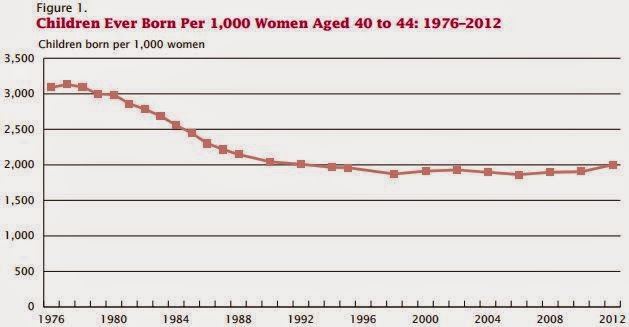
The Census Bureau issued a new report yesterday about the increase of childlessness among American women and, although they provide only a press release and XLS data (rather than a full report), the highlights of the data are perhaps ominous:
The percentage of U.S. women in their 30s and 40s who are childless is rising, new data from the U.S. Census Bureau show.
Some 15.3% of U.S. women aged 40 to 44 were childless in June 2014, up from 15.1% in 2012. . . .
For women in their late 30s, the rise in childlessness is sharper. Around 18.5% of women 35 to 39 were childless last June, up from 17.2% in 2012.
All told, 47.6% of U.S. women aged 15 to 44 were without children last year, up from 46.5% in 2012.
The data are the latest to show that childlessness is on the rise in the U.S. as more women (and their partners) delay marriage and childbearing.
Because fertility declines significantly for women in their 40s — the Centers for Disease Control and Prevention define a woman’s child-bearing years as 15 to 44 — demographers carefully watch these women to get a sense of how many children Americans are having, or not. . . .
With more women having their first child in their mid 30s, late 30s and early 40s, American families may be shrinking: The number of women aged 40 to 44 who had only one child roughly doubled between 1976 and 2014, Census said.
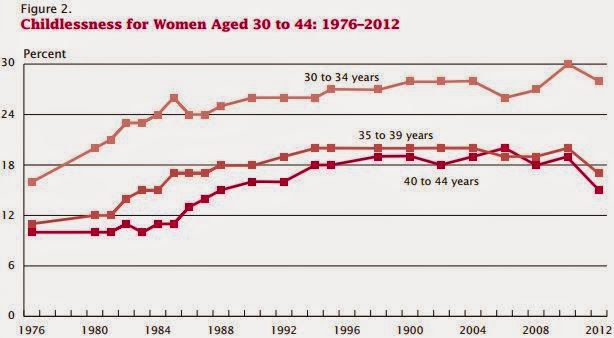
A more in-depth Census report on the 2012 numbers shows that, in 1976, 10% of women 40-44 (a cohort born 1932-36) were childless, whereas in 2012, 15% of women 40-44 (a cohort born 1968-72) were childless. An ethnic breakdown of the 2012 numbers shows important differences:
White (non-Hispanic)
0 …………………. 16.4
1 …………………. 19.2
2 …………………. 36.6
3 or more ……. 27.8
Hispanic
0 …………………. 10.0
1 …………………. 15.5
2 …………………. 28.7
3 or more ……. 44.9
Non-Hispanic white women were 64% more likely to be childless than Hispanic women, whereas Hispanic women were 61% more likely to have at least three children. Notice when you break it down this way:
White (non-Hispanic)
0 or 1 ………….. 35.6
2 or more ……. 64.4
Hispanic
0 or 1 ………….. 25.5
2 or more ……. 73.6
Considering so-called “replacement level” fertility (2 children per woman), we see that Hispanic women are 14% more likely to be at or above this level, whereas non-Hispanic white women are 40% more likely to be below replacement level. And if we look at the Census report’s data comparing U.S.-born women to immigrants, we find these numbers:
U.S.-born women, ages 40-50
Lifetime births (average) ….. 1.93
Childless ………………………….. 17.2%
Immigrant women, ages 40-50
Lifetime births (average) ….. 2.24
Childless ………………………….. 11.4%
So, immigrant women on average had 16% more children, and U.S-born women were 51% more likely to be childless. Now let’s break down the numbers by educational achievement:
Not a high school graduate
Lifetime births (average) ….. 2.6
Childless ………………………….. 11.6%
Bachelor’s degree
Lifetime births (average) ….. 1.8
Childless ………………………….. 19.9%
High-school dropouts, on average, had 44% more children than women who had college diplomas. Childlessness was 72% more common for college graduates than for high-school dropouts.
If you’ve studied population demographics, you realize that trends like these generally take decades to develop, and that finding cause-and-effect correlations is difficult. That is to say, people’s beliefs developed in childhood, their behavior as teenagers and the prevailing cultural trends in their young adult years will have an effect on whether they eventually have children. Today’s 40-year-old woman was born in 1975 and turned 18 in 1993, so if she is childless now, this necessarily implicates her choices and behaviors in the 1990s, as well as the belief system with which she was raised in the 1970s and ’80s.
Women’s behaviors are necessarily affected by men’s behaviors. If men are avoiding marriage and fatherhood — as Dr. Helen Smith’s Men on Strike documents — it will be more difficult for women to become wives and mothers. It may also be the case that men who might want to be husbands and fathers lack either the social skills or the financial resources needed to attract wives. Alternately, we may theorize that a general social climate of distrust and hostility between men and women make marriage and parenthood more problematic.
Studying demographic trends involves the complex interaction of multiple variables over time. However, it is important to note this: People make trends and not the other way around. That is to say, the individual is always free to act independently of the larger social trend, to swim against the demographic stream. You can make your own high-fertility subculture within a low-fertility society. My being a father of six is the result of beliefs and choices in the same way that other people become childless as the result of their own beliefs and choices.
People want to “fit in,” to have the approval of their peers and of the societ around them, and so being “conformed to this world” is the usual way of life. There is a prejudice I call “middle-classness,” which encourages young people to believe that they must have the credentials and accoutrements of middle-class life — college education, professional career, new cars, home ownership — or else be considered failures. This kind of concern for social status is perfectly understandable, yet in our striving for status (and encouraging our children to do the same) we can easily succumb to the kind of mentality that has produced the trend toward childlessness manifested in the latest Census Bureau report.
Did all these women decide to be childless? No.
If you could go back to 1993 to interview the 18-year-old who today is a childless 40-year-old, she likely would say she wanted to be a mother “someday,” under certain circumstances. However, those circumstances did not arise and thus “someday” never arrived.
The Contraceptive Culture encourages women (and men) to believe that fertility is entirely a matter of personal choice, but any fertility specialist will tell you this is a myth. The woman who has not become a mother by age 30 will have a significantly higher risk of experiencing infertility if and when she does try to become pregnant. And even if she has no medical problems with her reproductive health, the woman who delays motherhood past 30 will on average have fewer children in comparison to women who have their first child before they are 30.
Fertility delayed is fertility denied. Demographics is ultimately a matter of arithmetic, although the numbers involved represent human lives and the choices we make based on our own beliefs.
“See, I have set before thee this day life and good, and death and evil . . . I call heaven and earth to record this day against you, that I have set before you life and death, blessing and cursing: therefore choose life, that both thou and thy seed may live.”
— Deuteronomy 30:15, 19 (KJV)
RELATED:
- Dec. 27, 2014: Your Future (or Lack Thereof)
- July 19, 2014: Progressives Cheer: Sterilizing Poor People Is Totally Awesome!
- July 6, 2014: Feminist Attacked by Feminists After Telling the Truth About Birth Control
- July 3, 2014: Sex, Science, Nature and ‘Choice’
I’m going through the motions like every other dumb animal on planet earth. I see no reason to perpetuate that for another generation, though.
First child was at 40, and she didn’t need fertility drugs. Sorry, you are wrong again.
Her first was at 40.
All existence is meaningless outside your own mind.
That fact was not in evidence in your comment.
I know almost everyone here would get it. Good to see you my friend!
C’mon Dana, you know who I am and my disreputable past! I am sure that had I procreated my issue would have been as flawed as I was prior to the salvation of Christ and His redemption.
I guess my absence from commenting here and general silence on most blogs has made me forgettable. Perhaps it is the title. For the record, I am the same old ex-con that has been posting here for over four years, both under my own name and that of my parody account, RMNixon (Deceased). The former criminal and idiot who is now an Orthodox priest (married) that operates a ministry to ex-cons and disadvantaged former criminals. This ministry is supported out of my own pocket and does not accept donations from any individual, company or government program. Donations are not accepted period.
This is all part of my personal road of redemption.
To answer your question Adobe, no, not due to celibacy as I am a married priest, it is due to a conscious choice to not bring into the world children who may follow in my criminal footsteps.
What is the moral of this story? That women should give up their professional ambitions, and lives to have kids while they’re young?
Yeah, you should. Plowing the field is good for it’s own sake and needs no greater reason.
The moral is that by delaying procreation, the population growth rate will decline, the nuclear family will be further eroded. With today’s report that 70% of males between 18 and 36 are unmarried, I would think even you could extrapolate the outcome.
Which means, of course, that your flawed issue would have the same opportunity for salvation.
None of us are perfect, and I am a shining example of how imperfect a human being can be, but most of us are actually an asset to the human race.
Yes, actually: that’s when women were designed for reproduction, when they are at their strongest and healthiest.
I heartily agree most are assets. I simply didn’t want to risk another me in this world.
I guess I should crawl back under that rock before the haters get here …
Criminality isn’t genetic. While those you help might be considered a legacy what is left when they pass on?
Do you know Animika?
Moved this one up a notch…
Paul, you look like the mayor of Whoville with that beard of yours!
I think there is a bias against children in much of Europe and certain metro areas in the US, but honestly it is very difficult in our modern economy to have children young as the cost of living is so high and commutes are so long and many people have no immediate family anywhere near them — having children early in my cohort of friends (GenX) was late 20s with the exception of unplanned pregnancies — many of us had our children in our 30s and 40s as a result of economic realities — I do believe the best time to start having children is between 26 and 30 but it just wasn’t realistic for so many people I know…
it’s not infertility for women in their thirties so much as time if you have to wait 18 months between each C-section and/or you are someone who doesn’t get pregnant in the first few months, and then there are the all too common miscarriages and failures to implant — you don’t have the time to have 5 or 6 kids really more than 3 is tough if you start at say 33
And a person’s a person, no matter how small!
I am in the demographic mentioned since I turn 40 this year and was born in 1975. Your article led me to think about my high school years and what people were talking about then.
Honestly, most of my friends who swore they would never have kids ended up having babies before I did. My first I had at 29 though. I had always wanted to have kids and the late twenties sneaked up on me while I was working on my career. I had met a good man around the time I finished college but had been reluctant to get married.
He was the one who had asked me to marry him a month into the time we’d been seeing each other but I put the brakes on for SEVEN YEARS. Why? I didn’t think I was ready. I wanted an actual wedding ceremony that my parents could never afford. I wasn’t sure if he was the right person. It wasn’t until my friends started getting married that we just up and did it without further concern about the cost or anything else.
I honestly think the ‘right time’ for marriage and kids tends to be signaled by your peers. Most women don’t want to have children outside of marriage so until the marriage thing happens, the kids aren’t going to happen. In retrospect, if we’d gotten married sooner I probably would have had more kids. We had fertility problems after the first which delayed the 2nd one by 6 years and after the 2nd one there were complications and because of my age (don’t want to be too old to enjoy my grandkids someday) and also the cost of raising kids since I left the workforce to be a stay-at-home mommy we’ve decided against having more.
Now I’m anxious about going back into the workforce. My family can really use the income but my references are all ten years old and I’m out of practice so I will probably end up spending most of next year brushing up on computer programming and making sure I know the current lingo. Fortunately there ought to still be some demand for Software Engineers in the workplace so it’s not the end of the world. I don’t feel like I’ve betrayed women by not using my degree for the last ten years. My family will benefit immensely from it when I go back to work and it has allowed me to teach things to my kids that I might not otherwise know.
Sadly I think that there is a huge chunk of feminine lore that has been lost to women. Without the support of the extended family, women rely on their mothers to tell them about life as a parent and sometimes that’s not enough. Marriage and Pregnancy are both hugely life-changing events for women and I think that many suffer from a fear of the unknown. They don’t have a grandma or a mom holding their hand to tell them that it’s what they should do and so they avoid it. When it comes to having kids there really isn’t a ‘right time’ to have that first one. Typically people make it work even when the finances aren’t all there.
That’s a good thing. There are too many people as it is. One could argue the lower birth rates were now seeing are a result of men and women seeking greater equilibrium and understanding the scarcity of resources when our numbers grow too large.
Thanks Evi!
Their own (more happy) families and friends.
Piffle!
These are the kinds of demographics that Mark Steyn has been warning people about for years.
The really odd thing is that the leftists have been using these demographic facts as a kind of cudgel to beat people with over race. We keep seeing articles claiming whites will be a minority by 2050. So they have latched onto that bit of math-deficient, demographic distortion in a fit of racial glee to try and incite the potential “race war” that Eric Holder is helping to foment. It may be more virtual than real, but the concept has created massive conflict already.
Fact: the so-called “white” skin color group will be a majority well into the next century, because you cannot really separate “white hispanics” from “white non-hispanics” and still call it “race”, and whites of all language groups will still be a full majority well beyond 2050.
Fact: the fastest-growing demographics group is the “mixed race” group. Which means that all skin-color groups are being overtaken by “none of the above”, and that society at large agrees that race-based policies and groups are already fading anachronisms.
Race is a lie. Always was. Always will be.
Eh, I don’t know about the last sentence.
A Troublesome Inheritance: Genes, Race and Human History
http://www.amazon.com/Troublesome-Inheritance-Genes-Human-History/dp/1594204462/ref=sr_1_1?s=books&ie=UTF8&qid=1428540181&sr=1-1&keywords=a+troublesome+inheritance
I wouldn’t worry about it. They’ll just jump up and down and scream thinking they’re doing the world a favor somehow.
You didn’t refute any part of what I said so what was the point of your comment?
Other than to spout your own subjective viewpoint?
Truth. You can’t have infinite growth with finite resources.
It’s no more or less subjective than the blanket assertion that child-rearing is “difficult and unrewarding” or that “interactions with other peoples’ children create negative perceptions” about procreation. In truth, Dana is correct. No one can know the sort of relationship I have with my kids and the value it has to me and to them, no matter how many times they see us out and about.
Does having children necessitate lifestyle changes? Of course. Do some people wish to avoid those changes. Sure. So what? I don’t criticize a person’s decision not to have children. But I also think blanket pronouncements that kids aren’t worth the trouble are silly, too.
The “cost of living” rationale is one that I think is overstated. It all depends on what one’s priorities are. We reared our three on a single income, but we did without new cars, cable TV, a 2500 square foot house and a lot of things many of our peers had.
Where the prejudice does exist is directed against professional women who rear their children and then attempt to return to the workforce. In my admittedly anecdotal experience, such women are punished and that punishment tends to meted out by other women. The stay-at-home moms are viewed as sell-outs and actively prevented from resuming their careers. This is especially true in academe.
Race is a genetic fact that we deny at our peril. OTOH, the so called minorities hate each other and are more likely to be at each others throats than at the throats of white America. Latinos have already driven blacks out of large areas of LA, and they promising to go to work on other locales.
I read your post and didn’t respond because your post is so ignorant and stupid it doesn’t merit response. You were give the courtesy of a response from one of. Be satisfied, then go away and don’t bother the adults further.
I know how that goes Dana. Fortunately, not all of us were cursed to attend UKY.
I’m sure there are many experiences Brian Williams could tell us about, IF he weren’t sworn to absolute secrecy.
Only a white male could say “race is a lie” because they have never experienced racial discrimination. And Holder is formenting a race war by making the FBI do their job, and uncover systematic racist discrimination inside some of our police departments? That’s how you see it? Unbelievable.
Only a racist would hold that position. Sadly, it’s all too believable.
For those with reading comprehension skills, I did not write that racism isn’t real. I wrote that race is a lie. So your racism is your problem, not mine.
Ok, I’m a racist. Whatever, dumbass. It’s not even worth arguing with your stupidity, and pathetic lack of self awareness. Easier to just humor you.
PS-I’m white, and if you made that claim to a black
person they’d laugh their ass off over it.
Oh, do black people have some special scientific knowledge? You can’t just laugh off the debate. There are good points made on both sides.
Race is a flat out lie. Period.
The range of human skin color, hair type, height, weight, nose shapes, skull shapes, lip thickness, and all of the other “markers” of heritablility is such a huge number that it may as well be considered infinite.
To look at large groups of people from geographic regions and lazily assume there are four or six or ten or thiry “races” is laughably absurd. This is easily shown via simple Mendelian genetics and simple arithmetic.
Further, the percentage of genetic variablity among the so-called “races” is miniscule. The percentage difference between say, myself and my Italian American buddy from my band would be about the same as the difference between me and Nelson Mandela.
What people mistake for race is nothing more than basic inherited traits. You can look at a skull and predict the probable skin color of its owner, but you cannot guarantee it at all. You would also have to take into account where it was found and when. And still you are only dealing with probabilities.
The skull of many deeply-black skin colored people in India is much more similar to European whites than it is to Western African blacks. The skin color of those café-au-lait Brazilian women is nearly identical to polynesians. The examples go on and on. To attempt to reduce all this variability into “race” makes a joke out of basic demographics.
The problems people mistakenly attribute to race are actually problems of culture. It’s that simple. Pretending skin color is the root cause ignores everything we know about human nature.
I do. I’ve been studying demographics and pedigrees of various populations for years. It’s simple undeniable math.
Only Democrats care about your skin color. Your pathetic reliance on ad hominem could easily be taken by black supremacists as proof of your racial inferiority.
I wonder if this black person would laugh?
It’s interesting how a simple statement can stir people up. For years people were convinced that light simply *had* to propagate through some medium called the ether (aether). When it was shown not to be the case, a lot of people doggedly insisted the scientists were wrong.
Well, the human genomics researchers have learned that you can’t “find” genes for “race”. They already knew genetic variability within groups could be greater than between groups. And while true subspecies have come about in species other than man, something about mankind has erased such strong genetic expression. Perhaps if cro-magnon or neaderthal man had stuck around things would be different.
But race is nothing more than a matter of statistical meaning, which varies upon application. A similar phenomenon exists with regard to climate. After all, climate is much more about probabilities than it is about the weather. Climate and race are things that live as ideas. But race as a permanent, significant distinction between groups of people is no more “real” than the claim that living in a “temperate” zone means you’ll never experience harsh winters.
Race can be dangerously misleading, even though sometimes it can be a helpful construct. For example, most folks have come to believe you can only get sickle-cell anemia if you’re “black.” Well the reality is, some populations of folks who happen to fir the profile of the “black” race are susceptible. But that doesn’t mean they all are. It also doesn’t mean all white people are completely immune.
However, it’s mostly useful for doctors treating people to know their general demographic groups. But the general does not map to the specific, and vie-versa. Hatian blacks are not the same as Australian Aborigine people. A doctor needs to know that if he or she plans on treating someone for a “black” ailment. While that broad example is easy to follow, the math on genetics makes it clear that the real dangers come from over-reliance on such things as race and failure to do a full workup on the real demographic background of a person when treating them.
When it comes to predicting whether a person will do well in school, it gets even more dangerous. It’s true that black children do disproportionately worse than Asians in school. But nothing about that fact has any bearing on how one particular child will do, regardless of color.
The part about race that is a lie is the dogged belief that the supposed racial markers are significant with regard to species and with regard to some strange need by some to qualify populations on a scale of good-to-bad. You can’t justify either concept by pointing to images of people that look different. That’s because the human species has not followed the predisposition of animal species for selection of kind in mating. We spread the wealth. Animals don’t.
Racism, on the other hand, is entirely real.
You can think race is a lie all you like, but genetics disagrees with you. You exhibit the confusion that most people have about race. The race of a person can be judged from the bone structure, and many other characteristics, without referring at all to skin color. There are many factors that can be used to tell the race of an individual other than skin color. It is the layman that thinks it’s mostly about skin color, it is not.
Bluntly, the statement that race is a lie is laughable.
“It’s interesting how a simple statement can stir people up.”
Honestly, I’m disturbed to see that this post has generated the kind of discussion it has. What this indicates, I think, is that people’s attitudes have been so profoundly shaped by the Contraceptive Culture — and they have so seldom heard any dissent from those views — that merely calling attention to demographic trends and discussing the factors involved leads them respond with intense emotion.
People live according to their beliefs and values. When they encounter information that seems to contradict those beliefs and values in some basic way, they therefore react as if they have been attacked personally.
Another term for “racism” is ethnocentrism. Human beings are tribal by nature, and ethnic identity (i.e., a sense of self as belonging to a group based in shared ancestry) commonly informs our tribalism. Therefore, “racism’ is an entirely ordinary aspect of human existence, rather than being something anomalous. What people usually mean to condemn when they denounce “racism” is prejudice or discrimination and, in the United States, some people believe that whites have a monopoly on this kind of “racism.”
Go to Japan. Go to South America or Africa. Go somewhere else in the world — anywhere — and closely examine the racial attitudes that prevail in other countries. What you will learn from that experience, I hope, is that white people in the United States are not really any more “racist” than anyone else in the world. It has simply become popular to castigate white Americans as racist, because some people gain political advantage from doing so, and many whites have been so guilt-tripped over their alleged racism that they never object to these deliberate insults.
The discussion did go off the rails relatively quickly. Thus, my comment above about the precise nature of your thesis, which based upon clear demographic data should not be particularly controversial. I would note, if women were merely delaying procreation to later in life, but fertility remained a constant, the data would show a shift maternal age of children but not a reduction in the number children. The sociological reasons for the delay are varied, of course, but the effects are the same.