
Excuse my long absence from the blog, but I have a day job that keeps me quite busy this time of year. Anyway, I was amused this week by the shocking revelation that fake pollsters were able to get away with their fakery, being cited as reliable by the New York Times and other media outlets:
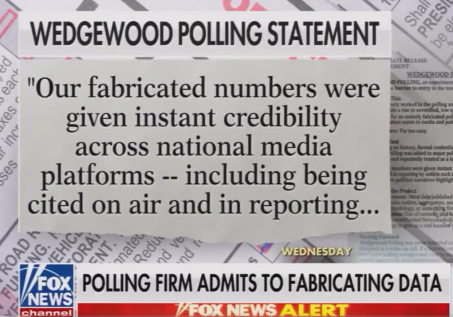
A sham polling firm publicly confessed to pumping out fake polls after it was caught fabricating data by election nerds at FiftyPlusOne, which had been poised to publish an investigation.
Wedgewood Polls . . . claimed it released fake data as a social experiment.
“Having previously worked in the polling and research sector, we watched as the public’s trust in polling eroded alongside a rise in unverified, low-quality methodology,” the group said in a statement posted to X.
“We wanted to test a simple hypothesis: How easy is it for an entirely fabricated polling firm to gain traction, be taken seriously, and expose how little scrutinization exists in media and public commentary?” it added.
“The short answer: Far too easy.”
That follows on the heels of an earlier revelation, in August, that another polling company, Median Strategies, was similarly bogus. On the latest story, here’s Time magazine:
Wedgewood’s polls had been used by multiple national outlets for their midterm reporting, including the New York Times, Newsweek, MS NOW, and POLITICO. The Times, which cited around 15 Wedgewood polls between June and October, has since removed the data from its stories. In an accompanying editor’s note, the publication detailed its checking process for polls and said Wedgewood had answered several of their inquiries prior to the data being published, including questions on the identities of the group’s pollsters, the methods used to draw their samples, and the source of their funding. . . .
While documented fake polls are rare, according to experts, polling in general often plays a large role in shaping the narrative of hotly contested races.
[University of Michigabn professor Michael] Traugott tells TIME that polls can affect voting behavior and support for campaigns “because by and large, the average citizen is interested in backing the winner, and backing means not just votes; it also means financial contributions, contributing time and effort to the campaign, and the like.”
Research has demonstrated what is known as the “bandwagon effect,” in which voters become more likely to vote for candidates or issues that are more favored in polls. A 2023 study from the Journal of Elections, Public Opinion and Parties showed that polls discouraged support for less popular ballot items, or as the paper’s authors put it: “polls demobilize the minority and mobilize the majority.”
You know who understands this? Journalists, that’s who.
Leveraging the “bandwagon effect” is a fundamental aspect of political bias in the news media. This is true not just in terms of election “horse-race” coverage, but also in shaping which political causes and social issues are considered popular or important. The difference between “fringe” concerns and the social/political “mainstream” is, to a great degree, dependent upon the choices made by the editors of the New York Times and the producers of major network news programs. In his 2001 book Bias, veteran CBS newsman Bernard Goldberg explained that the way the top stories were decided at the CBS Evening News was quite simple: The bosses arrived at work, picked up the New York Times, and lookad at the front page. You could predict, with clockwork precision, which story would lead the CBS Evening News simply by looking at the front page of that morning’s New York Times.
This kind of herd instinct among journalists is understood by those who seek to manipulate the news media for political advantage. How is it, for example, that the doomsday prophecies of “climate change” gained mainstream credibility? Or how did transgender ideology makes its way from the freaky fringe of kinky fetishes into every aspect of American public life? The news media plays a crucial role in promoting certain viewpoints, and it is difficult for many people to resist this kind of “bandwagon” messaging when it is cloaked in the pretense of Neutral Objective Journalism.
The polls may be fake, but the bias is real. Once you recognize how these influence operations function — once you start noticing the sneaky ways in which journalists smuggle their own prejudices into allegedly “objective” news coverage — you become skeptical about everything you see in the news media. Be not deceived!