A Narrow Victory for Liberty


First, the news:

The U.S. Supreme Court on Monday handed a victory on narrow grounds to a Colorado Christian baker who refused for religious reasons to make a wedding cake for a gay couple, stopping short of setting a major precedent allowing people to claim exemptions from anti-discrimination laws based on religious beliefs.
The justices, in a 7-2 decision, said the Colorado Civil Rights Commission showed an impermissible hostility toward religion when it found that baker Jack Phillips violated the state’s anti-discrimination law by rebuffing gay couple David Mullins and Charlie Craig in 2012. The state law bars businesses from refusing service based on race, sex, marital status or sexual orientation.
The ruling concluded that the commission violated Phillips’ religious rights under the U.S. Constitution’s First Amendment. . . .
Two of the court’s four liberals, Stephen Breyer and Elena Kagan, joined the five conservative justices in the ruling authored by Justice Anthony Kennedy, who also was the author of the landmark 2015 decision legalizing gay marriage nationwide.

Before getting to the commentary, let me interrupt to say that (a) the “landmark 2015 decision” was wrong — see Justice Scalia’s dissent in Obergefell — and also (b) the description of the decision as “legalizing gay marriage” is misleading. What the court majority did was, in essence, to abolish the political existence, in contravention of the 10th Amendment, of the 31 states that had passed constitutional amendments defining marriage in those states. Under the doctrine of Obergefell, the states are reduced to mere administrative jurisdictions of a centralized national authority. But I digress . . .

Paula Bolyard at PJMedia:

While the decision is a victory for Phillips, it didn’t settle the question of whether others similarly situated would have the right to refuse to bake a wedding cake or participate in other expressive arts in violation of their conscience. The court merely said that Phillips was treated unfairly by the Commission. . . .
In other words, not a lot has changed with this decision, except to get Jack Phillips out from under the thumb of the Colorado Civil Rights Commission, which received a sharp knuckle-rapping from the justices. Far from being a monumental religious liberty decision, the narrow scope of the case means that larger issues will perhaps be left for a future Supreme Court to decide.

(Hat-tip: Stephen Green at Instapundit.)

My friend and podcasting partner John Hoge offers commentary on this “narrow” victory, which we may liken to the Battle of Antietam. The bloodiest single day in American military history was a stalemate. McClellan’s Union army lost more than 2,000 men killed and nearly 10,000 wounded, but failed to “destroy the Rebel army,” as Lincoln had urged in his telegram before the battle. The Confederates had more than 1,500 men killed and nearly 8,000 wounded, but still held their position when the battle was over, and remained in line the whole next day, welcoming McClellan to renew the assault, which he declined to do. General Lee’s army retreated south of the Potomac without further injury. While the Confederate invasion of the North was turned back, the South was still unbeaten and, if anything, the invincible reputation of Lee’s army was enhanced. The war went on another two-and-half years.

Of course, this analogy is relevant to the issue of state’s rights, which is central to the Colorado dispute and “gay rights” generally. If states do not have the right to self-governance, so that the people through their state legislatures cannot write laws about marriage, how is it that states can empower a Civil Rights Commission which could trample the religious liberty of a Christian bakery owner like Jack Phillips?

It is the centralization of authority in Washington, and especially the Supreme Court’s effort to arrogate to itself the power to dictate law to the states in clear contradiction of the Constitution, that produced this conflict, as it has produced so many others in our history. Our nation’s Founding Fathers never intended the federal government to have the kind of power it now claims, nor could they have imagined that anyone would ever interpret the Constitution this way. More than 150 years after that bloodbath at Antietam, we are still fighting over the same issues, and this “narrow victory” for liberty portends a long struggle ahead.

UPDATE: David French writes:

Since the rise of the gay-marriage movement, it has become fashionable to decry dissenters as haters and bigots, to attempt to write them out of polite society. . . . Politicians thunder against Christian bigots. Media organizations put the words “religious liberty” in scare quotes, as if the expression of deeply held religious beliefs is a mere pretext, used to conceal darker motivations. And ideologues in state agencies give full vent to their rage, mocking faithful Christians as if they stand in the shoes of slavers and murderers.
Today, the Supreme Court said, “enough.” Today the Court breathed a bit of life back into religous-liberty jurisprudence.

French says this ruling is less “narrow” than some have claimed. And I know that some of my readers despise French as a #NeverTrump type, but on the subject of First Amendment rights, he is perfectly sound.


Are ‘Commitment-Phobic Men’ to Blame for England’s Declining Fertility?


Earlier this month, the British Fertility Education Initiative (FEI) advised that sex education in schools overemphasizes contraception and fails to warn about the risks of delayed childbearing. The median age at first birth in the United Kingdom is now 30. “Fertility delayed is fertility denied,” as demographers say, and approximately one-fifth of British women are doomed never to become mothers:

The rising age of women having children is a cause of concern, the group of academics and experts said, and the pain of involuntary childlessness should not be underestimated.

This isn’t just a personal problem. In societies where birth rates decline below “replacement level” (an average of 2.1 births per woman, the rate necessary to maintain population stability), there will eventually be too many retirees dependent on government pension programs with too few workers to pay the taxes needed to support these programs. In 1999, officials in the European Union sounded  the alarm about this trend, and Jim Sedlak of the American Life League warned that the U.S. could soon face similar problems:

“The ‘success’ of the population controllers in Europe is now taking its toll,” said Sedlak. “The average number of babies per woman has fallen from 1.95 to 1.65, and there is no end in sight.”
“In order to turn things around, four things are necessary,” Sedlak said. “First, the world has to understand that there is not an overpopulation problem, but a problem of too few children. Second, everyone in our society must accept large families and stop using peer pressure to convince people not to have more children. Third, governments and rich philanthropists must stop giving money to population control programs. Finally, young people getting married have to be thinking of having four or more children.”
“We have one generation to turn things around,” Sedlak said. “After that, it may be too late.”

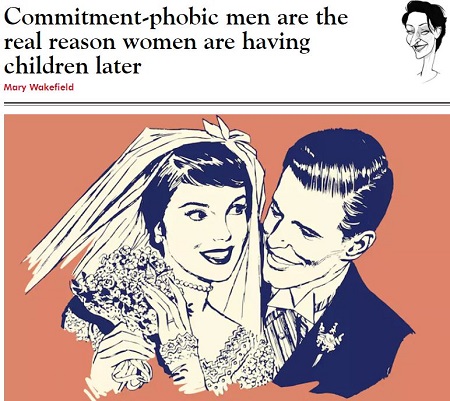
Raising awareness of the danger of demographic decline is difficult, because the liberal elite are so committed to promoting propaganda myths about the (wholly imaginary) dangers of “overpopulation.” From the standpoint of the population-control crowd, declining fertility is good news, and what about the extreme Left? If this trend produces social and economic crises, a sort of demographic Cloward-Piven strategy could be exploited to produce radical political change. Thus, many influential forces in society have a motive to obstruct understanding of fertility-related issues, and there is widespread confusion about the causes and effects of current trends. Mary Wakefield isn’t helping this:

I have several female friends in their early thirties who’ve wanted a baby for a while. Ninety-five per cent of girls do, says the FEI. The trouble for them hasn’t been the cost of childcare or a demanding career. The trouble has been finding a man who’s even halfway keen to settle down.
All my pals looking for Mr Right report identical patterns of behaviour. Dating is now all online. So they scroll through endless profiles and eventually make contact with a promising guy. Cue weeks of pointless text-ing followed eventually by an actual date. The evening often goes well. There might be a snog, more texting and another date arranged. After that: nothing. The promising man, who’s caught wind of a woman with family plans, submerges back into the internet to scroll through the options again. . . .
If online dating turns more men into commitment-phobes, I don’t see why anyone should be surprised. It’s women for the most part who feel the urge to nest and breed — as we all once quite freely acknowledged before gender became a choice. Most men don’t feel the same need to play house. It took the threat of public shame, fear of God and the censorious tutting of mutual friends to chivy a man towards family life. Online, dating strangers, who’s to see or care? . . .

You can read the whole thing, but it doesn’t get better. It doesn’t seem to occur to Ms. Wakefield to wonder why so many of her female acquaintances waited until they were in their early 30s to get serious about trying to find a mate. What were these women doing when they were ages 18-24? Because those are, in fact, the biological prime years, when a woman has the optimal chance to attract a male partner.

What happened to Ms. Wakefield’s friends, I would imagine, is that they squandered their youth in a series of dead-end relationships, negotiating from a position of weakness despite the inherent advantages a young woman naturally has in the mating market. The simplest way to express this is to say that, in the economics of sex, men represent the demand side of the equation, and women are the supply. This perspective dictates certain strategic considerations, the kind of old-fashioned common-sense stuff your grand-grandmother understood, but which seems to have been forgotten by so many allegedly “empowered” young women.

Blaming men for the dismal prospects of the 30-something single woman is erroneous, because any woman who is still single past the age of 30 must have already made many strategic errors, otherwise she would have been married long before. Unfortunately, riding the carousel tends to inflate a young woman’s sense of her own attractiveness. She’s getting plenty of offers when she’s 21, why should she fear for the future? By the time she realizes her sexual market value is declining, she has already missed her best chance at that fairy-tale happily-ever-after ending.

Youth is a precious resource, and ought not to be wasted. Teach young people — men and women alike — to be marriage-minded from the start. Certainly my kids have been equipped with the knowledge that marriage, not mere “dating,” is the desired goal, which is why I’ve already got four grandchildren, although none of my kids are yet 30. Such outcomes are still possible, if children are correctly instructed, and it is toward the proper instruction of youth that we ought to turn our attention, rather than wringing our hands over the pathetic plight of the 30-something singles who’ve already passed their sell-by date.


Feminist ‘Success’ (Or, Never Bet Against the Gods of the Copybook Headings)

“It is necessary to unite and fight to protect ourselves from exploitation as the world’s baby-makers.”
— Carol Hanisch, March 2014

“I don’t particularly like babies. They are loud and smelly and, above all other things, demanding . . . time-sucking monsters with their constant neediness. . . . I don’t want a baby. . . . Nothing will make me want a baby. . . . This is why, if my birth control fails, I am totally having an abortion.”
— Amanda Marcotte, March 2014

“Feminists don’t just hate men. They don’t just hate Republicans. Feminists hate the most helpless and innocent human lives. The road to feminism’s imagined utopia of ‘equality’ is paved with dead babies.”
— Robert Stacy McCain, April 2017

Feminism is a death cult. The feminist movement’s commitment to abortion as the essence of “women’s rights” tells you everything you need to know about their ideology. Consider, for example, how the feminist insistence on mandatory health insurance coverage for contraception catapulted Sandra Fluke into national notoriety in 2012, and became the basis of claim that Republicans were waging a “war on women.” As was demonstrated at the time, the cost of birth-control pills was less than $10 for a month’s supply, scarcely a major expense for Ms. Fluke and her fellow students at Georgetown University (annual tuition $50,547). However, Georgetown is a nominally Catholic institution and a loophole in ObamaCare had exempted (under a “conscience clause”) such institutions from the federal mandate that all health insurance must pay for contraception. Furthermore, now that Congress is wrangling with repealing and replacing ObamaCare, a major stumbling block is that conservative Republicans want to end federal funding for Planned Parenthood (the nation’s largest abortion provider) while Democrats and their feminist allies insist that this funding is sacrosanct.

Feminism is, and always has been, anti-marriage and anti-motherhood. You could cite a long list of feminists — from movement pioneers like Shulamith Firestone, Ti-Grace Atkinson and Gloria Steinem to such latter-day ideologues as Amanda Marcotte, Jaclyn Friedman and Meghan Murphy — without ever naming a woman who has given birth to a child.

This implacable hostility to motherhood, of course, is a logical consequence of feminism’s anti-male agenda. When the modern feminist movement first erupted in the late 1960s, their rhetoric involved condemnation of “male chauvinism” or “sexism.” Adapting the terminology of the civil rights movement (as opposition to “white supremacy”), feminists also used the phrase “male supremacy” to define their enemy. However, within a few years, the movement’s intellectual leadership substituted, as the preferred description of their ideological target, a term borrowed from anthropology, patriarchy. Originally coined (from the Greek words for “father” and “rule”) to refer to the primitive system of tribal authority under male elders, “patriarchy” was borrowed by feminists from the Communist Party co-founder Friedrich Engels, who used such phrases as “patriarchal order” and “the patriarchal family” in his 1884 treatise Origin of the Family, Private Property, and the State. As used by feminists, however, “patriarchy” means . . . well, just about anything a feminist doesn’t like. Yet if this word still has any actual meaning, then when the feminist denounces “patriarchy,” she especially intends to condemn men for their roles as fathers.

“Fatherhood, the exercise of men’s authority over women and children, is the position of men in the family,” feminists Jo Sutton and Scarlet Friedman wrote in 1979. “It is the means of instilling in the family members a recognition and acceptance of, and acquiescence to, male authority. . . . The end is political self-perpetuation, that is, the continuation and reproduction of male supremacy.”

We must observe that “male authority” and “male supremacy,” as used by feminists, are just synonyms for male influence. Ask any married father who much “authority” and “supremacy” he exercises within his family, and he will likely laugh at you. A happily married friend of mine, when invited recently to attend a social occasion, responded: “I don’t know. Let me check with the boss,” meaning his wife. That this friend is a retired military officer and a highly skilled professional in his civilian career, is of no consequence in terms of his “male authority” within his marriage. As far as his domestic and social life is concerned, he cannot act without his wife’s permission, or else risk her wrath, and this situation prevails in every marriage of long endurance with which I am familiar. Husbands refer to their wives as “boss” with both affection and irony, because no matter how much success and respect a man might obtain in his job, it counts for practically nothing on the home front. “If mama ain’t happy, ain’t nobody happy,” as the saying goes, and for feminists to denounce the family as an institution of “male supremacy” is a claim so counterfactual as to be quite nearly the opposite of reality. Their rhetoric, of course, conceals the actual purpose of feminism, namely the complete negation of male influence. Feminists do not actually seek equality, but rather advocate a totalitarian regime in which men have no rights at all, not even the right to speak in their own defense. In attacking fatherhood as “the exercise of men’s authority,” what feminists actually intend is to deprive men of any influence at all in the lives of their own offspring. In the feminist mind, males exist only as a caste of despised servants, assigned to work to pay child support and taxes for welfare programs: “Shut up and pay.” The fatherless family is the feminist ideal.

In practice, the “success” of feminism’s anti-male agenda has resulted in 40% of U.S. children being born to unmarried women, even while the feminist death-cult devotion to abortion and contraception greatly reduces the overall birth rate. Congratulations, feminists!

The number of women giving birth has been declining for years and just hit a historic low. If the trend continues . . . the country could face economic and cultural turmoil.
According to provisional 2016 population data released by the Centers for Disease Control and Prevention on Friday, the number of births fell 1 percent from a year earlier, bringing the general fertility rate to 62.0 births per 1,000 women ages 15 to 44. . . .
A country’s birthrate is among the most important measures of demographic health. The number needs to be within a certain range, called the “replacement level,” to keep a population stable so that it neither grows nor shrinks. If too low, there’s a danger that we wouldn’t be able to replace the aging workforce and have enough tax revenue to keep the economy stable.

When you start digging down into the CDC report (PDF), you discover that, despite the trendy belief that advances in reproductive technology will somehow solve this problem, particularly by enabling older women to become mothers, the data prove the demographic axiom that “fertility delayed is fertility denied.” The majority (55%) of babies are born to women under 30, whereas only 3% of U.S. births were to women 40 and older. The CDC report doesn’t provide adequate historical context for the lay reader to understand what is driving this trend, but in 1983 (the year I graduated college), the average age of first-time mothers was 23, whereas in 2014, the average first-time mother was 26. Keep in mind, however, that the average age of first-time mothers does not reflect the percentage of women who never have children — and childlessness has increased substantially in recent decades. Whereas in 1976, 10% of U.S. women ages 40-44 (i.e., born 1932-36) had never given birth, by 2006, this figure had doubled to 20% (for women born 1962-66). Furthermore, the percentage of childless women in the U.S. would have increased even more if not for immigration from high-fertility foreign countries. The percentage of U.S.-born women ages 40-50 who were childless in 2012 was 17%, whereas for immigrant women the number was 11%.

Thus, the paradoxical demographic result of feminist “success” is both (a) more childless women and (b) more fatherless children. Any student of this subject knows that unwed motherhood is a major contributing factor to  poverty (just FYI, 70% of black children in the U.S. are born to unmarried women), and that divorce almost always worsens the economic situation for mothers and their children. Insofar as feminists have been successful in their goal of destroying the marriage-based family, then, it is women and children who have suffered most as a result of this ideological war against “male authority.”

A skeptic might wonder if these demographic trends reflect some independent cultural or economic factor, rather than the influence of feminism (and the government policies advocated by feminists). In reply, I would ask the skeptic, “Where do feminists have the most influence?” The answer to that question is college and university campuses, where Title IX has had the effect of officially mandating discrimination against males, who are a despised minority (43%) of undergraduates. Male college students are routinely demonized by feminist faculty (e.g., “young, white, rich, clueless white males” who “think nothing of raping drunk girls at frat parties and snorting cocaine, cheating on exams, and threatening professors with physical violence”). Indoctrinated with this anti-male prejudice by their professors, female students spew hateful rhetoric about “imperialism, white supremacy, capitalism, ableism, and a cissexist heteropatriarchy” (Oberlin College) or “capitalist imperialist white supremacist cisheteronormative patriarchy” (USC). It is therefore not surprising that among college-educated women ages 40-50, 20% are childless, compared to 11% of high-school dropouts.


Feminists believe that “marriage constitutes slavery for women” (Sheila Cronan, 1970), and therefore seek to “to destroy patriarchal power at its source, the family” (Andrea Dworkin, 1974), because the only way women can avoid “forced motherhood and sexual slavery is escape from the patriarchal institution of marriage” (Alison Jaggar, 1988).

Most people are unaware of what the feminist agenda actually is because, when addressing the general public, feminists espouse bland slogans about “equality,” etc. When speaking amongst themselves, however, feminists express goals that are much more radical. This distinction between feminism’s public rhetoric (its exoteric discourse) and the anti-male ideology of the movement’s leadership (its esoteric doctrine) can best be shown by examining the content of university Women’s Studies courses. Consider for example, “Critical Approaches to Heterosexuality,” a freshman-level course taught at the University of California-Riverside by Professor Jane Ward. In the course syllabus, Professor Ward declares that the class is “organized around the argument that heterosexuality — as a system bound up with misogyny and reliant upon the gender binary — is ultimately unworkable.” Are the taxpayers of California, or the parents of students, aware of what is being taught at UC-Riverside?

Feminism is an anti-male/anti-heterosexual hate movement, masquerading as “social justice,” and what are the consequences of making feminist ideology the basis of public policy? Discrimination against male students in the education system is one obvious result, and the catastrophe caused by declining birth rates is another (cf., Jonathan V. Last’s What to Expect When No One’s Expecting: America’s Coming Demographic Disaster). It is when we examine the consequences as individual cases rather than statistical trends, however, that we can see where the feminist death-cult is leading us. Consider the story, for example, of a recent custody case in Tennessee:

In the first ruling of its kind in Tennessee, a judge has granted a woman the legal rights of a husband.
The ruling, issued [in May 2017], came as the state Legislature was pushing through a bill designed to stop Judge Greg McMillan of Fourth Circuit Court — and any other judge in Tennessee — from making that very decision, court records show.
McMillan penned approval of a divorce for same-sex couple Sabrina Witt and Erica Witt that includes designation of Erica Witt as the father of the couple’s daughter, conceived through artificial insemination.
Days later, Gov. Bill Haslam signed into law a bill inspired by the Witts’ case, the first in the state after a 2015 federal Supreme Court decision that conferred marital rights to same-sex couples. The state law ordered courts to give “natural meaning” to words such as mother and father.
Tennessee Attorney General Herbert Slatery III already had opined that judges would — and should — ignore the new law in such family law proceedings as divorce, custody and child support. The Legislature ignored the opinion.
Erica Witt and Sabrina Witt legally wed in April 2014 in the District of Columbia. They bought a home here and decided to have a child via artificial insemination from an anonymous donor.
Sabrina Witt bore a girl as a result in January 2015. Because Tennessee did not then recognize same-sex marriage as legal, Erica Witt’s name was not placed on the baby’s birth certificate.
When the U.S. Supreme Court gave gay people the right to marry and divorce in June 2015, their marriage became legal in Tennessee.
In February 2016, Sabrina Witt filed for divorce. Her lawyer, John Harber, argued that the law on custody rights in artificial-insemination cases in Tennessee used the term “husband.”
He said the natural meaning of that word is a man, so Erica Witt didn’t qualify. McMillan agreed.
But Erica Witt’s lawyer, Virginia Schwamm, filed a challenge to the constitutionality of the law since it was passed decades before the same-sex ruling and now runs afoul of it.
The Tennessee Legislature swung into action. The “natural meaning” bill was drafted to ban the legal labeling of a woman as a husband, and 53 legislators used a conservative legal group to try to step into the Witts’ divorce case. . . .
McMillan was having none of that. He refused in an April order to allow such an intervention, saying the Legislature needs to stay out of the court’s and the Witts’ business. . . .
Sara Sedgwick, senior counsel for the health care division of the office, urged McMillan in a brief to view the words “wife” and “husband” in a “gender-neutral” fashion. To do otherwise would be to violate constitutional law, particularly in light of the same-sex marriage decision, she wrote. . . .
Stripping away gender from the label of husband, McMillan said Erica Witt was a legal father with legal rights to see her daughter. She also has to pay child support.
“Erica Witt is a legal parent of the parties’ minor child,” McMillan wrote.

Let me point out the timeline here:

  1. April 2014: Erica and Sabrina marry in Washington, D.C., then move to Tennessee, where same-sex marriage is prohibited by the state constitution.
  2. January 2015: Sabrina gives birth in Tennessee to a girl conceived by artificial insemination.
  3. June 2015: The U.S. Supreme Court imposes same-sex marriage on Tennessee and the 33 other states where it was still illegal.
  4. February 2016: Sabrina files for divorce.

You see that this marriage lasted less than two years, and the baby girl at the center of this custody dispute was barely a year old when Sabrina filed for a divorce from Erica, just eight months after the Supreme Court’s Obergefell ruling compelled Tennessee to recognize such marriages as legally valid. However, based on this rather brief relationship between Sabrina and Erica, a Tennessee judge has now declared that Erica has “legal rights” to Sabrina’s baby girl, who is not even biologically related to Erica, the ex-wife whom the court has now officially deemed the legal “father” of the child!

Do you see how feminist ideas of “equality” lead to this kind of madness? Do you see how, as a consequence of the political influence of feminism’s “gender-neutral” ideology, our society has now added to the trend of childless women and fatherless children a whole new category of misery and confusion in the form of lesbian divorce and custody battles over children conceived via artificial insemination from anonymous donors? Do you understand why I keep saying Feminism Is a Totalitarian Movement to Destroy Civilization as We Know It?

In conclusion, we must invoke the poetry of Rudyard Kipling:

On the first Feminian Sandstones
We were promised the Fuller Life
(Which started by loving our neighbour
And ended by loving his wife)
Till our women had no more children
And the men lost reason and faith,
And the Gods of the Copybook Headings said:
“The Wages of Sin is Death.”

Never bet against the Gods of the Copybook Headings.



‘Equality,’ Florida-Style: Lesbian Arrested for Attacking Her Husband With Bleach

Lakeisha Regina LeGrand was arrested earlier this month.

History offers many examples of intellectuals dreaming up innovative schemes for “progress” which, as inspiring as they may seem to their advocates in the academic elite, don’t work out so well when applied in real life with real people. Just invoke the magic word “equality” and rational discussion ceases, because how can anyone be against “equality”? We are expected to ignore the fact that never in human history has anything like “equality” actually existed, and attempts to impose “equality” through government force have resulted in disaster in the former Soviet Union, Communist China, Cambodia, and elsewhere.

What did Ivy League professors imagine “equality” would mean in terms of marriage and families? Or what did Justice Anthony Kennedy (Harvard Law, Class of 1961) think would be the consequences of Obergefell?

Let’s take a look at how “equality” is working out in Orlando:

A 31-year-old Orlando woman was arrested Sunday on suspicion of splashing bleach in her husband’s face after they got into an argument about a woman whom she recently began dating.
Lakeisha Regina LeGrand was arrested on a charge of aggravated battery/permanent disfigurement.
According to an Orange County Sheriff’s Office arrest affidavit, LeGrand and her husband have been married for eight years, have four children together and live together in the same home.
Deputies said the couple got into an argument Saturday because LeGrand’s husband does not like the woman whom LeGrand is dating and he does not want the woman around their children. He said LeGrand “recently discovered that she is gay,” and it has caused stress on their relationship. . . .

(She “discovered” she’s gay, like it’s a scientific breakthrough.)

LeGrand’s husband asked her to keep the woman away from their children, and LeGrand took the children and left the home, deputies said. Her husband said he also left and returned home Sunday.
He said the children told him that they were left alone with LeGrand’s girlfriend, and he confronted her when she returned home, the affidavit said. She told him to “go back to where he came from” and he began to yell and throw boxes, deputies said.
LeGrand asked one of her children to get some bleach, but the child refused, so LeGrand grabbed a bottle from a closet, unscrewed the lid and splashed it on her husband’s face, according to the affidavit.

“Equality!” “Progress!” “Social justice!” These fine phrases are so inspiring to the intellectual elite, but what do they mean in real life for ordinary people who didn’t go to Harvard Law School?


‘An Uncomfortable Truth’


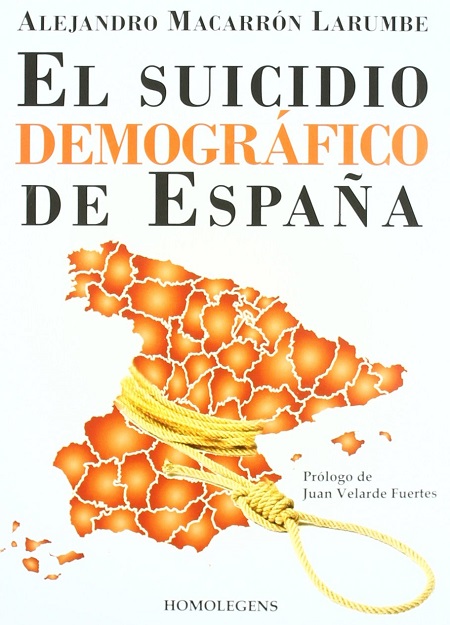
Spain is dying. The total fertility rate — average number of lifetime births per woman — is 1.49 in Spain, and this is nearly 30% below replacement level. In December 2015, demographers noted that Spain had passed a crucial milestone — more deaths than births, a harbinger of population decline. Before a nation dies, it first grows old, and the graying population of Spain creates a heavy burden on the country’s pension and health care system, as there are fewer and fewer younger workers to pay taxes.

What Spain is now facing is demographic winter, and a Spanish businessman named Alejandro Macarrón Larumbe has created an organization called Renacimiento Demografico (Demographic Renaissance) to spread awareness of this looming social problem.

“Demographic winter is an uncomfortable truth for radical feminism,” Macarrón said in an interview with La Contra TV this week. The Google translation of an article about his interview is a bit uneven — e.g., using “majors” where a better translation would be “senior citizens,” and using “bigger” where “older” was intended — but I’ll adjust it a bit and you can still get most of what he was trying to say:

Alejandro Macarrón, director general of the Demographic Renaissance Foundation, gives an interview to La Contra TV in which he describes the causes and consequences of the demographic winter that is living Spain. He defines this situation as a “suicide” of our country since, he says, “we are going to die as a people because we do not want children”.
During the half-hour interview, the director general of the Demographic Renaissance Foundation [says] that the fall in the birth rate in our country will cause a deterioration of pensions, “which will increasingly be worse and more painful to pay for active workers”.
Alejandro warns that movements in favor of euthanasia are going to exert more pressure on our society “because there are more and more [retirees] who are very expensive.” “The [elderly] are going to [become] a great percentage of voters, it is the decisive segment for the vote. When the population is smaller and the people are [older], the economy logically goes down,” he assured. . . .
In addition, Macarrón has denounced that before “the woman worked at home. Most of them now work outside the home and it seems that the one that does not is second, one late. Incentives are now given only to those who work outside the home, and that goes against the birth rate. It is discriminatory, the state must be central.”
“Birth is not only a woman’s thing, it seems that the figure of the father has disappeared, in abortion this is very much. Incentives are being given only to mothers. If we think only of women, it favors the absence of family,” he warned. . . .
Finally, Macarrón has pointed out that this situation “is an uncomfortable truth for radical feminism, which discredits traditional women. Also for the environmentalism, which defends that the human being is the problem, since, the less people, the less pollution.”

If you are fluent in Spanish, you may want to watch the video interview:


(Hat-tip: Pete Da Tech Guy on Gab.) Macarrón’s remarks about women working outside the home and the disappearance of the father’s role in families deserve more explanation. This sounds too much like “back-to-the-kitchen” male chauvinism, but motherhood is not incompatible with wage earning. Anyone who looks at demographic data knows that birth rates are actually higher in working-class families than among the affluent college-educated elite. So the idea that careers and motherhood are an “either/or” choice is a false dilemma. More important factors are the decline of marriage, the delay of childbearing, and the rise of the DINK (double income, no kids) lifestyle among upscale professionals. When divorce and unwed motherhood become commonplace, when young couples are discouraged from marrying, when materialism is promoted in popular culture, when young women are led to believe that postponing motherhood until they are past 30 is a good idea — well, these are core factors in the “demographic winter” Macarrón warns about.

Get me started on this topic, and I could go on for thousands of words, but the crucial question is, what kind of messages are young people getting from parents, from schools, from churches and from media?


While I don’t know what’s on TV in Spain, popular culture in the United States celebrates the illusion of eternal youth, the idea that everybody can be like the cast of Friends or The Big Bang Theory, eschewing the most important responsibilities of adult life, marriage and parenthood. We can laugh at the character of Sheldon Cooper, a brilliant scientist with the temperament of a petulant toddler, but such entertainment has the effect of idealizing a lifestyle of perpetual adolescence. Similar messages are reinforced by many other TV shows and movies, so that young people exposed to this incessant media bombardment develop beliefs and attitudes that are incompatible with becoming the kind of adults who make good husbands and wives, good fathers and mothers. Only if parents recognize that the cultural sewage spewing out of Hollywood is toxic, and do what they can to limit its impact on their children’s belief system, can there be hope to avert demographic winter. Parents must exercise a counter-cultural influence, or else their children will believe the deadly lies that Hollywood is selling. Public schools are doing nothing about this problem, because the schools are part of the problem. Our government education bureaucracy is now run by left-wing “progressives” who are anti-Christian, anti-capitalism, anti-marriage and anti-motherhood. Schools now teach young people that babies are bad, abortion is good and promiscuity is harmless. The public school curriculum systematically attacks Bible-based moral beliefs, and schools employ atheist teachers who ridicule Christianity in their classrooms.


There is a connection between belief and behavior, you see. Parents who allow their children’s beliefs to be scripted by Hollywood (and “educated” by government bureaucrats) should not be surprised when the results are catastrophic not only for their children as individuals, but for society as a whole. More than 15 years ago, Jim Sedlak of the American Life League looked at Europe’s demographic decline and warned:

“The ‘success’ of the population controllers in Europe is now taking its toll,” said Sedlak. “The average number of babies per woman has fallen from 1.95 to 1.65, and there is no end in sight.”
“In order to turn things around, four things are necessary,” Sedlak said. “First, the world has to understand that there is not an overpopulation problem, but a problem of too few children. Second, everyone in our society must accept large families and stop using peer pressure to convince people not to have more children. Third, governments and rich philanthropists must stop giving money to population control programs. Finally, young people getting married have to be thinking of having four or more children.”
“We have one generation to turn things around,” Sedlak said. “After that, it may be too late.”

That one idea — promoting “four or more children” as the ideal family size — struck me at the time as the only possible basis of hope. It just so happened that my wife and I already had four kids then, and we subsequently had two more. Our youngest is now 14, president of her eighth-grade class at a Christian school, in the 99th percentile on standardized tests. Just this morning I overheard her talking to a friend, explaining that when she has children, she wants to homeschool them.

You can’t beat something with nothing.

That is to say, pro-family Christians cannot hope to prevail against the toxic ideas of the Culture of Death — which celebrates abortion, divorce, promiscuity and homosexuality — if we are unwilling to be specific in describing what the pro-life alternative could look like.

When we behold the desperate situation of countries like Spain, which are far down the road toward demographic winter, we ought to understand how important it is that we act now to counteract this evil.


Doctor Kook and the Mysterious Case of the Bill-Paying Sperm Donor

Suppose you were a very intelligent young man from Massachusetts. You are not only smart, but tall and handsome. You go to college, then go to law school, hire on with a good firm, you’re making good money and then you meet a woman. She’s from the Midwest and attended a good state university where she was a sorority member. Like you, she’s tall, and she’s also got a winning personality. You’re thinking: “Wife material.”

Being a smart young lawyer, you realize that marriage involves risk. So at some point, as your relationship with this charming young woman drifts into serious territory, you will find a way to determine her attitude toward divorce. Perhaps you might mention a friend or relative who has gone through a nasty divorce, and how rough it is on him, arguing with his ex-wife, the emotional trauma the kids are suffering. You just bring this up casually, maybe looking for situations — some news item on TV, whatever — that function as a plausible cue to raise the subject, in a way where she doesn’t realize you’re trying to gauge her response.

When a man is assessing a woman as wife material, of course, he wants a woman who condemns divorce in the strongest possible terms. Obviously you, the handsome young lawyer, would be a fine “catch” as a husband, and the one thing you definitely don’t want is to have your life wrecked by a woman who cheats, or gets bored with married life, or for whatever other reason decides in 10 or 15 years that she’s going to dump you, taking your kids and half your assets. No, sir, you never want to be that sad figure, the Divorced Dad, trying to start your life over encumbered with the burden of monthly child-support payments and feeling like you’ve got a gigantic flashing neon sign over your head: “LOSER!”

“One life, one wife” — that’s the way any smart fellow approaches marriage, and therefore when considering a woman as wife material, the successful young lawyer should be looking for a deeply conservative woman. You’re looking for a religious woman, who views marriage as a sacred institution, divinely ordained: “Those whom God hath joined together let no man put asunder,” and everything else in the Book of Common Prayer ceremony. This consideration is especially important to the young lawyer who’s bringing home good money, because the world is full of wickedness in the 21st century, and woe be unto him who marries a woman who does not take her wedding vows seriously. “Till death do us part, according to God’s holy ordinance,” etc.

As the reader may have guessed by now, the lawyer I’ve described is not merely a hypothetical character. Both he and the Midwestern sorority girl are real, and I omit their names for a reason. You see, in addition to inquiring into a woman’s attitude toward divorce, a smart fellow nowadays must keep in mind that their are many dangers out there in this world full of wickedness. Here once again, the successful young lawyer would be advised to seek a conservative and religious woman as his bride. And just to make sure she is authentic wife material, he should make sure to ascertain her attitude toward homosexuality.

“Yuck! Disgusting! A perverse abomination!”

That would be an acceptable reaction. Your standards might vary, but a young man should be cautious about marrying a woman whose attitude toward the LGBT crowd seems unusually . . . shall we say, tolerant?

Perceptive as we would expect a smart young lawyer to be, he could see that a woman with conservative and religious views about the sanctity of marriage — which, as I say, should be sine qua non for wife material — is likely to frown on the LGBT way of life. Not a hateful bigot, maybe, but not too tolerant. Because the world is full of wickedness. Continue reading Doctor Kook and the Mysterious Case of the Bill-Paying Sperm Donor →

Sex Facts: Robots Don’t Have Babies and There Is No ‘Teenage Pregnancy Crisis’


In 1999, Maggie Gallagher published “The Age of Unwed Mothers,” in which she conclusively demonstrated that the panic about teenage pregnancy (“kids having kids”) was fundamentally misguided. Contrary to what the media and politicians were telling Americans, teenage motherhood had significantly declined since the 1960s, and what had actually changed about motherhood was the decline of marriage rates for young women. Gallagher showed that the astonishing increase of unwed motherhood — now 40% of U.S. births are to unmarried women — was largely a phenomenon involving women in their early 20s.


Teen motherhood is not a pathology. In fact, the highest rates of teenage motherhood in recent U.S. history were during the 1950s, the Golden Age of “Family Values.” The birth rate for females ages 15-19 was 96.3 per thousand in 1957, and is now a measly 26.6 per thousand. In “The Age of Unwed Mothers” (which you absolutely must read, if you’ve never read it before), Gallagher pointed out that statistics about “teenage pregnancy” had been consistently misrepresented in the media so that births to young adult women (ages 18 and 19) were conflated in the public mind with a negative stereotype, i.e., the 15-year-old girl who was doomed to be a high-school dropout and pass on to her child a legacy of poverty.

Liberals never let facts get in the way of their agenda, however, so the scare campaign about teenage motherhood has been leveraged to promote sex education in schools. Am I the only person in America who sees how redundant “sex education” classes are in the 21st century?

If kids have questions about sex — e.g., “How does pregnancy happen?” — it doesn’t require much skill to Google it. Insofar as teenagers have a problem with sex, it is not because of a lack of information, but a lack of virtue. The basic function of human reproductive organs is not exactly a mystery, and requires no more than a day or two to explain in an eighth-grade biology class. However, teaching kids the Latin names for what’s in their pants (“scrotum,” “labia,” etc.) is less important than teaching them how to keep their pants on. What kids need to be taught are lessons about courtesy, morality, and personal responsibility.

What most Americans don’t realize is that the push for sex education in schools is directly connected to Planned Parenthood’s agenda of promoting contraception and abortion, to reduce the U.S. birth rate as part of deliberate program of population control funded by major tax-exempt foundations and implemented worldwide by the United Nations. This is not a “conspiracy theory,” but is a matter of historic fact best explained in Donald Critchlow’s 2001 book Intended Consequences: Birth Control, Abortion, and the Federal Government in Modern America. John D. Rockefeller III and Hugh Moore were among the most influential proponents of what can fairly be described as an anti-motherhood crusade that led to both the development of the contraceptive pill and the legalization of abortion. Considering how contrary this was to the moral and religious beliefs of most Americans, the population-control movement set about to undermine those beliefs with a propaganda campaign, fostering a myth that reached its apogee with the 1968 publication of Paul Ehrlich’s book The Population Bomb. Ehrlich wrongly predicted worldwide mass starvation as a result of overpopulation, based on a fallacy of limited resources.

It was this misguided neo-Malthusian anti-baby agenda, rather than any concern for “women’s rights,” which was the driving force behind Planned Parenthood and the politics that led to the 1973 Roe v. Wade decision. As part of this campaign, Planned Parenthood lobbied for sex education programs to indoctrinate children with beliefs and attitudes that conform to and support the population-control agenda. When parents complained about what their children were being taught about sex at taxpayer expense, defenders of these programs claimed sex-ed classes were necessary to prevent teenage pregnancy. If this “education” is based on falsehood, guess what happens when these programs are implemented?

The lifelike dolls are meant to teach teenage girls what it’s like to raise an infant, warts and all. As part of high school sex-ed programs around the world, teachers give infant simulators to their female students, who care for the robots over the course of a few days.
The babies, which can run about $1,000 apiece, are programmed to cry, scream and sleep. Computers tucked within the dolls register when the babies are changed, burped, fed or — in instances where everything goes drastically wrong — when they “die.”
“We’ve had midnight telephone calls from parents saying: ‘Please tell me how to turn it off, my daughter’s going crazy,’” as Janette Collins, a London-based youth counselor said to the Financial Times last October. “It’s the very few girls who score really well that you have to look out for. In my experience they’re the ones who go off and get pregnant for real — you’ve accidentally taught them they can cope.”
Collins might have been onto something. In fact, according to a study published [Aug. 25] in the journal Lancet, putting a robot baby in the hands of 13- to 15-year-old Australian teens seemed to backfire.
Girls who participated in the virtual infant parenting, or VIP, program were more likely to become pregnant or have an abortion by their early 20s than those who did not, the authors found.
The Australian VIP program is similar to the RealCare babies — formerly, Baby Think It Over dolls — supplied by the U.S.-based company Realityworks. Researchers in the United States had previously criticized the Baby Think It Over dolls, but this marked the first randomized control trial examining the dolls’ efficacy. During the study, 1,267 girls took part in the VIP program, while a comparison group of 1,567 did not.
The trial period represented three years’ worth of robot interventions, from 2003 and 2006, involving 57 schools in Australia. The authors report that 8 percent of the girls who cared for infant dolls had at least one baby by age 20, whereas only 4 percent of the control group did; similarly, 9 percent of the VIP group had at least one abortion, compared with 6 percent of the non-doll group during that time.

You can read the whole thing. As someone who has extensive experience in the field of child care — with six children now ranging in age from 13 to 27 — I have long criticized these robot-baby programs, not because they might encourage pregnancy, but rather because babies are not robots. Children are not objects, but flesh-and-blood human beings.

Caring for our own flesh-and-blood offspring is both a matter of natural instinct and an entirely rational activity, once we understand the benefits of having babies, which no robotic doll can teach. You may not believe, as I do, that children are quite literally a blessing from God, yet the direct personal benefits of parenthood should be obvious to any young person who has the foresight to ask, “What will happen to me when I get old?” Do we want to be lonely, unloved and forgotten, or to be cherished, respected and cared for? This consideration alone should suffice as an incentive to have children, but beyond the purely selfish motives, having babies (and raising them with good values) also provides a benefit to society.

If you think there are “too many” people in the world, you are thinking of people too generally. Are there too many intelligent people in the world? Are there too many well-educated people, too many highly skilled people, too may hard-working people in the world? Are there too many kind people or too many honest people in the world? Most people who are literate enough to read this article probably think of themselves as above-average people, and rightly so. If you are a person of superior quality, doesn’t it make sense that you would have high-quality children? After all, a person as superior as yourself would be a very shrewd judge when it comes to selecting a spouse, so that your child would benefit from the superior qualities of both parents. And since you would instill excellent values in your children, teaching them to live according to the highest moral and ethical principles, the entire world will benefit from your decision to have a baby. Or six babies, as the case may be.


Contributing six superior quality offspring toward making the world a better place is not, however, my only philanthropic endeavor. I’m also busy explaining scientific truth to the blog-reading masses. For example, I’ve explained that feminism causes herpes, and now I’ve got some more scientific truth for you: Robots don’t have babies.

In fact, robots don’t have sex. Oh, sure, some people seem suspiciously enthusiastic about the idea of “sex robots,” but ask yourself, “Who is having ‘sex’ in that scenario?” (Hint: Not the robot.)

Really, it’s just robot-assisted onanism. Does anybody really need that kind of assistance? I rather doubt it. However, this technology does give feminists new opportunities to engage in paranoid outbursts: SEX ROBOTS WILL TURN MEN INTO MISOGYNIST MONSTERS! Of course, feminists already think all men are misogynist monsters, so this is not really anything new, not even in terms of blatant hypocrisy (because every feminist’s ideal boyfriend is a Hitachi Magic Wand.)

The best kind of sex is the old-fashioned kind.

“So God created man in his own image, in the image of God created he him; male and female created he them. And God blessed them, and God said unto them, Be fruitful, and multiply . . .”
— Genesis 1:27-28 (KJV)

Feminists hate God even more than they hate men, and feminists hate babies almost as much as they hate God. Basically, feminists hate life, so it’s probably better to have sex with a robot than to have sex with a feminist. At least a robot won’t give you herpes or accuse you of rape.


Remember: “PIV is always rape, OK?”


More Scenes from a Wedding

We were dining on barbecue beef brisket Sunday beneath the shade trees at Ole Gilliam Mill near Sanford, N.C., when Cassie asked, “When are you going to dance?” Cassie is a friend of my son Bob, and also of his twin brother Jim and Jim’s wife Danielle. Cassie remembered how I danced at Jim’s wedding — the old man busting out his old disco moves circa 1979 — and was eager for another show. “Not yet,” I said. The music wasn’t right.

About 15 minutes later, however, the deejay unleashed the classic groove, “Play That Funky Music,” and I was like, “OK, now.”

Cassie and I jumped up and started dancing, and immediately everybody else was dancing, too. There is something about the sight of an old man dancing like a fool that breaks the ice that way. Then I yelled, “Soul train!” Everybody formed up in two lines, and we took turns dancing down the line, showing our moves. By the time the song hit the key change (“Let me take you higher now”), we were, uh, moving and grooving.

Weddings are excellent occasions for a cardiovascular workout and, by the time the song ended, I’d had enough to last me until the next wedding.

After I’d caught my breath, I was content to be a spectator while the youngsters line-danced to “Uptown Funk,” and I hope somebody got video of my wife dancing the Macarena next to our 13-year-old daughter Reagan, our 15-year-old son Emerson, and our 17-year-old son Jefferson. We really are a fun family. Meanwhile, here are some more photos of the wedding, courtesy of my wife’s cellphone.

The groom, the groomsmen, two brothers and a brother-in-law.

The bride and groom, smiling after their wedding.

First dance of the newlyweds.

Mrs. McCain with our son, the groom.

The best man, Jim, with his lovely wife, Danielle.

Jade loves Jefferson, for some reason.

Myself and Mrs. McCain on the road; Reagan and Emerson in the back seat.


PREVIOUSLY: