Scenes from a Wedding

SANFORD, N.C.
As promised earlier, here are a few photos from Sunday’s wedding of my son Bob and his lovely bride, taken by my brother Kirby McCain.

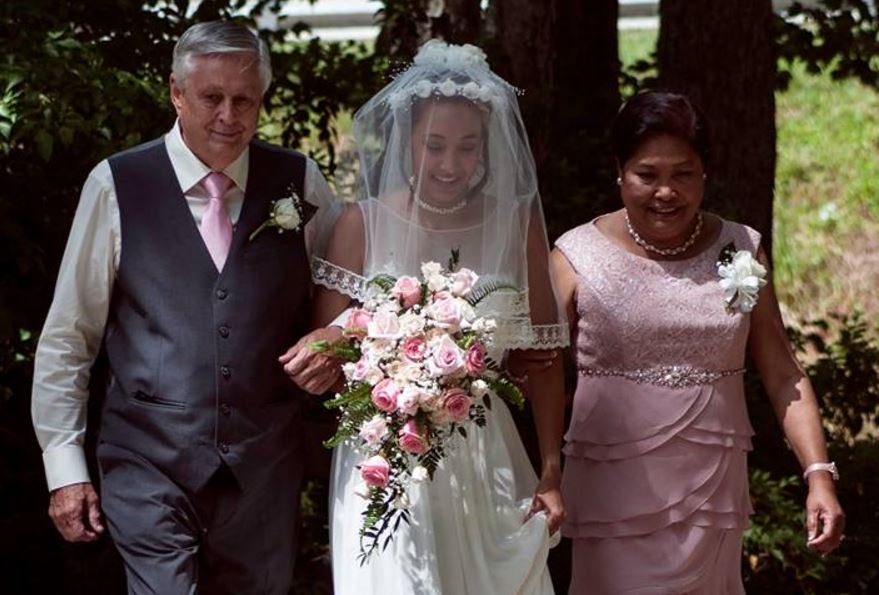
Here comes the bride!

The bride is escorted down the aisle by her parents.

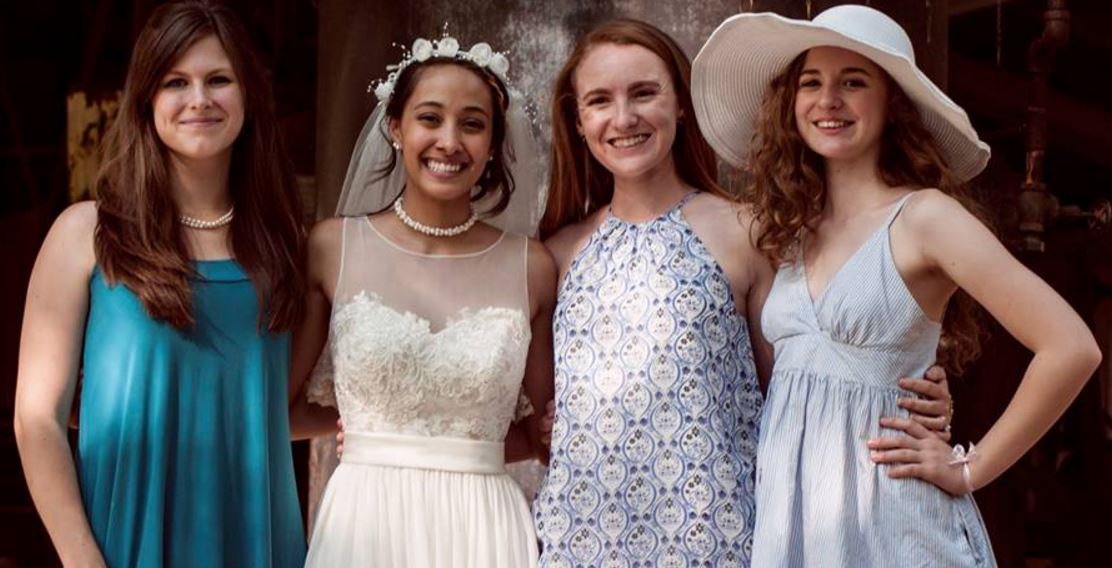
Our two daughters-in-law with our two daughters.

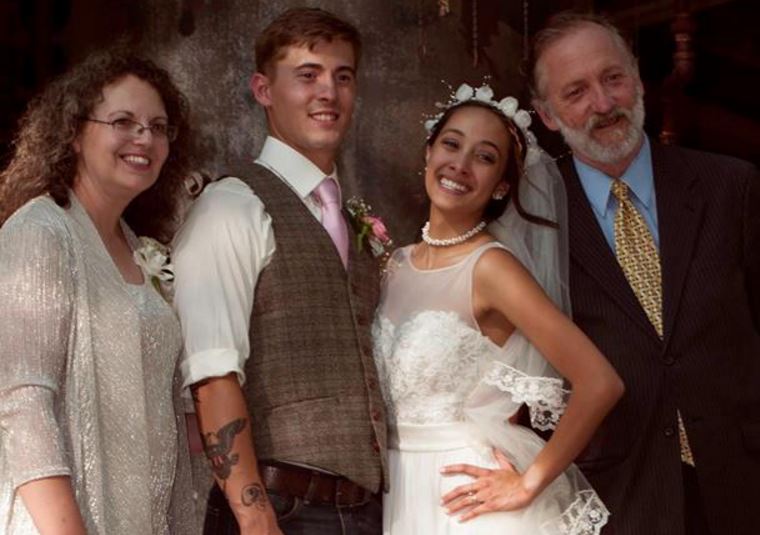
Mrs. McCain, Bob and his bride, me.

There will be more photos later, but right now we have to pack out of this hotel and go help clean up the venue. Thanks to readers who chipped in to help fund this occasion, and to those who haven’t chipped in yet, remember the Five Most Important Words in the English Language:

HIT THE FREAKING TIP JAR!


Army Bob Takes a Bride

Earlier this year, my son Bob and his girlfriend came to visit us for Easter. Bob has been in the Army since 2013 and, while stationed at Fort Bragg, met a lovely girl named Johanna who is an art student (she does video animation). While they were visiting, Bob invited Johanna to hike up to Black Rock, a peak on South Mountain along the Appalachian Trial that has been a favorite destination since Bob and his twin brother Jim were about 10 years old. It was a special occasion when Bob and Johanna hiked up and reached the scenic overlook, where he gave her a gift . . .


Yes, that’s an engagement ring on her finger. Bob popped the question, Johanna said yes, and they set the wedding for June 25.

Repeat: June 25. As in Saturday — tomorrow. [Sunday — see update]


The brevity of their engagement can be explained by saying that (a) Johanna is a fine Christian girl from a fine Christian family, so that (b) premarital cohabitation would be unacceptable, and (c) did I mention that married soldiers get a subsidy for off-base housing? Thank you, America, for promoting family values to our troops in such a direct way.

Our soldier is due for promotion at the end of this month, which means the couple soon will be Sergeant and Mrs. McCain. This makes the third of our six children to get married. Our oldest daughter Kennedy married her high-school sweetheart in 2010, while Bob’s twin brother Jim and his wife already have two sons. It’s a good kind of sibling rivalry.

Jim and Bob at Jim’s wedding.

Bob and Jim, age 5.

They were so inseparable (and almost indistinguishable) as boys my wife and I just called them “the boys,” as in, “Where are the boys? What trouble did the boys get into today?” For the first six years of the twins’ lives, our kids were “Kennedy and the boys.” Then came two more brothers and a baby sister, but Bob and Jim as “the boys” were a phenomenal tag-team of mischief. There was both teamwork and rivalry between them, and so when Jim married a lovely girl and provided us with two wonderful grandsons, it was like, “Gotta step up your game, Bob.”


Well done, soldier. Now, it’s time for the Old Man to do his part — rattling the hell out of the tip jar. Mrs. McCain expects me to foot the bill for our trip to North Carolina, three nights in a hotel, etc., and so I’m dusting of the Shoe Leather Fund, and requesting reader support for this 740-mile round-trip expedition. About $600 should suffice, so if 120 readers gave $5 each, or 60 readers gave $10 each, or 30 readers gave $20 each, this would enable me to tell my wife, “See? This blogging thing is a real job. The readers actually do care.”

Believe it or not, after all these years and the many miles I traveled on the Shoe Leather Fund, sometimes my wife occasionally doubts the power of the Five Most Important Words in the English Language:

HIT THE FREAKING TIP JAR!

Thanks in advance. I’ll post wedding photos this weekend.

UPDATE 10:30 p.m.: Greetings from beautiful downtown Sanford, N.C.

About 20 minutes after we left home, my brother called to inform me that the wedding is Sunday, not Saturday, which goes to show you how out of the loop I am in terms of the planning operations.


Julie Bindel Is Right: Marriage Can Never Be Feminist (So Don’t Marry a Feminist)

“Marriage is not about equality. It’s about perpetuating male privilege.”
— Julie Bindel, U.K. Guardian, May 25

Julie Bindel is a British feminist notorious for saying that all males should be rounded up and put “in some kind of camp.” She is a radical lesbian who is against heterosexuality, per se. This anti-male ideology is endorsed by many leading feminists, including Professor Charlotte Bunch, Professor Marilyn Frye, Professor Sheila Jeffreys and others. As Professor Susan M. Shaw and Professor Janet Lee declare in their textbook Women’s Voices, Feminist Visions, all women are oppressed by “heteropatriarchy,” a system of “inequality and privilege.”

Quite obviously, therefore, marriage is incompatible with feminism, and Julie Bindel wants to make sure everybody understands this:

Dress it up, subvert it, deny it all you want — marriage is an institution that has curtailed women’s freedom for centuries. But instead of rejecting the patriarchal and outdated tradition, some feminists have decided to “reclaim” it. We may have progressed since the Industrial Revolution, where Mary Wollstonecraft described marriage as “little more than a state of legal prostitution,” but let’s not kid ourselves. Even today, marriage is not about equality. It’s about perpetuating male privilege. Being given away by your father may seem cute and romantic, but it stems from a time when women were seen literally as their father’s, and then their husband’s, property. The majority of brides still opt for a white gown, but the implication that brides should be virgins is both ludicrous and insulting to women. That a female who has had sex is somehow spoiled goods goes against everything feminists claim to stand for. I know feminists who have taken their husband’s name because they say it’s easier. Easier than changing your personal email address, utilities bills and bank account details, I suppose. You’re basically being branded, so anyone who sees your name knows immediately who you belong to. Even if a woman does away with all these traditions, accept it — marriage can never be a feminist act. It has formed the backdrop to women’s oppression for centuries and it continues to do so. Forced marriage, child brides and polygamy all show how human rights of women and girls all too often go hand-in-hand with marriage. It was not until 1991 that rape in marriage was made a criminal offense in England and Wales, and today it is still perfectly legal for a man to rape his wife in 47 countries worldwide. If you want to get marriage, then just get on with it, but please stop pretending that because you’re a feminist, it’s some kind of subversive statement. I love Snoop Dogg despite his woman-hating lyrics, but I don’t pretend that listening to him is a feminist act, and women should stop pretending that marriage is anything other than a tool for their own oppression. Anyway, as the late human rights lawyer Paula Ettelbrick said, “Marriage is a great institution, if you like living in institutions.”

You can argue with Julie Bindel about the details of her anti-marriage rant, if you wish, but I never argue with feminists. All I do is quote them, so that everyone understands what I mean when I say Feminism Is a Totalitarian Movement to Destroy Civilization as We Know It.

Of course, it would be impossible for feminists to be oppressed by marriage, if men did not make the mistake of marrying feminists. Honestly, I can’t imagine why any man would do such a foolish thing:

Never talk to a feminist.
Guys: Learn to take a hint. Learn to walk away.
If a woman tells you she is a feminist, say nothing and walk away.
No feminist wants to hear what a man has to say, and life is too short to waste your time taking to feminists. Just walk away.
Leave feminists alone, and then they can complain about that.

Avoiding feminists, however, does not mean that a man is not oppressing feminists, to whom the very existence of males is oppressive.


Marriage Matters

Melissa Braunstein (@slowhoneybee on Twitter) is one of the handful of conservatives — along with Christina Hoff Sommers and Ashe Schow — who work the feminism beat on a full-time basis. She has an excellent article at The Federalist about the A&E series “Married at First Sight”:

Jann Gumbiner, a licensed psychologist and clinical professor at the University of California, Irvine College of Medicine, watched her own parents divorce when she was young. She wrote on Psychology Today’s blog:

Psychological theory of the 70s was heavily influenced by Maslow and self-actualization theory. People believed that it was OK to get divorced for self-growth. It was OK for parents to leave families to pursue a dream of happiness.This is selfish, plain and simple.

It’s now-grown children like Gumbiner that we see on “Married at First Sight.” These 20- and 30-somethings may be professionally successful, but emotionally speaking, they are the walking wounded.
In recent decades, boys have been told that they must not be overtly masculine, let alone chivalrous, because that would be sexist. American girls, meanwhile, have been taught that they must be strong and assertive, and that they don’t need a man.
Now, a woman doesn’t need a man, but she might want one in her life. While assertiveness can be a net positive, there must be room for compromise, because most of us find long-term happiness in complementary, caring relationships. But when young people enact this guidance, it doesn’t always play out happily.
Consider the latest season of “Married at First Sight.” . . . The six current “Married at First Sight” participants — all millennials — were plucked from 2,500 Atlanta-area singles, underscoring the widespread appeal of reality TV participation. . . .
Notably, five of the six singles participating this season saw their parents split by the time they were in high school. Divorce can have a long-lasting impact on children,including on their health.

Dr. Beverly Rodgers, founder of Adult Children of Divorce Parents and counselor for married couples from divorced families, said that many of her clients explain they feel ‘an overwhelming sense of doom’ about their relationships. A major consequence of this, she said, these children often have trouble trusting romantic partners in their adult lives because ‘trust could leave them feeling duped or foolish, in the same way that one or both parents felt in their own divorce.’

Of course, many children of divorce grow up to be emotionally healthy. However, some of the newlyweds here are uneasy with vulnerability and trust. Whether that’s related to the toxicity of their parents’ marriage, fall-out from the divorce, or an X-factor isn’t clarified, but surely that history haunts these new unions.

Read the whole thing. (Hat-tip: Instapundit.) Distrust, hostility, fear of commitment — if you’ve ever encountered one of these “walking wounded” victims of parental divorce, you know exactly what she’s talking about.  The first generation of these victims were the so-called “Generation X” kids born in the late 1960s and ’70s. Many of them became parents in the 1990s, and divorced, and so now you have a lot of 20-somethings whose parents and grandparents are divorced. Breaking the cycle of marital failure may be very difficult for such people.

Related: Wednesday, I spent a lot of time researching Professor Sandra Bem, a pioneer of feminist gender theory and author of the widely cited 1993 book The Lenses of Gender: Transforming the Debate on Sexual Inequality. I’ll write more about her later, but what is important to know is that, for decades, she and her husband, Professor Daryl Bem, were leading advocates of “egalitarian marriage” and “gender-neutral parenting.” After hours of researching, I came across a quote from Sandra Bem’s 1998 book An Unconventional Family.

This is significant, I think. What is suggested by the fact that this celebrated feminist “egalitarian marriage” ultimately failed, and that both spouses then entered homosexual relationships? And how do you suppose the experiment in gender-neutral parenting turned out?


A Prelude to Social Destruction

“Politics is downstream from culture,” Andrew Breitbart often said. This was why I spent Thursday writing 4,000 words — “Let’s Bring Back Guilt and Shame” — in preparation for the Supreme Court ruling on same-sex marriage which, as anyone who had been paying attention could have predicted, was a 5-4 decision with Justice Kennedy as the decisive vote. What we may discern from reading Justice Kennedy’s ruling is the same thing we discern from reading vulgar expressions of “gay pride” on Tumblr blogs. In both instances, we are confronted by irrational sentiment that not only refuses to recognize the potential for harmful social consequences, but which further insists that opponents are motivated by ignorance and prejudice. The Obergefell decision is not so much a legal argument as it is an accusation of bigotry against American society, an indictment of a nation that imposed a “demeaning” stigma on homosexuals. The decision declares that “marriage is a keystone of the Nation’s social order” (p. 4) before proceeding to declare that this social order must be destroyed because . . . well, why exactly?

There is no difference between same- and opposite-sex couples with respect to this principle . . .

(What principle? Never mind. Justice Kennedy’s on a roll now.)

. . . yet same-sex couples are denied the constellation of benefits that the States have linked to marriage . . .

(You see that, in Justice Kennedy’s enlightened mind, the “benefits” of marriage are supplied by government, rather than being intrinsic to the nature of marriage.)

. . . and are consigned to an instability many opposite-sex couples would find intolerable. . . .

(How dare you “consign” them to “instability,” you haters!)

It is demeaning to lock same-sex couples out of a central institution of the Nation’s society . . .

(They’re locked out of the institution — by haters!)

. . . for they too may aspire to the transcendent purposes of marriage.

(My wife has “transcendent purposes” for me to take out the garbage.)

The limitation of marriage to opposite-sex couples may long have seemed natural and just, but its inconsistency with the central meaning of the fundamental right to marry is now manifest.

What can anyone say in reply to such a lecture, except to wonder how or why this alleged “inconsistency . . . is now manifest” in a way it was not manifest at the time the Fourteenth Amendment was drafted and ratified by legislators who never so much as hinted any intention to alter the definition of marriage? Quite obviously, what is at the heart of this specious reasoning is a determination that gay people must be granted access, via marriage, to that “constellation of benefits” of which Justice Kennedy spoke. That is to say, insofar as the Welfare State doles out taxpayer dollars to straight people because of marriage, gay people must also be cut in for their share of the government-provided loot, and who cares what the larger consequences may be? We may expect, for example, that this will hasten the bankruptcy of Social Security as gay “widows” qualify for survivors benefits, but it is clear that Justice Kennedy would never pay heed to any such practical concern.

“The opinion is couched in a style that is as pretentious as its content is egotistic. . . . The Supreme Court of the United States has descended from the disciplined legal reasoning of John Marshall and Joseph Story to the mystical aphorisms of the fortune cookie.”
— Justice Antonin Scalia, dissenting

Equality with a capital E and Progress with a capital P are the inspirational touchstones of Obergefell. The past is a museum full of obsolete prejudices, where ideas that “may long have seemed natural and just” are dismissed as inferior to the ideas of our Enlightened Arbiters of Social Justice, these robed judicial eminences who are authorized to lecture us about the central meaning of fundamental rights. We can read the Constitution the same as they can, but only they are endowed with the extraordinary insight necessary to find “manifest” there a “principle” which had hitherto escaped our feeble perception.

The quasi-religious devotion to Equality and Progress that animates Obergefell moved Justice Kennedy to a mood of poetic rapture that reaches its ecstatic climax in his conclusion:

No union is more profound than marriage, for it embodies the highest ideals of love, fidelity, devotion, sacrifice, and family. In forming a marital union, two people become something greater than once they were. As some of the petitioners in these cases demonstrate, marriage embodies a love that may endure even past death. It would misunderstand these men and women to say they disrespect the idea of marriage. Their plea is that they do respect it, respect it so deeply that they seek to find its fulfillment for themselves. Their hope is not to be condemned to live in loneliness, excluded from one of civilization’s oldest institutions. They ask for equal dignity in the eyes of the law. The Constitution grants them that right.

One imagines the pages being stained and stuck together after Justice Kennedy finished writing that paragraph. Then he smoked a cigarette, got dressed in a hurry, put a $100 bill on the night stand and left quietly, while the Constitution cried herself to sleep.

About 20 years ago, when liberals began their push for gay marriage, it struck me as an absurd idea. I’m sure most other Americans felt the same way about it, and the social conservatives who took it seriously at the time seemed like hysterical alarmists. Certainly if anyone had told me, circa 1995, that we would reach this point so quickly, I would not have believed them, for I simply could not imagine that we would ever reach this point at all. Trusting in the basic common sense of the American people, I underestimated the persuasive power of the media and the entertainment industry, which have been playing the role of cheerleaders at the LGBT pep rally for so long. Also, I underestimated the extent to which the liberal gospel of Progress and Equality had taken root in the minds of people who, wishing to avoid serious thought about politics and social order, were content to go along with the crowd.

Conscientious people did not want to make themselves unpopular by resisting too loudly this lemming-herd stampede toward the cliff. If you do not wish gay people to be “condemned to live in loneliness” — note well Justice Kennedy’s accusatory implication that opponents are engaged in wanton cruelty — then you must Do Exactly What They Say and Give Them Exactly What They Demand. Thus we arrived at a 21st-century cultural Munich, where marriage was the Sudetenland.

Do you suspect that this will not be the totalitarians’ Final Demand? Well, you’re just a hateful homophobe, aren’t you?

What next? Ace of Spades ponders this briefly:

Now come the knock-on cases, where they ban federal funding of religious schools that don’t recognize gay marriage.

This is obvious enough, and there are many more equally obvious ramifications of Obergefell. The angry LGBT mob, full of destructive rage, will seize the whip they’ve been handed by the Supreme Court and employ it to inflict their sadistic revenge on America.

Be afraid. Be very afraid.



N.C. Schools Employ Radical Lesbian Who Called Marriage ‘Slavery’ for Women

By Robert Stacy McCain (@rsmccain on Twitter)

A pioneering lesbian activist who called heterosexuality “the ideology of male supremacy” and condemned marriage as “slavery” for women is now working as a math teacher in North Carolina.


As a graduate student in 1969, Margaret Small helped begin what became the Women’s Studies program at the State University of New York’s Buffalo campus and in 1972 co-taught a course called “Lesbianism 101” recognized as the first such class taught in the United States. Since 2009, Small has been employed as a K-12 Mathematics Curriculum Specialist for Buncombe County Schools in Asheville, N.C., according to her LinkedIn profile. However, in the 1970s, she was a member of a radical lesbian collective known as The Furies, co-founded by legendary feminist Charlotte Bunch. Small’s 1975 essay “Lesbians and the Class Position of Women” offered a Marxist interpretation of “lesbian consciousness” as part of a “revolutionary struggle” to end women’s “oppression” in the “relationship of slavery,” as she called marriage.

“Women’s oppression is based in the fact that she reproduces the species,” Small wrote in the essay, published in Lesbianism and the Women’s Movement, a book co-edited by Bunch and Nancy Myron. “The relationship of men to reproduction is defined by a single act of fucking at the moment of impregnation and ends at that point.”

Invoking the historical theories of Friedrich Engels (colleague of Karl Marx and co-author of the 1848 “Communist Manifesto”), Small declared: “Class society arose because of the oppression of women. . . . The exploitation of all women by all men made possible the exploitation of some men by other men. The more exploitative the relationship between men and women becomes, the stronger and more vital become the institutions of male supremacy.”


After getting her master’s degree from SUNY-Buffalo in 1973 Small “worked for 8 years as a machinist, first in a shipyard in San Diego and then at several manufacturing plants in Chicago,” before returning to school at the University of Illinois-Chicago, according to an online profile. She became a math teacher in Chicago public schools, got her PhD. and, in 2000, became “a founding Director of the Young Women’s Leadership Charter School of Chicago (YWLCS),” the only all-girls public school in Chicago. Small moved to North Carolina in 2009 and, in 2013, married her lesbian partner Peggy Baker. Also a former YWLCS teacher, Baker runs an education non-profit, EASL Institute, whose clients include schools in North Carolina, New York and Chicago.

Margaret Small’s pioneering work in the feminist movement has been recognized in numerous books, including Breaking the Wave: Women, Their Organizations, and Feminism, 1945-1985, edited by Kathleen Laughlin and Jacqueline Castledine (2010), and the Historical Dictionary of the Lesbian and Gay Liberation Movements, by JoAnne Myers (2013). Her role in teaching the first lesbian university course (along with Madeline Davis) was cited as No. 10 on a list of “20 Notable College Moments in LGBT History” by Best Colleges Online.

Small’s 1975 essay condemning marriage and heterosexuality has been cited in such books as Separatism and Women’s Community by Dana Shugar and The Invention of Heterosexuality by Jonathan Katz. The essay was adapted from a speech Small gave to the Wasington, D.C., think tank Institute for Policy Studies (IPS) on behalf of The Furies.

“In terms of the oppression of women, heterosexuality is the ideology of male supremacy,” Small wrote. “In order for men to have a justification for exploiting women and an ability to enforce that exploitation, heterosexuality has to become, not merely an act in relation to impregnation, but the dominant ideology.”

Under male supremacy, Small asserted, women “become defined as appendages to men” in a system “which maintains the ideological power of men over women.” Small’s article (the full text of which is embedded below) declares: “Heterosexual hegemony insures that people think it natural that male and female form a life-long sexual/reproductive unit with the female belonging to the male.”

Lesbians, Small wrote, were crucial to “the development of revolutionary consciousness” because they are “outside of the reality which heterosexual ideology explains.” Heterosexuality would become “irrelevant” as alternatives to sexual reproduction were developed.

“Male supremacy is what is attacked in lesbian ideology,” Small wrote. “What we are doing in revolutionary struggle is to make our consciousnesses different. When enough people’s consciousnesses are different, then we make a revolution.”

The Furies collective, which Small represented in her speech at IPS, was formed by Bunch and others in 1971, and announced its revolutionary feminist goals in early 1972. Bunch’s manifesto, “Lesbians in Revolt,” is included in many university Women’s Studies textbooks and curricula. Bunch became a distinguished academic at Rutgers University and in 1999 was honored with the Eleanor Roosevelt Award for Human Rights by President Bill Clinton. (Click here to see C-SPAN video of Hillary Clinton’s speech at the December 1999 ceremony.)

Lesbian Margaret Small 1975 by himself2462


John Hoge and Jeanette Runyon assisted in the research for this article, which is part of the Sex Trouble project that has been supported by contributions from readers. The first edition of Sex Trouble: Radical Feminism and the War on Human Nature is available from Amazon.com, $11.96 in paperback or $1.99 in Kindle ebook format.


‘Fempocalypse’

Exactly how I never before noticed the blog “Owning Your Sh*t,” I’m not sure. This lady has got it nailed cold:

Okay, someone commenting on my last video scoffed at my assertion that unless our attitudes change, society will, sooner or later, reach a…well, let’s call it a “fempocalypse.” That is, that feminism will eventually help bring about an economic and social collapse.
Many people are simply unable to wrap their heads around that idea, because we’ve all been told, ad nauseum, that feminism is a cause of prosperity, when in reality, it is largely–perhaps entirely–a consequence of it.

Watch the video:

Here is a key paragraph:

“By prioritizing women in education at all levels, we have handicapped men’s ability to be as productive as the system needs them to be to maintain itself. By encouraging single motherhood and allowing women to banish fathers from their children’s lives, we’re creating half a generation of boys who risk becoming unemployable and expensive burdens on the system as adults, and half a generation of girls who are more likely to perpetuate and exacerbate the problem by becoming single mothers themselves.”

These two factors are interrelated. When you separate motherhood from marriage — by subsidizing illegitimacy and incentivizing divorce — you are consequently disincentivizing the behaviors necessary to successful marriage. That is to say, where women’s desire to become mothers requires them first to attract a man’s commitment to monogamy, mothers will teach their daughters (and other cultural institutions will support this teaching) how to be the kind of women men want to marry. Meanwhile, in a marriage-oriented society, men will strive to become the kind of men that women admire and respect, in order to obtain the benefits of marriage.

Break this connection, however, and the whole thing unravels. Men and women can behave however they wish, without really losing anything. If everybody is selfish and irresponsible, and if “society” (i.e., the taxpayer) enables these attitudes and behaviors, then why teach your daughter the virtues of the Good Wife? Or why teach your son to strive toward the kind of behavior necessary to attract and keep the Good Wife? Let him be a “playa” with a string of “baby mamas,” and so what? Furthermore, since women can’t rely on men to behave responsibly, “prioritizing women in education at all levels” is necessary so that women can fend for themselves. Why invest in education for boys, if males are just lazy, violent, selfish, unreliable creatures who contribute nothing useful to society?

These attitudes are part of a syndrome that is like a snowball rolling downhill, gathering momentum until, next thing you know, it’s Detroit.

“Owning Your Sh*t Is” is an awesome blog, and you should follow her (@girlwriteswhat) on Twitter, too.


Fertility Delayed Is Fertility Denied


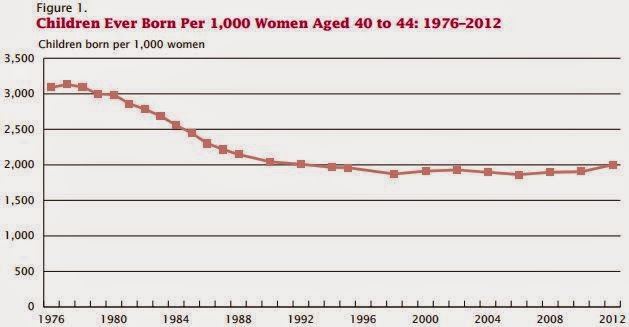
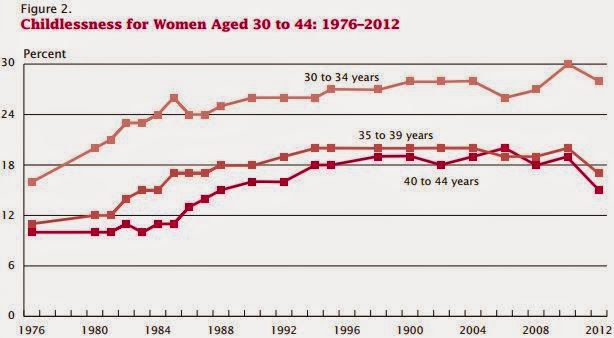
The Census Bureau issued a new report yesterday about the increase of childlessness among American women and, although they provide only a press release and XLS data (rather than a full report), the highlights of the data are perhaps ominous:

The percentage of U.S. women in their 30s and 40s who are childless is rising, new data from the U.S. Census Bureau show.
Some 15.3% of U.S. women aged 40 to 44 were childless in June 2014, up from 15.1% in 2012. . . .
For women in their late 30s, the rise in childlessness is sharper. Around 18.5% of women 35 to 39 were childless last June, up from 17.2% in 2012.
All told, 47.6% of U.S. women aged 15 to 44 were without children last year, up from 46.5% in 2012.
The data are the latest to show that childlessness is on the rise in the U.S. as more women (and their partners) delay marriage and childbearing.
Because fertility declines significantly for women in their 40s — the Centers for Disease Control and Prevention define a woman’s child-bearing years as 15 to 44 — demographers carefully watch these women to get a sense of how many children Americans are having, or not. . . .
With more women having their first child in their mid 30s, late 30s and early 40s, American families may be shrinking: The number of women aged 40 to 44 who had only one child roughly doubled between 1976 and 2014, Census said.


A more in-depth Census report on the 2012 numbers shows that, in 1976, 10% of women 40-44 (a cohort born 1932-36) were childless, whereas in 2012, 15% of women 40-44 (a cohort born 1968-72) were childless. An ethnic breakdown of the 2012 numbers shows important differences:

White (non-Hispanic)
0 …………………. 16.4
1 …………………. 19.2
2 …………………. 36.6
3 or more ……. 27.8

Hispanic
0 …………………. 10.0
1 …………………. 15.5
2 …………………. 28.7
3 or more ……. 44.9

Non-Hispanic white women were 64% more likely to be childless than Hispanic women, whereas Hispanic women were 61% more likely to have at least three children. Notice when you break it down this way:

White (non-Hispanic)
0 or 1 ………….. 35.6
2 or more ……. 64.4

Hispanic
0 or 1 ………….. 25.5
2 or more ……. 73.6

Considering so-called “replacement level” fertility (2 children per woman), we see that Hispanic women are 14% more likely to be at or above this level, whereas non-Hispanic white women are 40% more likely to be below replacement level. And if we look at the Census report’s data comparing U.S.-born women to immigrants, we find these numbers:

U.S.-born women, ages 40-50
Lifetime births (average) ….. 1.93
Childless ………………………….. 17.2%

Immigrant women, ages 40-50
Lifetime births (average) ….. 2.24
Childless ………………………….. 11.4%

So, immigrant women on average had 16% more children, and U.S-born women were 51% more likely to be childless. Now let’s break down the numbers by educational achievement:

Not a high school graduate
Lifetime births (average) ….. 2.6
Childless ………………………….. 11.6%

Bachelor’s degree
Lifetime births (average) ….. 1.8
Childless ………………………….. 19.9%

High-school dropouts, on average, had 44% more children than women who had college diplomas. Childlessness was 72% more common for college graduates than for high-school dropouts.

If you’ve studied population demographics, you realize that trends like these generally take decades to develop, and that finding cause-and-effect correlations is difficult. That is to say, people’s beliefs developed in childhood, their behavior as teenagers and the prevailing cultural trends in their young adult years will have an effect on whether they eventually have children. Today’s 40-year-old woman was born in 1975 and turned 18 in 1993, so if she is childless now, this necessarily implicates her choices and behaviors in the 1990s, as well as the belief system with which she was raised in the 1970s and ’80s.

Women’s behaviors are necessarily affected by men’s behaviors. If men are avoiding marriage and fatherhood — as Dr. Helen Smith’s Men on Strike documents — it will be more difficult for women to become wives and mothers. It may also be the case that men who might want to be husbands and fathers lack either the social skills or the financial resources needed to attract wives. Alternately, we may theorize that a general social climate of distrust and hostility between men and women make marriage and parenthood more problematic.

Studying demographic trends involves the complex interaction of multiple variables over time. However, it is important to note this: People make trends and not the other way around. That is to say, the individual is always free to act independently of the larger social trend, to swim against the demographic stream. You can make your own high-fertility subculture within a low-fertility society. My being a father of six is the result of beliefs and choices in the same way that other people become childless as the result of their own beliefs and choices.

People want to “fit in,” to have the approval of their peers and of the societ around them, and so being “conformed to this world” is the usual way of life. There is a prejudice I call “middle-classness,” which encourages young people to believe that they must have the credentials and accoutrements of middle-class life — college education, professional career, new cars, home ownership — or else be considered failures. This kind of concern for social status is perfectly understandable, yet in our striving for status (and encouraging our children to do the same) we can easily succumb to the kind of mentality that has produced the trend toward childlessness manifested in the latest Census Bureau report.

Did all these women decide to be childless? No.

If you could go back to 1993 to interview the 18-year-old who today is a childless 40-year-old, she likely would say she wanted to be a mother “someday,” under certain circumstances. However, those circumstances did not arise and thus “someday” never arrived.

The Contraceptive Culture encourages women (and men) to believe that fertility is entirely a matter of personal choice, but any fertility specialist will tell you this is a myth. The woman who has not become a mother by age 30 will have a significantly higher risk of experiencing infertility if and when she does try to become pregnant. And even if she has no medical problems with her reproductive health, the woman who delays motherhood past 30 will on average have fewer children in comparison to women who have their first child before they are 30.

Fertility delayed is fertility denied. Demographics is ultimately a matter of arithmetic, although the numbers involved represent human lives and the choices we make based on our own beliefs.

“See, I have set before thee this day life and good, and death and evil . . . I call heaven and earth to record this day against you, that I have set before you life and death, blessing and cursing: therefore choose life, that both thou and thy seed may live.”
— Deuteronomy 30:15, 19 (KJV)

RELATED: