Or serfdom. Whatever. President Barack Obama Parkway in Orlando will be built with federal stimulus money.
That is, if those stingy mean-spirited Republicans don’t find a way to stop it. They’re always obstructing Hope and Change, you know.
"One should either write ruthlessly what one believes to be the truth, or else shut up." — Arthur Koestler

Or serfdom. Whatever. President Barack Obama Parkway in Orlando will be built with federal stimulus money.
That is, if those stingy mean-spirited Republicans don’t find a way to stop it. They’re always obstructing Hope and Change, you know.
In punk-smacking young Isia Jasiewicz the other day, I evidently touched the pride of one of Jasiewicz’s fellow Princeton alumni. Ben has expressed his embarassment on his own blog, and in a comment at my post:
It’s pretty clear that the kid meant just to sneer at Beck — problem for her is that she revealed just how little she knew about 20th century intellectual history with her snide little description/dismissal of The Road to Serfdom.
As far as the top schools go, though, Princeton is pretty good on this stuff.
About a quarter of its student body votes Republican (25% for W in 2000, as I recall), and it was where I found out — from my friends, not my profs — that right-wingers didn’t have horns and make sacrifices to Lucifer at night.
And when I made a snide remark about George W Bush in my senior thesis (a year and some before I voted for the man), my advisor made me take it out — it weakened my paper, she said. (And she was right, of course.)
Anyway, Princeton is about as friendly as it gets, for Ivy League conservatives — people actually believe in freedom of expression there, unlike, say, at Brown.
So lay off a little, will you? Robert George has his Madison program there and is bringing alternative views to the ignorant.
Which prompted me to send Ben an e-mail:
Ben:
You’ll excuse my digs at the Princeton girl who flubbed Hayek, and I hope you won’t take it as a *general* putdown of your alma mater. It wasn’t even really a putdown of the girl who wrote that Newsweek item, merely a disciplinary whack upside the head to get her attention. These young kids think they know everything and must occasionally be reminded that they really don’t.
It happens that the finest intern we ever had at The Washington Times, Laura Vanderkam, was a Princetonian. So I am favorably disposed toward the institution. Also, my great-grandfather’s brigadier, J.J. Archer, was a Princeton man. Both were both captured at Gettysburg when the Iron Brigade outflanked them at Willoughby’s Run July 1.
— RSM
Being the southernmost (* see note below) of the Ivies, Princeton has always had its quota of Southerners, going back at least as far as when Virginia’s James Madison was a student during John Witherspoon’s presidency of Princeton. And I note that Isia Jasiewicz also has Southern ties, having grown up in Lexington, Virginia, where her father Krzysztof Jasiewicz is professor of sociology and anthropology at Washington and Lee University.
Miss Jasiewicz’s unfortune early detour into celebrity literary criticism (“Hey, let’s all have a Glenn Beck beatdown!”) need not permanently mar her otherwise promising career. Isia writes well — check out the clever piece on how Gary Cooper saved Warsaw she published at Newsweek last year — but I still hold that the proper job for a beginning journalist is as a regular news reporter.
Kids starting out in the news business need to be shoved onto a beat where they are required to crank out hundreds of words a day of deadline reporting — sink or swim. Wherever your ambitions may ultimately take you, there is no substitute for that kind of experience. I just received this e-mail:
By any chance did you work at the Calhoun (GA) Times in the late ’80s? Your career background would fit, and you look a lot like the Stacy McCain that I worked with there (well, you don’t have that “Flock of Seagulls” hair that he had LOL). Regardless, it looks as if you’ve worked hard and achieved a lot.
Good luck!
Jim G–
Heh. I never thought of it as a “Flock of Seagulls” haircut, although maybe I did sometimes get a little carried away with the styling products on the pompadour. As to hard work, I probably never worked harder in my life than when I was sports editor of the Calhoun Times.
Pulling insane deadline all-nighters to provide complete coverage of high school basketball tournaments is the kind of experience that came in handy when, for example, I found myself in the coffee shop at the Buffalo airport with mere hours to provide the final wisdom on Doug Hoffman’s NY-23 campaign. “Fourteen hundred words by noon? No problem.”
The ability to crank it out lightning-quick, by the way, is why Laura Vanderkam sticks out in memory as such a splendid intern. She arrived in the newsroom one morning in May or June — was it 1999 or 2000? — and got her first assignment about 11 a.m. About 2 p.m., she came over to the national desk and announced that she’d filed her story. Not expecting much, assistant national editor Joe Curl (who has since become White House correspondent) opened the file. His reaction: “Damn. She can write.”
Usually, you hand an intern an assignment and don’t expect much. You especially don’t expect much very soon. College kids have a way of dawdling over stories and not being sufficiently aggressive in blind-calling sources. But Vanderkam had quickly made her phone calls, done her research and cranked out 14 column inches (about 600 words) in about three hours. We were impressed.
Vanderkam recently published her second book and has a blog. Let other young Princetonians emulate her example.
* — A commenter below points out that Penn, in Philadelphia, is actually about 45 miles farther south than Princeton. I stand corrected.
by Smitty
Fabius puts up a post, “Will people on the right help cut Federal spending?“, that could have as easily been entitled “Will Lopping The Heads Off Of Dandelions Improve The Lawn?”
Fabius, the debt and deficit we face are rooted in the Federal government undertaking non-Federal tasks. Realizing that chronic deficit spending is unethical is a crucial corner to turn, or acute reductions in budgets will remain smoke, mirrors, and gimmickry. Until the economy catastrophically ‘splodes.
Fabius asks:
Will the people on the right, aflame with deficit-cutting fervor, cut the 25 – 30% of the government’s budget spent on defense (DoD, nukes, vets, pensions, foreign intelligence)? Without doing so it’s unlikely the budget can be balanced. . .
Yes, the DoD should feel the axe, particularly in the acquisition realm. Vets, not so much.
However, Defense remains a Constitutional, Federal task. So, until you figure out a way to de-globalize the economy, and re-orient the US away from being Team America: World Police (TAWP) (not a bad idea, but not one that can be achieved as quickly as Ron Paul would like), look for the build-down to go slowly.
Let’s double down on the point, since Fabius mentions Eisenhower: the National Security Act of 1947, too, is a part of Progressivism that must come under scrutiny. Prior to the WWII buildup, the US never maintained substantial military forces between wars. We can argue about Teddy Roosevelt and the Great White Fleet as a precursor to the modern TAWP, and Alfred Thayer Mahan as the face that launched copious tonnage, but that underscores my point.
The transition away from the global military superpower toward whatever nuanced, yet-to-be-named, post-everything utopia will be a slow one. It’s taken over a century to dig the military money-pit. The world direction, politically, seems to want to be in the direction of centralization, with the League of Nations giving way to the perpetually flailing United Nations. The Information Age exposes the truth that these so-called Statesmen would be twice as effective if they were half as bossy, with a quarter of the legislation they sign.
Full circle, then: real improvement will come from mature, historical analysis of what the country is trying to achieve at what level. Historical analysis and Hayek show that vast power in the hands of few is neither traditional, nor healthy, nor (if we dare let the Constitution mean what it says) legal.
Here’s a handy little chart showing the pattern of job losses in recessions since World War II:

That big red line is the current recession, and Scott Stoddard of Investor’s Business Daily explains:
Job recoveries have been increasingly sluggish over the past several recessions and the current downturn looks to be the longest since at least World War II. . . .
Today’s jobs slump, already at 29 months, could last five years or more, analysts say. Employers are expected to stay cautious amid a sluggish economic recovery.
“It would be strange but not inconceivable” for employment to fall short of its pre-recession peak before the next downturn, said Don Rissmiller, chief economist at Strategas Research Partners. . . .
OK, here come the magic words:
Rissmiller and other economists say a double-dip recession is unlikely. Yet hiring remains painfully slow. Excluding temporary hires for the 2010 Census, the economy has added about 500,000 jobs so far in 2010. The U.S. will need to add about 8 million jobs just to get back to the December 2007 peak, when the recession started.
Excluding the soon-to-disappear Census jobs, employers would need to average nearly 300,000 new jobs a month for the next 27 months just to get to the pre-recession peak by the end of 2012. . . .
Read the whole thing. Everybody keeps saying that a double-dip recession — that is, a “W”-shaped recession, instead of a “V” — is “unlikely.” Right, and if trends turn downward again, I’m sure that will happen unexpectedly.
Speaking of which, what about an unexpected debt crisis?
Former Federal Reserve Chairman Alan Greenspan said the U.S. may soon face higher borrowing costs on its swelling debt and called for a “tectonic shift” in fiscal policy to contain borrowing.
“Perceptions of a large U.S. borrowing capacity are misleading,” and current long-term bond yields are masking America’s debt challenge, Greenspan wrote in an opinion piece posted on the Wall Street Journal’s website. “Long-term rate increases can emerge with unexpected suddenness,” such as the 4 percentage point surge over four months in 1979-80, he said. . . .
“The federal government is currently saddled with commitments for the next three decades that it will be unable to meet in real terms,” Greenspan said. The “very severity of the pending crisis and growing analogies to Greece set the stage for a serious response.”
Don’t worry. I’m sure higher interest rates are as “unlikely” as a double-dip recession. Or the bursting of the Australian housing bubble. Wonder what’s up with gold prices?
UPDATE: Classic Obamanomics: Blame Republicans!
The FDIC has gotten into the habit of announcing bank closures on Fridays:
Regulators on Friday shut down a Nevada bank, raising to 83 the number of U.S. bank failures this year.
The Federal Deposit Insurance Corp. took over Nevada Security Bank, based in Reno, with $480.3 million in assets and $479.8 million in deposits. Umpqua Bank, based in Roseburg, Ore., agreed to assume the assets and deposits of the failed bank.
The failure of Nevada Security Bank is expected to cost the deposit insurance fund $80.9 million.
With 83 closures nationwide so far this year, the pace of bank failures is more than double that of 2009 . . .
The number of bank failures is expected to peak this year and be slightly higher than the 140 that fell in 2009.
Bank failures are expected to be only slightly higher, but (a) we’re actually on pace for about 170 failures this year; (b) the commercial real-estate crisis is getting worse, not better, and (c) “unexpectedly” has become the MSM’s all-purpose adverb for bad economic news lately.
Meanwhile, a new report by the Center for Responsible Lending looks at “Foreclosures by Race and Ethnicity: The Demographics of a Crisis.” The report includes this handy chart:
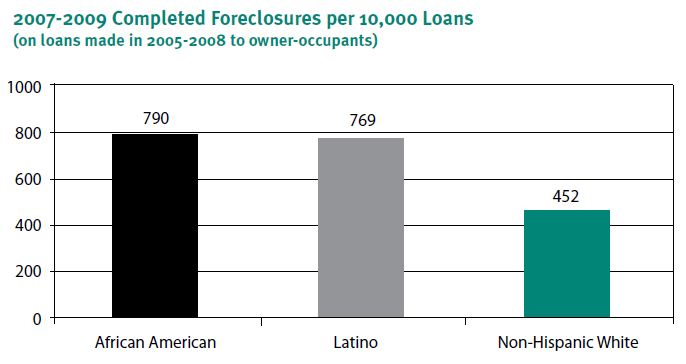
So the foreclosure rate for Hispanic mortgage holders is 68% higher and the rate for black mortgage holders is 75% higher, in comparison to whites. The report goes out of its way to dismiss as “red herrings” any suspicion that the Community Reinvestment Act and the government-sponsored entities (GSEs) Fannie Mae and Freddie Mac had anything to do with this problem.
The conclusion of the report can be summarized this way: People who took out mortgages they couldn’t afford, thus allowing themselves to live (temporarily) beyond their means, were victims of unfair lending practices.
And you people who have limited yourself to only borrowing money you can afford to pay back? You’re chumps.
Ask yourself this: If Fannie Mae and Freddie Mac didn’t cause the foreclosure crisis, why does FDIC Chairwoman Sheila Bair say reforming the GSEs is a top priority?
For decades, the mortgage GSEs raised funds in global markets at preferred, near-government rates on the basis of their quasi-governmental status. For many years, this arrangement lowered the cost of mortgage credit to millions of homeowners without adding to the federal debt. However, in the aftermath of the mortgage credit crisis and the conservatorship of Freddie Mac and Fannie Mae, the implicit backing of these entities is now an explicit cost. Federal subsidies for the GSEs in 2009 and 2010 are estimated at over $300 billion.
In banking, the implicit backing of large financial institutions under the doctrine of Too Big to Fail led to moral hazard and excessive risk taking . . .
Our future financial stability demands that we deal with these implicit liabilities head on, and limit the ability of private companies to take risks at the expense of the taxpayer. In the case of the mortgage GSEs, there are a variety of options for making some of their functions governmental while putting others in private hands. But what we cannot do is perpetuate their quasi-governmental status, which privatizes gains and socializes losses.
So the free ride is over for Fannie Mae and Freddie Mac, at least if Sheila Bair has anything to do with it, but do you really think Chris Dodd and his fellow Democrats want to crack down on their buddies at Fannie and Freddie? Let me remind you of the names of the top three recipients of Fannie/Freddie campaign contributions, 1989-2008:
And a few other names from that list:
Fannie and Freddie have already cost taxpayers upwards of $300 billion, and heaven only knows what the final bill will be at the FDIC for this record-breaking year for bank failures, which might “unexpectedly” be worse than anyone yet imagines. One thing is for certain: Democrats are laughing all the way to the (taxpayer-subsidized) bank.
UPDATE: Welcome, Instapundit readers!
Rick Burgess: “I would dare to say that we would never declare Fornication Pride Month”:
Pam Spaulding is having a conniption. Just in case anyone wants to do a guilt-by-association smear, I’ll point out that Rick and Bubba are alumni of my alma mater, Jacksonville (Ala.) State University, as is James Joyner of Outside the Beltway. And JSU is home of the World’s Most Politically Incorrect Marching Band.
(Via Memeorandum.)
Just in case you haven’t seen this yet:
Not to be judgmental, but by the time your kid learns to do the samba, don’t you think he’s probably ready for potty-training?
Writing about “our founding editor” in third-person again.
Will Folks is not scum. He’s the virus that infects the slime that covers the parasites that inhabit the entrails of scavengers that feed on scum.
(Via Memeorandum.)
UPDATE: Sacred Honor Watch at AOSHQ.