Friedrich Nietzsche vs. Robert E. Lee
Posted on | July 23, 2026 | 1 Comment
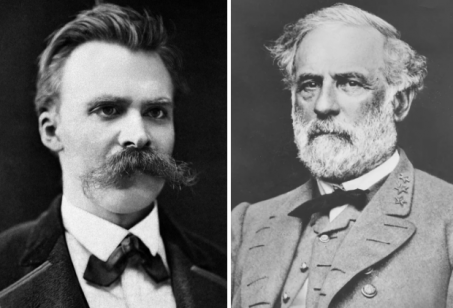
One of the benefits of being a bad student is that, by the time I began to take the world of ideas seriously, I was already an adult, with a job, a wife, three kids and a mortgage. It was in the early 1990s, when I was on the staff of the Rome (Ga.) News-Tribune, that I began haunting the local used book store, snapping up old volumes at 50 cents or a dollar each, pursuing an autodidactic course of remediation, to fill in the gaps in my knowledge that had by then become apparent to me.
The reason I view this way of learning as beneficial is that, unlike my younger self — a carefree hedonist, partying his way through school, paying just enough attention to scrape by — the 30-something me had sufficient life experience to evaluate ideas in a pragmatic manner. By comparison, those who were more diligent and conscientious during their schoolboy years are apt to be impressed by intellectuals in a way that it was impossible for me to be impressed. Understand the difference I’m attempting to illuminate here. Suppose, hypothetically, that I had actually given a damn about my grades when I was in school. In such an imaginary scenario, I would have eagerly followed the instruction of my teachers, taking notes as they explained subjects, striving to internalize the conceptual theme of their lessons so that I could regurgitate it on tests, in essays, etc. In other words, I would have become a mental carbon copy of my teachers, my knowledge limited by whatever was in the assigned textbooks and emphasized in the classroom lectures.
Think about the earnest young student, devoted to maintaining a top GPA, who takes a political science course in which Alexis de Tocqueville’s Democracy in America is an assigned text. In the usual order of things, the professor will have an outline of the lessons he intends to teach during the three or four class meetings in which Tocqueville is discussed. The diligent student will be expected to know by heart some specific points the professor seeks to drive home — the stuff he’s got to know for the final exam — and this summary version is likely to be the entirety of what the student remembers about Tocqueville’s great book. By comparison, think of me, a young newspaper staffer with a full-time job and a family, taking it upon himself to read Democracy in America in his spare hours, with no professor to tell me which parts of Tocqueville’s book I should underline and memorize for the final exam.
Encountering the text as a grownup, without the guidance or assistance of any instructor, with no agenda other than to acquire knowledge of a hitherto neglected subject, is a very different experience than how the high-GPA teenager encounters the same subject. And I pursued this autodidactic experience with many subjects: Edmund Burke, John Stuart Mill, Karl Marx, Ludwig von Mises, on and on. Which brings me, after that 500-word preamble, to the case of Friedrich Nietzsche.

Richard Spencer, moments before the world-famous punch.
Remember the “punch a Nazi” meme? On the day Donald Trump was first inaugurated in 2017, Richard Spencer was on a sidewalk in D.C. giving an interview to the Australian Broadcasting Company, when some Antifa thug blindsided him. Spencer was widely recognized as a leader — arguably the leader — of the so-called “alt right,” and it was this notoriety that made him a target of violence. I’d known him for nearly 10 years by then, having first met him when he was still a graduate student at Duke University, when we were both members of a panel discussion of the notorious Duke lacrosse rape hoax. Richard Spencer is extremely intelligent. He got his bachelor’s degree from the University of Virginia and a master’s degree from the University of Chicago, and was pursuing a Ph.D. at Duke before he dropped out of that program. These are all prestigious, selective universities, and we may therefore deduce not only that Spencer scores very high on standardized tests (which, as everyone knows, are a proxy for IQ), but that he is also a diligent student.
Years ago, I remarked that Richard’s basic problem is that he read Nietzsche at too young an age. Thank God I avoided that, because if I hadn’t been already a busy adult when I finally got around to reading Nietzsche, perhaps I might have been similarly radicalized.
Fortunately, I knew about Nietzsche before ever bothering to read anything he’d written. Nietzsche has a dreadful reputation among the kind of Christians I grew up around. Nietzsche has been widely denounced as an apostle of nihilism, the man who provided the philosophical basis of Nazism. There are those who insist that Nietzsche has been misunderstood, and that he doesn’t deserve such a bad reputation, but my point is, I was warned, and took those warnings seriously. So when, in my early 30s, I spent a weekend actually reading Nietzsche, my attitude toward his work was much like my attitude toward Karl Marx’s writings, which I’d also read extensively during those years.
Does Nietzsche “think outside the box,” as they say? Yes, and in doing so, he reminds us why the box is there in the first place. If “God is dead,” to take his most famous phrase seriously, then where are we? What are the rules in a godless world? Absent a shared moral code, what can be the basis of law? What does it mean to be Beyond God and Evil?
As a sort of thought experiment — the stuff sophomores chat about in a dorm room after they’ve had few bong hits — Nietzsche’s vision has some merit, and I would not deny that there could be benefits to engaging with his ideas, so long as you are adequately forewarned, as I was. Some very profound and scary stuff there and, reading it as an adult, my reaction was to cling even more tightly to “that old rugged cross.” Taking seriously the concept of a post-Christian world, and realizing what it might actually mean, I would urge everyone to pray that no such nightmare ever befalls us. And all of that (now past the 1,000-word mark) is preamble to explaining why I am bringing up Robert E. Lee.
“Boomer conservatives suffer from slave morality,” was the sentence which got me started on this. Never mind who wrote that sentence on X, but of course I recognized “slave morality” as one of Nietzsche’s most influential concepts. It is a deliberate insult to Christians and also, more infamously, an accusation against Jews. Without going into a detailed lecture, suffice it to say that Nietzsche accuses the Jews of devising a subversive value-system, subsequently embraced and spread by Christians, that seeks to undermine the earlier aristocratic value-system of the pagan world — “the transvaluation of all values,” as he calls it.
If one wanted to defend Nietzsche, it might be said that he makes this argument in the context of criticizing the kind of “democratic” egalitarianism that conservatives have always deplored. All of us know people whose ill-considered liberalism is rooted in a confused mishmash of pietistic notions of charity, mercy without judgment, etc. Rather than be content with such specific criticism of the soft-headed foolishness of liberals, however, Nietzsche’s “slave morality” argument attacks Christianity, per se, and in doing so, indicts the Jews as the authors of a devious scheme to sabotage everything noble and aristocratic.
Now, pay careful attention to this:
My experience of men has neither disposed me to think worse of them nor indisposed me to serve them; nor, in spite of failures which I lament, of errors which I now see and acknowledge, or of the present aspect of affairs, do I despair of the future. The truth is this: The march of Providence is so slow and our desires so impatient; the work of progress is so immense and our means of aiding it so feeble; the life of humanity is so long, that of the individual so brief, that we often see only the ebb of the advancing wave and are thus discouraged. It is history that teaches us to hope.
These are the words that Robert E. Lee wrote after the war in a letter to his former staff officer, Col. Charles Marshall. Pause for a moment to consider everything that Lee had lived through at that point, and how much cause he had for discouragement. What tremendous courage he displayed in refusing to “despair of the future”! Well do we understand why Lee has been so widely admired, and praised by men of judgment. Churchill called Lee “one of the noblest Americans who ever lived, and one of the great captains known to the annals of war.”
Re-read Lee’s letter, now, and what do you notice? He professed his duty “to serve” his fellow man, which is what he had done his entire life. Lee was the very embodiment of the “servant-leader” role that Christian preachers urge men to embrace. It is in serving our fellow man, after all, that we emulate Christ. A Christian does not even expect gratitude from those who benefit from his service. Like a soldier, he does his duty not because he expects to be praised, but simply because it is his duty.
Christian faith is, or at least ought to be, a sort of internal guidance system. Seeking always to do the right thing because it is right — rather than because you fear punishment for doing the wrong thing, or because you expect some kind of reward — this is true morality. The fact that Lee, who had commanded a mighty army that fought the greatest battles in his nation’s history, should in his final years of life speak of himself as disposed to serve others, rather than expect them to serve him, is testimony to how deeply rooted his moral code was.
What would Nietzsche have to say of Lee? Certainly this “great captain” embodied everything that an aristocratic value-system would consider praiseworthy. His ancestry was impeccable, the Lee family having been among the most eminent in Virginia since its earliest colonial period, and if anything, his mother’s side of the family was even more eminent. The greatest stain on Lee’s fortunes was that his father, the Revolutionary hero “Light Horse” Harry Lee, had been bankrupted because of bad postwar investments — the victim of a swindle — so that young Robert grew up in the shadow of genteel poverty, his mother dependent on her Carter relatives. By his own good behavior, however, Robert E. Lee made himself recognized as a man of promise at an early age, showing his merit in the Mexican War and other appointments as a young officer.
“Then the war came.” So many Southern stories turn upon that sentence. In the span of just a few months, the nation found itself thrust into a crisis that led inevitably to war, and over the next four years, the South was devastated in a way no one had imagined was possible before the war came. Lee became world-famous as a result — a historic figure in every sense of the word — and yet here he was, the president of a college in rural Virginia, writing a letter to his former aide to explain that his painful experiences had not “indisposed me to serve” his fellow man.
“Slave morality”? If so, we need more such slaves. But don’t come hurling at me phrases from Nietzsche as an insult, because I might be less courteous and patient than General Lee was. Deo vindice.
Comments
One Response to “Friedrich Nietzsche vs. Robert E. Lee”
THE FULL METAL JACKET REACH-AROUND AWARD
HIT THE FREAKING TIP JAR!
Search
Recent Posts
- In The Mailbox: 10.12.26 (Annual Admiral of the Ocean Sea Appreciation Post)
- Rule 5 Sunday: No Fishy Just Sexy
- FMJRA 2.0: A Winning Homestand
- In The Mailbox: 10.09.26
- Rumors Swirl: Where Is James Talarico? UPDATE: Talarico Appears in Public
- In The Mailbox: 10.08.26
- ‘A Reliable Barometer of Wrongness’
- In The Mailbox: 10.07.26
- In The Mailbox: 10.06.26 (Evening Edition)
- In The Mailbox: 10.06.26 (Afternoon Edition)
RSS reader subscription

MEMEORANDUM
Recent Comments
- on Rumors Swirl: Where Is James Talarico? UPDATE: Talarico Appears in Public
- on The Wrong Matthew Ingalls, the Correct ‘Jane Doe’ and the Cornell 7 Case
- on The Wrong Matthew Ingalls, the Correct ‘Jane Doe’ and the Cornell 7 Case
- on The Wrong Matthew Ingalls, the Correct ‘Jane Doe’ and the Cornell 7 Case
- on In The Mailbox: 10.02.26 (Evening Edition)
THE AMAZING GONZO FEED
Major Leagues
Archives
- October 2026 (16)
- September 2026 (38)
- August 2026 (43)
- July 2026 (39)
- June 2026 (40)
- May 2026 (43)
- April 2026 (59)
- March 2026 (44)
- February 2026 (37)
- January 2026 (45)
- December 2025 (42)
- November 2025 (44)
- October 2025 (44)
- September 2025 (47)
- August 2025 (48)
- July 2025 (48)
- June 2025 (47)
- May 2025 (48)
- April 2025 (42)
- March 2025 (48)
- February 2025 (49)
- January 2025 (48)
- December 2024 (42)
- November 2024 (44)
- October 2024 (47)
- September 2024 (43)
- August 2024 (55)
- July 2024 (63)
- June 2024 (59)
- May 2024 (48)
- April 2024 (43)
- March 2024 (55)
- February 2024 (46)
- January 2024 (45)
- December 2023 (53)
- November 2023 (62)
- October 2023 (57)
- September 2023 (56)
- August 2023 (53)
- July 2023 (69)
- June 2023 (67)
- May 2023 (53)
- April 2023 (60)
- March 2023 (73)
- February 2023 (65)
- January 2023 (56)
- December 2022 (60)
- November 2022 (64)
- October 2022 (58)
- September 2022 (68)
- August 2022 (75)
- July 2022 (69)
- June 2022 (73)
- May 2022 (74)
- April 2022 (57)
- March 2022 (79)
- February 2022 (65)
- January 2022 (58)
- December 2021 (62)
- November 2021 (68)
- October 2021 (73)
- September 2021 (63)
- August 2021 (60)
- July 2021 (80)
- June 2021 (64)
- May 2021 (64)
- April 2021 (58)
- March 2021 (73)
- February 2021 (57)
- January 2021 (71)
- December 2020 (77)
- November 2020 (81)
- October 2020 (84)
- September 2020 (94)
- August 2020 (75)
- July 2020 (68)
- June 2020 (83)
- May 2020 (77)
- April 2020 (65)
- March 2020 (85)
- February 2020 (94)
- January 2020 (95)
- December 2019 (88)
- November 2019 (60)
- October 2019 (113)
- September 2019 (91)
- August 2019 (91)
- July 2019 (88)
- June 2019 (80)
- May 2019 (74)
- April 2019 (97)
- March 2019 (100)
- February 2019 (85)
- January 2019 (93)
- December 2018 (90)
- November 2018 (83)
- October 2018 (96)
- September 2018 (79)
- August 2018 (107)
- July 2018 (98)
- June 2018 (86)
- May 2018 (78)
- April 2018 (78)
- March 2018 (97)
- February 2018 (61)
- January 2018 (70)
- December 2017 (62)
- November 2017 (68)
- October 2017 (67)
- September 2017 (70)
- August 2017 (68)
- July 2017 (52)
- June 2017 (60)
- May 2017 (56)
- April 2017 (80)
- March 2017 (80)
- February 2017 (102)
- January 2017 (104)
- December 2016 (65)
- November 2016 (86)
- October 2016 (77)
- September 2016 (81)
- August 2016 (66)
- July 2016 (83)
- June 2016 (81)
- May 2016 (65)
- April 2016 (64)
- March 2016 (81)
- February 2016 (74)
- January 2016 (66)
- December 2015 (64)
- November 2015 (85)
- October 2015 (71)
- September 2015 (80)
- August 2015 (67)
- July 2015 (79)
- June 2015 (69)
- May 2015 (72)
- April 2015 (94)
- March 2015 (122)
- February 2015 (71)
- January 2015 (93)
- December 2014 (99)
- November 2014 (67)
- October 2014 (109)
- September 2014 (87)
- August 2014 (106)
- July 2014 (132)
- June 2014 (154)
- May 2014 (126)
- April 2014 (145)
- March 2014 (144)
- February 2014 (142)
- January 2014 (185)
- December 2013 (192)
- November 2013 (173)
- October 2013 (175)
- September 2013 (181)
- August 2013 (167)
- July 2013 (147)
- June 2013 (135)
- May 2013 (128)
- April 2013 (105)
- March 2013 (162)
- February 2013 (191)
- January 2013 (206)
- December 2012 (190)
- November 2012 (176)
- October 2012 (240)
- September 2012 (206)
- August 2012 (235)
- July 2012 (223)
- June 2012 (161)
- May 2012 (230)
- April 2012 (269)
- March 2012 (282)
- February 2012 (247)
- January 2012 (267)
- December 2011 (285)
- November 2011 (300)
- October 2011 (302)
- September 2011 (297)
- August 2011 (288)
- July 2011 (297)
- June 2011 (245)
- May 2011 (260)
- April 2011 (344)
- March 2011 (293)
- February 2011 (201)
- January 2011 (263)
- December 2010 (265)
- November 2010 (266)
- October 2010 (305)
- September 2010 (280)
- August 2010 (272)
- July 2010 (230)
- June 2010 (244)
- May 2010 (256)
- April 2010 (222)
- March 2010 (271)
- February 2010 (286)
- January 2010 (229)
- December 2009 (21)
- October 2009 (1)
Free Agents
SHAMELESS CAPITALISM
Triple-A Franchises
- All-American Blogger
- American Power
- Anti-Idiotarian Rottweiler
- Athens & Jerusalem
- Barney Quick
- Bartholomew's Notes On Religion
- BatesLine
- Bear Creek Ledger
- Bearsears Patriots
- Blog de KingShamus
- Bride of Rove
- Cold Fury
- Daily Pundit
- Dr. Helen
- I Own The World
- Legal Insurrection
- Moe Lane
- No Runny Eggs
- Obi`s Sister
- Protein Wisdom
- Rhetorican
- Small Dead Animals
- The Conservatory
- The People's Cube
- The Sundries Shack
- VodkaPundit
- Vox Day
- Zilla of the Resistance
Blogroll
- 90 Miles From Tyranny
- A Conservative Shemale
- A Point of View
- Adrienne's Corner
- AmSpec Blog
- Bad Blue
- Blazing Cat Fur
- Calvin Freiburger Online
- Carol's Closet
- Catholic Bandita
- Caught Him With A Corndog
- Cecil Calvert
- Common Cents
- Conservative Hideout
- Conservative Watch News
- Conservatives for America
- Conservatives For Palin
- Crazy For Liberty
- Dad 29
- DC Damsel
- Dr. Flap
- Dyspepsia Generation
- Effing Conservatives
- Election Dissection
- Eric Reasons, IT Genius
- Eye of Polyphemus
- Finding Ponies. . .
- Free Will
- Grandpa John's
- Granite Grok
- GrEaT sAtAn"S gIrLfRiEnD
- Hoosier Access
- John William Perry
- Judicial Watch
- Jumping in Pools
- KURU Lounge
- Laughing Conservative
- Makes My Brain Itch
- Marathon Pundit
- Martin Eisenstadt's Blog
- Media Fade
- Michael Leahy
- Mister Pterodactyl
- Naked Villainy
- Nice Deb
- noot's observatory
- Not One Red Cent
- Okrahead
- Ollieander
- Pileus
- Pinup Girl
- Point of a Gun
- Political Pit Bull
- Reaganite Republican Resistance
- Red Alexandria
- Red State Eclectic
- Red, White & Conservative
- Republican Redefined
- ResCon1
- Ric's Rulez
- Ricochet
- Right of Course
- Robipedia
- Robomonkey
- Ruby Slippers Blog
- Saberpoint
- Scared Monkeys
- Sentry Journal
- SI VIS PACEM
- Skepticrats
- Smash Mouth Politics
- Sooper Mexican
- Taking Hayek Seriously
- Tel-Chai Nation
- Tequila & Javalinas
- The Aged P
- The Classic Liberal
- The Izzy Report
- The Minority Leader
- The NeoSexist
- The Nose on Your Face
- The Republican Mother
- The Right Sphere
- The Saint Angilbert Press
- The Snooper Report
- The Underground Conservative
- Thunder Tales
- Tom McLaughlin
- Tory Anarchist
- TrogloPundit
- Vets On The Watch
- Watcher of Weasels
- Western Experience
- World's Only Rational Man
- WyBlog
- Yankee Phil
- Zingstrom's Blog
July 26th, 2026 @ 10:58 pm
[…] Friedrich Nietzsche vs. Robert E. Lee EBL 357 Magnum […]