‘Uncle Vicha’ and the Doom of California
Posted on | September 2, 2026 | Comments Off on ‘Uncle Vicha’ and the Doom of California
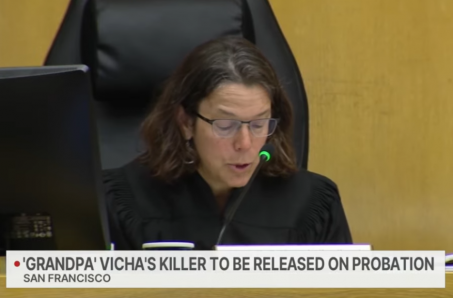
San Francisco Judge Linda Colfax
During the COVID-19 pandemic, the “Stop Asian Hate” movement gained nationwide attention, claiming there was a “sudden surge in anti-Asian racism” as a result of the pandemic. Some of us were skeptical, and noted how often attacks on Asian-Americans were perpetrated by the usual suspects. Such was the case in a 2021 incident in San Francisco:
Vicha Ratanapakdee . . . was an 84-year-old Thai man who was killed as a result of being forcefully pushed to the ground in a daylight attack in San Francisco, California, United States by an African-American male. His death became a lightning rod for the Stop Asian Hate movement.
At approximately 8 a.m. on January 28, Vicha left his daughter’s apartment in the Anza Vista neighborhood of San Francisco, where he had been supervising his grandsons, to go on a walk while the children were attending Zoom online classes. He was walking around Fortuna Avenue when 19-year-old Antoine Watson, an African-American male, ran across the street and violently shoved him to the ground. Vicha’s head hit the pavement as he fell. He never regained consciousness and died two days after arrival in the hospital from a brain hemorrhage. The killing was captured on a CCTV camera across the street.
Excuse the awkwardness of the prose in that Wikipedia summary, and let me call you attention to some of the facts here:
Two days after the assault, Antoine Watson was arrested and charged with assault with a deadly weapon, elder abuse and murder. Watson was identified through additional surveillance footage, matching clothes, and the license plate of his BMW, which was on record as he had been stopped hours before the assault at around 2 a.m. for reckless driving and speeding after running two stop signs on Cole Street at Parnassus Avenue and crashing into a parked car. Shortly before the attack, a surveillance camera captured Watson parking his car in Anza Vista and punching a different parked vehicle before running off-screen. Both cameras showed Watson returning to the car to retrieve his cell phone and walking back to Fortuna Avenue, where he took pictures of Vicha’s unconscious body before leaving for the parking lot again and driving away.
Antoine Watson was driving a BMW. Were you driving a BMW when you were 19 years old? Yet here was this teenager, driving around San Francisco at 2 a.m., running stop signs and crashing into a parked car, and the cops just turned him loose? Beyond that, after assaulting 84-year-old “Grandpa Vicha” in an unprovoked attack, Watson returned to the scene of the crime to take a picture of the unconscious body of his victim, as if to collect a trophy of his deed. Also, no matter how closely you might have followed this story, you may not have realized that Antoine Watson was not a San Francisco resident. He was from Daly City in suburban San Mateo County, about 10 miles away from where he fatally assaulted Ratanapakdee. Aggravating circumstances, you see.

Antoine Watson in the courtroom.
We do not have a mug shot of Antoine Watson because apparently, as a result of some “criminal justice reform,” police in California no longer publish mug shots of criminals, because heaven forbid the voters discover who is actually committing crimes in their communities. Anyway, it took nearly five years for this case to work its way to trial. In January 2026, a jury refused to convict Watson of murder, instead finding him guilty of the lesser sentence of involuntary manslaughter. Two months later, there was outrage when San Francisco Superior Court Judge Linda Colfax turned Watson loose on probation, giving him credit for time served:

The judge said at the sentencing that imprisonment would have a “poor impact” on Watson.
“She said Mr. Watson has trouble in his life because he’s from a broken family, parents fighting … that doesn’t mean you can kill other people,” Vicha’s daughter, Monthanus Ratanapakdee, told the California Post.
Colfax — a former public defender who has boasted about her “inclusive” courtroom featuring a nameplate with her she/her pronouns — has previously come under fire for the lenient treatment of other accused criminals. . . .
When it comes to Watson, Ratanapakdee argued the sentence reflects “a pattern of prior leniency.”
She said that her dad’s killer, who had a criminal record as a juvenile, had already been given second chances.
Ratanapakdee felt that Colfax was “biased” against the prosecution.
“I’ve been there almost two months in the trial, and I see how she was taking sides with the defense. That is my opinion,” she said.
San Francisco District Attorney Brooke Jenkins told The Post that Colfax’s decision was “troubling.”
“The judge was limited in some regard by the penal code that left his exposure at nine years, which is what we asked for,” Jenkins said. “But seemed to rely on this theory that because of his age at the time of the crime, he did not deserve more custody.
“While I can appreciate consideration of someone’s age and their youth, he took a man’s life — he took an innocent man’s life,” Jenkins added,
“And the fact that a judge believes that his time in the county jail was sufficient and he served probation is troubling to me. I don’t think it teaches him the magnitude of what he did.”
That phrase “limited in some regard by the penal code” is a major clue that the problem in California isn’t really just about left-wing judges — the legislature has enacted various “criminal justice reform” measures that make it difficult to put criminals behind bars and keep them there.
But who elects the legislature? Who elects the judges? And who was sitting on the jury that decided Watson was not guilty of murder?
The citizens of California are the problem.
In 2010, Kamala Harris was narrowly elected attorney general of California, getting only 46% of the vote, and defeating Republican Steve Cooley by a margin of less than 60,000 votes out of 9.6 million votes cast. Six years later, Harris was elected to the U.S. Senate with 62% of the vote. Running for president in 2024, Harris got 58% of the vote in California.
California is now a one-party state, and San Francisco has been a Democrat-controlled city so long that hardly anyone alive can remember the last time the city elected a Republican mayor (in 1964). Given this reality, California is utterly doomed. Nothing can be done to redeem the state, and this is true of any city or state where Democrats obtain hegemonic control. What is true of California may eventually be true of the entire United States, if people do not wake up to the danger.
Comments
THE FULL METAL JACKET REACH-AROUND AWARD
HIT THE FREAKING TIP JAR!
Search
Recent Posts
- In The Mailbox: 10.15.26
- In The Mailbox: 10.14.26 (Evening Edition)
- In The Mailbox: 10.14.26 (Afternoon Edition)
- In The Mailbox: 10.12.26 (Annual Admiral of the Ocean Sea Appreciation Post)
- Rule 5 Sunday: No Fishy Just Sexy
- FMJRA 2.0: A Winning Homestand
- In The Mailbox: 10.09.26
- Rumors Swirl: Where Is James Talarico? UPDATE: Talarico Appears in Public
- In The Mailbox: 10.08.26
- ‘A Reliable Barometer of Wrongness’
RSS reader subscription

MEMEORANDUM
Recent Comments
- on Rumors Swirl: Where Is James Talarico? UPDATE: Talarico Appears in Public
- on The Wrong Matthew Ingalls, the Correct ‘Jane Doe’ and the Cornell 7 Case
- on The Wrong Matthew Ingalls, the Correct ‘Jane Doe’ and the Cornell 7 Case
- on The Wrong Matthew Ingalls, the Correct ‘Jane Doe’ and the Cornell 7 Case
- on In The Mailbox: 10.02.26 (Evening Edition)
THE AMAZING GONZO FEED
Major Leagues
Archives
- October 2026 (19)
- September 2026 (38)
- August 2026 (43)
- July 2026 (39)
- June 2026 (40)
- May 2026 (43)
- April 2026 (59)
- March 2026 (44)
- February 2026 (37)
- January 2026 (45)
- December 2025 (42)
- November 2025 (44)
- October 2025 (44)
- September 2025 (47)
- August 2025 (48)
- July 2025 (48)
- June 2025 (47)
- May 2025 (48)
- April 2025 (42)
- March 2025 (48)
- February 2025 (49)
- January 2025 (48)
- December 2024 (42)
- November 2024 (44)
- October 2024 (47)
- September 2024 (43)
- August 2024 (55)
- July 2024 (63)
- June 2024 (59)
- May 2024 (48)
- April 2024 (43)
- March 2024 (55)
- February 2024 (46)
- January 2024 (45)
- December 2023 (53)
- November 2023 (62)
- October 2023 (57)
- September 2023 (56)
- August 2023 (53)
- July 2023 (69)
- June 2023 (67)
- May 2023 (53)
- April 2023 (60)
- March 2023 (73)
- February 2023 (65)
- January 2023 (56)
- December 2022 (60)
- November 2022 (64)
- October 2022 (58)
- September 2022 (68)
- August 2022 (75)
- July 2022 (69)
- June 2022 (73)
- May 2022 (74)
- April 2022 (57)
- March 2022 (79)
- February 2022 (65)
- January 2022 (58)
- December 2021 (62)
- November 2021 (68)
- October 2021 (73)
- September 2021 (63)
- August 2021 (60)
- July 2021 (80)
- June 2021 (64)
- May 2021 (64)
- April 2021 (58)
- March 2021 (73)
- February 2021 (57)
- January 2021 (71)
- December 2020 (77)
- November 2020 (81)
- October 2020 (84)
- September 2020 (94)
- August 2020 (75)
- July 2020 (68)
- June 2020 (83)
- May 2020 (77)
- April 2020 (65)
- March 2020 (85)
- February 2020 (94)
- January 2020 (95)
- December 2019 (88)
- November 2019 (60)
- October 2019 (113)
- September 2019 (91)
- August 2019 (91)
- July 2019 (88)
- June 2019 (80)
- May 2019 (74)
- April 2019 (97)
- March 2019 (100)
- February 2019 (85)
- January 2019 (93)
- December 2018 (90)
- November 2018 (83)
- October 2018 (96)
- September 2018 (79)
- August 2018 (107)
- July 2018 (98)
- June 2018 (86)
- May 2018 (78)
- April 2018 (78)
- March 2018 (97)
- February 2018 (61)
- January 2018 (70)
- December 2017 (62)
- November 2017 (68)
- October 2017 (67)
- September 2017 (70)
- August 2017 (68)
- July 2017 (52)
- June 2017 (60)
- May 2017 (56)
- April 2017 (80)
- March 2017 (80)
- February 2017 (102)
- January 2017 (104)
- December 2016 (65)
- November 2016 (86)
- October 2016 (77)
- September 2016 (81)
- August 2016 (66)
- July 2016 (83)
- June 2016 (81)
- May 2016 (65)
- April 2016 (64)
- March 2016 (81)
- February 2016 (74)
- January 2016 (66)
- December 2015 (64)
- November 2015 (85)
- October 2015 (71)
- September 2015 (80)
- August 2015 (67)
- July 2015 (79)
- June 2015 (69)
- May 2015 (72)
- April 2015 (94)
- March 2015 (122)
- February 2015 (71)
- January 2015 (93)
- December 2014 (99)
- November 2014 (67)
- October 2014 (109)
- September 2014 (87)
- August 2014 (106)
- July 2014 (132)
- June 2014 (154)
- May 2014 (126)
- April 2014 (145)
- March 2014 (144)
- February 2014 (142)
- January 2014 (185)
- December 2013 (192)
- November 2013 (173)
- October 2013 (175)
- September 2013 (181)
- August 2013 (167)
- July 2013 (147)
- June 2013 (135)
- May 2013 (128)
- April 2013 (105)
- March 2013 (162)
- February 2013 (191)
- January 2013 (206)
- December 2012 (190)
- November 2012 (176)
- October 2012 (240)
- September 2012 (206)
- August 2012 (235)
- July 2012 (223)
- June 2012 (161)
- May 2012 (230)
- April 2012 (269)
- March 2012 (282)
- February 2012 (247)
- January 2012 (267)
- December 2011 (285)
- November 2011 (300)
- October 2011 (302)
- September 2011 (297)
- August 2011 (288)
- July 2011 (297)
- June 2011 (245)
- May 2011 (260)
- April 2011 (344)
- March 2011 (293)
- February 2011 (201)
- January 2011 (263)
- December 2010 (265)
- November 2010 (266)
- October 2010 (305)
- September 2010 (280)
- August 2010 (272)
- July 2010 (230)
- June 2010 (244)
- May 2010 (256)
- April 2010 (222)
- March 2010 (271)
- February 2010 (286)
- January 2010 (229)
- December 2009 (21)
- October 2009 (1)
Free Agents
SHAMELESS CAPITALISM
Triple-A Franchises
- All-American Blogger
- American Power
- Anti-Idiotarian Rottweiler
- Athens & Jerusalem
- Barney Quick
- Bartholomew's Notes On Religion
- BatesLine
- Bear Creek Ledger
- Bearsears Patriots
- Blog de KingShamus
- Bride of Rove
- Cold Fury
- Daily Pundit
- Dr. Helen
- I Own The World
- Legal Insurrection
- Moe Lane
- No Runny Eggs
- Obi`s Sister
- Protein Wisdom
- Rhetorican
- Small Dead Animals
- The Conservatory
- The People's Cube
- The Sundries Shack
- VodkaPundit
- Vox Day
- Zilla of the Resistance
Blogroll
- 90 Miles From Tyranny
- A Conservative Shemale
- A Point of View
- Adrienne's Corner
- AmSpec Blog
- Bad Blue
- Blazing Cat Fur
- Calvin Freiburger Online
- Carol's Closet
- Catholic Bandita
- Caught Him With A Corndog
- Cecil Calvert
- Common Cents
- Conservative Hideout
- Conservative Watch News
- Conservatives for America
- Conservatives For Palin
- Crazy For Liberty
- Dad 29
- DC Damsel
- Dr. Flap
- Dyspepsia Generation
- Effing Conservatives
- Election Dissection
- Eric Reasons, IT Genius
- Eye of Polyphemus
- Finding Ponies. . .
- Free Will
- Grandpa John's
- Granite Grok
- GrEaT sAtAn"S gIrLfRiEnD
- Hoosier Access
- John William Perry
- Judicial Watch
- Jumping in Pools
- KURU Lounge
- Laughing Conservative
- Makes My Brain Itch
- Marathon Pundit
- Martin Eisenstadt's Blog
- Media Fade
- Michael Leahy
- Mister Pterodactyl
- Naked Villainy
- Nice Deb
- noot's observatory
- Not One Red Cent
- Okrahead
- Ollieander
- Pileus
- Pinup Girl
- Point of a Gun
- Political Pit Bull
- Reaganite Republican Resistance
- Red Alexandria
- Red State Eclectic
- Red, White & Conservative
- Republican Redefined
- ResCon1
- Ric's Rulez
- Ricochet
- Right of Course
- Robipedia
- Robomonkey
- Ruby Slippers Blog
- Saberpoint
- Scared Monkeys
- Sentry Journal
- SI VIS PACEM
- Skepticrats
- Smash Mouth Politics
- Sooper Mexican
- Taking Hayek Seriously
- Tel-Chai Nation
- Tequila & Javalinas
- The Aged P
- The Classic Liberal
- The Izzy Report
- The Minority Leader
- The NeoSexist
- The Nose on Your Face
- The Republican Mother
- The Right Sphere
- The Saint Angilbert Press
- The Snooper Report
- The Underground Conservative
- Thunder Tales
- Tom McLaughlin
- Tory Anarchist
- TrogloPundit
- Vets On The Watch
- Watcher of Weasels
- Western Experience
- World's Only Rational Man
- WyBlog
- Yankee Phil
- Zingstrom's Blog