
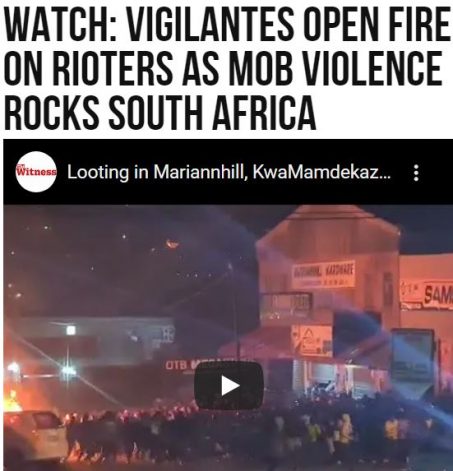
How bad is the violence in South Africa? It’s even worse than Chicago:
Crowds looted shops and offices in South Africa on Wednesday, defying government calls to end a week of violence that has killed more than 70 people and wrecked hundreds of businesses.
The unrest, the worst in South Africa for years, also disrupted hospitals struggling to cope with a third wave of COVID-19 and forced the closure of a refinery.
Protests triggered by the jailing of ex-president Jacob Zuma for failing to appear at a corruption inquiry last week have widened into looting and an outpouring of general anger over the hardship and inequality that persist 27 years after the end of apartheid.
Shopping malls and warehouses have been ransacked or set ablaze in several cities, mostly in Zuma’s home in KwaZulu-Natal province, and the financial and economic center Johannesburg and surrounding Gauteng province.
Overnight it spread to two other provinces — Mpumalanga, just east of Gauteng, and Northern Cape, police said.
A Reuters photographer saw several shops being looted in the town of Hammersdale, Kwazulu-Natal, on Wednesday. Local TV stations meanwhile showed more looting of shops in South Africa’s largest township Soweto, and in the Indian Ocean port city of Durban.
Soldiers have been sent onto the streets to help outnumbered police contain the unrest and order was being restored in some places on Wednesday, such as the northern Johannesburg township of Alexandra, local TV reported.
Less than 10% of South Africa’s remaining population is white — 4.6 million in a nation of 52 million. Nearly two-thirds of the white population lives in two provinces — Guateng (Johannesburg and Praetoria), with 1.9 million (41% of the white total) and Western Cape (Cape Town) with about 900,000 (20% of the white total). In the KwaZulu-Natal province (Durban, on the east coast near the Indian Ocean) where the violence broke out, only 5% of the population is white.
Now, look at this Monday video from a French-language news channel:
??? #SouthAfrica : la situation devient de plus en plus tendue dans le pays. Sur cette vidéo on aperçoit des hommes lourdement armés tirer sur des protestataires. On ignore si ces hommes armés sont de la police sud-africaine. #KZNViolence #ZumaArrest #SouthAfricanLivesMatter pic.twitter.com/Q6sFIiYCFa
— LSI AFRICA (@lsiafrica) July 12, 2021
The caption translates, “The situation is becoming increasingly tense in the country. In this video we see heavily armed men shooting at protesters. It is not known whether these gunmen are South African police.” Are the gunmen vigilantes? I don’t think so.
Notice they all seem fit and muscular, and they show a certain level of discipline. This suggests to me that they are professional security. What were they doing here? Trying to clear the highway, it looks like to me. But the appearance of such forces in the midst of this chaos is a warning of what lies ahead in South Africa, and perhaps here in the United States. That was a point raised last night by Tucker Carlson:
It is not a defense of apartheid, and certainly not an argument for a return to apartheid, to say that the current “hardship and inequality” causing violence in South Africa is a predictable consequence of the post-apartheid era. The underlying problem is not inequality, per se, but rather the unrealistic belief that politics can eradicate inequality. Poverty does not automatically cause of political unrest; rather, what causes unrest is the belief — promoted by left-wing activists — that political action can end poverty, and that a lack of political power is the only reason people are poor. Let me quote Federalist No. 10:
As long as the reason of man continues fallible, and he is at liberty to exercise it, different opinions will be formed. As long as the connection subsists between his reason and his self-love, his opinions and his passions will have a reciprocal influence on each other; and the former will be objects to which the latter will attach themselves. The diversity in the faculties of men, from which the rights of property originate, is not less an insuperable obstacle to a uniformity of interests. The protection of these faculties is the first object of government. From the protection of different and unequal faculties of acquiring property, the possession of different degrees and kinds of property immediately results; and from the influence of these on the sentiments and views of the respective proprietors, ensues a division of the society into different interests and parties. . . .
But the most common and durable source of factions has been the various and unequal distribution of property. Those who hold and those who are without property have ever formed distinct interests in society. Those who are creditors, and those who are debtors, fall under a like discrimination. A landed interest, a manufacturing interest, a mercantile interest, a moneyed interest, with many lesser interests, grow up of necessity in civilized nations, and divide them into different classes, actuated by different sentiments and views. The regulation of these various and interfering interests forms the principal task of modern legislation, and involves the spirit of party and faction in the necessary and ordinary operations of the government.
James Madison here describes the origins of political division as a matter of people freely pursuing their own interests. The basic job of government is the protection of property rights, and notice that Madison assumes that “different and unequal faculties” will result in people having “different degrees and kinds of property.” No matter what the government may do, this cannot be avoided in a free society. The problem we see in South Africa is that too many people there (as here) were led to believe otherwise and, nearly three decades after the end of apartheid, the failure of the false promise of “equality” produces an irrational rage among those who feel they have been cheated out of something.
“And he said unto them, Take heed, and beware of covetousness: for a man’s life consisteth not in the abundance of the things which he possesseth.”
— Luke 12:15
“Perverse disputings of men of corrupt minds, and destitute of the truth, supposing that gain is godliness: from such withdraw thyself. But godliness with contentment is great gain. For we brought nothing into this world, and it is certain we can carry nothing out. And having food and raiment let us be therewith content.”
— I Timothy 6:5-8
What is causing violence is an anti-Christian belief system — “doctrines of devils,” as the Apostle Paul says — encouraging covetousness, a sentiment that will always produce rage and violence.