“Patriarchy — an enforced belief in male dominance and control — is the ideology and sexism the system that holds it in place. . . .
“Homophobia works effectively as a weapon of sexism because it is joined with a powerful arm, heterosexism. Heterosexism creates the climate for homophobia with its assumption that the world is and must be heterosexual and its display of power and privilege as the norm. Heterosexism is the systemic display of homophobia in the institutions of society. Heterosexism and homophobia work together to enforce compulsory heterosexuality and that bastion of patriarchal power, the nuclear family.”
— Suzanne Pharr, Homophobia: A Weapon of Sexism (1997)
Last week, I spent some time compiling about two dozen feminist quotes into a Powerpoint slide presentation for the “Forum on Campus Sexual Assault, Consent and Due Process” to be held Aug. 1 at Central Piedmont Community College Central Campus in Charlotte, NC. These quotes are intended to demonstrate how the anti-male ideology of radical feminism has contributed to the current climate of fear and suspicion on American college campuses. Feminist rhetoric incites irrational hostility toward male students that fuels the “rape culture” hysteria, and this attitude of sexual paranoia is promoted in Women’s Studies course that enroll some 90,00 students annually in U.S. colleges and universities.
For example, does patriarchy as Pharr describes it — “an enforced belief in male dominance and control” — actually exist? And in what sense is “heterosexism” distinct from “homophobia”? Aren’t these just two different words describing the same concept? Words mean things, and a failure to interrogate the definitions of terms often leads us into confusion, especially when confronted with the tendentious claims of special pleaders like Suzanne Pharr, a lesbian who begins her treatise with what can only be described as a solicitation of sympathy:
Homophobia — the irrational fear and hatred of those who love and sexually desire those of the same sex. Though I intimately knew its meaning, the word homophobia was unknown to me until the late 1970s, and when I first heard it, I was struck by how difficult it is to say, what an ugly word it is, equally as ugly as its meaning. Like racism and anti-Semitism, it is a word that calls up images of loss of freedom, verbal and physical violence, death.
In my life I have experienced the effects of homophobia through rejection by friends, threats of loss of employment, and threats upon my life; and I have witnessed far worse things happening to other lesbian and gay people: loss of children, beatings, rape, death. Its power is great enough to keep ten to twenty percent of the population living lives of fear (if their sexual identity is hidden) or lives of danger (if their sexual identity is visible) or both. And its power is great enough to keep the remaining eighty to ninety percent of the population trapped in their own fears. Long before I had a word to describe the behavior, I was engaged in a search to discover the source of its power, the power to damage and destroy lives. The most common explanations were that to love the same sex was either abnormal (sick) or immoral (sinful).
She is a victim of hateful prejudice, Pharr would have us believe, and anyone who disapproves of homosexuality is “irrational.” Gay people are oppressed, and heterosexual people are “trapped in their own fears.” We must all RSVP to her pity party, or else be condemned as bigots.
What of this “irrational fear and hatred” of which Pharr speaks? Most critics of the gay-rights movement fail to see how the accusation of homophobia involves a diagnosis of psychopathology, an 180-degree reversal of the former consensus that homosexuality is a mental illness. Whereas Freud and other early psychologists saw homosexuality as a disease in need of treatment, it did not take too long after the American Psychiatric Association removed this diagnosis from the DSM in 1973 before gay radicals began playing armchair psychologist and telling straight people that we were the ones in need of treatment.
This kind of reversal is typical of the social justice mentality. Progressives constantly accuse their opponents of bad motives (mala fides), and contend that ordinary common-sense attitudes are harmful prejudices. For example, most people consider obesity unattractive, but this widespread attitude makes fat people unhappy, and so we have the “fat acceptance” movement insisting that “all bodies are beautiful” and feminists demanding equal representation for fat women in fashion ads. Almost any majority attitude is subject to this kind of indictment by the social justice crowd. Patriotism is stigmatized as xenophobia and religion is “anti-science,” etc.
Most people are heterosexual, and insofar as they ever think about homosexuals at all, it is not with “irrational hate and fear,” but rather to wonder: Why are those people so miserable and angry all the time? If “gay” is a synonym for happiness, it sure as heck doesn’t fit the militant activists and pathetic whining sad-sacks like Suzanne Pharr.
Well, you see, this is where the accusation of “homophobia” comes from. It’s not their fault they are so miserable. Instead, society is to blame. Our “irrational” disapproval make gay people feel sad. This accusation raises several questions that the accusers are never required to answer. For example, why is our approval for their private behavior so important to them? Beyond that, however, if an aversion to homosexuality is “homophobia,” isn’t every heterosexual in some sense a homophobe?
That is to say, if we really buy into the “equality” argument, believing that homosexual behavior is such wholesome fun that no one would dare disapprove of it, shouldn’t we be eager to participate in this pleasurable recreation? The mere fact that we are not gay ourselves rather strongly implies that we personally dislike homosexual behavior, and why should heterosexuals sit in guilty silence while Suzanne Pharr or anyone else lectures us about how “irrational” our preferences are?
The reason so many heterosexuals do suffer such insults in silence, I suspect, is that they have a guilty conscience and are afraid of being accused of “hate” if they defend themselves against the charge of homophobia. This is how “Kafkatrapping” tactics work: The liberal calls you a racist, and if you try to deny it, your denial is cited as proof of your guilt. How do you prove your innocence of such Thoughtcrimes as racism, sexism and homophobia? Shouldn’t the burden of proof be on the accuser? And beyond this lies the question that the person targeted by “Kafkatrapping” seldom thinks to ask the self-appointed Thought Police: Exactly how does my personal opinion on this subject harm anyone?
Suppose, for example, you find yourself accused of “Islamophobia.” You were engaged in a discussion of terrorism or immigration or foreign policy and said something a liberal didn’t like: “Islamophobia!” the liberal shouts, accusing you of being a hateful racist bigot. What the liberal is doing here is asserting that it is immoral to disagree with him.
Well, who is harmed by your opinion? You aren’t the Secretary of Defense or a member of Congress, so that your alleged anti-Muslim prejudice doesn’t influence public policy in any meaningful way. It’s not as if you are running around hurling Molotov cocktails at mosques or otherwise committing lawless violence against innocent Muslims. Therefore, why is this liberal ANGRILY TYPING IN ALL CAPS about what an awful person you are, merely because you expressed an opinion on the Internet? And exactly what does “Islamophobia” mean, anyway?
Words mean things, and the Left’s habit of coining new words to define as “oppressive” any attitude or opinion the Left dislikes is one that isn’t challenged often enough. It wasn’t until the AIDS crisis hit in the 1980s that the word “homophobia” began being hurled around haphazardly. In common usage, “homophobe” is simply a synonym for Republican. As with “sexist” and “racist,” the word “homophobe” is really just a political label which can be defined as someone a Democrat doesn’t like.
No one ever accused Suzanne Pharr of being a Republican, and she testifies to having “experienced the effects of homophobia through rejection by friends, threats of loss of employment, and threats upon my life.” Well, I’m not gay, but I’ve suffered “rejection” and “loss of employment” on various occasions, and I’ve been threatened, too. However, because I’m not a member of an Official Victim Group, there are no textbook anthologies teaching college kids to feel sorry for poor, pitiful me. And damn their pity all to hell, anyway. This whole liberal guilt-trip mentality is nothing but a political hustle, the kind of cheap scam no ordinary con artist would touch less it taint his reputation.
Suzanne Pharr would have you believe that your disapproval of her preference has “the power to damage and destroy lives.” I don’t make a habit of inquiring about people’s sexual habits, although since I began researching feminism I assume that all Women’s Studies majors are lesbians. It’s impossible to imagine how any woman could fill her mind with such toxic anti-male poison and actually like men. Only a man with enormously high self-esteem could read as much of this wretched stuff as I have without becoming completely demoralized.
Why does Suzanne Pharr hate men so much? In typical feminist fashion, she justifies this by accusing men of unjust “dominance and control” and denouncing the nuclear family as a “bastion of patriarchal power,” and more generally depicting men as brutal, loathsome tyrants:
Violence against women is directly related to the condition of women in a society that refuses us equal pay, equal access to resources, and equal status with males. From this condition comes men’s confirmation of their sense of ownership of women, power over women, and assumed right to control women for their own means. Men physically and emotionally abuse women because they can, because they live in a world that gives them permission. Male violence is fed by their sense of their right to dominate and control, and their sense of superiority over a group of people who, because of gender, they consider inferior to them.
Who are these men? Every time I read feminists going on about the universality of “violence against women,” and the “sense of superiority” over women by which men allegedly justify their abuse, I start wondering if somehow I’m failing here in my “bastion of patriarchal power.” Having been married for 27 years and fathered six children, certainly such a patriarch as myself ought to have some of this “power”and “dominance” and “control” that feminists insist I possess, but where is it?
Also, “boys don’t hit girls” is a basic rule that I was taught from childhood, as was every other boy from a decent Christian home, and my wife and I have taught the same thing to our sons and daughters. For a man to hit a woman is the act of a coward and, if a man should feel himself insulted by a woman, the manly thing to do is to walk away, speaking of which . . .
How many times do I have to repeat this advice? To be accused of oppressing women through domination, control, abuse and violence — which is what every feminist accuses all men of doing — is a deliberate insult that no decent man should be expected to tolerate.
Any intelligent person who reads Suzanne Pharr’s Homophobia: A Weapon of Sexism can see that what she is really doing is asserting the inferiority of men. Her vehement anti-male prejudice — her belief that all men are brutal monsters — is essentially a rationalization and justification of her own lesbianism. The emotional subtext of Pharr’s argument can be summarized succinctly: “I do not love men because men are bad and therefore do not deserve love.”
Of course, no one can be forced to love anyone else, and it would be cruel to compel someone to empty out their subconscious and publicly confess their most shameful secrets, but you read enough of this stuff (and dear God, I’ve read more than enough) and you cannot help noticing the rigidity of the psychological defense mechanisms involved. Dress it up in all fancy jargon you like — try reading Judith Butler sometime — and feminist theory is still a whirlpool of childish narcissism, an explanation of personal unhappiness inflated to the grandiose scale of a revolutionary creed. It’s not just the lesbian feminists who blame the patriarchy for all their woes, but also embittered heterosexual women like Jessica Valenti:
I wrote in my diary at the time, I’m so ugly I can’t stand it. I have a big gross nose, pimples, hairy arms. I will never have a boy like me or a boyfriend. All of my friends are pretty and I will be the one with no one.
All men must be made to suffer for her adolescent misery, you see.
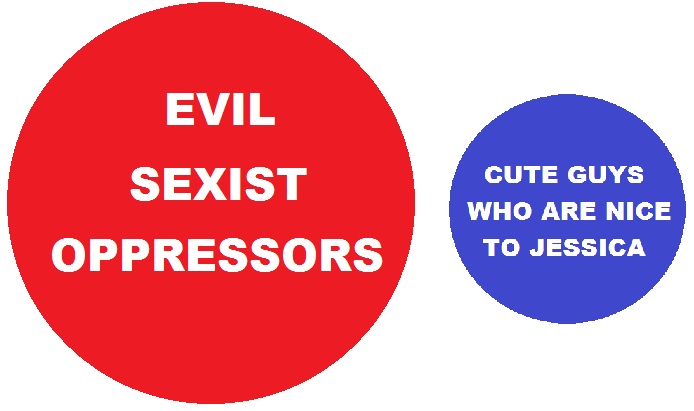
What is Jessica Valenti’s feminism except an elaborate revenge fantasy? And how is her vindictive hatred of men different from Suzanne Pharr’s? On the one hand, the lesbian feminist Pharr asserts that heterosexual women are all victims of violent male domination, whereas on the other hand, the heterosexual feminist Valenti recounts all the horrible abuse she’s suffered from every man except the handful of men she personally likes. Pharr asserts that 100% of men are bad, and Valenti merely reduces this figure to 99.9999%, to exempt from condemnation her husband and a few ex-boyfriends she remembers fondly. A Venn diagram:
To heterosexual feminists like Jessica Valenti, “sexist” is really nothing more than a synonym for a guy I don’t like, whereas to lesbian feminists like Suzanne Pharr, “sexist” is simply a synonym for male. Why are men expected to tolerate insults from emotionally damaged women who want to use us as scapegoats for their childhood resentments?
We can define feminism as an “irrational fear and hatred” of men. Why aren’t all feminists lesbians? This is the great mystery. If feminist theory is true, then Jessica Valenti is a victim of patriarchal power and also a willing enabler of oppression, since she is forcing her own daughter to be raised under the tyrannical male authority of her father.
However, the phrase “if feminist theory is true” signifies a speculative hypothetical, requiring us to imagine an alternative universe. Even I am not crazy enough to understand what the world would be like if feminist theory were true. And thank God, it’s not.
Our appetizer this week is of some Korean “race queens”, the F1 racing equivalent of booth babes, for reasons. As usual, many of the following links are to pics generally considered NSFW; the management is not responsible for whatever befalls you if you fail to exercise discretion in your clicking.
Thanks to everyone for their linkagery, especially those of you who linked back to us for the FMJRA and helped Rule 5 Sunday stay the most-linked post at The Other McCain! Deadline to submit links to the Wombat-socho mailbox for next week’s FMJRA is noon on Saturday, July 30; deadline to send in links to the Rule 5 Wombat mailbox for next week’s Rule 5 Sunday is midnight on Saturday.
CLEVELAND
Well, my five-day stay in this fair city has come to an end, and now it’s time for me to return home. My train ticket on the Capitol Limited is paid for, but there’s cab fare to the station, and I’d like to grab a bite to eat before I go. My wife wanted me to bring home souvenirs for the kids, and I bought a couple of T-shirts before realizing how depleted Ye Old Bank Account had become — a typical miscalculation.
Was there any Big Story here in Cleveland? Was the Republican National Convention anything more than a pre-scripted TV show? Is there any Final Wisdom to be found in all this?
On the bright side, terrorists didn’t blow us all to smithereens, thanks to the massive police presence in Cleveland. The biggest disruption of the whole week was Ted Cruz’s speech Wednesday, and also, Communist protesters burning the American flag, but what would a Republican convention be without a few Commies burning a flag? It’s predictable, as predictable as the blatant bias of the media.
Also predictable: Me rattling the tip jar. Anything readers can give — $5 or $10 or $20 — would be appreciated because, as always, the Five Most Important Words in the English Language are:
“The perpetrator was an 18-year-old German-Iranian from Munich,” police chief Hubertus Andrae told reporters after the massacre.
“The motive or explanation for this crime is completely unclear.”
Yeah, it’s “unclear” why this young Muslim committed a massacre.
The Bavarian Interior Ministry said three people were dead, NTV television reported. A Munich police spokeswoman said multiple people were killed or wounded.
“We believe we are dealing with a shooting rampage,” the spokeswoman said.
More than one gunman was believed to be involved and no one had been arrested, she said.
“We believe there was more than one perpetrator. The first reports came at 6 p.m., the shooting apparently began at a McDonald’s in the shopping center. There are still people in the shopping center. We are trying to get the people out and take care of them.”
Early reports on such events are always confusing, and often wrong. Right now, it is being reported that there were at least three gunmen, but we must be patient and wait for the facts to be sorted out.
Munich is in lockdown tonight as at least six people have been killed and 10 injured in a shooting rampage involving three gunmen.
A major police operation is ongoing around the city’s Olympic Park, with the force warning people to stay in their homes and avoid public spaces as they admitted they don’t know where the gunmen are.
Terrified shoppers were seen running for their lives from the Munich Olympia Shopping Centre, in the district of Moosach, after hearing gunshots. Witnesses said that the gunman screamed ‘I’m German’ and ‘Scheiss Auslander’ (s*** foreigners) before shooting.
This report is not confirmed, but if true, it would indicate some kind of nationalist anti-Muslim motive. We await more information.
UPDATE 4:40 p.m. EDT: The death toll now reportedly stand at eight. There were reportedly three gunmen, one of whom shot himself. However, we know nothing about who the shooters are, and can only speculate about a motive.
According to local media, the ninth dead person is believed by police to be one of the killers. His body was found 45 minutes ago on a green stretch near the Olympia shopping centre; 1km away from the scene of the crime.
The veteran police reporter Oliver Bendixen told Tagesthemen that the body found was believed to be that of the perpetrator who opened fire in front of the McDonald’s restaurant.
The identity of the shooter is unknown, and nothing has been confirmed as to the motives for this attack. Linked at American Power — thanks!
Zak Hasanin was walking along a downtown sidewalk Thursday afternoon when he said, “Did you hear that? ‘America Was Never Great’?” He was quoting a slogan shouted by left-wing protesters near the Republican National Convention here. “Those people need to go to Africa. They don’t know how good they’ve got it.”
Hasanin’s family immigrated to America from Sudan when he was a child, and the 23-year-old recent graduate of North Carolina State University was angered at the anti-American protest slogan.
“How is this not great?” Hasanin said, gesturing at the scene on Euclid Avenue, where vendors were hawking Donald Trump T-shirts outside shops and restaurants crowded with delegates. “This is Cleveland. Anywhere in Africa, this would be the greatest city in the country.”
The hope of renewing American greatness was what brought Hasanin and thousands of other Republicans to Cleveland, and Thursday night Trump delivered what was without doubt the strongest speech of his campaign to date.
“America is a nation of believers, dreamers, and strivers that is being led by a group of censors, critics, and cynics,” Trump said near the end of his hour-plus address to an enthusiastic crowd at Quicken Loans Arena. “Remember, all of the people telling you that you can’t have the country you want, are the same people telling you that I wouldn’t be standing here tonight.”
Indeed, in the past year, Trump’s success has confounded the cynics and critics who at first did not take his campaign seriously. The same doubters, including many conservative pundits, subsequently panicked when Trump’s populist campaign caught fire with primary voters who ignored the pundits and voted for the billionaire businessman who promised to put a stop to illegal immigration. Trump took special aim at “elites in media” who he said are “lining up behind the campaign of my opponent.”
Indeed, liberals reacted with alarm to Trump’s speech. Former MSNBC personality Melissa Harris-Perry walked out 10 minutes into his speech, declaring “I left early because I was afraid.” CNN personality Sally Kohn seemed traumatized, moaning on Twitter: “The problem is, this speech seems believable and convincing, especially in a vacuum. I’m scared.” On NBC, former Bush aide Nicolle Wallace announced, “The Republican Party that I worked for for two decades died in this room tonight.”
Of course, the GOP couldn’t beat Barack Obama in 2008 or 2012, and none of the regular Republican candidates could beat Trump for the nomination this year, so what were the chances that a Nicolle Wallace-approved Republican could have defeated Hillary Clinton this year? . . .
Read the whole thing at The American Spectator. What frightens so many elitists about Donald Trump, I believe, is that his views represent the non-elite majority of Americans. Nicolle Wallace attended Cal-Berkeley (Class of ’94) and got her graduate degree at Northwestern University. She got hired by the Bush family in 1999, married a Bush staffer, and has spent her entire adult life among the Republican Party elite, looking down her snooty nose at the rest of us. Nicolle Wallace despises ordinary Americans quite as thoroughly as any liberal elitist despises ordinary Americans.
To hell with such establishment snobbery, and good riddance to Bushism.