Say hello to Noemi Guzman and, while you’re at it, go ahead and say good-bye, because Omaha Police on Tuesday saved Nebraska taxpayers the cost of incarcerating Guzman forever:
An attempted kidnapping at an Omaha Walmart ended with a child injured and a woman dead.
According to Omaha police, officers were called to the Walmart near 72nd and Pine streets around 9:20 a.m. on Tuesday.
When officers arrived, they saw a woman, identified as 31-year-old Noemi Guzman, outside the store holding a knife to a 3-year-old boy, who was in a shopping cart, officials said.
Officials said Guzman approached the caretaker with a knife, giving the caretaker commands to go in front of the shopping cart. Investigators believe Guzman stole the knife from the store.
Police said Guzman followed the caretaker out of the store and into the parking lot.
The caretaker was able to get away and ask a woman in the parking lot to call 911. . . .
Two officers arrived at the store and approached the woman, who was making threats with the knife.
Video showed the suspect swiping the knife at the child, cutting him across the face.
Two Omaha police officers shot and killed the woman after she didn’t respond to verbal commands. . . .
Omaha police said it is unknown what provoked the suspect to approach the caretaker.
Omaha cop prepares to cure Noemi Guzman’s mental illness.
The 31-year-old woman shot dead by police officers during a kidnapping attempt at an Omaha Walmart had committed violent crimes in the past.
Omaha Police have identified the woman as Noemi Guzman.
She had been on the news before. In one case, the courts had found her not responsible for violent crimes by reason of insanity.
In March 2024, Guzman was accused of setting her father’s home on fire and then breaking into St. Frances Cabrini Catholic Church in Omaha — allegedly armed with a kitchen knife. Investigators said a priest had barricaded himself in an upstairs bedroom while Guzman tore the place apart.
For the four felonies, the courts found Guzman “not responsible by reason of insanity.”
In June 2025, the judge ruled that Guzman continued to suffer from a mental illness, namely schizophrenia. It was noted that she was a danger to herself or others and should remain under the court’s supervision.
The psychiatrist was tasked with notifying the courts immediately if Guzman didn’t follow the treatment plan. Until what unfolded Tuesday at Walmart, there was no indication in court records that Guzman hadn’t been following the treatment. She was scheduled for an annual review on June 12.
Well, she won’t show up for that appointment. Her mental illness has been cured by well-aimed gunfire. Crazy People Are Dangerous.
It should go without saying that you should never trust anything published by the New York Times, but Dartmouth College economics professor Paul Novosad has done a great service with this latest demonstration of the NYT “fake news” phenomenon.
The Upshot is a section of the New York Times that advertises itself as providing “analytical journalism in words and graphics,” which is to say, this is the part where they try to add the aura of statistical certainty to their dishonest propaganda: “See? Here’s a chart — numbers don’t lie!”
Last week, they published this steaming pile of poo:
“Fertility delayed is fertility denied” is one of the great maxims of demographics. As a matter of statistical average, postponing parenthood means reducing the total number of children. It requires a few more sentences to explain why this is true, but the fundamental fact is that every woman begins her fertile years at puberty (menarche) and concludes her fertility at menopause. Biology establishes a window of roughly 30 years (roughly ages 15 to 45) during which pregnancy can occur. Let us suppose that the reader is among those who feel a sense of horror about “teenage pregnancy.” While I could argue that this attitude is irrational, I’ll not belabor that point here. But in seeking to eradicate teenage motherhood, what you are attempting to do is to subtract five years from the potential baby-making years of the female population.
Stipulating, then, that no woman should ever give birth before age 20, you still have (in theory) a 25-year period during which births can occur. Ah, but biological fertility declines significantly after age 30, and the risk of birth defects (particularly Down syndrome) increases after age 35. The window for successful childbearing, you see, is actually narrower than the menarche-to-menopause span of 15-to-45 would suggest. That five-year delay you demanded to prevent teenage motherhood has consequences down the line, which is why in recent decades we have had so many 30-something women in crisis at the ticking of their “biological clock.” We cannot go back in time to take advantage of opportunities we have already passed up — fertility delayed is fertility denied.
Liberals don’t want to acknowledge this reality, and for many years have been selling false hope about egg-freezing, IVF and other advanced medical treatments as a panacea for the problems created by attempting to beat the biological clock. Even if you are buying what they’re selling — i.e., that becoming a mom at 45 is medically feasible — does it make sense that any large number of childless women would pursue these expensive procedures? You’ve gone childless for decades, and now at middle age, you’re going to pay tens of thousands of dollars to make a baby? Do you want to be the only 50-year-old mom at your kindergartner’s PTA? And then you’ll be eligible for Social Security by the time this kid graduates high school. This kind of choice just doesn’t make sense, which is why very few women actually do it. Yet the New York Times assigned Claire Cain Miller to keep selling this unrealistic idea:
Fertility in the United States has been declining since the Great Recession, and reached a new low last year, according to federal data released Thursday, causing some to fear a baby bust.
But it’s not clear that will happen. Instead, there could be a lull, demographers say — a period of very low fertility that could eventually rebound.
That’s because of a drastic shift among American women who are now of childbearing age: They are waiting longer to have babies. They’ve become much less likely to have them in their teens or 20s — and much more likely to in their 30s or 40s.
This is not true. Women are no more “likely” to become mothers in their 30s and 40s than they were when I was born in 1959, when my mom was 30 and I was her second child. In fact, the birth rate for women in their 30s and 40s is much lower now than it was during the Baby Boom.
Miller tries to sell this with a chart showing percentage increases in births to older women, but as Professor Novosad demonstrates, this misrepresents the change in the actual number of births.
Here's what the Upshot's graph looks like when we do it in number of births instead of % changes.
While it is true that, compared to 2007, there were about 120,000 more births to women 35 and older in 2024, this is a drop in the bucket compared to 1.2 million fewer births among women under 30.
The question of what can be done, as a matter of public policy, to reverse the current alarming trend of below-replacement fertility has perplexed the intellectuals and politicians of our age, but we can never fix a problem by denying the problem exists, which is what Claire Cain Miller is doing with her dishonest chart. Miller and the New York Times are still committed to promoting the same anti-marriage/anti-motherhood feminist propaganda that got us here in the first place. They are still part of the problem, and therefore cannot be part of the solution.
Current Virginia congressional districts (click image to enlarge)
When I was a young newspaper staffer in Rome, Georgia, my boss was Pierre-Rene Noth. He was half-Jewish and half-Catholic. His father had been a left-wing journalist in France before the family fled the Nazis. Pierre was very liberal, but when it came to journalism, his motto was “local, local, local.” Realizing that news consumers turned to TV and other media for national news, his obsession was about focusing on local issues, and one of Pierre’s pet peeves was how the congressional map in Georgia at the time had Rome being represented in Congress by a guy from the Atlanta suburbs in Cobb County. Pierre believed that, if the map were properly drawn, the northwest corner of the state would be its own congressional district, with Rome in the middle of it. Pierre died a few years ago and did not live to see the fruition of his vision, although I can’t imagine he would have been pleased when the Rome-based 14th District elected Marjorie Taylor Greene to Congress. Anyway . . .
Pierre’s idea about properly drawn congressional maps was on my mind Sunday as I drove — via Winchester, Warrenton and Culpeper — to Louisa, Virginia, to cover the “Vote No” rally. That route took me through some of the most scenic country I’d ever laid eyes on, and the beauty of the place just made me more angry that Abigail Spanberger wants to deprive the people who live there of their rightful representation.
As you can see from the map above, the current district map of Virginia is a masterpiece of simplicity. The two basic principles of a good map are that districts should be (a) coherent and (b) compact. By “coherent,” I mean that the geography of a district ought to make some kind of sense; counties shouldn’t be split up unnecessarily and districts ought not to cross mountain ranges or major rivers if such distortions can be avoided. By “compact,” I mean that a district ought not to go sprawling over the countryside for no reason. The shape of the district should not resemble a lizard or a crustacean. In both of these regards, it’s hard to find any fault with the current Virginia congressional maps. You’ll notice that two small districts — the 8th and the 11th — are crammed up next to the Potomac River across from D.C., representing the urbanized precincts of Alexandria, Arlington and Fairfax. The 10th District encompasses the rapidly growing area around Dulles International Airport, as well as Fauquier, Prince William and Rappahanock counties. Most admirable is how the northern end of the Shenandoah Valley, stretching from Roanoake up toward the West Virginia panhandle, is all encompassed in the Sixth District, while the southwest corner of the state — coal country down there — is represented as District 9. This is a near-perfect map, and you see that District 5 is both coherent and compact, covering central Virginia down to the North Carolina border. Now look at this:
That monstrosity is what the 5th District of Virginia would look like if this redistricting referendum passes next Tuesday. You could consult a thesaurus for the right words to describe it — abomination, etc. — but you certainly can’t call it compact or coherent. If you’re a Republican voter, it’s the Creature That Ate Your Representation.
Did I mention that Spanberger is from New Jersey? Her family moved to Virginia when she was 13, and she has hated it ever since. Being in Congress — she won her seat by a slender margin in 2018, a high-tide year for Democrats — was a way for Spanberger to inflict revenge on the Virginia natives she has always despised. And this is the factor you have to realize about Virginia politics: In the D.C. suburbs, almost none of the residents are actually from Virginia. They’re all from somewhere else originally, and often quite recent transplants. They are ambition-fueled careerists with no real roots in the community. Virginia has been positively overrun by these newcomers in recent decades. The population of the Commonwealth has increased by almost 2.5 million since 1990, and the bulk of those are crammed into Northern Virginia, living in townhouses, condominiums, apartments and cookie-cutter subdivisions of “McMansions” built on quarter-acre lots.
Get out into the countryside, however, and you meet the real Virginians. That’s who turned out at the Louisa County Courthouse on Sunday. Folks in that part of Virginia can not only tell you what regiment their Confederate great-grandfather fought with, they can tell you which regiment his great-grandfather served in under General Washington. These people have actual roots, some of them all the way back to Jamestown, and the Democrats absolutely hate these real Virginians.
Roadsides in this part of the Old Dominion are festooned with signs: “VOTE NO APRIL 21.” From here to Winchester, a distance of more than 100 miles, scarcely any signs could be seen expressing support for the Democrat-backed referendum that would redistrict Virginia’s congressional delegation and effectively silence the voices of those who dwell in the rural parts of the Commonwealth. But those voices were heard loudly Sunday afternoon on the lawn of the county courthouse here.
“What are you going to do?” Republican Rep. John McGuire asked the crowd.
“Vote no!” the hundred or so attendees shouted.
“I think you can do better than that,” the fifth district’s congressman said. “What are you going to do?”
“Vote no!” they yelled in reply.
Early voting has been going on for weeks, and when those at the courthouse rally were asked for a show of hands of who had already voted, nearly every hand was raised. With barely more than a week to go before April 21, however, the question is whether their votes — and those of Republican voters elsewhere in Virginia — will be enough to prevent passage of the partisan gerrymander that newly-installed Gov. Abigail Spanberger and the Democrat-controlled legislature would impose. . . .
Another good week to be a Senators fan! The week began badly as we lost two out of three at Cleveland, but tonight we swept Pete’s Brewers to finish the week 73-74, still in second place behind the Twins but now 15.5 games ahead of the Brewers – and more importantly, just a bit ahead of the 71-73 Royals, who are coming off a four-game losing streak and facing the Tribe, against whom they are 3-6. So I have a good chance to expand my hair-thin lead in the race for the last AL wildcard spot. Go Tribe! Ceterum autem censeo Silicon Valley et Hamas delendam sunt.
LOUISA, Virginia — It was a lovely 150-mile drive to get here for today’s “VOTE NO” rally at the Louisa County Courthouse. A sunny spring day, with the trees turning green, and the picturesque scenery of central Virginia, adorned with signs that the Old Dominion ain’t dead yet.
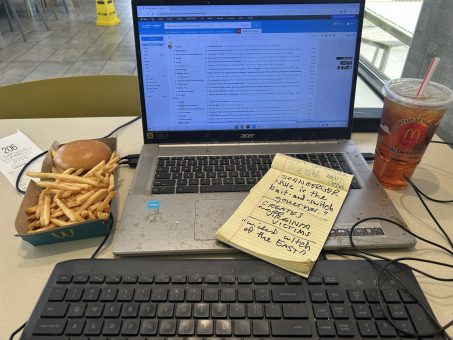
The courthouse crowd was friendly, and my biggest problem today was that my deadline for the American Spectator was 6 p.m., which meant that when the rally ended at 4, I had to race over here to the McDonald’s, set up the National Desk in the corner booth and get to work. Cranking out 1,000 words in two hours? Yeah, I used to do that routinely during the years when I was a roving campaign correspondent, but I was younger then, and the deadline rush is more challenging now that I’m a gray-bearded senior citizen. That Filet-O-Fish combo cost $10.34, if any of y’all are thinking of hitting the tip jar, as I certainly hope you do.
Some of y’all remember how wild it was back in the days of the Tea Party, when I raced all over upstate New York in a rented Nissan covering the special election campaign that ended the political career of Dede Scozzafava, then turned right around to cover Scott Brown’s campaign to win Ted Kennedy’s Senate seat in Massachusetts. For the final week of the 2010 midterm campaign, I drove all the way to Boca Raton, Florida, where I spent election night at Allen West’s victory party. There were a lot of victory parties that night — “The Republican Mandate,” I called it, after Ann Marie Buerkle was finally declared the winner in a New York district where she was outspent 5-to-1 by the Democrat incumbent she beat.
There’s a reason I don’t believe in quitting, because I have seen miracles with my own eyes. If you believe you can win, confidence is contagious, and a real grassroots effort can overcome even the most formidable odds. Such are the odds facing Republicans in this Virginia referendum battle, where the GOP has been outspent at least 3-to-1 by the big-money Democrats (including, of course, George Soros). The key point is that this is a special election with nothing else on the ballot except this godawful gerrymander, and polls indicate that at least 25% of Democrats don’t want to vote for Spanberger’s Monster, as we might call it. If Republicans can get any kind of grassroots energy going, they can deliver a punch in the nose that will make Democrats regret they ever tried to inflict this scheme on the Commonwealth. There are some hopeful signs.
People here are offended by what Spanberger and the Democrats are trying to do to them. This county would be shoved into a district that looks like a bad sketch of a lobster, the tail reaching all the way up to the Potomac River more than 100 miles away. All we can do is hope that their indignation is sufficient to inspire an overwhelming turnout that overwhelms the foreign scum currently occupying Northern Virginia.
Anyway, that’s getting ahead of the game. My column in the American Spectator should be online around midnight, and I’ve still got a two-and-half hour drive to get back home. Maybe you could cover that $10.34 Filet-O-Fish combo, or $4 for a gallon of gas, but as always I remind you that the Five Most Important Words in the English Language are still: