Intellectuals and the Total State: @JAMyerson’s Dilettante Marxism

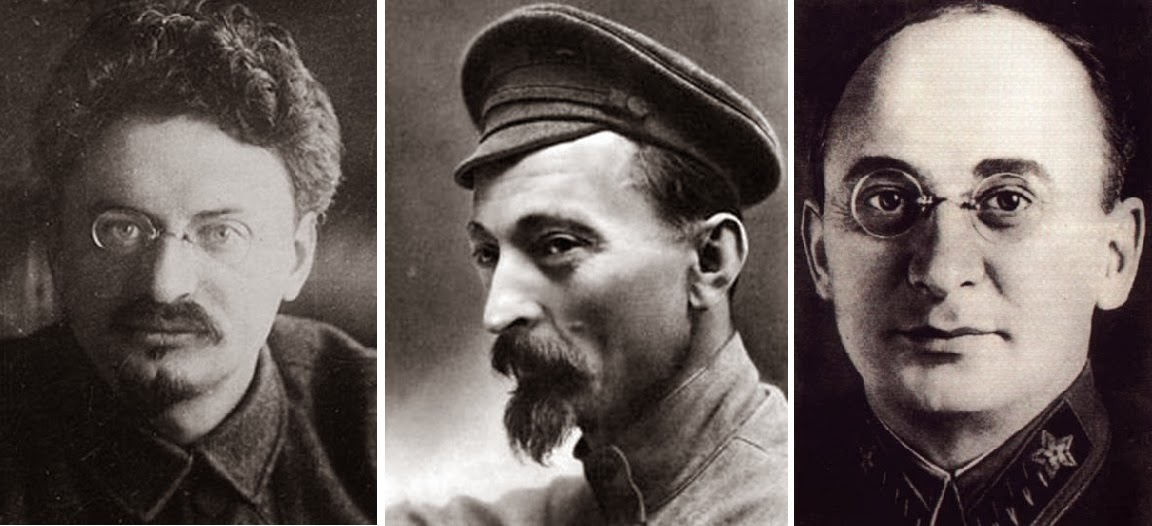
Left to right: Leon Trotsky, Felix Dzerzhinsky, Lavrenti Beria.

“Lenin, at every passing opportunity, emphasized the absolute necessity of the terror. . . .
“We heard such tirades from him a dozen times a day and they were always aimed at some one among those present who was suspected of ‘pacifism.'”

— Leon Trotsky, Lenin (1925)

“Socialism has never and nowhere been at first a working-class movement. . . . It is a construction of theorists, deriving from certain tendencies of abstract thought with which for a long time only the intellectuals were familiar . . .”
— F.A. Hayek, “The Intellectuals and Socialism” (1949)

Marxism envisions the “dictatorship of the proletariat,” so that there can be no Marxism without violent terror, and self-described communist Jesse Myerson must fail in his attempts to evade this truth.

Ever since his Rolling Stone article advocating the abolition of private property provoked a furious reaction last month, Myerson has sought to evade the consequences of his ideas by employing rhetorical tactics familiar to anyone who has long studied the Left. His Salon.com article last Sunday was a particularly tedious exercise in these methods, and inspired me to remind readers of how Ludwig von Mises had described the ultimate futility of socialism:

“Socialist writers may continue to publish books about the decay of Capitalism and the coming of the socialist millennium; they may paint the evils of Capitalism in lurid colours and contrast with them an enticing picture of the blessings of a socialist society; their writings may continue to impress the thoughtless — but all this cannot alter the fate of the socialist idea.”

Myerson’s fanciful blather about a “far more open, humane, democratic, participatory and egalitarian” communism in the future, which would somehow miraculously avoid the monstrous evils of previous communist regimes, signified his own ignorance of history. Myerson’s response, however, is to accuse communism’s opponents of being ignorant: He is knowledgeable and wise; we are McCarthyite fools.

Typical of his puerile irresponsibility, when Myerson appeared on MSNBC with Chris Hayes last month, the former Occupy Wall Street spokesman declared that his #FULLCOMMUNISM Twitter hashtag was “sort of a tongue in cheek, post-Occupy joke.”

Translation: “Haha! Stupid right-wingers don’t get the joke!”

As I said Saturday, “Myerson’s intellectual superiority to others is both the premise and conclusion of his every argument,” but these gestures of his — narcissistic poses intended to elicit admiration of his cleverness — only expose his own superficiality. Does he suppose that jokes will bring about the dispossession of the 1% he advocates? Is Myerson’s idea of communism as a “utopian aspiration” intended to result in any actual policy, or is it all just droll chatter?

These are not rhetorical questions.

If Myerson seriously wishes to advocate for specific policies, then those policies may be examined and criticized according to their likely consequences, on the basis of evidence and historical precedent. If not — if Myerson is just playing tongue-in-cheek word games — then we may rightly depict him as a clown in red nose and floppy shoes. The latter approach was preferred by Jonah Goldberg:

Myerson’s essay captures nearly everything the unconverted despise about left-wing youth culture, starting with the assumption that being authentically young requires being theatrically left wing.
Writing with unearned familiarity and embarrassingly glib confidence in the rightness of his positions, Myerson prattles on about how “unemployment blows” and therefore we need “guaranteed work for everybody.” He proceeds to report that jobs “blow” too, so we need guaranteed universal income. He has the same disdain for landlords, who “don’t really do anything to earn their money.” Which is why, Myerson writes, we need communal ownership of land, or something.
One wonders why he bothered to single out landlords, since he calls for the state appropriation of, well, everything. Why? Because “hoarders blow,” and he doesn’t mean folks who refuse to throw away their Kentucky Fried Chicken buckets and old Sharper Image catalogs. He means successful people who “hoard” the wealth that rightly belongs to all of us.

Myerson’s ideas deserve such ridicule because they are, in fact, ridiculous. Why, then, do so many young people take these ideas seriously? It is not merely because they are ignorant — although they are — but that they have been deliberately miseducated.

What kind of books do young people read nowadays?

In most cases, the answer is “none.” Except for what they are assigned to read in school, young people today typically never read any books at all, instead filling their minds with junk TV, videogames and Internet porn, when they’re not too busy attempting to hook up via text message: “ur so hot. call me 2nite. i wanna get w u.”

We are descending steadily into a post-literate culture, and increasingly young people learn only what they are taught.

Autodidactic curiosity — the impulse to educate yourself about the world, for the sheer satisfaction of knowing — is utterly dead in the current generation of youth. They may complete the assigned readings in school, in order to obtain good grades, but this activity is just an exercise in jumping through hoops in the pursuit of credentials that will qualify them for lucrative careers. Therefore, what today’s youth know about history is entirely a function of what they were required to learn in order to get a diploma. They feel no embarrassment at all about their vast and general ignorance, because none of their peers know anything, either.

The three most recent books I’ve read are Peter Collier’s Political Woman: The Big Little Life of Jeane Kirkpatrick, Paul Kengor’s The Communist: Frank Marshall Davis: The Untold Story of Barack Obama’s Mentor, and Robert Service’s Trotsky: A Biography.

Actually, I was re-reading the Trotsky book, which I first read in 2011:

Trotsky was inarguably the most intellectually gifted of the Bolshevik leaders, and his talent as a writer earned him the nickname “The Pen.” Certainly anyone who has read Trotsky’s work appreciates his subtlety as a writer in comparison to the blunt formulations of Lenin. I had often wondered how much of Trotsky’s reputation as a writer in the English-speaking world was due to the talents of his translator Max Eastman, but Service makes clear that Trotsky’s ability won him admiration among Russian radicals long before anyone in the English-speaking world had ever heard of him.

What makes Trotsky so endlessly fascinating is that such a civilized person could have become part of the brutal Soviet dictatorship.

No less than any of his comrades did Trotsky embrace the Red Terror unleashed against opponents of the Bolshevik regime. Indeed, as the People’s Commissar for Military Affairs, it was Trotsky’s leadership of the Red Army that saved the Bolsheviks and made possible their absolute dictatorship.

Not less essential to the Bolshevik dictatorship was the Extraordinary Commission to Combat Counter-Revolution and Sabotage, the dreaded secret police known as the Cheka. Led by Felix Dzerzhinsky, the Cheka carried out mass arrests, torture and summary executions with no regard for “bourgeois” notions of civil rights. Indeed, individual guilt or innocence was irrelevant to the purposes of the Cheka’s depredations. The aim of the Red Terror was simply to inspire fear among the regime’s potential opponents, and to excite revolutionary zeal by inflicting violence on demonized enemies, who were labeled “counter-revolutionaries” and “saboteurs” (with about as much accuracy as today’s leftists denounce Republicans as “racists” and “sexists”).

Trotsky “fully endorsed the Red Terror,” as his biographer says, and Trotsky justified this policy in his 1920 book Terrorism and Communism:

We were revolutionaries in opposition, and have remained revolutionaries in power. To make the individual sacred we must destroy the social order which crucifies him. And this problem can only be solved by blood and iron. . . .
The Red Terror is a weapon utilized against a class, doomed to destruction, which does not wish to perish. . . .
The man who recognizes the revolutionary historic importance of the very fact of the existence of the Soviet system must also sanction the Red Terror.

This, you see, is an unashamed  doctrine of deliberate violence, as expressed by one who — even as those words were written — was chief among those tasked with carrying out the Red Terror.

Can Jesse Myerson possibly be ignorant of this? Was this not among the lessons he learned while studying human rights at Bard College (annual tuition $45,730)? How can Myerson, self-declared communist, describe his project as proposing “to construct a set of social relations based on fellowship and mutual aid”? That’s not communism, that’s Kumbayah.

However, as I say, the point of Jesse Myerson’s arguments is always the same, i.e., the intellectual superiority of Jesse Myerson.

The whole purpose of his Salon.com article was to demonstrate how much smarter he is than everyone else, because “most of what Americans think they know about capitalism and communism is arrant nonsense.” You don’t actually know anything, you just think you know, and that’s why you stupid Americans need Jesse Myerson to tutor you about your “huge misconceptions.”

There is no antagonist whose arguments Myerson respects. If you don’t agree with Myerson, you are inferior, even if you happen to be a professor of political science like Donald Douglas:

Really? Hobbes and Locke were “classical political economists”? But never mind that, let’s talk about Ellen Meiksins Wood and her book,  The Origin of Capitalism. She is a Marxist historian whose late husband, Neal Wood, was likewise a Marxist historian. Together, they published such books as Class Ideology and Ancient Political Theory: Socrates, Plato, and Aristotle in Social Context, and Neal Wood’s final book was Tyranny in America: Capitalism and National Decay, published in 2004:

The US has been subjected to the ruthless and unrelenting tyranny of the world’s most advanced capitalism, permeating every aspect of American life. The chief difference from other tyrannies is its facelessness, its dependence on impersonal coercive power more than on direct violence and terror against its subjects. . . .
America is an inegalitarian class society with an ever-growing chasm separating a minuscule minority of the very rich from the poor and moderately well-off. . . . American society is a culture of rapidly proliferating violence, rampant consumerism, mindless entertainment, and freneticism, while its political culture, grounded in an eighteenth-century constitution that was never intended to create a democracy is ever more hollow and undemocratic.
Tyranny in America, written in the spirit of Tom Paine and inspired by Karl Marx, scathingly addresses the chief maladies afflicting the US and forcefully argues that fundamental change is necessary if moral, political, and social implosion is to be avoided.

Neal Wood hated America because he hated capitalism, which he considered a “ruthless and unrelenting tyranny” of “impersonal coercive power.” One rather suspects that he spent the Cold War cheering for America’s enemies. His widow’s book, recommended by Jesse Myerson, comes with this description:

In this original and provocative book Ellen Meiksins Wood reminds us that capitalism is not a natural and inevitable consequence of human nature, nor is it simply an extension of age-old practices of trade and commerce. Rather, it is a late and localized product of very specific historical conditions, which required great transformations in social relations and in the human interaction with nature.
This new edition is substantially revised and expanded, with extensive new material on imperialism, anti-Eurocentric history, capitalism and the nation-state, and the differences between capitalism and non-capitalist commerce. The author traces links between the origin of capitalism and contemporary conditions such as ‘globalization’, ecological degradation, and the current agricultural crisis.

This reflects the Marxist idea of historical materialism. You perhaps will not be surprised to learn she is also author of a 1995 book, Democracy Against Capitalism: Renewing Historical Materialism:

Ellen Meiksins Wood argues that with the collapse of Communism the theoretical project of Marxism and its critique of capitalism is more timely and important than ever. In this book she sets out to renew the critical program of historical materialism by redefining its basic concepts and its theory of history in original and imaginative ways, using them to identify the specificity of capitalism as a system of social relations and political power. She goes on to explore the concept of democracy in both the ancient and modern world, examining the concept’s relation to capitalism.

“Marxism — now more than ever!” Just as Hayek said, “a construction of theorists, deriving from certain tendencies of abstract thought” among intellectuals who, even with the castastrophic ruin of the Marxist dream staring them in the face, continued to insist that “the theoretical project of Marxism and its critique of capitalism” was still “timely and important.” No matter how much their ideas fail in practice, these intellectuals remain committed to Marxism in theory.
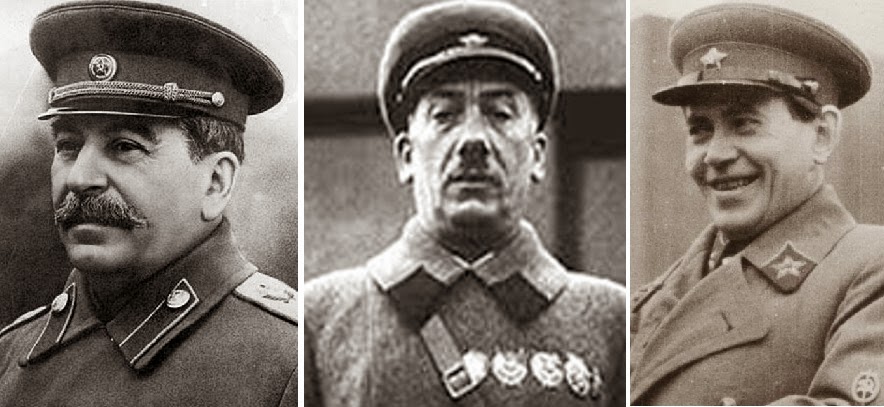
Left to right: Josef Stalin, Genrikh Yagoda, Nikolai Yezhov.

“That socialism can be put into practice only by methods which most socialists disapprove is, of course, a lesson learned by many social reformers in the past. The old socialist parties were inhibited by their ideals; they did not possess the ruthlessness required for the performance of their chosen task.”
— F.A. Hayek, The Road to Serfdom (1944)

This is a historic truth Jesse Myerson endeavors to evade by the smug cleverness of his “tongue-in-cheek” communism: Marx, Engels, Lenin and Trotsky were not mere intellectuals offering a “critique of capitalism.” They were socialist revolutionaries deeply committed to the violent overthrow of bourgeois democracy, which they aimed to replace with the dictatorship of the proletariat.

Citing the work of academic Marxists like  Ellen Meiksins Wood “cannot alter the fate of the socialist idea,” to borrow Mises’s phrase, yet Myerson would have us believe that it is our “huge misconceptions about communism” which are the problem.

Did Leon Trotsky have “huge misconceptions about communism”?

The intellectual who became commander of the Red Army and advocated revolutionary terror — “blood and iron. . . . a weapon utilized against a class, doomed to destruction” — was ultimately on the receiving end of that terror. After Lenin’s death in 1924, Stalin assumed power and within a few years, Trotsky was purged from the Bolshevik leadership, exiled and eventually assassinated.

By the time Ramon Mercader buried an ice-ax in Trotsky’s skull, the Soviet “experiment” had already killed millions of people whose misfortune it was to live and die under Stalin’s rule. The forcible collectivization of agriculture and the accompanying terror campaign against the kulaks (peasants whom the Soviets blamed for the failure of collectivization) produced a famine that killed millions of Ukrainians — estimates vary between 5 and 10 million — and many millions more elsewhere in the U.S.S.R. The truth about the horrors inflicted by Stalin’s policies was concealed for decades; there was no freedom of the press under Soviet rule, and many Western journalists like Walter Duranty of the New York Times were willing dupes of Stalinist propaganda.

After the death of Dzerzhinsky in 1926 — the Cheka commander died of a heart attack after a speech denouncing Trotsky — suppression of dissent continued under the People’s Commissariat for Internal Affairs (known by its Russian acronym, NKVD), whose leadership was a series of murderous monsters. Genrikh Yagoda was the active manager of the NKVD during the years of the Ukrainian terror-famine and began the subsequent “Show Trial” purge of Bolshevik leaders viewed as potential rivals by the paranoid Stalin.

Yagoda supervised the arrest and executions of Grigory Zinoviev and Lev Kamenev in 1936, but did not live to complete the purge, because he himself fell victim to it. Stalin announced that Yagoda had “proved unequal to the task of exposing the Trotskyite-Zinonievite bloc” and he was replaced as head of the NKVD by Nikolai Yezhov. Only five feet tall, Yezhov made up for his small size by his slavish devotion to Stalinism and a psychopathic tendency toward sadism.

Claiming that targets of the purge were “Fascist agents,” Yezhov did not deny that some innocent people were imprisoned or executed: “Better that ten innocent people should suffer than one spy get away. When you chop wood, chips fly.” Among the victims of the purge under Yezhov’s direction were a majority of top Soviet leaders, including generals in the Red Army. Yezhov specialized in the falsification of “evidence” again his victims and the extraction of “confessions” by torture. Yezhov personally tortured Yagoda, who was stripped naked and beaten before finally being shot to death in 1938.

The humiliation Yezhov inflicted on his predecessor was exceeded by the fate reserved for Yezhov when he was in turn disgraced, purged and replaced by Lavrenti Beria. In addition to implicating himself and others in fictitious espionage plots, Yezhov was forced to confess in detail his “longtime vice of homosexuality.” He was convicted in a secret trial, dragged away screaming and crying, and executed in February 1940.

Perhaps the reader is beginning to notice a pattern here.

Although the Soviets managed to keep details of many of their atrocities secret for decades, the general pattern of totalitarian brutality drew the attention of Friedrich Hayek:

There are strong reasons for believing that what to us appear the worst features of totalitarian systems are not accidental byproducts but phenomena which totalitarianism is certain to sooner or later produce.
Just as the choice architect who sets out to plan economic life will soon be confronted with the alternative of either assuming dictatorial powers or abandoning his plans, so the totalitarian dictator would soon have to choose between disregard of ordinary morals and failure.
It is for this reason that the unscrupulous and uninhibited are likely to be more “successful” in a society tending toward totalitarianism.

Jesse Myerson and other neo-communists certainly must understand this, but cannot admit it: Marxism requires coercive violence — systematic terror — and the people most likely to lead such a violent enterprise are not timid intellectuals, but amoral brutes, the “unscrupulous and uninhibited.” Bad causes attract bad people and communism is “The Worst Idea in the World.”

Interestingly, many historians believe Nikolai Yezhov’s confession of his “vice of homosexuality” was true. Stalin’s spies were everywhere, and Yezhov’s vulnerability in this regard may have made him a convenient tool for Stalin’s purposes. Certainly, no one could imagine that the man who succeeded Yezhov as commissar of the NKVD was a paragon of virtue. Lavrenti Beria was a notorious sexual predator who routinely raped women, with an especial appetite for teenage girls, several of whom he reportedly strangled and buried in the garden of his Moscow villa:

“Sometimes he would have his henchmen bring five, six or seven girls to him. He would make them strip, except for their shoes, and then force them into a circle on their hands and knees with their heads together.
“He would walk around in his dressing gown inspecting them. Then he would pull one out by her leg and haul her off to rape her. He called it the flower game.”

Protecting Stalin’s dictatorship, the ruthless Beria was protected in turn. He managed to stay in power for some 15 years, during which time he oversaw the Soviet espionage project that obtained atomic weapon secrets from the United States, as well as supervising imposition of communist rule in Eastern Europe after World War II.

Stalin’s death in 1953, however, inevitably made Beria a target of Stalin’s successor, Nikita Kruschev, who feared the murderous NKVD commissar would seize power. Beria was arrested along with six of his subordinates. They were all sentenced to death by Soviet Supreme Court on Dec. 23, 1953, and the verdict was carried out the same day. It is said Beria, who never showed mercy for his own victims, cried and begged for his life before he was shot to death.

Marx, Engels, Lenin, Trotsky, Stalin — all of them understood that communism could only be implemented by the violence of revolutionary terror. The preservation of the Soviet regime was therefore dependent on the merciless savagery of monsters like Dzezhinsky, Yagoda, Yezhov and Beria, whose crimes were not an accident of history, but were implicit in the Marxist ideology that academics like Ellen Meiksins Wood wish to rescue from the ruins of the Evil Empire it created.

Under the influence of such academic impostors — for it is the habit of latter-day Marxist intellectuals to deny the centrality of violent terror to their doctrine — the young fool Jesse Myerson supposes he is qualified to enlighten us, correcting our “huge misconceptions about communism.”

His dishonesty exceeded only by his selfishness, Myerson does not seriously advocate any policy, and his pseudo-radical poses are intended only to make himself an object of admiration. Communism cannot possibly succeed as an actual economic policy, and the only way it could ever be attempted is under the absolute authority of The Total State, where there can be no democracy, no rule of law, and no civil rights.

Were it not for the fact that millions would suffer under any future communist regime, just as they have suffered under previous communist regimes, one might almost hope that Myerson could have his wish. Sooner or later, the ruthless men who would govern in any communist state would tire of Myerson’s glib chatter, and he would almost certainly be tortured before he was executed.

Instead, Myerson tortures us with his “tongue-in-cheek” communism and, if citizens of a free society can ignore Myerson, we cannot ignore that such young fools are increasingly common, and that a majority of young voters elected Obama president.


PREVIOUSLY:


The Renegade Jesse Myerson

Jesse Myerson (@JAMyerson) in a March 2012 cable TV appearance.

“Dictatorship is rule based directly upon force and unrestricted by any laws.
“The revolutionary dictatorship of the proletariat is rule won and maintained by the use of violence by the proletariat against the bourgeoisie, rule that is unrestricted by any laws. . . .
“One cannot hide the fact that dictatorship presupposes and implies . . . revolutionary violence of one class against another.”

— Vladimir Ilyich Lenin, The Proletarian Revolution and the Renegade Kautsky (1918)

When Lenin was wounded in an August 1918 assassination attempt, Josef Stalin knew what to do. The future Soviet dictator sent a telegram to Moscow, announcing that he was “instituting open and systematic mass terror against the bourgeoisie and its agents.”

Stalin ignorantly blamed “the hirelings of the bourgeoisie” for the shooting of Lenin, but in fact the would-be assassin was a 28-year-old Socialist Revolutionary, Fanya Kaplan, who had spent 11 years at hard labor in tsarist prisons after being arrested for her part in a terrorist bombing plot when she was 16. What inspired Kaplan’s resolve to assassinate Lenin was the forcible suppression of the Constituent Assembly in January 1918, less than three months after the overthrow of the Kerensky government in October 1917 .

Lenin never erred on the side of leniency. Kaplan was executed with a bullet to the back of the head four days after her assassination attempt, as the Bolsheviks unleashed the Red Terror which, among thousands of deliberate atrocities, resulted in the summary execution of some 800 members of the Socialist Revolutionary Party.

“[T]here is only one way in which the murderous death agonies of the old society and the bloody birth throes of the new society can be shortened, simplified and concentrated, and that way is revolutionary terror.”
— Karl Marx, 1848

Communism’s explicit and enthusiastic embrace of violent “revolutionary terror” is among the many facts that self-described communist Jesse Myerson seeks to ignore or evade in pretending to correct our “huge misconceptions about communism.”

Supposing the enemies of communism to be as ignorant as himself, Myerson boasts of making “points” that his opponents are incapable of answering, thus to display his imaginary intellectual superiority. Myerson’s posing is intended, as I explained yesterday, for entirely selfish purposes: By presenting himself as an insuperable advocate of far-left “progressive” ideas, he expects to be praised and admired, and thus to be elevated to a position of leadership, obtaining for himself not only fame as a sort of radical celebrity, but also an easy income as a Professional Progressive Thinker.

Glorious Idol of the Obscure Masses

Myerson’s sociopathic dishonesty suits him well for this project of pseudo-revolutionary self-advancement, and his resemblance to Anonymous “famewhore” Barrett Brown is not coincidental, the main differences being that (a) Barrett is a much better writer, and (b) Barrett had the courage of his convictions, with the result that (c) Barrett is now in federal custody awaiting trial on enough felony charges to put him in prison for life, while (d) Myerson is still running free, getting paid to publish in Salon.com and Rolling Stone, and enjoying as much sex, drugs and rock-and-roll as he can afford.

Nice work, if you can get it, but not every leftist enjoys the privileges of the radical celebrity elite. For every rock star type like Myerson, there are many hundreds of their ideological comrades who toil in obscurity on behalf of the progressive cause. The leftist masses, by their silent acceptance of Myerson’s leadership, thereby acknowledge their inferiority to him: If they were as capable as Myerson of articulating their shared beliefs, they would be his equal. Instead, because Myerson is better than them, he gets the Rolling Stone commissions and the invitations to appear on cable TV talk shows. The role assigned to the progressive masses is merely to admire and applaud Jesse Myerson, contenting themselves to bask in his reflected glory.

Sic semper hoc.

The extreme egoism of communist leaders is a trait displayed throughout the history of the movement since Marx’s ridiculous insistence that only his socialism was “scientific.” Yet such is Jesse Myerson’s egoism that he imagines himself superior even to Marx, Engels, Lenin, Trotsky and Stalin. At least they had the integrity to admit that the abolition of private property — the expropriation of the bourgeosie — could only be accomplished by violent revolution, and that the victors of such a revolution would have to employ the methods of violent terror to establish their dictatorship.

When Myerson’s Jan. 3 Rolling Stone article drew criticism, he responded that he did not “want the 1% dead just dispossessed.”

This was ridiculous, as any true communist could have seen. Does this young Bard College alumnus expect that billionaires will voluntarily surrender their wealth? Eh, never mind: Myerson deleted the Tweet, evidently in embarrassment.

A revolution is certainly the most authoritarian thing there is … And the victorious party must maintain its rule by means of the terror which its arms inspire in the reactionaries.”
— Friedrich Engels, 1872

Nearly two decades ago, after undertaking a careful study of Marxist philosophy, I concluded that 19th-century Germans were envious of the French Revolution and craved a sans-culotte epoch to call their own. Marxism’s “dialectical materialism,” with its allegedly scientific devotion to historical development, assigned to the French Revolution a sort of runner-up trophy in history, declaring that the quest for political equality that had inspired the uprising of 1789 was mere “bourgeois democracy,” destined soon to be eclipsed by the coming socialist revolution of the proletariat. Though Marxism advocated internationalism and appealed to the “workers of the world,” its authors were distinctly German — deriving their concept of the dialectic from Hegel — and it was generally expected that Germany, with its advanced industrial economy, would be the scene of the outbreak of the proleterian revolution.

When the Bolsheviks seized power in backward Russia, critical sniping from the German social-democrat Karl Kautsky inspired contemptuous sarcasm from Lenin and Trotsky. But who could not pity the hapless German socialists? Here their own idea had been unexpectedly successful in an inferior nation — one the German army had beaten in the World War — and there was an unmistakable humiliation in the fact that the German people had once more lost out in the world-historic revolutionary sweepstakes. The 19th-century German socialists Marx and Engels borrowed the idea of revolutionary terror from 18th-century France, and yet it was 20th-century Russians who experienced the bloody fulfillment of that hand-me-down nightmare vision.

“Marx and Engels hammered out the idea of the dictatorship of the proletariat . . . the idea that the political autocracy of the proletariat is the ‘sole form in which it can realize its control of the state.’ . . . The man who repudiates terrorism in principle . . . must reject all idea of the political supremacy of the working class and its revolutionary dictatorship. The man who repudiates the dictatorship of the proletariat repudiates the Socialist revolution, and digs the grave of Socialism.”
— Leon Trotsky, 1920

Terroristic violence is the sine qua non of communism, first in overthrowing the capitalist order and then in maintaining the authority of its revolutionary dictatorship “unrestricted by any laws.”

This explicit rejection of civil rights and the Rule of Law, this maniacal devotion to violence as a core principle, guaranteed that the Soviet government would be a murderous totalitarianism. Nevertheless, self-described communist Jesse Myerson airily dismisses the bloody record of Marxist-Leninist regimes with a bit of rhetorical arm-waving as he lectures us on our “huge misconceptions about communism.” Revolutionary violence disappears in a fog of moral equivalence:

In capitalism, competing ownership claims are settled by the state’s willingness to use violence to exclude all but one claimant. If I lay claim to one of David Koch’s mansions, libertarian that he is, he’s going to rely on big government and its guns to set me right. He owns that mansion because the state says he does and threatens to imprison anyone who disagrees. Where there isn’t a state, whoever has the most violent power determines who gets the stuff, be that a warlord, a knight, the mafia or a gang of cowboys in the Wild West. Either by vigilantes or the state, property rights rely on violence.
This is true both of personal possessions and private property, but it is important not to confuse the two. Property implies not a good, but a title — deeds, contracts, stocks, bonds, mortgages, &c. When Marxists talk of collectivizing ownership claims on land or “the means of production,” we are in the realm of property; when Fox Business Channel hosts move to confiscate my tie, we are in the realm of personal possessions. Communism necessarily distributes property universally, but, at least as far as this communist is concerned, can still allow you to keep your smartphone. Deal?

Ah! We are ignorantly confused between “personal possessions and private property,” Myerson tells us, so that the principle which justifies expropriation of a billionaire’s wealth (property) will not be extended to your iPhone (a mere possession).

Of course, in actual practice — as opposed to Myerson’s word games — communism’s lawlessness routinely resulted in ordinary people being deprived not only of property and personal possessions, but also deprived of liberty and life. Beyond its inherent tendency toward terroristic violence, communism proved itself incapable of producing an adequate supply of those consumer goods (not just sophisticated devices like iPhones, but also such mundane items as shoes and bread) that Myerson takes for granted in capitalist America.

So not only do the rich people lose their wealth, but everybody else is doomed to hopeless poverty and — oh, yes, by the way — your communist rulers might decide to kill you and a few million other people, just so nobody forgets who’s in charge.

The Secret Elitism of the Occupy Movement

Did I mention that Jesse Myerson’s original claim to fame was as “media coordinator” for Occupy Wall Street? Remember when that mob of smelly losers shut down the Brooklyn Bridge?

New York City police say about 700 protesters have been arrested after they swarmed the Brooklyn Bridge and blocked traffic lanes for several hours.
On the second week of protests by the Occupy Wall Street movement, a large group of marchers broke off from others on the bridge’s pedestrian walkway and headed across the Brooklyn-bound lanes.
Police say demonstrators spilled onto the roadway Saturday night after being told to stay on the pedestrian pathway. They face charges of disorderly conduct and resisting arrest.
Some of the protesters said that authorities had tricked, trapped and then arrested them, according to The New York Times.
“The cops watched and did nothing, indeed, seemed to guide us onto the roadway,” Occupy Wall Street media coordinator Jesse Myerson told the newspaper.

Blame the cops! Yes, that’s it — the cops tricked us into breaking the law!

Here’s another bit from the same October 2011 article:

Protesters speaking out against corporate greed and social inequality took their “solidarity march” to Brooklyn, but battled in a war of words against officers, chanting “We are not criminals” and “Let us go!”
Some protesters tried to get away as officers started handcuffing members of the group. Dozens of protesters were seen handcuffed and sitting on the span as three buses were called in to take them away, witnesses and organizers said.
The New York Times reported a few protesters had “clambered dangerously up the structure of the bridge to get to the wooden pedestrian walkway, which is about 15 feet above the road.”
Erin Larkins, a graduate student at Columbia University who says she and her boyfriend have $130,000 combined in student loan debt, was among the thousands of protesters on the bridge. She said a friend persuaded her to join the march and she’s glad she did.
“I don’t think we’re asking for much, just to wake up every morning not worrying whether we can pay the rent, or whether our next meal will be rice and beans again,” Larkins wrote in an email to The Associated Press.

Oh, noes! A graduate student at Columbia (annual tuition, $44,716) is eating rice and beans and worrying how she and her boyfriend can pay their rent because . . . corporate greed! Social inequality!

Why do these neo-communists always have to attend elite private schools? Jesse Myerson attended Bard College (annual tuition $45,730) where he majored in theater and “human rights studies.”

Why would Myerson pay so much to attend an elite school in Annandale when, a half-hour drive away in Poughkeepsie, Dutchess Community College boasts that it offers “the lowest tuition in New York state,” just $3,200 a year? After a couple years getting your associate’s degree at DCC, then you could transfer to a SUNY campus — say, Albany, about an hour’s drive from Annandale — where annual tuition is $5,800.

Although I don’t know if Bard College requires any math classes to get a degree in human rights, by my calculations, the difference in tuition between attending Bard ($182,920 for four years) and going the DCC/SUNY-Albany route ($18,000) is $164,920.

Saving yourself $164,920 in tuition might not put you into the 1%, but it sure will buy a lot of rice and beans, so . . .

Why did Jesse Myerson go to Bard? Because he’s better than you.

Myerson’s intellectual superiority to others is both the premise and conclusion of his every argument, and you don’t expect someone with such superior qualities to rub shoulders with those lowbrow plebians at community college, do you? No, of course not. Educating the revolutionary vanguard requires the “prestigious faculty” and “vibrant” campus life “with world-class performing arts venues” that only an elite private $45,730-a-year liberal arts college can provide.

This young communist can’t be bothered to learn history or economics, nor has he studied Marxist theory enough to understand that his rejection of revolutionary terror condemns him to the same “renegade” category to which Lenin assigned the pathetic Kautsky. And this same Jesse Myerson (Bard ’08) presumes to enlighten us as to our “huge misconceptions about communism”?

“The first time as tragedy, the second time as farce.”

At least Marx got that much right . . .


Teach Your Children Well

Jesse Myerson (@JAMyerson) seems to believe he is so clever that the “points” he makes in advocating communism deserve a detailed rebuttal, and I suppose there may be people who have nothing better to do with their time than to supply such a response.

Both humility and impatience (as well as years of experience) lead me to avoid a point-by-point engagement with an impudent fool.

Jesse Myerson is not interested in the facts of history or economics that would contradict his communist enthusiasms. Myerson is merely striking the pose of a radical intellectual, expecting admiration and applause from those who share his socialist sympathies. No doubt he hopes these gestures will enable him to obtain TV appearances, book contracts and speaking invitations. His purported “idealism” is thus motivated by selfish ambition: The narcissist’s desire to be seen as praiseworthy, and to acquire an easy income by advocating ideas popular with the Left.

Many have trod that path before, and Myerson’s potential for success in this ideological endeavor cannot be underestimated.

Some people take Conor Friedersdorf seriously, you know.

Myerson is dishonest about many things, but mostly he is lying to himself, and foolishly believes his own lies about himself. He thinks he is a unique individual — a Special Snowflake™ — when in fact he is manifestly a type, and not a good type, either. His insulting impudence is reminiscent of Barrett Brown, now in federal custody awaiting trial.

Were I to learn that Myerson had a history of substance abuse and/or psychiatric problems, it would not surprise me.

Who Has ‘Huge Misconceptions’?

Myerson seems incapable of realizing that his insults are directed at someone who has seen his type a thousand times before. Presuming to lecture others about subjects which they know far better, Myerson petulantly pretends that their refusal to treat his faulty arguments seriously is proof of his own superiority. He imagines his elders who have lived through the history that he has merely read (and he doesn’t seem to have read it very carefully) need his sermons about their “huge misconceptions about communism.”

“In a socialist community the possibility of economic calculations is lacking: it is therefore impossible to ascertain the cost and result of an economic operation or to make the result of the calculation the test of the operation. . . .
“Too little attention has hitherto been given to these fundamental questions. . . . To understand the problem of economic calculation it was necessary to recognize the true character of the exchange relations expressed in the prices of the market. . . .
“It has not been realized that even exceptionally gifted men of high character cannot solve the problems created by socialist control of industry.”

— Ludwig von Mises, Socialism (1922)

Myerson is not illiterate, and is thus as capable as anyone else of reading Mises or Friedrich Hayek or Thomas Sowell. That he has never taken the time to do so — that he has not encountered the arguments of, e.g., Sowell’s The Quest for Cosmic Justice — is self-evident, and damning proof of Myerson’s intellectual sloth. He presents himself as an advocate of communism, but I can guarantee you that I have read more communist literature (including Marx, Engels, Lenin and Trotsky) than has Myerson, and that I am more familiar than he with the history of Marxist-Leninist governments. But while I have studied the works of communism’s foremost advocates, Myerson has not studied the works of the most insightful advocates of the market economy. His ignorance, however, is no hindrance to his arrogance:

Communism envisions a time beyond work, when people are free, as Marx wrote, “to do one thing today and another tomorrow, to hunt in the morning, fish in the afternoon, rear cattle in the evening, criticize after dinner … without ever becoming hunter, fisherman, herdsman or critic.” In that way, communism is based on the total opposite of uniformity: tremendous diversity, not just among people, but even within a single person’s “occupation.”

And good luck with that, OK? You might think Myerson would be embarrassed to recite the theoretical speculations of Karl Marx from 1845 (!) as if acquainting us with something hitherto unknown. Overlooking this puerile insult, let us instead contemplate the passage in Marx’s treatise preceding the one quoted by Myerson:

With the division of labour, in which all these contradictions are implicit, and which in its turn is based on the natural division of labour in the family and the separation of society into individual families opposed to one another, is given simultaneously the distribution, and indeed the unequal distribution, both quantitative and qualitative, of labour and its products, hence property: the nucleus, the first form, of which lies in the family, where wife and children are the slaves of the husband. This latent slavery in the family, though still very crude, is the first property, but even at this early stage it corresponds perfectly to the definition of modern economists who call it the power of disposing of the labour-power of others. Division of labour and private property are, moreover, identical expressions: in the one the same thing is affirmed with reference to activity as is affirmed in the other with reference to the product of the activity.
Further, the division of labour implies the contradiction between the interest of the separate individual or the individual family and the communal interest of all individuals who have intercourse with one another. And indeed, this communal interest does not exist merely in the imagination, as the “general interest,” but first of all in reality, as the mutual interdependence of the individuals among whom the labour is divided. And finally, the division of labour offers us the first example of how, as long as man remains in natural society, that is, as long as a cleavage exists between the particular and the common interest, as long, therefore, as activity is not voluntarily, but naturally, divided, man’s own deed becomes an alien power opposed to him, which enslaves him instead of being controlled by him. For as soon as the distribution of labour comes into being, each man has a particular, exclusive sphere of activity, which is forced upon him and from which he cannot escape.

What Marx was doing here, laying the groundwork for his theory of alienation, was mimicking the method of 18th- and 19th-century social, economic and political philosophers who were forever dragging readers back to a mythical State of Nature in the primordial past, then leading them forward through a process of historical “development” in order either (a) to justify the existing order, or (b) to advocate some change to that order. If you’ve read through a few of these philosophical State of Nature field trips, you understand what Marx is up to here. When Marx’s particular “development” lecture ends with a contrast to “communist society, where nobody has one exclusive sphere of activity but each can become accomplished in any branch he wishes,” the astute reader recognizes an attempted trickery: Marx merely imagines the possibility of this “communist society,” without bothering to specify how such an imaginary society could actually operate.

Marx assumes as a premise the feasibility of communism, which had never been proven prior to 1845 and which most observers would say has been quite conclusively disproven since. Yet here we have young Myerson holding up to us this bit of Marxian sophistry as if he has discovered a new and wonderful idea with which none of us ignorant right-wing stooges were ever previously acquainted!

Do you see the futility of arguing with Marxists? If they gave a damn about facts or logic, they wouldn’t be Marxists. And yet the brutal exposure of their errors is no idle or trivial exercise.

“Obama was already an ardent Marxist when I met in the fall of 1980. . . . I know it’s incendiary to say this [but Obama] was basically a Marxist-Leninist.”
— John Drew, Occidental College graduate

As anyone who has read Paul Kengor’s 2010 book The Communist is aware, the problem with Obama’s youthful Marxism is that he has never offered a conversion story to suggest that he ever abandoned it. When I was a young man, I was an ardently partisan Democrat — hell, I voted for Walter Mondale in 1984 — but I’ve often told the tale of when, why and how I became an ex-Democrat in the 1990s. While I was never a socialist, many others who once embraced socialism (including, inter alia, Whittaker Chambers, Ronald Reagan and David Horowitz) subsequently became conservatives, but all ex-Marxists in public life have typically made the story of their conversion a central part of their personal narrative. The absence of any such a conversion tale in Obama’s narrative is, as Kengor says, quite troubling.

Confronting the Anti-Bush Generation

Nor can we dismiss as an aberration Myerson’s enthusiasm for the discredited dream of communism. Perhaps others have overlooked how many college-educated 20-somethings like Myerson have taken up a far-left progressive stance. My interpretation of this phenomenon is that it is to a great degree a backlash to Bush-era GOP hegemony.

In the span of a decade (1998-2008), American public life went through a series of shocking events:

  • 1998 — The Lewinsky scandal and the Clinton impeachment.
  • 2000 — The Florida election deadlock and the Supreme Court decision that made George W. Bush president.
  • 2001 — The 9/11 terror attack and the invasion of Afghanistan.
  • 2002 — An unprecedented mid-term win for Republicans, securing GOP control of the White House, the Senate and the House of Representatives for the first time in nearly 50 years.
  • 2003 — The invasion of Iraq.
  • 2004 — Bush re-elected after the “Swiftboating” of John Kerry.
  • 2006 — Democrats recapture control of Congress.
  • 2008 — Barack Obama elected president.

This partial list of dramatic events occurred against a background of innovations and shifts in the field of political communication: The Drudge Report, the MoveOn.org list, the rise of Fox News, the leftward shift of MSNBC as a counterweight, and the accompanying development of the blogosphere, Facebook and Twitter.

During this decade, 1998-2008, when today’s 28-year-old went through his bildungsroman from middle schooler to college graduate, what did the Republican  Party represent to him? Insofar as this 28-year-old identified with the hegemonic liberalism of American’s most powerful cultural institutions — in academia, journalism and the entertainment industry — the GOP was clearly viewed as the enemy, representing war, greed, racism and homophobia.

Let us not bother to ask whether these perceptions were fair or accurate, nor engage in a useless blame game of finger-pointing. Whether these perceptions of “Republican conservatism” were unfair, and whoever we might blame for those perceptions, the reality is that a great many young people — especially alumni of elite private schools like Bard College, which is Myerson’s alma mater — have integrated these anti-GOP perceptions into their worldview.

To such young people, “Rush Limbaugh,” “Fox News” and “Republican” are epithets, and any policy or argument that contradicts their progressive worldview they reject with a knee-jerk reflex: “Sexist! Racist! Warmonger! Homophobe! Right-wing Koch whore!”

“In the hands of a skillful indoctrinator, the average student not only thinks what the indoctrinator wants him to think . . . but is altogether positive that he has arrived at his position by independent intellectual exertion. This man is outraged by the suggestion that he is the flesh-and-blood tribute to the success of his indoctrinators.”
– William F. Buckley Jr., Up From Liberalism (1959)

This is the problem for which our 21st-century “Republican strategists” and “conservative intellectuals” have no solution. Almost unnoticed in the quarter-century since the fall of the Berlin Wall, a chasm has emerged between the political world where Republicans contend with Democrats in hyper-partisan battle, and the cultural world where smart young people are indoctrinated with beliefs incompatible with the conservative philosophy of the GOP. Conservative faculty in academia are as scarce as conservative producers in Hollywood, and the output of the emerging Progressive Culture-Media Complex tends to reinforce the progressive lessons inculcated in most K-12 education.

Only in such an environment could a self-declared communist like Jesse Myerson be permitted to propagate a neo-Bolshevik vision without being criticized by any prominent liberal.

Where are the anti-communist liberals? Why have we seen no latter-day “Scoop Jackson Democrat” types warning against the dangers of backsliding toward discredited Marxist errors?

Where is the 21st-century Jeanne Kirkpatrick to sound the alarm?

There was a time when Americans knew what Communism was, and had the courage to fight against it. I fear for the future.


How Much Do You Hate Commies?

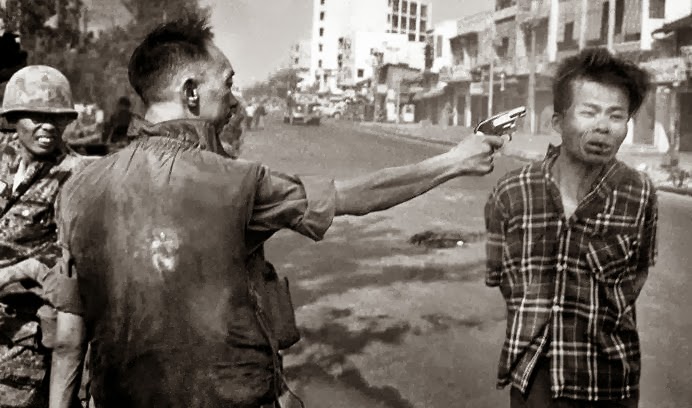
Gen. Nguyen Ngoc Loan executes a Vietcong terrorist, February 1968.

Salon.com’s Jesse Myerson (@JAMyerson) says “misconceptions” about Communism are the real problem, although survivors who escaped Communist regimes might beg to disagree.

Personally, I think the main problem with Communism is that we haven’t shot enough evil lying Commie scum:

Five years after the Bolshevik Revolution, Austrian economist Ludwig von Mises predicted that the Soviet project was doomed to fail. In his classic work Socialism, Mises explained that the attempt to replace the market system with central economic planning could not succeed, because the planners could not possibly have the information necessary to make all the decisions which, in a market economy, are made by individuals whose needs and desires are reflected in prices: “The problem of economic calculation is the fundamental problem of Socialism.”
“Everything brought forward in favour of Socialism during the last hundred years,” Mises wrote in 1922, “in thousands of writings and speeches, all the blood which has been spilt by the supporters of Socialism, cannot make Socialism workable. …. Socialist writers may continue to publish books about the decay of Capitalism and the coming of the socialist millennium; they may paint the evils of Capitalism in lurid colours and contrast with them an enticing picture of the blessings of a socialist society; their writings may continue to impress the thoughtless — but all this cannot alter the fate of the socialist idea.”
Undeterred by Mises’ criticism, the Soviet Union spent the next seven decades proving his prediction correct. By the time the Communist utopia collapsed in bankruptcy and disgrace, it seemed that everyone with two eyes and a brain understood the lesson: The Marxist-Leninist project was a complete failure and, as historians documented in The Black Book of Communism, tens of millions of people had died for this mistake, deliberately starved or slaughtered by totalitarian Communist governments.
The persistence of Marxist-Leninist regimes in Pyongyang and Havana notwithstanding, socialism has been utterly discredited in exactly the way Mises prophesied in 1922. . . .

Read the whole thing at The American Spectator. It’s already a Memeorandum thread, linked by Instapundit and Patterico — thanks! — and to answer the question, “How much do you hate Commies?”

Probably not as much as you should.


Failure Is Not a Public-Relations Problem: The Brutal Economics of ObamaCare

“Obama: Anatomy of a World Leader,” by Alex Gray (detail)

The Congressional Budget Office report about the economic impact of ObamaCare is out, and it paints an ugly picture. The Hill:

The new healthcare law will slow economic growth over the next decade, costing the nation about 2.5 million jobs and contributing to a $1 trillion increase in projected deficits, the Congressional Budget Office said in a report released Tuesday.

The Washington Post:

The Affordable Care Act will reduce the number of full-time workers by more than 2 million in coming years, congressional budget analysts said Tuesday in the most detailed analysis of the law’s impact on jobs.

ObamaCare is a disaster in pretty much exactly the same ways that Republican opponents of the bill predicted four years ago, although it’s also been a disaster in ways that even its harshest opponents did not predict. The problem for Obama, Democrats and their media allies is that they have treated the failure of ObamaCare as a matter of public-relations, as if the reality of failure could be concealed by a P.R. blitz claiming that it was actually a success. But the laws of economics can’t be changed by wishful thinking or political spin, and the failure of ObamaCare is a matter of basic economics.


This Should Not Be Necessary

Headline at Patterico:

No, Extending Unemployment Benefits
Does Not “Create Jobs”

The basic economics of this should be obvious — it’s simple common sense — but ignorance of basic economics is rampant and common sense is increasingly rare, and so Patterico feels obliged to rebut this fallacy promoted by You Know Who:

“Voting for extending unemployment insurance helps people and creates jobs,” Obama said. “Voting against it doesn’t.”
It’s about time we took on this silly notion that paying people not to work causes more people to work . . .

Read the whole thing. It makes my head hurt even to think that such fathomless stupidity is possible, and the fact that Obama got elected twice — because a majority of Americans are apparently brain-damaged — fills me with existential horror.


Carts and Horses, Causes and Effects

Complex causation in human behavior means that social science often isn’t very scientific. Not every variable can be measured with such accuracy as, for example, annual income and years of education, and things which are not measured tend to be neglected as factors in social science. Researchers don’t usually find correlations by accident, and they never find correlations except in measurable data, so that a certain level of inaccuracy and error is inevitable.

All of this is necessary preamble to an Atlantic Monthly article by Matthew O’Brien with this provocative headline:

Why Is the American Dream Dead in the South?

Uh, it’s not. The research O’Brien cites refers to the chance that someone whose parents are in the bottom 20% of the income distribution can rise to the top 20% of the distribution.

Stipulating that the data in the study is complete and accurate, and that everything in the analysis is legit — well, why is there a bright spot on the resulting map in the vicinity of Tuscaloosa, Alabama, but no corresponding bright spot near Athens, Georgia? Why does rural Arkansas look like a beacon of upward mobility, while the bustling economies of Atlanta and Charlotte produce no such effect?

Most of all, why does the map referenced by O’Brien show that impoverished Appalachia offers more opportunity for advancement than any of the more prosperous surrounding flatlands?

To use a social science term: Your data is obviously fucked up.

Look, O’Brien: I don’t want to start a fight, but if somebody tells you West Virginia is a glory land of economic opportunity, this is obviously somebody who never set foot in West Virginia. I don’t give a damn what they tell you after that, their credibility is shot.

With the strange mixture of credulous certainty and interventionist enthusiasm that behooves a writer for the Atlantic, however, O’Brien proceeds to draw conclusions from this research:

The researchers found that the larger the black population, the lower the upward mobility. But this isn’t actually a black-white issue. It’s a rich-poor one. Low-income whites who live in areas with more black people also have a harder time moving up the income ladder. In other words, it’s something about the places that black people live that hurts mobility.

Ri-iiiight.

Something like the poor being isolated — isolated from good jobs and good schools. See, the more black people a place has, the more divided it tends to be along racial and economic lines. The more divided it is, the more sprawl there is. And the more sprawl there is, the less higher-income people are willing to invest in things like public transit.
That leaves the poor in the ghetto, with no way out for their American Dreams. They’re stuck with bad schools, bad jobs, and bad commutes if they do manage to find better work. So it should be no surprise that the researchers found that racial segregation, income segregation, and sprawl are all strongly negatively correlated with upward mobility

So, if this is about “sprawl” that “leaves the poor in the ghetto,” why a vast expanse of low mobility in the rural South,  where there are no ghettos (because there are no major cities) and where there is no suburban “sprawl” (because there are no suburbs)?

Do you see what I mean about “credulous certainty”? If you begin with the assumption that the researchers have accurately measured something meaningful — West Virginia, land of opportunity! — and then start blabbering that “the researchers found” this, that and the other correlation, you’re likely to end up making all kinds of foolish arguments, as Matthew O’Brien eagerly does:

 The American Dream is alive in Denmark and Finland and Sweden. And in San Jose and Salt Lake City and Pittsburgh. But it’s dead in Atlanta and Raleigh and Charlotte. And in Indianapolis and Detroit and Jacksonville. Fixing that isn’t just about redistribution. It’s about building denser cities, so the poor aren’t so segregated. About good schools that you don’t have to live in the right (and expensive) neighborhood to attend. And about ending a destructive drug war that imprisons and blights the job prospects of far too many non-violent offenders — further shrinking the pool of “marriageable” men.

WHAT THE FUCK ARE YOU TALKING ABOUT?

You have no clue, O’Brien. “Building denser cities” in rural South Georgia? “Ending a destructive drug war” in Eutaw, Alabama? The American Dream “alive” in Pittsburgh but “dead” in Charlotte? You’re attempting to “solve” a problem you haven’t even begun to understand, and in the process making yourself a public nuisance.

UPDATE: Thanks to Eric Mertz and other commenters who looked over the Harvard study and spotted obvious issues. Here is an excerpt that clearly points toward the basic problem:

We characterize intergenerational mobility using information from de-identi ed federal income tax records, which provide data on the incomes of more than 40 million children and their parents between 1996 and 2012. . . . In our baseline analysis, we focus on current U.S. citizens in the 1980-1982 birth cohorts { the oldest children in our data for whom we can reliably identify parents based on information on dependent claiming. We measure these children’s income as mean total family income in 2011 and 2012, when they are approximately 30 years old. We measure their parents’ income as mean family income between 1996 and 2000, when the children are between the ages of 15 and 20.

Not to put too fine a point on it, this is insane. That is to say, what percentage of people reach the top 20% in income by age 30? Most people’s incomes peak in their 40s and 50s. Many 30-year-olds are just a few years out of college. Mertz promises a more complete analysis Monday at his blog, and we’ll wait to see what he finds. But my basic common-sense hunch — the alleged superior mobility of West Virginians — tells me something is wrong here.

UPDATE II: Welcome, Instapundit readers!


Take Paul Krugman’s Money

Paul Krugman tediously rehashes his “economic inequality” gripes:

The reality of rising American inequality is stark. Since the late 1970s real wages for the bottom half of the work force have stagnated or fallen, while the incomes of the top 1 percent have nearly quadrupled (and the incomes of the top 0.1 percent have risen even more). While we can and should have a serious debate about what to do about this situation, the simple fact — American capitalism as currently constituted is undermining the foundations of middle-class society — shouldn’t be up for argument.

Why the generalization, Dr. Krugman?

Why do you pin the blame so vaguely on “American capitalism,” when clearly the cause of economic inequality is you?

As the Smartest Economist in the Whole World™  it was your job to fix this  problem. Obviously you’ve been goofing off — phoning it in, going through the motions — and here you are again, recycling the same arguments you’ve been making for decades.

So we’re coming to take it back, Dr. Krugman. The middle class will be showing up to collect The People’s Refund. That three-bedroom $1.7-million Riverside Drive apartment you bought in 2009? It’s got enough square footage to house a dozen struggling grad students from Columbia and NYU. They’ll be moving in next week.

What’s your salary at Princeton University, professor? Last time I checked, the average Princeton professor made $190,000 a year and you’re clearly above average, so let’s say $250,000. We’re going to let you keep $60,000 of that — “incomes of the top 1 percent have nearly quadrupled” — and redistribute the other $190,000 to the janitorial staff at Princeton, because . . . fairness.

Now, how to redistribute your New York Times income? If they’re paying you $300,000 a year (which is Tom Friedman’s reported salary, and certainly they wouldn’t pay a Nobel Prize winner less) then I figure we’ll cut you back to $75,000, re-distributing $225,000 in $25,000 increments to nine struggling young writers to be chosen annually for what will be known as The Krugman Fellowships.

See, Dr. Krugman, this is why your “economic inequality” arguments haven’t been fixing the problem. By dwelling on general categories — “the top 1 percent” and the “middle class” — you have failed to make it personal. If you break it down to individual cases, people can relate a lot more directly to the issue, deciding on how they’ll divvy up the wealth of specific rich people, like you.

Even after we re-distribute three-quarters of your income, Professor, you’ll still be making more than $100,000 a year.

That money will come in handy when you’re buying pizza for all those grad students sleeping on the floor of your apartment.

Social justice, eh?