George Floyd and ‘The Riot Ideology’

The best book on the failure of liberal urban policy is Fred Siegel’s The Future Once Happened Here: New York, D.C., L.A., and the Fate of America’s Big Cities. Siegel devotes much analysis to the “riot ideology” whereby organized violence (or the threat thereof) is used to intimidate officials into doing the bidding of “community leaders.”

What we are witnessing in the trial of former Minneapolis Police Officer Derek Chauvin is how the “riot ideology” impacts law enforcement. Because George Floyd was black, and because Officer Chauvin is white, there is no presumption of innocence. Chauvin’s guilt is assumed as a fact, and if he is not convicted, the verdict will be regarded as an injustice — “systemic racism” — as a pretext for a riot, much the same way the verdict in the Rodney King case inspired the Los Angeles riot of 1992.

From the standpoint of law enforcement, this is a lose-lose proposition. Either officers are effectively prohibited from enforcing the law — because cops face legal jeopardy if they attempt to apprehend a suspect who resists arrest — or else the city is destroyed by violence. This is “democracy” as mob rule, where the criminal element holds the entire community hostage with the assistance of “civil rights” activists (e.g., Ben Crump) and the liberal media. The narrative of racial “injustice” requires that certain inconvenient facts be made to disappear.

It should be obvious, for example, that Officer Chauvin and other members of the Minneapolis police were not just randomly killing black people to advance some “white supremacist” ideology. When cops were called to the Cup Foods store last May to deal with a counterfeiting case, they did not murder every black person present at the store. George Floyd was in the company of two black accomplices, Morries Lester Hall and Shawanda Renee Hill, both of whom had criminal records, but neither of whom was harmed by the police. How can “systemic racism” explain this?

Body camera footage from Officer Thomas Lane, one of the first two cops to arrive on the scene, shows George Floyd’s erratic behavior:


Floyd’s movement inside the SUV caused Lane to fear he might be reaching for a handgun, so he ordered Floyd at gunpoint to put both hands on the wheel, while he radioed for backup. Lane then told Floyd to put his hands on top of his head and step out of the vehicle (1:02 in the video). It took about 30 seconds to get Floyd to exit the vehicle, then another 30 seconds to get him handcuffed. After that, Lane leaves Floyd to his partner, Officer Alexander Keung, while Lane deals with Hall and Hill. Things take a turn for the worse when Lane and Keung try to put Floyd in the back of their squad car:

Lane: What, are you on something right now?
Floyd: No, nothing.
Kueng: Because you are acting a little erratic.
Lane: [leading Floyd to the car] Let’s go. Let’s go.
Floyd: I’m scared, man.
Lane: Let’s go.
Kueng: You got foam around your mouth, too?
Floyd: Yes, I was just hooping earlier.

We are told that “hooping” is slang for “putting drugs in the anus, resulting in a quick and intense high.” Is that how George Floyd got a dose of fentanyl that was three times the lethal level?

Floyd refused to sit in the squad car, saying he was “claustrophobic” and his resistance — Floyd was 6-foot-4 and 220 pounds — made it impossible. It was at Floyd’s request that the officers put him on the ground instead, but not before he had said seven times “I can’t breathe.”


The activist narrative insists these facts be ignored. They call it “victim blaming” when critics point to Floyd’s behavior, and assert, “Derek Chauvin is on trial, not George Floyd.” But you see that (a) there never would have been a trial if Floyd had simply gotten in the back of the squad car, (b) Floyd’s erratic behavior is evidence of the severity of his fentanyl overdose, and (c) how are cops supposed to deal with a drug-crazed giant who refuses to cooperate with his arrest?

Do we or don’t we want to enforce the law? That is the real question, and what sort of answer do we get if this question is reduced to the eight-minute video of Chauvin with his knee on Floyd’s neck?

Too little consideration is being given to the larger social consequences of permitting the Black Lives Matter narrative to prevail, not just in this specific case, but in the general matter of how placing unreasonable limits on law enforcement will allow crime to proliferate. What happens if “social justice” makes it impossible for cops to do their jobs? Well, in Minnesota, the number of handgun permits increased last year to 96,554, up from 51,404 in 2019 — a one-year increase of 88%.

If cops can’t protect you — and Black Lives Matter is about destroying law-enforcement in America — you’ll have to protect yourself.

Liberal are not likely to be happy with the result.


‘I Saw Her Standing There’

Lately, I’ve been watching YouTube videos by Mike Pachelli, a guitarist, singer and producer who has done a series of tutorials on how to play classic Beatles songs note-for-note. What’s really fascinating to me is that Pachelli was able to isolate John Lennon’s rhythm guitar parts so well. For years, in listening to Beatles records, I simply couldn’t hear these parts. The way the records are mixed, George Harrison’s lead guitar is much more prominent and the two guitarists usually play together on rhythm parts, although each plays different riffs.

Pachelli breaks down each part in an instructive way, and then ends each lesson by performing the song all the way through. Watch and learn, as he does the 1963 classic, “I Saw Her Standing There”:


Maybe you’re not a Beatles fan as I am, so you may not enjoy that as much as I did, but do you remember how the lyrics of that song begin?

Well, she was just seventeen,
You know what I mean,
And the way she looked
Was way beyond compare.

Speaking of 17-year-old girls . . .

A Justice Department investigation into Rep. Matt Gaetz and Joel Greenberg is focusing on their involvement with multiple women who were recruited online for sex and received cash payments, according to people close to the investigation and text messages and payment receipts reviewed by The New York Times.
Investigators believe Greenberg, the former tax collector in Seminole County, who was indicted last year on a federal sex trafficking charge and other crimes, initially met the women through websites that connect people who go on dates in exchange for gifts, fine dining, travel and allowances, according to three people with knowledge of the encounters. Greenberg introduced the women to Gaetz, who also had sex with them, the people said.
One of the women who had sex with both men also agreed to have sex with an unidentified associate of theirs in Florida Republican politics, according to a person familiar with the arrangement. Greenberg had initially contacted her online and introduced her to Gaetz, the person said.
Gaetz denied ever paying a woman for sex.
The Justice Department inquiry is also examining whether Gaetz had sex with a 17-year-old girl and whether she received anything of material value, according to four people familiar with the investigation. The sex trafficking count against Greenberg involved the same girl, according to two people briefed on the investigation.
The authorities have also investigated whether other men connected to Gaetz and Greenberg had sex with the 17-year-old, two of the people said.
Gaetz, 38, was elected to Congress in 2016 and became one of former President Donald Trump’s most outspoken advocates.
The Times has reviewed receipts from Cash App, a mobile payments app, and Apple Pay that show payments from Gaetz and Greenberg to one of the women, and a payment from Greenberg to a second woman. The women told their friends that the payments were for sex with the two men, according to two people familiar with the conversations.
In encounters during 2019 and 2020, Gaetz and Greenberg instructed the women to meet at certain times and places, often at hotels around Florida, and would tell them the amount of money they were willing to pay, according to the messages and interviews.
One person said that the men also paid in cash, sometimes withdrawn from a hotel ATM.
Some of the men and women took ecstasy, an illegal mood-altering drug, before having sex, including Gaetz, two people familiar with the encounters said.
In some cases, Gaetz asked women to help find others who might be interested in having sex with him and his friends, according to two people familiar with those conversations. Should anyone inquire about their relationships, one person said, Gaetz told the women to say that he had paid for hotel rooms and dinners as part of their dates.
The FBI has questioned multiple women involved in the encounters, including as recently as January, to establish details of their relationships with Gaetz and his friends, according to text messages and two people familiar with the interviews. . . .
One of the sites the men met women through was called Seeking Arrangement, which describes itself as a place where wealthy people find attractive companions and pamper them “with fine dinners, exotic trips and allowances.” The site’s founder has said it has 20 million members worldwide.

After this story broke on Tuesday, I was willing to give Gaetz the benefit of the doubt. But it now appears that this isn’t just a smear job, and that there is some substance to the case. Even thought Gaetz continues to deny any wrongdoing, if there are CashApp receipts for his hook-ups with “sugar babies,” there’s no way he survives this scandal. Like the song says, he’ll never dance with another, except maybe in prison.


What Was George Floyd Doing?

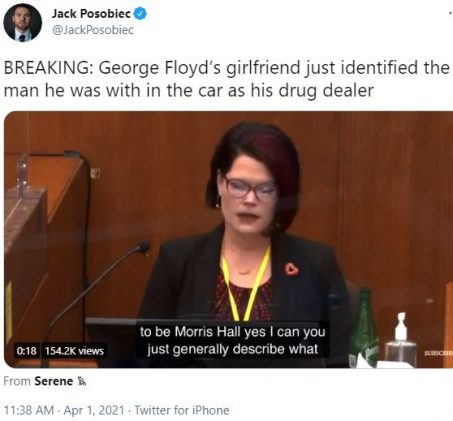
Most people seem to believe that Derek Chauvin is going to be found guilty, simply because of the emotional content of the testimony, and I suppose they’re right. Today, the prosecution called George Floyd’s girlfriend as a witness, and she boo-hooed during most of her testimony, which was characterized in the media as being about her and her boyfriend’s “struggle with addiction.” Excuse me if my eyes just rolled out of my head, but where was all this sympathy for drug users back when I was a teenage dope fiend? If I had gotten myself killed by cops while being arrested back in the day, I’m pretty sure nobody would have rioted on my behalf. Just another dead teenage dopehead — so what?

The emotional components of this trial, with George Floyd turned into a martyr for “social justice,” and Derek Chauvin treated as a symbol of “systemic racism,” may well indeed suffice to produce a guilty verdict, but on the other hand, maybe facts still matter. And the fact is that George Floyd died of a fentanyl overdose, with three times the lethal level of fentanyl in his system. It was obvious to Chauvin and the other cops on the scene that Floyd was under the influence of something, but they had no way of knowing that he had swallowed enough fentanyl to kill himself. However much emotion is generated by the video of Chauvin with his knee on Floyd’s neck, that’s not what killed him.

But let’s talk about something else that’s quite relevant to this case, namely, what was George Floyd doing at that store?

You can click here to read a detailed timeline of events. The fact is that George Floyd arrived at that store in the company of two career criminals, Morries Lester Hall and Shawanda Renee Hill. Early media accounts of Floyd’s death described Hill as Floyd’s girlfriend, even though he had another girlfriend, Courteney Ross, who was the one who testified at the trial today. Both Hill and Hall had records:

Morries Lester Hall (42) would flee Minneapolis two days after the incident and hitchhike to Houston, Texas, where he was originally from. He had outstanding warrants for his arrest in Minnesota. He had a previous arrest record and convictions in Minnesota for first-degree felony assault, burglary, aggravated robbery, and multiple domestic assault charges between 2012 and 2018. He would be detained in Houston and interrogated by Minneapolis investigators there pending extradition. He also had a criminal history in Texas. He was wanted for being a felon in possession of a firearm. . . .
Shawanda Renee Hill (45) . . . had a previous arrest record and convictions for check forgery, felony theft, disorderly conduct, solicitation for prostitution, and stalking and domestic abuse between 1997 and 2016.

Courteney Ross testified that she believed Hall and Hill were supplying Floyd with drugs. They also had evidently involved him in attempting to pass counterfeit currency, which was why the cops were there.

This wasn’t made clear in the media accounts of the events leading up to Floyd’s death. What happened was that Floyd and Hall went into the store while Hill waited outside in the SUV Floyd was driving. Floyd bought a pack of cigarettes with a counterfeit $20 while Hall attempted to buy some electronic equipment with more counterfeit $20s. The clerk who dealt with Hall spotted the counterfeit and refused the purchase. Then the store manager, realizing Floyd had entered the store with Hall, asked the clerk at the tobacco counter to check the $20 Floyd had given him, and learned that it was also counterfeit.

Then two store employees, seeing Floyd still outside leaning on the hood of the SUV, go out to confront him, demanding he return the cigarettes and the change he’d gotten. Floyd refuses. The two employees go back inside the store, then return with a third employee. Again, Floyd refuses to return the cigarettes and the change. One of the employees takes down the tag number of the SUV, and then they go back inside the store. It’s now about 8 p.m., roughly 15 minutes after Floyd first entered the store. At 8:01, one of the employees calls 911:

Operator: 911 what’s the address of the emergency?
Caller: This is ah 3759 Chicago AV.
Operator: How can I help you?
Caller: Um someone comes our store and give us fake bills and we realize it before he left the store, and we ran back outside, they was sitting on their car. We tell them to give us their phone, put their (inaudible) thing back and everything and he was also drunk and everything and return to give us our cigarettes back and so he can, so he can go home but he doesn’t want to do that, and he’s sitting on his car cause he is awfully drunk and he’s not in control of himself.
Operator: Okay, what type of vehicle does he have?
Caller: And…. um he’s got a vehicle that is ah…ah he got a vehicle that is ah…one second let me see if I can see the license. The driver license is BRJ026.
Operator: Okay, what color is it?
Caller: It’s a blue color. It’s a blue van.
Operator: Blue van?
Caller: Yes, van.
Operator: Alright blue van, gotcha. Is it out front or is it on 38th ST?
Caller: Ah it’s on 38th ST.
Operator: On 38th ST. So, this guy gave a counterfeit bill, has your cigarettes, and he’s under the influence of something?
Caller: Something like that, yes. He is not acting right.

You see that the store employee mentioned Floyd’s intoxication — he was “not in control of himself . . . not acting right.” As it turned out, he had taken fake Percocet tablets that were actually a mixture of fentanyl and methamphetamine. This was the garbage dope Hall was apparently dealing, and also, it seems, running a counterfeit cash operation.

Possession of counterfeit currency is a federal crime that can get you up to 15 years in prison. A lot of people, upon hearing that the cops were called on Floyd because of a fake $20 were like, “They killed him for $20,” but several other fake $20s were found in the SUV, and there hasn’t been much reporting on the investigation of that crime, but this incident might have been the tip of an iceberg of a much larger conspiracy. Somebody in Minneapolis was circulating counterfeit currency, and the role of Morries Hall in this crime cannot be ignored.

Of course, the underlying crime — the reason the cops were there — is being ignored by the media, who are promoting the narrative that the real crime was Derek Chauvin’s knee on Floyd’s neck, despite the evidence from the toxicology report that Floyd was already dying of an overdose (and complaining “I can’t breathe”) before the cops put him on the ground. The reason they put him on the ground was because he refused to get in back of the squad car, and they decided to call for EMS because he appeared to be in a state of “excited delirium” which we now know was due to his drug overdose. But the emotional nature of the testimony at the trial is intended to cancel out these known facts, to make the jurors convict Chauvin of murder even though it was the fentanyl that killed Floyd who was, by the way, a criminal:

Between 1997 and 2005, he was convicted of eight crimes. He served four years in prison after accepting a plea bargain for a 2007 aggravated robbery in a home invasion.

That’s nine crimes total, that we know of, before he tried to pass counterfeit currency that day and — oh, by the way, another crime — possession of the illegal narcotics that killed him.

Please explain to me how dopehead criminals became secular saints in our culture. When did this happen? Because as I say, when I was a teenage dopehead, nobody treated me like a saint, and if I had died of an overdose with a cop’s knee on my neck, no one would have rioted.

Maybe I was being oppressed, but was too stoned to know it. Also, I’m pretty sure I saw Excited Delirium open for Cheap Trick in 1979.


Anatomy of a Smear

When this story first broke Tuesday, I didn’t know what to make of it, and even after Rep. Matt Gaetz went on Tucker Carlson to defend himself, I still wasn’t sure what the truth was. After another 24 hours, however, the picture is becoming clearer: A scammer named Bob Kent, who has raised money supposedly to help free an American citizen named Robert Levinson from prison in Iran, evidently realized Gaetz’s father is rich, and decided to make him the target of an extortion scheme.

Allegedly, I hasten to add, because this complex story involves a lot of accusations and counter-accusations that I can’t fully evaluate. But if the story laid out by Emily Brooks and Joseph Simonson in the Washington Examiner is accurate, apparently Kent came up with the idea of telling Gaetz’s father that the congressman was under investigation by the FBI for sex trafficking. In return for funding Kent’s project of rescuing Levinson from Iran, the elder Gaetz was told, his son would be guaranteed a pardon by Joe Biden. Crazy.

The “sex trafficking” part of the thing involved an allegation that Gaetz had paid for a 17-year-old girlfriend’s interstate travel, but he says he hasn’t had any 17-year-old girlfriends. Assuming that this denial is truthful, then Gaetz is the victim of a crime, not a perpetrator.

However, we must wait and see what shakes out because (a) Gaetz is a bachelor, (b) he’s been known to date younger women, and (c) one could imagine how this might lead to trouble, even if it doesn’t actually amount to “sex trafficking.” Still, at this point, it looks like Gaetz is the target of a politically motivated smear, which the New York Times was willing to assist. There has even been a guilt-by-association element to the smear, with outlets reporting on Gaetz’s acquaintance with Joel Greenberg, a local Florida politician who actually did get charged with sex trafficking last year. And so what? There is zero evidence that Gaetz (or anyone else) knew what Greenberg was doing with his “sugar daddy” accounts.

I hesitate to go all-out defending someone in Gaetz’s situation because it may turn out he is guilty of something, but from what I’ve seen so far, this looks like an elaborate smear job. We shall see.


Trump-Hating BLM Activist Charged for Attacking Asian Women in Seattle

News that doesn’t fit the preferred media narrative:

A Black Lives Matter activist and fervent Democrat Party supporter is accused of committing anti-Asian hate crimes in Seattle.
King County prosecutors charged 51-year-old Christopher Allen Hamner, of SeaTac, Wash., with a felony hate crime for targeting multiple Asian victims on two separate occasions in March. Hamner, who is mixed-race, is accused of threatening women and children of Asian background as young as five years old with racial slurs.
On March 16, Hamner allegedly harassed a woman while she was in her car with two children, ages five and 10.
Pamela Cole, the victim, alleged in a Facebook post that Hamner yelled, “F— you, Asian bitch!” She says he jumped out of his vehicle and started “punching his fist together” before throwing projectiles at her car. She called the police.
Three days later on March 19, Hamner allegedly cut off two Asian women with his sedan near a supermarket, blocked traffic in the middle of the road and screamed similar profanities at them. Hamner then got out of his car, charged at the victims who were driving together and launched an object at them, the probable cause affidavit cites. Jenny Wong, one of the victims, posted photos and video of her encounter with Hamner on Instagram.
The Seattle Police Department arrested Hamner on Thursday. His bail is set at $75,000. He is being held at the King County Correctional Facility for the felony hate crime charge plus three additional counts of malicious harassment.
The videos and accusations against Hamner have been surprising for some given his reputation as a staunch BLM and racial-justice activist in the Seattle-area.
In June 2020, Hamner participated in the Capitol Hill Autonomous Zone (CHAZ), where BLM and Antifa extremists seized six blocks of city property. He recorded video of himself in the zone where he was holding an anti-Donald Trump and anti-police sign.
His social media is filled with posts expressing hatred of Donald Trump and Republicans.

Don’t expect to see this reported on CNN.

(Hat-tip: Instapundit.)


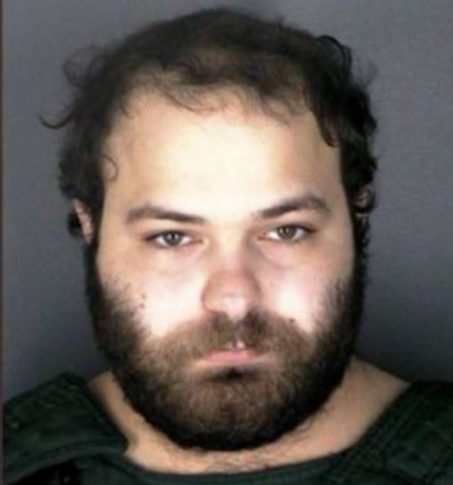
Syrian Immigrant Ahmad Al-Issa Identified as Boulder Gunman

Early this morning — it was about 2:30 a.m. — I noted that there was something odd about how police were dealing with the shooting in Boulder. Even though they had the shooter in custody, they didn’t name him. Why? What purpose was served by withholding that information?

It was not until about 11 a.m. today we discovered why:

he 21-year-old Arvada man arrested in Monday’s mass shooting at a Boulder King Sooper’s was violent, short-tempered and paranoid during high school, his former classmates said Tuesday.
Ahmad Al Aliwi Alissa is suspected of killing 10 people at the grocery store Monday when he walked in around 2:30 p.m. and began shooting, according to law enforcement. He was taken into custody about an hour later with a gunshot wound in his leg.
Alissa was hospitalized for treatment and is expected to be transported to the Boulder County Jail Tuesday to face 10 counts of first-degree murder.
He attended Arvada West High School from 2015 until he graduated in 2018, Jeffco Public Schools spokeswoman Cameron Bell confirmed Tuesday. He was on the wrestling team his junior and senior years.
“He was kind of scary to be around,” said Dayton Marvel, a teammate on the wrestling team. Alissa once had an outburst and threatened to kill people during an intra-team match, Marvel said.
“His senior year, during the wrestle-offs to see who makes varsity, he actually lost his match and quit the team and yelled out in the wrestling room that he was, like, going to kill everybody,” Marvel said. “Nobody believed him. We were just all kind of freaked out by it, but nobody did anything about it.”
He said he did not like spending time with Alissa, and Alissa was not close with anyone on the wrestling team. Another teammate, Angel Hernandez, said Alissa got into a fight in the parking lot after the match.
“(The other wrestler) was just teasing him and goes, ‘Maybe if you were a better wrestler, you would have won.’ (Alissa) just lost it. He started punching him,” Hernandez said.
Hernandez said Alissa frequently appeared to be paranoid about perceived slights against him, and Marvel said Alissa was often concerned about being targeted because of his Muslim faith.
“He would talk about him being Muslim and how if anybody tried anything, he would file a hate crime and say they were making it up,” Marvel said. “It was a crazy deal. I just know he was a pretty cool kid until something made him mad, and then whatever made him mad, he went over the edge — way too far.”
“He was always talking about (how) people were looking at him and there was no one ever where he was pointing people out,” Hernandez said. “We always thought he was messing around with us or something.”
In 2017, Alissa, then 18, attacked a classmate at Arvada West High School, according to an affidavit filed in the case. He punched the classmate in the head without warning, and when the boy fell to the ground, Alissa continued to punch him. The classmate suffered bruises and cuts to his head, according to the affidavit.
Witnesses told police they didn’t see or hear any reason for Alissa to attack the classmate. Alissa told officers that the classmate “had made fun of him and called him racial names weeks earlier,” according to the affidavit.
He was convicted of misdemeanor assault in 2018 and was sentenced to probation and 48 hours of community service, according to court records.
Despite his short temper, Hernandez said Alissa could also be friendly and “joyful.”
“The sad thing about it is that if you really were to get to know him, he was a good guy,” Hernandez said. “Whenever you went up to him, he was always so joyful and so nice. But you could tell there was a dark side in him. If he did get ticked off about something, within a split second, it was like if something takes over, like a demon. He’d just unleash all his anger.”
Another former classmate, Keaton Hyatt, said he took a weightlifting class with Alissa and never knew him to be violent. Hyatt liked Alissa’s quick wit and sharp comebacks during locker room banter.
“He was super cool and super funny,” Hyatt said. “… It was never violent jokes about people or America or anything.”
Arvada Police Detective Dave Snelling confirmed Tuesday the local department had at least two interactions with Alissa over the past several years, including a case of criminal mischief. The details of that case were not immediately available.
Snelling would not say whether local police had received any warnings or complaints about Alissa recently, however, and instead deferred the question to the FBI.
Alissa lived with his family in an Arvada subdivision on West 65th Place, a quiet neighborhood of single-family homes. Neighbors said the household appeared to be multi-generational with a large number of family members living there.
The home is owned by Ali Aliwi Alissa, who also owns a nearby restaurant. The eatery, in a strip mall that shares space with a coffee shop, UPS store, battery store and other restaurants, was closed Tuesday.
Jamie Poeling moved her business, Dream Dinners, a few doors down from the restaurant just over a year ago and said she ate there infrequently. Employees there gave Poeling a discount and she returned the favor.
Poeling said she doesn’t know everyone in the family by name, but that she never had a negative experience at the restaurant. Employees would go out of their way to offer food to a homeless woman living behind the restaurant, she said.
“I’ve been in the shop while they’ve given her food and they’re very kind,” Poeling said.
It was not immediately clear Tuesday whether any of Alissa’s family knew of his plan to attack King Soopers.
A relative told investigators Monday night that she’d seen Alissa “playing” with a gun that looked like a “machine gun” about two days prior, according to the affidavit.
“Alissa had been talking about having a bullet stuck in the gun and was playing with the gun,” the affidavit said. Others in the home became upset that he had the gun inside and took it from him, the relative told police, although she believed it had later been returned to him.
Alissa purchased a Ruger AR-556 pistol six days before the attack, according to a police affidavit released Tuesday. Witnesses to the shooting described the gunman as firing a “patrol rifle,” Boulder police have said.
On a Facebook page that appeared to belong to Alissa and has since been removed, the user posted in 2019 that he believed his former high school was hacking his cell phone. In a comment to someone who asked why the school would do that, he blamed racism.
“I believe part racism for sure,”
he replied. “I believe someone spread rumors about me which are false and maybe that set it off.”
In other posts, the user expressed anti-LGBTQ sentiments and warned about perils he perceived from too much government control.

Now brace yourself for this:

The suspect’s identity was known to the F.B.I. because he was linked to another individual under investigation by the bureau, according to law enforcement officials.

So the FBI actually knew about this gun-wielding Syrian psycho, but they were too busy chasing down “white supremacists” to do anything.


Boulder: 10 Dead, Including Police Officer; Suspect in Custody, Not Yet Identified

There is something . . . off about this story, and I don’t know what it is yet. We saw the suspect walked out in handcuffs and yet, several hours later, police have still not identified him. While I have seen some speculation online about the gunman’s identity, the fact that police did not name him at their press conference strikes me as significant, because why not name him? Certainly, his identity will be public very soon, so what is accomplished by delaying the release of this information?

What this delay has done, in practical terms, is to allow the media to build the narrative that this is a gun-control story. The shooter reportedly used an AR-15-style weapon, and so the narrative is not about the shooter and his motive, but rather about his choice of weapon.

Is it paranoid to suspect that perhaps police delayed the identification of the shooter for this very reason? That is to say, it may be that police believed that publicly naming the shooter would have some undesired political consequence, and so they delayed this, to prevent the public from reacting in an undesirable way. Meanwhile, this delay gives the media a chance to spin it as a gun-control narrative, even though we have no reason to believe that any proposed gun-control measure (short of outright confiscation) could have prevented this particular shooting.

As always in cases like this, I discourage speculation about motives, particularly when we don’t know the identity of the shooter. Yet the delay in identifying the suspect strikes me as significant. Once we learn who it is, perhaps we will be able to deduce the reasons for the delay.

Anyway, here is what is actually known so far:

The Boulder Police Department confirmed 10 people are dead, including one Boulder Police officer, in a shooting at the King Soopers on Table Mesa Drive.
Boulder Police Chief Maris Herold confirmed Officer Eric Talley, 51, was the first to respond to the King Soopers minutes after initial 911 calls around 2:30 p.m. He was shot and killed. Talley had been with the department since 2010.
“I’m grateful for the police officers that responded, and I am so sorry about the loss of Officer Talley,” Herold said. . . .
The Boulder County District Attorney Michael Dougherty said the suspect is in custody and his office will do everything they can do to get justice for the victims.
“I also want to stress how incredibly sorry I am for all victims who were killed at King Soopers. These were people going about their day, doing their food shopping, and their lives were cut abruptly and tragically short by the shooter who is now in custody,” Dougherty said.
Officials confirmed the suspect went to the hospital. They say he is the only person injured that they’re aware of and they know of no other serious injuries at this point.

To summarize, we don’t actually know much yet — and this is unusual. I’ve covered plenty of events like this, and cannot remember any case where a mass-shooting suspect was in custody but police waited more than eight hours before publicly identifying the suspect, as in this case.

In a paranoid age, where trust of the media is at an all-time low, this concerns me, and not just because CNN is using this as an excuse to run 24/7 gun-control propaganda. Let me get ahead of that by saying that the vast majority of homicides in America (about 45 a day, on average) are committed with common pistols — 9mm, .380, .40 — and that the use of “assault rifles” in homicides is a statistical rarity. So the predictable push to ban “assault rifles” in the wake of this Boulder massacre will be in contradiction of facts and logic. For 10 years, beginning in 1994, we had a federal ban and, after Congress allowed it to expire in 2004, it was demonstrated to have no impact on the overall level of violent crime.


Atlanta: The Backstory Emerges

The bottom line is that anti-Asian racial prejudice was not the motive for the shooting rampage at three Atlanta-area massage parlors.

The Washington Post assigned a team of reporters to do a full background profile on gunman Robert Aaron Long. The resulting article is nearly 2,000 words, with four bylines and five other reporters listed as contributors. This is the kind of all-out journalistic blitz that major news organizations rarely do on any crime story, which shows what a priority it was for the editors. Here is the summary paragraph:

But over the past four years, Long’s life turned toward the tumultuous. He started college classes and left after one year. He believed he was straying from his faith, telling friends that he was fixated on sex to the extent that he thought he was addicted. His relationship with a girlfriend collapsed after she found out that he frequented massage businesses, according to his roommate. His bond with his parents frayed; on the night before the shootings, they threw him out of their house, according to police.

Being kicked out by his parents seems to have been the event that precipitated his shooting rampage. This appears to have been part of a pattern of parental efforts to control their son:

[A]fter finishing high school, Long seems to have drifted. He took odd jobs for neighbors. He enrolled at the University of North Georgia campus in Cumming, 45 minutes from home, but left after one year without completing any degree program at the school, which primarily offers community college-level courses.
In 2018, he was baptized at his family’s church.
By January 2019, he was involved in a relationship with a woman in Chattanooga, Tenn., but his parents called the police that month to report that Long, then 19, had gone to visit the girlfriend and refused to return, according to a report from the Cherokee County Sheriff’s Office.
A deputy who met with the parents at their house wrote that Long had not returned on time from the girlfriend’s home in Chattanooga and had texted his parents to inform them that he would not be coming back. “He wanted a fresh start,” the deputy wrote. Long and his girlfriend ignored his parents’ repeated calls, they told the deputy, so they called 911. . . .
By August of that year, Long was back in Woodstock, but not home with his parents. He was living, for about six months, at Maverick Recovery, a 12-step transitional-housing facility in Roswell, Ga., about 13 miles from home. He was also frequenting massage spas, one of his friends said — including, according to Atlanta police, the same Atlanta spas where this week’s slayings occurred.
Long sought treatment for his pornography habit and penchant for buying sexual services at massage facilities, according to his parents and Tyler Bayless, a roommate at Maverick from August 2019 through at least January 2020. . . .
Long blamed his troubles on pornography, Bayless said: “He hated the pornography industry. He was pretty passionate about what a bad influence it was on him. He felt exploited by it, taken advantage of by it.”

Wait, didn’t liberals tell us pornography is harmless? But we will leave that aside to the more immediate point: Nothing in this extensively reported Washington Post account shows any indication that Long was motivated by racial prejudice, despite the fact that, at the same time their editors were assigning this story, they were also publishing numerous analysis/commentary articles which sought to frame this crime within the preferred political narrative of anti-Asian “white supremacy”:

Accompanying one original piece on the known facts, the NYT ran nine — nine! — separate stories about the incident as part of the narrative that this was an anti-Asian hate crime, fueled by white supremacy and/or misogyny. Not to be outdone, the WaPo ran sixteen separate stories on the incident as an anti-Asian white supremacist hate crime. Sixteen! One story for the facts; sixteen stories on how critical race theory would interpret the event regardless of the facts. For good measure, one of their columnists denounced reporting of law enforcement’s version of events in the newspaper, because it distracted attention from the “real” motives.

That’s from Andrew Sullivan, of all people, giving Ed Driscoll a chance to employ the “BIZARRE HELL-WORLD” theme. Sullivan also extensively documents the reality that anti-Asian “hate crimes” are most often committed by black suspects, so read the whole thing.