“I’m a big lesbian who looks like a man. I’m not Anchor Babe and I’m never going to be. … I one hundred per cent believe that the reason I have not gone further in television is not only because I’m gay but because of what I look like.”
— Rachel Maddow, 2007
“A lot of society’s discomfort with homosexuality is a discomfort about the upending of the traditional patriarchal model of dominant man/submissive woman pairs with children in tiny box houses.”
— Marie Lynn “Riese” Bernard, 2013
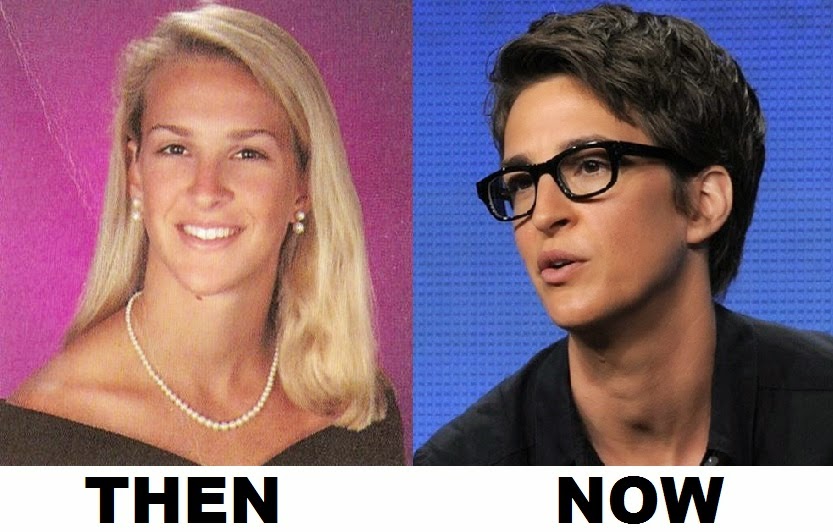
Everybody remembers in 2010 when BuzzFeed found Rachel Maddow’s 1991 senior picture from Castro Valley (Calif.) High School. That incident inspired a rant at the lesbian blog Autostraddle:
BuzzFeed’s “Rachel Maddow Yearbook Picture” post, which has gone completely uncontrollably viral, is subtitled “Three words I never thought I could say about Rachel Maddow: I’d tap that!”
Hahahah! That’s so funny! You know, ’cause in this photo she has long blonde hair and is so PRETTY like a WOMAN and now she’s this scary butch lesbian with short hair and glasses and Opinions and who the hell would ever want to tap THAT? I mean, besides everyone and all of us here. But isn’t it so super-special that once upon a time, Rachel Maddow was still you know attractive by heteronormative patriarchal standards of beauty? I’d tap that! Hahaha!
That 2010 post showed up while I was searching for the word “heteronormative,” which is, like “patriarchy” and “gender roles,” a linguistic dye-marker of radical feminist thinking.
Anybody can be merely gay, but you need a theory — an ideology, a political philosophy — in order to have this kind of jargon that interprets your gayness in the context of oppression and social justice.
Wednesday’s citation of two lesbian feminist texts, one from 1973 and another from 1993, demonstrates how this radical theory of women as oppressed by the gender roles of heteronormative patriarchy (or “heteropatriarchy,” as feminist psychologists Celia Kitzinger and Rachel Perkins call it) originated in the Women’s Liberation movement of the late 1960s and early ’70s, and has been institutionalized by the faculty and curricula of Women’s Studies programs.
One of the rhetorical tricks of radicalism, a tactic at least as old as Karl Marx’s claim to have developed a scientific doctrine of socialism, is (a) to produce an elaborate theoretical explanation of whatever phenomenon they wish to criticize, (b) to denounce as a self-serving “myth” whatever common-sense justification is offered by defenders of the status quo, and (c) to claim that the inability of the status quo’s defenders to refute the radical challenge is proof that the “system” is illegitimate and must be destroyed. (It is certainly no accident that nearly all feminist theorists cite Friedrich Engels’s The Origins of the Family, Private Property and the State in expounding their own critiques of “male supremacy.”) Defenders of any traditional way of life are always at a disadvantage in debate with radical intellectuals who, having built or borrowed some theoretical argument for revolution, scornfully dismiss the defense of tradition as mere sentimental prejudice in favor of the status quo. Hurling accusations of bigotry and ignorance at their antagonists, radicals insist that progress beckons us toward an enlightened future, if only we can overcome the irrational opposition of The Forces of Darkness who wish to keep society enslaved to the benighted past.
If you have read Thomas Sowell’s The Vision of the Anointed: Self-Congratulation as a Basis for Social Policy, you recognize such “arguments” as the dishonest sophistry they really are. And if you have also read Eric Hoffer’s The True Believer: Thoughts on the Nature of Mass Movements, you understand how radicalism appeals to certain personality types. Understanding these things, the defender of tradition realizes that what actually requires explantation is not how “the system” works in theory, but rather why certain people are so implacably hostile to a system that works in practice. If the system does not work perfectly, we can consider how best to improve it, but mild reform projects are not what radicals have in mind, and feminism has always been inherently radical. This has been my longstanding disagreement with Christina Hoff Sommers’s 1995 book Who Stole Feminism?
As the title implies, Sommers postulates that there was (and still should be) a “mainstream” feminism of which she approves, but that this benign democratic reform movement has been hijacked by radicals of whom Sommers does not approve. My contention, which I have spent years endeavoring to demonstrate, is that this is a complete misunderstanding of what feminism is and has always been since the rise of the Women’s Liberation movement in the 1960s. Having traced the history of this movement to its origins in the New Left — specifically, the radical Students for a Democratic Society (SDS) — I am obligated by my commitment to historical truth to call bullshit on anyone who tries to tell me that radicals stole feminism. It was their rightful property all along; radicals created feminism, they theorized and promoted feminism, and if anyone joined the feminist movement because they bought into its mainstream facade, their folly in doing so is not my problem.
Radicals didn’t “hijack” feminism. Radicals own the feminist plane. Anyone woman who buys a ticket on Feminist Airlines should not be surprised when she arrives at her lesbian destination.
There are lesbians who are not feminists, just as there are feminists who are not lesbians, but if you attend the annual conference of the National Women’s Studies Association, you’ll find that the NWSA’s Lesbian Caucus is large and influential. Continue reading Is Rachel @Maddow’s Haircut Waging War Against Heteronormative Patriarchy? →


