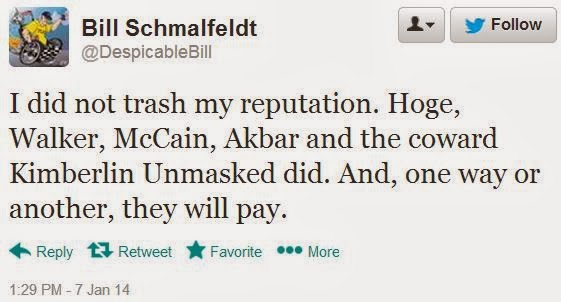
She wants to believe that it is about sexism or misogyny, but as a guy who has experienced online harassment myself, I know this is false. Yes, women are in many ways particularly vulnerable to this — ask Michelle Malkin, Dana Loesch, Ann Coulter or Katie Pavlich — but the fundamental problem isn’t really about that:
On the one hand, it seemed unlikely that I’d soon be defiled and decapitated at the hands of a serial rapist-murderer. On the other hand, headlessfemalepig was clearly a deranged individual with a bizarre fixation on me. I picked up my phone and dialed 911.
Two hours later, a Palm Springs police officer lumbered up the steps to my hotel room, paused on the outdoor threshold, and began questioning me in a steady clip. I wheeled through the relevant background information: I am a journalist; I live in Los Angeles; sometimes, people don’t like what I write about women, relationships, or sexuality; this was not the first time that someone had responded to my work by threatening to rape and kill me. The cop anchored his hands on his belt, looked me in the eye, and said, “What is Twitter?” . . .
Andy Trotter, a communications adviser for the British police, announced that it was Twitter’s responsibility to crack down on the messages. . . . Police “don’t want to be in this arena.” It diverts their attention from “dealing with something else.” . . .
Abusers tend to operate anonymously, or under pseudonyms. But the women they target often write on professional platforms, under their given names, and in the context of their real lives. Victims don’t have the luxury of separating themselves from the crime. When it comes to online threats, “one person is feeling the reality of the Internet very viscerally: the person who is being threatened,” says Jurgenson. “It’s a lot easier for the person who made the threat — and the person who is investigating the threat — to believe that what’s happening on the Internet isn’t real.”
You can and should read the whole thing, because Amanda Hess has located the basic problem: Police are either ignorant of social media — “What is Twitter?” — or can’t comprehend the reality of a type of threat that has never been aimed at them.
Unless and until you have been targeted by obsessed hate-trolls, you really can’t understand what it’s like. And the inherent imbalance between anonymous harassers and their targets — “who write on professional platforms, under their given names, and in the context of their real lives” — is not a problem that is limited to women. When your livelihood is in large measure dependent on using Twitter to obtain information and promote your work, whereas the anonymous hate-troll uses the Twitter platform only to engage in harassment, you quickly discover that your ability to counteract the harassment is quite limited.
Amanda Hess should ask Patrick “Patterico” Frey how difficult it is to get law enforcement to take online harassment seriously. The dangerous tactic of “SWATting” is dismissed by some journalists as a “prank” and, despite the fact that some people have been sentenced to prison for SWATting hoaxes, so few perpetrators are prosecuted that SWATters believe (quite correctly) that they are unlikely to face serious consequences for their actions.
Part of the problem — and perhaps Hess hasn’t thought about this — is that many journalists actually celebrate online harassment.
What else were the crimes of “Anonymous,” except orchestrated online harassment of designated enemies? The fact that this criminality was done in the name of a political cause, and that the targets were corporations like Sony and Amazon rather than individuals, does not change the fact: Crime was committed, and many journalists have treated Anonymous hackers as heroes.
“The time for talk is over, it’s time for collective refusal, civil disobedience, and direct action.”
— Jeremy Hammond, Anonymous hacker
Why is it acceptable to target PayPal with DDOS attacks, but not to target journalists with personal threats? Why have some people tried to make a hero of former Anonymous spokesman Barrett Brown, who threatened to “destroy” an FBI agent’s family?
Why didn’t Amanda Hess take notice of Mandy Nagy’s harassment by Anonymous supporter “Occupy Rebellion”? Here you have a gang of vicious cyberterrorists whose very name, Anonymous, is intrinsic to the problem of online harassment, and whose claim of “civil disobedience” in defense of their crimes is a direct challenge to the rule of law. And, in case Amanda Hess has forgotten, it was the defense of Julian Assange’s Wikileaks that was the rallying cry of Anonymous in 2010.
Julian Assange is an accused rapist. Kinda relevant.
Law enforcement must take online harassment more seriously. Amanda Hess has that exactly right. But we cannot expect law enforcement to prosecute harassment if we ignore (or endorse) the lawless anarchist impulse of digital terrorists. Nor can we expect online harassment of women to be taken seriously when liberals like Amanda Hess tolerate the constant obscene harassment of conservative women:


The C-word and the F-word, and various combinations thereof, are somehow acceptable political discourse when liberals do it. Eventually, Amanda Hess managed to overcome the problems of anonymity and of law enforcement not taking online harassment seriously:
My harasser finally acquiesced to the protection order when my lawyer showed him that we knew the blog comments were coming from his computer—he had made a valiant attempt to obscure his comments, but he’d slipped up in a couple of instances, and we could prove the rape threats were his. When the judge approved the order, she instructed my harasser that he was not allowed to contact me in any way—not by email, Twitter, phone, blog comment, or by hiring a hot air balloon to float over my house with a message, she said. And he had to stay at least 100 feet away from me at all times. The restraining order would last one year.
Soon after the order expired, he sent an email to my new workplace. Every once in a while, he re-establishes contact. . . .
A few days before I received the threats in Palm Springs, he sent me a link via Twitter to a story he wrote about another woman who had been abused online. Occasionally, he sends his tweets directly my way—a little reminder that his “game” is back on.
This raises a question: Why doesn’t Amanda Hess publicly name the monster who is perpetrating this harassment? Crime is a people problem. Identifying the perpetrators is essential to preventing and discouraging crime, but perhaps Amanda Hess is afraid of being sued by her harasser. That can be a problem, too.
BomberSuesBloggers.com
UPDATE: Credit where credit is due:
As I say, I mostly agree with Hess’s analysis of the online harassment problem, but I don’t think turning it into a Women’s Studies candlelight-vigil take-back-the-night rally is the solution. That kind of “consciousness raising” solidarity protest may feel good, but is no substitute for law enforcement locking up criminals.



 : Kindle edition is on sale for $2.99.