Having previously referenced Arthur M. Schlessinger Jr.’s 1949 book The Vital Center as the source of a pernicious falsehood in American political thought, it seems necessary to explain more fully what I mean by this. And this explanation is made easier by the discovery that extensive excepts of The Vital Center are available in online form. (This here “Internet” thing is amazing, ain’t it?)
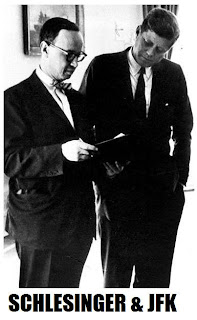 Schlessinger introduces himself as having been born in 1917, coming of age during the Great Depression, his pivotal political experience being FDR’s inaugural address in 1933. Speaking for himself and others of his generation, he says:
“American liberalism has had a positive and confident ring. It has stood for responsibility and for achievement, not for frustration and sentimentalism; it has been the instrument of social change, not of private neurosis. During most of my political consciousness this has been a New Deal country. I expect that it will continue to be a New Deal country.”
Thus Schlessinger is not merely an ideological liberal, but a partisan Democrat, an advocate and defender of FDR’s New Deal economic program, and it is from this specific perspective that he conceives of The Vital Center.
Now, ask yourself why this book was written and published in 1949. What was the political context? The electoral magic of the New Deal did not outlive its creator. After FDR’s death in 1945, and in the wake of a hard-fought victory in World War II, American voters were ready for a change.
Republicans won big in the 1946 mid-terms, gaining 55 seats in the House to capture a 246-188 majority and adding 13 Senate seats for a slender 51-seat majority in the upper chamber. The GOP controlled Congress for the first time since the Hoover administration. To understand the electoral mood at the time we need only note that among the new Republican members were Rep. Richard Nixon of California and Sen. Joe McCarthy of Wisconsin.
It was widely charged that, at the 1945 Yalta Conference, Roosevelt had surrendered Eastern Europe to Stalin’s Soviet Union. In March 1946, Winston Churchill delivered his famous “Iron Curtain” speech at Fulton, Missouri. Suspicion that Democrats were “soft on Communism” was heightened in investigations by the 1948 House Committee on Un-American Activities, which exposed former State Department official Alger Hiss as a Communist agent.
Harry Truman was an ineffective and deeply unpopular president. Labor unions, near their peak of membership — some 35% of workers belonged to a union in 1948 — nearly paralyzed the economy with a series of strikes. The Democratic Party split three ways in the 1948 election. Southern segregationists nominated Strom Thurmond on the Dixiecrat ticket and left-wingers nominated former Agriculture Secretary Henry Wallace on the Progressive ticket.
 It was only because of an extraordinarily weak campaign by Republican nominee Thomas Dewey — and, as Republicans charged, widespread vote fraud — that the famous “Dewey Defeats Truman” headline wasn’t true. Truman squeaked past with plurality margins of less than 1% in California (25 Electoral College votes) and Ohio (25 Electoral College votes), while carrying Illinois and its 28 Electoral College votes by barely 30,000 votes out of more than 4 million. Had the Republican vote been 1% higher in those three states, Dewey indeed would have defeated Truman.
Although he narrowly won re-election, Truman had campaigned against what he called a “do-nothing Congress,” and that message seems to have had its effect, so that the Democrats picked up 75 House seats and nine Senate seats, recapturing the majority in both houses of Congress.
Despite the Democratic successes of 1948, however, young liberals like Arthur Schlessinger — then in his early 30s — had witnessed since FDR’s death three years of extreme political volatility which had exposed the fragility of the Democrat’s New Deal coalition. And all of this domestic turmoil was taking place against the foreign-policy backdrop of Stalinist belligerence (the Soviets would explode their first atomic bomb in August 1949) and Mao Zedong’s Communist Revolution in China.
It is important to note that in 1947, in the immediate aftermath of the GOP’s 1946 congressional victory and two years before the publication of The Vital Center, Schlesinger had joined with Eleanor Roosevelt, UAW president Walter Reuther and others to create Americans for Democratic Action. The first task of this major liberal organization task was to prevent the Democratic Party from being captured by Communist influence.
Henry Wallace’s Progressives were very much pro-Soviet — “peace” — and Wallace was endorsed by the CPUSA. Separating the Wallace faction from the New Deal coalition was painful for the Democratic Party. In 1948, Wallace got more than a half-million votes in New York, enough to tip the state to the Republican Dewey, and the Progressive vote was also enough to keep Truman from winning Michigan and Maryland.
Given this background, it is not suprising that Schlesinger begins The Vital Center by explaining why young liberals like himself felt none of the sentimental attraction to the Soviet Union that had characterized an earlier generation of idealists:
 It was partly the fact that we did not need so desperately to believe in the Soviet utopia. Franklin Roosevelt was showing that democracy was capable of taking care of its own; the New Deal was filling the vacuum of faith which we had inherited from the cynicism and complacency of the twenties, and from the breadlines of the early thirties. Partly too the Soviet Union itself was no longer the bright dream of the twenties . . . What we saw in the Russia of the thirties was a land where industrialization was underwritten by mass starvation, where delusions of political infallibility led to the brutal extermination of dissent, and where the execution of heroes of the revolution testified to some deep inner contradiction in the system. . . [H]istory had spared us any emotional involvement in the Soviet mirage.
The degeneration of the Soviet Union taught us a useful lesson, however. It broke the bubble of the false optimism of the nineteenth century. . . . The Soviet experience, on top of the rise of fascism, reminded my generation rather forcibly that man was, indeed, imperfect, and that the corruptions of power could unleash great evil in the world. We discovered a new dimension of experience – the dimension of anxiety, guilt and corruption.
So Schlessinger turns his back on Communism, and declares that “an unconditional rejection of totalitarianism and a reassertion of the ultimate integrity of the individual” is an “awakening [that] constitutes the unique experience and fundamental faith of contemporary liberalism.”
This is an amazing declaration of a remarkably empty faith. In the immediate aftermath of World War II, with half of Europe in ashes and the other half under Stalin’s heel, did Schlesinger really think this rejection of totalitarianism to be something so “unique”? Against whom, other than the pro-Soviet Left, did Schlesinger’s “contemporary liberalism” stand so uniquely in opposition to totalitarianism?
Here Schlesinger delivers himself of a brilliant bit of sophistry:
This faith [i.e., contemporary liberalism] has been and will continue to be under attack from the far right and the far left. In this book I have deliberately given more space to the problem of protecting the liberal faith from Communism than from reaction, not because reaction is the lesser threat, but because it is the enemy we know, whose features are clearly delineated for us, against whom our efforts have always been oriented. It is perhaps our very absorption in this age-old foe which has made us fatally slow to recognize the danger on what we carelessly thought was our left — forgetting in our enthusiasm that the totalitarian left and the totalitarian right meet at last on the murky grounds of tyranny and terror. I am persuaded that the restoration of business to political power in this country would have the calamitous results that have generally accompanied business control of the government; that this time we might be delivered through the incompetence of the right into the hands of the totalitarians of the left.
Schlesinger conflates “business control of government” (by which he quite obviously means a return to Coolidge-era economic policy) with “the far right,” and suggests this putative menace as a political doppelgänger to the “totalitarian left.”
Am I the only one who finds this outrageous? Whatever the sins of Corporate America, it does not deserve — and has never deserved — to be compared to the murderous despotism of Stalin or Hitler. There was not in 1949, and has never been, any real danger of the kind of “reaction” that would lead us to that “murky grounds of tyranny and terror” against which Schlesinger warns.
After some very praiseworthy chastisement of the “Doughface” Progressives, Schlesinger eventually returns to his doppelgänger formulation:
Conservatism in its crisis of despair turns to fascism: so progressivism in its crisis of despair turns to Communism. Each in a sober mood has a great contribution to make to free society: the conservative in his emphasis on law and liberty, the progressive in his emphasis on mass welfare. But neither is capable of saving free society. Both, faced by problems they cannot understand and fear to meet, tend to compound their own failure by delivering free society to its totalitarian foe.
You see then, that, Schlesinger has arranged the political spectrum in just such a way that his “vital center” can be filled by one thing and one thing only: Liberalism.
Well, what is this Schlesingerian liberalism? What does it believe? What does it advocate? What are its fundamental tenets? And exactly why the hell is it so “vital”?
 It’s like trying to nail Jello to a wall, and the attempt to delineate the exact contours and content of liberalism at its apex of prestige was a challenge even to so great a mind as William F. Buckley Jr., who named Schlesinger — along with such other eminences as Richard Rovere, Averell Harriman, Hubert Humphrey and Adlai Stevenson — as examples of what he meant by the term “liberal,” describing them thus:
They are men and women who tend to believe that the human being is perfectible and social progress predictable, and that the instrument for effecting the two is reason; that truths are transitory and empirically determined; that equality is desirable and attainable through the action of state power; that social and individual differences, if they are not rational, are objectionable, and should be scientifically eliminated; that all peoples and societies should strive to organize themselves upon a rationalist and scientific paradigm.
Probably Schlesinger would have objected to that description, but if Buckley’s definition of 1950s liberalism was wrong, what exactly was the true definition, beyond the specific policy issues involved in the defense and expansion of the New Deal? The minimum wage, the 40-hour week, a progressive income tax, and Social Security — well, yes, liberals believed in those things, but mere policy details cannot be said to comprise the foundations of a political philosophy.
Remember that The Vital Center was written by a liberal Democrat at a specific time to achieve a specific political goal. Whatever value it had at the time, isn’t this Cold War artifact entirely obsolete two decades after the fall of the Soviet Union?
Beyond a very limited purpose of cutting off Henry Wallace and his pro-Soviet “doughface” Progressives from the postwar Democratic Party, The Vital Center defines nothing particularly meaningful. And by presenting his “center” as existing between equally untenable alternatives of conservatism and progressivism — with “business control of the government” threatening the onset of a “totalitarian right” — Schlesinger defines the political landscape in such a way that conservatives can never expect to get a fair hearing. We are, by his definition, outside the mainstream “center.”
This is why I roll my eyes whenever anyone employs the term “center-right” to describe the political aims of conservatism. Chasing a “center-right coalition” is to pursue a will-o’-th’-wisp into a swamp of confusion. It’s a snipe hunt, because so long as liberals have any influence in defining the terms — and their dominance in media and academia assure them that influence — the “center” will always be someplace acceptable to liberals.
Instead of fretting about the center, then, conservatives should aim to build a conservative majority. And one key to building that majority is to speak blunt truth about the idiocy of “centrism” — the kind of idiocy that permits people in Pennsylvania’s 12th District to vote for Mark Critz and think the result will be anything other than the advancement of a liberal agenda.
It is time to say good-bye to The Vital Center. Damn the Blue Dogs, and to hell with the RINOs. Let’s define the distinctions between conservatism and liberalism so clearly that nobody who pays attention can doubt what side they’re on.
UPDATE: Welcome, Instapundit readers! To be linked as an addendum to Jesse Walker’s excellent examination of Frankfurt School psychopolitics is a great honor.
The still-popular concept of American conservatism as a form of crypto-fascist neurosis dates back to the same era when Schlessinger wrote The Vital Center. Accusing liberalism’s critics of harboring secret totalitarian longings, of opposing liberalism because they are emotionally stunted or sexually repressed, neatly averts any discussion of whether liberal policies actually work.
UPDATE II: Thrasymachus in the comments:
Time has shown the New Deal state is a beast that can’t be controlled; it doesn’t have any limits and it doesn’t recognize any limits.
This is the basic problem with liberalism — it has no definite goal and no logical stopping-point short of the Total State. There must always be some innovative new policy or program, some “crisis” that requires liberal intervention.
And, just for the record, I don’t like it when Republicans attempt to emulate this crisis-mongering aspect of liberalism. During the Nixon era, we got wage-and-price controls and the Environmental Protection Agency; Reagan let Mothers Against Drunk Driving bully him into nationalizing the drinking age at 21; Bush 41 promised to win The War On Drugs; and Bush 43’s presidency gave us No Child Left Behind, the USA-PATRIOT Act and the Department of Homeland Security.



