by Smitty
Klavan is an absolute absurdist genius:
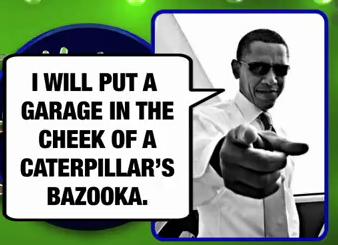
Get yourself some PJTV love:
"One should either write ruthlessly what one believes to be the truth, or else shut up." — Arthur Koestler

by Smitty
Klavan is an absolute absurdist genius:
Get yourself some PJTV love:
Woke up this morning to the shocking news that Bart Stupak will retire from Congress — confirmation of the effectiveness of the Tea Party movement and of the pro-life movement:
“Bart Stupak entered into a sham political deal that couldn’t be defended with a straight face. He put politics over principle and now even the politics are catching up to him. This is just the beginning of the fallout over pro-abortion health care reform. Ramming federal funding for abortion through against the will of the American people was a radioactive vote.”
— Charmain Yoest, President & CEO, Americans United for Life Action
Michelle Malkin has more reaction. Stupak apparently figured out something that a lot of other people are going to figure out soon enough: The Blue Dogs will be an endangered species this fall. That Dog Won’t Hunt.
by Smitty (via Zogger on Slashdot)
The Market Oracle is bereft of cheer as the inevitability of the VAT draws near:
What has surprisingly received little media attention is that the US Government has been steadily reducing the maturity of its treasury portfolio to keep fiscal deficits down. Whether interest rates rise or it becomes a problem for the US Treasury to re-fund the ever expanding roll-over pools, both suggest a Maturity Wall is dead ahead. It will occur no later than 2012, but it will likely be triggered with the next financial default scare.
Read the whole thing. Vast amounts of unsavory graphs to be found.
Think of US taxpayers as a single person, and the VAT as a blood donation that ends somewhere after the second pint, when the heart ‘unexpectedly’ implodes.
Or, maybe, these friendly Progressive vampires will find a way to keep the donor barely alive, just slightly above the point of catastrophic collapse. Won’t that be a swell thing to explain to the Founding Fathers in the afterlife?
What I want to see after the inevitable crisis is a removal of direct taxation power from DC. Let the Appropriations Committee be a wrestling match to determine the funding targets, and impose them on the States by whatever rule becomes law. But if the bill as presented is too great, then the funding targets go down. I realize that the notion of a negative feedback loop is mature, radical, sane, and unworkable. However, if we had more engineers and fewer lawyers driving the bus, the end might not be so predictable:
Update: via Insty, more VAT love, which may not have been the sort of affection for which you voted.
NEW ORLEANS — Just arrived at the rental home just off Chartres Street where I’ll be staying for the next four days. The blogger bash starts in an hour and a half and I need to take a shower and get dressed.
UPDATE: Ready for the Southern Republican Leadership Conference blogger bash:

Sharp-dressed man in front of the rental home where I’m staying with Ali Akbar and several other New Media operatives.
Update II: (Smitty) Things went pear-shaped from there, as this photo sent in from an internet cafe reveals:

For most people, New Orleans is the Big Easy. Robert Stacy McCain . . . not so much.
Update III: (Smitty) Linked by American Freedom!
by Smitty
George Mason University’s Mercatus Center seems beset with difficulties upholding ‘the Narrative’. Veronique de Rugy, in particular, seems mired in un-fluffy questions and hard, cold facts about all of that stimulus spending.
Her new update to the Stimulus Facts working paper, after engaging in proper academic dialog on the topic, the way the AGW climate change carbon clowns never have, boils down to noticing that the stench of decay is present in the stimulus spending for a reason.
As it turns out, when controlling for state capitals and a host of other potentially relevant variables, we find that the original findings still hold. We learn a few other things, too:
- First, how and where the money is spent doesn’t seem to be related to unemployment or decline in employment in the district where it is spent.
- Second, the district’s party affiliation matters in where the money is spent. (We still don’t know how much it matters compared to other factors.) The average Democratic district receives 81 percent more than the average Republican district. Even after taking out the money spent through state capitals, the average Democratic district receives at least 30 percent more than the average Republican district.
- Third, whether a district has part of a state capital in it is an important factor in how stimulus money is spent. However, controlling for this factor, or even taking the money going to state capitals out altogether, doesn’t negate the finding that the district’s party affiliation matters in where the money is spent.
- Finally, how long the district’s representative has been in office seems to have a small but significant impact on how the money is spent (this is a new finding, as well).
There is still much more to learn on the question “How are stimulus funds being spent and why?”
The more I dig into this, the more important the question seems.
This research is crucial for driving a stake through the heart of the mugging in Keynsian clothing that is this Administration’s policy.
However, what’s as important is the ‘so, what?’ question of how we structure the country to minimize the concentration of power. The reason that the DC cart thinks itself the economic horse, for all the cart’s lack of sensory organs and real driving power makes useful forward motion problematic, is that nothing else can lay claim to being the economic horse. This November’s election must restore the proper order of things.
. . . Paul Krugman is still a moron about economics:
Free markets are “efficient” — which, in economics-speak as opposed to plain English, means that nobody can be made better off without making someone else worse off.
Voluntary exchange — the free market — is mutually beneficial. The guy at the convenience store has gasoline. I’ve got a car. I want the gasoline, the guy at the gas station wants $3 a gallon. I decide to buy, he decides to sell.
According to Krugman, one of the parties to this mutually-agreeable exchange is “worse off” due to that transaction, but he doesn’t explain how, nor can he. Krugman’s fixed-pie, zero-sum-game perspective is antithetical to the pursuit of economic truth.
Which explains why he’s working for the New York Times . . .
 “When my face was smeared across the papers in my state with accusations that I was an apologist for white supremacy, I thought it was time to get involved.”
— Professor Carol Swain, Vanderbilt University Law School
by Smitty
Thaddeus McCotter appeared on PJTV, in a welcome outburst of sanity from within the beltway.
Topics proffered include:
Here he is his YouTube channel, if you care to subscribe.
His latest RedEye appearance, demonstrates the superiority of his baseball knowledge to that of the POTUS, and mentions Stormy Daniels, with a sad, sad campaign slogan suggestion. Then the Michael Steele riff, which works *against* McCotter, absolutely makes the clip.