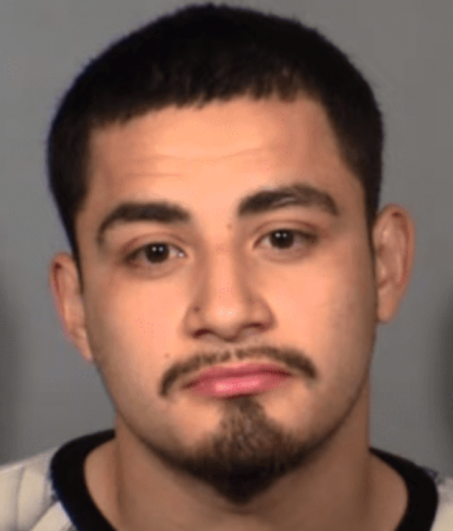
Say hello to 27-year-old Gabriel Charles and, while you’re at it, go ahead and say good-bye, because this criminal scumbag ceased to be a threat to public safety just a few seconds after he shot a Las Vegas cop.
It was shortly after 1 a.m. Saturday when Officer Tierney Tomburo and her partner pulled over a vehicle for a traffic violation. Three males were in the vehicle, including Charles, the front-seat passenger. Officer Tomburo asked all three of the men to exit the vehicle while she investigated and, just after she asked if any of them had any weapons on them, Charles took off running. Officer Tomburo pursued on foot when suddenly, without warning, Charles turned around and fired one shot from a 9-mm Smith & Wesson semiautomatic pistol. Officer Tomburo was struck in the pelvis and knocked down, but she was able to grab her own pistol and return fire. She fired four shots, and Charles was fatally wounded. It turned out that, although Charles’ pistol had 14 rounds in the magazine, the gun jammed after he fired the first shot at Officer Tomburo. Assistant Sheriff John McGrath “called the jam a ‘stovepipe’ where the bullet casing doesn’t eject clear from the handgun’s slide”:
“The gun will not fire when it’s like that, but there were 14 additional rounds in the magazine,” he said.
Bodycam shows Charles shooting Officer Tomburo.
A typical amateur error. We may surmise that, after his gun jammed, Charles tried to clear the “stovepipe” — with the intent to shoot Officer Tomburo again — instead of running away. That meant he was standing stock-still right next to the wounded cop, who had a clear target at close range: Bam! Bam! Bam! Bam! R.I.P., criminal scumbag.
Assistant Sheriff McGrath said that “if Charles had survived, he would have been facing several charges including attempted murder with a deadly weapon on a protected person, battery with a deadly weapon, resisting with a firearm, and prohibited person in possession of a firearm.” Oh, wait — a “prohibited person”? So what he’s really telling us is, the deceased Gabriel Charles was already a convicted felon. Officially, however, “Investigators are not releasing details on Charles’ criminal history, and leaving that responsibility to the District Attorney’s Office.” Just gonna guess he had a very lengthy record, and should not have been out on the streets to begin with. The whole scene was captured on bodycam video and Officer Tomburo’s voice after she was shot doesn’t sound very heroic, but the results speak for themselves.
Did I mention that Officer Tomburo is only 24? That she had only been a member of the Las Vegas police force for two years?
One of the great liberal myths of our age is the belief that America’s prisons are full of Wrongly Convicted Black Men. Even in cases where the evidence of guilt is overwhelming, liberals view Systemic Racism is an all-purpose excuse, so that even if he’s caught red-handed and confesses his guilt, no black man is ever really guilty of criminal wrongdoing. In this warped view, every black inmate in America’s prisons is a Victim of Oppression, and therefore — following this Liberal Logic™ to its inescapable conclusion — it is wrong for any black person ever to be arrested, prosecuted or incarcerated. The influence of what we may call the Myth of Universal Black Innocence is obvious in the policies pursued by left-wing district attorneys like Larry Krasner in Philadelphia, Alvin Bragg in New York and George Gascón in LA, as well as in Democrat-controlled states such as Illinois and California that have enacted “reform” policies to turn dangerous criminals loose on the streets.
Democrat soft-on-crime policies also result in lenient treatment of white criminals who get turned loose and become repeat offenders, but that is incidental to the political objective of such policies, which are advocated as a measure of “racial justice” with the intent of ending so-called “mass incarceration” of black criminals. But I digress . . .
I haven’t paid much attention to the Senate campaign in Pennsylvania, or any other Senate campaign, for that matter, because it seems to me that (a) the GOP has a near-certain chance to take back the House majority in the midterms, and (b) winning the Senate would merely be the cherry on top of that result. Also, I wasn’t a huge fan of Trump’s endorsement of Doctor Oz in the Pennsylvania GOP primary, not because of anything particular against Doctor Oz, but just because I would have preferred a candidate with a more typical background, rather than a celebrity with no political record. The more I’ve learned about the Democratic candidate in Pennsylvania, however, the more obvious it seems that conservatives have a duty to rally behind Doctor Oz. Because the Democrat, Lt. Gov. John Fetterman, is a very dangerous person, and would certainly be defeated if Pennsylvania voters were fully informed about him.
A few recent headlines about an important controversy:
This is an important controversy, as I say, because it highlights both Fetterman’s policy toward crime and justice issues, as well as his judgment and honest (or lack thereof). The two convicted murderers Fetterman hired on his campaign staff are Lee and Dennis Horton.
Convicted felons Lee and Dennis Horton
Notice the liberal media seek to suggest that the Horton brothers were “wrongfully convicted,” or that, because they were “granted clemency,” somehow their guilt is in doubt. In fact, there is no doubt at all, and it is neither “misleading” nor a “smear” for Oz to call attention to this situation, which speaks volumes about Fetterman’s worldview.
Despite repeated appeals, no court has overturned the convictions of Lee and Dennis Horton, and there is absolutely no reason for anyone to believe that they were “wrongfully convicted.” The most recent court ruling points out that the only new “evidence” Lee Horton offered in seeking PCRA relief was a handwritten note by one of the police investigators, previously not included as part of discovery during the proceedings, which could not possibly have affected the outcome of his original trial. But what about this “clemency”? And what about the original crime for which the Hortons were convicted?
The evidence adduced at trial established that on May 31, 1993, [Lee Horton], his brother Dennis Horton (“Dennis”), and a coconspirator Robert Leaf (“Leaf”) robbed Filito’s Bar located at 5th and Hunting Park Avenue. During the course of the robbery, Dennis, who was brandishing a rifle, shot Samuel Alemo multiple times. He later died from his gunshot wounds. Dennis also shot Luz Archella and her daughter Luz Martinez, injuring both. After leaving the bar, the three men fled in a blue automobile. A passerby was able to supply a description of the vehicle and a partial license plate number. A radio call was sent out, which included a description of the three assailants, their vehicle, and the last four digits of the license plate. A police officer observed the vehicle a short time later only a mile from the crime scene and placed [Horton] and his companions under arrest. Police recovered a .22 caliber semi-automatic rifle from the backseat of the car as well as a black pellet gun under the front passenger seat. Ballistics testing identified the rifle as the same weapon used during the robbery at Filito’s. [Horton], Dennis, and Leaf were taken to the hospital where Martinez and her daughter, as well as another bar patron Miguel DeJesus, identified them as the robbers. . . .
The evidence shows that [Horton] entered the bar with Leaf and Dennis, who were both armed. [Lee Horton] took money from a bar patron while Leaf held a gun to the patron’s head. [Horton] remained present when Dennis opened fire on two other bar patrons and murdered Alemo. He then fled the bar together with Leaf and Dennis, and was arrested with them a short time later. . . . Regardless who opened fire, [Horton] remains liable as an accomplice for any resulting deaths as well as any other crimes committed that night at Filito’s bar during the robbery.
This is the law in most states on capital murder: If you participate in a crime, such as a robbery, that results in someone being killed, you can be charged with murder even if you didn’t pull the trigger, and even if the person who got killed was one of your accomplices. One reason the law is this way is because, when two or more perpetrators are involved in a crime that ends in homicide, it can be difficult to determine which of the criminals did the fatal deed. If Moe, Larry and Curly decide to rob a bank, and a teller gets shot to death in the process, cops may not be able to figure out which one of the Three Stooges pulled the trigger, and Moe might be pointing the finger at Curly or Larry, both of whom insist that it was really Moe that did the killing; however, insofar as all three were involved in the robbery-turned-murder, all of them are equally liable under the capital murder law. Interestingly, in the Horton brothers’ case, while Dennis and Lee were both convicted of second-degree murder and sentenced to life in prison, their accomplice Ryan Leaf was convicted of third-degree murder and only sentenced to “a term of years,” eventually being released in 2008. Nobody knows where Ryan Leaf is now, but the fact that he had already gotten out of prison was widely cited last year as an argument for releasing the Horton brothers. Among other things, such an argument seeks to void the findings of the jury and the judgment of the prosecutors, who were certainly more familiar with the facts of the case in 1993 than any of the liberal journalists or “activist” types running their mouths about the case in 2022. Regardless of why Leaf was sentenced to less time than the Horton brothers, no reasonable person would find this a reason to believe the Hortons were “wrongfully convicted” or that their life sentences were unjust. A man was killed and two women were wounded in this robbery, and unless you’re the kind of liberal idiot that thinks it’s OK to let murderers go with a slap on the wrist, life in prison is an entirely justifiable sentence in such a case.
The Pennsylvania Board of Pardons meets four times a year to consider the ever-growing pile of applications for a pardon or a commutation submitted by inmates at state prisons across the Commonwealth. There are five people on the board: the lieutenant governor, the state attorney general (Josh Shapiro), and three other members with relevant expertise picked by the governor and approved by the state Senate. Votes on cases involving death sentences and life imprisonment must be unanimous; otherwise, recommendations for a pardon/commutation (the conferring of which ultimately lies with the governor) are denied.
With Fetterman at the helm, the board has been wading through the huge backlog of applications at a determined clip. Shocked and shaken by the overwhelming majority of elderly Black faces among the 5,400 inmates currently serving life sentences in Pennsylvania’s state prisons, Fetterman has made it his mission to shift the emphasis from cruelty to compassion. “We’re making it all about second chances, about redemption and forgiveness and completing the circle,” he says. “People think the face of life in prison is Hannibal Lecter, but sometimes it’s the face of Morgan Freeman in Shawshank Redemption.”
This is from a May 2021 Philadelphia magazine profile and, sweet holy jeebus, are you kidding me with this Shawshank Redemption crap? I mean, really? Hollywood dramas are the basis of your decision-making as chairman of the state Board of Pardons? But wait, there’s more from the Philadelphia magazine profile:
Two people Fetterman deemed worthy of a second chance are Lee and Dennis Horton, brothers from North Philadelphia who, until their release in February, had served 27 years of life sentences as accessories to a murder they maintain they had no part in. In one of the many cruel ironies of the U.S. justice system, the man who confessed to committing the murder was released in 2008.
This is how laziness functions as a servant to bias in journalism. Any reporter diligent enough to look up the court records on the case against the Horton brothers could see that this tale is false. According to witnesses and victims (to say nothing of the jury’s verdict and the various courts that repeatedly rejected Lee Horton’s appeals), it was not Ryan Leaf, but Dennis Horton who shot the three victims. The reporter who wrote this feature profile about Fetterman simply repeats what he was told by the Hortons, without having bothered to check the facts for himself. There is no “cruel irony” to why the Hortons were still behind bars; they were both guilty, but never once have they acknowledged their guilt. Returning to the Philadelphia profile:
By all accounts, the Horton brothers were model prisoners, counseling fellow inmates struggling with incarceration, teaching yoga, convincing their peers to act in and build props for productions of plays they wrote about atonement and restorative justice.
Two wardens and assorted deputies, not to mention the state secretary of corrections, advocated for their release at a Board of Pardons hearing in December of 2020. When it came time to vote on the Horton brothers’ request for a commutation, Fetterman wept openly as the other board members voted “yes”; when his turn came, he was too overcome with emotion to speak. AG Josh Shapiro, who’s locked horns with Fetterman in the past over whom to let out and whom to keep in, answered for him: “I’m a yes, and I think the lieutenant governor is a yes as well,” he said over Zoom. The Horton brothers were watching all of this go down from the warden’s office at SCI Chester, where they were incarcerated.
“This is a man who supported us with everything he had in him; he was all in, emotionally, physically,” Dennis Horton told me back in April, just a few weeks after he and his brother were released from prison. “He gave what he had to help free us from the clutches of a life sentence.” “He saved our lives, because life in Pennsylvania means you die in prison — they call it ‘death by incarceration,’” said Lee. “When he broke down, I was taken aback, because you don’t expect a guy that big to be that emotional.”
“Especially with all those tattoos on him,” Dennis chimed in. Since their release, the Horton brothers have been hired by Fetterman’s U.S. Senate campaign to coordinate voter outreach in Philadelphia.
Perhaps “outreach” to the family of their victims? See, that’s the magician’s trick in this kind of story, where liberal journalists portray criminals as victims, while — abracadbra! — making the real victims disappear. But they should never be forgotten:
The victim’s brother, Reinaldo Alamo, 62, said he opposes clemency for the Hortons. “They took a human life, and they don’t deserve to be out in society,” he said. . . .
Attempts to locate Leaf and witnesses from the 1993 trial were unsuccessful. To Reinaldo Alamo, it was and remains an open-and-shut case, given the brothers were caught with the weapon an hour after the murder. He won’t be speaking at the hearing, but submitted a letter noting his opposition.
“When I heard this it put me in a state of depression,” Alamo said of the commutation hearing. “To think of … the turmoil they caused my family, the pain and suffering that it did to my mother.”
John Fetterman doesn’t care about the suffering of crime victims.
That’s what this controversy is really about. Democrats have become the pro-criminal party, advocating policies that ensure violence criminals are turned loose to commit more crimes, and Democrats like John Fetterman are absolutely indifferent to the impact that these policies have on innocent law-abiding citizens. You must be some kind of racist if you think murderers should be sentenced to life in prison, and even if your own brother gets killed by these monsters, well, tough luck!
Whether or not Republicans win a Senate majority in November, and without regard to what we may otherwise think of Doctor Oz’s candidacy, it seems to me that conservatives have an obligation to do everything in our power to stop John Fetterman from being elected.
Today’s pic deserves a little explanation – it is, of course, Yor Forger from Spy x Family, but it reminded me of this picture of the DC Comics antihero Thorn in its reflection of, as Private Joker once said, “the duality of man”.
Silicon Valley delenda est.
MyPillow chief executive Mike Lindell said Tuesday that federal agents seized his cellphone and questioned him about a Colorado clerk who has been charged in what prosecutors say was a “deceptive scheme” to breach voting system technology used across the country.
Lindell was approached in the drive-thru of a Hardee’s fast-food restaurant in Mankato, Minnesota, by several FBI agents, he said on his podcast, “The Lindell Report.” The agents questioned him about Dominion Voting Systems, Mesa County Clerk Tina Peters and his connection to Doug Frank, an Ohio educator who claims voting machines have been manipulated, he said.
The agents then told Lindell they had a warrant to seize his cellphone and ordered him to turn it over, he said. On a video version of his podcast, Lindell displayed a letter signed by an assistant U.S. attorney in Colorado that said prosecutors were conducting an “official criminal investigation of a suspected felony” and noted the use of a federal grand jury.
The circumstances of the investigation were unclear. The Justice Department did not immediately respond Tuesday night to a request for comment about the seizure or investigation.
“Without commenting on this specific matter, I can confirm that the FBI was at that location executing a search warrant authorized by a federal judge,” FBI spokeswoman Vikki Migoya said in an email.
I don’t like this. I don’t like it one bit. More than three days after Ukrainian forces claimed the capture of Kupiansk, they have not established bridgeheads on the east bank of the Oskil River, meaning that their ability to continue advancing eastward — i.e., to drive the Russians out of Luhansk Oblast — is in doubt. While the Ukrainians have reportedly reoccupied Lyman, that crucial foothold is likely to become the focus of Russian counterattacks, if the forces that took Kupiansk and Izyum do not find a way to cross the Oskil and keep pushing eastward.
Momentum counts for a lot in war, and when the Ukrainian advance sent Russian troops scrambling out of Kupiansk and Izyum, it appeared that the Russian panic might spread quickly eastward. The Ukrainian governor of the region said that on Friday or Saturday, Russian forces fled from the towns of Svatove (about 35 miles southwest of Kupiansk on the P07 highway) and Kreminna (another 30 miles south of Svatove on P66 highway). Anyone who looks at a map can see that Svatove and Kreminna are crucial points on the supply line for Russian forces along the front from Lyman eastward to Severodonetsk. So if Ukrainian forces could have seized those towns — even with small patrols of lightly armed infantry, which could not withstand a full-strength counterattack — Russian troops on the Lyman front would have been cut off.
Today, the same regional governor said Svatove has now been reoccupied by the Russian forces that fled earlier, so that golden opportunity — made possible by the panicked reaction to Ukraine’s rapid advance on Kupiansk — appears now to have been lost, at least for the time being. And, as I say, there is no evidence that Ukraine has crossed to the east bank of the Oskil River anywhere between Kupiansk and Izyum. The most obvious sites for such crossings would be at the P79 highway bridges, between Senkove and Kruhlyakivka, and further south between Horokhovatka and Borova. Establishing east-bank bridgeheads in Kruhlyakivka and Borova, and then linking these together in a wider front — the two towns are about 12 miles apart — would provide a solid base for advancing east, toward the P07/P66 junction near Svatove.
Now I suppose that Ukraine’s rapid advance created logistical problems — they outran their supply line — and further suppose that the P79 bridges across the Oskil River have been damaged or destroyed. Be that as it may, the panic in the immediate aftermath of the Ukrainian advance created an opportunity that does not appear to have been fully exploited. Troops and equipment can be ferried across a river (at night, if necessary), and even a fairly small force of infantry scouts might have been enough to chase off any Russians around Kruhlyakivka and Borova, amid the chaotic scramble of this past weekend. Given another couple of days to bring over armor and artillery, that would have been enough to establish a solid grip on the east bank of the Oskil. While I’m perhaps guilty of underestimating the difficulty of such a task, the fact that nothing at all seems to have been attempted in the past three days is discouraging. Given time to recover from their disasters near Kharkiv, the Russians are likely to dig in on the east bank of the Oskil now, making further Ukrainian advances difficult, if not impossible, in the short term.
In the aftermath of the first Battle of Manassas, Confederate commander Joseph Johnston remarked that his army had been as disorganized by its victory as the Yankees had been disorganized by their defeat. Something like this may have happened to the Ukrainians, who recaptured some 1,200 square miles of territory in a few days last week. Probably they did not expect to be as successful as they were and, having reached Kupiansk and stampeded the Russians out of Izyum, the troops figured they’d accomplished everything that had been asked of them, and more.
Yet the war is not won yet, and it won’t be won anytime soon if the Ukrainians don’t make the most of every advantage they gain.
“Mom knew more about football than half these people,” my brother Kirby remarked this morning, discussing the role of “analytics” in the Monday Night Football defeat of the Denver Broncos. Indeed, our mother was a pretty savvy football fan, and no doubt she would have advised the Broncos, “Kick the damned field goal.”
Denver trailed 17-13 at halftime and, on their opening drive of the second half, drove 78 yards in nine plays to reach the one-yard-line of the Seattle Seahawks. On fourth-and-goal, the Broncos disdained the opportunity for a field goal that would have brought them within a point, 17-16, and instead went for it. Running back Melvin Gordon III was stopped short of the end zone and fumbled. And this choice would come back to haunt Denver later. In the fourth quarter, the Broncos again drove deep into Seahawks territory, coming up on fourth-and-goal from the Seattle 8 with a little more than six minutes left in the game. This time, though, they were willing to settle for three points and cut it to 17-16. However, if they had kicked a field goal when they had the chance earlier, this fourth-quarter FG would have put Denver ahead 19-17 — and enough to win the game, as it turned out. In the end, the Broncos got the ball back with about four minutes left, drove to the Seattle 46 and, with 20 seconds left, attempted a 64-yard field goal that missed. So because they turned down the chip-shot early in the third quarter, they lost the game on a 64-yarder at the end. Another sterling example of “analytics” in action.