Maybe not as Goth as, say, Ally Slayter, but she’ll do, she’ll do.
Post title from the Most Pretentious Card Game Ever Made, which is unfortunately out of print. Ceterum autem censeo Silicon Valley et Hamas delendam sunt.
How long have I been a Beatles fans? Since the mid-1970s, when there was a sort of reverb echo of “Beatlemania.” Born in 1959, I’d been much too young to take notice of the Beatles craze that swept America in 1964, although I do recall my cousins Deb and Trish (teenagers at the time) being fans of the four moptop lads from Liverpool. It was about a decade later that I started listening to the Beatles, especially one of my older brother’s albums (The Beatles 1962-1966, the so-called “Red Album.”) By 1976, after reading Hunter Davies’ Authorized Biography (checked out of the library at Lithia Springs High School), I was a full-blown Beatlemaniac, and soon discovered I wasn’t alone. Working at Six Flags that summer, I met a skinny girl who jumped in harmonizing perfectly when she overheard me singing “Eight Days a Week.” Her favorite Beatle was George, whereas I was more of a John fan, but despite this difference we got along just fine. And there were many thousands like us across the country at the time, born too late to have experienced the original “Beatlemania” craze, but hoping for a reunion while digging on the old songs and accumulating trivia about the band’s history.
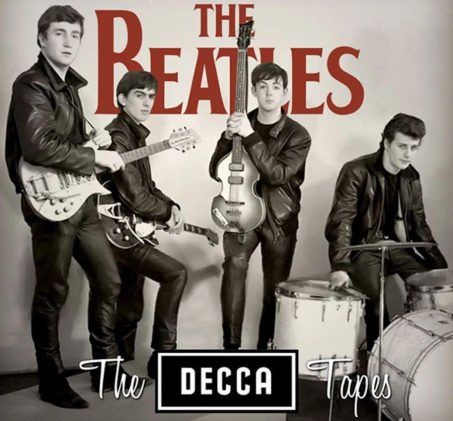
One bit of Beatles lore known to every true fan is that in 1962, the band auditioned for Decca Records but were rejected because “guitar groups are on the way out,” as an executive at the label supposedly told the band’s manager, Brian Epstein. This tale has taken on a life of its own, with the “on the way out” line being cited as a classic example of institutional cluelessness. But is this legend really accurate?
A few days ago, I was skimming through an article that mentioned an early song written by John Lennon (“Hello Little Girl”) that was one of three originals included in the Decca audition. So then I went to YouTube and listened to that song, as well as several others (both originals and covers) recorded during that audition. And I can say without hesistation it’s no surprise Decca rejected the Beatles based on that tape.
A brief summary of what’s wrong with it: Everything.
For the most part, the band on the Decca audition tapes doesn’t even sound like The Beatles, i.e., the group we know from their subsequent recordings for EMI with George Martin as producer. Of the 15 tunes they recorded during that session at Decca’s London studio, only two — “Money (That’s What I Want)” and “Till There Was You” — were later released on Beatles albums, and a direct comparison of those songs (the Decca audition versions versus the versions recorded for EMI) tells you a lot about why George Martin has so often been called “the fifth Beatle.” His skill as a producer made all the difference in the world.
From Liverpool to Hamburg to the Decca Session
For those who aren’t steeped in Beatles trivia, permit me to share the backstory leading up to the Decca audition. Originating as a skiffle group known as The Quarrymen (so named because they attended Liverpool’s Quarry Bank High School) led by John Lennon, the core of what would become the Beatles was formed when Paul McCartney showed up at a Quarrymen’s gig in 1957 and impressed John with a performance of Eddie Cochran’s “Twenty Flight Rock.” McCartney, a year-and-a-half younger than Lennon, then brought along his still-younger friend George Harrison, who earned his membership in 1958 by performing the instrumental “Raunchy.” This trio of guitarist/singers played in various permutations (sometimes Lennon and McCartney as a duo, or as a larger band with different players joining on drums, bass or piano) around Liverpool. In 1960, John convinced his art school classmate Stuart Sutcliffe to purchase a bass guitar and join the group. Among the places they played in Liverpool was the Casbah Club, operated in the basement of a home owned by Mona Best, whose son Pete was a drummer. In August 1960, the group’s then-manager, Allan Williams, arranged for them to play as the house band at the Indra nightclub in Hamburg, Germany, and they recruited Pete Best as their drummer for this gig.
The Beatles in Hamburg, 1960
It was in Hamburg, where they were required to play for many hours nightly in front of rowdy audiences, that the Beatles underwent a transformation which subsequently made them Liverpool’s hottest rock-and-roll band. Their popularity brought them to the attention of Brian Epstein, whose family owned the city’s largest record store, NEMS (North End Music Stores). In November 1961, Epstein visited the Cavern Club to see the Beatles perform. (By this time, Sutcliffe had left the band, moving in with his German girlfriend Astrid Kirchherr in Hamburg; Sutcliffe tragically died in April 1962). Epstein was sufficiently impressed by the Beatles’ Cavern Club performance that in December 1961 he proposed a management deal. Because his job as manager of NEMS gave him business connections with England’s record labels (which were all based in London), Epstein was quickly able to convince a Decca producer (known as an A&R man, for “artists and repertoire”) named Mike Smith to visit Liverpool and hear the group for himself. Smith liked them enough that he arranged for the Beatles to do a recorded audition session at Decca’s studio in London, scheduled for January 1, 1962.
Less than 16 months had elapsed between August 1960, when the Beatles first went to Hamburg, and their Decca audition on New Year’s Day 1962. They were all still very young. John had only recently turned 21, Pete Best was 20, Paul was still 19 and George was just 18. It would be unfair to expect this group of young rockers to sound like seasoned professionals in a recording studio. But that doesn’t explain everything that’s wrong with their sound on the Decca audition recordings. Wikipedia tells us, “At the audition, the Beatles performed songs chosen by Epstein” [emphasis added], citing renowned Beatles musicologist Mark Lewisohn.
This may be the biggest clue about the basic problem with the Decca audition. Epstein notably sought to “clean up” the Beatles’ image, putting them in suits and ties to replace the jeans-and-leather-jackets look they’d adopted in Hamburg. Epstein’s effort to make them “presentable” likely extended to the song selection for the Decca audition. Of the 15 songs they recorded during the session, only two (“Money” and the Chuck Berry tune “Memphis”) are really rockers. They also included two do-wop hits by the Coasters (“Three Cool Cats” and “Searchin’,” the latter of which features McCartney’s best vocal performance of the session). Evidently, in pitching them to the big London record label, Epstein wanted the Beatles to come across as more of a conventional pop music act, downplaying their rowdy rock-and-roll aspect, which is the most likely explanation of why they don’t sound anything like what they later became.
A Very Fortunate Failure
The three Lennon-McCartney originals (“Hello Little Girl,” with Lennon on lead vocal, and “Love of the Loved” and “Like Dreamers Do,” both sung by Paul) are, to put it as politely as possible, sub-standard. Think of the very worst B-side the Beatles ever released on EMI (I’d nominate “Ask Me Why”) and all of these songs are even worse. Permit me to bullet-point the subsequent fate of each tune:
“Hello Little Girl” — Once the Beatles had made it big in 1963, this was recorded as the debut single by another Liverpool band, The Fourmost, who were also managed by Epstein. The record made it as high as No. 9 on the UK pop charts.
“Love of the Loved” — This was the debut single for Liverpool singer Cilla Black, who was also managed by Epstein after being introduced to her by John Lennon. It peaked at No. 35 on the UK charts.
“Like Dreamers Do” — Released as the second single for The Applejacks, it was released in mid-1964 and made it to No. 20 on the UK charts.
You see that, even at the very zenith of “Beatlemania” in England, when it seemed any Liverpool act could ride the wave to stardom, none of these Lennon-McCartney songs made it as high as the Top Five.
Another thing about the Decca audition session:
HOW ABOUT TUNING YOUR BLOODY GUITARS, BOYS?
To me, this is the most inexcusable problem. Let us stipulate that, in those days before anyone had even thought of inventing digital tuners, it might have required a bit of time to get three guitars tuned properly, and then to pause occasionally during the session to keep them in tune. But, oh, my God! To hear George go off on a solo so badly off-key as to set one’s teeth on edge — how could any self-respecting record producer have permitted this atrocity? A slightly out-of-tune guitar wouldn’t make much difference when you’re playing a Hamburg bar gig for a bunch of drunk Germans, or a Cavern session for teenage fans, but in a recording studio, it matters — a lot. Any musician who’s ever done any recording knows this, and the intonation problems on the Beatles’ Decca tapes are simply inexcusable. Mike Smith must be blamed for this.
Remember, this recording session was on New Year’s Day. The Beatles showed up at 10 a.m., as scheduled, but Smith arrived late, because he’d been out drinking all night on New Year’s Eve. Perhaps that affected what happened during the session. It is believed that all 15 songs were recorded in one take, with no overdubs or retakes, and the whole thing was probably wrapped up not much later than noon. This hurried pace no doubt accounts for much of the general sloppiness of the Beatles’ performance in the Decca audition. If you’ve paid any attention at all to the Beatles’ subsequent discography, you know that they nearly always did multiple takes with George Martin as their producer, even on fairly simple songs (e.g., nine takes for “I Saw Her Standing There”).
Were “guitar groups on the way out”? Was this why Decca rejected the Beatles? That explanation doesn’t make sense because, on the same day the Beatles recorded their audition tape for Decca, another band — Brian Poole and the Tremeloes — also recorded an audition tape for Decca with Mike Smith as producer. They were also a “guitar group” (although their rhythm guitarist also played keyboards) and what actually happened was that the executives at Decca told Mike Smith he could give a contract to one group or the other, but not both. Because the Tremeloes were from London, it would be easier to work with them than with the Beatles some 200 miles away up in Liverpool. That seems to have been the key factor in Smith’s decision to sign the Tremeloes and reject the Beatles.
Of all the lucky breaks the Beatles ever got, this rejection by Decca Records might have been the luckiest of them all, because it ended up connecting them with “the fifth Beatle,” George Martin.
George Martin circa 1962
Arguably the biggest lesson we can learn from listening to the Beatles’ failed Decca audition is how important George Martin was to their subsequent success. In giving Martin his due credit, we do not in any way diminish the talents of John, Paul, George and Ringo. We can analogize this to a football coach and a great team — the University of Alabama attracts fine football talent, but coaches like Bear Bryant and Nick Saban are crucial to producing championship teams, and the same could be said of the relationship between George Martin and the Beatles.
‘For Starters, I Don’t Like Your Tie’
George Martin was a classically trained musician, having played piano since childhood, and later studying for three years at the Guildhall School, including courses in composition and orchestration. He was 24 when he joined EMI in 1950 as an assistant to the head of the subsidiary Parlophone label. In addition to his work on Parlophone’s classical music catalog, by 1962, Martin had already produced a No. 1 UK hit (“You’re Driving Me Crazy” by the Temperance Seven) as well as other pop records that had reached the Top 20 in England. He knew a thing or two about how to make a hit record and, after the Beatles’ failure to land a Decca contract, the fates swiftly steered them into Martin’s capable hands.
After Decca rejected the Beatles, Epstein took the tape of their Decca audition and went to EMI, where he met with Martin in mid-February 1962. Martin was not particularly impressed with what he heard on tape. Separately, however, Epstein was also trying to land a publishing contract for Lennon and McCartney as songwriters. This attracted the interest of the head of EMI’s music publishing division, Sid Colman, who pressured his EMI bosses to sign the Beatles in hopes that this would give him leverage toward signing the Lennon-McCartney songwriting team. It so happened in spring 1962 that there was bad blood between George Martin and the managing director of EMI, Len Wood. Not only was there a disagreement over business decisions, but Wood had discovered that Martin was having an affair with Wood’s secretary. To appease Colman, and also to punish Martin, Wood directed Martin to sign this weirdly-named rock band from Liverpool (who weren’t good enough for Decca).
It’s amazing to consider how many things had to go wrong for this fortuitous combination to come together. At any rate, Martin met with Epstein again in May 1962 and said he’d offer the Beatles a deal for three singles. The Beatles’ first EMI recording session was scheduled for June 6, 1962. Martin had not yet even met the band. After the session got underway, the group’s limitations were apparent to Martin. To begin with, he didn’t much care for the three original songs (“Love Me Do,” “Ask Me Why” and “P.S. I Love You”) they brought to the session. Beyond that, however, Martin wasn’t satisfied with Pete Best on drums.
Things didn’t look very promising until, at one point, Martin switched on the microphone connection from the control room to tell the Beatles in the studio to let him know if there was anything they didn’t like. Immediately, George Harrison quipped back, “Well for starters, I don’t like your tie.” This wisecrack broke the strain and, despite the other problems, the relationship between Martin and the Beatles began to warm up. Another issue facing Martin was whether to focus on Lennon or McCartney as the group’s primary lead singer, but he had a Solomonic insight: “Suddenly it hit me that I had to take them as they were, which was a new thing. I was being too conventional.” Both John and Paul would take their turns as lead singer (with occasional spotlights for George and, later, Ringo Starr). The June 6 session finished without producing anything worthy of commercial release, but Martin conveyed to Epstein his complaints about Pete Best. A follow-up recording session was scheduled for September and, in the meantime, the Beatles had to find a way to get rid of Best and replace him with Ringo.
Ringo and George in Hamburg, 1961
The Beatles had known Ringo for a couple of years. He was the drummer of Rory Storm and the Hurricanes, one of their rivals for most popular band in Liverpool, and also veterans of the Hamburg scene. There was probably no good way to accomplish the business of ditching Pete Best, which caused a furor among the Beatles’ fandom in Liverpool, and swiping another band’s drummer didn’t exactly endear the Beatles to their fellow musicians. But this was a major upgrade for the Beatles, as Ringo had a much more polished style, and George Martin deserves credit for forcing the group to make this change.
Ringo shaved his beard and got a new hairstyle, and the band returned to EMI’s Abbey Road studio on September 4. They re-recorded “Love Me Do.” They also tried recording a new song they’d written, a ballad called “Please Please Me.” But because Martin didn’t think their originals were good enough, he wanted the Beatles to record a professionally written song called “How Do You Do It?” The Beatles dug in their heels, however, insisting that they’d stand or fall on the basis of their own original material. Reluctantly, Martin told them to work up more new material, while deciding to go ahead and release “Love Me Do” as their first single (backed with “P.S. I Love You” on the B side). Another studio session was scheduled for September 11 to try and get better recordings of these songs. Martin brought in a professional session drummer, Andy White, to play on “Love Me Do,” a snub of Ringo that the band resented, although subsequently Martin praised Ringo’s ability as a drummer.
“Love Me Do” is a childishly simple song and arguably its strongest selling point is Lennon’s harmonica part. One almost suspects that Martin shared the belief attributed to Decca executives that “guitar groups” were obsolete, which may explain why the first three Beatles singles (“Love Me Do,” “Please Please Me” and “From Me to You”) all featured John’s harmonica. Released in early October 1962, “Love Me Do” made its way up the charts to peak at No. 17 in November.
The record’s popularity surprised Martin, who hadn’t expected such strong sales, and he then scheduled a new recording session. He already had the Beatles’ earlier recording of “How Do You Do It?” in the can, and was considering making it their second single, but they returned to London with a renovated version of “Please Please Me” that was much better than the first time they tried it. Lennon later explained it was inspired by Roy Orbison’s “Only the Lonely,” and the first version was a slow ballad that Martin found “dreary.” Now, however — perhaps feeling pressure because they knew Martin wanted to release “How Do You Do It?” — the Beatles brought in a turbocharged uptempo version of “Please Please Me.” They did 18 takes of the song on November 26, 1962, before Martin was satisfied, but when the band came up to the control room afterwards, he told them, “Gentlemen, you have just made your first number one record.” His prediction was soon proved correct.
The single was released on January 11, 1963, and the Beatles made their first nationwide TV appearance eight days later, quickly pushing “Please Please Me” to the top of the charts. Seeing a chance to capitalize on this success, George Martin hastily arranged an all-day recording session for February 20, 1963, where in the span of about 12 hours, the Beatles recorded 10 songs which (along with the two singles and their respective B-sides) would comprise their first album, Please Please Me. That session yielded two classics, “I Saw Her Standing There” and a rave-up cover of the Isley Brothers’ “Twist & Shout” which became a crowd favorite during the band’s early concert tours. Released on March 22, the Beatles’ first LP almost immediately soared to No. 1 on the British charts.
Screaming for the Dominant Fifth
Even before the first album could be released, however, the Beatles had returned to Abbey Road on March 5 to record their next single, “From Me to You,” which was released on April 11 and was an even bigger hit than “Please Please Me.” This was the point where the “Beatlemania” phenomenon really began to break out in England, partly because of a clever trick in the bridge of “From Me to You.” The bridge works its way up to the dominant fifth chord as John and Paul harmonize on the phrase “keep you satisfied” then punctuate it by hitting a falsetto “ooh!” When they performed it in concerts, the Beatles would shake their heads on that falsetto note, which made their mop top haircuts flop around, and this absolutely drove girls crazy. That’s when screaming became ritualistic at Beatles concerts. You may be thinking, “What do screaming girls have to do with George Martin?” Remember I said he’d studied composition at Guildhall? Music theory, my friends, is involved with the way that a song’s chord progression can build up tension — peaking on the dominant fifth chord (G, in the key of C) — which is released by the return to the tonic (C) chord. This is what drove girls crazy.
“Beatlemania” in Manchester, England, 1963
Working with George Martin was an educational experience for the Beatles, and they were eager students. Martin himself said:
“I taught them the importance of the hook. You had to get people’s attention in the first ten seconds, and so I would generally get hold of their song and ‘top and tail’ it—make a beginning and end. . . . I would meet them in the studio to hear a new number. I would perch myself on a high stool and John and Paul would stand around me with their acoustic guitars and play and sing it. … Then I would make suggestions to improve it and we’d try it again.”
Martin was publicly modest about his contributions to the Beatles success, insisting it was due to their genius, not his. But there was a symbiotic relationship to it. While “From Me to You” was almost as simple as “Love Me Do,” Martin still insisted on six takes (plus overdubs) before he was satisfied with it. The next Beatles single — arguably the best of their early hits — again employed the trick of adding a falsetto whoop on the dominant fifth: “She loves you and you know you should glad — ooh!” If Beatlemania had been breaking out before “She Loves You” was released in August 1963, now it went pandemic. With its memorable “yeah yeah yeah” refrain, it broke every existing sales record for British singles, and remained on the UK charts for an astonishing 31 weeks. If it was George Martin who had taught the Beatles “the importance of the hook,” they had obviously aced the exam.
The Beatles had begun 1962 with that Decca audition session that flopped, when Lennon and McCartney were writing miserable dreck like “Hello Little Girl” and “Like Dreamer Do.” But by January 1963, they’d released what would become their first No. 1 hit, and swiftly followed up that success with their first album, as well as two more chart-topping hit singles. Before 1963 was over, they would release yet another No. 1 hit, “I Want to Hold Your Hand,” which would finally break them into the U.S. market, and by February 1964, they were on the Ed Sullivan show driving the American girls crazy with their falsetto whoops.
Getting rejected by Decca was surely disappointing for the Beatles when it happened, but because it ended up putting them under the tutelage of George Martin, it was the biggest break they ever got.
While I’m sorting through my roster trying to figure out which ten -I think it’s ten- players I want to keep*, the Cincinnati Reds are playing the Baltimore Orioles for all the marbles in Pete’s league. The Chicago Cubs (79-83) and Montreal Expos (66-96) are looking for new managers, so if you want to give Dynasty League baseball a try, you could do worse than take over one of these teams. Ceterum autem censeo Silicon Valley et Hamas delendam sunt.
In fond remembrance of Wally The Beer Man (no, he’s not dead)
*No offense to Pete, but the player retention rules really don’t seem like they were intended to cover situations where multiple teams are tied in terms of wins and losses.
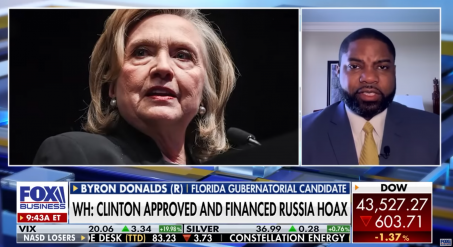
Of course I’m kidding. We’ve all known from the get-go who was really behind the “Russian collusion” hoax, but I just had to use that line from The Godfather now, because the release of the so-called Durham annex (previously classified evidence obtained by John Durham during his Special Counsel investigation) has finally proven what we’ve suspected. We have reached that “a-ha!” moment, like Don Corleone watching Barzini play puppet-master to Tattaglia in the meeting of the Five Families, where everything is now crystal clear.
Matt Taibbi, who has been covering this story for years, points out that it “has long been one of the most convoluted, hard-to-follow news stories of all time,” but the convolutions are now resolved:
Now, we know. With the help of the declassified Durham material, we can explain the whole affair in three brushstrokes.
One, Hillary Clinton and her team apparently hoped to deflect from her email scandal and other problems via a campaign tying Trump to Putin. Two, American security services learned of these plans. Three — and this is the most important part — instead of outing them, authorities used state resources to massively expand and amplify her scheme. The last stage required the enthusiastic cooperation and canine incuriosity of the entire commercial news business, which cheered as conspirators made an enforcement target of Trump, actually an irrelevant bystander.
It’s the motive that explains everything, you see. Too many people have forgotten — or, if they were getting their news from the mainstream media, never knew about — the scandal of Hillary’s private email server. As Secretary of State during the first term of Obama’s presidency, her official communications were covered by the Federal Records Act, but it was discovered that she had used “a private email server for official public communications rather than using official State Department email accounts maintained on federal servers.” The FBI investigated and found that at least 100 of these emails “contained information that should have been deemed classified at the time they were sent, including 65 emails deemed ‘Secret’ and 22 deemed ‘Top Secret.'”
Hillary Clinton broke the law and, in doing so, jeopardized national security. And then there were the more 30,000 deleted emails, which looks an awful lot like obstruction of justice to me, but I am not a lawyer.
That is the email scandal from which Hillary wanted to “deflect,” as Taibbi says, by ginning up the Trump-Russia hoax. It should not be confused with the DNC email leak (or “hack”), although the two are closely intertwined. What was the content of those emails?
The leaks resulted in allegations of bias against Bernie Sanders’s presidential campaign, in apparent contradiction with the DNC leadership’s publicly stated neutrality, as several DNC operatives openly derided Sanders’s campaign and discussed ways to advance Clinton’s nomination. Later reveals included controversial DNC–Clinton agreements dated before the primary, regarding financial arrangements and control over policy and hiring decisions. The revelations prompted the resignation of DNC chair Debbie Wasserman Schultz before the 2016 Democratic National Convention. The DNC issued a formal apology to Bernie Sanders and his supporters “for the inexcusable remarks made over email” that did not reflect the DNC’s “steadfast commitment to neutrality during the nominating process.” After the convention, DNC CEO Amy Dacey, CFO Brad Marshall, and Communications Director Luis Miranda also resigned in the wake of the controversy.
What the DNC emails showed was that the Democratic Party’s nominating process had been rigged in Hillary Clinton’s favor, which Bernie Sanders’ supporters had believed even before the emails were released by Wikileaks in July 2016. It had the effect of de-energizing a substantial fraction of the Democrats’ grassroots “base.” So these were two separate email scandals affecting Hillary’s campaign, both of which lent credibility to Trump’s “crooked Hillary” rhetoric, and the response from the Clinton team — the gambit that has since become known as RussiaGate — was to kill two birds with one stone, as it were. By claiming that the leaked DNC emails were “hacked” by Russian spies (a claim that has been asserted, rather than proven), Hillary used a DARVO (Deny, Attack, Reverse Victim and Offender) strategy. Instead of her being the perpetrator of wrongdoing, Hillary presented herself as being the victim of wrongdoing, targeted by the sinister Vladimir Putin, of whom Trump was accused of being an ally. This had the added benefit, as Taibbi says, of distracting from the scandal of Hillary’s illegal use of a private email server during her tenure as Secretary of State.
Democrats now say 'no one argued that Russia hacked the 2016 election' — yet here is Hillary Clinton herself doing exactly that.
May 2019: Hillary claims Russia hacked the election, and that the election “wasn't on the level."
The revelations from the Durham annex, coming in the wake of other disclosures by Director of National Intelligence (DNI) Tulsi Gabbard, provide us with a very detailed understanding of how Team Hillary got the Obama administration’s intelligence community (IC) to support the “Russian collusion” narrative, which is how former DNI James Clapper, former CIA Director John Brennan and former FBI Director James Comey are involved, along with many others (e.g., Susan Rice) who participated in the corrupt conspiracy that is RussiaGate.
We thus arrive at the scene where the Godfather realizes “it was Barzini all along” and you know what that means. Eventually, someone must settle all family business, and Carlo gets handed an airplane ticket.
Thanks to everyone who bought stuff through my Amazon links in July. I do appreciate you!
Usual weekend deadlines for the usual weekend posts. Ceterum autem censeo Silicon Valley et Hamas delendam sunt.
I applied to countless tenure-track positions across the country in 2019 and 2020. One of those applications went to Cornell, for a position in their Neurobiology and Behavior department. Unknown to me, a few months later Cornell initiated a separate search for a faculty member in evolutionary biology—my exact field—but kept it confidential. Internal emails now show this was no accident.
Last month, the America First Policy Institute released internal Cornell emails showing the university conducted an effort to recruit what the search committee referred to as a “diversity hire.” One committee member described the process bluntly: “What we should be doing is inviting one person whom we have identified as being somebody that we would like to join our department and not have that person in competition with others.” That “somebody,” who is black, was selected not because of research excellence, but because of race. I was denied the chance to compete—so were other academics who might have been qualified.
This discriminatory practice, conducted in coordination with Cornell’s Office of the Provost—led at the time by current Cornell President Michael Kotlikoff—violates Title VII of the Civil Rights Act, which prohibits employment discrimination on the basis of race. That’s why, with representation from the America First Policy Institute, I’m taking legal action against Cornell.
What makes this worse is the university’s continued dishonesty. This year, Mr. Kotlikoff wrote: “We do not exclude anyone at Cornell for reasons irrelevant to merit, neither do we admit or evaluate students, hire or promote employees, award chairs or tenure, or make any other merit-driven decisions at Cornell based on race, ethnicity, or other attributes not relevant to merit.” The leaked documents show otherwise.
In addition to orchestrating the discriminatory hiring scheme, Cornell created other racially filtered hiring pipelines, including a $16 million National Institutes of Health-funded initiative called the Faculty Institutional Recruitment for Sustainable Transformation program. or First. This program, the stated purpose of which is “enhancing compositional diversity,” required hiring committees to revise applicant lists repeatedly until they were diverse enough. If the applicant pool wasn’t diverse enough, the process was paused for “additional robust outreach.” . . .
To be white is to be persona non grata at Cornell and other Ivy League universities. They hate white people, and will engage in illegal discrimination to prevent white people from being hired. As I’ve been saying for years, The Ivy League Is Decadent and Depraved.