Hillary’s Worldwide Blame-America Tour


People who refuse to accept responsibility for failure always require scapegoats to bear the blame. Hillary Clinton lost the election and, because this cannot be her fault — she is always blameless — she must rationalize defeat by heaping scorn on those who voted against her:

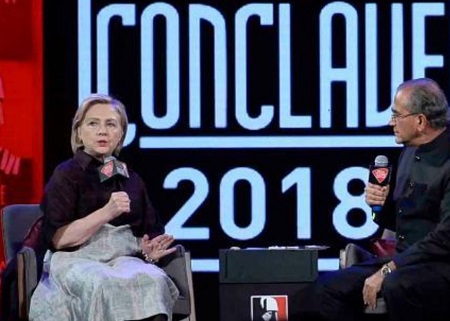
If you look at the map of the United States, there is all that red in the middle where Trump won. I won in the coasts, I win, you know, Illinois, Minnesota, places like that. But what the map doesn’t show you is that I won the places that represent two thirds of America’s gross domestic product. So I won the places that are optimistic, diverse, dynamic, moving forward, and his whole campaign, “make America great again,” was looking backwards. You know, “You didn’t like black people getting rights, you don’t like women getting jobs, you don’t want to see that Indian American succeeding more than you are. Whatever your problem is, I’m going to solve it.”


Bitter much, ma’am? Allahpundit points out that, during the same event in Mumbai, India, Hillary also recycled a claim she’s made before, namely that married women voted against her because of . . . well, patriarchy: “Part of that is an identification with the Republican Party, and a sort of ongoing pressure to vote the way that your husband, your boss, your son, whoever, believes you should.”


This is not an explanation, it’s an excuse. It is a refusal to accept failure, a selfish rationalization that allows Hillary (and other Democrats) to avoid admitting that their policy agenda isn’t popular. By the way, their policies weren’t popular during the eight years of Obama’s presidency, either; the difference was that Obama had a personal charisma that Hillary Clinton doesn’t have. Obama defeated John McCain and Mitt Romney largely on the basis of his own charisma, and also as a result of Bush-era GOP policy failures. What was Hillary’s selling point in 2016? First, that she was an experienced politician and, second, that she would continue the general direction of Obama-era policy. Trump offered voters an alternative, one untainted by association with Bush-style Republicanism, and this was enough to shift the balance in several states (including Pennsylvania and Michigan) long considered “safe” for Democrats.

In a way, however, Hillary is right. She was popular among voters in places that were “optimistic” and “moving forward” as a result of Obama-era policies intended to benefit certain people in certain places — which isn’t necessarily an argument in favor of those policies, especially if you did not benefit yourself. What did Hillary offer to working-class voters in Pennsylvania and Michigan, except a continuation of the same liberal policies that had resulted in their economic and social marginalization? For decades, going back at least as far as the early 1990s, these voters have felt neglected by the political elite, and they do not like being told that their problems are due to their being “backwards” and prejudiced.

If you habitually insult people — which is what Democrats have been doing to white voters in “all that red in the middle” for many years now — you should not be surprised when they vote against you. Elections have consequences, and Trump’s success in breaking the bipartisan elite’s stranglehold on federal policy could produce a decisive shift in American politics. If he fails, however, would it be fair for him to blame Democrat voters? Wouldn’t we laugh in scorn if Trump made such excuses?

Winners don’t need excuses. Victory is its own justification. Whatever criticism you might have of Nick Saban’s coaching strategies, you can’t deny that Alabama won the national championship, and whatever you say about Trump, he is the president, isn’t he?

Hillary travels to Mumbai, disparaging Trump voters — “all that red in the middle” of America — to the delight of her international audience. Let’s hope American voters never forget that insult.


Where Did Hillary Go Wrong?

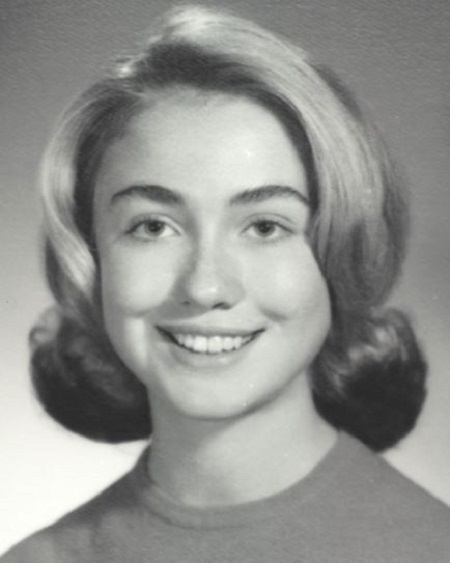
The lovely young Hillary Rodham, 1965.

This morning, the hosts of Fox & Friends were mocking the latest installment of Hillary Clinton’s “Excuse Tour,” as we might call her ongoing crusade to avoid responsibility for her own failures:

In an interview posted Wednesday with radio host Hugh Hewitt, Clinton bemoaned being seen as an extension of the Obama years.
“It is true that when you run to succeed a two-term president of your own party, you have a historical headwind blowing against you,” Clinton told Hewitt. “It’s not just this campaign can be set apart from everything that’s ever happened in our politics. It is a challenge.”
Clinton suggested her campaign suffered from mixed messaging.
“If you are both the candidate defending a lot of the areas of agreement, but also putting forth an agenda for change, which is what I tried to do, it is often difficult to get the second part of that message through.”
Not that she wanted to distance herself from Obama. “I was proud to serve in the Obama administration. I did not agree with everything that President Obama decided, but on balance, I really think he did what had to be done to rescue the economy, which as we all remember, was in desperate straits,” Clinton said.

This is not merely false, but delusional. In 1988, Vice President George H.W. Bush was running for Ronald Reagan’s “third term,” as it was commonly said at the time. The election that year was clearly a referendum on Reagan’s policies and, while Bush sought to distance himself somewhat from Reagan — famously promising a “kinder, gentler America” — the voters in 1988 had a clear choice: Continue the pro-business, pro-military, anti-Communist policies of Reaganism, or return to Jimmy Carterism, so to speak, in the person of Mike Dukakis.

Bush won in a landslide that year, 53% to 45%, with 426 Electoral College votes to 111 for Dukakis. This was not as impressive as Reagan’s historic landslide in 1984, yet it was still a solid victory — a wider margin than Obama won in his 2012 re-election, for example. What had happened during the 1980s was that Reagan had produced (or at least had capitalized on) a decisive shift in our nation’s’s politics. After the radical turmoil of the 1960s and the decade-long misery of the 1970s, a majority of the American electorate had rejected liberalism, and this was something that Arkansas Gov. Bill Clinton recognized.

As he prepared to campaign for president in 1992, Bill Clinton knew that he would have to present himself as a different kind of Democrat (unfortunately for Ricky Ray Rector). Clinton was himself a radical at heart, but he was also “an unusually good liar,” as Bob Kerrey observed.

The Clinton campaign of 1992 was one of the most dishonest in American history, and we are still reckoning with the consequences to this day. The media went all-in for Clinton (89% of D.C. journalists voted for him) that year, and the blatant partisanship of their pro-Clinton coverage gave Democrats the idea that they were on the verge of returning to Camelot. During the 1993 inauguration festivities, Democrats danced jubilantly to the tune of Fleetwood Mac’s “Don’t Stop Thinking About Tomorrow,” and had no idea of how soon a Republican tomorrow would arrive. In 1994, the GOP captured control of both houses of Congress for the first time in 40 years, a testimony both to the enduring strength of the Reagan coalition and to the failure of Clinton to understand why he had won in 1992. The voters had not rejected Reaganism, they had rejected Bushism, and these are two very different animals. Bush had been elected in 1988 in the expectation that he would “stay the course” of the Reagan years, yet in many ways he departed from that path. This opened the door for Clinton (assisted by the populist third-party challenge of Ross Perot), but the Democrats failed to understand what had happened in 1992, which set the stage for the “Republican Revolution” of 1994.

Before you plan for the future, you must first understand the past.

Our political leaders, in both parties, have failed to learn the lessons of history, and this is true of the American people in general. In a representative form of government, we get the kind of leaders we deserve, and when we behold the corrupt clown show in Washington, we must admit that it is a negative verdict on ourselves. “We the People” have failed, or else we would have better leaders, and it doesn’t matter whether you are a Republican or a Democrat. If you were a better citizen — if you were more respected, so that your opinions had more influence — you would be able to persuade your fellow citizens to vote for the candidates of your choice and, once they were in office, your elected representatives would pursue the policies you recommended.

The “Never Trump” Republicans and the Bernie Sanders Democrats, who could not win their own party primaries, merely prove the old Persian adage, “The dogs may bark, but the caravan moves on.”

So where did Hillary go wrong? I covered her on the campaign trail during the 2008 Democratic primaries, which she lost to Obama. When she spoke at Shepherdstown, West Virginia — where I had a pleasant conversation with her daughter Chelsea — I felt a certain sympathy for Mrs. Clinton. There I was, sitting on the grassy lawn of Shepherd College, scarcely 10 feet from the former First Lady, watching her being raked over the coals with hostile questions from the liberal D.C. press corps. After her defeat in the North Carolina primaries, the reporters kept asking, wasn’t it time for her to quit? Wasn’t it her duty as a Democrat to concede the race and urge her voters to support Obama?

Ah — live by the liberal media bias, die by the liberal media bias!

That’s one of the great ironies of American politics. Because the vast majority of journalists are liberals, Democrats live inside a “bubble” of favorable media propaganda, an echo chamber within which they never have to wonder if maybe their ideas are fundamentally wrong. It is quite difficult for any Republican to be as deluded by ideological hubris to such an extent as Democrats so often are. Every GOP politician is hounded by liberal reporters who are as much a part of the Democrat Party campaign operation as any paid DNC operative. To get elected as a Republican is to paint a target on your back, as far as the press corps is concerned, and there is always a swarm of penny-ante “progressive” bloggers who fancy themselves to be latter-day Woodards and Bernsteins, ready to expose the scandal that will destroy a GOP politician’s career.

Somehow, Donald Trump figured out a way to defeat the media. Whether you are pro-Trump or anti-Trump, you have to admit that the man is a master of jiu-jitsu tactics, defeating the liberal media elite by attacking them directly, taunting them and laughing at their impotence.

So, I ask again, where did Hillary go wrong? Responding to a comment on an earlier post, I offered this historic perspective:

It is important to remember that she came from a prosperous Republican family. Her father was a successful businessman and in 1964, young Hillary Rodham was a “Goldwater Girl.” Unfortunately, she was also a Methodist, and came under the influence of a church youth leader with a “social justice” outlook. She was swept along in the general leftward drift of the Methodist Church (like all WCC denominations) and also internalized the generational narcissism of the Baby Boomers.
Bright young people in the 1950s and ’60s were repeatedly told that their generation were the future leaders of America. Their heads were filled with a lot of slogans about “democracy,” “freedom” and “equality” and they weren’t taught much about skepticism and humility. It would have been better for them if they had been given more good old-fashioned Calvinism, but instead their education turned them into fools, ready to believe in a lot of utopian dreams. In a society where liberalism prevails among the academic elite, the more education you get, the more of a hopeless fool you become. By the time she went off to Wellesley, Hillary was already on the wrong path, and no one she encountered at college, or later at Yale Law, did anything to correct her path.

That’s the real problem. Hillary made a left turn in the late 1960s, and never thereafter reconsidered her devotion to the Democrat Party. At the time she drifted into student radicalism, of course, many other young people were doing the same. She followed the herd, with the ambition of becoming a leader of the herd, and failed to anticipate — even as a shadow of a doubt — that history might turn in the other direction.

“Don’t Stop Thinking About Tomorrow,” but yesterday is never really gone. The past always offers lessons for the future. And young people who fail to study history will eventually regret neglecting these lessons.



Sex, Power, Weakness and Evil

“I would be happy to give [Bill Clinton] a blowjob just to thank him for keeping abortion legal. I think American women should be lining up with their Presidential kneepads on to show their gratitude for keeping the theocracy off our backs.”
— Nina Burleigh, 1998

“Feminists keep trying to explain Weinstein in terms of power — he is the ‘patriarchy’ or whatever — but what this sordid scandal reveals is his weakness.”
— Robert Stacy McCain, Nov. 21, 2017

When did the shift happen? Reading about the Sexual Harassment Apocalypse now destroying so many powerful men — Rep. John Conyers (D-Mich.) is the latest big name to be exposed — I keep returning to the question: “How did we get here?” The most obvious catalyst for this bonfire of feminist rage is the election of Donald Trump. So many feminists had gone “all-in” for Hillary Clinton last year, and believed that the Access Hollywood tape would prove fatal to Trump’s campaign, that the results of Nov. 8 inflicted an emotional trauma. As they worked through their feelings, they realized that a major cause of their defeat was the compromises they had made for the sake of Democrat Party coalition politics. One obvious reason Hillary lost was that her defense of Bill’s predatory sexual behavior exposed her as an untrustworthy hypocrite.

Yet the roots of this problem go back farther than the Lewinsky scandal. In 1969, Ted Kennedy left a woman to die in the back of a submerged Oldsmobile, but because he was a powerful Democrat, he was able to avoid vehicular manslaughter charges, retain his Senate seat and was even celebrated with a heroic defender of “women’s rights.” Guy Benson pointed out that a video tribute to Kennedy was shown at the 2012 Democratic National Convention and when Katie Pavlich objected to this during a CNN panel discussion, she was scolded for having the bad taste to mention that Ted Kennedy once killed a woman.

Ted Kennedy was a weakling, a specimen of moral cowardice. An alcoholic and a womanizer, Kennedy and his Senate colleague Chris Dodd once infamously made a “waitress sandwich” at a D.C. restaurant.

Likewise, Bill Clinton is an infamous weakling, unable to control his sexual appetites, and too foolish to avoid temptation. When Monica Lewinsky flashed her thong underwear at him, what did Bill do? If you’re the President of the United States, you have the power to enforce decorum in the workplace, to require the White House staff to comport themselves respectfully. Rather than to suppress Lewinsky’s lewd behavior, instead Clinton began pursuing sexual encounters with this emotionally unstable woman less than half his age. His misconduct (and hers) eventually came to light because one of his previous victims, Paula Jones, filed a federal civil rights lawsuit against Clinton. Jones’s lawyers learned of the Lewinsky affair, questioned Clinton about it during a sworn deposition, and he perjured himself by denying it. Clinton furthermore arguably obstructed justice by arranging to get Lewinsky out of Washington (getting her a job with Revlon, whose CEO was a major Democrat donor) and having his attorney Vernon Jordan get Lewinsky to sign a false affidavit denying her affair with Clinton.

In other words, Clinton used his political power to conceal his personal weakness and, in doing so, committed impeachable offenses.

“And lead us not into temptation, but deliver us from evil,” Jesus taught His disciples to pray. Knowing our own weakness — “For all have sinned and come short of the glory of God” — Christians ought to be humble, and to fear any situation that might tempt us to sin. Are you a stronger or more virtuous man than Bill Clinton? You ought to hesitate before answering “yes,” lest the Devil decide to prove you wrong.

Mike Pence has been derided by liberals for his “open door” rule, refusing ever to meet alone with a woman other than his wife, but the wisdom of his policy is revealed every time we see a new headline about the wicked behavior of men like Harvey Weinstein, Brett Rattner, Al Franken, Glenn Thrush, Louis C.K., James Toback, Kevin Spacey, Charlie Rose, Michael Oreskes, John Lasseter, Mark Halperin, on and on and on.

There is no doubt that the Sexual Harassment Apocalypse will also destroy some Republicans — new allegations against Roy Moore seem to emerge every day — but on balance, these exposures mainly involve liberal men in politics, journalism and Hollywood. This is deeply ironic, of course, because Democrats campaigned in 2012 on the claim that there was a Republican “War on Women,” Hillary Clinton made feminist “empowerment” a major theme of her campaign in 2016, and it was only because Hillary lost that we have now entered this climate where feminists are willing to pour gasoline all over the machinery of male Democrat power, strike a match and burn it to the ground.

You can thank the 63 million Trump voters for this “empowerment.”

Power is beneficial when used to protect the weak and helpless, but wicked people who seek power for selfish reasons will often use dishonest claims of humanitarian intentions to mask their selfishness. Only a fool could be deceived by an argument like “Vote Democrat, Because Social Justice,” yet millions of Americans are such fools. (Hillary could have called her book It Takes a Village of Idiots to Elect a Clinton.) What liberals do, in making these pseudo-humanitarian appeals, is to drape themselves in a costume of secondhand victimhood: “Elect me,” the powerful multimillionaire Hillary Clinton essentially said, “because these other women are raped and discriminated against.”

This identity-politics argument is always false: Did Stalin’s power benefit the peasants of Russia? Did Hitler’s power benefit the average German? Did the typical citizen of Arkansas benefit from Bill Clinton’s presidency? Are black people better off because John Conyers is in Congress?

Identity politics dishonestly tells us that we are “empowered” if the person in the White House is a member of own own particular tribe. There are still millions of Irish Catholics who still vote Democrat because their Irish ancestors were Democrats and John Kennedy was a Catholic. And I was a partisan Democrat, maintaining that allegiance until I was in my mid-30s, for quite similar reasons of ancestral loyalty. There used to be fewer Republicans in the South than there are in Detroit today, and if black people ever figure out that they’re being scammed (the same way white Southerners were scammed by Democrats), this might bring about a cataclysmic political shift in American politics.

What about women? For many decades, Democrats have been the party of abortion, claiming that abortion is a synonym for “women’s rights.” And guess what? Wicked men eagerly agree with that claim.

Never forget: The Clintons and Harvey Weinstein are pro-abortion, and this was all that was necessary to make them acceptable to feminists who support the Democrat Party for that reason, and that reason only. Feminists will tolerate anything, so long as you’re pro-abortion:

Feminism is a movement devoted to destroying the family. Feminist theory condemns marriage and motherhood as institutions of “male domination,” which is why taxpayer funding for Planned Parenthood is sacred to feminists: The road to “equality” is paved with dead babies.

Abortion is wrong, and its supporters are evil. Bad people do bad things, and it is not really surprising that Harvey Weinstein is a monster.

Now these monsters are being hunted down by their former feminist “allies,” and all the power and money in the world cannot save them.

Karma is a bitch, they say. And what a deeply ironic bitch she is.

UPDATE: Welcome, Instapundit readers!


Hiroshima for the DNC: @DonnaBrazile Devastates Democrat Corruption


Democrats don’t just deceive, cheat and swindle the voters and taxpayers, they also deceive, cheat and swindle each other:

My predecessor [as chairwoman of the Democratic National Committee], Florida Rep. Debbie Wasserman Schultz, had not been the most active chair in fundraising at a time when President Barack Obama’s neglect had left the party in significant debt. As Hillary’s campaign gained momentum, she resolved the party’s debt and put it on a starvation diet. It had become dependent on her campaign for survival, for which she expected to wield control of its operations.
Debbie was not a good manager. She hadn’t been very interested in controlling the party — she let Clinton’s headquarters in Brooklyn do as it desired so she didn’t have to inform the party officers how bad the situation was. . . .
The Saturday morning after the convention in July, I called Gary Gensler, the chief financial officer of Hillary’s campaign. He wasted no words. He told me the Democratic Party was broke and $2 million in debt. . . .
Officials from Hillary’s campaign had taken a look at the DNC’s books. Obama left the party $24 million in debt — $15 million in bank debt and more than $8 million owed to vendors after the 2012 campaign — and had been paying that off very slowly. Obama’s campaign was not scheduled to pay it off until 2016. Hillary for America (the campaign) and the Hillary Victory Fund (its joint fundraising vehicle with the DNC) had taken care of 80 percent of the remaining debt in 2016, about $10 million, and had placed the party on an allowance. . . .

There’s a lot more where that came from. This is devastating beyond words. Everybody’s talking about how Brazile has confirmed the suspicion of Bernie Sanders that the Democrat primary process was basically rigged for Hillary, but the larger revelations are even worse:

  1. Democrats have been squandering their donors’ money in much the same way they routinely squander taxpayers’ money;
  2. The triumph of Obama’s two-term presidency, which should have yielded a fund-raising windfall for the DNC, instead left the party more than $20 million in debt;
    and
  3. The DNC’s indebtedness was exploited by the Clinton campaign to defraud Democrat primary voters.

It was this perception of a rigged nomination process that made Trump’s “Crooked Hillary” charge resonate with working-class voters in states like Pennsylvania and Michigan. And so the corruption of the Democrat Party — profligate spending, irresponsible management and insider favoritism at DNC headquarters — was a major cause of their devastating defeat last year. These revelations confirm the suspicions that a lot of grassroots Democrats have had all along, and will make the party’s recovery a very difficult prospect. If an appealing left-wing third-party candidate emerges before 2020, that might be R.I.P. for Democrats.


The Harvey Weinstein Democrat Bonfire


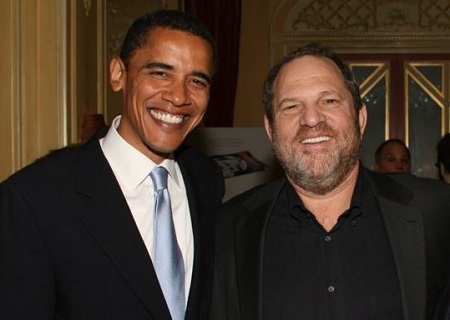
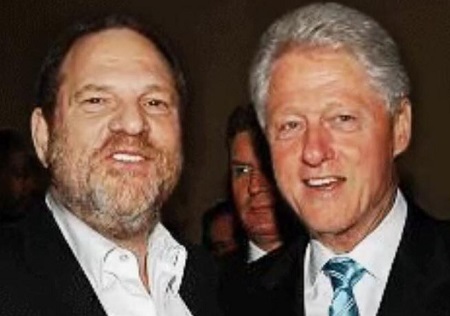
Just five months ago, Harvey Weinstein was hanging out with Hillary Clinton at Planned Parenthood’s 100th anniversary gala:

At the celebration, Planned Parenthood awarded former Democratic presidential candidate Hillary Clinton the Champion of the Century Award. According to The Hollywood Reporter, Weinstein gave Clinton a standing ovation at the event where she insisted on the “morality” of “reproductive health care” (aka abortion) and stressed “trusting and valuing women.” . . .
According to Artnet editor Sarah Cascone, Weinstein also purchased artwork by British painter Cecily Brown at a charity auction at the gala for $100,000. . . .
According to Planned Parenthood’s most recently published annual report, the organization performed 328,348 abortions and received $554.6 million in “government health services grants and reimbursements” for the year 2015-2016.

Democrats loved Harvey Weinstein, until they hated him:

Hillary Clinton on Tuesday said she was “shocked and appalled” in the wake of sexual harassment allegations against Hollywood mogul Harvey Weinstein, speaking publicly for the first time about the longtime Democratic donor five days after it first emerged that multiple women had accused him of harassment over the course of decades.
“I was shocked and appalled by the revelations about Harvey Weinstein,” Clinton said in a statement. “Their courage and support of others is critical in helping to stop this kind of behavior.”
A high-profile donor in the Democratic Party, Weinstein has contributed more $20,000 to Clinton’s campaigns since she ran for U.S. Senate in New York in 1999, according to the Center for Responsive Politics.


Weinstein has given an estimated $2 million to Democrats over the past 25 years, but his money won’t help him anymore:

Last week, the New York Times, in a powerful report by Jodi Kantor and Megan Twohey, revealed multiple allegations of sexual harassment against Weinstein, a story that led to the resignation of four members of his company’s all-male board, and to Weinstein’s firing from the company.
The story, however, is more complex, and there is more to know and to understand. In the course of a ten-month investigation, I was told by thirteen women that, between the nineteen-nineties and 2015, Weinstein sexually harassed or assaulted them, allegations that corroborate and overlap with the Times’ revelations, and also include far more serious claims.
Three women — among them [actress Asia] Argento and a former aspiring actress named Lucia Evans — told me that Weinstein raped them, allegations that include Weinstein forcibly performing or receiving oral sex and forcing vaginal sex. Four women said that they experienced unwanted touching that could be classified as an assault. In an audio recording captured during a New York Police Department sting operation in 2015 and made public here for the first time, Weinstein admits to groping a Filipina-Italian model named Ambra Battilana Gutierrez, describing it as behavior he is “used to.” Four of the women I interviewed cited encounters in which Weinstein exposed himself or masturbated in front of them.

But wait — there’s more!

When Gwyneth Paltrow was 22 years old, she got a role that would take her from actress to star: The film producer Harvey Weinstein hired her for the lead in the Jane Austen adaptation “Emma.” Before shooting began, he summoned her to his suite at the Peninsula Beverly Hills hotel for a work meeting that began uneventfully.
It ended with Mr. Weinstein placing his hands on her and suggesting they head to the bedroom for massages, she said. . . .
Rosanna Arquette, a star of “Pulp Fiction,” has a similar account of Mr. Weinstein’s behavior, as does Judith Godrèche, a leading French actress. So does Angelina Jolie, who said that during the release of “Playing by Heart” in the late 1990s, he made unwanted advances on her in a hotel room, which she rejected.

Are there any women in Hollywood that Harvey Weinstein didn’t harass? But never mind, liberals are shocked, shocked:

Academy Award winner George Clooney, who was given his first major big-screen role by Harvey Weinstein, has become the latest — and most high-profile — member of Hollywood to speak out on the alleged sexual-misconduct allegations against his sometime employer.
“It’s indefensible. That’s the only word you can start with,” he says. “Harvey’s admitted to it, and it’s indefensible. I’ve known Harvey for 20 years. He gave me my first big break as an actor in films on From Dusk Till Dawn, he gave me my first big break as a director with Confessions of a Dangerous Mind. We’ve had dinners, we’ve been on location together, we’ve had arguments. But I can tell you that I’ve never seen any of this behavior — ever.” . . .
Weinstein, the former co-chief of Miramax, has since been fired from The Weinstein Company—which he co-founded with his brother Bob—and many of the male actors and filmmakers in particular who have benefited from the studio executive’s Oscar Midas touch, from Matt Damon and Ben Affleck (Good Will Hunting) to Quentin Tarantino (Pulp Fiction), have remained alarmingly silent.

“Alarmingly silent.”


PREVIOUSLY:


Hillary’s Delusional Reading of Classics


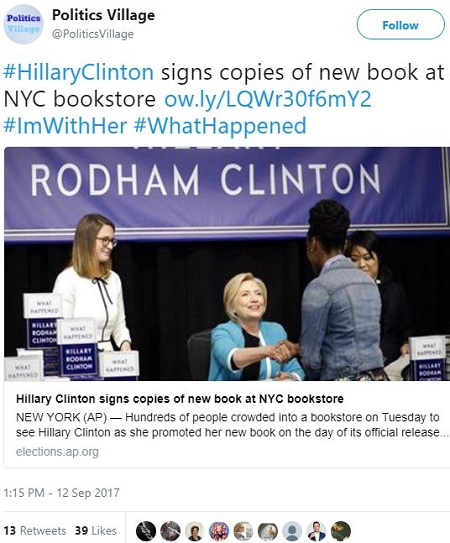
Everyone is stunned by the self-deceptions and blame-shifting in Hillary Clinton’s campaign memoir What Happened, and Ace of Spades aggregates several of the most mind-blowing excerpts.

Most notably, as British socialist writer James Heartfield observes, Hillary claims that George Orwell’s Nineteen Eighty-Four is about the importance of trusting “our leaders, the press, experts” — a 180-degree reversal of Orwell’s actual meaning. A free society requires a citizenry distrustful of power, and not predisposed to accept whatever beliefs officially-approved “experts” advocate. Independent minds must be skeptical, for example, of the suggestion that we should reorganize our healthcare system according to what “leaders” and “experts” tell us.

Only her arrogance — imagining herself as the expert leader who deserves our unquestioning trust — could lead Hillary to reverse the lesson of a classic anti-totalitarian novel like Nineteen Eighty-Four.

However, Hillary also misinterprets Eric Hoffer’s 1951 classic The True Believer: Thoughts on the Nature of Mass Movements. This is a book that I have repeatedly recommended as a guide to understanding the kind of people who are attracted to radical ideologies like feminism:

. . . especially Part 2 (“Potential Converts”) and sections IV (“The Role of the Undesirables in Human Affairs”) and VI (“Misfits”). What Hoffer writes about the influence of “the inferior elements in a nation” (p. 24) and the “incurably frustrated” who have “an unfulfilled craving for creative work” (p 47) applies to many of the angry young men and unhappy young women who rush to join the mob of disgruntled “progressives.”

Being familiar with Hoffer’s ideas — The True Believer is sitting on my desk even now — it was mind-boggling to read Hillary’s warped view:

During the campaign, Bill and I both went back and reread The True Believer, Eric Hoffer’s 1951 explanation of the psychology behind fanaticism and mass movements, and I shared it with my senior staff. On the campaign trail, I offered ideas that I believed would address many of the underlying causes of discontent and help make life better for all Americans. But I couldn’t — and wouldn’t — compete to stoke people’s rage and resentment. I think that’s dangerous. It helps leaders who want to take advantage of that rage to hurt people rather than help them. Besides, it’s just not how I’m wired.

Really? A campaign that denounced Republican voters as “deplorables,” led by a candidate who promised among other things to destroy the jobs of coal miners (helping “make life better,” you see), who irresponsibly incited a phony campus “rape culture” hysteria and endorsed the racial violence of “Black Lives Matters,” was not about stoking rage?

It is easy to condemn the populism of Donald Trump (or Bernie Sanders) as a demagogic appeal to ressentiment, but populism flourishes only because elites are out of touch with the needs and interests of ordinary Americans. This is true in both Democrat and Republican parties, but because the educational system and the news media are both controlled by Democrat partisans, it is possible for someone like Hillary Clinton to exist within a liberal bubble where the grievances expressed by the populist Left seem legitimate in a way that the grievances of the populist Right do not. When she was sharing Eric Hoffer’s book “with my senior staff,” did Hillary ever suggest that its critique of fanaticism applied to them or to her own supporters? Isn’t it true that Hillary had her own True Believers, and that the Clinton campaign sought to harness the mentality of a “mass movement” — #ImWithHer — to win the election?

“Inside a cult, the only people who matter are Us, and your identity as one of Us requires you to buy into whatever ideology defines the cult. If you are not willing to constantly prove your loyalty to Us, you might be exiled and ostracized from the cult, becoming one of Them — and this, to the cult member, is a fate worse than death.”
— Robert Stacy McCain, May 19, 2016

There was always a creepy totalitarian vibe surrounding the Hillary campaign, including a paranoid mentality that has expressed itself, since the election, as a search for scapegoats (“Bernie bros”) and conspiracies (Russian hackers) to explain how it was that The Maximum Leader was wrongly deprived of the victory she deserved. Indeed, one could invoke the works of Orwell and Hoffer to analyze the 2016 campaign, but the lessons are not flattering to Hillary. “SJWs Always Project,” as Vox Day says, and Hillary’s psychological projections are illustrative of What Happened, and more importantly Why It Happened.


How Bad Was the Hillary Campaign?


Matt Taibbi is certainly not my favorite political journalist, and Rolling Stone was permanently disgraced by the UVA hoax, but nevertheless Taibbi’s brief review of the new Clinton campaign book, Shattered by Jonathan Allen and Amie Parnes, is very worthwhile reading. After recounting the comedic failure of Clinton insiders to figure out their campaign’s raison d’etre — why did Hillary want to be president? — Taibbi summarizes the problem briefly and accurately:

What Allen and Parnes captured in Shattered was a far more revealing portrait of the Democratic Party intelligentsia than, say, the WikiLeaks dumps. And while the book is profoundly unflattering to Hillary Clinton, the problem it describes really has nothing to do with Secretary Clinton.
The real protagonist of this book is a Washington political establishment that has lost the ability to explain itself or its motives to people outside the Beltway.

What is true of the “Washington political establishment” in the Democrat Party is similarly true for Republicans. There is a yawning chasm of misunderstanding between the voters and people who make their careers in politics, and Taibbi doesn’t want to admit that he and his employer are part of the problem. That is to say, the liberal bias of the media creates such a huge advantage for Democrats, easily worth 5% of the vote in national elections, as to create a sort of cushion against reality. Meanwhile, Republicans in Washington are apt to succumb to “Potomac fever,” betraying their conservative voters in pursuit of a “centrist” or “mainstream” image, which leads them into debacles like the “Gang of Eight” immigration plan. Journalists contribute to this problem — call it The Reality Gap — with reporting so one-sided as to be dishonest.

Is Matt Taibbi willing to admit that Rolling Stone published that UVA rape hoax story for partisan purposes? Isn’t it true that the “campus rape epidemic” hysteria of 2014 was part of a Clinton-friendly propaganda blitz to make feminism a central focus of the 2016 campaign? And isn’t it also true that the Black Lives Matter movement was similarly a Democrat Party propaganda operation intended to mobilize black voters?

Liberal journalists devote enormous effort to promoting narratives that portray Democrat Party core constituencies — women, racial minorities, gay people — as victims of systematic injustice, while demonizing Republicans as racist, sexist, homophobic villains. The media become so entranced by this victimhood narrative that, like the Clinton campaign insiders, they are stunned to discover American voters aren’t buying it.

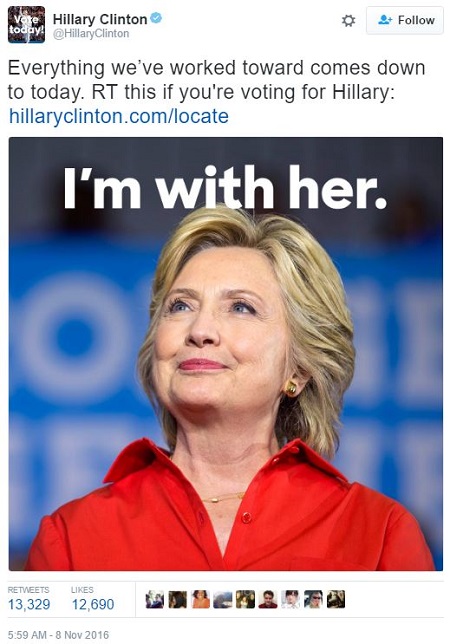
This was the entirety of Hillary’s campaign logic — (a) she’s a woman, (b) women are victims, and therefore, (c) vote Democrat: “I’m With Her.”


If that’s the only argument you’ve got, you deserve to lose. And anyone who thinks Bernie Sanders would have done better is insane. Our national debt is now nearly $20 trillion — that’s trillion, with a “T,” $20,000,000,000,000 — and we cannot afford to pay for the massive federal welfare state we’ve already got, much less the outright socialism that the Bernie voters want. Go take a look at the disaster in Venezuela, if you want to see where the Bernie Sanders agenda leads. Unless and until Democrats are willing to confront the reality of socialism’s failure, and abandon the divisive Cultural Marxism of identity politics, they will continue to alienate the ordinary American voter.


The Kaiser and the Clintonistas


“Those who cannot remember the past are condemned to repeat it,” George Santayana remarked, and young people today know so little about the past that they are well and truly doomed. The teaching of history has been replaced by indoctrination for progressive activism, as Jane Shaw has recently explained, which means that the more “educated” a young person is, the less they are likely to know about the past. There are patterns in history, and the more we study history, the more easily we recognize the repetition of these patterns. In the last couple of weeks, my bedtime reading has been Martin Gilbert’s history of the First World War, a book I’ve already read twice, but one thing about good books is that you can enjoy re-reading them at intervals of five or 10 years.

At any rate, while re-reading Gilbert’s book, I took note of a certain pattern that some people with bad memories are condemned to repeat:

Few things are more likely to precede defeat than the conviction that you are on the verge of victory. One hundred years ago, in the spring of 1917, Germany had every reason to believe that it would triumph over its enemies in the First World War. France had been bled white in repeated attacks on the German army’s fortified lines, England was suffering from shortages of both munitions and military manpower, and Russia was descending into a revolution that would, within a year, enable Germany and its Austro-Hungarian allies to shift enormous numbers of troops and guns to the Western Front. Yet the entry of the United States into the war on April 6, 1917, proved to be the counterweight that shifted the balance. By the autumn of 1918, the fond hope of Germany victory had been exposed as a delusion. The ultimate result of the Kaiser’s war was the destruction of the Kaiser’s empire, and of much else besides.
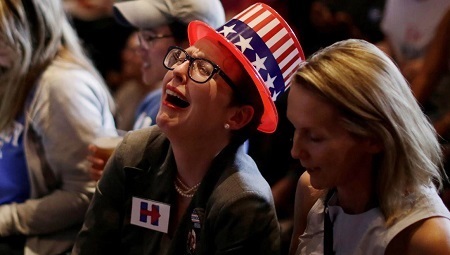
What is true in war is true also in politics. Hubris is nearly always the precedent to unexpected defeat. In 1964, Lyndon Johnson won a landslide victory; less than four years later, LBJ could not even win his own party’s nomination for re-election. In 1972, Richard Nixon was re-elected in a landslide; less than two years later, he was forced to resign from office. More recently, after George W. Bush’s 2004 re-election, some imagined that this victory was the harbinger of a “permanent Republican majority” — a GOP electoral hegemony based on a so-called “center-right” realignment — but two years later, Democrats captured control of Congress and in 2008 Barack Obama was elected president. Obama’s success in turn led Democrats to become overconfident, and Hillary Clinton’s supporters believed they were “on the right side of history,” as rock singer Bruce Springsteen told a rally in Philadelphia on the eve of the 2016 election. Unfortunately for Democrats, history disagreed. . . .

Read the whole thing at The American Spectator.