Ben Hill and the New South


As a boy growing up in Douglas County, Georgia, I did not realize that Ben Hill Road, which ran by our family’s house, was named for a historic figure. Benjamin Harvey Hill was a brilliant statesman, hailed as a “peerless orator,” who was so widely admired in Georgia that, although he had eloquently spoken in opposition secession in the crisis of 1860-61, he was nevertheless elected to the Confederate Senate. After the war, he spoke out against radical Reconstruction, and was subsequently elected first to the U.S. House and then to the Senate.

Of all he accomplished in his long career, however, perhaps Ben Hill’s most lasting achievement was his role in inspiring the New South. In a commencement speech at the University of Georgia in 1871, Hill bemoaned the lack of industrial development in the state, and encouraged Georgians to embark on a program to educate their sons to undertake this work. The question, Hill said, was not whether the abundant resources of the South would be developed, but instead by whom these resources would be developed. Would this work be done (and the rewards be reaped) by Georgians, or would her native sons be replaced by others who were more willing and able to take up the mechanical and commercial trades necessary to industrial development?

We must establish schools of science and educate our children. Others will come in and supplant us, and we shall perish truly from slavery. Our own sons must be taught to build and operate all machinery. We must build up schools of science. Our duty towards the negro is plain — we must educate and elevate him.
We must have educated labor, acquire a knowledge of mining operations, and skill in the manipulation of all metals . . . and the prosecution of every craft that will tend to contribute to the material interests of the country, or to develop its wonderful resources. Our children must take the lead and point the way.

This speech proved a pivotal turn in Georgia’s history, because one of those who heard Ben Hill speak that day was a young alumnus of the university named Henry Grady, who as a journalist became the most famous proponent of the “New South.” Grady made his case to the North, urging Yankees to invest in Southern industries, and the result was that soon every good-sized town in the South had a textile mill, and a pro-business attitude came to define the region’s leading cities, most particularly my hometown of Atlanta. My father, who grew up on a farm in Alabama, left home at 16 to work in a textile mill in West Point, Georgia, then after the war attended the University of Alabama on the G.I. Bill. After graduation, he moved to Atlanta, where he first worked a year for the Southern Railroad before hiring on at the Lockheed Aircraft plant in Marietta, where he worked the next 37 years. Growing up in the suburbs of Atlanta, I witnessed the booming prosperity of “The City Too Busy to Hate,” and as a young journalist saw how communities competed to attract business and encourage economic growth. And what remarkable success! In 1970, when I was in fifth grade, the population of Georgia was 4.6 million; by 2010, the population was 9.7 million — more than doubled. By comparison, during the same 40-year span when Georgia’s population increased by more than 5 million (110% growth), the state of New York’s population increased by just 1.1. million (6%). The result has been that Georgia has increased its influence in national affairs, while New York has waned. Whereas in the 1940s, New York had 45 House seats and Georgia had 10, now New York’s representation has dwindled to 27 House seats, while Georgia has increased to 14.

This historical background is necessary to understanding my indignation at a Yankee journalist’s recent display of ignorance. Ginia Bellafante of the New York Times wrote an article with the headline “Abortion and the Future of the New South,” implying that the recent passage of legislation restricting abortion in Alabama, Georgia and other states was somehow a threat to the region’s progress. The problem, of course, is that Ms. Bellafante considers liberalism as a synonym for progress, and misinterprets contrary evidence:

At the end of last year, LinkedIn, which regularly mines its database of 150 million worker profiles to analyze patterns in American employment and migration, reported that Atlanta had received more workers from New York City than any other place in the country during the preceding 12 months. That development has continued for most of this year.

Ms. Bellafante cites this data after invoking “the system of afflictions that places like New York and San Francisco impose on their young” — i.e., the heavily regulated social-welfare nightmares that degrade the quality of life. It does not seem to occur to her that this “system of afflictions” is yoked to the pro-abortion politics of the Left, for in turning their cities into places where no sane person would want to raise a child, Democrats thereby incentivize abortion. Rod Dreher has taken Ms. Bellafante to the woodshed, but I thought it important to point out how her concept of the New South was at odds with its historic origins. Certainly, we cannot imagine Ben Hill advocating abortion, because his vision of the New South was rooted in a spirit of pragmatic optimism, a hopeful promise that Southerners could adapt to the challenges of an industrial future, so that their descendants might inherit a better life. The advocates of abortion, by contrast, are possessed by an evil spirit, telling young women that there is no such hope for the future, that children are a curse, and that the life of their offspring is without value.

Not only Southerners, but all Americans with a sense of pride in our nation’s history, must reject these wicked voices of the Culture of Death.

If the godless liberals of New York wish to abort themselves into oblivion, I am powerless to stop them, but I hope Southerners will not be persuaded to follow the foolish example of Yankees. The future belongs to those who show up for it, as Mark Stein has observed. Let us do all we can to make America great again for our descendants. Selah.

(Hat-tip: Ed Driscoll at Instapundit.)


The Belated Admission of Media Error


One of the things about media malpractice is, you may not notice it until the media begin reporting on a subject with which you are directly familiar. Like, have you ever seen a Nick Saban press conference? He obviously hates the media, because nobody knows Alabama football better than the coach, and their “spin” annoys him. If media bias is a problem in sports coverage — and you can ask Coach Nick about it — how much more of a problem is it in political journalism?

Another thing about media malpractice is that, by the time they admit they got the story wrong, the correction gets less coverage than their original error, and sometimes people’s lives can be wrecked by a published falsehood long before the media says, “Oops.”

Consider the case of President Trump and “Russian collusion.” Professor Glenn Reynolds reminds us that this entire narrative started with Hillary Clinton’s campaign team — specifically Robbie Mook and John Podesta — deciding immediately after her 2016 defeat “to engineer the case that the election wasn’t entirely on the up-and-up . . . Russian hacking was the centerpiece of the argument.” The hacking of Democrat emails was actually a crime for which Robert Mueller has indicted Russian military intelligence officers but (a) those emails didn’t make a decisive impact on the 2016 campaign and (b) Trump was not responsible for it. However, the media’s amplification and repetition of this simple message — “Russia stole the election” — eventually inspired the (completely unsubstantiated) suggestion that the reason Trump fired FBI Director James Comey in May 2017 was to prevent Comey from uncovering “collusion” between Russia and the Trump campaign, a suggestion that in turn led to the appointment of Mueller as special counsel. And it took nearly two years for Mueller to admit what Trump has said all along — there was no “collusion” at all. However, the media outlets that promoted the Clinton campaign’s phony Russia-stole-the-election message are now trying to spin this revelation in such a way as to conceal their role in a damaging political propaganda campaign against the President.

Now that Mueller has finished his investigation and filed his report, the New York Times is finally admitting what every Fox News viewer has known for more than a year: The Steele dossier, commissioned by the Clinton campaign and used to justify federal surveillance of the Trump campaign, was a pack of lies based on dubious Russian sources:

[T]he most sensational claims in the dossier appeared to be false, and others were impossible to prove. Mr. Mueller’s report contained over a dozen passing references to the document’s claims but no overall assessment of why so much did not check out. . . .
How the dossier ended up loaded with dubious or exaggerated details remains uncertain, but the document may be the result of a high-stakes game of telephone, in which rumors and hearsay were passed from source to source.
Another possibility — one that Mr. Steele has not ruled out — could be Russian disinformation. That would mean that in addition to carrying out an effective attack on the Clinton campaign, Russian spymasters hedged their bets and placed a few land mines under Mr. Trump’s presidency as well.

Oh, isn’t that convenient? Now that the Trump presidency has spent 22 months under the shadow of Mueller’s investigation, and after many of the president’s associates have been prosecuted on various grounds having nothing to do with Russia, the New York Times decides it’s OK to admit that the Steele dossier — the original pretext of this whole “Russian collusion” hoax — was a pile of bogus smears, possibly including disinformation from the Kremlin! This might be news to the Times readership, even though the truth about the Steele dossier been reported five nights a week, month after month, on Sean Hannity’s show.

Since I’m playing ombudsman here, allow me to enumerate the possible reasons for suspicion of “Russian collusion”:

  1. Trump’s business ties to Russia — Trump’s real-estate empire is heavily leveraged, and some of his debt is owed (mostly via German banks) to Russian investors.
  2. Trump’s “nationalism” — In contrast to the D.C. political elite in both parties, Trump is skeptical of the “globalization” consensus that has prevailed since the end of the Cold War. Trump isn’t inclined to defer to the Brussels-based European Union leadership, and seems to believe our NATO allies are not as friendly as they should be. Trump’s skepticism toward the EU and the whole “globalization” narrative makes him more sympathetic to the argument that Russia is suffering unfairly from Europe’s anti-Russian policies left over from the Cold War.
  3. Roger Stone’s fingerprints on the Wikileaks release of Democrat emails — According to Mueller’s indictment, the hacker “Guccifer 2.0” was an operative of Russian military intelligence. Stone, a notorious practitioner of political dirty tricks, was deeply interested in this, and reportedly had advance knowledge of Wikileaks obtaining the hacked emails.
  4. The Trump Tower meeting — In June 2016, “three senior members of the 2016 Trump campaign – Donald Trump Jr., Jared Kushner, and Paul Manafort — [met with] at least five other people, including Russian lawyer Natalia Veselnitskaya,” who had promised to provide “dirt” on Hillary Clinton. However, there is evidence to suggest that this was a Clinton campaign dirty trick orchestrated by Fusion GPS, using Veselnitskaya as bait to compromise the Trump campaign.

All of this can be admitted as giving credence to suspicion that there was something going on between Trump and the Russians, but suspicion is not proof, and all of this can be defended or explained as innocent. What happened instead was that a lot of the media (especially including CNN, MSNBC, the Washington Post and the New York Times) let themselves become a conduit for the Clinton campaign’s post-election “spin” operation, depicting Trump’s presidency as illegitimate and corrupt because the election had been wrongly “stolen” with Russian assistance.

Why did the New York Times wait this long to admit that the Steele dossier was a tainted source? Because to have examined this subject earlier would have undermined Team Clinton’s narrative, which was the underlying pretext of the Mueller investigation. Now that Trump has officially been cleared of “collusion,” it is OK for the media to admit the Steele dossier was a pile of garbage, because it has already served its purpose, i.e., to damage Trump by justifying the investigation.

You see, however, that this admission by the New York Times is too late to undo the harm inflicted by the months of their dishonest reporting which ignored or downplayed the problems with the “Russian collusion” narrative. It’s sort of like the way the New York Times was happy to collect a Pulitzer for Walter Duranty’s dishonest reporting about Stalin’s Soviet regime, and then wait decades before admitting Duranty got it wrong. As long as the Soviet Union was an ongoing enterprise, the New York Times couldn’t admit the truth about how they had published Stalinist propaganda as “journalism,” but once the Berlin Wall fell and the Cold War ended: “Oops.” That they were so wrong, for so long, about some of the greatest atrocities in human history — the terror-famine in Ukraine, and Stalin’s bloody purges — ought to have forever destroyed the credibility of the New York Times, but some people keep believing them anyway. Because some people are idiots.


How Anti-Christian Bias in #FakeNews Media Is Encouraging Anti-Semitism


This is a topic I am reluctant to write about, but in the wake of the Covington Catholic school story, the elephant in the room is now so large that it is more dangerous to ignore it than to mention it:

It’s rare to see a major media outlet be so honest about its ideological bias. But yet there was New York Times reporter Dan Levin on Twitter the other day, openly soliciting negative stories about Christian schools. “I’m a New York Times reporter writing about #exposechristianschools,” Levin tweeted, “Are you in your 20s or younger who went to a Christian school? I’d like to hear about your experience and its impact on your life. Please DM me.” . . .
You probably won’t be surprised to learn . . . that the #exposechristianschools hashtag Levin used did not initially go viral because Twitter users were anxious to share their enriching experiences in Christian-based educational institutions. The tag was predominately used to dox and smear the Covington Catholic School kids. . . .
The New York Times’ long history of prejudicial coverage of religious Christians should cement your skepticism about its intentions. Even while the newspaper was rifling through Twitter looking for people who had been damaged by a traditional Christian education, it was running a fawning profile on the overtly racist and anti-Semitic “Black Hebrew Israelites.” The piece opens with the line: “They are sidewalk ministers who use confrontation as their gospel.”
Christian schools, of course, irritate the sensibilities of contemporary Democrats for a number of reasons. It’s not only that students who attend them are often saved from the leftist cultural and political indoctrination, but also that the very existence of parochial schools, private schools and home schooling undermines their institutional political monopoly.

(Hat-tip: Instapundit via Hogewash.)

Wow. That’s what they call a “bad look,” Dan Levin.

Or perhaps as some would say, it’s a shanda fur die goyim.

As David Harsanyi says, the anti-Christian bias of the New York Times has long been notorious, and this bias is transparently partisan: The Times has always been a propaganda organ of the Democrat Party and, ever since the 1980s, when the so-called “religious Right” was identified as a core constituency of the Reagan coalition, attacking Christianity has become a more or less regular “beat” in Times coverage.

Understanding this as a partisan bias is important. Whenever religion can be used as an issue in favor of Democrats, we find the liberal media singing from the same hymnal, so to speak. When John F. Kennedy’s Catholic faith became an issue in the 1960 campaign, the New York Times became more ardently Catholic than the Pope. When the Southern Baptist Jimmy Carter was the Democrat presidential candidate, the New York Times coverage was almost evangelical in its endorsement. Over and over, we can see it is the partisan political value of religion that dictates how the topic is covered in the New York Times — anything that helps Democrats is good, anything that helps Republicans is bad.

This partisan explanation of why the New York Times hates Christians is important to understand, because otherwise people might notice a name like Dan Levin and then point at the paper’s masthead — nudge, nudge, wink, wink — and you had better believe that this has been happening since the Covington Catholic fiasco. How is it, as David Harsanyi points out, that a New York Times reporter is seeking to “expose” Christian schools while at the same time his newspaper is giving softball coverage to a bizarre racialist cult like the Black Hebrew Israelites? Doesn’t such obvious bias lend credence to hateful stereotypes and conspiracy theories about Jewish influence? As a conservative Christian who is the exact opposite of an anti-Semite, I get tired of dealing with the anti-Semitic comments that crop up online whenever one of (((those names))) features prominently in a story about media bias.

Why Are Jews Liberals? the late Norman Podhoretz asked in a 2010 book that ought to be required reading in political science classes. Anyone can look at the exit poll numbers. In 2004, for example, Democrat John Kerry got 74% of the Jewish vote, which was more than his percentage of union members (61%) or Latino voters (53%).

That Jews voted 3-to-1 against Bush, who had invaded Iraq to crush the Jew-hating dictator Saddam Hussein, should have aroused critical scrutiny from the media, but for (((some reason))) it didn’t. Instead, the media were so blatant in their partisan loyalty to the Democrats that their negative coverage of the Bush administration lent credence to anti-Semitic conspiracy theories about “Zionist” neoconservatives.

Am I the only one who sees the feedback loop at work here?

  1. A majority of Jews are Democrats;
  2. Many Jews have prominent positions in the news media;
  3. The allegedly “objective” media are in fact dishonest partisans, consistently promoting pro-Democrat messages;
  4. Republican voters express resentment of the media’s dishonest propaganda;
    and
  5. The media then cite these complaints about bias as proof of Republican anti-Semitism.

Isn’t it obvious, in such a situation, that assigning (((Dan Levin))) to “expose” Christian schools was a very bad idea? And what I fear most is that this feedback-loop effect could create a sort of self-fulfilling prophecy. The media uses accusations of anti-Semitism to justify their blind fanatical hatred of Trump, and this might actually (a) increase the partisan skew toward Democrats among Jewish voters while at the same time (b) encouraging avowed anti-Semites to support Trump, and then (c) lather, rinse, repeat with potentially dangerous consequences.

Democrats and the media (but I repeat myself) seem to believe that there is no downside to their divisive identity-politics game, so that even if there is some kind of backlash, they’ll be able to exploit this to their advantage, and never mind if innocent people actually get hurt. The media have recently tried to play victim — “Orange Man Bad!” — with CNN’s Jim Acosta actually getting a contract to write a book about how that evil bully Donald Trump is mean to famous millionaire TV reporters. So it can be expected that this media victimhood narrative will be merged with the “Republicans hate Jews” theme to create a new message: Criticism of liberal media bias is an anti-Semitic “dog whistle.”

Meanwhile, of course, Dan Levin will “expose” Christian schools and if you dare mention the hateful bias involved, you’re literally Hitler.

UPDATE: Welcome, Instapundit readers!


Can We Deport the NY Times, Please?

It’s difficult to maintain my emotional equilibrium this morning, as my senses are assailed by woeful tidings from every direction. Go take a look at Ed Morrissey’s roundup of how the pull-out from Syria means that our Kurdish allies in the region are now totally screwed. This isn’t some whining #NeverTrump tantrum, but geopolitical realism and, even if we can trace it all back to the Obama-era meddling of the 2011 “Arab Spring” project, it’s a responsibility Trump inherited when he became president and abandoning allies is always bad business. Meanwhile . . .


The New York Times has published the most anti-American column imaginable on the subject of immigration, with this astonishing headline:

None of Us Deserve Citizenship

From that startling premise — that Americans, including New York Times readers, are undeserving of any protection by our own government — the writer Michelle Alexander continues her argument:

After all, none of us born here did anything to deserve our citizenship. On what moral grounds can we deny others rights, privileges and opportunities that we did not earn ourselves?
Jose Antonio Vargas’s powerful book “Dear America: Notes of an Undocumented Citizen” wrestles with the moral, emotional and psychological dimensions of America’s perennial question: Who deserves citizenship? With remarkable sensitivity to the extraordinarily wide range of people whose lives are affected by our nation’s immigration policies, he writes from the perspective of someone who was brought to this country illegally at the age of 12 to live with his grandparents, leaving his mother in the Philippines. Ever since his grandfather confessed to him, at age 16, that “you are not supposed to be here,” he has battled deep feelings of unworthiness and has striven to earn the right to belong. . . .
It’s tempting to imagine that our position as gatekeepers is morally sound — since we’re frequently reminded that “all nations have a right to defend their borders” — but our relationship to those who are fleeing poverty and violence is morally complex. Not only does birthright citizenship bestow upon us a privileged status that we haven’t earned; our nation’s unparalleled wealth and power, as well as our actual borders, lack a sturdy moral foundation. But for slavery, genocide and colonization, we would not be the wealthiest, most powerful nation in the world — in fact, our nation would not even exist. This is not hyperbole; it’s history.

The word for this is sophistry, a tendentious argument that begins by assuming a conclusion (in this case, that the U.S. has no right to enforce its own immigration laws) and then scours around for any sort of “evidence” to throw into the balance of an appeal to emotion necessary to compel our acquiescence. If you reject Michelle Alexander’s argument, she implies, your opposition is proof of your blood-drenched guilt for “slavery, genocide and colonization.” She expects us to be so overcome by sympathy for Jose Antonio Vargas, author of a “powerful book,” that we ignore every practical consideration which might cause us to disagree with her open-borders stance. Every fact the could be introduced to the discussion as evidence in favor of strict border enforcement she simply waves away by asserting that “history” renders our national existence morally illegitimate. Because no one born in America has “earned” citizenship in a nation whose “unparalleled wealth and power” was wrongfully obtained, Ms. Alexander implies, therefore our “privileged status” means we have no right to defend our interests.

By the way, why is this “America’s perennial question”? Isn’t it because our decadent elite are deeply soaked in the kind of anti-American sentiment manifested in Ms. Alexander’s column? Hasn’t our intellectual class been tutored in Cultural Marxism by their university professors? Didn’t the prejudicial beliefs she cites as “history” originate as Soviet propaganda during the Cold War? Can’t we trace her arguments back to the work of CPUSA members Herbert Aptheker and Howard Zinn?

Using “history” to de-legitimize America, to turn our nation’s success into proof of our own evil, was a hallmark of Communist propaganda during those decades when, as Nikita Khrushchev boasted, the Soviet Union aimed to “bury” us, and it is remarkable how this kind of anti-American rhetoric has outlived the Soviet regime by more than 25 years.

Since Ms. Alexander wishes to recommend “powerful” books to her readers, I will respond by recommending Thomas Sowell’s powerful 1998 book, Conquests and Cultures: An International History. Sowell patiently explains why the kind of arguments made by Ms. Alexander are invalid, namely that “slavery, genocide and colonization” are worldwide phenomena, commonplace occurrences in human history, rather than a unique moral failing of America. If we examine history from this global perspective, certainly we cannot be made to feel ashamed of the remarkable success of the United States, and become more interested in preserving our heritage than in destroying it, which is what Michelle Alexander and her editors at the New York Times would have us do.

Nevertheless, since Ms. Alexander has asserted that no one, herself included, has a right to U.S. citizenship, what is to prevent President Trump from issuing an executive order to permanently exile her from the United States? Indeed, as liberals are eager to have us believe Trump is an authoritarian dictator, why couldn’t he draw up an “enemies list,” perhaps including the entire staff of the New York Times, and order them shipped to some foreign country, perhaps Syria. If no one “deserves” citizenship — a “privileged status” that protects us from arbitrary power — then Trump might use his dictatorial authority to rid the country of his critics. You don’t like ICE rounding up illegal aliens? OK, then, instead we’ll order ICE to start rounding up liberals. We’ll put them on a boat and ship them to Syria, and they can join the Kurdistani freedom fighters in the battle against ISIS, or Turkey, or whoever else they want to fight. It doesn’t matter, so long as we can get these liberals out of America, a country they so obviously hate. Good-bye, “privileged status”!


The Left’s Pyrrhic Victory (and When Did Everybody Become ‘Alt-Right’?)


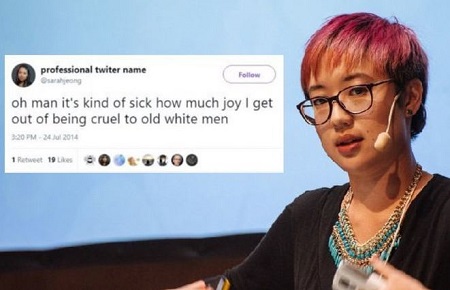
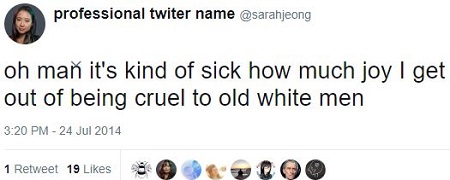
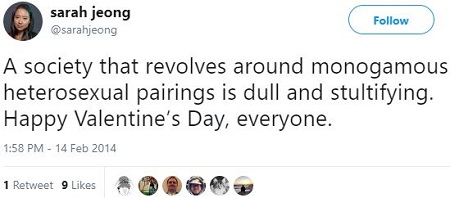
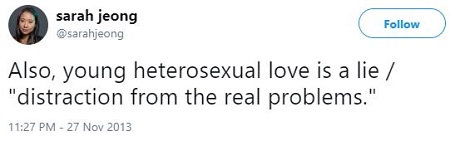
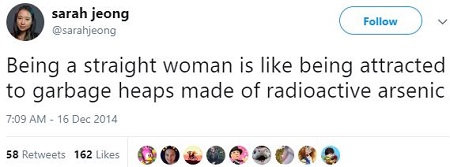
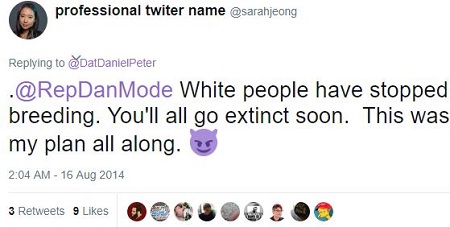
Let me begin by congratulating Sarah Jeong on becoming America’s most successful young hate-monger. She is arguably more racist than Richard Spencer, and yet is employed by the New York Times, and Vox is celebrating this as a victory over the “alt-right”:

She’s also an outspoken progressive and feminist, making her an obvious target for the right-wing internet mobs that have been especially active of late, launching organized smear campaigns against left-leaning celebrities by weaponizing their old jokes and tweets.
The most high-profile recent example of this is Guardians of the Galaxy director James Gunn, who was fired by Disney after a concerted push to dredge up and circulate several of Gunn’s old tweets. Many of the tweets contained jokes about topics like rape and pedophilia — but they were also several years old, purposely taken out of context, and pointedly curated and misrepresented to paint a very specific picture of Gunn with the express goal of getting him fired.
A similar thing happened to Jeong, and the resulting fray became something of a test for the New York Times, as well as a test of the power of alt-right internet mobs. In this case, the mob lost — which might be a sign that one of the alt-right’s signature trolling tactics is losing its effectiveness.

This interpretation includes so many wild distortions that I hesitate to begin unpacking them all. For example, there was no “context” for James Gunn’s “jokes” about rape and pedophilia. You can’t take something out of context if there is no context to begin with; what Gunn’s tweets showed is that, before the Internet feminist brigades began their #MeToo crusades, such remarks were acceptable as “edgy” humor on the Left. And given what we know about Hollywood in the wake of the scandals surrounding Harvey Weinstein, Kevin Spacey, Bryan Singer, et al., it is by no means certain that Gunn was merely joking.

Furthermore, it is absurd to describe research into a public figure’s past writings — on Twitter or anywhere else — as a “trolling tactic,” which is certainly not limited to the “alt-right.” Media Matters actually made this their “signature” tactic, compiling dossiers on various conservative media personalities in an effort to discredit them. Rush Limbaugh has been doing 15 hours of talk radio for 30 years, and so it is easy for the Left’s Argus-eyed media monitors to accumulate various things he’s said which, when “taken out of context,” make him look like a disreputable ogre.

Ask any conservative hate-listed by the SPLC (me, for example) what it’s like to work for decades to achieve a successful career and then be labeled a menace to society based on some left-wing ideologue’s interpretation. The Left has been smearing the Right this way for so long — they did it to Barry Goldwater, they did it Ronald Reagan, they do it to every conservative — that we scarcely even notice it anymore.

What has happened in recent years is that the Right has begun to fight fire with fire, and the Left calls this “harassment.” This was the basic story of #GamerGate: Videogame enthusiasts had grown tired of their hobby being targeted by “social justice warriors” (SJWs) and decided to fight back. Defending themselves against the organized lobby of politically correct censors and critical-theory busybodies (e.g., Anita Sarkeesian), the #GamerGate crew were accused of “misogyny” and “haraassment.” And this exposes the double-standard: When the Left attacks the videogame industry, this is “activism”; when gamers fight back, this is “harassment.” Likewise, when left-wing outfits use the past words of conservatives to brand them racist, this is “research”; when the tables are turned, liberals call it “trolling.”

As John Sexton at Hot Air notes, the Left is defending Sarah Jeong’s anti-white hatred as simply “the way the social justice left talks”:

“White people” is a shorthand in these communities, one that’s used to capture the way that many whites still act in clueless and/or racist ways. It’s typically used satirically and hyperbolically to emphasize how white people continue to benefit (even unknowingly) from their skin color, or to point out the ways in which a power structure that favors white people continues to exist.

Having engaged in a bit of satirical hyperbole myself, I call bulls–t here. It’s a blatant double-standard — one rule for liberals, another rule for everybody else — that permits “the social justice left” to engage in blatant hate-mongering, while conservatives are compelled to tiptoe carefully and watch every word lest they accidentally say something that might somehow be interpreted as “racism.” What conservatives need to do is to start calling the Left’s rhetoric what it is: hate propaganda.

“Everything is implicitly organized around how men see the world — and not just men, how white men see the world — and this is a problem, this is why so many things suck.”
— Sarah Jeong, Oct. 27, 2015

Clay Waters at Newsbusters notes how “alt-right” is used as a smear:

While Jeong’s critics were given the hostile ideological labels and smeared as “alt-right,” her obviously liberal journalistic defenders needed no label besides “journalists.”
The media has defined “alt-right” as racist and violent, so lumping the “alt-right” in with mainstream conservative publications that have called out Jeong’s tweets for racism amounts to a slur.

You see how the “alt-right” label is an attempt to discredit criticism, implying that anyone who objects to Ms. Jeong’s words is some sort of extremist troglodyte, engaged in “bullying” and “harassment.” By this rhetorical device, the vicious hate-monger Sarah Jeong is magically transformed into a heroic victim, a martyr for “social justice.”

We have a way to defeat this. It’s called “voting.”


Donald Trump is president in large measure because millions of Americans are tired of being demonized — racist! sexist! homophobe! — as a rhetorical substitute for any actual policy the Democrats might offer. Americans were expected to vote for Obama to prove they weren’t racist, and many were OK with that, but when it was demanded that they vote for Hillary Clinton to prove they weren’t sexist, they said, “Hell, no.”

Let the Left celebrate its pyrrhic victory, making the New York Times synonymous with the hate propaganda spewed by Sarah Jeong.

Instapundit explains how this should work out:

By keeping her on and defending her, the New York Times — and the blue-check tribe on Twitter that’s been taking her side — is playing into Trump’s hands. See, Trump can say, this is what they really think of you. Because, you know, it is.

November 6 is barely three months away.


Why Does @SarahJeong Hate Jesus?

“For the wrath of God is revealed from heaven against all ungodliness and unrighteousness of men, who hold the truth in unrighteousness; Because that which may be known of God is manifest in them; for God hath shewed it unto them.”
— Romans 1:18-19 (KJV)

After posting about this controversy Thursday afternoon (“Fringe Extremist Hate-Monger @SarahJeong Hired by New York Times”), I had lunch with my brother, then took a nap and, when I woke up, decided to dig a bit more into Ms. Jeong’s Twitter timeline. What I found was rather remarkable, and I worked until dawn to write a column about it:

In the uproar over Sarah Jeong’s hiring by the New York Times, the focus on her history of hateful rhetoric against white people overlooked her many other expressions of hatred — toward males, Christians, and police officers, among others. While her new employers have apparently accepted Ms. Jeong’s disingenuous excuse that she was “engaged in what I thought of at the time as counter-trolling… intended as satire,” this cannot explain away her demonstrable habit of deliberately insulting entire groups of people. It is not true, as she claimed, that she merely “mimicked the language of my harassers.”
Consider, for example, Ms. Jeong’s oft-expressed contempt for Christians, including her own parents. She “grew up in a conservative evangelical Christian bubble,” but “became an annoying atheist” as a teenager, when she was “trapped in a fundamentalist Christian school.” After attending the University of California-Berkeley and graduating from Harvard Law, Ms. Jeong pronounced herself a member of the “educated left wing elite.” She says she has now “mostly cut myself off from the conservative evangelical community,”and condemns Christians who “indoctrinate children” with “reality-denying belief systems.” Ms. Jeong’s spiteful denunciation of her parents’ faith was not “counter-trolling,” nor was it “intended as satire.” These anti-Christian remarks appear to express her sincere beliefs, no different from her many similar expressions of contempt for other groups. . . .

You can read the whole thing at The American Spectator. It’s been linked at Instapundit and by Daniel Greenfield at FrontPageMagazine, and there’s a Memeorandum thread, too. One well-aimed shot can have remarkable effects, and the Daily Caller has followed up with some anti-police tweets from Ms. Jeong (e.g., “f–k the police”) that even I overlooked.

Bad things tend to happen to people who invite the wrath of God. Selah.


Fringe Extremist Hate-Monger @SarahJeong Hired by New York Times


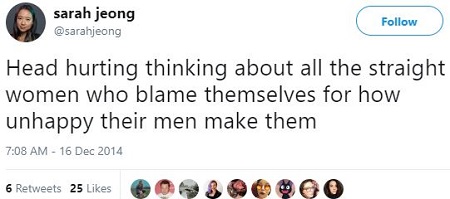
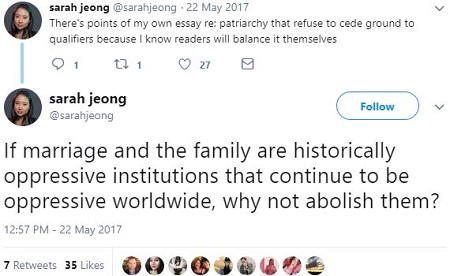
Sarah Jeong is a Harvard Law School graduate who hates men, heterosexuality and white people, not necessarily in that order:

The New York Times’ newest editorial hire has a history of racist tweets against white people.
NYT announced on Wednesday that they hired Sarah Jeong to join their editorial board. Jeong previously wrote for the Verge and authored “The Internet of Garbage,” a book about online harassment and free speech.
Shortly after Jeong’s hire, Twitter users unearthed old tweets in which she expressed an extreme distaste for white people.
“Dumbass f–king white people marking up the internet with their opinions like dogs p–sing on fire hydrants,” she tweeted in 2016. . . .
The New York Times has yet to comment on Jeong’s racist past, however some Twitter users pointed out that they previously fired Quinn Norton after learning that she had tweeted derogatory terms about black and gay people. . . .

The New York Times now has a strict policy against hiring heterosexuals, white people, or anyone who disagrees with Sarah Jeong.


NY Times Reporter and Senate Staffer Caught in Sex-for-Leaks Scandal

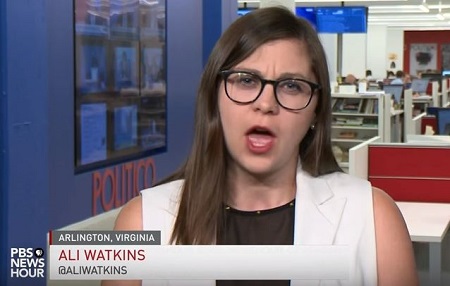
Ali Watkins worked for Politico before joining the New York Times.

The former security director for the Senate Intelligence Committee has been arrested after lying to the FBI about illegally leaking classified information to a young reporter he dated for three years. The arrest exposed James A. Wolfe as the source of multiple leaks of sensitive national security information — including details of the investigation of former Trump campaign aide Carter Page — to New York Times reporter Ali Watkins. Wolfe, 57, had been in a sexual relationship with Watkins, a 2014 Temple University graduate who previously worked for BuzzFeed and Politico before joining the Times late last year.

And after writing that lead paragraph in the Official Neutral Objective Journalism Style, now permit me to add: BWAHAHAHAHAHAHA!

Don’t ever lecture me about “journalism ethics,” you bastards.

All that “full disclosure” business about “conflicts of interest”? Trying to guilt-trip an honest man about a few free beers with Republican operatives who just happened to be useful sources? Not me, baby. I was never ashamed of smoking cigarettes with Herman Cain’s campaign director Mark Block or having beers and pizza with Rick Santorum and his finance director the weekend before the Iowa caucuses. You do whatever it takes to get the story, and there’s no shame in that. The whole point of Gonzo is to be more or less blatant about your biases, as if any reader of Hunter S. Thompson could be mistaken about his opinion of Hubert Humphrey, “a treacherous, gutless old ward-heeler who should be put in a goddamn bottle and sent out with the Japanese current.”

So, no “ethics” lectures from you thieving bastards at the New York Times, or Politico, or BuzzFeed, or whoever is currently employing Dave Weigel and his various friends in Neutral Objective Journalism. Look, Dave’s a friend of mine, and I would never burn a friend. Good relationships are based on reciprocity and trust, and I owe Dave a few favors, so I would certainly never do anything to hurt my friend Dave.

Never mind all that. Veiled threats were never my style, but I know a thing or two about the behavioral patterns of herd animals, and the universal contempt for Our President among the left-wing hacks of the D.C. press corps is hardly a secret, unlike the classified information that James Wolfe was handing over to Ali Watkins in exchange for sucking his middle-aged penis. Heckuva job there, Miss Watkins.

You do whatever it takes to get the story, but none of my sources ever expected that from me, at least not in a literal sense. Yeah, I’ve written a few paragraphs of journalistic fellatio in my time, providing favorable coverage in an effort to butter up a source, but that’s the minor currency of informational commerce in Washington, D.C.

All I ever wanted out of this miserable racket was an appointment as the first U.S. ambassador to Vanuatu, an honorable ambition. A six-figure salary from the American taxpayers as a reward for my long years toiling in the field of Neutral Objective Journalism, and why should this diplomatic post in the South Pacific go to some deep-pocket GOP campaign donor, huh? Why not give it to the man with the keen political insight that enabled him to see that, once Herman Cain got taken out by his enemies, the man to beat as the “Anyone But Mitt” candidate was a former Pennsylvania Senator then languishing at sixth place in the polls? The Santorum Surge in late 2011 didn’t just happen by coincidence, my friends. No, there was a telephone conversation, where Santorum was in the Fort Worth airport between flights, and he promised me that gig in Vanuatu. If he tells you he didn’t, he’s lying, and my close personal friend Rick is a pious Catholic, so he would never lie. Whether he actually would have delivered me that coveted ambassadorship, had he won the White House in 2012, is another question altogether. But I digress . . .

My old friend Hogan Gidley‘s working at the White House now, and he’s not the only one of my buddies who’s moved up the political food chain since I left the campaign trail after the 2012 catastrophe. Now that I’ve finally got my driver’s license back, I could conceivably return to that miserable swamp in D.C. to do some shoe-leather work, maybe reporting on how this Wolfe-Watkins connection exposes the collusion, you might say, between the “fake news” media and the corrupt “Deep State.”

All I need now is a vehicle. Just a couple thousand dollars in the tip jar ought to be enough to get my hands on an old secondhand car.

Let me make a few phone calls, and we’ll see what happens. Just crowdfund me — $5 or $10, whatever you can afford — and in a week or two, I might take my old fedora off the rack and hit the road. Selah.