Chris Cassone is an old and dear friend of the blog, having recorded arguably the best blues ever:
Thus, when word broke out about his new book, “ART OF THE STOMP BOX: Celebrating The Visual Artistry of Effects Pedals” I didn’t hesitate to order a copy. I have an equally old friend who is a guitarist and is getting married in June. When it arrived, I sent the book to Chris for an autograph. This volume will make a perfect wedding gift.
The book is a visually interesting snapshot of the state of the art, whether or not you are a guitarist. My personal favorite was the Shellfire Screamer, by Ulrich Dahlgren. But that’s just because I have both spent some time in Dahlgren, Virginia as an enlisted sailor and Dahlgren Hall while I was at Sing-Sing on the Severn.
Having grown up listening to rock-and-roll, I had questions. For a Wikipedia-deep review, the first stompbox to make a big impact was the 1962 Maestro Fuzz Tone in Ben Shapiro’s favorite, 1965’s (I Can’t Get No) Satisfaction. I recall the double-negative in the title setting Shapiro off regarding the question of whether Jagger ever did or did not obtain satisfaction. Feel free to opine in the comments.
Later effect pedals like the MXR M-117 flanger drove Unchained by the mighty Van Halen.
Anybody who knows how to get ahold of Rick Beato, please speak up. We need him to interview Cassone.
In a world increasingly awash in the fakery of Artificial Intelligence, this book is a breath of fresh air. Real human beings are still hand-crafting unique artifacts.
Consider getting this book and finding some of the vendors mentioned and musician using their wares. Then go take in some live music. Fight the power!
A man armed with guns and knives stormed the lobby outside the White House Correspondents’ Association Dinner attended by President Donald Trump on Saturday night, charging toward the ballroom in a chaotic encounter with Secret Service agents as guests dived under tables at the sound of shots being fired. The president was uninjured and was rushed off the stage. The armed man, who officials said was a guest at the Washington Hilton where the dinner was being held, was taken into custody and was expected in court Monday. Police believe he opened fire and acted alone but did not say who was his intended target or describe a motive.
“When you’re impactful, they go after you. When you’re not impactful, they leave you alone,” Trump, safe and uninjured and still in his tuxedo, said at the White House two hours later. “They seem to think he was a lone wolf.”
The shooting unfolded just outside the vast subterranean ballroom holding thousands of dinner guests, disrupting minutes after it began an annual event meant to honor journalism and the First Amendment that was being especially scrutinized this year because it was the first time since Trump became president that he had attended. . . .
Video posted by Trump showed the suspect running past security barricades as Secret Service agents ran toward him. One officer was shot in a bullet-resistant vest but was recovering, officials said. The gunman was tackled to the ground and was not injured, but was being evaluated at a hospital, police said. The shooting suspect was identified as Cole Tomas Allen, 31, of Torrance, California, according to two law enforcement officials who spoke to The Associated Press on condition of anonymity to discuss an ongoing investigation. He is facing two firearm-related charges, including a count of assaulting an officer with a deadly weapon.
Notice something missing in that Associated Press story? “Assassination.” You could say, “an apparent assassination attempt,” or use the phrase “would-be assassin,” but the AP goes out of its way to avoid saying the obvious: THIS GUY WANTED TO KILL TRUMP.
Furthermore, despite cramming the story full of all kinds of irrelevancies — quotes from this or that politician in attendance — the AP doesn’t include important details about the suspect’s background: First, that Cole Allen donated to Kamala Harris’s campaign, and second, that there was a campaign sign for a Democratic candidate for a state judge position in the front lawn of Allen’s home in California. In other words, evidence clearly suggests the shooter is a Democrat with a political motive, but the Associated Press didn’t think that merited inclusion in the story.
Why is it that everything turns into a story about media bias?
This is what irritates me, after 40 years in the news business. There would be no need for conservative journalism, as such, if it were not for the pervasive bias of the industry. If journalists at the Associated Press, the New York Times, the major networks, etc., would just do their jobs without turning every story into some kind of Democratic Party propaganda message, guys like me would be out of work.
It is rather symbolic that a deranged Democrat decided that the best place to kill the president was at the most prestigious annual gathering of journalists in America. And I’m sure members of the White House Correspondents Association are disappointed that their fellow Democrat failed to murder the president they’ve demonized for years.
A roomful of journalists just watched a radicalized member of their own audience act on their reporting. pic.twitter.com/mQebJMu4QZ
BREAKING: Authorities have just breached the Torrance, CA home of Cole Allen, presumably serving a warrant after two occupants turned Feds away earlier this evening. pic.twitter.com/Nn6c6phCz9
Very seldom do I use the same headline twice in one week, but seldom does an idea as monstrously bad as Samuel Monyn’s attract my attention. To summarize as succinctly as possible, Moyn’s argument is this: “Old people have too much stuff. We should kill them and steal their stuff.”
Have I exaggerated for the sake of brevity? Perhaps so, but the subtext of Moyn’s book-length argument (Gerontocracy in America: How the Old Are Hoarding Power and Wealth—and What to Do About It) is pretty clear — everything wrong in America is because of old people, and therefore we should adopt policies to inflict harm on these elderly enemies. If you’re 65 or older, you are analogous to a Tutsi in Rwanda in 1994 and Professor Moyn is Radio Hutu. This is simply hate propaganda, demonizing the elderly, and nothing good will come of it. Both Ed Morrissey and Matt Taibbi have taken stabs at explaining what’s wrong with Moyn’s idea, as expressed in the professor’s New York Times op-ed.
“Ageism” identifies an enduring phenomenon: the mistreatment of older people for no reason other than being older. Americans in middle age and beyond are routinely passed over for opportunities because of the irrelevant fact of a number on paper or how they act and look after getting older.
In today’s world, the unfair discrimination they cite coexists with a different kind of unfairness: a gerontocratic society in which the old control ever more power and wealth, leading to overrepresentation in political life and unequal power in social life.
It is not ageist to ask whether older people should be required to give more to younger Americans and national priorities — it is critical to the future of our democracy and society. America needs to confront gerontocracy before the system collapses under the weight of its inequality and injustice.
Older Americans deserve a say over the future even when they might not live to see it. But they do not deserve the stranglehold over it they currently enjoy through overrepresentation in elections, which produces too many regressive policies and too many seniors in the highest offices. . . .
The United States has one of the highest wage inequality by age of any country in the world, and the numbers keep getting worse: The pay gap between workers over 55 and those under 35 widened 61 percent between 1979 and 2018. The share of workers over 55 in the work force rose 88 percent in those same years.
Housing follows the same pattern. Older Americans own much of the most desirable real estate in the country’s best cities, and they are not moving. . . .
You can read the rest, but ask yourself how Professor Moyn would react to these arguments about “overrepresentation” and “unequal power,” etc., if we replaced the phrase “older people” with one word: Jews.
The headline “Jews Are Hoarding America’s Potential” would probably not be published by the New York Times, nor would the author of such a piece have a book deal with Farrar, Straus and Giroux, let alone a tenured faculty position at Yale Law School. What is offensive about crude anti-Semitism is the same thing that offends me about Professor Moyn’s argument, i.e., that such scapegoating involves collective blame, and that this invalid categorization of guilt simultaneously creates an invalid category of allegedly innocent victims. This blame game is a distraction. It’s like the Black Lives Matters movement yelping about “systemic racism” and “white privilege” when the problem is (checks notes) criminals getting killed by police while resisting arrest.
Because I am 66 years old — and thus, according to Professor Moyn, part of the gerontocracy that is oppressing younger Americans — let me ask a few questions: How do I, specifically, “control ever more power and wealth”? How much of “the most desirable real estate” do I own? How am I exercising a “stranglehold” and benefiting from a “pay gap”? My kids own more real estate than I do, and my lawyer son’s starting pay at his first job is more than I’m earning after 40 years in journalism.
Trying to scapegoat me because of a statistical trend — the “pay gap” that “widened 61 percent” in a 40-year period — would be offensive even if the underlying numbers were not demonstrably invalid, but in fact this alleged trend is an apples-and-oranges comparison which ignores the fact that the overall quality of young people has changed since the 1970s, and not in a good way. Whatever problems my generation had as teenagers back in the day, the vast majority of us at least came from two-parent married households. If my now-adult offspring are doing better than the average member of their own generation, it’s probably due in large measure to this factor — my wife and I got married and have stayed married, and at least tried to give our kids an old-fashioned wholesome sort of upbringing. Professor Moyn is obsessed with demonizing old people for “hoarding” wealth, but how much of the widening gap between young and old is actually due to declines in the average socioeconomic background of young people caused by rising rates of out-of-wedlock births and the prevalence of divorce? And what about the role of mass immigration in this generational trend? Professor Moyn doesn’t mention that at all, but let us just ask: What percentage of American 18-year-olds were the children of immigrants in 1978, versus today’s 18-year-olds? What would it look like if you charted the U.S. percentage of immigrant population over time, as one line, and the “pay gap” as another line?
Professor Moyn is certainly not alone in ignoring this factor. Twenty or 30 years ago, I recall seeing politicians and pundits bemoaning “the growing gap between rich and poor” in America, even while those same people had nothing to say about mass immigration. If you are importing tens of millions of impoverished Third World refugees — which has been our de facto policy for decades — it is hardly a surprise to see an increase in the “poor” side of this “growing gap” that you’re complaining about, no matter what your policy is toward the rich. But of course, the people doing the complaining were liberals, predictably arguing for economic redistribution, rather than actually trying to solve the problem (which their own policies have caused). Sic semper hoc — liberal policies fail, and then liberals tell us that the solution is more liberalism.
Because he has chosen the elderly as scapegoats, and because he is a liberal, Professor Moyn is oblivious to all of this. He has another long essay in Harper‘s magazine, with this interesting section:
At the core of the gerontocracy’s rise is a historical irony. The modern world— — and America above all – once stood for youth, novelty, and energy. And yet the same modernity that gave us democracy and other forms of progress also prompted scientific advances that prolonged life. Those advances drove a startling demographic transformation that has increased the proportion of elders in our society, unintentionally empowering a caste that has slowed progress. Call it the Great Aging. The age pyramid — which decreed almost as a law across space and time that the younger the humans, the more of them there were — has been rebuilt. There is still a narrowing tip in the upper echelons, because people still die. But below it, the structure is a rectangle, with steady-state survival of most cohorts, and some younger groups smaller than some older ones. The rectangle is slowly ascending in height, which means that, where there was once a smaller proportion of people over forty, now more than half the population in some countries, and just about half in America, are above that age. Our current median age is nearing forty, up from thirty in 1980 and from the mid-teens early in our national history. And while the trends in life extension have been irresistible, the coincidence of a declining birth rate with the ongoing survival of the baby boomers is creating an especially lopsided upper age cohort. There were just under five million Americans aged sixty-five or older in 1920, accounting for less than 5 percent of the population; now there are more than fifty-five million, making up almost 17 percent of the total.
Wow, talk about bias — it’s like he’s looking through the wrong end of a telescope. The “startling demographic transformation” has far more to do with declining fertility than with “gerontocracy.”
U.S. total fertility rate (TFR), 1950-2023
Total fertility rate (TFR) “represents the number of children that would be born to a woman if she were to live to the end of her childbearing years and bear children in accordance with age-specific fertility rates of the specified year.” It is the standard metric of reproductive behavior used for all comparisons, whether between nations, or ethnic groups within nations, or between the same groups over time. While I have seen Census Bureau data that differs slightly from the numbers on this particular chart (i.e., with TFR peaking in 1957, rather than 1960), the overall trend is roughly the same. At the peak of the postwar “Baby Boom,” American women were having so many babies that it was more common for a family to have four children than to have “only” three.
However, once those children reached adulthood — the first Baby Boomers, born in 1946, turned 18 in 1964 — birth rates swiftly plummeted, and by 1973 were below “replacement rate” (2.1 TFR) needed to maintain population stability. For more than 15 years, TFR never reached replacement level and, when it finally (and just barely) did so in 1990, this was mainly due to higher birth rates among immigrant women, of whom there were a lot more than there had been 15 years earlier.
Every time I bring up this topic, two responses are typical — first, personal defensiveness, with people who have few children (or none) acting as if they have been accused of wrongdoing. Secondly, there is the economic excuse, the claim that young people “can’t afford” to have kids. Yet this excuse ignores the obvious fact that poor people are actually having more kids than rich people. The actual explanation, I would argue, involves what we may called lifestyle expectations. If you grow up in affluent circumstances, it is natural to believe you shouldn’t have kids until you can afford to give them a similarly affluent upbringing. And if both husband and wife are working full-time (as is the case for nearly all middle-class couples), childbearing almost unavoidably means taking a step down the economic ladder, however temporary it may be. Either (a) mom has to stay home to care for the children for a few years or (b) you have to pay someone else for childcare. Because I am the father of six children, I have extensive direct experience in the difficulties involved, and all I can say is what my dad told me when our oldest was just a wee baby: “Son, if you wait to have children until you can afford to have children, you’d never have children.” You just bite the bullet.
Having done my part, personally, to combat demographic decline, I disavow any blame for a trend caused by other people’s choices.
Some people choose to go to Yale University, for example, but I wouldn’t go near the place — full of dangerous degenerates like Samuel Moyn — and I’d urge others to heed my warning. Elite academic know-it-alls have been the architects of our societal disaster (e.g., Stanford University professor Paul Ehrlich) and cannot be trusted to provide solutions to the problems they have themselves caused. And I’ve been saying this since long before I was old enough to join the “gerontocracy.”
There is a lot of irony in the federal grand jury indictment of the Southern Poverty Law Center on 11 counts including wire fraud. About 30 years ago, it was explained to me why the SPLC’s “hate watch” racket exists — i.e., that Morris Dees had taken the mailing list of donors to the 1972 George McGovern campaign and turned it into a gold mine.
Dees discovered that rich Yankee liberals would give! give! give! if you told them you were fighting racism in the South. Never mind that, by the time the SPLC got rolling, the Civil Rights era had come and gone, and nearly everybody in the South had made their peace with integration. Liberals had a weird nostalgia for the “heroic struggle” narrative in which they taught a lesson to those benighted bigots down in Dixie, and they’d pay big money if you could keep that narrative alive, which is what Dees and the SPLC were really all about. Sometimes you’ll hear conservative critics of the SPLC contend that the SPLC originally did worthwhile things, but then strayed from their noble mission. No — it was a scam from the outset, an elaborate fraud to collect money from gullible liberals.
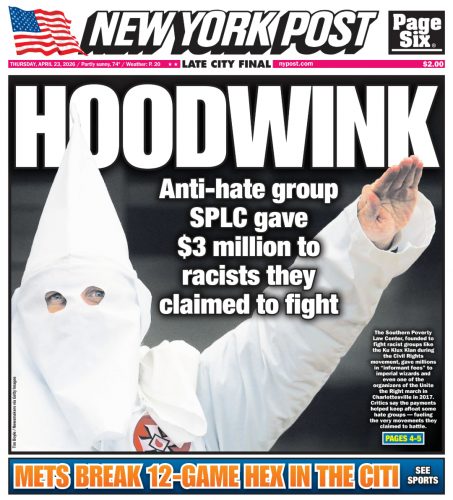
The Southern Poverty Law Center is accused of funneling millions of dollars to at least eight leaders and members of hate groups — including a Ku Klux Klan Imperial Wizard and a fundraiser for a neo-Nazi group — to act as informants, which one nonprofit leader likened to paying an arsonist to help put out a fire.
The Alabama-based non-profit was charged by the Department of Justice with wire fraud, bank fraud, and money laundering conspiracy on Tuesday for allegedly hiding from donors the fact that it doled out more than $3 million over the course of nearly a decade to “field sources” tasked with infiltrating violent extremist groups, acting Attorney General Todd Blanche and FBI Director Kash Patel announced Wednesday.
The field sources — or “Fs” — were “secretly paid” by SPLC between 2014 and 2023, the indictment claims.
America First Legal president Gene Hamilton, a former DOJ official, told The Post Wednesday it’s unprecedented for a tax-exempt nonprofit to use donor funding to pay informants in violent extremist groups
“I’ve seen some leftists talking about, seen some chatter on social media and elsewhere saying, ‘Oh this is a commonly used tactic amongst the government for years to infiltrate organizations,’” added the lawyer for the conservative group. “That’s one thing if it’s the government — the government can prosecute people.”
Hamilton likened it to paying the proverbial arsonist to help put out a fire.
He said it would be like if his own MAGA-tied group was secretly giving money to DEI officials to set up more DEI programs — while raising money to fight against DEI.
“It’s mind bogglingly dumb,” he said.
Liora Rez, the founder of StopAntisemitism, said that SPLC’s work fighting antisemitism appeared to have fallen off in recent years. He was infuriated by the allegations.
“It’s unimaginable to us that a civil rights group would gin up fake bigotry in order to solicit donations from concerned Americans,” he said.
“If this is what the SPLC did, it is shameful and outrageous.” . . .
One informant was part of an “online leadership chat group” organizing the 2017 Unite the Right white supremacist rally in Charlottesville, Va., and ended up posting racist comments at the SPLC’s behest while also coordinating rides for others to attend, per the indictment.
In total, SPLC paid the informant $270,000 between 2015 and 2023, the papers claim.
A veteran informant from the neo-Nazi National Alliance was paid $1 million over the same period and assisted SPLC at one point by stealing 25 boxes of documents from the violent extremist group’s headquarters, the filing alleges.
He worked as a fundraiser for the neo-Nazi group, according to the DOJ.
You can read the whole thing. If you’re laughing at the SPLC’s disgrace, that probably means you’re a neo-Confederate supremacist.
If I had any brains I would already have been in bed, but I don’t want to fall even further behind on the blogging. Silicon Valley et Hamas delenda sunt.