Cameron teamed up with Joseph Romm, the founding editor of ClimateProgress, to create Front Page Live, the Post reported, which describes itself as “a site dedicated to helping diverse voices and content go viral, and a news source that reflects the values of the majority of good people on our amazing planet.”
“Part of our goal is to be an antidote to the Drudge Report. But whereas Drudge aggregates and viralizes right-wing content, which includes a lot of disinformation and climate science denial, we will aim to aggregate and viralize accurate news,” Romm, who serves as editor-in-chief and CEO, said in a statement to The Hill. “We are ‘liberal’ only in the sense that climate science has been labeled ‘liberal’ by climate science deniers.”
“We are trying to be a place that will save people time because it’s simply way too hard for anyone to sip quality water from the open fire hydrant that is online news and social media — especially because there is so much sewage thrown in,” he added.
Romm told The Washington Post that he views the organization as a “viralizing engine” for the left.
You want to launch a news site and you start by smearing Drudge?
The assertion that what Drudge does is “right-wing . . . disinformation” shows how out of touch with reality Joseph Romm is. He is a monomaniacal fanatic, obsessed with “climate change,” and if you put somebody like that in charge of a news site, failure is guaranteed.
Cuban-American pop singer Camila Cabello made her debut as a member of girl group Fifth Harmony via The X Factor back in 2012, and went on to a successful solo career – her debut album Camila went platinum – in December 2016. She’s been the opening act for Taylor Swift on the latter’s Reputation tour, been a model for Guess, and is going to star in a remake of Cinderella.
It’s that time of year, when patriotic Americans have their garages stacked to the rafters with cases full of fireworks:
“Yeah, I know what you’re thinking — this has ‘divorce’ written all over it. . . . I did some math on this stuff, because we’ve got such a ridiculous quantity of fireworks here. So I did some math, and I found out that I have enough fireworks here that, if sold at retail value in the U.S.A., I could pay off all of my credit-card debt and the remaining loan on my pickup, and still have money left over to buy more fireworks.”
Nice you’ve got a sense of humor about it, Cody. Remind me some day to tell you the story about the time the ATF raided my house . . .
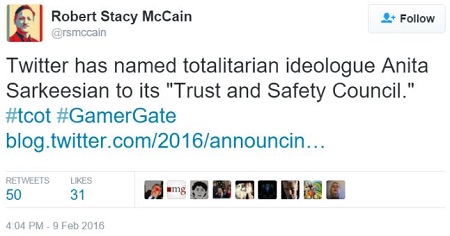
Remember when the name “Anita Sarkeesian” was influential? When the feminist commissar was named to Twitter’s “Trust and Safety Council”? The anti-male hatemonger rose to fame from 2012 to 2016 by demonizing men in the videogame industry and claiming to be a victim of sexist harassment. In 2014, the year of the #GamerGate controversy, Sarkeesian’s Feminist Frequency project raised more than $400,000 and, over a five-year-period, her organization raised nearly $1.6 million. Yet as Brad Glasgow explains in a remarkable YouTube video, Sarkeesian’s non-profit is now essentially bankrupt, having begun the year with a balance of barely $30,000 and laying off its employees:
John Sexton at Hot Air calls attention to a recent profile of Sarkeesian at the videogame blog Polygon, which is interesting in terms of confirming pretty much everything you’d expect about her, for example that she has always hated America. She was 15 when her immigrant family moved from Canada to Orange County, California, and instead of being happy — sunshine! beaches! palm trees! — Sarkeesian was miserable and angry:
The teenage misfit never grew up, extending her adolescent tantrums into adulthood by protesting against the Iraq War in college:
“There were rooms where the Anarchists would meet across the hall from where the Marxists would meet and they didn’t get along,” she says. “I didn’t know any of the philosophy or politics behind any of this stuff, so I started reading a lot more political theory.”
“I learned about public speaking and audience analysis and understanding what gets people emotionally engaged,” she adds. “I ended up doing a lot of organizing; spending time in horribly ventilated back-rooms, having meetings and discussions.” . . .
Sarkeesian gained a bachelor’s degree in communications studies at California State. Her work was increasingly focused on economic theory and alternatives to modern capitalism.
She then moved to New York, where she once again joined forces with political action groups, while working various jobs.
“I got really interested in performance and guerrilla theater as a mode of activism,” she says. “I supported nonviolent direct actions. . . .
“We would figure out how to send out press releases, and how to get the media to cover this. He worked on crafting our message. I was interested in getting the message out there.”
Sarkeesian did not want the protestors’ actions to go unnoticed. “You can do a die-in in front of the [military] recruiter’s office, but it doesn’t matter if only three people see it. You need to get more people to see it.” . ..
Sarkeesian recalls attending workshops and group meetings and speeches by activists like Noam Chomsky. “I had already been politicized but I realized then that this is a life of work that people commit themselves to doing,” she says.
She began to focus more on feminist ideas. “I had done all this work on economic theory but I literally had no idea about identity politics. So I started learning about feminism.” She linked up with women who had been activists since the Vietnam era, who had experienced hostility and marginalization from male protest leaders. She listened to the stories of how women had to force their way into the conversation, sometimes storming the stage.
“The thing about the activist’s life is there are a lot of meetings,” she says. “You’re sitting on these conference calls with a hundred people. There’s all this sectarian politics and all this strife. It’s just the same bulls–t that is everywhere else. I was watching these young people reproduce the same systems as white, male-dominated spaces.”
So, she hates males, she hates white people, she hates the military, she hates capitalism — why would you give money to such a person? And of course, the money she raised was squandered to no good purpose, concluding with the same misfit attitude she began with:
But she knows that the job of educating game-makers about representation is far from over. “There is progress being made, but I struggle with how to talk about it. It’s like a pendulum swinging: This one thing is great, and then, oh, this other thing is shitty.
“When we talk about, oh, we solved the problem, we’re moving forward … no, we haven’t even begun to solve the problem. We’re just taking the next step to the greater vision. I’m always trying to remind people to look at the vision of what we’re fighting for. Understanding that helps influence how we work. It influences how we tell our stories and what stories we want to tell. It influences students coming out of school and the careers and jobs that they want.”
Part of the problem is that many of those who are willing to be persuaded have been persuaded. And those who are not will never come around. “They’re either not paying attention to the conversation or they are, and they’re on the other side of it. And I don’t like talking about it as a ‘sides’ thing. Because you either care about the humanity of people or you don’t. That’s the side you’re on.”
Despite wasting $1.6 million, Sarkeesian “hasn’t even begun to solve the problem,” and if you disagree with her, that’s because you don’t “care about the humanity of people.” Is anyone really surprised that sane people don’t want to support this fanatical ideologue?
Look at the date on that New York Times story — how did it happen that, in August 2016, Ukraine’s “newly formed National Anti-Corruption Bureau” took an interest in Donald Trump’s campaign manager and these reporters had no trouble finding sources in Kiev telling them all about these “ledgers”? What that just a coincidence? Or does it seem to you more likely, as Ace of Spades suggests, that this story was about protecting the interests of the U.S. political establishment?
Remember, it was critical to Hillary Clinton that the FBI have active investigations opened into the Trump campaign, because she had a high profile investigation into her own actions, and she desperately needed to be able to play the They Do It Too Card.
Do you believe in coincidences like that? A powerful politician needs to smear her opponent and — oh, what a coincidence! — sources direct reporters for the New York Times to the Ukraine, where investigators cite a “secret ledger” that appears to prove wrongdoing by the opponent’s campaign manager. Well, guess what? Three years later, we discover that (a) the “ledger” was probably a forgery, and (b) the FBI was actively engaged in feeding this stuff to the media:
In search warrant affidavits, the FBI portrayed the ledger as one reason it resurrected a criminal case against Manafort that was dropped in 2014 and needed search warrants in 2017 for bank records to prove he worked for the Russian-backed Party of Regions in Ukraine.
There’s just one problem: The FBI’s public reliance on the ledger came months after the feds were warned repeatedly that the document couldn’t be trusted and likely was a fake, according to documents and more than a dozen interviews with knowledgeable sources. . . .
Manafort’s Ukrainian business partner Konstantin Kilimnik, a regular informer for the State Department, told the U.S. government almost immediately after The New York Times wrote about the ledger in August 2016 that the document probably was fake.
Manafort “could not have possibly taken large amounts of cash across three borders. It was always a different arrangement — payments were in wire transfers to his companies, which is not a violation,” Kilimnik wrote in an email to a senior U.S. official on Aug. 22, 2016. . . .
[T]he FBI and Mueller’s office did not cite the actual ledger — which would require agents to discuss their assessment of the evidence — and instead cited media reports about it. The feds assisted on one of those stories as sources.
For example, agents mentioned the ledger in an affidavit supporting a July 2017 search warrant for Manafort’s house, citing it as one of the reasons the FBI resurrected the criminal case against Manafort.
“On August 19, 2016, after public reports regarding connections between Manafort, Ukraine and Russia == including an alleged ‘black ledger’ of off-the-book payments from the Party of Regions to Manafort — Manafort left his post as chairman of the Trump Campaign,” the July 25, 2017, FBI agent’s affidavit stated.
Three months later, the FBI went further in arguing probable cause for a search warrant for Manafort’s bank records, citing a specific article about the ledger as evidence Manafort was paid to perform U.S. lobbying work for the Ukrainians.
“The April 12, 2017, Associated Press article reported that DMI [Manafort’s company] records showed at least two payments were made to DMI that correspond to payments in the ‘black ledger,’ ” an FBI agent wrote in a footnote to the affidavit.
There are two glaring problems with that assertion.
First, the agent failed to disclose that both FBI officials and Department of Justice (DOJ) prosecutor Andrew Weissmann, who later became Mueller’s deputy, met with those AP reporters one day before the story was published and assisted their reporting.
An FBI record of the April 11, 2017, meeting declared that the AP reporters “were advised that they appeared to have a good understanding of Manafort’s business dealings” in Ukraine.
So, essentially, the FBI cited a leak that the government had facilitated and then used it to support the black ledger evidence, even though it had been clearly warned about the document.
Secondly, the FBI was told the ledger claimed to show cash payments to Manafort when, in fact, agents had been told since 2014 that Manafort received money only by bank wires, mostly routed through the island of Cyprus, memos show.
So, Manafort was forced to resign from the campaign after someone fed this fake “secret ledger” story to the New York Times and then, in order to justify search warrants for Manafort’s bank records, the FBI leaks more “secret ledger” stories to the media, then cites those stories as “evidence” to claim probably cause on the warrant application. I’m not a lawyer, but it seems to me the people responsible for this need to be prosecuted to the fullest extent of the law. This kind of “Deep State” stuff — government bureaucrats acting improperly to exercise a corrupt political infleunce, and exploiting the news media in the process — is why every American should be glad Hillary lost. If she had won, we never would have learned what kind of shenanigans were going on at the FBI.
Imagine you’re a famous billionaire real estate developer. Now imagine you’ve got nothing better to do than to hang around department stores, raping magazine columnists in dressing rooms:
President Donald Trump strongly denounced an allegation of sexual assault from author E. Jean Carroll on Friday, saying that he never met the woman in his life.
“I’ve never met this person in my life,” Trump said in a statement sent to reporters. “She is trying to sell a new book — that should indicate her motivation. It should be sold in the fiction section.”
Carroll published an excerpt of her story in New York Magazine claiming that Trump raped her in a dressing room at the Bergdorf Goodman department store in 1995. Bergdorf Goodman confirmed that they had no surveillance video of the alleged incident.
Carroll is now 75, is an advice columnist for Elle, and wrote magazine features for Playboy and Esquire.
Trump noted that there was no pictures, no surveillance, no video, no reports, and no sales representatives who could prove the assault.
“It’s just as bad for people to believe it, particularly when there is zero evidence,” Trump said. “Worse still for a dying publication to try to prop itself up by peddling fake news — it’s an epidemic.”
Trump also denounced false rape accusations for diminishing the seriousness of real assault cases.
“If anyone has information that the Democratic Party is working with Ms. Carroll or New York Magazine, please notify us as soon as possible,” Trump wrote. “The world should know what’s really going on. It is a disgrace and people should pay dearly for such false accusations.”
The media have called attention to photos showing Carroll in attendance at a 1995 event with Trump at Mar-a-Lago, which would seem to refute his claim that he “never met this person,” but so what? Trump is a famous guy who meets lots of people, and he can’t remember all of them. Besides which, Carroll claims their encounter happened in midtown Manhattan, not Palm Beach, Florida. My hunch is that this story, which got saturation coverage on CNN and MSNBC yesterday, will have zero political impact. Only people who already hate Trump will believe it, and everybody else will see it as further evidence that the #MeToo movement has become a witch hunt. Even if you believe Jean Carroll is telling the truth, how convenient is it that she saves the story of this alleged felony for a book published nearly 25 years afterwards?