These essays help provide a factual understanding of a complex phenomenon that most historians and journalists have tried to avoid, with the result that silence and ignorance have given rise to paranoia. You cannot suppress anti-Semitism by avoiding unfortunate facts, and the fact is that Communists used false accusations of anti-Semitism as part of their propaganda efforts against the United States during the Cold War. Yes, there were a disproportionate number of Jews involved in the CPUSA, and many Jewish Communists (including Morton Sobell and the Rosenbergs) were also among those engaged in Soviet espionage. However, in the immediate aftermath of World War II, with the crimes of Hitler still a very fresh memory, the Soviets and their CPUSA henchmen cleverly exploited this to their advantage, accusing American anti-Communists of being Jew-hating “fascists” while proclaiming the innocence of the Rosenbergs and other Soviet spies. As Wisse points out, this Big Lie isn’t just some remote historical controversy, but it has consequences down to this very day, persuading many Jewish Americans that they must always identify with those allegedly “oppressed” by American society. Furthermore, because our universities and media institutions have been unwilling to address this topic directly, they have unwittingly given aid and comfort to anti-Semites, who love to depict Jews as inherently subversive, while claiming that powerful Jews use their influence to conceal the extent of this subversion.
To depict all Jews, collectively, as responsible for the bad actions of a minority within their community, is the kind of guilt-by-association smear that ought never to be tolerated. The truth is the only possible antidote to such smears, and this means we have to be able to acknowledge unpleasant truths that we might prefer to sweep under the rug. It’s a simple fact that the Communist Party included a lot of Jews, as Harvey Klehr makes clear:
Although Jews made up a disproportionate share of the Communist Party USA (CPUSA) — perhaps as much as 40 percent in 1939 — the party itself never held more than 100,000 members. So, in an American Jewish population of several million, a tiny percentage were Communists. . . .
In 1945, three of the six people arrested in the Amerasia case, the first espionage case of the cold war, were Jewish. (None was ever successfully prosecuted for spying.) In 1947, six of the Hollywood Ten who on First Amendment grounds refused to answer questions when subpoenaed by the House Un-American Activities Commission (HUAC) were Jewish. In 1949, five of the eleven top leaders of the CPUSA convicted under the Smith Act of conspiring to teach and advocate the overthrow of the American government were Jewish. In the 1948 presidential election, Henry Wallace, formerly FDR’s vice-president now running on the Progressive ticket with Communist backing, drew only a little more than a million votes altogether; but, by one estimate, about a third of American Jewish voters, a much larger percentage than the number of Jews in the CPUSA, cast their ballots for him.
In other words, if you were concerned about Communism circa 1947-49, a certain level of suspicion toward Jews was justified, even though the vast majority of Jews were not Communists. And to look at the obverse of the case, it might be that an ordinary Jew-hater would engage in anti-Communist rhetoric as a way to promote his pet prejudice, but this certainly doesn’t mean that every anti-Communist was a Jew-hater.
You cannot protect the innocent by denying the guilt of the guilty. You cannot solve a social problem by pretending it doesn’t exist, by minimizing it, justifying it or rationalizing it. Communism was a grave threat to constitutional liberty in America, and to U.S. national security, and the role of Jews in supporting Communism needs to be confronted soberly by historians, especially by Jewish historians. One thing I like to point out, whenever anti-Semitism rears its ugly head in discussions of the Cold War, is that while the Rosenbergs were Jews, the federal judge who sentenced them to death, Judge Irving Kaufman, was also Jewish.
Part of the problem is that Cold War history is either ignored in our schools, or taught from a pro-Communist perspective, recycling Soviet propaganda claims about the irrational “paranoia” of the 1950s, with “McCarthyism” made to seem a greater menace than Stalinism. Young people generally know nothing about the Bolshevik Revolution or the atrocities committed by Communist regimes. Sympathetic portrayals of accused Communists as being victims of a right-wing “witch hunt” in the 1950s are part of a liberal mythology that Jeanne Kirkpatrick once summarized succinctly: “They always blame America first.”
To augment that mythology by falsely accusing anti-Communists of anti-Semitism is dangerous for several reasons, particularly because Jew-haters are likely to exploit this for their own purposes, and the editors of Mosaic deserve credit for taking direct aim at this myth.
Officials said the president had initially approved attacks on a handful of Iranian targets, like radar and missile batteries.
The operation was underway in its early stages when it was called off, a senior administration official said. Planes were in the air and ships were in position, but no missiles had been fired when word came to stand down, the official said.
The abrupt reversal put a halt to what would have been the president’s third military action against targets in the Middle East. Mr. Trump had struck twice at targets in Syria, in 2017 and 2018.
It was not clear whether Mr. Trump simply changed his mind on the strikes or whether the administration altered course because of logistics or strategy. It was also not clear whether the attacks might still go forward.
Asked about the plans for a strike and the decision to hold back, the White House declined to comment, as did Pentagon officials. No government officials asked The New York Times to withhold the article.
The retaliation plan was intended as a response to the shooting down of the unmanned, $130 million surveillance drone, which was struck Thursday morning by an Iranian surface-to-air missile, according to a senior administration official who was briefed on the military planning and spoke on the condition of anonymity to discuss confidential plans.
The strike was set to take place just before dawn Friday in Iran to minimize risk to the Iranian military and civilians.
But military officials received word a short time later that the strike was off, at least temporarily.
My hunch is that this report is true, and that the reason a “senior administration official” would share this information with the media is because President Trump wants Iran to know how close they were to getting hammered. The president approved the strike and then decided against it — we were this close to war, and Iran really doesn’t want that.
One thing I’ve tried to do with my kids is what I call “cultural education.” Like, there’s no reason children should grow up without an awareness of rock-and-roll classics, and I’ve had many rewarding experiences like the time I heard my youngest son, born in 2000, in the shower singing along to his Spotify rotation of Led Zeppelin. How cool is that?
A couple of days ago, I was driving my youngest daughter (born in 2002) to her summer internship and told her to look up “California Dreamin'” on her Spotify. Why was that song in my mind? Probably some headline I’d read about California’s recent descent into Third World chaos. It’s a forlorn bit of nostalgia to recall what California signified in the 1960s, before Democrats turned it into a socialist nightmare of typhus infections, homeless encampments and heroin needles. At any rate, the song had been stuck in my head and so I asked my 16-year-old daughter to play it on her phone — she’d never heard it before — and when it ended, I said, “That was Number One for the Mamas and Papas in 1966.”
My daughter is quite the chip off the old block, however, and she quickly Googled up the fact that “California Dreamin'” only made it to #4.
That seemed wrong, an injustice. From the first notes of the classical guitar intro to the sonic crescendo of the vocal harmony ending, “California Dreamin'” is a musical masterpiece, two-and-a-half minutes of pure genius in the key of A-minor. In 2004, when Rolling Stone published its list of “The 500 Greatest Songs of All Time,” this 1966 hit was #89 on the list and yet it never actually topped the charts? When I got home, I decided to explore this mystery further and, being rather obsessive about research, I dived in deep.
The Mamas and the Papas were formed in 1965 after the breakup of John Phillips’s first group, The Journeymen. Phillips, the son of a Marine Corps officer, had grown up in Alexandria, Virginia, attended a military school and won an appointment to the Naval Academy in Annapolis, but quit during his first year and then enrolled at Hampden-Sydney College before dropping out to pursue his musical career in New York City. Phillips became part of the folk-music scene in Greenwich Village, and The Journeymen landed a record contract in 1961, when Phillips was 25. (Click here to watch the group on the TV show Hootenanny in 1963.)
In 1962, while touring with The Journeymen, Phillips met a long-legged 17-year-old model in San Francisco. He divorced his first wife and married the model, Michelle Gilliam, but this new romance was one of the factors that contributed to the breakup of The Journeymen. The other factor was the arrival of The Beatles and the subsequent “British invasion,” which put an end to the folk-music scene. For a while, Phillips tried to keep going down the folk road, teaming up with Denny Doherty (from another Greenwich Village group, the Mugwumps) and Michelle to perform as The New Journeymen, but with little success. It was Doherty who suggested adding his former Mugwumps colleague and occasional girlfriend Cass Elliot (neé Ellen Cohen) to form a quartet. The new group’s name was inspired by the notorious Hell’s Angels motorcycle gang, who referred to their girlfriends as “Mamas.”
Meanwhile, there was a song inspired by Michelle Phillips’s first trip to New York in 1963. According to John Phillips, the couple went for a walk around the city “and all she had was California clothing . . . tennis shoes and . . . a tank top and jeans or something.” There was snow on the ground and Michelle was cold, so the couple went into a church to escape the weather and let her warm up for a few minutes. That night, in their Greenwich Village hotel room, Michelle was asleep while John was playing his guitar when the song began to take shape:
So I tried to wake Michelle up to write the lyrics down that I was doing. And she said, “Leave me alone. I want to sleep.”
He persisted until she did wake up, thus earning herself half the songwriting royalties of one of the greatest songs of the decade. The couple offered the song to folk singer Barry McGuire, who did them the favor of introducing them to Dunhill Records chief Lou Adler. The Mamas and the Papas performed background vocals on McGuire’s version of the song, but his gruff baritone didn’t give the record much energy. So what happened next is that, after Adler signed the Mamas and the Papas to their own contract, John Phillips took the master tape of the session, erased McGuire’s voice, and replaced it with him and Doherty singing the lead in duet. On the second verse (“Stopped into a church”), Doherty sings the solo lead in a strong bluesy tenor and then comes the song’s real magic moment. McGuire’s version of “California Dreamin'” had included a forgettable harmonica solo, but for the Mamas and the Papas version, Phillips brought in top studio pro Bud Shank, a veteran L.A. jazz musician. Shank listened to the track, improvised the alto flute solo, and “nailed it on the first take.” It was absolutely brilliant.
The success of “California Dreamin'” had an important influence on pop music in the 1960s, showing that the fusion of rock and folk — pioneered in 1965 by the Byrds — was a durable phenomenon. It helped establish the West Coast as the main scene for American rock music, solidified in 1967 when Jon Phillips organized the Monterrey Pop Festival, with a number of subsequently famous acts, including Jefferson Airplane, Jimi Hendrix and the Grateful Dead, performing in a show with the Mamas and the Papas as headliners. It’s possible that the subsequent careers of acts like the Eagles, Linda Ronstadt and Jackson Browne might never have happened had it not been for “California Dreamin’.”
OK, so why did it never make it to Number One?
When my daughter informed me that “California Dreamin'” peaked at #4 on the Billboard Hot 100, my assumption was that this was because the top three slots at the time must have been held by classic hits by major groups — the Beatles, the Rolling Stones, various Motown hitmakers. And indeed, after the song was first released in December 1965, the songs at the top of the chart included many such big hits by big names. For the week of Jan. 29, 1966, when the Mamas and the Papas were at #44, the Beatles had the #1 spot with “We Can Work It Out,” and upper reaches of the chart also included Smokey Robinson and the Miracles (“Going to a Go-Go,” #23), Stevie Wonder (“Uptight,” #21), the Rolling Stones (“As Tears Go By,” #6) and the Beach Boys (“Barbara Ann,” #2). But these weren’t the artists who ultimately froze “California Dreamin'” out of the top spot. Instead, on the week of March 12, when the Mamas and the Papas’ record peaked at #4, the song in the third-place spot was a wretched piece of drek by Herman’s Hermits. Why was this inspid tune, “Listen People,” at #3? Apparently because it was featured in a Connie Francis movie, When The Boys Meet The Girls.
Imagine that. You record one of the greatest records of the decade, but never get to Number One because of a stupid song from a crappy teen movie, a novelty tune by Frank Sinatra’s daughter, and a flag-waving tribute to militarism. “Vanity of vanities, all is vanity!”
So that was this week’s “cultural education” lesson. Kind of depressing, and the fate of the Mamas and the Papas makes it even sadder. The group broke up in part because Michelle Phillips cheated on her husband, first with Denny Doherty and then with Gene Clark of the Byrds. John Phillips became a heroin addict and, allegedly, raped his own daughter.
What’s perhaps weirdest of all about the Mamas and the Papas is that, whereas John Phillips was the leader of the group, Doherty sang lead on their first hit, and Michelle was movie-star beautiful, “Mama Cass” was the fan favorite, and the only member to have any musical success after the group broke up. The obese daughter of a Baltimore delicatessen owner, she had an IQ of 165 and had toured in a road company of The Music Man before becoming involved in the folk music scene.
All this, you see, from a song stuck in my head and a conversation with my teenage daughter. The car broke down today. Hit the freaking tip jar.
UPDATE: The comments immediately included objections to my statement that Cass Elliot’s death was “reportedly” from choking on a sandwich. As I said in reply to these comments, I linked to a contemporaneous Rolling Stone article that included this version, attributed to a “post-mortem” examination and a “coroner’s hearing.” This account was also part of the New York Times obituary: “According to The Associated Press, her physician said the singer probably choked on a sandwich.”
(Click to enlarge the image.) Yes, of course, I was aware that this has since been classified as an “urban legend,” although I have found only unsourced secondhand stories of how this legend allegedly got started: Supposedly, when they found Mama Cass’s body — she was in England, where she’d just played the London Palladium — there was a sandwich on the nightstand, and this led the coroner to jump to an erroneous conclusion that she had asphyxiated. Heart failure was apparently the actual cause of death, and it has been suggested that Elliot’s health had been impaired by her extreme diets in an effort to lose weight. She had been hospitalized a few months earlier after collapsing prior to a scheduled TV appearance. Certainly, it was not my intention to malign Cass Elliot — a talented performer I always admired — by repeating a disproven story. However, in point of fact, I am still not certain the death-by-choking story has been disproven, because I could not find online any well-sourced account explaining how the original (and supposedly discredited) report made it into the mainstream media before the truth was discovered. So I guess the bottom line here is the same as always: Never trust the New York Times.
Oh, and what I said about my car breaking down? Not an urban legend. Our ancient Nissan overheated on the interstate and I’ve now got a tow bill to worry about, not to mention whatever the repairs cost, so please remember the Five Most Important Words in the English Language:
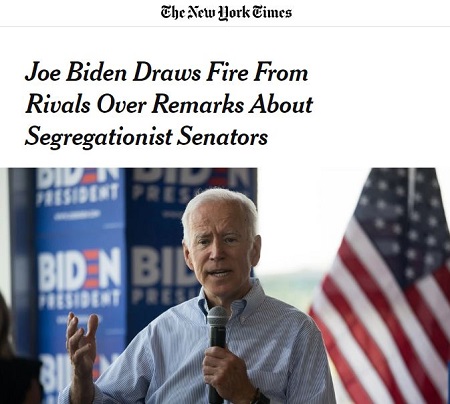
Several Democratic presidential candidates sharply criticized Joseph R. Biden Jr. on Wednesday for invoking two Southern segregationist senators by name as he defended himself over accusations of being “old-fashioned” and fondly recalled the “civility” of the Senate in the 1970s and 1980s.
Mr. Biden, speaking at a fund-raiser at the Carlyle Hotel in New York City on Tuesday night, stressed the need to “be able to reach consensus under our system,” and cast his decades in the Senate as a time of relative comity. His remarks come as some in his party say that Mr. Biden, the former vice president, is too focused on overtures to the right as he seeks the Democratic presidential nomination.
At the event, Mr. Biden noted that he served with the late Senators James O. Eastland of Mississippi and Herman Talmadge of Georgia, both Democrats who were staunch opponents of desegregation. Mr. Eastland was the powerful chair of the Senate Judiciary Committee when Mr. Biden entered the chamber in 1973.
“I was in a caucus with James O. Eastland,” said Mr. Biden, 76, slipping briefly into a Southern accent, according to a pool report from the fund-raiser. “He never called me ‘boy,’ he always called me ‘son.’”
He called Mr. Talmadge “one of the meanest guys I ever knew, you go down the list of all these guys.”
“Well guess what?” Mr. Biden continued. “At least there was some civility. We got things done. We didn’t agree on much of anything. We got things done. We got it finished. But today you look at the other side and you’re the enemy. Not the opposition, the enemy. We don’t talk to each other anymore.”
Let me remind you of the Brett Kavanaugh confirmation hearings, where a Supreme Court nominee was viciously smeared because of dubious claims about sexual misconduct in 1982, when he was 17.
That was just wrong, and it’s likewise wrong to drag Biden (or anyone else) for their political activity more than 40 years ago. Unfortunately for Biden, he was the one who raised the subject — quite deliberately — to make a point about how it is necessary, in order to accomplish anything in politics, to work with people who have very different opinions on important issues. And while this shows why Biden’s candidacy might not be the slam-dunk some pundits might think, my hunch is that this won’t actually hurt him much. Let’s face it: Lots of Democrat primary voters in Iowa and New Hampshire are probably as sick of this “social justice” identity politics stuff as we are. They want to support a Democrat who can beat Trump, and if that requires saying nice things about segregationists, well, “very fine people on both sides,” eh?
Like I said, it’s 2019, and practically everybody is “racist” according to the Left, and having Biden say this kind of stuff might help extinguish the bonfires on which the SJWs want to incinerate us all. But that wasn’t the only controversial thing Joe said Tuesday:
Former Vice President Joe Biden told affluent donors Tuesday that he wanted their support and — perhaps unlike some other Democratic presidential candidates — wouldn’t be making them political targets because of their wealth.
“Remember, I got in trouble with some of the people on my team, on the Democratic side, because I said, you know, what I’ve found is rich people are just as patriotic as poor people. Not a joke. I mean, we may not want to demonize anybody who’s made money,” Biden told about 100 well-dressed donors at the Carlyle Hotel on New York’s Upper East Side, where the hors d’oeuvres included lobster, chicken satay and crudites.
“Truth of the matter is, you all know, you all know in your gut what has to be done,” Biden said. “We can disagree in the margins. But the truth of the matter is, it’s all within our wheelhouse and nobody has to be punished. No one’s standard of living would change. Nothing would fundamentally change,” he said.
Former Clinton Treasury Secretary Robert Rubin and former Deputy Treasury Secretary Roger Altman, both of whom spent decades on Wall Street, were among the attendees at the event.
Sometimes a Democrat accidentally tells the truth.
Two Democrat senators in 1975. One of them was a segregationist. The other one drowned a girl in an Oldsmobile. Guess which one Joe Biden is in trouble for working with? pic.twitter.com/dbPwZp2dXg
A federal grand jury on Tuesday indicted two of the defendants in the killing of Anchorage teenager Cynthia Hoffman on new child pornography charges.
The indictments represent the latest twist in a tangled case involving two young people whose online relationship, prosecutors say, crossed over into real-world murder plot that drew in five Anchorage teenagers and led to the killing of a young developmentally disabled woman.
“For all the good the internet can do, it can be a very dark place,” said Bryan Schroder, the U.S. Attorney in Alaska, at a press conference in Anchorage on Tuesday. “Parents would be wise to monitor the activity of their children online.” Denali Brehmer, 18, now faces four federal child pornography charges in addition to state murder charges in the slaying of Cynthia Hoffman. Darin Schilmiller, the 21-year-old Indiana man who prosecutors say offered Brehmer $9 million to “rape and murder someone in Alaska,” was also included in the indictment announced Tuesday.
He’d already been arrested on federal child pornography offenses last week. The new indictment includes five federal charges against Schilmiller, including conspiracy to produce child pornography, production of child pornography, receipt and distribution of child pornography and coercion and enticement of a minor. . . .
Prosecutors say the murder plot was a bizarre online “catfishing” scheme in which the rural Indiana 21-year-old posed as a millionaire named “Tyler” on the internet and recruited Brehmer to kill Hoffman.
Brehmer, in turn, involved four other Anchorage teenagers in the plan, promising them money, prosecutors say.
Hoffman was taken to the Thunderbird Falls trailhead in Chugiak where she was bound with duct tape, shot and left in the Eklutna River on June 2, according to charges. Authorities say Brehmer sent Schilmiller Snapchat images of Hoffman both before and after the killing.
Hoffman’s family has said she considered Brehmer to be her best friend.
Six people have been charged in her death: Schilmiller, Brehmer, 16-year-old gunman Kayden McIntosh, 19-year-old Caleb Leyland and two unnamed juveniles. . . .
Detectives found images of Brehmer sexually abusing a 15-year-old girl, which she then shared with Schilmiller, who was posing as “Tyler.”
Text message exchanges included in other criminal complaints in the case show the Indiana man asking Brehmer to “rape” the girl, who was said to be 14 but was actually 15. . . .
The indictments do not add detail to the narrative of the killing of Hoffman, or answer the many questions about the interactions between Schilmiller, a 21-year-old from rural Indiana who had a troubling history of befriending people online only to ask them for pictures of their children.
Hey, kids, be careful about people who claim to be millionaires on the Internet. Also, don’t rape and murder people. That’s not cool.