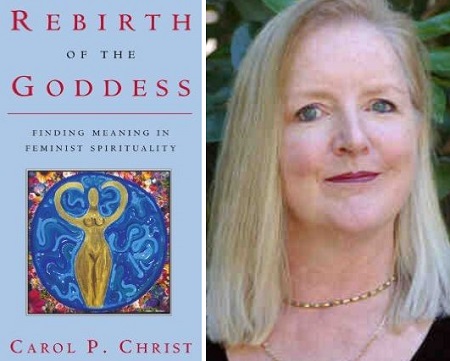
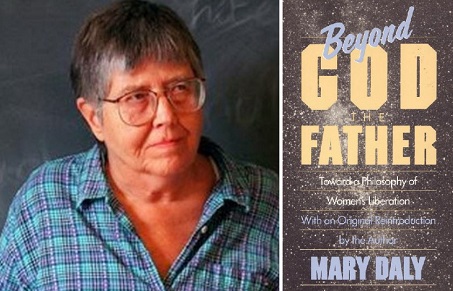
‘Rebirth of the Goddess’ author Carol Christ.
“We question the most unquestioned assumption of all, the notion that scholarship is or should be objective. . . .
“Feminists understand that the ethos of scholarly objectivity is in fact mythos. We know that there is no dispassionate, disinterested scholarship.”
— Carol P. Christ, 1997
“If life is to survive on this planet, there must be a decontamination of the Earth. I think this will be accompanied by an evolutionary process that will result in a drastic reduction of the population of males.”
— Mary Daly, 1999
A basic rule of researching feminism is that if you ever encounter an author who cites Mary Daly as a source, you know you’re dealing with a person who is (a) dishonest, (b) insane or (b) both insane and dishonest. Any intelligent person knowledgeable of abnormal psychology can read Mary Daly’s first three books — The Church and the Second Sex (1968), Beyond God the Father (1973) and Gyn/Ecology (1978) — and conclude that Professor Daly suffered a complete nervous breakdown sometime in the late 1960s, and that her subsequent work was the product of a mind destroyed by chronic schizophrenia. Any psychiatrist could read Beyond God the Father and find symptoms of Daly’s dementia on every page and, in the “reintroduction” of the second edition, published in 1985, the symptomatic word salad typical of schizophrenia is clearly in evidence.
Anyone who attempts to read Gyn/Ecology: The Metaethics of Radical Feminism, or Professor Daly’s wretched 1984 book Pure Lust: Elemental Feminist Philosophy, will discover how she produced page after page of deranged gibberish and called it “philosophy.” If Mary Daly was a philosopher, then Charles Manson is a philosopher, too.
‘Beyond God the Father’ author Mary Daly.
Only because she was a college professor, with a cult of similarly psychotic feminists willing to defend her, was Mary Daly able to continue teaching until 1999, when she was forced into retirement by a federal civil rights lawsuit over her policy of banning male students from her classes. No educated adult could take Mary Daly seriously, except as an example of how feminism (and particularly the academic fraud called Women’s Studies) serves as a breeding ground for dangerous antisocial lunacy.
Carol P. Christ, who has a Ph.D. in religious studies from Yale University, is arguably the most influential figure in “feminist spirituality.” Among other things, she is an adjunct professor of Women’s Spirituality in the department of Philosophy and Religion in the School of Consciousness and Transformation at the California Institute of Integral Studies. In 1978, at the “Great Goddess Re-emerging” conference at the University of California-Santa Cruz, she gave a speech called “Why Women Need the Goddess.” A search of Google Books shows “Why Women Need the Goddess” is cited in nearly 1,000 different books, and we find almost 400 citations in a Google Scholar search. This essay is cited in such diverse works as Professor Alison M. Jaggar’s Feminist Politics and Human Nature (1983), Professor Cynthia Eller’s Living in the Lap of the Goddess: The Feminist Spirituality Movement in America (1993), and Professor Rosemary Radford Ruether’s Goddesses and the Divine Feminine: A Western Religious History (2005). In this influential essay, Carol Christ invokes the theological authority of Mary Daly:
In Beyond God the Father, feminist theologian Mary Daly detailed the psychological and political ramifications of father religion for women.
If God in “his” heaven is a father ruling his people, then it is the “nature” of things and according to divine plan and the order of the universe that society be male dominated. Within this context, a mystification of roles takes place: The husband dominating his wife represents God “himself.” The images and values of a given society have been projected into the realm of dogmas and “Articles of Faith,” and these in turn justify the social structures which have given rise to them and which sustain their plausibility.
Leave aside, for the moment, any consideration of whether what Professor Daly claimed is true, and instead note merely this: Carol Christ cites Professor Daly’s 1973 book as if it were self-evidently true, and thus rests her argument squarely on Professor Daly’s authority. And let it not be said that Carol Christ was alone in placing total confidence in Professor Daly’s authority. Practically every feminist in academia endorsed Professor Daly’s rejection of Christianity as a “patriarchal” religion. Professor Eller writes in Living in the Lap of the Goddess (p. 47):
Mary Daly . . . led the way for many women to matriculate into feminist spirituality after long years as the perennial freshmen of the established religions. In 1971, Daly was invited to be the first woman preacher in Harvard Memorial Church. Her sermon topic was “The Women’s Movement: An Exodus Community.” She ended her sermon by walking out of the church in protest . . . and inviting the other women present to do likewise. She defended this exodus in her sermon, saying: “We cannot really belong to institutional religion as it exists. . . . Singing sexist hymns, praying to a male god breaks our spirit, makes us less than human. . . .”
This feminist rejection of established religions saw women’s oppression in patriarchal religion occurring along many axes. . . . But the entire interlocking system of oppressions was finally summed up in a single metaphor: the maleness of God. Simply put, a religion with a male god is no religion for women.
If feminism is a religion, Mary Daly was its first Pope and, as Carol Christ says, feminists reject “the notion that scholarship is or should be objective.” Claims to objectivity are merely mythos, she asserts, and “feminist spirituality” — the anti-Christian religion of which Professor Daly can be considered the founder — aims not only to destroy the mythos of scholarly objectivity, but also to create its own mythos.
What does “feminist spirituality” require? In “The Radical Theology of Feminism,” I described how Professor Daly advocated “castrating God”:
In her 1973 book Beyond God the Father, Professor Daly called for “cutting away the Supreme Phallus” (p. 19) so that “Christianity itself should be castrated” (p. 71), because “the role of liberating the human race form the original sin of sexism would seem to be precisely the role that a male symbol cannot perform. The image itself . . . functions to glorify maleness” (p. 72). Daly endorses “an ethic which transcends the most basic of role stereotypes, those of masculine/feminine,” bringing about an “androgynous world” free from “the archaic heritage of psycho-sexual dualism,” a liberation made possible by women “castrating the phallic ethic” (pp. 105-106). As bizarre as all that may sound, Daly furthermore called for a “renaming of the cosmos” by a feminist sisterhood she called the “Antichurch . . . the bringing forth into the world of New Being” (pp. 138-139). Daly continues on pg. 140:
There is a bond, then, between the significance of the women’s revolution as Antichrist and its import as Antichurch. Seen in the positive perspective in which I have presented it, as a spiritual uprising that can bring us beyond sexist myths, the Antichrist has a natural corrrelative in the coming of the Antichurch, which is the communal uprising against the social extensions of the male Incarnation myth, as this has been objectified in the structures of political power.
Daly describes this as “the Second Coming of female presence not only as Antichrist but also as Antichurch,” as a “rising woman-consciousness” that “has an organic consequence in the rejection of sexist rituals” (pp. 140-141). Daly sees this “spiritual dimension of feminist consciousness” as unleashing chaos and terror by destroying the “Christocentric cosmos”:
This women’s revolution as Antichurch represents this terror of chaos and says it will no longer kept at bay. It rejects not only the myths of patriarchy but their externalization in ritual.
So, according to Professor Daly, feminism is Antichrist, rejecting the “myth” of Jesus as the divine incarnation of God. And it is Professor Daly’s authority, we recall, which Carol Christ invoked in justifying feminism’s rejection of Christianity. Having repudiated the God of the Bible — because “a religion with a male god is no religion for women,” as Professor Eller says — where does the feminist turn for spiritual and moral guidance? In her 1997 book
The God I met in church was, like my father and grandfathers, wise and powerful, the ultimate judge in whose eyes I hoped to find favor. . . . I suppose I decided to major in religion [at Stanford University, where she got her bachelor’s degree in 1967] in the hope that I could understand God well enough to make myself acceptable to him. . . .
Several years of graduate study in theology convinced me that there was something wrong with the traditional image of God. . . . Gradually, it began to dawn on me that the image of God as Father, Son, and Spirit was at the root of the problem. . . .
As I became increasingly alienated from God as Father, I found myself unable to attend church, sing hymns, or pray. . . .
[In Berkeley, California, in 1975], when I heard the name of the Goddess in a [witchcraft] workshop led by a woman called Starhawk, I felt the experience of my entire life affirmed. . . .
A series of mystical experiences in places where the Goddess had been worshiped in ancient Greece convinced me that I had chosen the right path.
Here we have, then, a first-person narrative of how feminism leads a woman to become “increasingly alienated from God as Father.” The farther she advances in the study of theology, the less hope she has of making herself “acceptable” to a “wise and powerful” God, whose “traditional image” her feminism requires her to reject, so that she is “unable to attend church, sing hymns, or pray.” Exactly as Professor Daly said, feminism requires the castration of God — the destruction of male authority, in heaven and earth alike. Feminists have no use for a “wise and powerful” God, just as they deny that any man can have the wisdom or power necessary to exercise the fatherly authority of judgment. Having denied that the God of the Bible could have any authority over her, Carol Christ says she found “the right path” through witchcraft, as taught by Starhawk (neé Miriam Simos), high priestess of a neo-pagan feminist witchcraft cult known as the “Reclaiming” tradition. Starhawk was one of the earliest disciples of Z. Budapest (neé Zsuzsanna Emese Mokcsa), high priestess of the Dianic Wicca cult of feminist witchcraft.
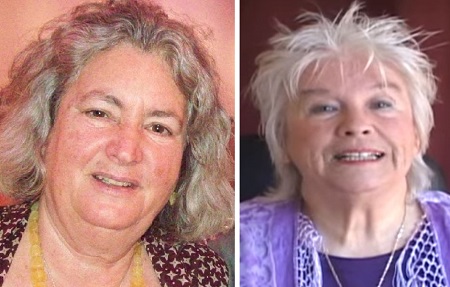
High priestesses of feminist witchcraft Starhawk (left) and Z Budapest (right).
Carol Christ would not accept the authority of the Bible, and she was “alienated” from God the Father, but she knew she had “chosen the right path” by following the Goddess of neo-pagan witchcraft. Keep in mind that Carol Christ turned to Wicca and goddess-worship after receiving her Ph.D. from Yale Divinity School. It should be noted that Yale University was founded by a group of Puritan (Congregationalist) ministers to train young men as clergy. Among the first alumni of Yale was Jonathan Edwards, who married the daughter of Yale’s chief founder, and whose most famous sermon was a classic of Calvinist doctrine, “Sinners in the Hands of an Angry God.” Yale was an all-male institution, which did not admit its first female undergraduate until 1969. Scarcely six years later, however, immediately after getting her Ph.D. at Yale, Carol Christ became a convert to neo-pagan Wicca — rapid progress, indeed! Continue reading The Myth-Making of Academic Feminism →