
What Interest Rate Would You Charge Yourself for a Loan of Monopoly Money?

This is the question posed by the Fed policy of “quantitative easing”:

The Federal Reserve’s experimental effort to spur a recovery by purchasing vast quantities of federal debt has pumped up the stock market, reduced the cost of American exports and allowed companies to borrow money at lower interest rates. . . .
The Fed limited the program to $600 billion under considerable political pressure. While that sounds like a lot of money, the purchases have not even kept pace with the government’s issuance of new debt . . .
The Fed’s decision to buy bonds, known as quantitative easing, emulated Japan’s central bank, which started buying bonds in 2001 to break a deflationary cycle.
The American version worked well at first. From November 2008 to March 2010, the Fed bought more than $1.7 trillion in mortgage and Treasury bonds . . .
As the economy sputtered last summer, Mr. Bernanke indicated in an August speech that the Fed would start a second round of quantitative easing, soon nicknamed QE 2. The initial response was the same: Asset prices rose, interest rates fell, and the dollar declined in value.

So: In the past two-and-a-half years, the Federal Reserve has printed enough currency — just created it out of thin air — to purchase $2.3 trillion in Treasury debt. You can call it “quantitative easing” if you wish, but the proper term is monetizing the debt, using inflation to hide two facts:

  1. The government can’t pay its bills, and
  2. The government also can’t get enough new credit to cover its current obligation if it were forced to rely entirely on loans from (i.e., bond sales to) private investors.

Without this Fed bond-buying policy, the government would be paying higher rates to service its debt, which cost would then result in higher interest rates for everyone. By making the Fed the default consumer for Treasury bonds, then, “quantitative easing” artificially lowers interest rates, which would otherwise rise to reflect the oversupply (or under-demand) for U.S. debt. And the actual cost of this policy is simple: Inflation.

The failure of QE2 to have the as much Keynesian “stimulus” effect as hoped for (this failure being the main topic of the article quoted) is reflective of the fact that, while the Fed can print money, it does not thereby create wealth, and the resulting inflation is a drain on the national economy.

Why is the effect of “quantitative easing” on my mind today? Here’s Peter Suderman of Reason magazine:

The administration is arguing that we shouldn’t worry about a debt crisis because investors are demanding low interest rates in exchange for loaning money to America. The argument is that if investors were actually worried about the long-term U.S. fiscal outlook, they would be expressing that concern by demanding a higher rate of return. Essentially, the administration is arguing that we can safely use interest rates as a warning system.

But wait: If  a rise in interest rates would signal the onset of a debt crisis (i.e., government’s solvency being threatened by a reluctance of private investors to buy bonds), and if “quantitative easing” artificially lowers interest rates, isn’t it possible that QE and QE2 represent efforts to obscure the market signals of U.S. debt problems?

Even with a $2.3 trillion price-tag, the Fed’s inflationary intervention has been a modest monetary Band-Aid on a very large fiscal wound. And if that Band-Aid holding down interest rates should come unglued, as Suderman says, the hemorrhage of a full-blown debt crisis may hit quite suddenly.

Monday’s warning from Standard & Poors about the long-term prospects for U.S. sovereign debt reflects the inherent risks of the game that Ben Bernanke and Tim Geithner have been playing with fiscal and monetary policy. Matt Welch points out that the reaction by liberals — from the HuffPo’s R.J. Eskow to the Atlantic‘s James Fallows — was to derogate S&P. (Hat-tip: Instapundit.)

Let them scoff all they want, but the fact remains that these Monopoly-money manipulations cannot continue forever. If the current policy of massive deficit spending continues, the supply of new Treasury debt will eventually outstrip investor demand to the point that these Bernanke-Geithner “quantitative easing” games won’t be able to hide the gap, at which point higher interest rates will be required. What Team Obama is counting on is that either:

A. The day of reckoning can be postponed past Nov. 6, 2012; or
B. If the day of reckoning comes early, they can somehow pin the blame on Republicans.

The prospects of a return to Carter-style “stagflation” are very real, and the denouement may be even uglier than that. The current policy is unsustainable in the long term and the longer it continues, the closer we get to the point when “the long term” becomes tomorrow.
UPDATE: “But how in the world did Mrs. Palin, who is supposed to be so thick, manage to figure all this out so far ahead of the New York Times and all the economists it talked to?”


The Futility of Class Warfare Rhetoric

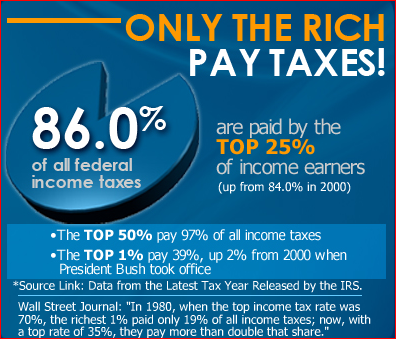
Graphic: RushLimbaugh.com via Hot Air Pundit

Demonizing the rich may work as politics for Democrats, but the problem is that it fails as policy. One could argue that Americans are undertaxed in general, and that some kind of across-the-board rate increase (or closing of loopholes) is therefore necessary for the purpose of enhancing federal revenue to eliminate the deficit.

When I say “one could argue” this, I don’t actually mean to make such an argument. My belief is that overspending, not undertaxation, is to blame for the deficit. However, if liberals wish to make deficit reduction the putative goal of their argument for raising taxes, they must base that argument on an assertion of general undertaxation and a need for across-the-board increases, rather than attempting to persuade Americans that the rich in particular need to pay more taxes. If the top 25% of earners pay 86% of all federal income taxes, and the bottom 50% of earners provide only 3% of such revenue, how can anyone plausibly claim that the budget deficit is a result of “tax cuts for the rich”? This is especially so because, as the chart above points out, the share of taxes paid by the “rich” actually increased during Bush’s presidency.

Well, they’re liberals — no fair citing facts. Continue reading The Futility of Class Warfare Rhetoric →

One Can Admire Norquist’s Sadism, But We’re Still Beating Around The Bush

by Smitty

To raise the debt ceiling, or not? National Review has a bunch of opinions from the wise guys. I can imagine Sprinklerman listening to Norquist:

My preference would be to keep the administration on a short leash and extend the debt limit by only a small amount and for a short period of time. This debt-limit increase is one of the few pieces of legislation that Obama must sign. Why not have such an extension every month and attach to each of them something small, reasonable, and related to debt or spending?

and then sending a bill from the House to the Petulant Desk, and BHO saying, “Yeah, we’ll just over-ride that with a signing statement.”
Listen, Norquist: if you want to be for tax reform, then be for tax reform. Taxation and spending are symptomatic of the notion that DC is a cosmic nipple from which milk and honey should flow. Use this debt ceiling vote to lay the foundations for load-shedding the federal over-reach that you know is really driving the problem. The Ruling Class continues its incessant campaign of beating around the bush.

Tax Day 2011

It is no small irony that Tax Day came late this year because on Friday, Washington, D.C., celebrated “Emancipation Day.” The Lonely Conservative:

Isn’t it nice to know that so many of our fellow Americans pay no federal taxes?

The Associated Press article linked does not make clear that most of these non-taxpayers are low-income households, many of whom are exempted from taxation because of the child tax credits that are the one part of the “Bush tax cuts” nobody ever seems to talk about. As a father of six (our youngest was born in 2002, the year the credits took effect) I love those credits!

As for the Obama idea that we can balance the budget by hiking taxes on “millionaires and billionaires” — hey, do they teach math at Harvard Law School?

If there are any guilt-stricken billionaires out there who think their taxes are too low, just hit my tip jar. It’s for the children!

The Ryan Budget

I’m tempted to call it “The Savage Young Ryan Budget,” but seriously, folks: House Republicans did the smart thing yesterday, and don’t let worry-wart Allahpundit tell you any different.

Not a single Democrat voted for it, and DCCC Chairman Steve Israel’s boast that this will help Democrats recapture the House is nonsense. Let the Democrats spend the next 18 months trying to demagogue entitlement reform all they want — the pressure is now actually on Senate Democrats for 2012.

The willingness of the House GOP to lay down a marker — take a vote on a definite proposal for fixing the entitlement mess — shows they’ve learned the lessons of 2005-06, when Republicans botched the entitlement-reform debate.

Here’s what most people miss about that: The Republicans controlled the House, and Tom Delay could have rammed through any proposal that the White House wanted. But the GOP wanted to play defense, so it was decided that the thing to do was (a) to send Bush out giving a lot of speeches about entitlement reform, and (b) let the Senate do a lot of debating about entitlement reform.

Talk, talk, talk — and the Senate never passed anything, so there was never any specific plan on the table, with numbers and stuff, that people could look at see what was actually being proposed. Democrats got an opportunity to do their usual demagoguery — “Those evil Republicans want to take away Granny’s Social Security check!” — without ever being forced to vote up-or-down on anything.

The House vote to approve the Ryan budget changes that. Now the Democrats who control the Senate have before them a specific plan, already approved by the House, upon which they can now be pressured to act. And with Democrats defending lots of vulnerable Senate seats in 2012, the question becomes: Where’s Harry Reid’s budget?

No more “talk, talk, talk,” you see. Reid can’t just kick the can down the road like he did last year, when he and Nancy Pelosi decided not even to pass an FY 2011 budget, because they wanted to play politics instead. Paul Ryan and the House GOP just called Harry’s bluff.

Obama’s gimmicky and unrealistic “framework” for deficit-reduction won’t work as actual legislation. Harry Reid and the Democrat-controlled Senate are going to have to come up with an honest-to-goodness budget, and the House is going to be sending over appropriations bills that will require senators to take votes, if the federal government is to be funded for FY2012.

Actual legislation. Actual votes.

The fun-and-games of just talk, talk, talking is over. And I’m convinced that Harry Reid can’t match the determination of the House Republicans, so there’s no way the Democrats can “win” this part of the process.

The American people aren’t as stupid as Democrats think.

Boehner’s Bargain Approved 260-167; 59 Republicans Vote ‘No,’ 81 Dems Vote ‘Yes’

Reported by Robert Costa at National Review, noting that Michelle Bachmann, Mike Pence and Allen West were among the Republican “no” votes, while the Democrats voting “yes” included Debbie Wasserman-Schultz.

Y’know, I think that pretty much settles the argument of whether this was a good deal from the conservative perspective.

Debbie Wasserman-Schultz voted for it, OK? I rest my case.

More at The Hill and the Washington Post, via Memeorandum.

UPDATE: Allahpundit notes that the 59 Republican “no” votes would have been enough to kill the bill without Democrats voting “yes” and asks:

Were they afraid Obama would look bad if they torpedoed a deal he signed off on? Or are there still enough Democrats left in purplish districts that they wanted to bank some budget-cutting cred ahead of next year’s elections?

UPDATE II: Jim Antle at The American Spectator goes over the list of 59 Republican “no” votes and notes that (a) only 27 of 87 GOP freshmen voted “no”; and (b) five of the GOP “no” votes are members of the Appropriations Committee. Looking at the list, I’m happy to see the names of Chip Cravaack and Morgan Griffith, both of whom this blog promoted during the 2010 campaign, plus Thad McCotter (perhaps Smitty’s favorite congressman), and my own Maryland Rep. Roscoe Bartlett.

‘No Poor Man Ever Gave Me a Job’

As an impoverished American — hey, buddy, you wanna try raising six kids on a freelance journalist’s income? — I look on in amusement at the self-described “Patriotic Millionaires” who insist that they should pay more taxes. I agree with Moe Lane: “Raise Your Own Damned Taxes.”

Contrary to all the class-warfare demagoguery pouring forth from Democrats and the media (but I repeat myself), conservatives do not oppose tax increases because we are beholden to the rich. Rather, the question is whether wealth does more good when it is invested in the private sector, to create jobs and economic growth, or surrendered to the federal government as taxes to support the metastatic growth of a pestiferous bureaucracy. Rich liberals have always failed to understand blue-collar conservatism, seeking to explain away working-class support of free enterprise as the consequence of a proto-fascist “Authoritarian Personality” or (more recently), bitter gun-and-Bible clinging.

Permit me to remind you exactly how old this game is:

“If you dismiss a priori the possibility that there are rational grounds for resisting the Liberal view of things, one necessarily looks elsewhere than to reason for explanations,” Buckley wrote in his 1959 classic, Up From Liberalism. Buckley observed that “one needs no advanced degrees in clinical psychology and psychoanalytic theory in order to penetrate the fallacy of The Authoritarian Personality” — the most famous work of Adorno, a leader of what has become known as the Frankfurt School of political theory.
Adorno claimed to have proven scientifically that American conservatism was rooted in psychological maladjustment, fostering a tendency toward authoritarianism, which he asserted was the fundamental source of European fascism.
However, as Buckley explained, Adorno’s argument was a tautology based on the implicit presumption that all opposition to liberalism was illegitimate and therefore irrational. Adorno’s theory was “marvelously convenient” for liberals, Buckley said, and it has been recycled periodically ever since.

In fact, whatever the cultural component of conservatism, the Ordinary American’s resistance to redistributionist Welfare State policies is rooted in a common-sense view once magnificently expressed by Ronald Reagan: “No poor man ever gave me a job.” Continue reading ‘No Poor Man Ever Gave Me a Job’ →

It’s a ‘Framework,’ Not a ‘Plan’

Last night I glanced at the White House talking-points outline of Obama’s Big Important Speech and had to smile at the effrontery of this part:

$4 Trillion in Deficit Reduction: The President is setting a goal of reducing our deficit by $4 trillion in 12 years or less. This deficit reduction would be phased in over time to protect and strengthen our economic recovery and the recovering labor market.

A very old Beltway trick: First, project the budget waaaayyy out in the future, where hypothetical rates of economic growth are always robust, revenue gains are inevitably encouraging and political opposition magically vanishes.

Next, propose reductions in spending that only get semi-drastic in the far-off-in-the-future years of such a forecast.

Voila! You’ve “reduced the deficit” by an Impressively Large Number!

Except, of course, that you haven’t done any such thing. Because (a) the anticipated economic growth never matches the hypothetical forecast, (b) the cuts in spending you “projected” to make six, eight, 10 years in the future don’t actually happen, and instead (c) spending continues to grow due to what’s known as “baseline budgeting.”

So it’s easy as pie to do what Team Obama has done here: Propose $4 trillion in deficit-reduction over 12 years, which when you do the math only amounts to $333 billion a year in spending “cuts” (or tax increases), except that trying to apply math to this “framework” is hopeless, because we’ve got no freaking clue what the economy is going to be doing in 2022 — by which time, of course, Obama will have long since become a very wealthy ex-president who can play golf even more than he does now.

Speaking of the Impressively Large Number trick, here’s another timeless variation: Just make up some numbers.

Call it $38 billion and if it’s actually only $334 million — hey, the president already called it “historic,” so who’s going to notice the discrepancy?

UPDATE: William Teach at Pirate’s Cove calls attention to the fact that Dan Balz of the Washington Post recognized The Big Speech as mere campaign politics.