Texas Gov. Rick Perry kicked off his presidential campaign with an aggressive fundraising schedule that quickly made him a front-runner for the Republican nomination. But reports his campaign filed with the Federal Election Commission show that his ability to attract big money fell off steeply in September — perhaps not coincidentally — at the same time a series of rocky debate performances threatened his early front-runner status.
As Perry arrives on Friday in Washington for a private meeting with K Street insiders, the question is whether he can convince the smart money that his campaign is worth an investment. After three torrid weeks in August when he raised more than twice as much as his nearest fundraising rival, Perry has now fallen back into a much more competitive fundraising race with Mitt Romney. That is not good news for a candidate who, because of his late entry into the race, has a lot of catching up to do. Romney has raised $32 million since the beginning of this campaign cycle.
If you think back to when the Perry bandwagon got rolling (less than 10 weeks ago, although it seems like ancient history now), the perception of inevitability was central to the argument: The Smilin’ Texan was it — The Man, the Real Deal — and everybody else was supposed to gaze in awe while Perry proceeded to dismantle Romney. Continue reading Money Problems for Rick Perry? Also: Thoughts on the Logic of Strategy →
The National Affairs Desk, in the smoking lounge at
Dulles International Airport, 1:10 p.m., Monday, Oct. 17, 2011
DULLES INTERNATIONAL AIRPORT
Less than hour until final boarding for my flight to LAX en route to Vegas, and no time to waste on trivia now. While I was checking in the one-way rental car ($164), I was on the phone with Sarah Rumpf, who told me a bizarre reverse-angle on the Rubio/Romney conspiracy theory. Pagan Temple had picked this out of Javier’s post earlier:
Convoluting matters further, one of Perry’s top campaign consultants was also Governor Charlie Crist’s consultant during the 2010 Senate race before Crist jumped ship and ran as an Independent, and that Perry’s Florida team was being led by Rich Heffley, Jim Rimes and Randy Enwright. Heffley was responsible for fabricating the infamous “truthaboutRubio” attack website against now Senator Rubio.
Get it? Sarah has a post about this that provides links to the dots – including Javier’s post from Friday – but leaves it to the reader to imagine how those dots might be connected. What am I getting at? Some of Rubio’s allies suspect that the Crist/LeMieux/Perry forces in Florida, eager to strike a blow against Romney, and also damage the hated Rubio, spread the rumor of a Romney/Rubio conspiracy to move up Florida’s primary to Jan. 31. By blaming it on Rubio’s chief of staff, Cesar Conda, they help LeMieux in next year’s Senate primary, because Rubio is also viewed as an ally of Adam Hasner.
Rubio has tried to stay officially neutral in both the presidential primary and the Florida Senate primary but – if this connect-the-dots theory is true – somebody in Team Perry managed to spread a damaging rumor in such a way that they must have known would reach me. Because I had solid sources telling me as first-hand knowledge that the Romney/Rubio conspiracy (with Conda as the middleman) was true. Were my sources duped? Or were they part of the Perry plot? Or is the original conspiracy theory true, and this new reverse-angle theory a defensive spin to protect Romney’s operation in Florida? The fact that Rich Heffley was one of the first Florida operatives hired by Team Perry suggests the possibility of dirty tricks, and by now the possibilities have multiplied so much I don’t know who or what to believe.
You see that we’re deep into savage weirdness at this point and, of course, when the going gets weird, the weird turn pro. But now I’ve got less than half an hour until they call final boarding, so I’ll have to leave all that for later, and finish with the Five Most Important Words in the English Language: Hit the freaking tip jar!
Those were the first four words of Texas Gov. Rick Perry’s announcement speech at the Red State Gathering in Charleston, S.C., on Aug. 13. At the time, I was the only one who saw Perry’s diss of Iowa Republicans — his deliberate attempt to upstage the Ames Straw Poll held the same day — as an ominous portent of doom.
Perry’s decision to make his announcement in South Carolina was widely viewed at the time as a genius move that would lock down his support in a crucial early primary state, and once he emerged as the most viable conservative alternative to Mitt Romney, Perry would have no trouble making up whatever he’d lost in Iowa by dissing Ames.
Such was the conventional wisdom in August, but now today (via Wombat’s “Live at Five” aggregation) we see this headline:
Cain Takes Lead In South Carolina
ATLANTA — Herman Cain holds a decisive lead in the South Carolina Republican primary, according to a survey conducted Sunday for The Augusta Chronicle.
The InsiderAdvantage/Majority Opinion Research poll of 476 registered voters likely to vote in the GOP primary gave Cain 32 percent, twice the share of Mitt Romney’s 16. Rick Perry holds12 percent, making him essentially tied with Romney because the difference is within the 5 percent margin of error.
“In this case, South Carolina is a three-man race,” said InsiderAdvantage CEO Matt Towery. . . .
In a telephone conversation over the weekend, a Perry supporter tried to convince me that the Texas governor is still the only viable alternative to Romney, that Herman Cain can’t possibly win the nomination, and that anyone who is supporting any candidate other than Perry is therefore effectively pro-Romney.
I’m a complete idiot who knows nothing about politics or blogging (just ask Tabitha Hale), so it is beyond my ability to explain that, or to fathom why Rick “Viable Alternative” Perry is in sixth place — trailing Jon Huntsman! — in the recent New Hampshire polls.
Maybe Rick Perry will have bought $15 million worth of debate mojo, and maybe Herman Cain will have forgotten how to tie his own shoes. And then all the bloggers in Denver can laugh at me some more, just like you’ve been laughing at me all along.
Being the guy who has been talking up Herman Cain since Nov. 13, 2010, pretty much guarantees nobody will give you credit when the impossible actually happens:
Fueled by Tea Party supporters, conservatives and high-interest GOP primary voters, former Godfather’s Pizza CEO Herman Cain now leads the race for the Republican presidential nomination, according to the latest NBC News/Wall Street Journal poll. . . .
Cain checks in as the first choice of 27 percent of Republican voters in the poll, followed by former Massachusetts Gov. Mitt Romney at 23 percent and Perry at 16 percent. . . .
In the previous survey, conducted in late August, Perry led the field at 38 percent, Romney stood at 23 percent, while Cain was at only 5 percent.
In the span of six weeks, Cain has gained 22 points and Perry has lost 22 points. And so the guy I started boosting 11 months ago is trouncing the guy whom I dubbed “The Phantom Menace” three months ago. But no linky-love for the Blogger Whom Allah Hateth. Instead, we get this kind of contingency/hypothetical doomsaying:
Even if Cain pulls the upset in South Carolina — which isn’t impossible given its social conservatism and Cain’s southern roots — how does he compete with Romney in a state as expensive as Florida and in the dozens of primaries that’ll follow that? . . .
Via Greg Hengler, here’s a “3 a.m. phone call” compare-and-contrast between Cain and Gingrich on the subject of how they’d handle the Iranian terror plot. This sort of thing — plus the fact that his 9-9-9 plan has alienated tax warriors like Grover Norquist — could knock Cain back enough by the time Iowa arrives to restore Perry to frontrunner status in the all-important “Not Romney” competition. Problem is, I have no confidence that Perry’s answer to this question would be any better than Cain’s. And, giving how Perry tends to avoid interviews, he probably doesn’t have any confidence either. Exit question: Second look at Gingrich?
Resisting the temptation to blame raaaaacism for all these doubts about Cain — whose emergence as front-runner none of the “smart” pundits ever imagined possible — I’ll instead attribute it to their unwillingness to speak the Four Dreaded Words: “Stacy McCain Was Right.”
Hi Robert,
You have been issued credentials. Please note:
The credential will grant journalists access to the press filing center and media spin room, which will be located in Hall G of the Sands Expo and Convention Center.
###
Jennifer A. Scoggins
CNN Washington
My flight is already booked, departing Monday from Dulles International via LAX to Vegas. After last night’s debate in New Hampshire, this CNN debate in Las Vegas is sure to be a pivotal event in the 2012 presidential campaign. Via Memeorandum, a few headlines:
Maybe that last headline isn’t quite so obviously relevant, from a strictly political perspective. But you see the basic point: The fate of a nation hangs in the balance as this critical Las Vegas debate looms ahead.
Full text of a press release sent by the Bachmann campaign last night:
Perry and the Texas Strategy for the Economy
Rick Perry’s biggest weakness is on the highest priority issue at stake in 2012: he’s not a fiscal conservative.
Rick Perry is not fiscally conservative on spending and debt.
1. During Rick Perry’s tenure as governor, real spending in the state budget increased nearly 50 percent. In the 2000-01 biennium, real spending in the Texas state budget (adjusted to 2009 dollars) was $122.71 billion. In 2010-11 biennium, real spending in the Texas state budget was $182.02 billion, an increase of 48.33 percent. (Texas State Legislature, 76th Legislative Session, Conference Committee Report on H.B. 1 As Modified by S.B. 4 and Governor’s Veto Proclamation and Contingent Appropriations Included in H.B. 3211, Available at: www.lbb.state.tx.us; Texas State Legislature, 81st Legislative Session, Conference Committee Report on S.B.1, Available at: http://www.lbb.state.tx.us/Bill_81/5_Conference/Bill-81-5_Conference_0509.pdf; Governor Rick Perry, S.B. 1 Veto Proclamation, 6/19/09, Available at: www.governor.state.tx.us; U.S. Labor Department’s Bureau of Labor Statistics Inflation Calculator, Available at: www.bls.gov)
2. During Rick Perry’s tenure as governor, real per capita spending in the state budget increased more than 20 percent. In the 2000-01 biennium, real per capita spending (adjusted to 2009 dollars) in the Texas state budget was $5,800.53. In the 2010-11 biennium, real Per capita spending in the Texas state budget was $7,102.17, an increase of 22.44 percent. (Texas State Legislature, 76th Legislative Session, Conference Committee Report on H.B. 1 As Modified by S.B. 4 and Governor’s Veto Proclamation and Contingent Appropriations Included in H.B. 3211, Available at: www.lbb.state.tx.us; Texas State Legislature, 81st Legislative Session, Conference Committee Report on S.B.1, Available at: http://www.lbb.state.tx.us/Bill_81/5_Conference/Bill-81-5_Conference_0509.pdf; Governor Rick Perry, S.B. 1 Veto Proclamation, 6/19/09, Available at: www.governor.state.tx.us; U.S. Labor Department’s Bureau of Labor Statistics Inflation Calculator, Available at: www.bls.gov; Texas State Comptroller Of Public Accounts, 2008 Comprehensive Annual Financial Report for the State of Texas, p. 252, Available at: www.window.state.tx.us; Texas Department of State Health Services Website, Projected Texas Population by Area, Available at: www.dshs.state.tx.us)
3. State government employees grew faster under Perry than federal government employees (U.S. Census Bureau website, www.census.gov, accessed 7/09):
From March 2000 to March 2007, the number of Texas state government employees increased 10.07 percent, from 303,795 to 334,378.
According to U.S. Census Bureau estimates, from July 2000 to July 2007, the population of Texas increased 13.83%, from 20,946,049 to 23,843,432.
From March 2000 to March 2007, the number of civilian federal government employees decreased 5.83%, from 2,899,000 to 2,730,000.
According to U.S. Census Bureau Estimates, from July 2000 to July 2007, the population of the U.S. increased 6.78%, from 282,171,936 to 301,290,332.
4. During Rick Perry’s tenure as governor, bonded debt has increased 137 percent. In FY 2000, bonded debt in Texas was $13.2 billion. In FY 2008, bonded debt in Texas was $31.3 billion. (“Debt Affordability Study,” Texas Bond Review Board, 2/09, p.4 Available at: www.brb.state.tx.us)
5. Perry signed the largest state budget into law – $182.3 billion – using his line item veto sparingly:
“With little debate, the Texas House passed its largest budget ever Friday, a day after senators also breezed through the $182.3 billion plan for the next two years.” (Aman Batheja, “Texas House approves $182.3 billion state budget,” Fort Worth Star-Telegram, 5/30/09)
“Gov. Rick Perry, muting his usual criticism, generally praised lawmakers and signed into law a two-year, $182.3 billion budget late Friday after making barely a change. The Republican governor took credit for slashing nearly $290 million of spending, but virtually all of the money wouldn’t have been spent anyway because it was part of bills that died, such as a proposal to expand the Children’s Health Insurance Program.” (Robert T. Garrett, “Perry shows restraint — on his own line-item vetoes of budget,” The Dallas Morning News’ “Trail Blazers” Blog, http://trailblazersblog.dallasnews.com, 6/20/09)
“He used his veto pen to remove from the budget 28 ‘contingency riders’ — 25 of which would have paid for bills that died before the session ended June 1. Three others would have funded bills that Perry vetoed. While he didn’t mention it, there would have been a net savings of some $12 million if all three had become law, the proclamation indicates.” (Robert T. Garrett, “Perry shows restraint — on his own line-item vetoes of budget,” Dallas Morning News’ “Trail Blazers” Blog, http://trailblazersblog.dallasnews.com, 6/20/09)
6. Despite criticizing President Obama’s stimulus bill (the American Recovery and Reinvestment Act of 2009) as a “bailout,” Perry’s spokeswoman said he would “fight” for Texas’ “fair share” of stimulus if bill passed and lobbied for funds:
“Democratic Rep. James Oberstar of Minnesota recently asked Texas transportation officials if they intended to reject their share of $30 billion in road and bridge funds. Their answer: nope. ‘The governor has been pretty clear that he thinks it is bad policy and does not support it,’ said Allison Castle, a Perry spokeswoman. ‘But he has said that if Washington is going to be sending out taxpayer dollars, a large portion of which is Texas taxpayer dollars, we’ll fight for our fair share.'” (Dave Michaels, “Perry Blasts ‘Bailout Mentality’ But Will Take Texas’ Share,” Dallas Morning News, 1/30/09)
“For months, Gov. Rick Perry has been an outspoken opponent of emergency spending measures that created a record federal deficit. At the same time, his Transportation Department has lobbied to maximize its haul of federal money from an $819 billion stimulus bill.” (Dave Michaels, “Perry Blasts ‘Bailout Mentality’ But Will Take Texas’ Share,” Dallas Morning News, 1/30/09)
7. According to national conference of state legislatures, Perry’s Texas used stimulus money to plug more of its budget gap than any other state. “[National Conference of State Legislatures] asked states to indicate the major actions they took to close FY 2010 budget gaps and the relative share of the total that each action represented. The information provided by the 35 reporting states is as follows: Twenty-five of the reporting states used federal ARRA funds as part of their solution to close FY 2010 budget gaps. … The states depending most heavily on these funds were Texas (ARRA represented 96.7 percent of the total solution) and Nebraska (88 percent of the total solution).” (“State Budget Update: July 2009,” National Conference of State Legislatures, p. 7, www.ncsl.org)
8. Perry claimed he opposed using stimulus funds for ongoing expenditures, but used the funds for permanent public school teacher pay raises:
In a February 2009 letter to President Obama, Perry said he opposed use of stimulus funds for “ongoing expenditures.” “On behalf of the people of Texas, please allow this letter to certify that we will accept the funds in H.R. 1 and use them to
promote economic growth and create jobs in a fiscally responsible manner that is in the best interest of Texas taxpayers. I remain opposed to using these funds to expand existing government programs, burdening the state with ongoing expenditures long after the funding has dried up.” (Gov. Rick Perry, Letter To President Barack Obama, 2/19/09)
Perry rejected federal some stimulus funds, claiming the strings attached would leave Texas paying the bill after the stimulus ran out, but ultimately used stimulus funds for permanent public school teacher pay raises. “That will become apparent in 2011 when legislators have to fill in the budget hole left when the stimulus dollars go away. The teacher pay raises will be a permanent fixture, as will other spending enabled by the stimulus money. … There are no projections about where to find the money, but it will either come from taxpayers or from school budget cuts.” (Editorial, “Strings Attached To Stimulus Money For Schools,” Fort Worth Star-Telegram, 7/28/09)
Raises are expected to cost state $2.8 billion in 2012-13 budget. “The Legislative Budget Board estimates the cost for the 2012-13 budget at $2.8 billion.” (Editorial, “Strings Attached To Stimulus Money For Schools,” Fort Worth Star-Telegram, 7/28/09)
9. Texas received low marks for stimulus spending transparency in the July 2009 Good Jobs First Report. “Texas doesn’t get high marks for transparency on its official Web sites tracking how federal stimulus money is spent here. The Washington, D.C.-based group Good Jobs First gave Texas a 15 (out of 100) for how transparent its main stimulus tracking Web site was; Texas did better with its site tracking transportation stimulus dollars, earning 40 points out of a possible 100 points. State policymakers maybe can take some comfort that they are not alone in getting dinged for the relative openness with which they disclose how stimulus money is being spent.” (John Reynolds, “Texas Scores Low Marks On Stimulus Spending Transparency,” Quorum Report, 7/29/09)
10. Perry’s “political machine” received an infusion of stimulus money:
“And those grants have become an integral part of Perry’s political machine….While Perry’s office is the conduit for the federal money [for local law enforcement agencies], the governor chooses which agencies receive the money and how it is spent. The political payoff has been great.” (R.G. Ratcliffe, “Perry Making Use of Stimulus Boost,” Houston Chronicle, 9/8/09)
“Every time Perry doles out the federal Byrne grants, he sounds like the money is his. ‘Texas is tough on crime and remains dedicated to equipping our law enforcement with the resources necessary to protect our citizens and ensure the safety of our communities,’ the governor said while handing out $2 million of the federal money to East Texas communities last year.” (R.G. Ratcliffe, “Perry Making Use Of Stimulus Boost,” Houston Chronicle, 9/8/09)
Byrne Grants helped Perry win the endorsement of the Border Sheriff’s Coalition in 2006. “Perry in 2005 gave $6 million in funds to the counties participating in the Texas Border Sheriff’s Coalition ‘to deter illegal immigration and prevent border-related crime.’ Days before Perry’s 2006 re-election victory, the sheriffs made a high-profile trip to Washington with the governor to discuss border crime, and most endorsed Perry. ‘I don’t think it was a coincidence that the grants roughly correlated with those endorsements,’ said Democratic political consultant Jason Stanford, who managed the gubernatorial campaign of party nominee Chris Bell.” (R.G. Ratcliffe, “Perry Making Use Of Stimulus Boost,” Houston Chronicle, 9/8/09)
11. Perry was played both sides in the fall 2008 debate over the TARP bailout:
Perry wrote a letter to Congress urging support of “An Economic Recovery Package” in the middle of the TARP debate. “[The Letter] Was Widely Interpreted Wednesday To Mean That Perry And His Democratic Counterpart Supported The Revised Bailout Plan The Senate Passed.” “Perry, who chairs the Republican Governors Association, wrote a letter with West Virginia Gov. Joe Manchin, chairman of the Democratic Governors Association , urging members of Congress to ‘leave partisanship at the door and pass an economic recovery package.’ That was widely interpreted Wednesday to mean that Perry and his Democratic counterpart supported the revised bailout plan the Senate passed.” (Jason Embry, “Perry’s Stand On Bailout Could Figure In 2010 Governor’s Race,” Austin American-Statesman, 10/3/2008)
The same day he released the letter with Manchin, Perry sent out a statement condemning the bailout. “In October, Mr. Perry, as chairman of the Republican Governors Association, and his Democratic counterpart, Joe Manchin of West Virginia, issued an urgent appeal for Congress to ‘pass an economic recovery package.’ Congress did. But when Ms. Hutchison said she’d be voting for it, the Texas governor issued another statement: ‘Government should not be in the business of using taxpayer dollars to bail out corporate America.'” (Wayne Slater, “Quick Take: Governor’s Jab At Washington Pokes His Potential Political Rival,” Dallas Morning News, 11/21/08)
When it rains, it pours, and with Rick Perry slipping into third place in the latest Gallup Poll, the deluge of pain comes pouring down. Here’s a press release that’s got to have Team Perry on suicide watch:
Verona, PA – Former Senator Rick Santorum (R-PA) announced the additions of Sheila Murphy and Kip Murphy to his Iowa campaign team to coordinate campaign operations in Southwest Iowa and to advise in the area of statewide field operations.
Prior to the Iowa Straw Poll, Kip Murphy worked as part of the “Americans for Rick Perry” organization helping to lay the groundwork for an entrance into the presidential race. However, since that time, both the Murphys have selected Rick Santorum as their choice for the GOP nomination, citing both Santorum’s substantive policy stands and his campaign style and strategies.
Sheila Murphy said, “I am excited to join the team of the hardest working candidate in the GOP field. Senator Santorum’s relentless campaign energy has set him apart. Senator Rick Santorum understands that Iowa Republicans are looking for a candidate who is conservative in both word and deed and he is working tirelessly to bring this message to all corners of Iowa. I am confident that Iowa voters will see as I do that Rick Santorum is the complete conservative- strong on every issue- solid in every way. This will resonate with Iowa voters and drive the campaign to victory at the caucuses.”
Kip Murphy said, “Senator Santorum has not taken any Iowa votes for granted. He has not just campaigned in the major media markets, but has visited the rural Iowa counties and talked to all Iowa voters. Senator Santorum appreciates the important role Iowa plays in the nominating process and has taken his conservative message straight to Iowa voters. I am looking forward to helping Senator Santorum transform this hard work into victory at the Iowa caucuses.”
Senator Santorum said, “Sheila and Kip are among the hardest working activists in western Iowa. They have proven to be super-organizers and well respected conservatives in a critical part of the First-in-the-Nation caucus state. I am looking forward to working with both Sheila and Kip as we move to victory in the Iowa caucuses.”
The brother and sister consulting team are originally from Nebraska where Kip Murphy served as Statewide Field Director for the Nebraska Republican Party and as Field Director for the Lee Terry for Congress Campaign. Sheila Murphy served as Statewide Field Director for Victory 2000 for the Nebraska Republican Party.
Sheila Murphy is currently the Republican Chairwoman of Harrison County. She previously served as campaign manager for Brenna Findley’s 2010 campaign for Iowa Attorney General and as political director for Rod Robert’s 2010 gubernatorial campaign.
Kip Murphy previously served as Victory director for the southwest Iowa field office of the Republican Party of Iowa, as well as field director for the Rod Robert’s gubernatorial campaign and numerous campaigns throughout Iowa and the Midwest.
These are both experienced Iowa operatives, one of whom formerly supported Perry, joining a campaign that raised about $600,000 in the third quarter. That’s what you’d call a “hint.”
Remember that Perry began his campaign with a gigantic diss to the Iowa GOP, skipping the Ames Straw Poll to make his announcement with his buddies in South Carolina. (According to the official transcript, Perry’s Aug. 13 announcement speech began, “Howdy. Thank you, Erick.”) Nobody figured dissing Iowa would really hurt Perry much, back when he was on top of the polls — leading Mitt Romney by as many as 19 points in early September — but now?
Perry’s in single digits in New Hampshire, and Santorum’s held more events in Iowa than any other candidate in the field, including Bachmann (who practically moved to Iowa this summer). What happens if former front-runner Perry finishes third, fourth or even fifth in Iowa, then goes to New Hampshire — with an aura of defeat already dogging his every step — and gets beaten silly again?
Perry’s got $17 million in the bank, so it’s probably way too soon to make some kind of “no path to victory” statement, but . . . Dude.
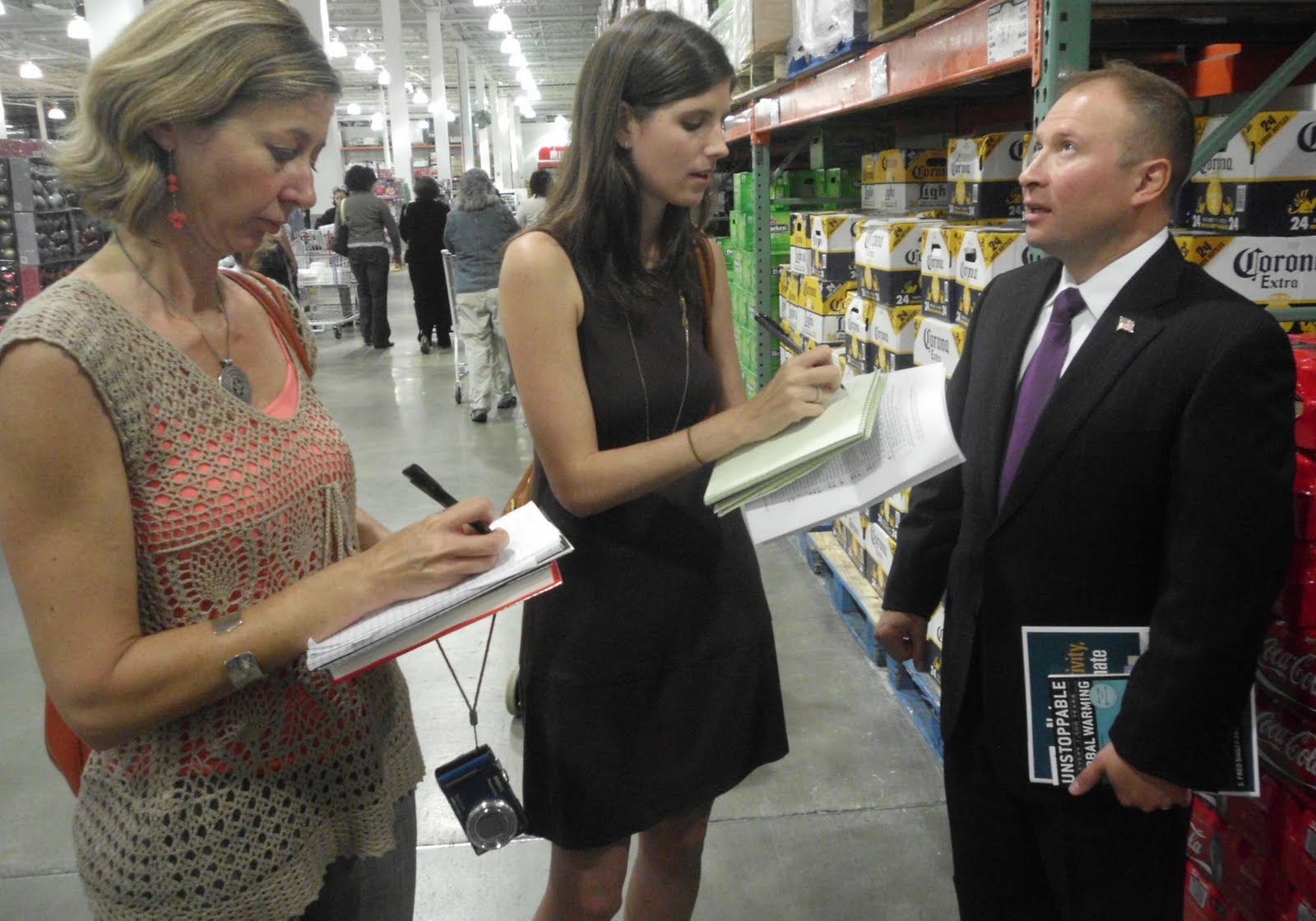
Reporters from The Times of London and The New Republic interview
J.D. Gordon, communications director for the Herman Cain campaign,
at the Pentagon City Costco in Arlington, Va., Friday Oct. 7
If nothing else, the “Occupy Wall Street” protests give the media a reason to ignore the GOP presidential campaign, and to avoid discussion of the increasing possibility that Herman Cain could be the Last Man Standing in the conservative grassroots battle to stop Mitt Romney from getting the nomination on the basis of the Republican Establishment’s “It’s His Turn” principle. “Sunshine State Sarah” has a nice round-up of Cain campign news today, and reminds me of something I wrote Friday:
You may have noticed that some of our Republican friends seemed to lose interest in the GOP nomination fight just about the time Rick Perry melted down and Herman Cain surged into contender status. These people are already making peace with the idea of Romney carrying the 2012 Republican banner.
There was a time, barely a month ago, when these friends of mine seemed to be convinced, and were trying to convince everybody else, that a Perry-Romney showdown for the nomination was a fait accompli, so that supporters of all the other candidates might as well pack it in and quit now. The collapse of the Perry bubble has embarrassed a lot of people, including those who accused Michelle Malkin of “bad faith” and lacking “intelligence and integrity.”
The Perrybots’ response to political demoralization has been a sort of Kübler-Ross grieving process and, while I’ve had occasion to point out that I predicted Perry’s collapse, I don’t blame the bandwagon-jumpers for thinking they were rolling to inevitable victory. It seemed logical, after all, that the Texas governor would be a strong voice for conservative values with the necessary skills, money and campaign organization to take on the brutally efficient Romney machine. We really can’t blame Perry’s supporters for the unfortunate fact that the candidate they supported turned out to be a doomed and useless dingbat.
People stood in line for more than an hour Friday at the Costco discount store in the Pentagon City complex of Arlington, Virginia, across the river from D.C. At the front of the line was the man they had come to see, who smiled and chatted cheerfully as he signed his autograph on the first page of his new book, This Is Herman Cain!
The exclamation point serves as a fitting symbol of the shock among the political class at how far Cain has come along the path described by his book’s subtitle: “My Journey to the White House.” The Atlanta businessman’s sharp rise in national polls since winning a Florida GOP straw poll on Sept. 24 has left pundits of all persuasions struggling to explain how a candidate so recently rated somewhere between “long shot” and “no chance” could have suddenly emerged as a contender. Even Cain — who has said all along that he was “in it to win it” — seems slightly surprised by how quickly he’s jumped to second place in the Republican field, edging past Texas Gov. Rick Perry and closing the gap with the front-runner, former Massachusetts Gov. Mitt Romney.
Although he has “enjoyed a phenomenal surge within the last couple of weeks,” Cain told reporters after his Friday book signing, his campaign “has gradually built momentum” for several months. His stunning breakthrough last month in Orlando, where the Republican straw poll delegates gave him more votes than Perry and Romney combined, has kicked that slow-building momentum into overdrive. And the question now is whether he can sustain his surging momentum or whether Cain, who has never before held elected office, will become just another “flavor of the week” in the see-saw GOP campaign. . . .
Please read the whole thing. I’ve got more photos and videos to upload, and there’s more campaign news to share, but I’ll add that in updates.
UPDATE: One of the things I foreshadowed in this morning’s column was an expectation that Rick Santorum was ready to go on the attack against Cain:
The Pennsylvanian is one of the few Republican candidates who hasn’t yet gotten a “flavor of the week” moment and, with another round of debates Tuesday in Hanover, N.H., and Oct. 18 in Las Vegas, Santorum may be foremost among those looking to throw a few rhetorical punches toward the surging Cain.
And this afternoon came the news that Santorum has released a radio ad — with a $30,000 buy in Iowa — that includes a shot at Cain for supporting the 2008 TARP bailout. As the Washington Post‘s Aaron Blake says, Santorum thus “effectively becomes the first major candidate to attack Cain.”
Cain has said he knows he’s got a target on his back now, and we’ll see how well he handles it in the debates Tuesday (Hanover, N.H., on Bloomberg TV) and Oct. 18 in Las Vegas. I have previously remarked that Santorum has proven himself a “brutal counter-puncher in debates.” He has been bumping along in single digits in the polls, waiting for his shot, and talking to him Friday at the Values Voters Summit, I got the sense he was ready to make a move.
UPDATE II: Here are a couple of videos from Herman Cain’s book-signing event Friday in Arlington. First, I spotted some familiar faces in the line at Costco:
And here is Cain, after the book-signing and his Q&A with reporters, talking about his “phenomenal surge” in the campaign:
Perry clocks in at four percent, tied for fifth with Huntsman behind Romney, Cain, Paul, and Gingrich at five percent. Four percent is also what he polled in last week’s WMUR survey of New Hampshire likely voters, so in case you were thinking of discarding that one as an outlier, think again. This guy is, for the moment, on life support in one of the big five early-primary states . . .
Allah goes to great lengths trying to imagine a comeback strategy for Perry, but . . . Dude. When your “conservative” Republican front-runner candidate is tied with Jon Huntsman, it’s over.
UPDATE IV: A commenter objects to my employing the phrase “useless dingbat” to describe Rick Perry. This required an explanation in the comments, which I’ll repeat up here for the benefit of anyone who might be curious:
“Useless dingbat” is a phrase borrowed from Hunter S. Thompson’s description of Ed Muskie in 1972. If you haven’t read Fear and Loathing on the Campaign Trail ’72, you probably didn’t notice the parallels between Perry’s meltdown in the Orlando debate and Muskie’s infamous “Sunshine Special” debacle. But I noticed the parallel, and the idea of describing Perry in similar terms as Thompson described Muskie was inspired by that parallel.
Given how Perry’s supporters spent the first six weeks of his campaign personally savaging anyone who criticized Perry — including Michelle Malkin — I’m not in much of mood to hear pleas for mercy from Perrybots now that their candidate is doomed beyond hope of recovery.
I warned readers in early August of my concerns about the Perry campaign. Little notice was paid to my warning, while other blogs were urging everybody to jump on that $17 million bandwagon. So if the Perrybots are feeling butt-hurt now, that’s not my fault. You chumps need to go ask Erick Erickson why he didn’t warn you that Perry couldn’t debate his way out of a wet paper sack.
UPDATE V: Having mentioned my warnings, let’s take a stroll down memory lane, why don’t we? On Aug. 5 — the third day of my Iowa trip — I wrote:
Having Rick Perry’s potential campaign looming on the horizon casts a certain shadow over the proceedings here.
Perry’s supporters were running TV ads in Iowa in the run-up to the Ames Straw Poll, even though (a) Perry was not yet officially a candidate; and (b) Perry wasn’t participating in the straw poll.
Whiskey Tango Foxtrot? Who does a thing like that? Later that day (Aug. 5 was a Friday), I posted:
My phone just rang with a tip from a source who says his Texas sources tell him that Rick Perry is going to unofficially announce this weekend that he’s going to make an official announcement next week.
Which was pretty close to right: The “unofficial” word went out Monday, and the official announcement was . . . Saturday, Aug. 13, the same day as the Ames Straw Poll, a deliberate diss to Iowa and an attempt to upstage the other candidates already in the race.
Yeah, I know political journalists aren’t supposed to believe in “omens.” Still, there’s something vaguely . . . hinky about the way Perry’s stealth campaign has been operating here in Iowa.
Call me crazy. Attribute my forebodings of doom to irrational prejudice. Say what you will, and I don’t care, but I felt a need to put on the record my instinctive sense that there’s something fundamentally wrong about the Perry campaign. And if Jan. 20, 2013, brings the joyous inauguration of President Perry, then you can say my fears were mistaken. Yet I can’t shake my gut hunch is that it won’t work out that way. Some kind of catastrophe will result, one way or another.
And in response to a comment by Steven in TN, I explained:
There have been a few little things — including one source who says Perry has been on the wrong side of the eminent-domain issue — that lead me to think Perry is a lot less certain ultimately to win the nomination than some people seem to think. What I fear will happen is that Perry will spend several months sucking up media oxygen and burning through GOP donor cash, only to collapse early next year. This will have the effect of suffocating other conservative candidates, and thereby lead to … Romney 2012.
Understand, Steve: I’m not exactly anti-Perry. I got nothing against him personally or ideologically, and many of my Texas friends swear by the guy. But in my experience, when something looks too good to be true, it usually is. And there is a too-good-to-be-true vibe to this idea of “Perry to the Rescue.” Maybe my Jedi senses are wrong this time, but I’ve got a spooky bad feeling and I just can’t shake it.
I stuck by that prediction without apology, and on Aug. 28 — while Perry was building a huge lead on Romney in the polls — I re-iterated:
Go back to what first concerned me: Why would a Republican campaign go out of its way to “diss” the Iowa GOP in that manner? It is one thing for a candidate like Mitt Romney to de-emphasize Iowa, skip the straw poll and concentrate his efforts elsewhere. It was another thing — an unnecessarily provocative thing — for Perry’s campaign to deliberately upstage the Ames Straw Poll the way it did.
And who was the primary victim of that gesture? Michele Bachmann.
Bachmann won the straw poll, thereby destroying Tim Pawlenty’s campaign, but no sooner had the Republican 2012 herd been thinned by the culling of its weakest candidate — Pawlenty was always weak — than Perry jumped in and vaulted to the front of the pack. This put Perry ahead of other candidates who had spent many months criss-crossing the country and shaking hands with folks at county GOP events and hustling up contributions $50 and $100 at a time.
OK, fine. Congratulations to Team Perry on their Instant Front-Runner status. But I again repeat that I’m getting bad vibes about this development. When all is said and done, my early sense of foreboding will either be vindicated or discredited.
And I think we see which way matters are tending, eh? Perry stuck his thumb in Iowa’s eye, and it was the kind of bullying gesture that seemed to me so ill-advised as to raise serious doubts. There was more than that, though.
Before Perry ever got in the race, I had talked to an operative who had met Perry and worked with him in Texas. The operative said that (a) Perry was not a dynamic speaker, and (b) Perry was “uncomfortable in his own skin.” My source wasn’t very specific about what that last remark meant, but once the debates started, I could see what he was talking about.
And here’s the thing: My source was not anti-Perry. He liked the guy, but was being frank in expressing doubts as to whether Perry could make it at the presidential level.
The worst of it, though, was the godawful defensiveness of Perry’s supporters. For about six weeks there, anybody who criticized Perry got ripped to shreds because (so the Perry supporters had convinced themselves) Perry was the only alternative to Romney.
Ergo, if Bachmann hit Perry on the Gardasil thing, or if Santorum slammed Perry on immigration, Bachmann and Santorum were de facto Romney allies, and must be destroyed. All of that venom directed at Perry’s critics — including Streiff’s vicious attack on Michelle Malkin — did nothing to help Perry, however.
In fact, once Perry started freefalling, nothing could help him. So Perry’s defenders were just wasting their time and energy defending him, and the parallels to Ed Muskie’s startling collapse in 1972 were hard to ignore.
Why did Team Perry wait nearly two months into their campaign to do this? If the argument for their candidate is “He Can Beat Mitt,” why not, y’know, start beating Mitt?
But never mind. I don’t know nothing about politics. And here’s some sad news for you Perrybots:
I really hope Perry gets his act together and soon. There are debates scheduled for this week and next. With the primary schedule getting ever more condensed, it’s getting late pretty early for Perry.
Ace seems to be making the assumption that Cain can’t possibly go the distance and beat Romney. But nobody ever thought Cain would get this far, did they? Having covered Cain for 10 months, I’ve been hearing the “Cain can’t win” argument for 10 months. Maybe the people who keep saying “Cain can’t win” are right.
But Herman Cain just keeps on winning, doesn’t he?