More than a decade ago, the first time some left-wing scumbag tagged me with the “white supremacist” label, I was both insulted and amused. The obvious question — which no liberal ever seems to ask — is this: “What does ‘white supremacist’ mean?” Historically, this term is associated with those who defended Jim Crow segregation in the 1950s and ’60s, and so the term is obsolete as a matter of political science. Anyone who supposes, at this late date, that America could feasibly reinstate segregation or any similar regime is a deluded fool. Even more deluded are Neo-Nazis, who believe they can stage a putsch and institute a 21st-century racial totalitarianism. Neo-Nazis are auto-marginalizing, for the simple and obvious reason that the American people overwhelmingly agree with Jake in The Blues Brothers: “I hate Illinois Nazis.”

My Dad was wounded within an inch of his life fighting Nazis in World War II, and irresponsible smear merchants (hello, Max Blumenthal) who thought they could get away with impugning my character in this fashion have been repeatedly exposed as frauds and liars. Friends who actually know me (as the fun-loving, gregarious human being I am) were stunned when, in 2009, a certain despicable lizard tried to recycle those smears, after he previously tried to defame Pamela Geller as a crypto-fascist.
Another problem with the phrase “white supremacist,” beyond its use by the Left as a crude pejorative slur, is that insofar as it has any meaning in the 21st century, it can only describe an adherent of a theory. One must ignore a lot of historical facts in order to embrace such a theory, and thus I am not a “white supremacist” for the same basic reason I reject feminism, another ideology based on counter-factual theory. We must live in the world as it actually is, rather than attempting to “reform” the world according to some intellectual theory of how the world should be, and this rejection of ideological schemes is equally applicable to Marxism, feminism, “white supremacy” or Keynesian economics. Think of all of the wicked mischief Americans have endured the past 15 or 20 years because of George Soros and his warped interpretation of Karl Popper’s “open society” theory. Popper is not to blame for Soros any more than pickup artists (PUAs) are to blame for Elliot Rodger, but the fact is that Soros is a fanatic devoted to an ideological theory, and it is this error — a preference for theory over facts — which makes Soros such a menace.
As I’ve stated before, in politics I am a conservative, in economics I am an Austrian, and in religion I am a Calvinist. All of these are reputable schools of thought, with many able defenders, which spares me the labor of always having to explain myself. Being an adherent of certain fundamental principles also prevents me from being tossed around like a feather on the wind by every controversy that comes along. My basic modus operandi, based on a simple logic, is to figure out what side of the issue the Left is on, and get on the other side. You can seldom go wrong in politics by betting against the prevailing beliefs of the New York Times.
All of that is preamble to something Steve Sailer linked at his blog Friday, a research paper by Florida State University psychology graduate student Bo Winegard and two of his associates, entitled “Human Biological and Psychological Diversity.” Winegard and his colleagues could be fairly described as disciples of E.O. Wilson’s Sociobiology thesis, members of a school of thought known as evolutionary psychology. A professor of biology at Harvard University, Wilson applied Darwinian theory rigorously to the problem of human social behavior, and his 1975 book was highly influential. Unfortunately, the arbiters of political correctness in academia (who have long embraced Darwinism as a justification of atheism) were willing to ignore even this eminent scientist’s work because it did not wholly confirm their own left-wing biases.
Darwin is only useful to the Left insofar as evolution can be used by degenerates as a weapon to attack Christian morality, but when Darwinian theory is made the basis of arguments the Left doesn’t like, we find reputable researchers condemned as crypto-Nazis merely for going wherever the facts about human nature may lead them. We may suppose that Winegard, et al., know the risks involved in their argument:
Many evolutionary psychologists have asserted that there is a panhuman nature, a species typical psychological structure that is invariant across human populations. Although many social scientists dispute the basic assumptions of evolutionary psychology, they seem widely to agree with this hypothesis. Psychological differences among human populations (demes, ethnic groups, races) are almost always attributed to cultural and sociological forces in the relevant literatures. However, there are strong reasons to suspect that the hypothesis of a panhuman nature is incorrect. . . . It is likely that humans also evolved slightly different psychological traits as a response to different selection pressures in different environments and niches. One possible example is the high intelligence of the Ashkenazi Jewish people. Frank discussions of such differences among human groups have provoked strong ethical concerns in the past. We understand those ethical concerns and believe that it is important to address them. However, we also believe that the benefits of discussing possible human population differences outweigh the costs.
You can read the whole thing in PDF format. Because I am neither much interested in theory nor qualified to discuss this paper in terms of science, I will not attempt to summarize the arguments made by Winegard and his colleagues. Being a father of six children, however, I can testify to my own observation that certain psychological traits tend to be passed along from parents to their children, and I think any parent who pays attention would agree that the acorn seldom falls far from the tree. Of course, every child has two parents, and one obvious way we can affect the traits of our offspring is by seeking mates who exhibit traits we find desirable.
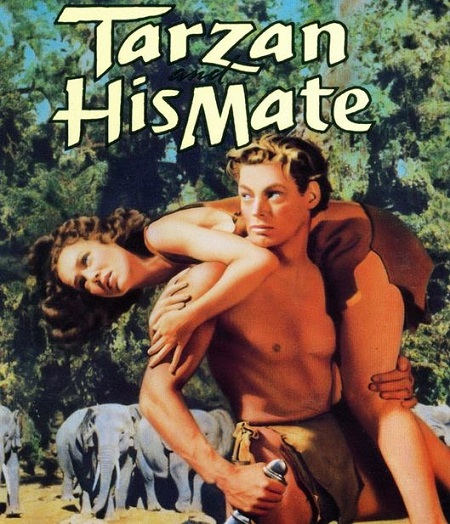
My wife sometimes gets angry when I say that it was her excellent character and temperament which appealed to me as much as her high cheekbones and beautiful smile, but when a man chooses a wife — “Me Tarzan, you Jane” — he certainly ought to be conscious of such matters. What kind of mother will she be? How will her hereditary traits combine with his traits to create a the hybrid offspring of the next generation? Just yesterday my 18-year-old son remarked about the circumstantial fluke by which his mother and I met, a seemingly random coincidence to which he owes his own existence. As a Calvinist, of course, I don’t believe in coincidences, and so our children must consider themselves indebted to the grace of God for their lives, and also for their parents.
We have heard a lot recently about Planned Parenthood, but there is a popular saying among evangelical Christians, “If you want to hear God laugh, tell him your plans.” Man proposes and God disposes. What some people call luck or fate, the Christian must accept as divine will.
Poll: How do Americans feel about
Obamacare and Planned Parenthood?
Is the question how Americans do feel, or how they should feel? We know that the Democrat Party and the liberal media (but I repeat myself) want people to approve of abortion and socialized medicine, but what would people think about these topics if it were not for the media’s constant partisan cheerleading for the atheistic Culture of Death? Continue reading The Problem of ‘Racist Facts’ →